by Rebecca Hall (30/6/23)
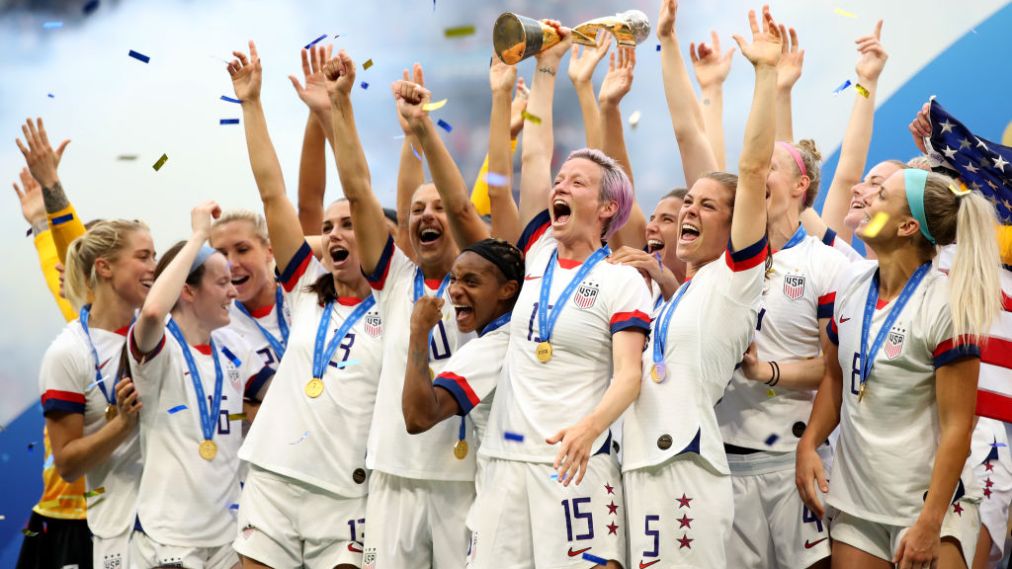
Above: The USA lift the World Cup in 2019. Despite this year’s tournament being bigger than ever and with more exposure, too many of the competing nations are having to fight for equality and fairness. Photo: PDA Football.
With less than a month to go until the start of the Women’s World Cup, players from Jamaica’s national team have publicly united to express their disappointment in the support and resources provided by the Jamaica Football Federation. The Reggae Girlz join an ever-growing list of teams coming forward and protesting their conditions.
In the months building up to the World Cup, headlines have been dominated by player protests from Canada, Spain, and France, as well as other controversies such as a potential European FIFA TV blackout, and sponsorship rows.
Is the World Cup at risk of being undermined by the very people who are responsible for the administration and development of women’s football? Impetus takes a look at the many controversies that have surrounded the build-up and discusses what it all means…
The Protests
As a collective, women’s football is no stranger to protesting for the most basic levels of respect and rights. The sport’s history is arguably defined by a constant struggle, and many teams succeed in spite of rather than because of those who should support them. Previous player protests have led to success.
In 2015, the Australian squad boycotted a tour of the USA, going on a two-month strike over a dispute with Football Federation Australia (FFA) over pay and conditions. The FFA originally condemned their actions, but now the Matildas are on equal terms with the Socceroos. They have since become one of Australia’s most loved teams. Four-time World Cup Winners, the USA also resorted to intensive collective action to gain equal pay.
However, we have also seen the negative repercussions, where players are unfairly punished and silenced. French striker and captain, Amandine Henry, was previously dropped. Argentina forward, Estefania Banini, was left out of her national team for years after speaking out against former coach Carlos Borrello, and Mexican goal scorer, Charlyn Corral, suffered the same fate. Sadly, the list could go on.
By calling for change and highlighting situations of injustice, players understand the consequences their actions could have. Despite the risk of retribution, players continue to bravely speak out.
Jamaica

Players from Jamaica’s national team, including Manchester City’s star goal-scorer, Khadija ‘Bunny’ Shaw, have expressed their “utmost disappointment” with “subpar planning, transportation, accommodations, training conditions, compensation, communication, nutrition and accessibility to proper resources”. The open letter goes on to explain that the team have often played without “receiving contractually agreed upon compensation” and have missed friendly matches because of “extreme disorganisation”.
The players are calling for “immediate and systematic change” within the federation “and those in charge of protecting the integrity of women’s football”.
In the following days, the Federation announced a sponsorship deal for the women’s team with a fast-food chain, and Michael Ricketts, President of the governing body, told Nationwide News Network that “we want to make sure we provide as much as we can for the girls”.
Cheyna Matthews, Chicago Red Stars forward, posted on Twitter sharing that a teammate’s mother had started a crowdfunding campaign to raise $100,000 for the squad. So far it has raised just over $30,000.
Canada

The reigning Olympic Champions began protesting several months ago after their budget was severely cut, as the federation claimed it did not have the revenue to support all aspects of the game. Despite this, former Canada international, Kaylan Kyle, claimed on social media that Canada Soccer has turned away potential investors of the women’s team in the past. The team were also not paid at all in 2022.
As a result, the Canadian Women’s team attempted to go on strike in February. However, it was forcibly ended by Canada Soccer after they allegedly threatened legal action. The team played in the SheBelieves Cup under difficult circumstances, while other national teams, including England and Australia, wore purple wristbands to support the fight for equity.
On the 28th of February, Nick Bontis resigned as the Head of Canada Soccer, following requests from regional officials and both men’s and women’s national teams concerning Canadian leadership. While Bontis has left his post, he continues to hold power in international soccer as he was named vice-president for North America at Concacaf.
A retroactive agreement for 2022 has now been put in place and its terms mirror those in the men’s national team’s deal. The governing body has also said it is in the process of addressing other demands made by the team. While some elements of the problem have been resolved, remuneration for this summer’s World Cup and the past have not been agreed upon.
In addition, many critics suggest nothing has changed within Canada Soccer on a structural level. Both the men’s and women’s teams remain embroiled in a labour dispute with the federation. This week reports also emerged that Canada Soccer was considering bankruptcy procedures, although this is something the organisation has publicly denied. As the prospect of going to the World Cup without remuneration looms, suggestions of a player boycott have once again surfaced.
France

Just a week after the Canadian National Team came forward, and a mere three days after playing in the Tournoi De France, the French National Team had three leading players withdraw themselves, citing working conditions. French captain, Wendie Renard, quickly followed by forwards Marie-Antoinette Katoto and Kadidiatou Diani all announced they would not play at the World Cup to preserve their mental health. There have long been rumours of a long-term breakdown between Head Coach Corinne Diacre and her players, but it has all come to a boil ahead of the World Cup.
Noël Le Graët, President of the French Football Federation, also resigned following an investigation into allegations of sexual misconduct. Graët continues to deny these claims. This situation also had a knock-on effect on Diacre’s future as the former President was a huge supporter of the coach.
Diacre was promptly sacked due to issues that had “reached the point of no return”, according to the federation. While she insists she is the victim of a “smear campaign”, several problems over the years have been well-documented, including coaching methods, selection decisions, and intense individual player criticism to the press.
Renard lost her captaincy after France’s 2017 quarter-final exit from the Euros, and it was only returned to her in 2021. Diacre also chose to exclude Katoto from the 2019 World Cup, even though she was the Ligue 1 top scorer. Similarly, Amandine Henry and Eugénie Le Sommer were not included in the 2022 Euros, after the two Lyon players had a public falling-out with the coach. In July 2020 PSG goalkeeper Sarah Bouhaddi stepped back from the international team during Diacre’s tenure.
Since the introduction of Hervé Renard, who left his role as Saudi Arabia’s men’s coach, no French players are refusing to play and Wendie Renard will , once again, captain the side.
Spain

After qualifying for the World Cup, 15 members of the Spanish squad wrote to the Federation (the RFEF), declaring themselves unavailable for selection, stating the cause was the situation within the team affecting their emotional state and health. The players involved included Ona Battle, Mapi Leon, Lucía García, and Irene Paredes. While Ballon d’Or winner Alexia Putellas was not part of the so-called Las 15, as she was unavailable to play at the time due to injury, she did post a message from the players, suggesting they had her support.
The Federation responded with a strongly worded public statement, suggesting the player’s actions are “unprecedented” and that it “goes beyond sport to be a question of dignity”, insisting they would not give in to player pressure. The players are known to have spoken privately with the federation before they held a press conference on the matter. Despite the response from RFEF, the players maintain that at no point have they demanded the removal of the manager, Jorge Vilda.
Vilda has been in charge since 2015. Spain are widely described as having a golden generation of footballers but it could all go to waste. Some in the game consider Vilda to have created an environment of control, anxiety, and stress that emotionally impacts the squad. Local media in Spain has previously reported that he forced players to leave the doors to their hotels open at night so that staff could ensure they were in their rooms, as well as allegedly checking players’ bags. Although, this has never been concretely proven. Additionally, his management of player loads and tactics have been called into question by pundits and fans alike.
Vilda is allegedly protected by the federation, which reduces the impact of player protests. Angel Vilda, Jorge’s father, is head of the RFEF’s women’s national teams. Jorge started his managerial career by being Angel’s assistant for the Spanish U-17 side. Jorge Vilda won a considerable amount at youth level, but that success is yet to translate. In addition to his father’s position, Jorge Vilda is the Women’s Technical Director as well as head coach – essentially making him his own boss and a powerful figure in a complicated chain of command.
An even more heart-breaking element of Spain’s situation is that Vilda replaced Ignacio Quereda, Spain’s Head coach for 27 years, who was ousted following a player boycott. It was alleged by the players that Quereda had psychologically and verbally abused them, been openly homophobic, manipulative, and created a toxic environment. During this time, Spanish players were also blacklisted.
Despite the initial statements, all but three of Las 15 ultimately made themselves available for World Cup selection. The three that remain unavailable are Mapi León, Patri Guijarro, and Claudia Pina. Of the remaining twelve however, just three were chosen by the coach for the 30-player provisional squad – Aitana Bonmatí, Mariona Caldentey, and Ona Battle.
There have been questions surrounding the selections of those that made themselves available but still did not make the team. For example, Cata Coll has been selected as one of the four provisional goalkeepers, but Sandra Paños has not. Paños is Barcelona’s first-choice keeper, with Coll, while very talented and has minutes under her belt for Barcelona, she is ultimately the second-choice. Paños was part of the group of 15, while Coll was not.
It has been reported that some elements of the national team have changed, such as the introduction of a nutritionist and more freedom at camps. However, the situation clearly remains ongoing, with many issues unresolved heading into the World Cup.
What do the protests mean?
The sheer number of protests highlights just how large the problems facing women’s football are.
Sadly, even as women’s football gains even more stature and popularity the individuals who are largely responsible for its rise, the players themselves, remain the most powerless. This paradox can be baffling to some as the players are the labour, the overall product, meaning while many are structurally powerless, they also have the greatest leverage, hence why players are essentially forced into protests and boycotts as their only means of creating change.
What is an even more concerning prospect to consider is the potential of what may be happening in other teams that have less star power behind the protests, are less professional, and experience less media coverage. It is perhaps no coincidence that of the four teams discussed above, three make up FIFA’s top ten, and Jamaica are in the top 50.
Other Controversies: FIFA and TV rights
Women’s football at the highest level is riding the crest of a wave, with fans, attendances, viewing figures, transfer deals, commercial deals, and sponsorship – there’s been an explosion. Even with all of this success, nerves were growing around the possibility of a broadcasting blackout of the World Cup, especially in the major football European nations.
To the relief of European fans, deals were eventually established. BBC and ITV will be sharing games in the UK, with the final being on both stations. However, at the time of writing, Japan is still without a deal. The issue became so intense that sports ministers of some European nations released a joint statement calling for the matter to be resolved.
This is the first Women’s World Cup in which commercial and television rights have been separated from men’s tournaments. The new commercial strategy shifts the way potential investors and partners understand and view the tournament.
FIFA president Gianni Infantino said there had been “disappointing offers” from many nations that translated into a “slap in the face… to all women worldwide”. He noted that FIFA had a “moral and legal obligation not to undersell” the event.
While it is an obvious positive outcome that fans will be able to watch, the length of time it took to secure these deals has had negative impacts. At this late stage, sponsorship deals are still coming in, and snack giant Frito-Lay has recently been unveiled as a North American partner. The deal represents “the largest ever investment in women’s sports”, according to the company. South Korean car companies Hyundai and Kia have extended their deals. The impasse over television rights has led to confusion and frustration among commercial parties. Moreover, the later a deal is signed, the less time brands have to plan and activate, which impacts the value of the deal itself.
From a fan perspective, the time for advertising fixtures and the tournament has been reduced, which could have a knock-on effect at drawing people in and matching the impressive figures of the Euro’s, for example.
Other controversies: Women’s football and the ACL epidemic

Injuries are a fact of sport, however, to say there is an injury crisis in women’s football would not be an exaggeration. Female players are significantly more likely to suffer from anterior cruciate ligament damage than their male counterparts. Vivianne Miedema, Katoto, Catarina Macario, Beth Mead, and Leah Williamson are just some of football’s biggest names to be missing out this year.
While there are factors that can’t be changed, a lot of ACL research points to issues of player loading and lack of rotation. Factors like this relate to how federations and coaches treat their players, both points of disagreement that have been noted in the protests discussed above.
Even if we completely separate the causes of the crisis from the situation, ultimately having some of the biggest stars of the game missing, will sadly have a negative impact. Having the likes of Vivianne Miedema, Beth Mead, Janine Beckie and Christen Press means the very best ‘product’ will not be on display for the world to enjoy. While fans will undoubtedly continue to back their team, missing so many elite stars will have huge disadvantages, in terms of team selection, marketing and social media engagement.
What are the takeaways from these situations?
With more eyes on women’s football than ever before, and increased interest from fans and investors, player protests and other issues dominating the headlines need to be a catalyst to strengthen the sport. Not just for the individual elite athletes but globally down to the grassroots level to address the systemic failings from those in positions of power. This is something echoed by Canadian captain, Christine Sinclair, who stated they are fighting for the next generation of players as well as themselves. As we head into a World Cup that is set to be the most watched and include the most teams, there is a worry that the situation is regressing behind the scenes, as many decision-makers continue to do what benefits them and not the sport as a whole.
Federations, internationally and domestically, have too often been slow to realise the opportunities for growth in women’s football. Investing in the women’s game is not just simply the right thing to do, but it can be profitable for all involved when done sustainably.
How many major tournaments can we expect to experience that are dominated by brave player protests, injuries, toxic environments, and other controversies? Can the sport even sustain this behaviour? What is clear, if federations lack respect for their players the continued interest and legitimacy of these tournaments, and the sport as a whole, can all be called into question. Only time will tell if we continue down this dangerous path.
Follow Impetus on social media – we’re @ImpetusFootball on Instagram, Twitter, and Facebook.
 impetusfootball.org