

Among the Impetus team covering the World Cup are several who have watched, supported, and covered The Matildas for a number of years. Ben Gilby, Kieran Yap, and Genevieve Henry come together to share their thoughts on how a very special women’s football team is transforming the sporting landscape of a nation, and how they are so proud and emotional about it, having been on the Matildas rollercoaster ride for a such a long time (14/8/23).
by Ben Gilby in Sydney
Above: The Matildas run to celebrate with Cortnee Vine after she scored the winning penalty in the shoot-out against France on Saturday. Photo: Football Australia.
A nation is coming to a standstill. Across the land, hundreds of thousands are gathered in front of big screens, in fan zones, or in pubs. Millions more are watching at home.
Sound familiar? Like a European hotbed of football? Like England during the Euros Final? Except this is different. This is in Australia. A country where football is only the fourth or fifth biggest spectator sport. A country where hundreds of thousands of people pack into AFL (Australian Rules Football) stadiums each week or NRL (Rugby League) grounds.
A nation where the free-to-air TV networks and newspapers show very little in the way of coverage of the round ball game. A nation where free-to-air TV was only showing one game a day during the group stages, with the tournament otherwise hidden away on a pay TV channel.
But now, it’s all changed. And a women’s football team is the change maker. The Matildas are everywhere.
Before the tournament, I wrote:
The Matildas are universally adored in Australia. Think the reaction to the Socceroos’ exploits at the Qatar Men’s World Cup was a big deal? You haven’t seen anything yet. A raucous home support with rammed full stadiums allied with their Never Say Die spirit which drives them to compete with the best when they play the top sides, means anything is possible.
But the extent to which that reaction has come has taken me aback. It’s actually something that makes long-time Matildas watchers emotional. I’m not afraid to admit there were tears after Cortnee Vine’s winning penalty. This is a team with a special connection and ethos getting stronger together, riding the wave of national idolatry, and still maintaining that normal, grounded sense that has always made them who they are.
As I walked through the city centre of Sydney yesterday wearing a Matildas away shirt with Charli Grant’s name and number on it, people stopped me on two separate occasions and said: “Oh! The Matildas!” and then proceeded to break into discussion about where they watched Saturday’s game and how much they adore the team. In Sydney. Rugby League Central.
There has been ‘banter’ from some people in the UK about the extent to which the Australian public are reacting to the Matildas’ achievements. But those tweets are naive at best. It’s very easy to criticise or poke fun when you are writing from a country like England where football is the biggest sport by a long way, and whose national women’s side are European champions. Imagine if the UK’s fourth-biggest spectator sport suddenly outstripped the historic biggest “bums on seats” sport and was mentioned non-stop on the TV or in the media every day. This is what the Matildas have done.

Things started to change around the second-round tie with Denmark. The fan zones were that bit fuller. The mentions on TV got that bit more frequent. The West Australian published a pull-out poster. But that was nothing compared to Saturday’s game with France.
The start times of AFL matches were amended to avoid clashing with The Matildas. The match with France was shown on big screens inside AFL stadiums. The AFL, it must be remembered have never had any interest in supporting the round ball code. This was a massive symbolic change.
Stadiums were being opened up around the nation for people to go to in order to watch the France game.
Stadium Australia invited all ticket holders attending that night’s England v Colombia game to come down to watch The Matildas on a chain of big screens in Cathy Freeman Park. I was among around 50,000 people gathered on the grass and amidst the trees to watch a night of high drama explode into sheer joy.
What an apt location to watch it. Cathy Freeman – one of this nation’s most iconic female athletes, who has inspired so many young girls in Australia, including a good number of this current Matildas team. An athlete whose symbolic gold medal win in the 2000 Sydney Olympics captured a TV audience of 8,000,000 here – and The Matildas are on their way to getting similar TV figures.
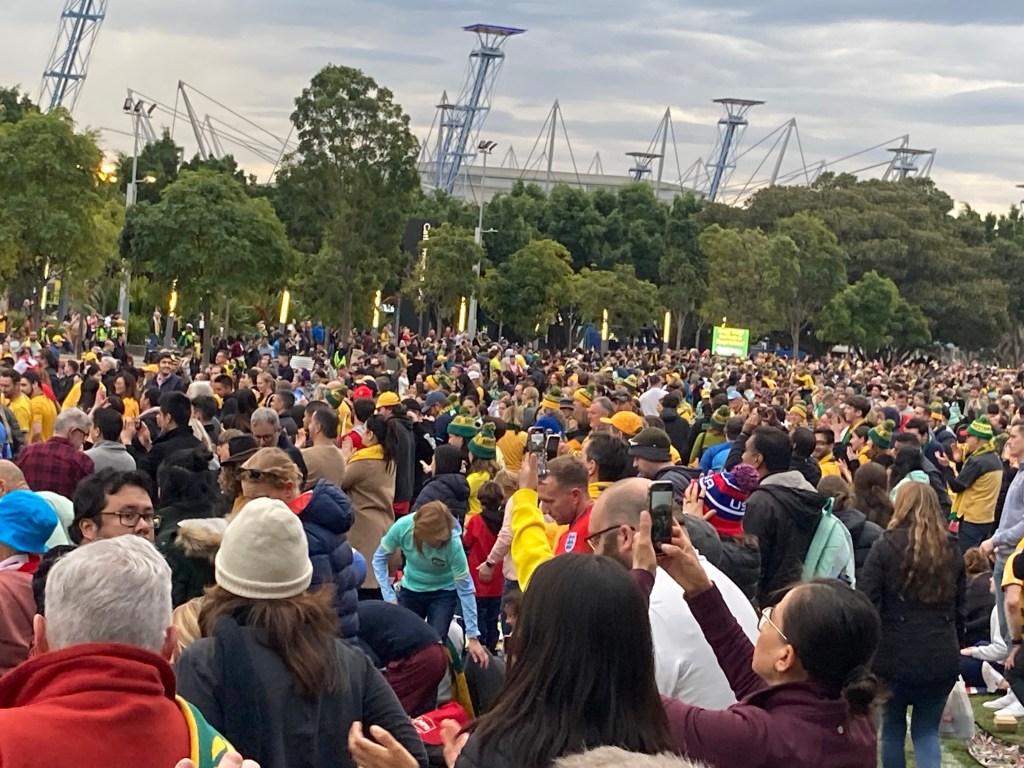
The TV rating figures for the win over Denmark were bigger than any for the AFL or NRL Grand Finals in recent years. Again, unprecedented for football here.
Then there is the reaction towards head coach Tony Gustavsson. Derided as “a clown” (among the more polite opinions) in the early and middle stages of his tenure, indeed heavily criticised after the group stage defeat to Nigeria. That’s all forgotten.
Gustavsson has always, for me, been a man with a plan – a long-term plan at that. Having been in the majority of his media conferences before this tournament over the past two and a half years, the Swede has always spoken of a desire for his team to get “one day better, not one day older.”
He blooded more debutants than any other Matildas head coach in years and exposed those players to every single one of the world’s top ten nations at least once. He is a man of deep intelligence, a real student of the game. No wonder Sam Kerr told me at the team’s media conference before their game with England in April that: “When he speaks, we listen, he’s been there and done it.”
The challenge now is for the Australian Professional Leagues (who run the A-League Women) to capitalise on this and market the domestic women’s game properly at last. On too many occasions have there been false dawns for football in Australia.

by Kieran Yap in Melbourne
Before this tournament started, the common notion was that most of Australia was not ready for the size and scale of what was about the happen.
Women’s football fans nodded in agreement. World Cups are huge events, and crowds and viewership had been growing steadily over the last few editions, even if publicity on the ground in France 2019 was relatively minimal.
What has happened since has been beyond even the most optimistic dreams. The Matildas have done historically well, but even before the group stage had ended, ticket sales had already gone beyond 2019’s edition. The success of the 2023 World Cup was not dependent on the home side, it had been embraced by the home nations, and seen as an adventure by those who travelled around the world.
Concerns that the change in timezone might impact TV viewership have been brushed aside amid a wave of unprecedented attention. In the US and Europe, people have set their alarms, in China alone 53.9 million people tuned in to watch the country’s game against England.
In January, FIFA announced that 500,000 tickets had been sold. By July, before a ball had been kicked 1.5 million people had bought seats to watch games in stadiums.
Put simply, more people have been exposed to women’s football at one time than ever before. They would not have been disappointed with what they saw. The underdogs got up, Nigeria, South Africa, and Morocco all advanced to the knockout stages. Brazil departed early but put on a show with a sparkling display against Panama. While perennial underachievers like Spain gradually hit top gear and played some stunning football at times.
Of the expected 1.7 million people who will pass through the gates, and the repeated millions who tune in on Australian network TV, many will be from overseas, but the majority will be from one of the host nations.
This provides an opportunity to change the game.
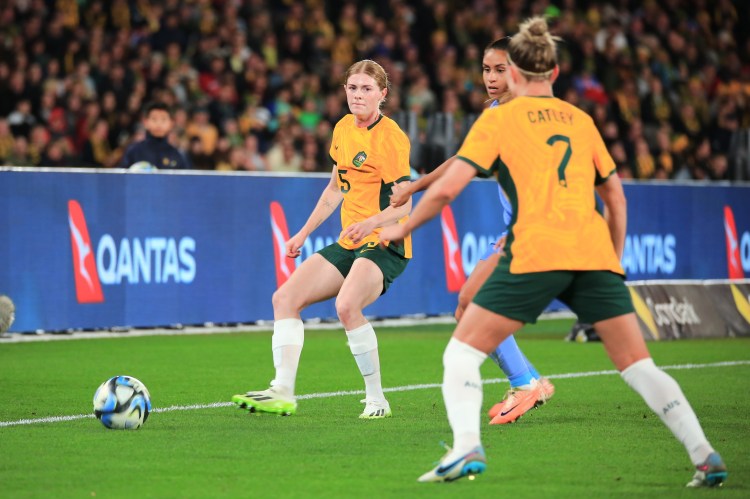
As things stand, the A-League Women still struggles to attract live crowds. This despite every single Matilda coming through the local competition, with Kyra Cooney-Cross, Charli Grant, and Courtney Nevin having departed only two seasons ago, and the likes of Clare Hunt, Alex Chidiac, and Cortnee Vine on the books of A-League clubs last season.
The league only needs to attract a small percentage of the curious or dedicated fans to change the future of the domestic game. Major WSL clubs like Chelsea and Arsenal average three to five thousand for normal league games played away from their men’s team’s stadiums. If the Australian Professional Leagues can attract one percent of the World Cup attendees, the effects will be seismic.
That is the potential that this World Cup has unlocked. It has shown people what women’s football can provide, and it is one of the most entertaining sports on the planet.
The World Cup has also shown that people will turn out for prime-time games. Women’s football need not be relegated to the unplayable 3pm kick-off under the guise of “family-friendly times.”
Not all of the World Cup fans will be interested in the A-League. Australians love a big event, but if that one percent can be converted, the foundations are set for long-term success.
None of this is the responsibility of Football Australia or the Legacy Committee. The unbundling of the professional league from the governing body has put the ball squarely on the Australian Professional Leagues’ penalty spot to knock in or miss.
At the time of writing, there is no A-League Women’s fixture available for fans to buy tickets. Memberships have gone on sale, but tickets to individual games have not.
This World Cup has the potential to change the game, and in many ways it already has. We will see the true effects in generations, as a child who once marvelled at Mia Hamm, it took almost 20 years for me to put that passion into action. Kids watching now may become fans or players. They may be around forever or for a few years, but this tournament has already changed lives and sparked the flames that will change the world for women’s sports.
However, the opportunity that has been presented to the A-League Women may never happen again. If they miss this chance, it will be worse than an own goal, it will be the equivalent of sleeping through the alarm and missing the team bus to the game.
But this tournament has given us real tangible, measurable hope, and that is something the football community in Australia needs and may thrive on.
by Genevieve Henry in Sydney

From the moment I stepped off the plane in Sydney, I could see that the Women’s World Cup was a big deal.
The baggage claim screens all read “GO MATILDAS” at the bottom, reminding many travellers just what they had come for. I could see hints of this theme throughout the airport, but was shocked when I came upon a bright orange, pink, and teal lounge area, the FIFA Women’s World Cup meeting point, filled with flyers, guides, and photo opportunities.
When I finally escaped the airport to breathe in the excitement of the Australian air, the first thing I saw was Ellie Carpenter, blown up on a giant billboard. I knew it was going to be a big deal, I just hadn’t realised how big of a deal this tournament is.
From city to city, the buzz grew. At first, people commented on our trip, calling it exhausting. To be fair, flying from the United States and driving around the country to every Matildas game, plus more is tiresome. After the first result went our way, friends and family started calling us lucky, and that they were happy for us.
By the time we had made it out of the group stage, folks were downright jealous that we had gotten to be a part of this. The most frequently asked question was “How did you manage to get tickets?” The answer: We’ve been planning since last spring. A year’s anticipation has paid off.
Each stadium and city brought a different vibe. But, one thing is certain: Each time the Matildas play, the energy and attention only grows. Not only for our girls in green and gold but for all of women’s football.
In every city, people began to buy tickets to the games of whatever countries they could. People want to be a part of this historical month. Out in public, I see a hair ribbon or a jersey every once in a while. But far more commonplace is running into a friend and chatting about the previous night’s game. Football fever has gripped this nation. Each of the Matildas are becoming household names. No matter how far they can go, their impact is immense.
Follow Impetus on social media – we’re @ImpetusFootball on Threads, Instagram, Twitter, and Facebook. DON’T MISS our brand new TikTok platform @ImpetusFootball too!
 impetusfootball.org