

In her debut article for Impetus, Aimee-Lou Caldecourt reflects on the World Cup Final, looking at how Spain won the day against an England side who grew into the tournament (21/8/23).
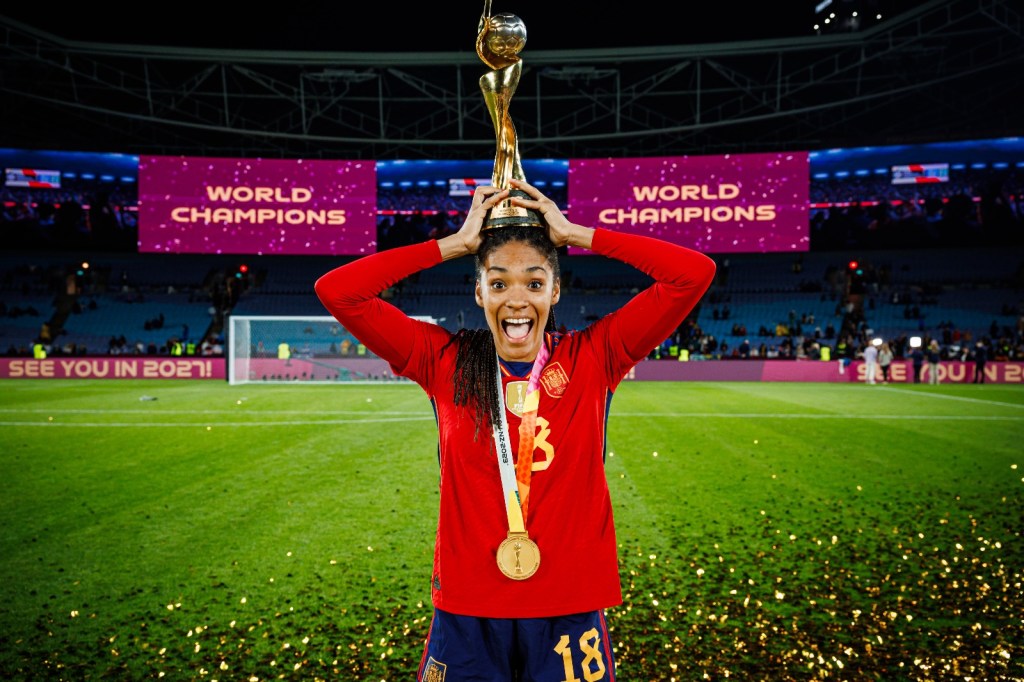
Above: Spain lift the World Cup at Stadium Australia last night. Photo: SEFutbolFem.
Joy for Spain, heartbreak for England, but how did Spain get it right and how did England get it wrong?
Starting with the starting XIs before the game, looking at them at face value, it emphasised how difficult the two sides would be to break down. England remained unchanged from their 3-1 semi-final win over Australia. Sarina Wiegman had the option of Lauren James to start as well following her suspension but opted to keep her on the bench until the start of the second half.
The one change for Spain, bringing in talented youngster Salma Paralluelo for the experienced two times Ballon D’Or winner Alexia Putellas. Not only for that drop of youth, but Paralluelo has had a huge impact on this Spain side all tournament, scoring a few goals in the process, Putellas having only just come back from an ACL injury a few months ago, the injury which saw her out of the 2022 Euro campaign. Paralluelo became the first teenager to start in a World Cup final since the 1999 tournament.
In the early stages of the game, the advanced wingback role which Wiegman’s England side took on with Lucy Bronze on the right and Rachel Daly on the left seemed to be working going forward, but when Spain attacked, they wouldn’t gather close enough to form what was akin to a back five with the three defenders to stop the progess forward onto goal. Spain seemed to be a much harder team to make the 3-4-1-2 formation work against, which explains why Wiegman opted for the back four instead for the second half.
From the start, it was obvious that Spain would capitalise on the fact that the wingbacks were more focused on the attacking side of their role, so they were able to float crosses into the box easily and were given enough space to do so. This was especially seen with the influence of Ona Battle on the left channel creating many of the first-half chances as Bonmati, who was outstanding, a difficult player to shut down in a high-stakes game.
Spain were able to exploit England. There was some hesitance to shoot and most of England’s forward momentum was then passed back to the defence which in the past had helped England create chances, but against Spain, this looked quite the opposite.
But it wasn’t all doom and gloom for England, Lauren Hemp was by far the most clinical of them all today, hitting the crossbar early on. She found herself in positions where she collected the ball, but couldn’t see past Catalina Coll.
Spain’s goal came from some high-quality football. Lucy Bronze lost the ball to Abelleira and found Caldentey in the space which Bronze would usually have been occupying. Caldentey drove it forward until Olga Carmona ran on and shot just past the gloves of Mary Earps into the bottom right corner.
After the goal, England started to crumble and their shape began to fall apart. Spain were constantly looking for a way to regain possession once lost, sometimes playing two-on-one to pressurise. The only thing saving this misshaped England side was misplaced passes in the final third.
Halftime couldn’t have come quick enough for Wiegman’s side and the Lionesses head coach made two changes, taking off Russo and Daly and replacing them with James and Kelly. This enabled the side to revert to the usual back four which was the go-to before this tournament.
It’s worth noting the penalty call as well. After protests, the decision went to VAR and after a hefty amount of time rewatching the event, referee Tori Penso announced the penalty. Hermoso stepped up, hesitated slightly, giving Earps the opportunity to see which way the ball was going and keep England in the game.
As soon as the Spanish found the way to break down this England side, the game was won. Going into the game, England fans were quietly confident, despite the less convincing wins throughout the tournament. England never really got going in the game, they never really tested Coll.
In addition, the tournament was also rocky for Spain who needed to find their feet again after the heavy defeat to Japan in the group and the unrest that proceeded the World Cup.
All credit goes to Spain as tactically and technically, they were the better side. This is only the start of amazing things for both sides with so much young talent in the works.
Teams: SPAIN (4-3-3): Coll, Batlle, Paredes, Codina, Carmona, Bonmati, Abelleira, Hermoso, Redondo, Paralluelo, Caldentey. Substitutes used: Hernandez (for Redondo 60’), Andres (for Codina 70’), Putellas (for Caldentey 90’).
Scorer: Carmona 29′.
ENGLAND (3-4-1-2): Earps, Carter, Bright, Greenwood, Bronze, Stanway, Walsh, Daly, Toone, Hemp, Russo. Substitutes used: James (for Russo 46’), Kelly (for Daly 46’), England (for Toone 87’).
Referee: Tori Penso.
Attendance: 75,784.
Follow Impetus on social media – we’re @ImpetusFootball on Threads, Instagram, Twitter, and Facebook. DON’T MISS our brand new TikTok platform @ImpetusFootball too!
This is Aimee-Lou Caldecourt’s debut article for Impetus, to read her writers’ bio and those of all our contributors, click here: https://impetusfootball.org/about-our-contributors/
 impetusfootball.org