
By Kieran Yap 20/8/23
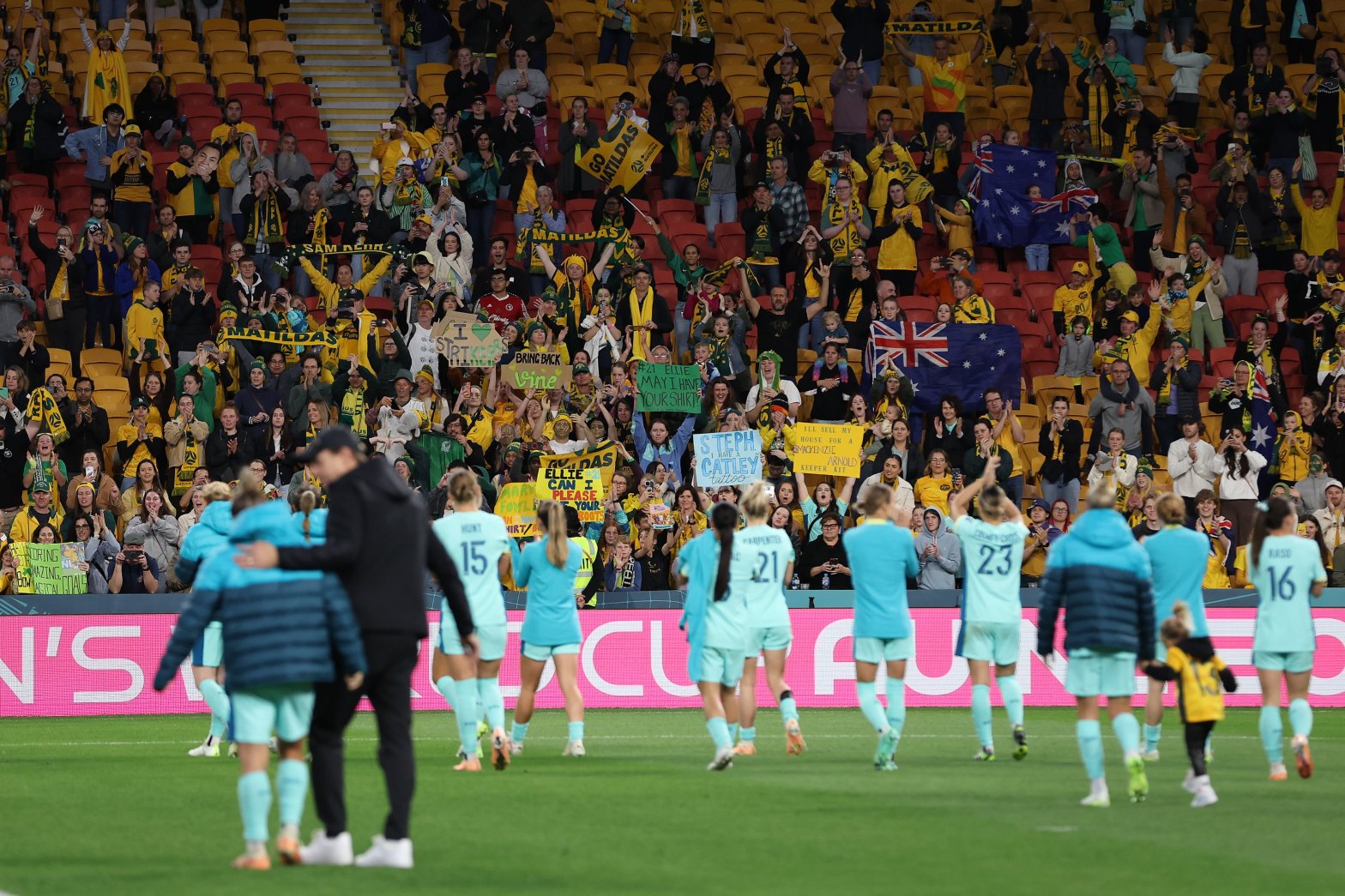
Above: The Matildas thank the fans following defeat to Sweden. Image: Football Australia
Australia’s top four finish at the 2023 FIFA Women’s World Cup was a vindication of the last four years of tough decisions. There could be more ahead for the players and manager.
The Matildas have finished fourth in the 2023 FIFA Women’s World Cup. In the immediate aftermath of a lacklustre loss to Sweden in the third-place playoff, this feels like a failure. In the context of the tournament’s history and the last four years of The Matildas, it is a remarkable achievement.
Prior to this tournament, the last host to lift the trophy was the USA in 1999. The last time a home team got beyond the quarter finals was in 2003. The common notion is that hosting a World Cup gives you a once in a lifetime chance to win it. The statistics show that there is no correlation between the two.
Here is what was achieved at this World Cup. The Matildas finished the highest any senior Australian team has at a World Cup, men’s or women’s, Australia won two knockout games for the first time in our history, The Matildas won a penalty shootout, forever banishing the ghosts of the 2016 Olympics and the 2019 World Cup.
Australia have also routinely beaten European opposition. The Republic of Ireland and Denmark were defeated, overcoming the most pressing issue to come out of the last four years.
Almost immediately after being eliminated by Norway and suffering a surprise loss to Italy in 2019, most of the senior Matildas moved to Europe. That was where the future of the game was, and being able to compete with these nations would be essential.
It took until 2022, and wins over Denmark and Sweden to accomplish this convincingly, but it helped set the stage for this World Cup, and vindicated the sacrifices the players had all made.
When Tony Gustavsson first took over the national side, and the team suffered immediate and huge losses to German and Denmark a top four finish looked incredibly unlikely. The manager continued to press ahead with program of unprecedented difficulty. Improvement was not always instantly apparent, but the graph trended upwards over time to get to now.
The final result is a historic run at a World Cup in front of live crowds and tv audiences the like of which the Women’s game has never seen. On the way there have been highlights delivered and memories created that will last a lifetime, long after the disappointment of the last two games is barely a thought.
That is not to say that everything went to plan, or that the team reached their full potential. Overall history will record this as a successful run, but a closer look shows some issues that need to be addressed for the Paris Olympics should Australia qualify.
The Kyah Simon selection has to go down as a mistake. She is an all time great and a unique footballer, but it was always a risk taking a player with a long term injury into a major tournament. Gustavsson has since said that she was on schedule to return but suffered a setback after the deadline which meant she was unable to play.
In hindsight, this meant that once Sam Kerr and Mary Fowler were unavailable, Australia had no backup centre forward. Simon’s selection was a gamble that did not pay off.
Guatavsson’s use of substitutions will also rightly come under scrutiny. It seems to be a trend of the modern game to make subs late, and having won more games than lost it is understandable why Gustavsson did not want to mess with consistency despite the drawbacks.
That loss proved fateful for the rest of the tournament. A win in the second game would have guaranteed qualification for the knockout stages. More squad players could have been given game time against Canada and others rested.
Instead, The Matildas were forced into a series of must win games, where not risk could be taken. The Denmark game seems straightforward now, but in the moment, had Pernille Harder’s radar been more finely attuned, the result could have gone down to the wire.
That lack of breathing room meant that there was little chance for experimentation.
However, Australia show no significant drop off in form when Charli Grant comes in for Ellie Carpenter or Alex Chidiac for Cortnee Vine. There were still opportunities to rotate some players even in high pressure circumstances.
This is an issue that Gustavsson has said that he will look at, but the “what if?” will always remain, especially as it was visibly obvious that Australia was tiring in the final two games.
The third issue is a lack of a specialist number six or defensive midfielder. Common wisdom says this is an unused Clare Wheeler, but she is not deployed in that role for Everton, nor was she for Fortuna Hjorring or Sydney FC. Wheeler is a mobile, hard running box to box player. She could be used as a stopper, but she prefers to run up and down the pitch rather than left to right to screen the defence and support the strikers.
The truth is, that these players are rare in Australian football. Holly Murray performs the role sporadically for Canberra United, Shay Holman and Taylor Ray for Sydney FC, Amy Jackson for Victory and Leah Davidson for Melbourne City. We know that Emily Van Egmond has not excelled as a defensive player despite dominating in the position for San Diego Wave.
Even after the long absence of Elise Kellond-Knight, no solution was found. Even after the failures of 2019 can be directly linked to “KK” being shifted from that position, was there an attempt to develop someone else who could do the job.
Katrina Gorry, Mary Fowler and Kyra Cooney-Cross were three of Australia’s best and most tireless performers, but particularly against England, Sweden and Nigeria, they were overrun in midfield without a sweeper to mop up.
In time, one will emerge. Sarah Hunter looks like the most likely candidate, but the solution against Nigeria was to have Ellie Carpenter cut inside when Australia had the ball. This resulted in wide open wings for the African side.
The final repetitive issue was a lack of an obvious plan B or C. There clearly was one, as players shifted positions and the team changed formations, but it was not obvious to any onlookers what the team was trying to accomplish when the transition plan had not worked out.
This feels like the only real backward step from The Olympics. In that tournament, Australia rotated the squad each group stage game and used well-timed subs and a major formation shift to overcome Team GB in the quarter-final.
That ability was not really evident in this World Cup, although Australia won more games, finished higher, and scored more goals this last month, the Olympic campaign felt more promising at the time with squad depth used more readily and seamlessly.
Gustavsson has another year left on his contract, there are upcoming Olympic qualifiers just over a month away in Perth. The USA is rumoured to be attempted to poach him, and many are calling for his resignation in Australia.
His tenure is not certain, no coaches is, but unless three major criteria are not met, he should be allowed to continue and try for an Olympic medal.
- Does he have any ideas left? If Gustavsson and his staff have tried everything they know and have no more ways to take this team one extra step he should look for a fresh start. I believe he does, the gradual shift in personnel, tactics and improved result show that the team has been on an upward trend. Only he will know if this can be continued by himself.
- Does he still enjoy the support of the players? This is an unknown, and Football Australia’s review will uncover this. So far, despite the rocky road to now, the players have all shown unwavering support and many have enjoyed the same. The players should be listened to on this subject, or changes made immediately to the way things work if needed.
- Does he think that Australia can win an Olympic medal? Semifinals at the Olympics and World Cup show that The Matildas can overcome the hump that has plagued them in the past. It shows that Gustavsson was the right man to help them achieve that, but is he the right person to take them one step further? Only he will know that. As a devout analyst of the game, he might have an inkling that this is as far as he is capable of taking them. In many ways, Australia overachieved compared to better-resourced and more battle-hardened teams, but semifinals may be their limit. Just one step below perennial third-placer’s Sweden.
The final point to consider is if there is a realistic, suitable replacement. It is hard to think of one out there currently, especially given the poor results and performances of other nations.
Many Australian pundits like to throw out names like Joe Montemurro, but the Juventus coach has rarely shown an interest in any job outside of the day-to-day business of club land and has no national team program experience.
Mel Andreatta and Leah Blayney are potential senior managers and have both played a big part in forming this current senior side, but even with any game-day deficiencies, Gustavsson’s fourth-place finish at this World Cup has earned him the right to see out his deal.
This was a monumental achievement. It has set a new benchmark and could change the future of the sport in this country for men and women.
It hurts now, and there will always be plenty of work to do, but this was the best performance by an Australian side in senior World Cup history. In the end, that is how history will remember it.
Australia lost their final two games to teams that most other teams lose to. There’s a gap between us and the other three finalists. More subs would have helped but there are more complex issues at play such as investment in the domestic league and playing more competitive games.
Despite these differences, Gustavsson’s Matildas almost delivered a miracle. Success is within reach.
With some adjustments, they could easily go one better in Paris.
Follow Impetus on social media – we’re @ImpetusFootball on Threads, Instagram, Twitter, and Facebook. DON’T MISS our brand new TikTok platform @ImpetusFootball too!
 impetusfootball.org