

By Rachel Cohen, with Hannah Chadwick (4/11/2023)
Above: There has been plenty to celebrate for Tottenham Hotspur this season. Photo: Tottenham Hotspur Women.
Tottenham Hotspur are looking like a team reborn this season. They have now won three on the trot and are on nine points from the first four WSL games. Compare this to Spurs’ final four games last season in which they collected just four points after draws against West Ham and Brighton Hove & Albion, a win against relegation-bound Reading and a capitulation to Manchester United.
Under new manager Robert Vilahamn the team has made significant changes across the board. Rachel Cohen discusses some of these: goalscoring, mentality, partnerships, passing, squad depth and the team’s captains.
Then, Rachel is joined by another Impetus contributor, and Spurs supporter, Hannah Chadwick (HC), to pick their key players and games so far.
Goalscoring
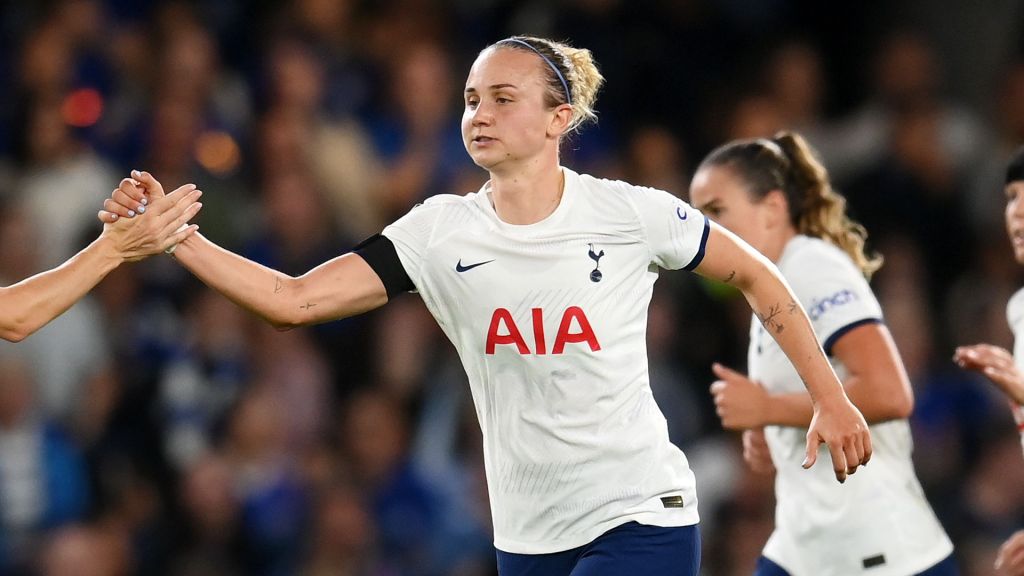
RC: Last season Spurs’ goal drought was only ended by the recruitment of Beth England who scored 12 in as many games. So England’s surgery and consequent absence from the team left many pundits wondering where the goals would come from this time out. But four games in and Spurs have scored more goals than any other WSL team (for good measure Spurs also out-scored all other teams in the first round of the Conti Cup).
On the one hand, Martha Thomas has been a goal monster, and the October WSL Player of the Month is an early leader in the race for the WSL Golden Boot. Incredibly with her six goals for Spurs, Thomas has already equalled her tally from two seasons at Manchester United, where she had limited minutes and was often played out of position. Nothing short of a revelation, Thomas seems to be in that moment where everything goes in – indeed against Villa she scored three from just four shots.
But even if we omit Thomas’s output, Spurs have scored five goals (with five different scorers), a tally that would put them ahead of Everton, Villa, Bristol City, West Ham, or Liverpool, and the same as Brighton for goals scored at this point in the season.
So, what is going on? There are several notable things. First, the team has massively overshot its xG (expected goals): Spurs 11 goals is double the team’s xG (5.5). In other words, players are making the most of their chances. This can be a sign of an excellent striker (the best strikers consistently overshoot their xG, since this is a measure of how likely the average player is to score from a particular opportunity). Beating your xG is also a sign that a team is on form, and Spurs are clearly riding a confidence high. That said, it is likely that there will be some regression to the mean (with goalscoring reverting closer to the xG).
Second, and more optimistically in terms of longer-term success, if we look at where Spurs goals are coming from we see that they include a number that Thomas has created out of very little, largely by pressuring opposition defenders and goalkeepers and pouncing on the half chances their mistakes produce. This is not by accident but is a core aspect of Thomas’s playing style. It is also something that is clearly part of Vilahamn’s set up.
Third, several players have scored wonder goals (Summanen’s free kick; Ahtinen’s strike from the edge of the box; Clinton’s curling ball from even further out). These are low-percentage shots, but they are also the kind of goal that better players will more often score. That two were scored by new members of the squad is notable. Indeed overall, new players have scored eight of the eleven goals scored so far. With Ria Percival, a player who missed almost all of last season with injury, scoring one other. Clearly, therefore the change in personnel from last year is a significant part of Spurs’ improvement in goalscoring.
It may of course be necessary to create a few more clearer-cut chances if Spurs are to maintain this purple patch. But the signs are good that the current situation is not simply the product of luck. With England yet to return, things look pretty rosy on the goalscoring front.
Mentality
This season has seen a sea change in the team’s mentality. On the one hand, the pattern of allowing other teams to score first is not great. Vilahamn has admitted that he wants to cut out mistakes, especially that Spurs need to work on their set pieces, which is how they have most often conceded this season. But on the other hand, Spurs have now twice come back to win after conceding first (against Brighton and Villa), and even against Chelsea were able to respond after going two down, to make the final minutes much tighter than they might otherwise have been.
Perhaps even more than winning after conceding (something they did not do for the whole of last season), what has been clear is that conceding or going behind is not knocking the team off course. Rather Spurs are continuing to play their own style of football. In interviews Vilahamn has repeatedly recognised that this may not always result in a win – that there will be losses – but that this consistency of approach is what he wants to see. From the evidence we have so far seen this team is in the head space to handle future defeats without a total collapse in form.
Partnerships

Spurs’ success so far this year has been underpinned by the development of a few key partnerships on and off the pitch.
Starting at the back we have seen Molly Bartrip and Luana Bühler rapidly develop an understanding at centre-back. Both are comfortable on the ball, happily passing between themselves – and Becky Spencer – within the box as they look for space to pass out. Both are also able to occasionally ping balls forward on the diagonal to create direct moments of play, and can equally themselves make progressive runs with the ball, covering for one another.
In front of them, the Finnish midfield pairing of Eveliina Summanen and Olga Ahtinen are the heart of how this Spurs team plays. Ahtinen’s introduction has provided Summanen with a partner who allows her to play her complete game. And now we see both constantly involved – from defending the box, creating space, to attacking the box (and they both regularly create chances, take key defensive actions, and have each both scored and assisted on a goal).
There are other partnerships that are blossoming: Ashleigh Neville and Jessica Naz seem to intuitively find one another while attacking down the wing – although ironically their combination for a goal came from a moment when they found themselves on opposite wings. While Drew Spence creates lovely passing partnerships with both Celin Bizet and Grace Clinton.
But perhaps the most important partnership is manager Robert Vilahamn and ‘the Tottenham Way’. In every interview and press conference, Vilahamn has emphasised that his priority is that the team develop a style of play that is both his and that also fits the identity of the club. This is aligned to, albeit not identical to what Ange Postecoglou is doing with the men’s team – each has distinctive characteristics – but both are developing high-tempo, possession-based attacking football. And the fan base across both Spurs teams has bought in.
Passing

Last season Spurs completed an average of 317 passes per game. This season they are averaging 473 per game. In other words, under Vilahamn’s leadership the number of completed passes has increased a whopping 50 percent. A big part of this is that the team’s pass completion has gone from just 74.5 to 81.9 percent, which is the second highest in the league, after Chelsea.
Spurs are also second in terms of progressive passing distance – meaning that the team’s passing is attacking. The team is not making a lot of crosses nor winning corner kicks regularly (and are well behind Arsenal’s ridiculous 141 crosses and 41 corners from four games). But Spurs are finding ways to pass through and into the middle of the pitch and, by holding on to the ball, provide fewer opportunities for opposition attacks, which has, in turn, relieved what last year was near-constant pressure on the defence.
There are a few reasons for this transformation. First Vilahamn has a clear plan for how he wants to play, where he wants players to be, and has used players in consistent ways. This means that some players have had relatively few minutes, but those getting minutes know what is expected of them and where their team-mates are likely to be on the pitch making it that much easier to create fluid passing patterns.
Second, Vilahamn has prioritised passing and ‘keeping the ball’ in training, team selection (for instance choosing to use James at right back because of her ball control), and recruitment (especially notable here are new signings, Ahtinen and Bühler, ball-playing midfielder and defender, respectively). Third, the team is set up to ensure that there are multiple outlets available to the keeper and centre-backs when they are looking to break an opposition press, allowing Spurs to move the ball quickly up the field.
A consequence of this is that new players are passing well, but we have also seen dramatic improvements in the passing statistics of existing players. The most extreme example here is keeper, Becky Spencer, whose pass completion has transformed from 75 to 92 percent. Making similarly transformative leaps are Molly Bartrip who has gone from 82 to 90, Ash Neville from 70 to 79, and Eveliina Summanen from 70 to 83 percent completion. This has meant that Spencer, Bartrip, and Buhler all feature in the top ten WSL players for pass completion.
Squad Depth
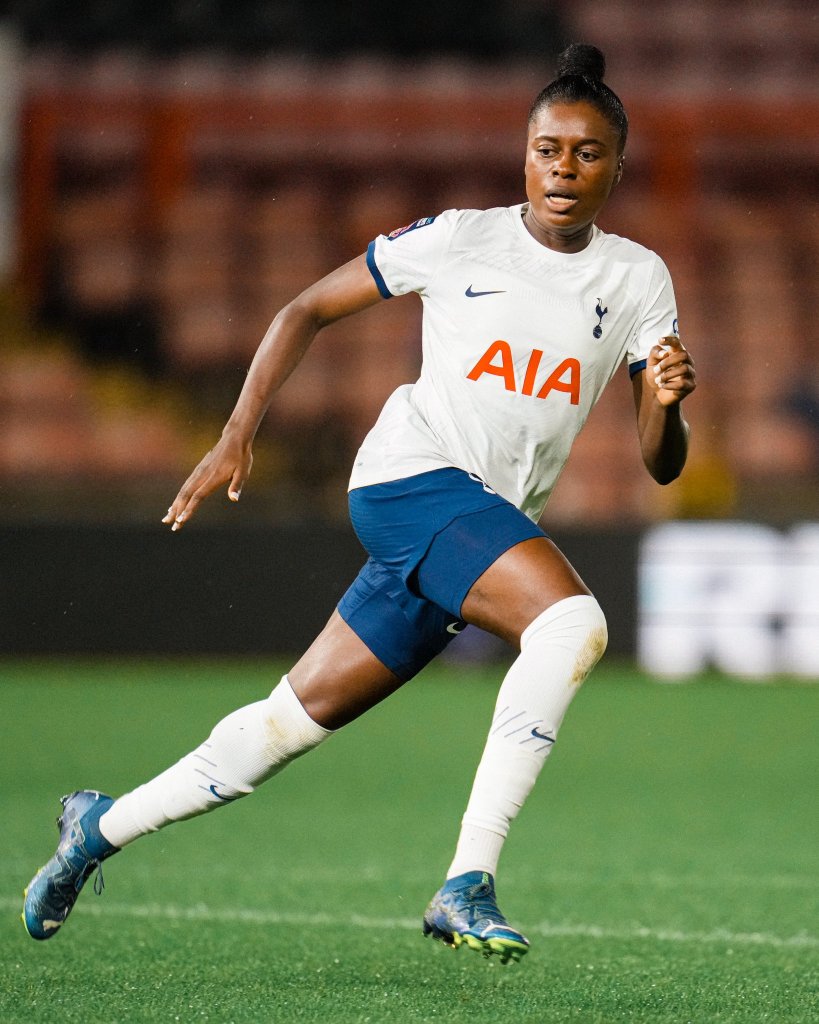
This is the first time in a long time that Spurs have been able to start the same players week on week, with just one change to the starting lineup across four games. That those players are also (almost all) playing in their preferred positions and are on song is the icing on the cake. Underpinning this consistency are changes behind the scenes which seem to have resulted in better conditioning, better fitness, and fewer injury-related absences.
The team also now has a much stronger bench, with players who can come on to bring energy, attacking dynamism, and chance creation (most obviously Jessica Naz and Kit Graham so far, but potentially also Linyan Zhang) as well as players who have the experience as well as skills to see out games while also introducing new attacking threats (Ria Percival and Drew Spence spring to mind). We also have more than competent backups in defence (with Shelina Zadorsky, Amy Turner, Grace Pearse, and Asmita Ale all available). There are also players returning from injury who will present new options (most obviously Beth England, but more imminently, Ellie Brazil).
And, critically, because Vilahamn has a clear plan he is also able to use substitutes while maintaining the rhythms of play. All of which has meant that Spurs have been able to maintain their high-tempo game throughout the full 45 each half – in the knowledge that there are good options off the bench should they be needed. Indeed we have now seen Spurs twice score in the dying minutes of the first half in moments when they have appeared to have more energy than their opponents.
Captains

After he arrived Robert Vilahamn made Beth England captain. Although she is recovering from hip surgery and has not played a minute this season, England has been ever-present: at every game, joining in chants from the stands (alongside other injured players, including Ellie Brazil), part of every post-match huddle, greeting fans and high-fiving players. Clearly, the steeliness England brought to the club last season continues to drive the team forward even while she remains off the field of play.
Meanwhile, Vilahamn’s two new co-captains, Molly Bartrip and Olga Ahtinen have been among the team’s most consistent performers. Bartrip is the player who has been initially chosen to take the armband in England’s absence. For the past two seasons, Bartrip played more WSL minutes than any other Spurs player and it looks like this may again be the case this season. Ahtinen played fewer minutes in her first couple of games but has now played full 90s against Brighton and Aston Villa.
Both Bartrip and Ahtinen are in their peak footballing years (aged 27 and 26) and, in a context in which short contracts are the norm, both have multiple years left at Spurs. Bartrip, who has worn the armband for the first four games, is an eloquent and calm presence. She has overcome personal issues relating to mental health and spoken out about these. She has also been at the club long enough to provide a sense of continuity alongside Ahtinen (and to some extent) Beth England’s newness.
There are no clear divides in the team, but it is notable that the three leaders cover the three parts of the pitch: attack (England), midfield (Ahtinen), and defence (Bartrip). This should ensure that voices from across the team are heard.
Standouts
Rachel Cohen (RC) and Hannah Chadwick (HC) pick out their star players and games from the start of the season.
Key Signing
HC: When you look past the obvious choice being Martha Thomas, for me its Grace Clinton although she is only on loan from Manchester United she has grown as a player and then managed to be on Sarina Weigman’s (England Women Senior manager) radar for get her first senior call up. She has brought pace and structure to Spurs’ movement forwards.
RC: It is hard to look beyond Martha Thomas’s goals (and movement), but I have to say Olga Ahtinen for the balance she (alongside Eveliina Summanen) has brought to the Tottenham midfield, and the way that this has relieved pressure on the backline. Without this the attacking play would not be possible.
Best Player so far
HC: It has to be a player who has flourished this season and has really stepped up to lead the team and the backline. Molly Batrip has been brilliant so far this season, and has really stepped up to become a vital member of the team.
RC: Got to give this to Martha Thomas. Though lots of other players might be in with a shout – and special mention should go to Becky Spencer who has retained her impressive World Cup form.
Best game so far
HC: The first game of the season Chelsea away. Spurs came back from 2-0 down to a strong and hungry Chelsea team and then deservedly got one back. It shows how the team’s mentality has changed under Vilahamn that they don’t crumble under pressure and maintain a positive mentality.
RC: Maybe Brighton because that was the hardest fought. But winning so easily at Villa (last season’s ‘best of the rest’) felt pretty sweet.
Follow Impetus on social media – we’re @ImpetusFootball on Threads, Instagram, X (Twitter), and Facebook. DON’T MISS our brand new TikTok platform @ImpetusFootball too!
 impetusfootball.org