
By Genevieve Henry and Kieran Yap 10/1/24
Above: Sophie Harding is the in-form Australian striker. Photo: Western Sydney Wanderers.
The devastating news that Sam Kerr has torn her ACL leaves much of the football world mourning. But it leaves another thing: an opening and opportunity in the ever-competitive Matildas squad, especially with the Olympic qualifiers coming up.
Should Australia qualify, An 18-player squad for the Olympics not only means that some of the players from the World Cup will be excluded, but that there is very little space for new players. However, with only Mary Fowler, Hayley Raso and Caitlin Foord as the remaining recognised forwards virtually guaranteed a place, there is a need to find at least one more option.
This piece will focus on Australia’s various options, including profiles on some of the A-League Women’s top attacking talents.
Current Squad

With a very versatile attacking line, the answer to Kerr’s absence was something that the Matildas found decent solutions for during the World Cup. Between Mary Fowler and Caitlin Foord, Australia had quite capable strikers. Although Caitlin Foord operates best as a striker when she is paired with Kerr, she can manage well on her own. But, in the past when deployed in the centre of the attack, she has been sorely missed on the left wing. However, since the World Cup, Mary Fowler has come into her own on the left at Manchester City. Alternatively, moving Fowler into the nine role could provide amazing results, whether alone or with another attacker to play off, like Emily Van Egmond. With wingers like Cortnee Vine (if she is fit) and Hayley Raso who are capable of producing results on their own, Australia shouldn’t be lacking for goals. This also practically secures Tameka Yallop a spot in the squad, her contribution as a flexible utility player makes her invaluable.
Fringe Squad
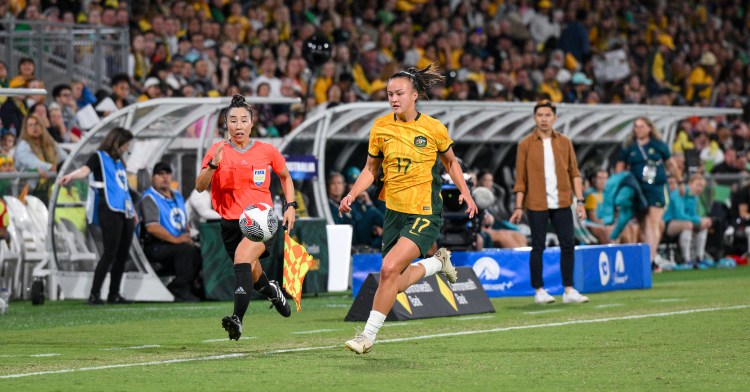
Australia has many great attacking options in and around the squad. With both promising young players and players in their prime, there are many options. Amy Sayer is a likely solution to Kerr’s absence, with her physical presence and tactical awareness. She is certainly a player for the future of Australia, but her time may come sooner than she thought. Alex Chidiac is another great option that can inject energy into a game. One player with Olympic experience who is currently thriving in the A-League is Chloe Logarzo. The 29-year-old midfielder has 54 Matildas caps as well as eight goals and could be a valuable addition after her time away due to injury. Another experienced Matilda who has been injured is Emily Gielnik, who may have a chance if she begins to start and score for Melbourne Victory.
Both Sarah Hunter and Charlie Rule, who recently earned their first Matildas caps against Canada, can play attacking roles, with Hunter functioning more as an attacking midfielder while Rule can pretty much play anywhere (and started as a striker in the Under 20 World Cup). One name that has dropped off the radar but could be in the mix is Larissa Crummer. The forward wasn’t often utilised in her preferred position when playing with the national team over the past few years but has been doing well at Brann. As mentioned in the previous section, World Cup hero Vine is struggling on her return from injury but has a good chance to be in upcoming squads. Lastly, an out-and-out nine, Remy Siemsen has always been an option but would need to hit form at Leicester to be considered.
A-League
At the time of Sam Kerr’s injury, the best five attacking players in the A-League Women are Vesna Milivojevic, Mille Farrow, Sarina Bolden, Daniela Galic and Sophie Harding.
Of those five, only two are eligible to play for Australia, and only one is a striker.
As discussed in an earlier Impetus article, the next generation of Australian striking options are plentiful, but the Olympics is a short tournament, there is no time to find your feet, and with an 18-player squad, anybody selected must be able to meaningfully contribute. There is also a huge step up between being the A-League Women and international football. Australia’s best domestic players struggled against the might of Spain in 2022, but we have players who can fill an attacking role in an already talented team.
Sophie Harding
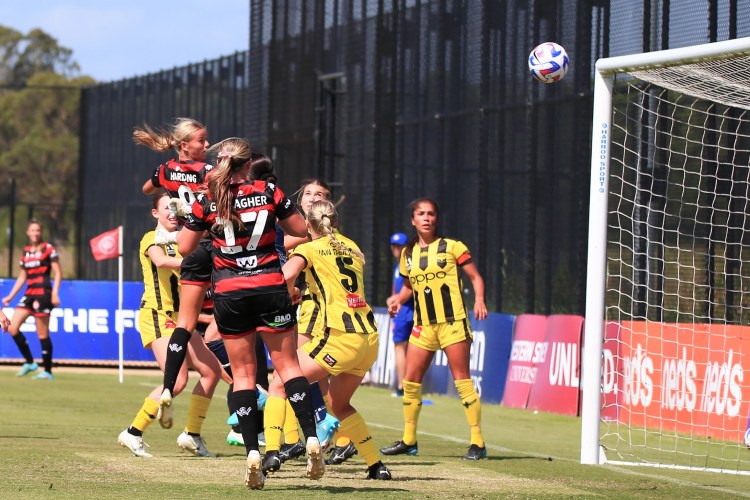
Harding has six goals in nine games for the Western Sydney Wanderers. These are strong numbers, but the way she has been playing could benefit The Matildas if she is called upon.
The former Jets winger was moved inside last season by Kat Smith and has taken on more responsibility as the Wanderers spearhead in the absence of Sarina Bolden.
Harding is a powerful, purposeful runner with the ball, is composed in the box and has a venomous strike from range. She has all the attributes needed to play at a higher level and her style of game would suit a counter-attacking Matildas set-up.
She shoots without hesitation or hurry and is in career-best form. Speed is still an essential element for international football, it can make up for a lack of experience. Harding is reminiscent of Emily Gielnik at her best. She is a forward who can operate in a front three or two. But can also do a job as a solo nine.
Daniela Galic
Galic is an excellent player and one of the best attackers in the league. She has poise, balance and underrated acceleration, particularly in close quarters. She can shoot off either foot and has developed the cutting edge that all good forwards need.
She is, however, a playmaker, best used out wide by City and in midfield by The Young Matildas. Her selection could be merited if her form continues, especially if she has a standout Under-20 Asian Cup, but it would not be a like-for-like replacement for Kerr. It would require a tactical rethink and that might be too much to risk for a 17-year-old who has yet to play a senior international. She has plenty of time to develop.
Galic is a potential Matilda for up to three World Cups to come. She is one of the most exciting talents in the country, but like Mary Fowler before her, will likely be managed carefully.
Susan Phonsongkham
Susan Phonsongkham is another good option, but again unproven as a senior international. She has been prepared by her time with The Young Matildas and came up in the same crop as Mary Fowler, Kyra Cooney-Cross, Courtney Nevin and Charli Grant so there would be some familiarity with the squad.
She is inventive and explosive and can score goals out of seemingly nothing. Her performances have been consistent for Perth Glory, but her scoring rate has slowed since the opening rounds. One thing going for Phonsongkham is that she is a left-footer. Australia lacks them in the senior side, and although she mostly uses it to cut inside and shoot from the right, it is an attribute that could come in handy on either wing.
Hana Lowry

Phonsongkham’s Perth Glory teammate Hana Lowry is another option. A part of the Future Matildas program and one of Western Australia’s brightest prospects since Kerr emerged. Lowry can play almost any midfield or attacking role but has found her feet as a box-to-box player in Glory’s so far successful season.
Lowry combined with Galic to form the Young Matildas midfield at the Under 20 World Cup and is a similar player, although with a more varied passing range.
Like Galic, her inclusion would mean a tactical reshuffle for the side, and there is likely not enough time for that, but in an attacking role, her height, power and control could make an impact.
Chelsie Dawber
Chelsie Dawber has scored goals for Adelaide United, she has scored goals for The Australian Under 23s, and she has scored goals for IFK Norrkoping in Sweden. Dawber is a clever, creative forward with a thunderous right boot.
Goals are harder to come by at Adelaide United this season, but the prodigal striker scored in her second game back for her hometown club.
Her playing style is similar to Kyah Simon in her ability to drop deep and wide and link play as well as finish it. Her finishing is excellent from long range or in the box and she has a willingness to try and take responsibility in match-winning moments.
Her time with the Under 23s means that she is familiar with The Matildas’ preferred style, and she can be a lethal addition to any attack. Crucially, Dawber can play any role in a front three or drop deeper. Her crossing and off-the-ball movement is excellent and her vision and anticipation are some of her standout qualities.
More goals or assists for Adelaide could put her in contention.
Kahli Johnson
Impetus has previously written about Kahli Johnson here. She is one of the brightest prospects in the under-23s and under-20 Matildas setups. A strong, fast, tricky forward with leadership qualities, Johnson is the sort of player who could physically handle international football and has been developed in similar coaching setups that the senior team has been.
She is currently injured and has not featured for Western United in recent games, but her recent experience travelling abroad and ability to float along either flank to score or assist make her one of the country’s best young attackers.
Historically, The Matildas have drawn players from the youth sides, and if Johnson has a strong Under 20 Asian Cup, she could put herself in contention for a senior call-up.
Follow Impetus ’71 on social media –
Twitter (X): @impetusfootball and @impetus71 TikTok: @Impetus71 Facebook: @Impetus71
Instagram: @Impetus_71 Threads: @Impetus_71
 impetusfootball.org