
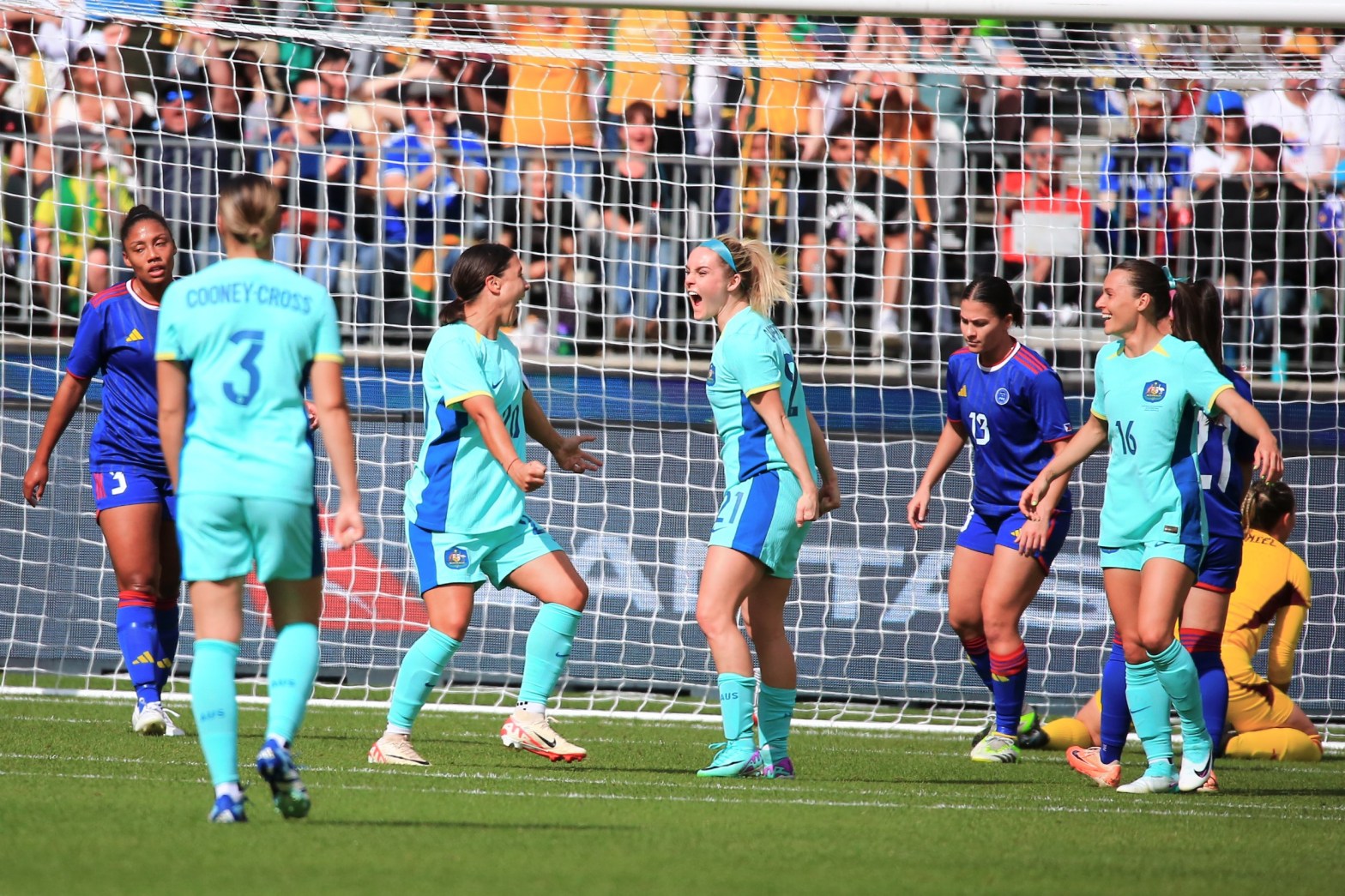
Above: Ellie Carpenter and Sam Kerr celebrate Carpenter’s goal. Photo: Kris Goman for Impetus.
By Genevieve Henry (25/7/24).
Going to her third Olympics at just age 24, Ellie Carpenter is often considered one of the world’s best players. Her speed, tenacity, and drive set her apart from most. But, as good as she already is, Carpenter has the potential to become the best player in the world. How can she take her game to the next level?
While Carpenter herself has called her forced break from football “a blessing in disguise” and “the best thing that’s happened to me”, a few critics would argue. Since Carpenter’s horrific ACL tear in the 2021-22 UEFA Women’s Champions League Final, her form has been closely followed and scrutinised by fans. Although her playing time and statistics have remained largely the same as before her injury, many seem to think she has fallen off. I suspect people have just begun to expect more from her.
Already a veteran at her young age, the sky’s the limit for Carpenter. She’s spent years breaking records, but she could break even more. Carpenter has previously said, “I want to be the best right-back in the world.” She’s not far off.
Defence
Carpenter is known for her lightning pace up the right flank, functioning at times as more of a winger than a defender. This leaves miles of space behind her. It’s a conundrum all wingbacks and their coaches face. How can they add to the attack without leaving the defence vulnerable?
Carpenter has the capability to defend very well. But, throughout her years as a Matilda, she seems to be relied on less for actual defending. While she is faster than almost every player she faces, it’s often her positioning that lets her down. Whether it’s her actions or the coach’s, it desperately needs to be amended. Luckily for Carpenter, she has strong centrebacks beside her for both club and country, with Wendie Renard, Griedge Mbock, or Vanessa Gilles; and Alanna Kennedy and Clare Hunt to step in and help out.
When she was 16 at her first Olympics, Carpenter had to prove why she deserved the call-up. She marked Marta in a game that tournament and to this day, it’s probably her best defensive performance in a Matildas shirt. Now, as a thoroughly established starter, there is less pressure on her at the back and she is free to go on side quests up the pitch. 99% of the time, this is a good, even great, thing. But, that 1% left causes catastrophic opportunities for the opponents to pounce. This situation desperately needs to be rectified for both the Matildas and Lyon or opponents will mercilessly target this weakness, and although fitness is not something Carpenter struggles with, it’s a lot to ask a player to repeatedly sprint the length of the field for a full 90 minutes.
It can be remedied in a back four with the right-sided centre-back shifting over the cover for Carpenter as she hustles back; or have Carpenter and Raso switch back and forth on the wing for the Matildas. It’s never for a lack of trying that she gets beat, but it is simply impossible to be in two places at once. Depending on the opponent, Carpenter’s game just must adapt to the situation at hand. In the World Cup, she put on her best display in defence since the Rio Olympics, against Pernille Harder. She had Harder absolutely pocketed the entire game, nullifying Denmark’s biggest attacking threat. When instructed to play defensively, she thrives. It’s just too hard to do both all the time. To excel, she must improve what she can control.

One of Carpenter’s best qualities is her strength and physicality. Growing up playing against boys, she learned to fight hard against every opponent. She has incredible stability and balance, with her ability to stay on her feet and keep running through challenges unmatched by most.
Her tackling skills are quite good, making fewer unsuccessful challenges than other top fullbacks, making only five failed tackles where top fullbacks often lose far more, up to 20 throughout the season. She also excels at using her body to stop attacks, being skilled at blocking both balls and players from sneaking by her. Her interceptions are also good when compared to elite players such as Ona Batlle, Lucy Bronze, Selma Bacha, Emily Fox, and Ashley Lawrence, making 1.2 per game while Lawrence only makes .37 per game. She is dispossessed and mis-controls the ball the least out of these top fullbacks.
Although not a huge detriment to her game, Carpenter struggles aerially, only winning 14% of duels, while the comparable players generally complete over 50%. She struggles with clearances, but most elite fullbacks, all rank just as low, or even lower than Carpenter in this statistic.
Attack
Having scored only 13 goals in her career, most of which came in her teenage years playing in attacking roles in the W-League, Carpenter is not really a threat in front of net. If she can carry her runs into the box and back herself to shoot, she could become a truly dangerous asset for any team.
Although Carpenter ranks in the 71st percentile for assists in comparison to other defenders, to truly become an elite fullback, her crossing abilities should get even better. When compared to the likes of Bacha, Battle and crew; Carpenter shows the lowest xG+AG (expected goals plus assists), signifying that there is still some ground to make up in direct contributions to goals.
Carpenter has a similar number and percentage of passes completed (around 80%) compared to these other top fullbacks for both short and medium-distance passes but ranks significantly higher in long passes, completing 66% while the other top fullbacks generally complete around 50%. She is on the upper end of passes in the final third and passes into the penalty area. She crosses the ball an average amount, with 2.93 per game, while Bacha is the cream of the crop with a whopping 11.9. But, the quality of Carpenter’s crosses can often leave something to be desired, as shown by her amount of assists and shot-creating actions, which are lower than the amount of crosses. She is also fairly average in her amount of shot-creating actions when compared to the best of the best, creating 2.85 chances per 90. She creates better chances when making runs and passing into the box, as opposed to crossing.

Carpenter is a model fullback with progressive movement, being on top of the statistics in both progressive passes and progressive passes received. Her link-up play, especially for Australia, is extremely dangerous and hard to defend. She completes more give-and-go’s than most, her speed making her runs impossible to contain.
The Paris Olympics are a chance for Carpenter to once again prove herself to the world.
Carpenter has been on an upward trajectory since she was 16. To become the most complete fullback, she simply needs to continue to work hard, refine her crossing, and work on positioning. Once she hits her prime, I have no doubt that she could be the best defender, if not player, in the world.
Twitter (X): @impetusfootball TikTok: @impetusfootball
Facebook: @impetuswomensfootball Instagram: @impetusfootball
 impetusfootball.org