

By Kieran Yap 24/11/25
Above: The Matildas in 2023. Photo: Kris Goman for Impetus.
Who the next Matildas coach should be has been much discussed, but just as important is what they will need to do once appointed.
The incoming coach of Australia’s most high profile team will have their work cut out for them. With a home Asian Cup fast approaching and a World Cup on the horizon, they will have minimal time to imprint their style and make any changes. The possible to-do list is as difficult as it is long.
Satisfying a fan base hungry for success will have to be balanced with appeasing an historically impatient media while winning football matches. No matter who is in the hot seat, this will be a great challenge.
Regenerate the squad
The Matildas of 2023 went deeper into a World Cup than any other Australian side and changed women’s football forever in this country. The players that reached the semi final will forever be sporting immortals, but time is undefeated and by the time the 2027 World Cup arrives, some players will be three years past what was widely considered this generation’s “last chance to win something.”
The new coach should not be under any pressure to instantly retire players, but younger players should be given the same opportunity that the senior players current generation were when they were the same age.
That is not to say that only young players should be considered. The emergence of Tash Prior or Leah Davidson show that players in their mid 20’s are potentially able to step up for those in their early to mid 30’s.
This work has begun with Tom Sermanni and must continue.
It is a delicate balancing act.
Players need to be brought through under circumstances where they can flourish or at least improve, while older players like Katrina Gorry cannot be simply jettisoned.
Their experience and talent are valuable, but the side must eventually skew younger to avoid it being too old to physically compete at the 2027 World Cup in a sport that is constantly increasing in pace and athleticism.
Team selection should be done not just on who is currently performing, but also with an eye on who will be approaching their peak in or after 2027, and who will be sadly too far beyond their best years.
Sam Kerr replaced Kate Gill and Fowler stepped up in a post Lisa De Vanna world. It is the way football works and although it cannot be achieved as instantly as Emma Hayes has done in the U.S, there’s increasing urgency to start the process soon.
A clearer selection criteria
That brings us to the second point. The new manager should be clear on what they need players to produce for The Matildas. Fans would like this to be as public as possible, which is unlikely. Secrets must be kept to maintain a competitive edge. But confusion with the media and public should be minimal.
Tony Gustavsson went through extensive explanations about why players were selected in the squads, but mystery remained about actual game time. From the outside it looks like some can be given infinite chances while other are starved of opportunity.
More recent squad announcements have highlighted the importance of playing in a top league or playing regular football, only to select some who have seen few minutes or had even yet to begin pre-season training over ones who met the public criteria.
There are those that will always be exceptional, or provide something that others cannot.
Charli Grant for example, can play to an international level at left or right back and almost nobody would sensibly call for Teagan Micah to be dropped or to exclude Cooney-Cross because of limited game time.
Often the coach will not be able to explain every reason publicly, but they should avoid making blanket statements that confuse or irritate fans (and fringe players.)
This can also give rise to conspiracy theories and angry posts on social media aimed at players who have done nothing other than be selected for the national team.
Realistically, football teams for club or country are chosen based on who fits the tactics or opposition best.
But it has been at times confusing to see the likes of Kahli Johnson miss selection as a player who has recently featured in two Under-20 World Cups, had four years of Young Matildas experience, and was leading the Golden Boot charge in the A-League Women.
Be bold with selection and game plan
There seems to have been a temptation over the last four years to try and fit in as many of the big guns into the XI as possible. This has been coupled with a reluctance to change the lineup even if the opposition might require it.
It’s is more art than science. Nobody knows for certain what the right answers are. But while the double pivot of Kyra Cooney-Cross and Katrina Gorry has driven Australia to unprecedented success, it is no longer a combination or formation suited to all occasions.
Likewise, the Mary Fowler conundrum is an issue of selection as much as tactics. She is a uniquely talented player (who will hopefully be available again sooner rather than later), and plays her best on the wing. However, the wings are one area where Australia is spoiled for choice.
The problem is, only two wingers can fit into any XI. One of them is Fowler, and the reality is that the team is more dangerous with another gun players sitting on the bench than it is trying to squeeze them into an unwieldy formation.
The most common solution has been to move Fowler to a 10 role, but one of the main reasons it has rarely worked is that Australia is not really set up to play with a 10. The Matildas strengths are out wide, and that’s where the midfielders and centre backs aim to get it.
When she is fit again, there will have to be hard decisions made. Some very talented wingers might have to miss out on a starting role.
But it is a good problem to have, as long as it is solved to maximize the team and not to squeeze in every gun player possible.

It is an issue that can also be applied to defence.
Sorting out the defence
Almost every fan and analyst has a slightly different view of what the Matildas backline should look like, but The Olympics and proceeding friendly matches showed us that it needs work.
Currently, neither of our two regular central defenders are in a good position.
Clare Hunt is not starting regularly for Tottenham and Alanna Kennedy is playing in midfield for Angel City. It is not ideal for Australia.
The Matildas look at their best defensively when Steph Catley is at centre back, but also look at their most dangerous as an attacking side when she is at left back. Australia has potential solutions to this with the likes of Matilda McNamara and Jess Nash’s individual seasons and potential surely warranting more call-ups.
If they use Catley at left back, Jamilla Rankin, Courtney Nevin or Charlotte Grant are all excellent options. If all three can maintain or increase club minutes it could give the incoming manager a welcome selection headache and make using Catley in her common Arsenal position easier.
But defence is not a four-player job. It starts up the pitch and while Australia had success with a spread out 4-4-2 formation during the World Cup, it appears that may have run its course.
Other formations or personnel will need to be tried. Could Clare Wheeler or Leah Davidson be an option to screen the defence in midfield?
Perhaps a back five or three needs to be trialed. Wini Heatley’s recent emergence unlocks possible solutions in midfield or defence.
Will Sam Kerr still possess her otherworldly and clairvoyant pressing abilities post-injury?
The defence struggled at the Olympics to an almost unprecedented level and was not much better at the She Believes Cup. The incoming coach needs to stop Australia conceding early, and find a way to dam the breach when games are going against them.
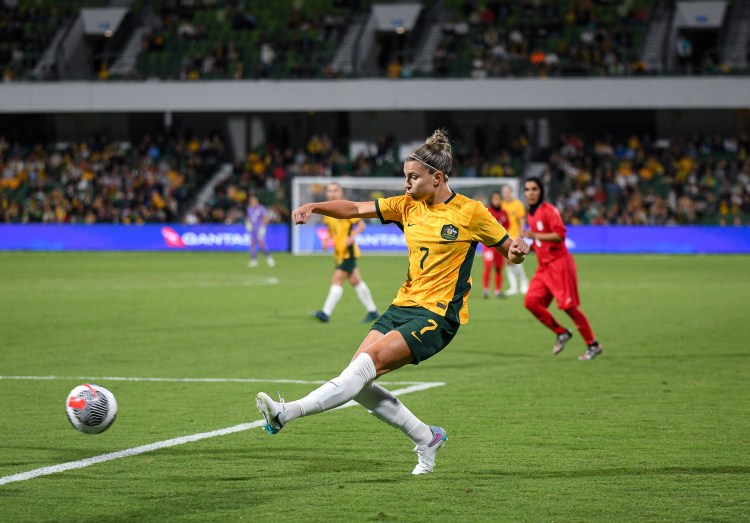
Develop a better emergency plan
We are getting to the shorter and simpler ones now. It is not plan B or even Plan C, but when the Matildas have gotten desperate in recent times, they have thrown Alanna Kennedy up front.
It has not really worked, and the new coach should find a better last resort.
No more picking injured players for major tournaments
This has been litigated and discussed for years now, and when the Asian Cup rolls around it is likely to come up again. But Australia simply cannot afford to select injured footballers for a major tournament. It should not even be considered (no, not even just to take a penalty.)
It stretches the rest of the team, and limits the coach’s options.
Keep calm, and look at other players.
Unify and utlise the youth systems
Australia has an Under 17 team and an Under 20 team, the future of the Under 23 side remains unclear with coach Mel Andreatta accepting a role as Scotland’s senior coach.
Ideally, the youth teams should be preparing players to step into the senior side. That is how the likes of Karly Roestbakken and Kyra Cooney-Cross adjusted relatively quickly to the top level, and the Matildas lineup that defeated Taiwan drew heavily on the last Under 23 side to meet up.
This does not necessarily mean playing with the same tactics, but at least with the same philosophy. This has been the practice for most of the last five years, and should continue.
Give the fans more credit that they will support anybody wearing the shirt
Some Matildas fans are there to see their favourite player, but most understand that it is a sporting team and not a touring band. The lineup will change, but fans will still show up.
After the win against Chinese Taipei in Geelong, supporters flocked to the fences to get signatures and photos with the largely A-League based Matildas. Just as they would the overseas and World Cup stars.
Fans love the sport, they love the shirt, and they love the team no matter who is wearing it.
There is a creeping feeling that some squads are selected to maximize the unprecedented interest in women’s football. Big names are picked despite being out of form, fitness or just in need or a rest (research increasingly shows that players experiencing a lot of travel and an intense schedule are at higher risk of ACL injury.)
The problem is that if too many players are picked that aren’t at their best it will eventually lead to a drop off in fandom anyway. Results will fall, performances will frustrate and the broad interest that sells 50,000 tickets and fuels broadcast deals can wilt away.
The commercial aspect is not something to brush aside too quickly. The growth of the sport is important, and this is an unprecedented opportunity to do that thanks to a team of household names. But it cannot override long term sporting goals.
The best chance for maintaining commercial interest in this team is to pick the most competitive, fit, rested and entertaining side, no matter who that consists of.
Asian Cup success
All of this will mean nothing without immediate success at the Asian Cup. But what does that look like?
Winning it will be a hard task, there’s been too much preparation time lost already. Japan are seemingly ready to steamroll everybody and North Korea are always a strong side in this tournament.
But a top four finish is a must, not only for pride and to make the most of attendances at a home tournament, but for World Cup qualification.
Is it too much to ask of a coach to push for a first trophy in 15 years, regenerate the squad, re-structure the selection process, find new tactics, sort out the defence, find the best attack and keep stadiums full?
It probably is.
But everyone from the head of Football Australia to sponsors, the players themselves and to the kids holding signs want the team to win, So while the incoming coach will have a lot to accomplish, the rest of us might have to be a little patient while they get us in a realistic position to do so.
The biggest issue now is there is not much time. We are almost two years into a traditional four-year cycle and so much of it has been spent waiting for a coach to begin this important work.
Follow Impetus on social media-
Twitter (X): @impetusfootball TikTok: @impetusfootball
Instagram: @impetusfootball
 impetusfootball.org