
29/04/2025
Above: Arsenal’s Chloe Kelly and Leah Williamson celebrate. Photo: Jay Patel.
Impetus‘ UK co-editors Catherine MacKenzie and Ava-Marianne Elliot look back at four games of top-level European football: the UEFA Women’s Champions League semi-finals between Chelsea and Barcelona, and Arsenal and Lyon.
A number of players from the England national team were on show across the ties; but how did they fare? We take a look at some key take-aways and consider what we can learn about the Lionesses from their UWCL appearances.
Chelsea vs Barcelona: the importance of maintaining a strong mindset
By Catherine MacKenzie
First leg: Barcelona 4 – 1 Chelsea
Second leg: Chelsea 1 – 4 Barcelona
Aggregate: Barcelona 8 – 2 Chelsea
No Lionesses started for Barcelona in either game; goalkeeper Ellie Roebuck was on the bench. Chelsea, however, featured many Lionesses across the pitch: goalkeeper Hannah Hampton, defenders Millie Bright, Niamh Charles and Lucy Bronze, midfielder Keira Walsh, and forward Aggie Beever-Jones all featured in the tie.
Whilst it was never going to be easy for Chelsea to get past their frequent foes Barcelona, few would have anticipated the 8-2 aggregate drubbing. The way the first game elapsed, there was a combination of defensive frailty and tactical naivety that left Chelsea exposed to a ruthless Barca side.
The frequency with which English clubs are eliminated from European competitions raises wider questions. Chelsea are the dominant force in English women’s football, and their squad to face Barcelona included four Lionesses with winning medals from the 2022 European Championships.
For Barcelona, five of the starting eleven lifted the World Cup trophy in Australia, with Salma Paralluelo also coming off the bench to make it six Spain players involved. The gulf in that final was smaller – Spain eventual 1-0 winners – but the Spanish have since gone on to dominate much of European international football, winning the inaugural Nations League.
If England’s lack of dominance does say something about the progress of women’s football in England, there is a chance to have a rebuttal: Arsenal will face Barcelona in the Champions League final, and England will soon face Spain in the Nations League.
So, with those games in mind – what can we learn from Chelsea’s double loss?
Moments of calamity make the difference
Chelsea’s starting defence for both games included a duo who are mainstays of the Lionesses back line: Lucy Bronze and Millie Bright. They were joined in the return leg by relative youngster Niamh Charles – Charles has been in and out of the Lionesses starting lineup and returned from injury earlier this year.
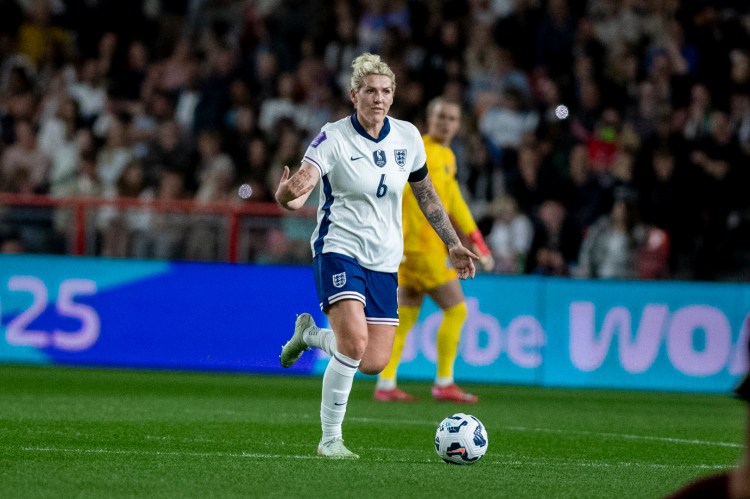
The England defence has had a mixed run of form. Friendlies in late 2024 were used as a way of tweaking defensive tactics, and the team conceded four in a loss to Germany at Wembley, going 3-0 down within half an hour.
A capitulation like that has been rare from Sarina Wiegman’s England side – perhaps the closest they had come before was going 2-0 down to the Netherlands in the Nations League in the autumn of 2023.
The third iteration of England defending calamitously came in their most recent game away to Belgium, where Bright and Charles were withdrawn at half-time with the Lionesses 3-1 down. The team did eventually stage a comeback to reduce the scoreline to 3-2, and the second half performance was much stronger.
These games show that England can be easily rattled at times — and when they are, they often collapse, at least for a moment.
When Chelsea conceded their second goal (in either leg) against Barcelona, there was a sense of immediate panic that was reminiscent of England when they conceded their second against Belgium.
For a few moments, Chelsea looked so shaken that they seemed to forget the basics, and it was obvious that a third goal would be conceded.
The panicked moments for both England and Chelsea were small in duration – lasting mere minutes in a long game. However, at these levels, those small moments will be exploited, particularly when opposing teams know it is likely to happen and can tailor their press towards it.
It must be said that England are not alone in having these moments. Spain themselves ended up 2-0 down to Belgium.
The difference was that they eventually staged a comeback to win 3-2, and there was a longer length of time between the two goals; England and Chelsea both conceded in quick succession.
These moments of chaos after first conceding should be something both Bompastor and Wiegman are eager to stop – particularly as an increasing number of teams will be able to exploit them.
What does this mean for England’s starting XI?
It is unfortunate for Bronze, Bright and Charles that these performances have come at a time when there are increasing calls for Manchester United’s Maya Le Tissier and Millie Turner to get more game time for England. The duo have been a rock-solid centre back pairing this season for the Red Devils, contributing to the league’s best defensive record.

Whilst it is likely that recent Chelsea performances have only heightened those calls, the fact remains that England are currently two months away from a major tournament, with little time to experiment.
Le Tissier and Turner have both featured as recently as winter 2024, and whilst it is unlikely they will be promoted to the starting lineup with the Euros so quickly approaching, their form does point to an interesting discussion about what happens to England’s starting defence post-2025.
Arsenal vs Lyon: a more positive outlook
By Ava-Marianne Elliot
First leg: Arsenal 1 – 2 Olympique Lyonnais
Second leg: Olympique Lyonnais 1 – 4 Arsenal
Aggregate: Arsenal 5 – 3 Lyon
For Arsenal, turning around a 2-1 first-leg deficit away in Lyon was going to be no easy feat. The Gunners struggled against the French giants on home turf.
Three Lionesses appeared in the starting lineup. The usual centre-back choice of vice-captain Leah Williamson was no surprise, Chloe Kelly made a start on the wing, and Alessia Russo was of course the one to lead the line. Beth Mead lost her spot in the lineup to Kelly this time around, starting on the bench alongside a now injury-free Lotte Wubben-Moy.
Whilst Kelly was originally a question mark for Wiegman’s Euros squad, it feels like her place should be set in stone now. The winger has found flying form since departing Manchester City for Arsenal on loan, and the confidence and joy she’s found in North London has reflected hugely in her displays on the pitch.

Against Lyon, Kelly was stellar. She caused a number of problems and kept Lyon’s Australian fullback, Ellie Carpenter, on her toes. In particular, Kelly was brilliant at exploiting space to push Arsenal forwards. She certainly gave Lyon the run around.
Beth Mead is in good form, and always seems to be in the right place on the pitch, particularly excellent at finding space. In the first leg, she had a good first half despite Arsenal’s loss, but in the second leg, she came on the 72nd minute, not really having the time to make a significant impact with her side already far in the lead.
At this point, it seems cemented that both players will be heading to Switzerland. The debate now falls to who is more likely to get the starting spot, and who will be an impact substitution for Wiegman’s side.
One figure who will never be in doubt for Wiegman is England captain Williamson, who was crucial in the Gunners’ fight against Lyon. With an 80% pass accuracy and forceful when meeting the threat of Ada Hegerberg, Williamson seems to never fail to be a reliable figure.
Similarly, Russo appears to be another incredibly reliable figure, especially as of late. In the Champions League, the striker has scored seven goals, meaning she’s joint second for the competition’s leading goal-scorer with Ewa Pajor.

Her goal was clever, and she’s been so phenomenal this season, it feels inevitable that we may see her have a brilliant run in Switzerland.
Wubben-Moy is one of the biggest question marks. Whilst the centre-back is solid for her club side and works well paired with Williamson, she seems to be further away from Wiegman’s vision, and rarely features on pitch for the country.
Against Lyon, Wubben-Moy was brought on in the 87th minute to see out the game. In the few minutes she featured, she was a solid figure at the back for Arsenal. Being just off the back of an injury and a huge competition for spots in the defender position, whether Wubben-Moy will be named will be unclear until the final Euros squad is released.
Follow Impetus on social media –
Twitter (X): @impetusfootball TikTok: @impetusfootball
Instagram: @impetusfootball
 impetusfootball.org