

By Catherine MacKenzie (17/05/2025)
Above: Southampton Women lifting the inaugural Mitre Challenge Trophy. Photo: The National Football Museum.
On Sunday, Manchester United and Chelsea face off in the final of one of England’s most prestigous tournaments. Ahead of the game, Impetus‘ Catherine MacKenzie looks back at the competition’s long history.
If you ask fans of men’s football in England, they will likely say the FA Cup is magical. The Football Association Challenge Cup is the world’s oldest football competition, dating back to the 1870s. Open to all football clubs across the football pyramid, it has become famous for upsets – spirited underdogs beating a team three or four leagues above them. The 2025 men’s trophy is emblematic of this: won by underdogs Crystal Palace by beating giants Manchester City 1-0 in the Wembley final.
Throughout the 1970s and 80s, the frequency of these upsets led pundits to coin the phrase “the magic of the FA Cup” – capturing the sense that anything can happen in the competition.
Some of these games include Southampton beating Manchester United in 1976; Wimbledon beating Liverpool in 1988; Millwall beating Arsenal in 1995; Wigan winning against Manchester City in 2013, and bottom-tier Shrewsbury Town beating premier-league side Everton in 2003.
The women’s competition may be comparatively recent, but it has proved to be just as magical. After the FA wrote a letter to the Women’s Football Association (WFA) in December 1969 confirming that the longstanding ban on women playing football would be lifted, the Mitre Challenge Trophy was established.
Independent of the formal FA, the WFA worked across the whole of the UK and allowed teams from Scotland and Wales to compete in its competitions – including early Mitre Challenge competitions. In 1972, the Scottish Women’s Football Association (SWFA) was founded, and Scottish teams reverted to playing in competitions organised by them – no teams from outside of England have competed since the early years.
The first final: Southampton 4 – 1 Stewarton Thistle
Early years were dominated by current National League South club Southampton Women FC (not to be confused with the WSL2 club of the same name) and current National League North side Doncaster; Southampton’s Sirens won the first final on the 9th of May 1971 by a scoreline of 4-1, beating Scotland’s Stewarton Thistle.

From the 1970s to the early 1990s, most games were played at small non-league grounds around the country. As the ban on women’s football was only on the verge of being officially lifted when the competition was established, no club from the men’s Football League offered their ground for its first final.
As a result, the WFA arranged for the final to be played at the Crystal Palace National Sports Centre – a venue steeped in history as the host of 20 men’s FA Cup finals, the last of which took place in 1914.
Footage from the final – although grainy – reveals a pitch with long grass and a surface that would be considered substandard by today’s expectations. The crowd is thinly spread along the perimeter behind the barriers near the running track, but the main stand is nearly full; although no official attendance records exist, it is thought that at least hundreds of spectators were in attendance (the following year, 1,500 attended the final).
Speaking of that first final, then-Southampton captain Lesley Lloyd told The Women’s FA Cup website: “Cup final day was fantastic. For me, it felt like being at Wembley. The feeling of lifting that cup is something I will never forget, thinking that we had actually won it, and the feeling that after all that time the FA had finally recognised that women could play football.”

In 1979, the FA dedicated a new trophy to the competition as a celebration of its 10th anniversary. The original trophy has since disappeared.
Early years: 1971-1993, Southampton’s Sirens and the Doncaster Belles
Throughout the 1960s, the rise of feminism meant women started campaigning more vigorously for the right to play football. On November 1, 1969, delegates from 44 clubs gathered in London for the inaugural meeting of the WFA. Arthur Hobbs, a carpenter and amateur player, became the WFA’s first Honorary Secretary, and Pat Dunn was appointed as its first Chairperson.
An early ally of women’s football, in 1967 Hobbs had spearheaded the organisation of a women’s football tournament in Deal, Kent, with backing from the local mining community at Betteshanger Colliery. As the ban was still in place and no FA fields could be used, the game was played on the colliery’s fields. The Deal Tournament aimed to celebrate women’s football; it became a precursor to the Mitre trophy, proving a women’s tournament could be successful.
After beating Stewarton Thistle 4-1 in the first Mitre Trophy final, Southampton continued to dominate. The team from the South made it to the first three finals of the competition, beating Scottish teams to the trophy on all three occasions. The Sirens’ squad boasted some of the country’s top talents, including Sue Lopez, prolific forward Pat Davies and goalkeeper Sue Buckett. The team would go on to win seven of the first ten finals; the last of which came in 1982.
Following Southampton’s dominance, women’s football was growing more competitive throughout the 1980s. Founded in 1969, the Doncaster Belles eventually found their share of the dominance too. The Belle Vue Belles were established in 1969 by a group of women who sold raffle tickets at Doncaster Rovers’ Belle Vue stadium. Initially named after the stadium, they changed their name to Doncaster Belles in 1971.
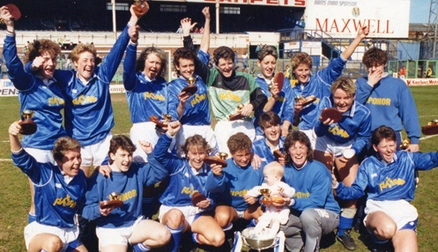
During the 1980s and early 1990s, the Belles established themselves as a powerhouse in English women’s football. Between 1983 and 1994, they appeared in the FA Women’s Cup final 11 times over a 12-year span, claiming the title on six occasions during that remarkable run.
Mitre stopped sponsoring the competition in 1976; it was then known as the WFA Cup until the FA takeover in 1993.
Recent history: FA takeover and dominant London clubs
The FA took over running the competition in 1993. This meant it became official and more closely aligned with the men’s FA Cup – including being rebranded as the ‘FA Women’s Cup’. While the WFA is credited for establishing and nurturing women’s football through difficult early decades following the ban, the FA’s takeover in 1993 provided the institutional backing needed for the sport to grow nationally and eventually reach more professional standards. This coincided with men’s top-tier clubs beginning to further finance their women’s sides.
Chelsea, for example, have been backed extensively over the last two decades, and Arsenal have long been integrated into the club’s structure. Being early starters gave both clubs a head start in scouting the nation’s best talent, building infrastructure, and establishing the dominance that enabled them to continue that investment. Arsenal have been pioneers – founded in 1987, they dominated the game for years and have a rich trophy history, including a UEFA Women’s Cup (now the Champions League) win in 2007.
Arsenal won their first final in the 1992-93 season and have won 13 since, including a run of four successive wins between 2005 and 2009.
More recently, women’s football in England has been dominated by another London club: Chelsea. The blues have won five FA Cups, most recently in 2023. That year’s runners up were Manchester United, who celebrated their first major trophy in 2024 by lifting the FA Cup at Wembley in front of over 76,000 spectators.
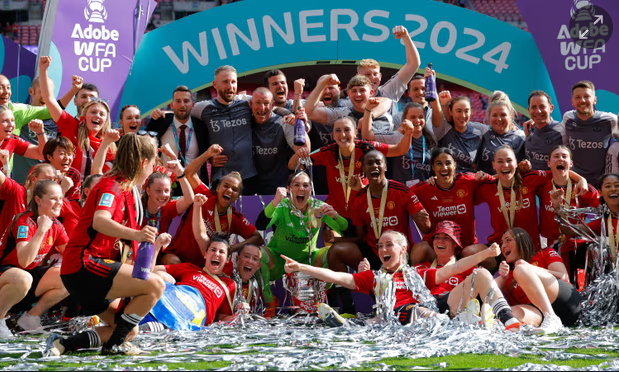
This Sunday, United face Chelsea in the FA Cup final at Wembley once again, and they will be hoping to avenge that 2023 defeat. The game has officially sold out, exemplifying the progression of women’s football. In 2015, the stadium hosted its first women’s FA Cup final, seeing Chelsea beat Notts County 1-0 in front of 30,000 spectators.
That ten years later the final would be played in front of a sold-out crowd would have been unthinkable then, and even more unthinkable back at the Crystal Palace National Sports Centre in 1972.
Chelsea v Manchester United kicks off at 13:30 BST at Wembley Stadium. The game will be broadcast live on BBC One in the UK and on Optus Sport in Australia.
Follow Impetus on social media –
Twitter (X): @impetusfootballTikTok: @impetusfootball
Instagram: @impetusfootball
 impetusfootball.org