

By Clare McEwen (15/05/2025)
Above: Arsenal’s Champions-League winning squad in 2007. Photo: Arsenal FC.
In the second piece of our week’s countdown to the UWCL final, Impetus Football’s Clare McEwen revisits Arsenal’s history as a trophy-winning machine.
In England during the 1980s and into the 1990s, Doncaster Belles was the team name that even casual followers of the game had heard. Appearing in many FA Cup finals — at the time, the only women’s game shown on TV — they were probably the only team most people could name. They were a successful team, a fairly dominant team. And their dominance was about to be challenged.
In 1987, Vic Akers began his mission to build a successful women’s football team: Arsenal Ladies was born. Akers didn’t want to just put together a team though, he wanted to change how women’s football was built. In a time when it was a completely amateur sport, Akers employed a level of professionalism at Arsenal that other WSL clubs are only reaching now. It was this professional approach that made Arsenal so successful then, and is why they still lead the way now.

Aker’s professionalism covered all aspects of the game: his tactics, his scouting and recruitment practices, his training drills, and the way he approached the financial management, even with very limited resources. He often found jobs for the players at the club so they didn’t have to travel for training and could support themselves without leaving the Arsenal environment. He committed himself to his players, both their wellbeing and their football careers, and in return he got a level of professionalism from them that was unrivalled at the time. It’s not an exaggeration to say that Vic Akers revolutionised women’s football in England and set the standard.
He and his players soon began to reap what they’d sown as trophies began to fill the Arsenal cabinet. It should be noted that even at this early stage in the women’s team’s history, they were very much part of the Arsenal family. Unlike other clubs, Arsenal were proud of their women’s team and supported them from the start. The support they received from the men’s team was instrumental in their rise to glory and what helps keep them there today, ahead of the rest in terms of equality.
In 1992, Arsenal Ladies won their first trophy, the Premier League Cup. In the 1992-93 season, they won their first FA Cup beating Doncaster Belles 3-0 at Oxford United’s Manor Ground. During that season they recorded an historic treble, also beating Doncaster Belles to the league title by a single point, before beating Knowsley United (later Liverpool) in the League Cup Final. That League Cup Final also made history as the first women’s cup final to be played at Wembley, when it was the support act for the men’s Third Division play-off final played straight after it.

Akers had two spells in charge of Arsenal Women (he left to be Arsenal men’s kit man in between). His first was between 1987 and 1997 and then he was back between 1998 and 2009. During his 22-years in charge, the team won 33 major trophies. In total, he helped them win three trebles, 10 FA Cups, 10 Premier League Cups, and 12 Premier League titles. He also oversaw their historic quadruple winning season when they picked up all possible domestic trophies as well as their first Champions League title (although the tournament was called the UEFA Women’s Cup at the time).
The European competition was only in its sixth season when the Gunners lifted the trophy. During that competition, 43 teams took part. Arsenal were drawn in group B4 alongside Danish side Brøndby, Russian team Rossiyanka, and the Hungarian Femina. They won all three games and comfortably qualified for the quarter-finals. The Gunners drew Icelandic team Breiöablik in the two-legged quarter-final, beating them 5-0 and 4-1. In the semi-final they again faced Brøndby, this time beating them 5-2 on aggregate to progress to the final.
Umeå, the strong Swedish side were their opponents in the final. The team included a young Marta who finished the tournament as second top-scorer (six goals) behind another Umeå player, Hanna Ljungberg (seven). Arsenal had Kelly Smith (third highest with five goals), but it was a tall order to beat the Swedish team.
The final was played over two legs. Despite all the goalscorers in the teams, it was the defence who were the sharpest as it ended as a 1-0 aggregate win for Arsenal. Fittingly it was a defender who scored the winner when Alex Scott found the back of the net during time added on. Arsenal took the 1-0 lead from the away leg and saw out a scoreless draw at home to lift the European trophy. So far, they are the only English team to have done so.
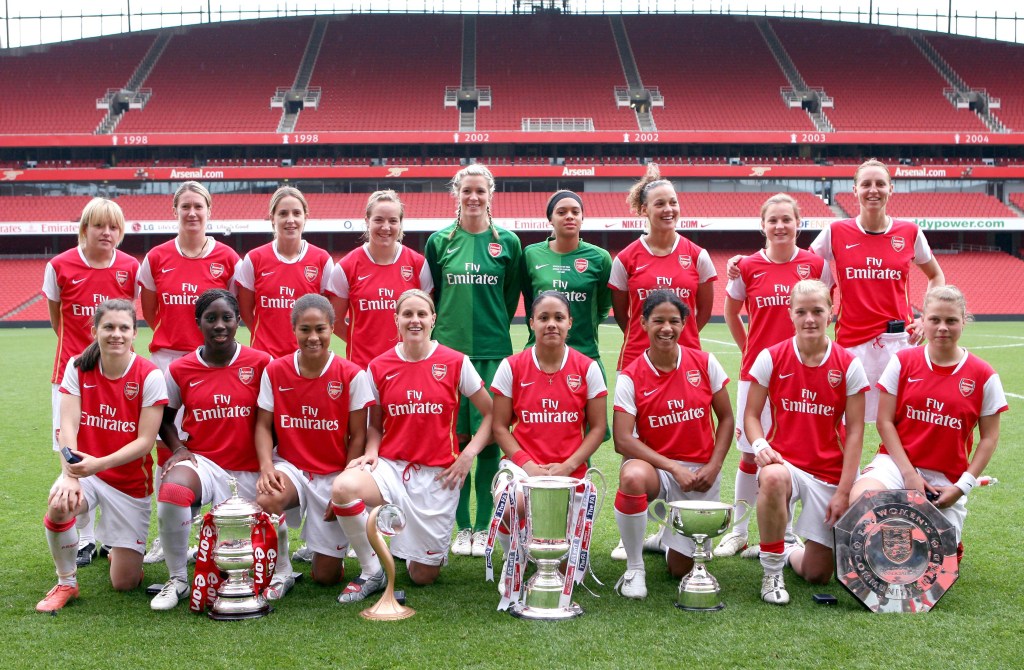
If you need proof of Vic Akers’ prowess when it came to scouting, that Arsenal squad included Faye White, Anita Asante, Mary Phillip, Gilly Flaherty, Katie Chapman, Lianne Sanders, Rachel Yankey, Julie Fleeting, and Karen Carney, as well as Kelly Smith and Alex Scott. It also included Renée Slegers.
That campaign fell within a period of complete dominance by this Arsenal side, the women’s Invincibles. Between 2004 and 2012, The Gunners won nine league titles in a row. During that period, they lost only five games; between 2003 and 2009, they didn’t lose a single league game: 108 games without defeat. A record that is unlikely to ever be broken. They also recorded 51 league wins in a row during this spell.
Since Akers moved on in 2009, the team have had a range of coaches, but the very fabric of Arsenal Women and Vic Akers’ influence remain strong. With increased competition from other teams the trophy cabinet expansions have slowed, but trophies rarely stop flowing in. During their history, Arsenal Women have also made eight prior Champions League quarter-final appearances and six prior semi-final appearances.
Now, already with 52 major trophies to their name, Renée Slegers will hope to add the biggest to their bulging trophy cabinet once more.
If you missed the first article in our countdown to the UWCL final, you can find it here.
The Champions league final between Arsenal and Barcelona will be played in Lisbon, Portugal on Saturday May 24th at 17:00 UK time. It will be broadcast on TNT Sports in the UK and on DAZN elsewhere.
Follow Impetus on social media –
Twitter (X): @impetusfootball TikTok: @impetusfootball
Instagram: @impetusfootball
 impetusfootball.org