
By Catherine MacKenzie and Alyce Collett (26/05/2025)
Above: Leah Williamson battles for Arsenal against Barcelona. Photo: Arsenal website.
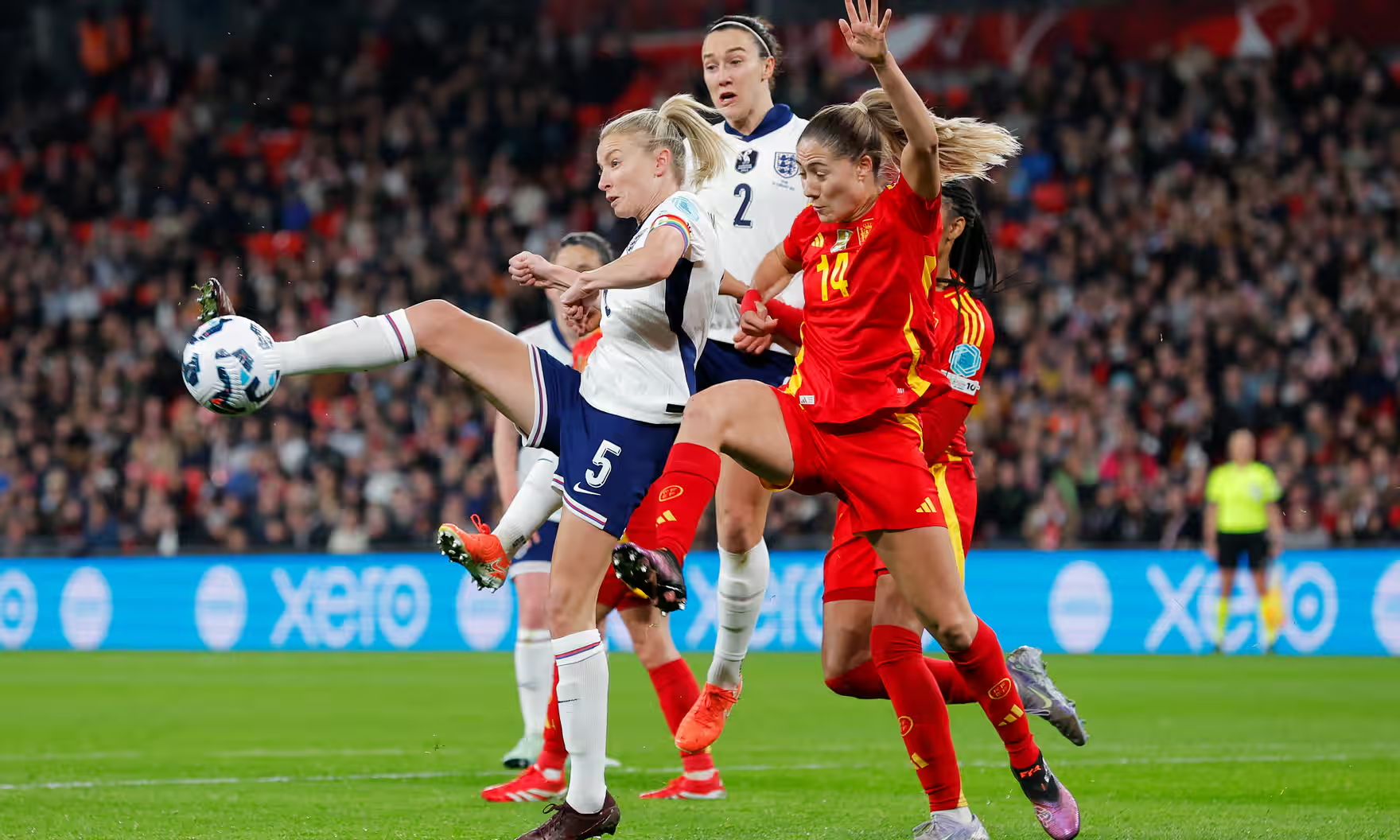
England and Spain, two favourites for this year’s European Championships, have a chequered recent history. The two nations faced off in Australia’s World Cup final in 2023, resulting in a narrow win for Spain. The previous year, England had come from behind to claim a 2-1 win in the quarter-final of the 2022 Euros, and earlier this year, the Lionesses claimed a similarly narrow victory over the World Champions, beating them 1-0 in the nations league.
The closeness of the games between nations has been echoed in matches between clubs – Barcelona’s squad includes a huge raft of Spanish national team players, including first-choice Spain goalkeeper Cata Coll; Batlle, Paredes, and Leon in defense; Bonmati, Putellas, and Guijarro forming the basis of both midfields; and Pina and Paraluello in the forward line.
Spain and Barcelona also play a very similar style of football: heavily possession-based and technical, focusing on skill and athleticism.
Although Lyon have been the dominant force in the Champions League, Barcelona have won three titles, with only one English club – Arsenal – winning the tournament throughout its history. The Spanish giants have swept aside Chelsea, who are the eight-time English champions, repeatedly in Europe.
Combined with Spain’s victories at the World Cup and in the 2024 Nations League, Barcelona’s UWCL success has prompted a narrative that Spain are the most unbeatable force in women’s football.
However, Arsenal’s win in this year’s UWCL final and England’s win earlier in the year pose an interesting question: are we learning how to play Barcelona, and to what extent do club and national football learn from each other?
Maintaining composure in transitions
The battle between Arsenal and Barcelona was, in many ways, reminiscent of England’s game against Spain a few months earlier. In both cases, the underdogs – undeniably England and Arsenal – toed a careful line balancing sitting back and defending with their entire eleven and running at their Spanish opposition to rattle them.
Spain and Barcelona have both been masters of catching teams out on the transition, using their athleticism and physicality to hold on to the ball. Where England and Arsenal succeeded was by letting the Spanish teams do this and accepting that they would not have much time on the ball. In the final, Arsenal got their win with only 32% possession – England had 41%.
Although the recent trend is for fans to want their teams to play ‘attractive’ football – high possession, technical – the reality is that this is not always the best way to win the game. Arsenal and England both succeeded by admitting that their opponents would play more attractive football than them and letting them create chances while trusting their own defensive line.
Leah Williamson and the art of technical defending
A defensive performance is often seen as ‘playing for the draw’, unattractive and boring. However, when done well, it can be entertaining to watch – if viewers are not expecting a high-scoring game. There is a technical side to defending, and an intelligence: things like understanding positioning, anticipation, and controlling the ball under immense pressure. These are all facets of defending Arsenal and England displayed during their wins.
Barcelona had 20 shots in the UWCL final, five of which were on target. When they played against England, Spain also had 20 shots overall and five on target. There were few yellow cards in both games (one for each side in the England game, and one for Arsenal in the final), because the defenders focused on technicality rather than physicality.
A stellar example of this is the performance of Leah Williamson in the UWCL final.
Williamson played the UWCL final as the right-sided centre back, with her usual partner Steph Catley playing on her left. One of the big strengths of Williamson’s game is her positioning on the pitch, keeping her distance and ensuring the pack does not get overcrowded – whilst also getting herself into effective positions to stop the shot without impeding the goalkeeper.

Against Barcelona, Williamson also exemplified the importance of maintaining a mindset of concentration over 90 minutes. As a player with over 200 appearances for the Gunners and plenty more at international level, Williamson was exactly the type of player whose calming influence and experience is needed in a side like Arsenal – who had exactly one player with previous experience in a Champions League Final – especially against a side playing in their sixth final in a row.
That experience proved its usefulness in the second half, when Barcelona stepped up a gear and really started to attack the Arsenal goal. On a number of occasions Williamson was able to clear the ball out of danger and give herself and the rest of the defenders some breathing space. Although these clearances were not always the most accurate in terms of passing the ball to a teammate, the clearing kicks were powerful enough that it gave her team time to either run onto it and take possession or create the pressure on the Barcelona player who did get the ball.
Arguably the biggest skill on display was her ability to time her tackles perfectly – gaining possession through interceptions and careful tackles that would not run the risk of summoning the referee’s whistle.
What next?
Spain do not have to wait for long to have a chance to get some revenge: they face England in the Nations League next week. Whilst England and clubs like Arsenal have had recent success against Spain in recent months, it remains to be seen if this will last for the third consecutive meeting.
There is something at stake as well: the winner of the game is most likely going to top the Nations League group and progress to the quarterfinals of the competition – whilst the team that loses will have to settle for second place and give up the chance for another trophy.
England v Spain is on Tuesday the 3rd of June at 18:00 BST.
Follow Impetus on social media –
Twitter (X): @impetusfootball TikTok: @impetusfootball
Instagram: @impetusfootball
 impetusfootball.org