

By Catherine MacKenzie (28/05/2025)
Above: FC Twente celebrate lifting their 10th championship. Photo: VrEredivisie on X.
Mention European women’s football leagues and most people think of England’s WSL or Germany’s Frauen-Bundesliga. These are arguably the most competitive; although Chelsea have won the WSL for the last six years, they have been challenged by other clubs, and VfL Wolfsburg, Bayern Munich and Eintracht Frankfurt vie for the top spots in Germany.
Less discussed is the Vrouwen Eredivisie in the Netherlands. The Dutch league is often referred to as a ‘training league’; there is an established informal pathway from ‘lower club’ to ‘top club’ to ‘club abroad’. Nevertheless, the league has created some of the world’s biggest football talents: Vivianne Miedema, Jill Roord, Wieke Kaptein, Daphne van Domselaar, Danielle van de Donk, and Victoria Pelova all have roots in the Dutch league.
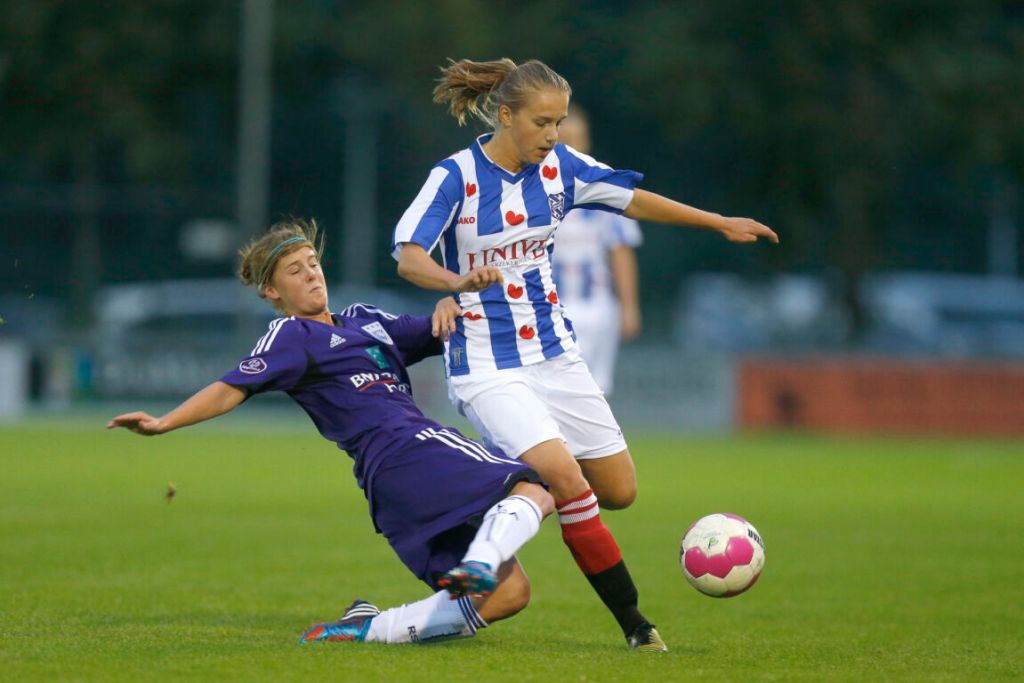
The league itself has had a tumultuous journey since its origins in 2007. For a couple of years, the Netherlands joined forces with Belgium for the ‘BeNe league’ (2012-2015), and since then, the format has shifted from a NWSL-style round robin followed by championship round, to league-phase only like the WSL.
Founding members of the Eredivisie include: ADO Den Haag (then led by current England head coach Sarina Wiegman), AZ, SC Heerenveen, FC Twente, FC Utrecht, and Willem II. From the outset, the clubs have poured vastly different levels of resources into their women’s teams; FC Twente have become a powerhouse in the league, winning 10 titles – Ajax and AZ have won three each, and ADO one (2011-12, under Wiegman).
Numerous clubs in the Vrouwen Eredivisie struggle financially, largely due to restricted income from ticket sales, sponsorship deals, varying support from the clubs themselves, and broadcast rights. Even though the matches are broadcast live on ESPN, significant overhead costs mean little revenue for clubs. Moreover, despite the Netherlands’ winning the 2017 European Championship, average match attendance remains below 1,000, with many clubs seeing regular attendances of less than 500 – and the lowest in the 2024-25 season was only 50.
Despite low attendances, some clubs have continued to invest in their women’s teams more significantly. Clubs with more successful men’s sides – such as FC Twente and Ajax – are able to bring in the top talent from around the country and are provided with more resources on a sporting level (such as nutritionists to work with players).
Following a club in the Vrouwen Eredivisie
ADO Den Haag, based in The Hague, is not one of these clubs. Their men’s team play in the second tier of Dutch football and have had recurring issues around hooliganism and disorder – even burning down part of their own stadium in 1982. Winning the league at the end of the Second World War, the club have had less success in the decades since. New owners have consistently promised to make the club a powerhouse in Dutch football, however thus far, there has been limited success.
The women’s side was founded in 2007, as soon as there was a professional league for women – the Vrouwen Eredivisie. Sarina Wiegman left her role coaching the ‘amateur’ (although non-professional, the club have had extensive success) Ter Leede and joined ADO – although she was only asked to do this on a semi-professional basis at first:
“If you want me to take the job, I want to do it full-time. That’s the only way.”
The club were bouncing between the Eredivisie and the Eerste Divisie (first division, tier two of Dutch football) at the time – they would not have the same level of resources as clubs who had been consistently playing in the top tier, such as FC Twente and Ajax.
Twenty years later, the Dutch National Team (the OranjeLeeuwinnen, or “orange Lionesses”) have a major trophy under their belt. Following their unexpected 2017 Euros win, the canals of Utrecht turned orange with celebrations, and it looked like the entire population of the Netherlands was celebrating.

In hindsight, it is tempting to assume the win would be transformative. However, this hindsight is tinged with the knowledge of what happened in England five years later. When the English Lionesses won their Euros, the transformation was unparalleled:
The WSL’s average attendance nearly tripled, rising from 1,923 in the 2021-22 season to 5,616 in 2022-23, a 200% increase. Whilst decreasing slightly, the increase is still there, with clubs like Arsenal regularly seeing crowds of over 30,000 when they play at the Emirates stadium. The FA reported a 150% increase in football participation for girls under the age of sixteen, following the tournament.
For the Netherlands, the impact from the 2017 win was there but nowhere near as big. Following the victory, the Royal Dutch Football Association (KNVB) reported a 6.8% increase in female football memberships during August and September 2017 compared to the previous year. There was a small boost again when the Leeuwinnen reached the quarter-finals of the 2022 euros, as clubs like Fortuna Sittard established professional women’s teams. However, this boost did not last – and Sittard, who only opened their doors to the women’s team in 2022, closed them again this year.
Fortuna Sittard’s primary sponsor, Principion, committed to funding the club for three years; the club hierarchy hoped the funds would provide a solid base for them to build on, attracting new investors for the long-term. However, new investors were difficult to find and consequently, the club reduced its budget, leading to the departure of key players like league top scorer Tessa Wullaert; these players either moved to clubs in the top half of the Eredivisie or to clubs abroad.
Club ownerships play a vital role in how they approach their women’s teams (and whether they have them at all). ADO have had a range of majority shareholders in recent years, and it is likely the support has ranged significantly. Whilst the men’s side seem to continously come close to promotion but ultimately fall short, the women are at the top of the pyramid.
This disparity will always cause friction: do the club (and new shareholders) focus on making their men’s side more successful – by pumping resources into ensuring they are promoted – or do they spend resource on feeding their women’s team, who are already in the top flight? There is a sense that a promoted men’s side would provide more sustainable funds to aid the women, but promotion struggles have hit the club continuously – this year, their final playoff game was abandoned after fans threw toilet paper and fireworks onto the pitch.
What sets ADO apart is a known sense of community and pride (as one fan described it to me, the women’s side in particular is “a big family”), and passionate support. There is a loyal and dedicated fanbase who have largely extended their support to the club’s women – traveling the country with huge flags of green and yellow dedicated to the team representing their club.
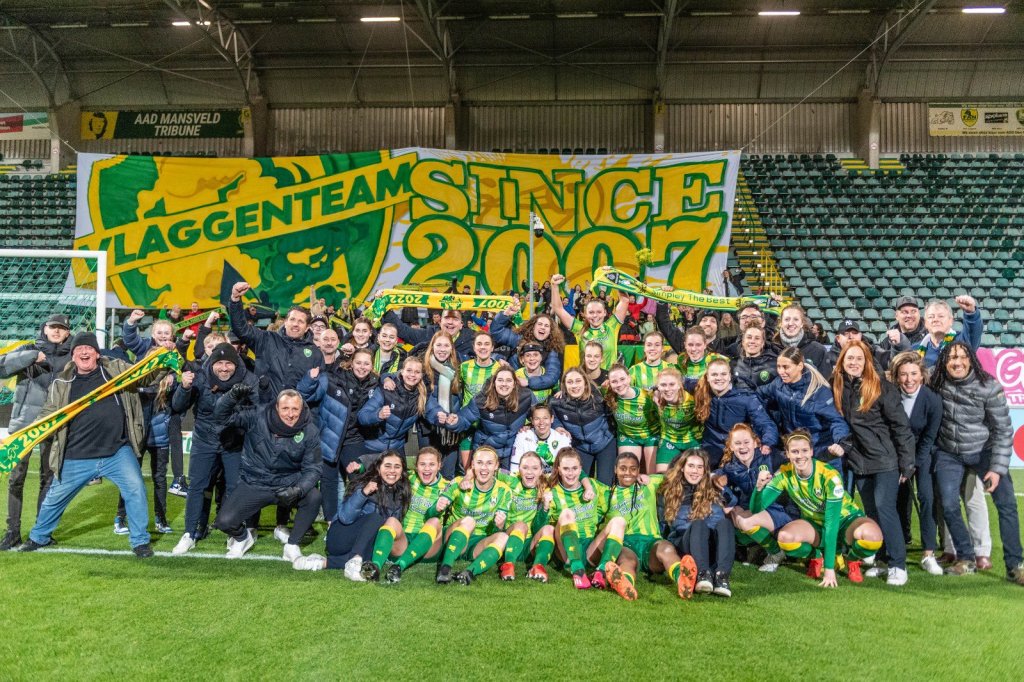
Like many in the Dutch league, ADO players often seem to aim for playing abroad, normally via a ‘top six’ club like Ajax or FC Twente – the club has had arrangements in the past to send its most promising young talent to such clubs. However, this is a difficult path to tread; the players have to commit to their development in professional football whilst also either studying or working second jobs to supplement their income.
For example, veteran goalkeeper Barbara Lorsheyd (who has been capped for the OranjeLeeuwinnen) has also worked as a swimming teacher. Chosen in the preliminary squad for the delayed 2021 Olympic Games in Tokyo, special dispensation had to be given to Lorsheyd by the KNVB – as she was not a full-time professional footballer, and could not afford to commit fully to preparations without financial help.
A number of players in the league retire early, choosing the financial stability of a career outside of football. Whilst male footballers in the Netherlands earn an average of just over 417,000 Euros a year, the average salary in the Vrouwen Eredivisie is thought to be more of an ‘expense allowance‘ rather than a living wage.
Current ADO head coach Marten Glotzbach said recently: “Unfortunately, the situation is still that we can’t even pay all the selection players the minimum wage, while I would like to grant them that.”
This year, there have been several early retirements, both from ADO and other Eredivisie clubs: former Twente and Feyenoord midfielder Cheyenne van den Goorbergh recently retired at the age of 27 after joining ADO last summer, and some have retired even younger – NAC Breda captain Fleur Mol retired at 22, and ADO midfielder Lauren Glotzbach at only 21. Mol recently commented:
“If I’m honest, you don’t earn a lot of money as a football player. That’s why we all have a job on the side. I’ve reached an age where I had to make that choice.”
Mol’s coach at NAC, Richard Mank, has called for action: “If you are 22 and you have to stop playing football, then we are doing something wrong in the Netherlands.” He continued, “But girls have to stop eventually, because they can no longer afford it financially. I find that deeply sad.”

Earlier this year, ADO lost another player as their league top-scorer Lobke Loonen transferred to FC Utrecht in the January transfer window. The transfer saw ADO’s women profit from a player sale for the very first time. The move caused a short-term decline in the team’s performances – with no natural striker left in the senior team, then 17-year-old Floortje Bol was promoted from the reserves. Despite an impressive run including goals in three league games (and one cup game) alongside assists in two, having that responsibility at such a young age is never going to be healthy long-term.
The results dipped for a while and it looked like the club would be relegated from the top flight for the first time in its history, finding themselves one from bottom three points ahead of the team in twelfth. However, the team did recover and start scoring goals as young OranjeLeeuwinnen Iris Remmers and Louise van Oosten returned from injury. This resurgence occurred under the guidance of new head coach Marten Glotzbach – from facing relegation in March, the team ended up in seventh place, only one below where they finished last season.
Glotzbach has been a different presence on the touchline to most Eredivisie coaches – loud and extremely vocal, he also has the typical Dutch directness. In a recent interview, he was asked about the difficult season his team has endured, commenting that “we had a period with a very small selection – then players were forced to make their debut, which you would not have made in other circumstances.”
It is easy to assume that the funds generated by the sale of Loonen to Utrecht would be used to increase standards for the women’s team – increasing salaries, additional resources, or bringing in reinforcements. However, Glotzbach has asserted that this is not the case; the funds from Loonen’s transfer would not be used by his team..
The transfer only went through late in the January window, when there was no time to consider reinforcements. The problem has only been exemplified this summer, however, as three more of the team’s most experienced players decided not to renew their contracts. Mid-season, the club relied on its youth setup – once viewed as one of the best in the country – however the gap from the youth setup to the Eredivisie is big.
The youth groups will not be easy to rely on in the future; the club has recently decided to disband one of its youth teams – the under 16 group where many of their current players started. If the funds from transfers will not make their way to the women’s team and the youth setup is limited, it is difficult to see where new players will come from.
Actions like this mean clubs like ADO will find it increasingly difficult to compete in a world that is growing, especially when some clubs are prepared to invest. When FC Twente can bring experienced international Jill Roord back into the fold and Ajax are playing lucrative tournaments like the World Sevens, some clubs are in increasing danger of being left behind.

This is already being felt in the league, with pundits often commenting on the difference between the ‘top six’ and ‘bottom six’ – the division between the two clear to see, and the gap difficult to breach. ADO have often been perceived as “the best of the rest” – but that is in danger of disintegrating.
As the women’s game grows, there should be an increased focus on making sure the clubs that have women’s teams are willing to invest in them. If they do not, there is a danger we will see more clubs like Fortuna Sittard, and ADO – who despite a dedicated fanbase, cannot escape that bottom six. To bridge that gap, these clubs need to disrupt the pathway to playing abroad and stop selling their best players, especially if the funds from those sales are not being reinvested.
There is also an opportunity now – with the Euros this summer, and the OranjeLeeuwinnen considered strong contenders. The focus should be on ensuring any resulting boost is sustainable – and that clubs benefitting from increased attendance revenue next season do so with the intention of reinvestment in infrastructure for their teams.
Follow Impetus on social media –
Twitter (X): @impetusfootball TikTok: @impetusfootball
Instagram: @impetusfootball
 impetusfootball.org