
By Clare McEwen (28/06/2025)
Above: Sweden’s win in 1984. Photo: UEFA website.
Euro 2025 is nearly here, but do you know the history?
UEFA organised their first Women’s Euros in 1984 (the men’s began in 1960). Before that, other tournaments paved the way. Let’s start in 1957.
Women’s football was growing as European countries began playing more international friendlies. In 1956, 18,000 people came out to watch Germany’s first international against the Netherlands – despite the women’s game still being officially banned throughout much of Europe, including both Germany and the Netherlands, England and France.
Players fought the ban with increasing strength. In the summer of 1957, Germany, Austria, Netherlands, and England formed the International Ladies Football Association in Nuremberg, Germany. They quickly organised their own European tournament with the four founding members.
Berlin hosted the event at the Poststadion, a prestigious venue. Naturally there was plenty of opposition, but also some good support. Often at that time, “national” teams were represented by club sides. England, for example, were represented by the Manchester Corinthians. The Corinthians were at the end of a tour of Germany, which they ended by winning the 1957 trophy. Unfortunately, some financial irregularities spoiled the event and it was over a decade before a similar tournament was organised.
For a period in the late 1960s/early 1970s, women’s football was organised by some Italian businessmen — who had spotted the potential of the sport. In 1969, the newly formed Federazione Italiana Calcio Femminile (FICF) organsied another European competition. The Coppa Europa per Nazioni — now considered a precursor to the UEFA Euros — included Italy, France, Denmark, and England. It was sponsored by the drinks giant Martini & Rossi who bankrolled the event. FIFA tried to stop it going ahead but were unsuccessful.
Although the ban in England was being lifted, England didn’t yet have an official FA team. So, the legendary Harry Batt took a team to represent his country. England were drawn against Denmark (represented by club side Femina BK). Despite a hat trick from Sue Lopez, Denmark won and progressed to the final. Italy beat France but Denmark took the title. England took third, beating France in front of 10,000 spectators. The event was a huge success on and off the pitch.
The Italians organised two World Cup events too (one being the Mexico 1971 World Cup), but in 1971 UEFA couldn’t ignore the growth of women’s football any longer. They decided to take control, making it “official”. They set up a committee for women’s football and then stalled the development of a Women’s Euros tournament for over a decade.
In 1984, UEFA finally caved to pressure and put its name to the Women’s Euros for the first time. Sixteen teams played in the qualifiers with only four making it to the tournament proper: Sweden, Italy, Denmark, and England. Games were 70-minutes long, used a size four ball, and consisted of home and away legs for both semi-finals and the final. England drew the favourites, Denmark, but beat them to reach the final against Sweden.
The first leg in Sweden was covered by the media and brought in a decent crowd. Sweden edged it 1-0. The return leg in England was played at Kenilworth Road, Luton on a pitch described by their captain, Carol Thomas, as “the battle of Kenilworth bog”. The only media at the match was a very small TV company that disappeared soon after. England squeaked a 1-0 win, making it 1-1 on aggregate. Because the pitch was so bad, the tie went straight to penalties. Sweden edged it 4-3, with current Switzerland head coach Pia Sundhage scoring the winner.
The format remained the same for the 1987 Euros where the four qualifiers were Norway, Sweden, Italy, and England. Norway won their first trophy, beating Sweden in the final; Italy beat England to third place. In a strange contrast, over 8000 people watched the final but only 500 watched the third-place play-off.
At this point, the Women’s Euros was the only major event so enjoyed a two-year cycle. The next edition was 1989 but still only included four teams. However, there was a host country for the first time: West Germany. Norway, Sweden, and Italy joined them and it soon became clear they didn’t need home advantage. West Germany won the first of Germany’s eight Women’s Euros titles by beating the holders, Norway, 4-1 in front of 22,000 people.
The four-team tournament continued into the 1990s. Denmark hosted in 1991 and once again, Germany beat Norway in the final, winning their second title. But the Germans didn’t fare so well in 1993 when they came fourth behind winners Norway (their second title), Italy, and Denmark.
It had been eight years since England last qualified for the Euros but they were back in 1995 joined by Germany, Norway, and Sweden. The qualifying rounds before the main event had expanded to 29 teams, meaning there were now eight qualifying groups; but still only four countries competed for the trophy. England drew Germany in the semi-finals and were soundly beaten over two legs. Germany and Sweden contested the final (played in Germany) and Germany lifted their third trophy in front of 8,500 people.
In 1997, the Women’s Euros format changed to resemble what we recognise now. Norway and Sweden hosted the tournament over two weeks in the summer. The competition expanded to eight final teams in two groups of four. Sweden, Spain (their first appearance), Italy and Germany reached the knockout stages. And yes, Germany won number four, beating Italy in the final.
The next advancement was settling into a four-yearly schedule (the FIFA Women’s World Cup began in 1991 making scheduling harder). In 2001, eight teams competed in the main tournament in Germany. Unsurprisingly, Germany won again, making it their fifth. England only managed a point from a draw with Russia.
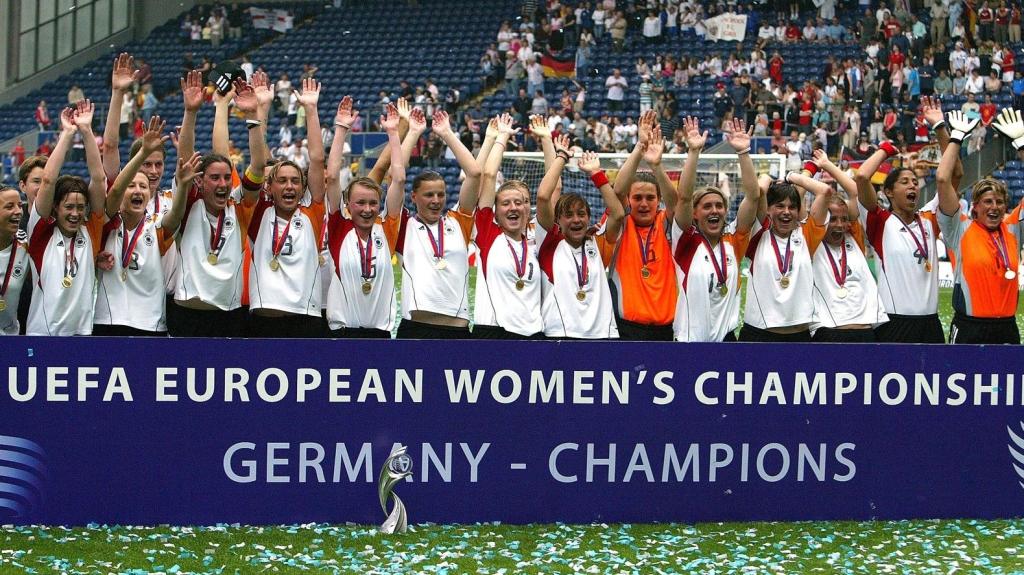
In 2005, England hosted the Euros and had high hopes for the tournament. It was the first time they’d hosted a major women’s competition and was part of The FA’s strategy to (finally) grow the game. It attracted record crowds. Despite a heart-stopping win against Finland in their opener, England finished bottom of their group. Finland, along with Germany, Sweden, and Norway progressed. The final was again Germany versus Norway; and again Germany finished as champions (their fourth in a row, sixth in total).
Disappointment at home for the Lionesses turned into progress in 2009. Hosted by Finland, the event saw 12 teams take part for the first time. Finland, Netherlands, Germany, France, Norway, Sweden, Italy, and England progressed to the quarter-finals. Germany and Norway continued their rivalry, this time meeting in the semi-final. England needed an extra time winner from Jill Scott to overcome Netherlands in their semi-final, lining up a tasty final against Germany. Disappointingly, England couldn’t keep up with the perennial winners and lost 6-2.
Sweden hosted in 2013, and the familiar pattern continued with Germany beating Norway in the final; their eighth title. However, this is where Germany’s run came to an end. In 2017, Netherlands hosted their first Euros. Sixteen teams took part for the first time. Netherlands, Denmark, Germany, Sweden, Austria, France, England and Spain reached the knockout stages with some familiar names beginning to appear on teamsheets.
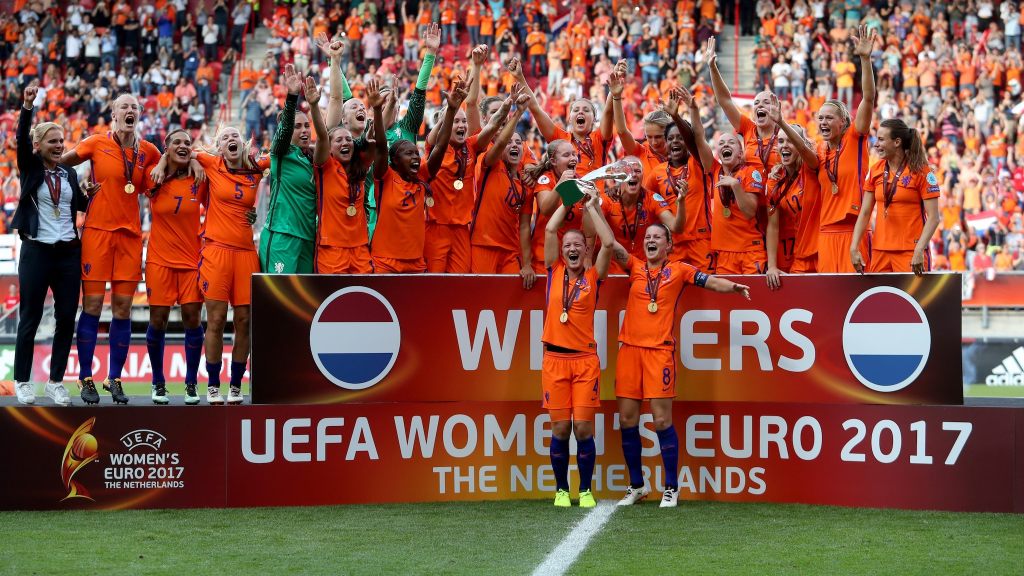
In the semi-finals, Netherlands played England and Denmark played Austria. You read that right: Germany had been knocked in the quarters (by Denmark). Things were changing in European football. A Sarina Wiegman-led Netherlands made short work of England in a 3-0 win. Meanwhile Denmark needed penalties to beat newcomers Austria. Finishing the fairytale, Netherlands beat Denmark to win their first Euros trophy at their home event. The English Lionesses’ Jodie Taylor was top-scorer (one ahead of Vivianne Miedema).
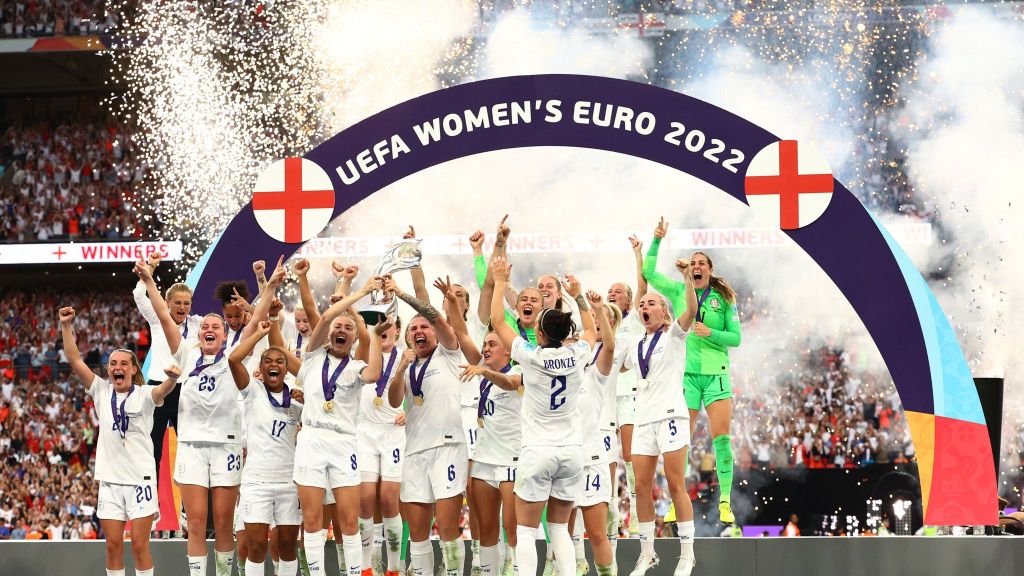
And the rest, as they say, is history. Wiegman moved to England, repeated the whole thing in 2022 and will now be hoping she can continue her unbeaten Euros streak this summer.
Follow Impetus on social media –
Twitter (X): @impetusfootball TikTok: @impetusfootball
Instagram: @impetusfootball
 impetusfootball.org