

by Ben Gilby and Kieran Yap (7/7/25)
Above: Perth SC’s Ella Lincoln (pink shirt) battles away in the NPLW WA game with Perth RedStar, which was watched by Kieran Yap. Perth SC were wearing pink in the match to support Breast Cancer Care WA. Photo: Rob Lizzi.
Impetus’ Ben Gilby and Kieran Yap have covered the NPLW for a number of years now. Whilst Ben brings weekly in-depth coverage from the Western Australian competition, Kieran does the same for the league in Victoria. One of the age-old questions is – how do different state NPLW competitions compare?
In order to have a go at answering this question, the pair swapped leagues for one weekend each. On 21st June, Ben Gilby watched Heidelberg United against Bentleigh Greens and Bulleen Lions take on Spring Hills in the NPLW Victoria, whilst on 28th June, Kieran Yap viewed Perth SC v Perth RedStar in the NPLW WA.
Whilst it’s virtually impossible to arrive at any concrete ideas from just viewing such a tiny number of games, there were some themes that were immediately apparent.
Before we look at Ben and Kieran’s observations in more detail, there are some important caveats to consider. Whilst this is the 10th season of Victoria’s NPLW, 2025 sees only the sixth year of the competition in Western Australia. The relative population sizes – Melbourne at 5,200,000 and Perth at 2,300,000 are a factor as well.
Victoria boasts three A-League Women clubs, and just across the state borders, a further three more in Canberra United, Sydney FC, and Western Sydney Wanderers. Western Australia has just one A-League Women club and huge travelling distances to the nation’s other states.
Victoria’s NPLW currently has 12 clubs with annual promotion and relegation. Western Australia has eight clubs, and in its six seasons, only one club has departed from the league – Curtin University, who were replaced in 2024 by UWA-Nedlands. Whilst the Victoria league has seen four different champions in its nine seasons prior to this one, Western Australia has seen two champions in its five years.
NPLW Victoria
by Ben Gilby

For my first ever look at the competition, I viewed two games on matchweek 13: Heidelberg United against Bentleigh Greens, and Bulleen Lions v Spring Hills.
Going into this round of action, Heidelberg, the league’s defending champions, were six points clear at the top of the ladder from South Melbourne and Alamein, having won nine games and suffered just one defeat (5-1 to South Melbourne). Bentleigh were third bottom with two wins and eight losses.
In my years covering the NPLW WA, games between two teams with such different league records can be one-sided. There is still a gap between the top four or five sides in the league and the rest. However, this game was anything but one-sided from the very start.
This was a battle between two sides who had excellent technical skill – the passing was at speed, with consistent accuracy and rapid movement in short passing movements between midfield and the flanks. Players had very little free time on the ball – control had to be instant, and rapid footwork was a necessity in order to turn markers and make the quick pass to advance play. It was evident that both sides had these abilities despite their very different positions on the ladder.

It was a similar situation in the other game, where Bulleen came into the match fourth with six wins from 12 games, and Spring Hills were fourth bottom with three wins and five losses.
Spring Hills were able to cause problems all game long to their higher-placed opponents. Indeed, they would take the lead thanks to Emily Tanaka midway through the first half.
Nia Salleh levelled matters for the hosts with a snap volley at the near post before Dani Butrus hit a powerful low shot with 23 minutes remaining to put Bulleen ahead. Young star Ava Breidis hit a long-range rocket seven minutes from the end to seal the home side’s win.
In this encounter, the pace on show from both teams was standout, both in terms of athleticism and crisp use of the ball. There were regular searing breaks through the tightest of gaps between defenders, and the speed applied to the pass in order to ensure it was too quick for the opposition to cut out. Across both matches, the game was much less transitional than it tends to be in the NPLW WA, with the ball being held onto by the attacking team for significantly longer before moves broke down.
A key reason for this is the observation that, as often as possible, the player in possession always had more than one option for the pass, generally an on-the-floor pass in order to maintain possession, with teammates in close proximity both inside and out on the flanks.
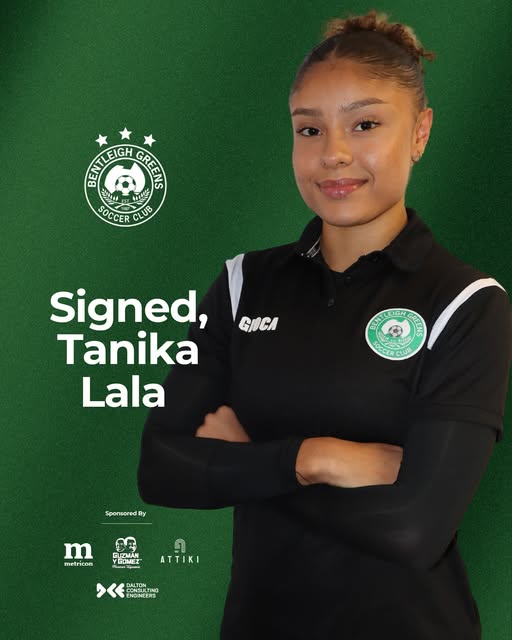
The above is not meant as a slight on the competition in Western Australia – it just underlines the historic issue that the state’s NPLW has had to face. A number of its best players leave WA to play their football on the east coast. Indeed, two of our best young talents – Bella Wallhead and Tanika Lala were playing in the game between Heidelberg United and Bentleigh Greens on opposite sides. If you can’t find a way to keep young players long-term in your own competition, then it’s very difficult to consistently grow it.
Additionally, unlike some of the NPLW leagues elsewhere in Australia, no A-League Women players go interstate to play in the Western Australian comp. WA does not benefit in the way that Victoria does. So, not only does the NPLW Victoria have more pro clubs to attract players from, but it can also bring them in from other parts of the country.
Linked intrinsically with the above point is the sheer number of A-League Women players taking part in the two games. In the clash between Heidelberg and Bentleigh, Wallhead and Lala were joined by their Perth Glory teammate Sarah O’Donoghue on the pitch at Olympic Park. All together, there were at least seven players on the teamsheets who either played A-League Women in 2024/25 or had done so in recent seasons.
The other game at the David Barro Stadium, where Bulleen Lions hosted Spring Hills, involved a similar number of prominent A-League Women players, including two of the brightest young stars in Paige Zois and Ava Briedis.

Zois, who is still in the early days returning from long-term injury, was simply outstanding in this game. This wasn’t just the performance of a good A-League Women player; this is someone who has it in her locker to be a big-name Matilda. Vision, runs, set-piece accuracy, it was a joy to see her directing traffic for Bulleen.
Western Australia isn’t able to match that. Whilst some clubs can highlight current or former A-League Women players – the most prominent of which are Ella Lincoln, Georgia Cassidy, Tijan McKenna, Izzy Foletta, Jess Skinner, Sarah Carroll, Caitlin Doeglas, Gabby Dal Busco, and Marianna Tabain, that is a comparatively small number compared to the total number across the NPLW in Victoria. So it is no wonder that the overall standard is more technical and intricate in the eastern states.
The argument has always been from those tempting Western Australia’s best young talent to the East Coast that they will become better players by taking part in a higher standard league. But, conversely, how can WA’s female players ever get a consistently higher quality NPLW when so many of its stars go east? It’s frustrating beyond words.
It was fantastic to see the duo of Wallhead and Lala mix it in the game between Heidelberg and Bentleigh. Wallhead, in particular, was superb in her link-up play with the outstanding Cam Barriero and Sawa Matsuda. The Western Australian played no-look passes at a rapid pace, she knew the channels to find her teammates, and had quick thinking in changing the point of attack as well as covering her defensive duties.
The goals in that game encapsulated all I described above in terms of quality. Heidelberg had to soak up a lot of pressure in the opening stages, but they hit back on the counter with an exquisite move after seven minutes. A ball from the left was dispatched into the net first time with some aplomb by Sawa Matsuda.
Six minutes before the break, the hosts doubled their lead when Asuka Miyata turned her marker instantly and curled the ball home. With 20 minutes remaining, Bentleigh got back in the game when Lala turned her defender and calmly slotted the ball in. Three minutes from time, Heidelberg made sure of the three points when Matsuda squared a pass for O’Donoghue to sweep in for 3-1 at the final whistle.
Conclusions – A sense of what might be
I’m passionate about the NPLW WA. The six months or so each year I cover it are the highlight of my football writing year. The characters, the stories, and the gradual growth of the competition are a joy to follow. Yet viewing the two games from the NPLW Victoria this weekend left me with a real sense of frustration. A sense of what might be in Western Australia.
We have great coaches and superb clubs who do outstanding work in supporting young girls and women develop as footballers. Yet we need more of them to stay in our league to enable it to gradually reach the level that I saw in those two games in Victoria’s comp during one weekend.
Can we achieve it? How can we achieve it? Without significant funding and a change of mindset from agents, as well as a tightly joined-up set of thinking between Perth Glory and the NPLW clubs to work in partnership to grow the women’s game in WA by encouraging our best players to stay in the state and not go east, it’s hard to see things changing. We need to throw a u-ey on decades of thinking.
NPLW WA
by Kieran Yap

My main knowledge of the NPLW WA comes from the players who have left it. The legends of the state that became icons of the game, such as Lisa De Vanna and Ella Mastrantonio. Or the ones who stayed and represented their home state while wearing the national team colours, like Kim Carroll. So it was interesting to watch a full league match for the first time between Perth Soccer Club and Perth RedStar.
I was familiar with players from either side, although because my coverage of Victoria’s NPLW I was probably most happy to see Tijan McKenna play again and after watching Georgia Cassidy make an impact for The Young Matildas at the last Asian Cup, I was keen to see how she played outside of Perth Glory and the Australian team.
A glance at both lineups also told me what the table confirmed. These were two of the state’s top teams. It feels common across all NPLW leagues that there are a handful of powerhouses with other teams trying to either catch them or fight for whatever is left, and with WA having a slightly smaller league, it felt particularly pronounced here.
Often, when two strong sides meet, it can be a defensive arm wrestle. Not this game– within 10 seconds, the first meaningful attack had occurred and RedStar had hit the woodwork. A few minutes later, they had the lead. Sarah Carroll hit a perfect half volley from a half-cleared corner, and it was 1-0 to Perth RedStar.
As a first-time viewer, these opening moments felt like I was seeing where the power lay in WA. RedStar looked aggressive, confident, and dangerous with the ball. I was not prepared for what happened next.
Perth SC had been surprised by the early blitz, but soon found their way back into the game. Tijan McKenna got a shot away from long range, and Jess Flannery was there to follow up and equalise.
From this point on, Perth SC seemed to take full control of the game. Daisy McAllister scored twice and Flannery added another to make it 4-1 by halftime. It could have been more.
While RedStar was able to use its pace in the early stages, the growing scoreline made it easier for Perth SC to sit deeper, take fewer risks, and use the mobility and passing of Georgia Cassidy to keep things ticking over.
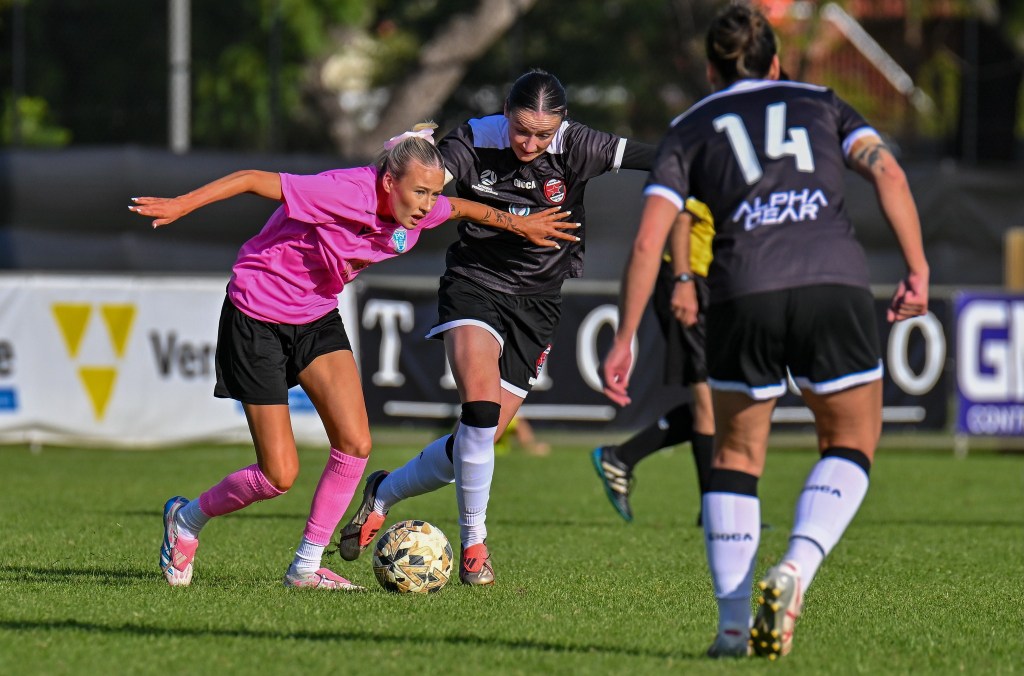
She may not have the highlights reel that Hana Lowry, Leticia McKenna, or Sam Kerr had at the same age, but Cassidy could be one of WA’s brightest prospects. She combines pace and composure in midfield. Cassidy is still a developing talent at the elite level, but this game provided a great insight as to what she looks like in an environment she can dominate rather than learn from.
Keeping hold of the best talent is a challenge for Western Australia’s NPLW. Tanika Lala has recently moved across to Victoria’s league, but the return of Tijan McKenna, her excellent form in the A-League Women, and international call-up have shown that it is still a league that can attract or retain talent.
Cassidy may still need to move states to test her limits as a player. Truth be told, her versatility and ability to cover the entire midfield make her a good candidate for the European League, but right now, it appears WA is the best league for her. Football fans should try and watch her while they can.
The second half saw McKenna leave the pitch after what looked like a knock to the face. RedStar began to work their way back into the game.
A goal from Caitlin Doeglas brought things back to 4-2, and they were then denied a goal from the offside flag, but the momentum had shifted, and the game was opening up.
Sam Mathers’ 68th-minute goal for Perth SC re-established the buffer and effectively ended the game as a contest, but not as a spectacle.
The match ended with Cassidy clearing a RedStar attack off the line with a desperate piece of defending, but the visitors earned a penalty from the scramble. Sarah Carroll stepped up to take it and end the game 5-3.
It spoke of the adrenaline that RedStar approached the entire match with.
Conclusion
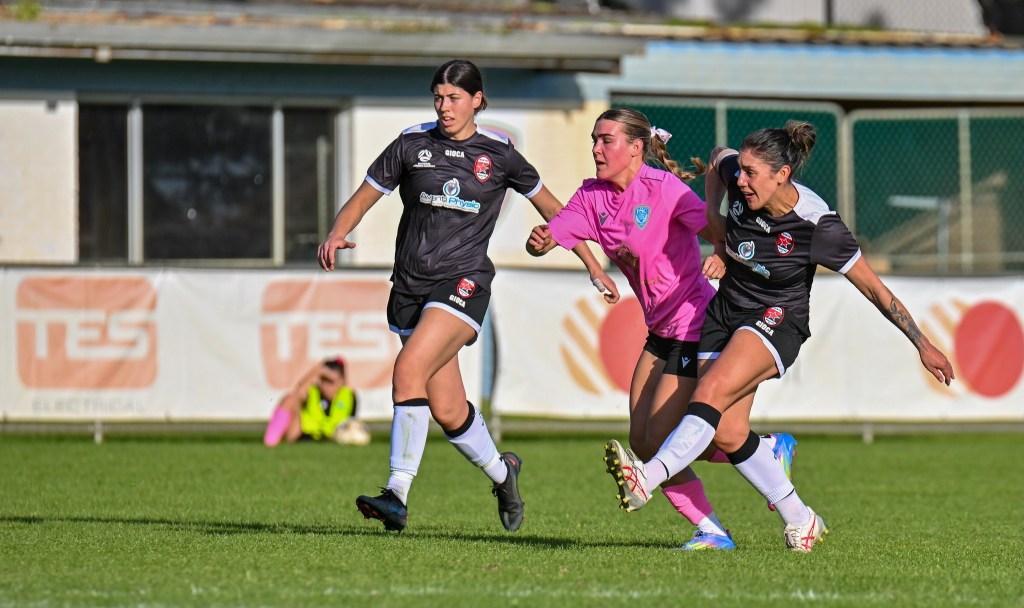
I don’t know if every game is like this, but if it is, sign me up! This was an exciting, relentless game with quality on display from both sides. Defending at this level is often the hardest part, and the scoreline reflected that.
The attacking quality on display was top-class and ruthless. Mistakes were punished, and any lapse in concentration at the back was potentially damaging. Comparisons to Victoria feel hard, especially this season, where anybody can win on any day. It felt obvious that these were two of the top sides in WA, but based on this game and this game alone, they would both concede similar amounts on a weekly basis in the NPLW Vic.
What this game underlined more than anything is that outside of the most famous names in WA Football history, there is a lot of talent, and not just at the younger end. Like everywhere else, investment can help nurture these players into elite footballers. Where WA appears to have the bigger hurdle is that it is a smaller league, has limited room to grow, and that will always affect things like investment. The geographical distance makes it hard to sign A-League players or even top NPLW stars from other states.
The introduction of relegation in the Victorian NPLW and the expansion of the league from 10 to 12 sides have led to increased investment. Clubs are luring A-League Women talent like Rhianna Pollicina or Maja Markovski, even outside of the obvious title contenders. More importantly, even ‘smaller clubs’ like Alamein FC have heavily investment in academies to develop talent and compete with the big dogs.
Whether WA has the capacity to expand, or to grow and attract sponsors and investors, is something that remains to be seen, but for now, the state league is a great way to watch the best locally produced talent. They did not disappoint, and it looks obvious that this league will continue to produce Matildas.
Follow Impetus on social media –
Twitter (X): @impetusfootball TikTok: @impetusfootball
Instagram: @impetusfootball
 impetusfootball.org