
By Catherine MacKenzie (19/07/2025)
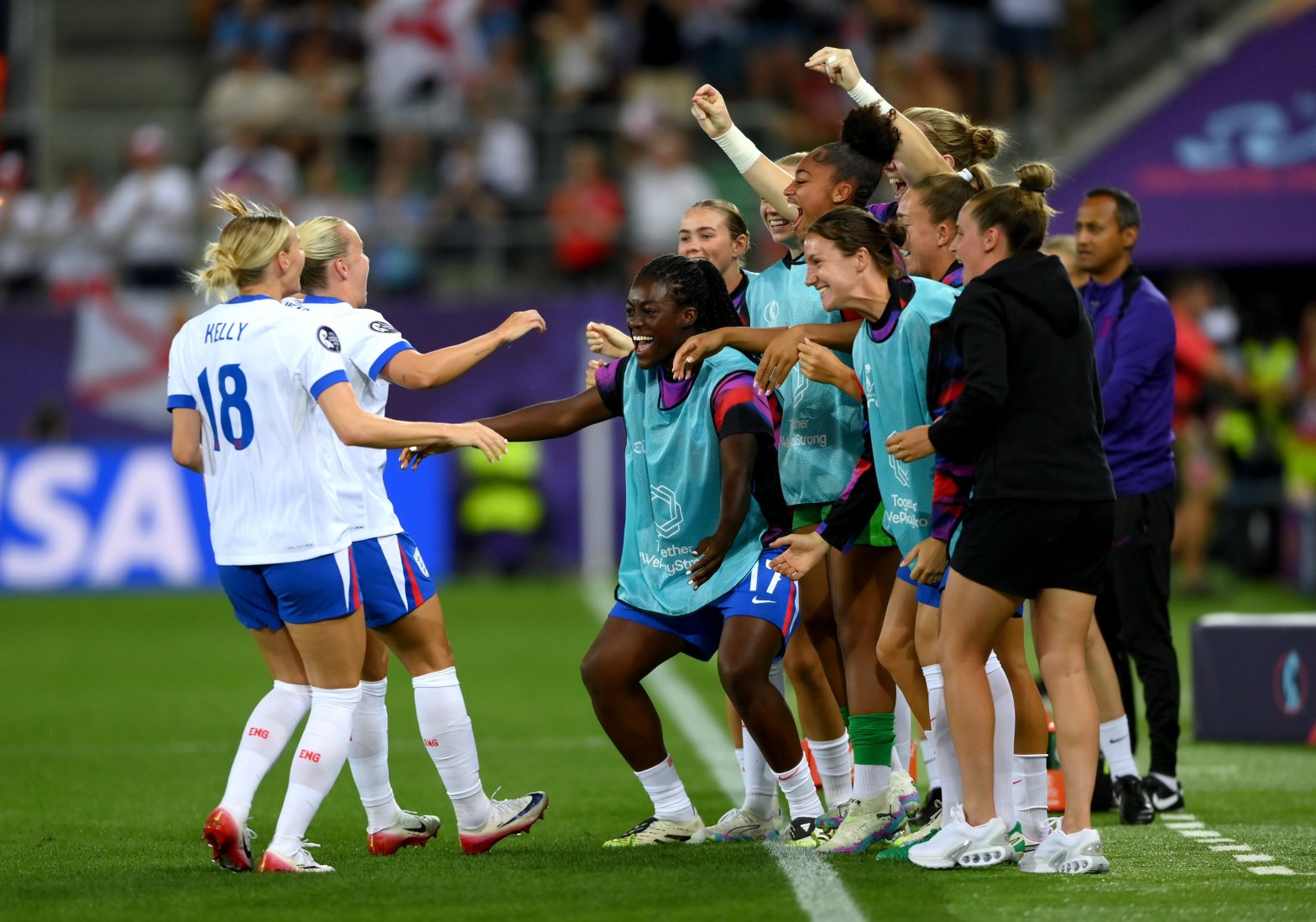
Above: England celebrate a goal as one team. Photo: Lionesses on X.
Sarina Wiegman rarely makes early substitutions, ‘trusting the gameplan’ to eventually succeed. This is a cause of frustration for some fans and pundits, but are there positives to making substitutions late? What does this approach say about the team dynamics?
Following England’s unlikely triumph in the quarter-final of the 2025 Women’s Euros, most fans and pundits were delighted. That the team had gone to the brink of disaster by conceding two goals in the first half – but emerged victorious – was just cause for jubilation on a large scale. Few would have thought a comeback was possible at half-time, when England were struggling and Sweden were piling the pressure on.
A comeback was possible, however. Following the introduction of substitutes Chloe Kelly, Michelle Agyemang, and Beth Mead, the Lionesses’ scored two goals in three minutes to bring themselves level and take the game to extra-time. No more goals came from either team, and England eventually triumphed through either the best or the worst penalty shootout of all time, depending on who you ask.
The substitutes changed the game, just as they did in 2022 – it was Kelly’s perfectly-placed crosses into the box that gave Lucy Bronze and Agyemang the chances to bring the game level.
A key feature of Wiegman’s success at England has been the use of the ‘finisher’ to change the game, and this tournament has been no different. In their first game, that seismic 2-1 loss to France, 19 year old Agyemang emerged from the bench to run at the French defence.
England finally looked like they had some energy, and they did pull one goal back, but there was not enough time to complete the turnaround. Wiegman was criticised extensively for the lateness of her substitutions – Agyemang in particular, who came on with 10 minutes left on the clock – and England became the first reigning champion to lose their opening group stage game.
On Thursday evening, Agyemang made another appearance off the bench – this time 10 minutes earlier. On the 70th minute mark, she and Kelly stepped foot onto the pitch and truly changed the game. Within 10 minutes, England had pulled one back – and a mere few minutes later had the equaliser. It seemed Wiegman had learned from that opening game. However, some pundits and fans were still not satisfied, calling for much earlier substitutions to be made.

It is arguable that they have a point with one player. Jess Carter was struggling at center-back, despite an improvement mid-way through the first half when Wiegman had her switch sides with center-back partner Leah Williamson. The switch allowed Carter more protection whilst pushing Williamson more towards the wing, where she could distribute the ball more easily to where Sweden were leaving space.
Carter improved as the half progressed, however a half-time substitution would not have been surprising. When Esme Morgan eventually did come on, she made a positive impact, bringing an aura of calmness to the calamatious defensive line.
This brings us to the most common criticism levelled at Wiegman: she often leaves substitutions until later on in the game. When she makes earlier substitutions, these actually tend to be players who have had a strong game. For example, withdrawing Ella Toone at half-time in the match against Wales. Toone wanted to continue, and had put in a strong performance – but Wiegman opted to give other players minutes.
When a player has a poor game, for the most part they are trusted to continue following the half-time break. The exception seems to be when the scoreline is not close – for example, against Belgium in April when the Lionesses were already 3-1 down by half-time and Millie Bright and Niamh Charles were replaced during the interval. Largely, there seems to be immense trust in the starting eleven’s ability to do better – and that trust is arguably a fundamental part of the squad togetherness and cohesion.
It seems to be Wiegman’s view that if a player has a poor first-half, they are talked to at half-time; tactical tweaks made; perhaps a pat on the back (or the hairdryer treatment).
They are then given a second chance: 15-20 minutes of the second half to improve. If there is little in the way of improvement or if the opponent has changed something that requires a formation adjustment, the player is then substituted out – knowing their manager trusts them to be better and that they have been given that chance.
If the Lionesses are successful in this Euros – whatever that success means – a large contributing factor will be their cohesion and togetherness. In the face of extensive adversity off-pitch including high-profile withdrawls and retirements, the team seem more together than ever.
Players have said it numerous times – Ella Toone said recently that “If I had to sum up the game in just a few words, I would go for togetherness, hard work, resilience and fun”, Sarina Wiegman post-Wales win echoed that: “I think we built momentum… You could see the togetherness of the team.” The substitutes even have their own celebration – a positive clicking.

Trust is a huge part of that togetherness. Without building trust in each other, a team does not work, and the manager is no exception to that rule.
Tactically, it is also arguable that there is reason to leave substitutions until late. If the point of the finishers is to be game changers that disrupt the flow of the game, giving the opponent ample time to adapt to this change is likely not a good thing.
In Thursday’s quarterfinal, England were level with around fifteen minutes remaining on the clock (including injury time) – just about enough time for Sweden to adapt to the different qualities on the pitch. In extra time, Sweden did grow momentum, because they had been given the time to settle down.
Trusting substitutes to make an immediate impact in a very short amount of time is risky and will not always pay off – but in this case, there was good reason to be confident. After all, Agyemang scored within 41 seconds on her debut, and teams do not know that much about her yet.
In the famous 1999 men’s Champions League final between Manchester United and Bayern Munich, it was substitute Ole Gunnar Solskjaer who disrupted the German giants enough to get the winner, after being introduced with less than 10 minutes left on the clock. In the 2014 men’s World Cup final, Mario Götze was subbed on in the 88th minute – and he was the one to score the winner. Finally, Chloe Kelly did not enter the pitch until gone the 60th minute in the 2022 final against Germany.
There is a long tradition of late substitutions changing the game.
If England are to reach the final or even win the tournament, it is likely that there will still be rumblings about late substitutions among supporters. The narrative has solidified enough to become part and parcel of debates surrounding this England side and it is unlikely that will change.
Frustrations over timing aside, the substitutes are an integral part of the Lionesses’ progress in this competition, just as they were three years ago, and they can take comfort in that trusting environment.
England play Italy on Tuesday 22nd July at 20:00 BST in the first semi-final of the 2025 Women’s European Championship.
Follow Impetus on social media –
Twitter (X): @impetusfootball TikTok: @impetusfootball
Instagram: @impetusfootball
 impetusfootball.org