

By Catherine MacKenzie and Alyce Collett (22/07/2025)
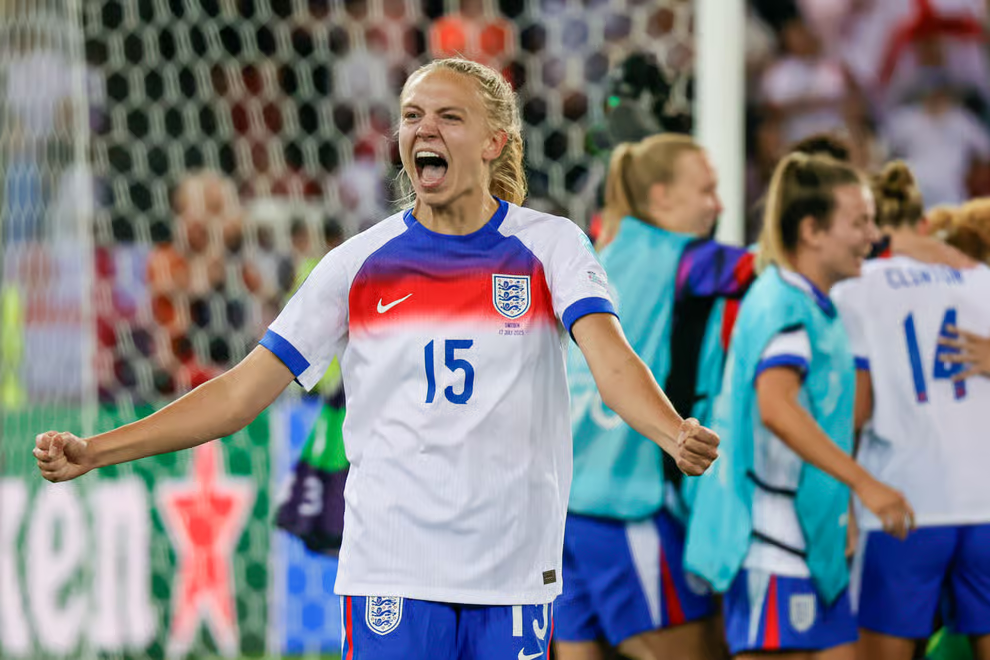
Above: Esme Morgan celebrates with Hannah Hampton and Khiara Keating. Photo: Reuters.
When people talk about game-changers in football, they are normally referring to players who create and score goals. In England’s last match against Sweden, the term was reserved for Chloe Kelly and Michelle Agyemang, a winger and striker responsible for creating and scoring the two goals that brought the game level. Little has been spoken about the impact of another ‘finisher’ (as head coach Sarina Wiegman refers to substitutes): the versatile defender Esme Morgan. In this piece, Impetus digs into Morgan’s history, providing insights on her contribution to this England team.
Morgan has had to wait for consistent minutes with England. Making her debut under Sarina Wiegman in 2022, she has been a permanent member of the squad since – but only made her major tournament debut against Sweden at the Euros in 2025. She was an unused substitute for the 2023 World Cup, her minutes primarily coming in the Nations League and friendly games.
Her impact was first noticed in October 2023, when England faced the Netherlands at Wembley in the Nations League. The Dutch were 2-0 up at half-time with England suffering from a drop in form following the World Cup. As per the trend in Wiegman’s tenure, her finishers proved the difference: Morgan was introduced for Carter on the hour mark, having two shots blocked and making a difference with her ability to pass through the lines, bypassing a stacked Dutch midfield. England went on to win the game 3-2.
Jumping forward to April 2025, there is a similar story: in a Nations League match against Belgium, Millie Bright and Niamh Charles struggled to cope with the speed of Tessa Wullaert. With England down 3-0 within 30 minutes (the deficit reduced to 3-1 at half-time), the match highlighted a key area of concern for the Lionesses: the lack of speed in the back line, particularly down the left.
Bright and Charles were both withdrawn at half-time. Morgan and Carter were introduced, and stabilised the team defensively; both have more pace, and provided more composure off the ball. Morgan made two tackes, completed 89% of her passes, and won four of her six duels.
Following the match, Morgan spoke to Impetus and other media about the instructions she had received: “We needed to be a little bit tighter on the transition, really get pressure on the ball and counter their press.”
The most recent instance of Morgan acting as a gamechanger came months later, in the 2025 Euros quarter-final against Sweden. England’s slow pace on the left side was again exploited, and Sweden had a 2-0 lead at half-time. Wiegman rarely makes changes at the interval, choosing instead to show trust in her players by giving them the chance to improve. Morgan was introduced at the 70-minute mark, alongside fellow game-changers Agyemang and Beth Mead.
Carter was the defender to make way, and the back line shifted to a back three, with Morgan joining Alex Greenwood and Williamson, giving Lucy Bronze more freedom to get forward. England scored within 10 minutes of the changes, equalising three minutes later. Whilst the goals scored the headlines, Morgan’s influence was also noticed. She made two clearances, blocked two shots, had 29 touches and a 92% pass accuracy – significantly higher than the rest of the back line (Williamson was second-highest with 79%).
England went on to overturn that scoreline and win the game on penalties, progressing to the semi-final.
Washington Spirit and the NWSL
Morgan’s journey has taken her from the Manchester City youth system to Washington DC, where she currently plays for the reigning Challenge Cup winners, Washington Spirit. Last year, Spirit’s head coach was serial-winner Jonatan Giráldez, formerly of Spanish giants Barcelona. Under his guidance and with twelve months playing in the transitional, fast-paced NWSL, many parts of Morgan’s game have seen improvements. She is quite fast – a rarity in this England squad – and has a strong ability to get a pass through the opponent’s lines, in a similar vein to Leah Williamson.
Morgan made the move across the pond in the summer of 2024, starting six games of the 2024 regular season and all three playoff games. The NWSL is a different animal compared to many European leagues; running from March until November, it includes a league phase followed by championship playoffs. This means players approach summer tournaments in a different state: they are mid-season rather than in-between. Whilst the benefits and drawbacks of this are subjective, Morgan sees the calendar as a positive one, telling The Guardian:
“The calendar running from March to November was something that I looked at as a real positive of coming to this league, in terms of setting you up for being able to sort of peak for international tournaments.”
The NWSL is also different techically. NWSL games often feature rapid transitions—teams go from defense to attack very quickly, using less build-up play and prioritising getting the ball high up the pitch rather than building possession. This can make the game feel more physically demanding because it is more end-to-end and arguably requires a higher level of fitness. Statistically, teams in the NWSL take significantly more shots, while in the WSL, there are more passes, dribbles, and interestingly, goals. Morgan has spoken about the differences:
“It’s really fast-flowing and you don’t get much time on the ball. That’s helped me become sharper in possession, and I’ve developed a lot defensively too. The forwards in this league are so quick and strong – every game is a battle.
“It’s a bit faster and more direct than England, which is a little slower and more tactical. But it’s been a great challenge to adapt and grow.”
This more transitional style means Morgan brings a different skillset to the Lionesses back line, being used to chasing down strikers who are much faster and more physical than many in the WSL. It is perhaps unsurprising that the three England players playing in the US are all in the backline – Gotham center-back Jess Carter, Orlando Pride goalkeeper Anna Moorhouse, and Morgan.

Versatility
Morgan is often used as a substitute for captain Williamson at right-sided center-back, but she can play all over the back line – or even in central midfield. Due to a glut of injuries at Spirit, she has utilised this versatility at club; although she played most games at left-sided center-back, she also spent games at right-back and in a back three.
England have more depth in the center-back roles, with Williamson, Lotte Wubben-Moy, Carter, Greenwood, and Bright (if available) all able to play there. The main areas of weakness are on the wings, with stalwart Bronze approaching the latter stages of her career, and Greenwood, Charles, and Carter alternating on the left. In her appearances for England, Morgan has played on both sides of the center-back pairing, on the right in a back three and at left-back.
Mentality
It is arguable that Morgan’s greatest strength is neither her passing ability nor her versatility: it is her team-first attitude and mentality. Against Sweden, Williamson was substituted due to injury and left the stadium in a protective boot, and Morgan was asked if she was thinking about the possibility that Williamson’s injury may open the door to a spot in the starting line-up. Morgan was emphatic in her reply:
“I want what’s best for the team and that’s absolutely having our captain on the pitch.”
Much like in 2022, the ‘finishers’ have played a massive role in the team’s success so far. Unlike 2022, more has been made of the entire squad this time around, with a ‘one team’ mentality at the forefront. Morgan has been asked about this role:
“I’m always content knowing that I’ve given absolutely everything to be in the best position to make an impact and just do whatever role I have to the best of my ability, so my mindset doesn’t change at all. I’m going to prepare in exactly the same way. And obviously, being able to play the other night was such an amazing feeling and it’s given me the confidence to perform should I be called upon again. But obviously that’s not my decision. I’m just going to make sure I’m ready for whatever my role is.”
Whilst some have been critical of Wiegman’s direct approach to communication with players, others have highlighted the benefits of having clarity on their roles. The ability to embrace a ‘finisher’ role with an awareness of one’s contribution to the team – without letting ego get in the way – is valuable. The focus is on pushing the rest of the team – starters and finishers – as far as they can, to make sure competition for places is high and the team grows stronger.
That she accomplishes this feat whilst maintaining an aura of positivity and encouraging the squad to bond – she recently got the entire squad involved in a TikTok video playing basketball, and during the World Cup made friendship bracelets – makes her a vital member of a squad that prides itself on togetherness.
There is a feeling amongst fans that Morgan’s minutes at this summer’s Euros may not be finished yet – and there is still a semi-final and potential final to go. Even without stepping foot on the pitch, Morgan can rest assured that her presence and approach to the competition is strengthening the Lionesses greatly – both on-field and off.
Follow Impetus on social media –
Twitter (X): @impetusfootball TikTok: @impetusfootball
Instagram: @impetusfootball
 impetusfootball.org