
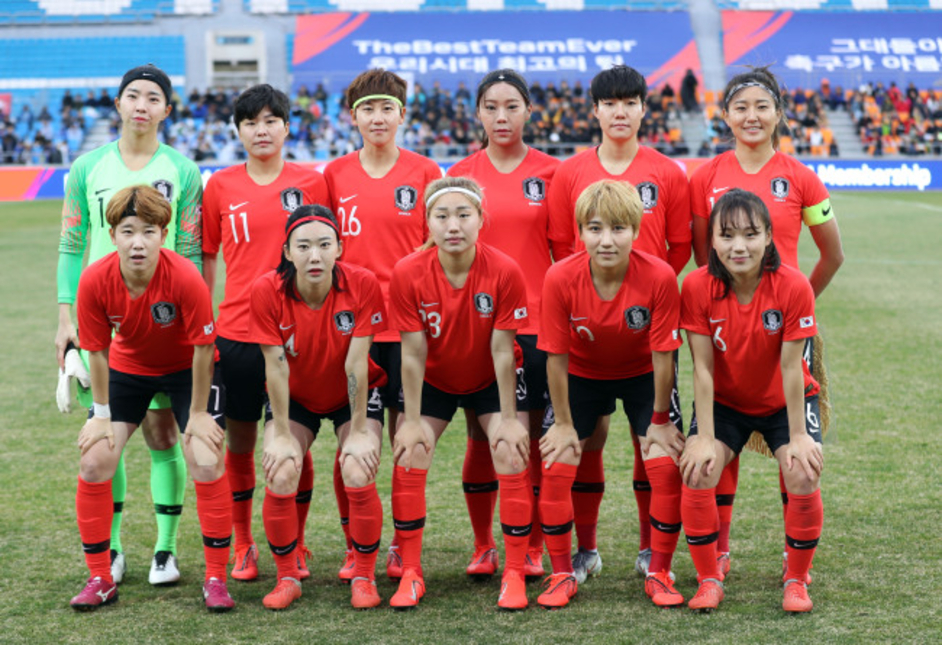
Above: The South Korean women’s national team lines up. Image: Yonhap.
By Genevieve Henry (17/2/26).
The South Korean Women’s National Team, known as Taegeuk Nangja (Taegeuk Ladies) are ready to compete in their 15th Asian Cup and will be looking to earn their first-ever trophy in the competition. Drawn into Group A, alongside Australia, Iran, and the Philippines, South Korea may not have the easiest path to victory.
One of the stronger teams in Asia, South Korea has a few prominent players and plenty of impressive history under their belt. Recent results have been a mixed bag, including a 5-0 loss to the Netherlands and 1-1 tie with Wales– but against Asian opponents they have fared quite well. South Korea held both Japan and China to draws, beat Thailand, Uzbekistan, India, and Chinese Taipei, and only lost to Australia in a two-game series in April.
In late January, members of the South Korea team sent a statement to their federation threatening to boycott the Asian Cup for “harsh and unreasonable” conditions, especially relating to travel and accommodation. The statement was sent in September and outlined that the team would not participate in the tournament if the federation didn’t respond by October 17. The issue was supposedly solved in early February.
Squad:
Goalkeepers: Kim Min-jeong (Incheon Hyundai Steel Red Angels), Ryu Ji-soo (Sejong Sportstoto), Woo Seo-bin (Seoul WFC)
Defenders: Kim Hye-ri (Suwon FC), Jang Sel-gi (Gyeongju KHNP), Choo Hyo-joo (Ottawa Rapid), Kim Jin-hui (Gyeongju KHNP), Ko Yoo-jin (Incheon Hyundai Steel Red Angels), Noh Jin-young (Mungyeong Sangmu), Shin Na-yeong (Brooklyn FC), Lee Min-hwa (Hwacheon KSPO)
Midfielders: Ji So-yun (Suwon FC), Choe Yu-ri (Suwon FC), Kang Chae-rim (Montreal Roses), Lee Eun-young (Gangjin Swans), Mun Eun-ju (Hwacheon KSPO), Kim Shin-ji (Rangers), Kim Min-ji (Seoul WFC), Jung Min-young (Ottawa Rapid), Park Soo-jeong (AC Milan), Song Jae-eun (Gangjin Swans), Park Hye-jeong (Incheon Hyundai Steel Red Angels)
Forwards: Son Hwa-yeon (Gangjin Swans), Casey Phair (Angel City), Choi Yoo-jung (Hwacheon KSPO), Jeon Yu-gyeong (Molde)
Head Coach:
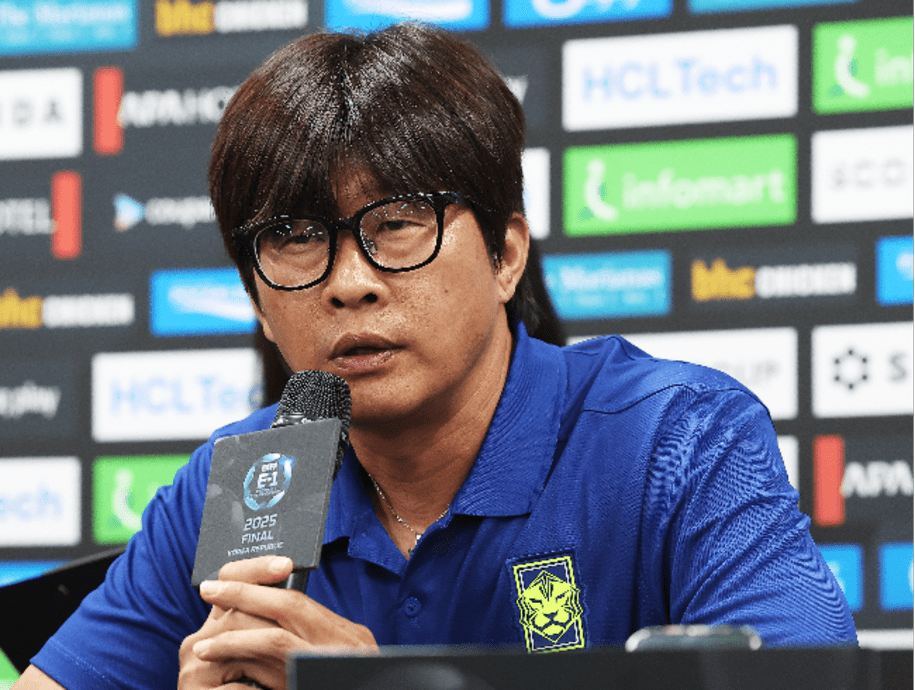
Shin Sang-woo, who took the reins as head coach in 2024, has a long history as a player and coach in South Korea. He played professionally from 1999 to 2011 before starting his journey as a coach in 2010. He coached WK League clubs Changnyeong WFC and Icheon Daekyo before its disbandment in 2017, as well as being the assistant coach at others. His most recent job was as the assistant coach for men’s K League 1 side Gimcheon Sangmu. This is his first experience in international football and certainly his most high-profile gig. He is contracted until 2028.
Asian Cup History:
Although they have racked up 14 appearances at the Asian Cup, South Korea are yet to bag a victory. They came closest in the latest edition in 2022, where they beat out Australia on their run to the final.
How They Qualified:
South Korea qualified automatically as runners-up in the 2022 edition, their best run ever.
Strengths:
South Korea has been typically strong against both lower and higher-ranked opponents with adaptable tactics. Against teams like Australia and Japan, South Korea are comfortable to sit back and defend for long stretches and prove lethal on the counter attack. However, they can also dominate less experienced teams while maintaining possession and high pressure.
Development Areas:
South Korea does not have a very deep talent pool, with few players overseas in top leagues and a domestic league still in development. Due to the WK League’s semi-pro status, many players have to juggle careers outside of football, similar to the A-League Women.
South Korea is also not known for being high-scoring, their excellence lying more in the midfield and defence. Especially against top opponents, South Korea doesn’t often score consistently or through many avenues. Significantly, they only have four players listed as forwards in their squad, which will be a concern if any are injured.
Key Players:
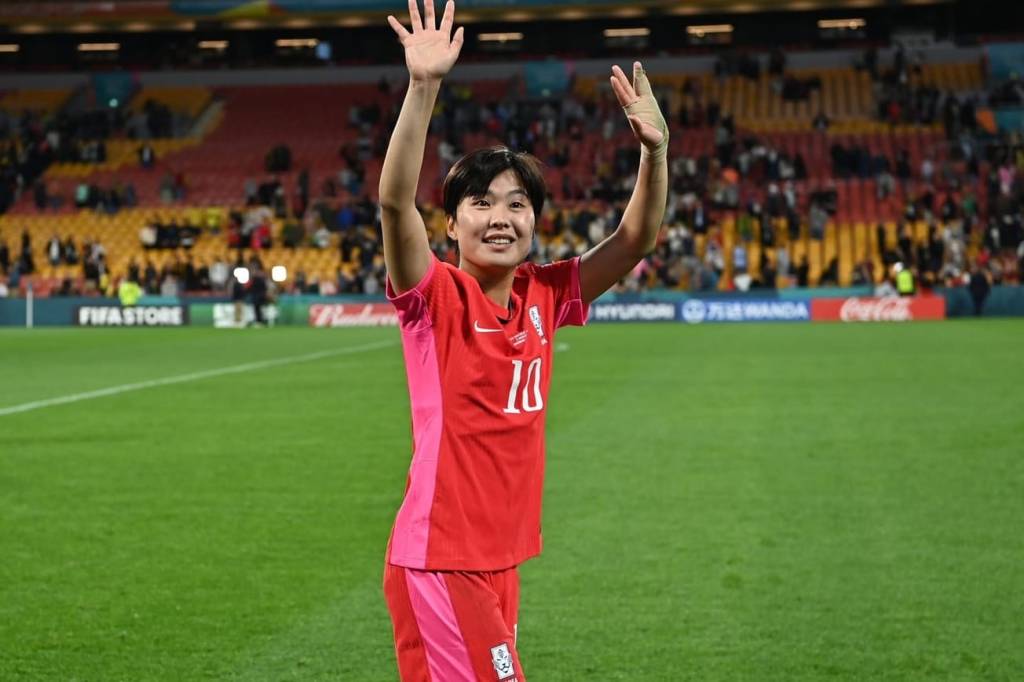
South Korea’s top scorer and most capped player is Ji So-yun, who just relocated back to South Korea to compete for Suwon FC. The 35-year old has 171 caps and 74 goals for South Korea. Ji is best known for time in Chelsea colors, where she played for 8 years, scoring 37 goals and making 124 appearances. She is often regarded as one of the best midfielders in the world. Notably, it was her goal that sent South Korea to the semifinals of the 2022 edition of the Asian Cup, knocking out Australia.
Choe Yu-ri anchors the midfield alongside Ji. The 31-year old is one of the most capped members of the squad and has 13 goals. Her defensive contributions are important in giving Ji the freedom to roam and attack. Choe also plays for Suwon Fc alongside Ji, making the partnership the most critical among the squad.
35-year old defender Kim Hye-ri captains South Korea, leading from the back. With 136 caps, she is one of the most experienced players in the team and maintains the side’s defense solidity with her leadership. Kim has spent the majority of her career in South Korea, playing for Seoul WFC and Hyundai Steel Red Angels, but moved to play for Wuhan Jiangda in China in 2025. In her youth career, Kim captained the U-20 team to finish third in the 2010 U-20 Women’s World Cup, becoming the first South Korean team to finish as high as third in a FIFA tournament.
One to Watch:
18-year old Casey Yu-Jin Phair burst onto the scene in 2023, becoming the youngest player to ever appear in the men’s or women’s World Cup. Her performances at the U-17 level had drawn notice, scoring 8 goals in 9 matches. The forward then signed to Angel City in 2024, where she made few appearances. Although Angel City signed her to a three-year deal, she was loaned out to Swedish club Djurgården. She is now back at Angel City. Her best performances have largely come in the South Korean kit, scoring 4 goals in 17 appearances for her country. She is also the first multiracial player to represent South Korea at a World Cup.
Success Would Be:
If South Korea makes it to the semifinals, it will be a small victory. While they are certainly one of the stronger teams in the tournament, it could be the luck of the draw that determines their fate.
Prediction:
Quarterfinal exit, but win the play-off to continue in their quest for World Cup qualification. This is a strong side, but without the level of high-profile players that the other top teams in Asia have, South Korea will need excellent tactics. There’s not much room for error in this tournament, as South Korea reminded Australia in 2023.
Fixtures:
1st March — South Korea vs Iran, 7pm, Gold Coast Stadium
5th March — Philippines vs South Korea, 1pm, Gold Coast Stadium
8th March — Australia vs South Korea, 8pm, Stadium Australia
Follow Impetus on social media:
@ImpetusFootball on Threads, Instagram and TikTok.
 impetusfootball.org