
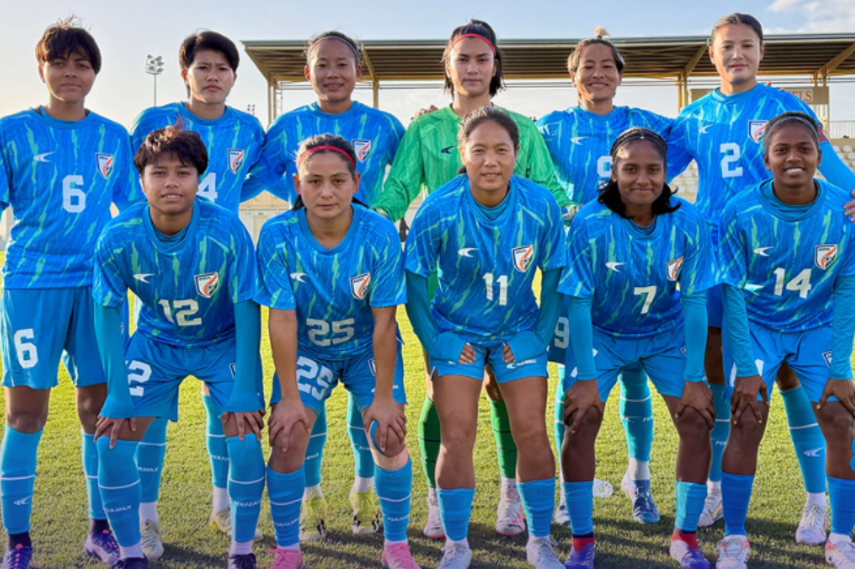
Above: India lines up for a team photo. Image: Indian Football on X.
By Genevieve Henry (25/2/26).
The Indian women’s national team, known fondly as the Blue Tigresses, were one of the better teams in Asia in the early days of the AFC. Since then, their dominance has fluctuated due to lack of support, but they are now on a positive trajectory. The Blue Tigresses were the second-highest scoring team in qualification.
India will compete in Group B alongside Japan, Chinese Taipei, and Vietnam. Although they were set to play in the 2022 Asian Cup, they were thwarted by COVID-19, making this India’s first Asian Cup appearance since 2003.
Squad:
Goalkeepers: Panthoi Chanu Elangbam (East Bengal), Shreya Hooda (Gokulam Kerala), Sowmiya Narayanasamy (Gokulam Kerala)
Defenders: Sweety Devi Ngangbam (East Bengal), Sanju Yadav (Sribhumi), Shilky Devi Hemam (East Bengal), Martina Thokchom (Sethu), Juli Kishan (Nita), Nirmala Devi Phanjoubam (Sethu), Astam Oraon (East Bengal), Sarita Yumnam (East Bengal), Sushmita Lepcha (East Bengal)
Midfielders: Sangita Basfore (East Bengal), Babina Devi Lisham (Sethu), Jasoda Munda (Nita), Sanfida Nongrum (Garhwal United), Aveka Singh (Naestved HG)
Forwards: Grace Dangmei (Sribhumi), Manisha Kalyan (Alianza Lima), Pyari Xaxa (Nita), Soumya Guguloth (East Bengal), Karishma Shirvoikar (Sribhumi), Rimpa Haldar (Sribhumi), Lynda Kom (Sethu), Malavika Prasad (Sethu), Kaviya Pakkirisamy (Sethu)
Head Coach:

India is in experienced hands with Amelia Valverde. The Costa Rican manager has club and international experience. She was with the Costa Rican women’s national team as an assistant from 2011 to 2014 and the head coach from 2015-2023. She also coached Monterrey for one season. She was named the CONCACAF Female Coach of the Year in 2016. She has only been in charge since the beginning of 2026.
Asian Cup History:
Set to make their 10th appearance at the tournament, India will be looking forward to actually playing (knock on wood) this time around. In heartbreaking fashion, India were forced to withdraw from their home tournament as they could not name the required 13 players for their group stage match against Chinese Taipei, due to a COVID-19 outbreak in their camp.
In the early years of the Asian Cup, India finished as runners-up twice, in 1979 and 1983.
How They Qualified:
India qualified as the winners of qualification Group B, blazing through the group. Winning all of their matches and finishing with a goal difference of 23, India looked to be sending a message to their opponents: We’re ready. It will be their first appearance via qualification (rather than hosting) in the modern era.
Strengths:
India thrives in transition. Their direct attacking patterns and ability to burst forward is crucial in the Asian Cup, where the gap between competitors can feel vast. When playing one of the top teams, such as Japan in Group C, India will have their best opportunity to get a result through counter attacks. Against other mid-level competition, the Blue Tigresses have proven their scoring chops when attacking quickly and without excessive build up.
This team has put in lots of preparation and come in off the back of many friendlies. Another strength lies in the fact that most of India’s squad is spread among three or four clubs. The players know each other very well. The attacking depth is commendable, with players like Grace Dangmei, Lynda Kom, Pyari Xaxa, Sangita Basfore, and Manisha Kalyan all contributing majorly to the goals. It will be a good conundrum for Valverde.
Development Areas:
India has a lot of room for development on the game management, personnel, and structural sides of the team. The lack of squad depth in certain areas leads to struggles when a player is injured and noticeable drop off in rotating players. Their midfield is their area with the least depth, which can be detrimental in maintaining games. In tournament football, this can make or break a team. Even when finishing out games, India struggles to maintain tempo. They often concede late goals, especially if pressed aggressively.
Key Players:
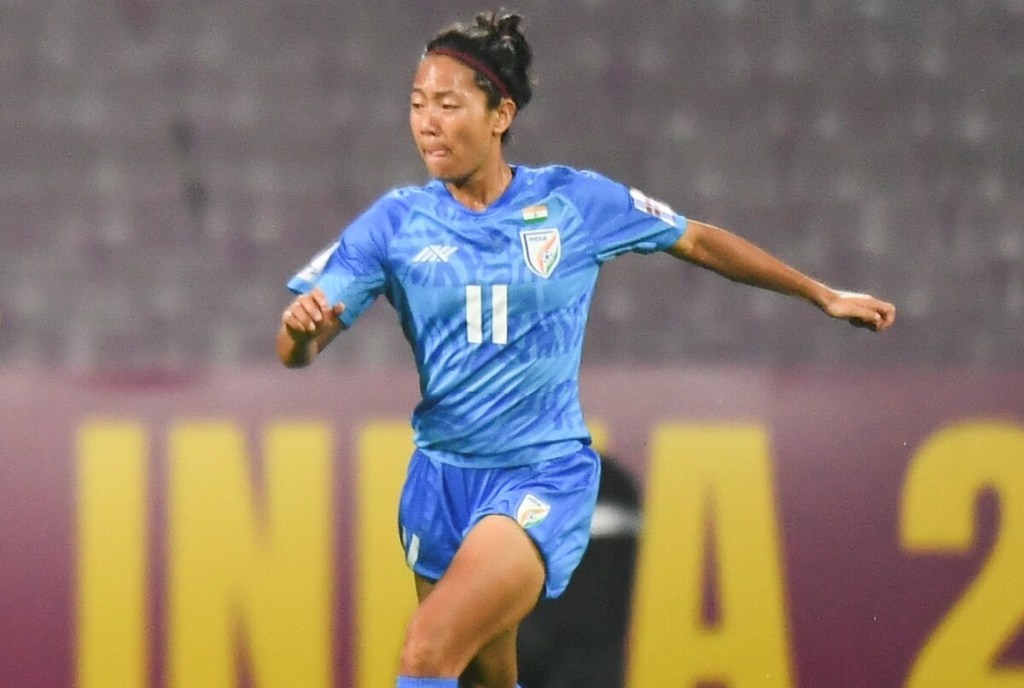
Grace Dangmei has the second most appearances for India and fourth most goals. Dangmei has been with the Blue Tigresses since 2013 and has been involved in many crucial tournaments, often popping up with big goals. She has been a key figure in the Indian Women’s League for almost a decade and has competed in the AFC Women’s Champions League. She has also played in Uzbekistan. She now plays for Indian club Sribhumi.
Nicknamed “Ferrari,” Pyari Xaxa is regarded as one of the most dynamic attackers in India. A player in the prime of her career, Xaxa put her name up in lights on the road to this tournament, scoring five goals in just one game during qualification. The 28-year old forward will aim to continue her form at this tournament. With 18 goals in 39 games, Xaxa has been critical in India’s rise back up to the top. She plays for Nita in India, and has previously played for other teams while posting phenomenal scoring numbers — 43 goals in 40 appearances for Odisha and 14 goals in 11 games for Rising Students Club.
Sweety Devi Ngangbam captains the Blue Tigresses and is another key defender. She has made 67 appearances since 2018, scoring one goal. The 26-year old is in the prime of her career and will be important in leading India in their quest to achieve more.
One to Watch:
21-year old Lynda Kom has started strong for the Blue Tigresses, scoring five goals in her ten appearances. She scored at a similarly high rate for the U20 and U17 teams. She now plays for Sethu in India, where she has found great success. Previously, she scored 17 goals in 32 appearances for Odisha. Her story is one of perseverance and has already drawn recognition across Asia.
Success Would Be:
India will hope for winning a game or making it out of the group. The Blue Tigresses will see Vietnam and Chinese Taipei as the opponents they have the potential to gain a result against, though anything can happen.
Prediction:
India will have a hard time escaping the group stage. They should be able to score a few goals, but the likelihood of finishing second or as one of the best third placed teams is slim.
Fixtures:
4th March — Vietnam vs India, 7pm, Perth Rectangular Stadium
7th March — India vs Japan, 7pm, Perth Rectangular Stadium
10th March — India vs Chinese Taipei, 8pm, Western Sydney Stadium
Follow Impetus on social media:
@ImpetusFootball on Threads, Instagram and TikTok.
 impetusfootball.org