
By Jan-Kees Joosse (14/3/26)
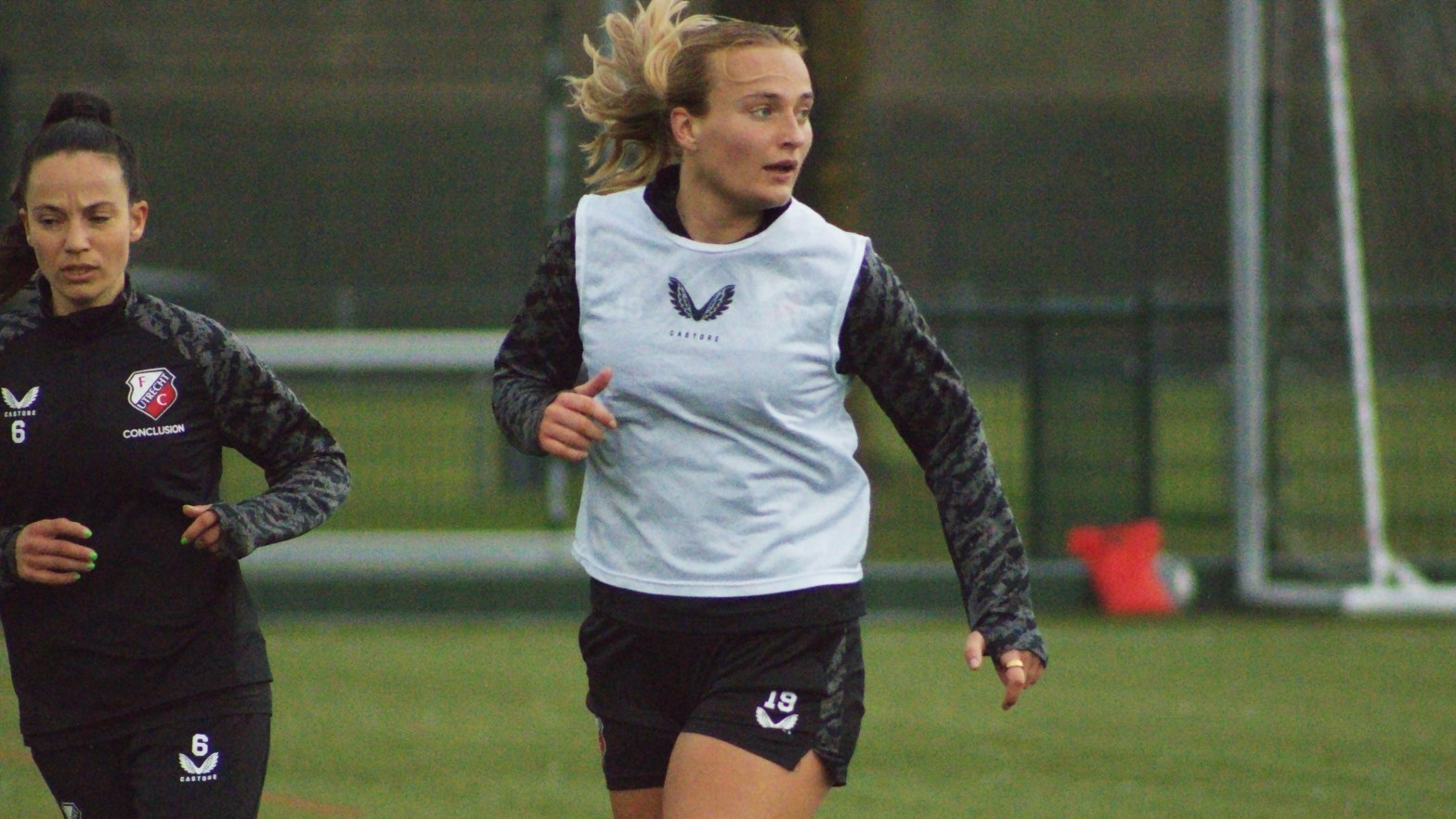
Above: Lobke Loonen in training. Photo: Jan-Kees Joosse.
On a Tuesday morning, FC Utrecht are training ahead of their match against Ajax. After weeks of sunshine, the weather has turned nasty, but for one striker there is not a cloud in the sky. Lobke Loonen currently sits second on the top scorers list in the Women’s Eredivisie with 12 goals, one behind Twente’s Jaimy Ravensbergen. With the form she’s in right now, the football world seems at her feet and she is rightly seen as one of the rising stars of Dutch football.
After taking photos in the rain, I was in the canteen at Stadion Zoudenbalch drying my dripping hair before heading to Stadion Galgenwaard to interview her. Lobke walked into the canteen by herself, which briefly made me think we would do the interview there. That turned out to be coincidence — she had “bib duty.” Later she explained she had forgotten to fill in her daily wellbeing check, which meant she got an extra task and had to hand in the training bibs. Once we were sitting in the players’ area at Stadion Galgenwaard, it gave me the perfect opener to ask how her “wellbeing” was.
Yeah, things are good!
That doesn’t surprise me when you’re having a season like this.
Yeah, those things are connected. I can only speak for myself of course, but I feel that if I’m feeling good off the pitch, you can see that on the pitch as well. I play with more confidence, I’m braver. And when I feel good on the pitch, I automatically feel better off the field too. So I do think there’s a link there.
You’re currently second on the top scorers list in the Eredivisie. Does that make you nervous or does it give you a kick?
I’m not nervous about it, I just enjoy it. It’s a reward for what I show on the pitch, that I’m up there. So that’s a nice bonus. It also motivates me to keep scoring, keep working and keep going. I’m one goal behind Jaimy (Ravensbergen, ed.), so that’s a nice challenge to catch her.
When I looked into your career, I saw that when you were 17 at KAA Gent you took a penalty in your very first match. How do you do that at 17, playing at the highest level for the first time for a new club?
I actually don’t know how that happened. I went there from PSV’s youth team and I was brought in with the idea that I would play. That was the reason I went to Belgium. I wanted to get out of the youth league and play lots of minutes at the highest level. At PSV I could train with the first team and sometimes sit on the bench, but I was never going to get minutes. So I thought: I just want to play at the highest level and get minutes.
Then Gent approached me and that already felt good, because it means they see something in you. That gives confidence and the idea you can play a lot. I was young, but I came there to play, so that gave me more the position of a starting player and not the “young kid”. I’m a striker, so I thought: if there’s a penalty, I’m taking it! I never really thought about how strange it might be when you’re 17.
I also remember that I had already scored quite a lot in pre-season, so then you also think: yeah, I can take that one. Then you’ve earned your spot.
Is the football culture in the Netherlands different from Belgium?
Yeah, I do think so. People often say the Dutch are more direct than Belgians. That’s also how I experienced it. Sometimes things stay a bit under the surface there, whereas in the Netherlands we would say it straight away. That’s not always better either, because sometimes things just explode, so to speak. But that’s a big difference.
I was there with another Dutch girl, so we could laugh about those cultural differences. Or the Belgians would laugh at us. That made it quite funny.
You’re from North-Brabant — did you live in Ghent?
Yeah, I lived there at the time. I’m from near Den Bosch. It was about a two-hour drive to my parents, so I lived in Gent.
That’s quite young to make a step like that.
Yeah. I have two sisters and they had already left home to study. I had also finished secondary school. I didn’t really think too much about it. I finished high school quite early, so I just thought: yeah, this is possible.
Maybe you matured early?
Yeah… I don’t know.
Was it a strategic choice to leave PSV for Gent?
Yeah, I wasn’t really ready to play at PSV yet either. They had Katja (Snoeijs, ed.) and Joëlle (Smits, ed.) as strikers then. I was always going to lose that competition at that moment. So it was a strategic choice to get minutes. Not necessarily to leave the Netherlands. It could also have been ADO at the time. The chance to go to Gent just came up, and with Covid it was a bit harder as well.
Two years later ADO Den Haag came calling. Did that feel like a chance to prove yourself in the Netherlands?
Yeah, it was my first chance to play in the Eredivisie, so I definitely felt like: now I want to show it here as well. I knew a lot of girls from the national teams, so I wanted to show in the Netherlands what kind of player I am. I felt that if I could score goals in Belgium, I could do it here too.
What did Linda Helbling say when she wanted to bring you to FC Utrecht?
She told me a lot about the club, her vision, the playing style and why she thought I would fit in. It was also about what she sees in me and what Utrecht needed at that moment. I think Utrecht were third at the time, so that already said a lot. It was a really fun team to watch. Good football. Lots of energy.
The week before I had played against Utrecht with ADO and we had lost 2–0 quite convincingly. That also made me think: I want to take the next step.
Did you feel that it was necessary for your career?
Yeah, and that summer I had already wanted to make a move, but it didn’t happen.
Was that move to FC Utrecht?
No, to another club. So I already had that thought in my head. When it didn’t happen I stayed at ADO and thought: then I’ll give everything for one more season. Work extra hard. I could train extra with the coach, really focus on my own development.
The plan was basically to move the following summer. But then the opportunity already came in the winter to go somewhere higher. Then I thought: why wait if it can happen now?
Maybe it was a great way to adjust to the club and benefit this season?
Yeah, I think so. The first six months here weren’t amazing. I underestimated how difficult it is to join halfway through the season. The group is already formed. Everyone has their place and suddenly someone new comes in and changes the group dynamics.
I struggled with finding my place socially. Linda gave me a lot of trust, but that also brought pressure. I felt like I had to score and be important every match. That made me think too much on the pitch, which doesn’t help me at all.
For me it works best when I feel good, when I feel free and play with that mindset. I play much better like that than when I’m constantly thinking about what people think of me or what I should do. So it was good that I had that half-year to adjust. After six months things fell into place and I found my spot. Now it’s paying off.
You study psychology. Does that help when you go through a period where the goals aren’t coming?
Since my time at PSV I’ve been in contact with a sports psychologist. That helps me anyway. When things weren’t going well I also reached out to him more. I’m really interested in that side of football — the mental aspect. Learning about it is one thing, but applying it to yourself is always harder. But it definitely helps me in some way. It remains a complex thing.
Utrecht are known this season as a team that often comes back from behind. What’s the psychology behind that?
I think it’s also something in our team. When things aren’t going well, at some point something just drops off us. When we’re 3–0 down it almost feels like… not that the match is gone… but you start thinking: well you don’t give a shit at that point! We’re already behind anyway. Let’s just play football and do everything we can to turn it around.
It gives you more freedom. It’s easier to attack something — to have to score goals — than to defend a 3–0 lead. When you’re chasing the game like that you also have nothing to lose. Maybe that’s it.
Why are you no longer with the Netherlands U23s?
Last season was basically my last year. That age group is finished unless you get special permission. Last year was my final period. I’m too old now.
You’ve said before that you want to reach the top. What do you think it takes nowadays to represent The Netherlands?
I think you have to play for a top club and show it on the pitch — that you can handle that level. In the Netherlands you probably have to be the best player on the pitch to really get noticed. Otherwise I think you have to make the step to a higher league abroad and show it there.
If you look at the Dutch national team players, they all play abroad and they actually play for their clubs. From the Eredivisie it’s difficult to reach that level, so at some point you have to make the step abroad.
Would you choose a growing club, or if Chelsea called would you go anyway — even if it meant getting benched?
If Chelsea calls, I’m going, she laughs.
I see it a bit like the start of my career. If I make a step, I want to play. You can never get guarantees, but at least the intention to play. Because that’s where you learn the most. That probably means not going straight to a top club, but to a mid-table club or a lower club in a top league.
Do you have role models?
Not really players, but I have huge respect for Sarina (Wiegman, ed.). For everything she has achieved. First with the Netherlands and then with England. But also how she keeps speaking out about the development of women’s football and the position of women in society. I think that’s really cool.
Because I didn’t really grow up with women’s football, I never had a real idol. But if I look now, for example at Alessia Russo — I’d like that.
In the way she plays?
Yeah. I think our playing style is a bit similar. Physically strong. A real finisher. She always works incredibly hard. I’ve always had that too. She won the Champions League last year and the European Championship, and she played everything.
When did you realise you wanted to become a professional footballer?
I always wrote in those little friendship books at school that I wanted to be a professional footballer. But at that time I had no idea what the possibilities were. Women’s football was never on TV, for example. That makes a difference.
That’s why it’s so nice for young girls now. We can be role models. The club you support — you can actually play there yourself. I’m sure that if it had been on TV back then, I would have watched every week.
Did you grow up in a sporting family?
Yeah, very sporty, but not really a football family. My mum and my sisters all played hockey and my dad used to be a cyclist. But everyone was very active. My parents still run a lot. Just not much football.
How important was the role of your parents in your career?
Without my parents this would never have worked. The mental support first of all. When I had a bad match or was going through a tough period, they always made me feel like I was good enough and that I mattered. Even if I played badly — just as much as when I played well. It’s about who you are.
But it was also practical. Driving me to training, making sure there was food. When I was in secondary school I had to go to Eindhoven four or five times a week. Sometimes I could manage by train, but sometimes I had class until a certain time and someone had to take me. Luckily my parents had that possibility. Without them it would never have worked.
FC Utrecht face Ajax on Sunday 15th March at 11:15 UK time – the match is broadcast on ESPN in the Netherlands.
This interview was published in Dutch on www.fcleeuwinnen.nl – follow Jan there for news on Dutch women’s football.
Follow Impetus on social media –
TikTok: @impetusfootball
Instagram and Threads: @impetusfootball
 impetusfootball.org