Perth Glory reveal new head coach

26/7/24

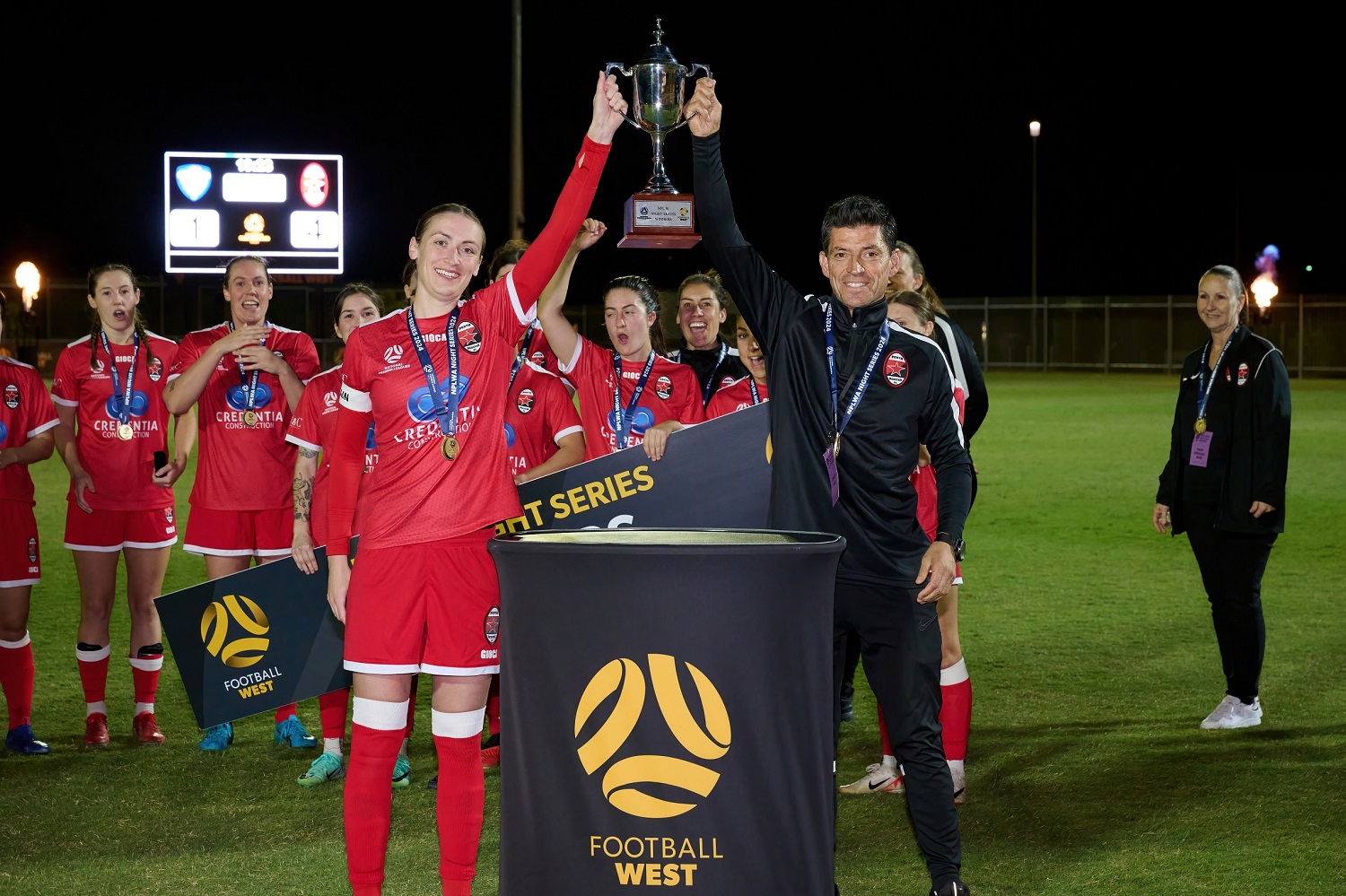
Above: Stephen Peters with Bethany Gordon after winning the NPLW NSW in 2022. Photo: NPL NSW.

Perth Glory have today confirmed the appointment of Stephen Peters as the club’s new A-League Women’s Head Coach.

Currently in charge of Macarthur Rams Women’s FC in the New South Wales National Premier League, Peters has signed a two-year deal with Glory.

The 40-year-old has enjoyed sustained success throughout his 15-year-coaching career, notably during his time as Head Coach at North West Sydney Koalas FC and most recently, with Macarthur Rams whom he guided to consecutive NSW NPL championships in 2022 and 2023.

Peters, who was named NSW NPL Women’s Coach of the Year in 2023, is now relishing the prospect of taking charge of a new-look Glory squad ahead of the 2024/25 ALW campaign which is set to get underway in early November.

“What drew me to the role is the opportunity to coach at the highest level in the country,” he said, “and what better place to start than with Perth Glory, a club with a great sense of community and history.

“We want to have a team that plays a positive style of football that the people of Perth will enjoy watching and resonate with. I’m really excited by what lies ahead for our squad and the club in general.”

Glory CEO Anthony Radich is confident that Peters has what it takes to secure sustained success and grow the club’s women’s program.

“Stephen is an experienced, highly-credentialled Head Coach with an extremely impressive record in women’s football and we are very pleased to have him on board,” he said.

“We are embarking upon what is very much a new era for our ALW side and firmly believe that Stephen has all the right attributes to drive us forward. Our Football Director, Stan Lazaridis, has been working away diligently and the redevelopment of our playing group is at an advanced stage.

“With Stephen now on board, further signings will be made to finalise the squad and consequently, a number of player announcements will be made shortly.

Sydneysider Peters began his coaching journey with Gladesville Ravens before securing his first senior Head Coach role at North West Sydney Koalas FC.

After steering the Koalas to the coveted club championship, he moved on to Blacktown Spartans FC where he further developed his coaching skills by working with both junior teams and the First Grade side.

Peters was subsequently appointed by Football NSW as Head Coach of their U15s Women’s State Team and under his stewardship, they were crowned champions at the 2018 FFA National Youth Championships.

Glory’s new Head Coach duly took up the First Grade Head Coach role at Macarthur Rams in 2021 and after helping them secure a top-five finish in his first season at the helm, he led the Campbelltown-based side to back-to-back NSW NPL championships, breaking the league record of 26 matches without defeat in the process.

During his career, Peters has worked with numerous Matildas representatives, including Casey Dumont, Leena Khamis Kylie Ledbrook, Renee Rollason, and Alex Huynh, along with a host of junior internationals.

Artwork: Perth Glory

Follow Impetus on social media –

Twitter (X): @impetusfootball TikTok: @impetusfootball 
Facebook: @impetuswomensfootball Instagram: @impetusfootball

Imagining Team GB Women’s Football for Paris 2024

Above: Sarina Wiegman’s Lionesses after this month’s 0-0 draw against Sweden. Photo: @Lionesses

Stu Barker, Hannah Chadwick, Freya Ward, Aimee Reynolds, and Ava-Marianne Elliott team up to select a Great Britain team to compete at the Olympic Games (26/7/24).

As the Olympic flame burns brightly in Paris, Team GB go into the Games without a women’s football team. Our team of writers were starting to wonder what the squad might look like if they were representing in Paris, so we thought we’d have a bit of fun and suggest the squad that we’d select if in charge.

After complicated terms were agreed between the relevant organisations, England, the top-ranked nation, was chosen to represent Great Britain.

In Europe, The Nations League acts as a qualifying competition for the Olympics. To qualify, England needed to finish top of their group, including Netherlands, Belgium, and Scotland. Sarina Wiegman’s Lionesses finished with twelve points, the same as the Netherlands. However, the Oranje Leeuwinnen took the top spot with a superior goal difference of one goal.

Goalkeepers
  • Mary Earps (Paris St Germain)
  • Hannah Hampton (Chelsea)

This selection was straightforward, with Earps and Hampton being standout options.

Most recently, Hampton has been preferred by Sarina Wiegman in the Nations League matches, securing victories against the Republic of Ireland and Sweden.

Earps would likely start, given her big-game experience, ball-handling skills, and shot-stopping ability.

Defenders
  • Leah Williamson (captain) (Arsenal)
  • Lucy Bronze (Chelsea)
  • Jess Carter (Chelsea)
  • Niamh Charles (Chelsea)
  • Millie Bright (Chelsea)
  • Alex Greenwood (Manchester City)

Despite the desire to represent all home nations, England’s defence boasts world-class talent. Williamson’s leadership and Bright’s solidity form a formidable central pairing, with Greenwood and Bronze protecting the flanks.

As one of the most experienced and versatile members of the current England Senior Squad, Alex Greenwood’s addition to the backline would inevitably give Sarina Wiegman’s squad an edge.

Above: Alex Greenwood during the UEFA Women’s Nations League match between England Women and Belgium Women at the King Power Stadium, Leicester, England on 27 October 2023. Photo: Chris Foxwell

Greenwood is a technically gifted player and sensational defender, the assets she brings to the table such as her phenomenal progressive passes and wealth of experience are a must if she is available for selection heading into a major tournament. 

It is arguable that she doesn’t get the credit she deserves in comparison to her colleagues in the back line.

Midfielders
  • Keira Walsh (Barcelona)
  • Erin Cuthbert (vice-captain) (Chelsea)
  • Angharad James (Seattle Reign)
  • Beth Mead (Arsenal)
  • Fran Kirby (Brighton & Hove Albion)
  • Ella Toone (Manchester United)
  • Georgia Stanway (Bayern Munich)
  • Lauren James (Chelsea)
  • Lauren Hemp (Manchester City)

This group of players is perhaps only rivalled by Spain in terms of quality and depth. Selecting a starting group of players is not an easy task, nor was selecting this group of players. There are a number who could be argued are worth a place in this team.

A central midfield pairing of Walsh and Cuthbert would be sensational. The vision and tenacity of the pair make them a formidable combination. Both are comfortable with winning the ball and finding the killer pass for their forwards to convert.

There are many combinations for attacking midfield but if forced to come off the fence, we would go for the trio of Toone, James, and Hemp.

Forwards
  • Alessia Russo (Arsenal)
  • Martha Thomas (Tottenham Hotspur)

Russo and Thomas would both hope to be heir to Ellen White who is the current top scorer for Team GB with six goals, all of which came in Tokyo.

Above: Martha Thomas (left) and Alessia Russo (right) lining up together for their previous club, Manchester United against Lewes. Photo: James Boyes.

Russo would of course take the number nine shirt, but Thomas would be good value if the team were chasing a goal in the latter stages of the match. Some fans questioned the Scotland international’s credentials when she moved from West Ham United to Manchester United, but given her minutes on the pitch and that she was often shifted to the right her three goals in thirty-eight matches were not a fair reflection of her ability.

Though it’s disappointing not to see Team GB in Paris, we hope for their return in Los Angeles 2028. Imagine facing the host nation in the final, with Emma Hayes leading the United States, it would capture the attention of the entire country.

At Impetus we have completed a thorough preview of each nation hoping to take home the gold medal in the women’s football competition which is available here.

Follow Impetus on social media –

Twitter (X): @impetusfootball TikTok: @impetusfootball 
Facebook: @impetuswomensfootball Instagram: @impetusfootball
Brilliant Brand inspires Germany to comfortable win over Matildas

Germany 3-0 Australia

by Ben Gilby (25/7/24)

Above: Steph Catley looks to escape during tonight’s game in Marseille. Photo: Luisa Gonzalez/Guardian.

A hugely impressive Germany side, inspired by the outstanding Jule Brand put Australia to the sword in the opening Group B clash at Marseille’s Stade Vélodrome tonight.

It was a hard lesson for The Matildas, who were never allowed to get going from an attacking perspective. That, and the relentless creativity, multiple runs into channels and razor sharp German offensive play pressured Tony Gustavsson’s side into too many errors at the back.

Australia went into the game boosted by their talismanic Arsenal duo of Caitlin Foord and Steph Catley returning to the starting lineup after missing the team’s final warm-up match against Canada with injury. Kaitlyn Torpey, who also missed that encounter, was on the bench and Mackenzie Arnold won her 50th cap in goal. On the minus side of the ledger, Tameka Yallop was ruled out.

Germany had had their own injury issues with star Lena Oberdorf missing, but they had the better of the opening exchanges offensively, with Klara Bühl breaking through on the left but the Matildas back line ensured she strayed offside.

Conversely, Australia were looking to maximise possession with Hunt and Cooney-Cross linking up well to begin to build from the back before switching out to Foord on the left and the duo of Ellie Carpenter and Hayley Raso on the right. The efforts and forward momentum it gained won the reward of two early corners. However, as the half wore on, Carpenter and Raso were rarely seen from an attacking perspective.

Australia’s second corner with 10 minutes played was gathered by German keeper Ann-Katrin Berger who released Brand into acres of space. She left Gorry in her wake upon approaching the area and, with Carpenter unable to cover, looked certain to score, but fired wildly over the top from 10 yards out.

Brand continued to exploit space, and earned her side another corner as she was able to run between Fowler and Cooney-Cross just outside the box to the right of centre. Shortly afterwards Giulia Gwinn saw a shot blocked as Germany ratcheted up the pressure.

Above: The Germany team line-up before the game and show support for their injured star Lena Oberdorf. Photo: DFB Frauen.

Australia took advantage of a short stoppage as Catley received a blow to the head to re-set and went back to maximise possession once more with a slow and patient approach around the middle third of the pitch. Cooney-Cross and Foord were looking to spread the play at every opportunity, with Germany happy to let them do so as long as the Matildas were outside their box.

The next focal point for Australia was to be to find an outlet up top. Fowler was shadowed by two or three white shirts on a regular basis, and Cortnee Vine had little or no time on the ball. It would be a puzzle that Tony Gustavsson’s side struggled to solve all night, and it seriously impacted their ability to maintain any sort of possession or momentum.

That crucial nature of being able to finish at this level was emphasised when Germany won a corner on the right just before the 24-minute mark. Gwinn delivered a high flag kick to the back post where Marina Hegering got up highest between Alanna Kennedy and Foord to send a thumping header into the net.

Australia initially responded well with Fowler able to find space in the box but the Manchester City attacker couldn’t quite get a shot in on target.

Germany remained on the front foot for much of the remainder of the half. They focussed on running the ball into the channels along their right-hand flank in particular as Brand and Gwinn looked to create. They were reaping the rewards of playing two tough Euro 2025 qualifiers just before the Olympics – the understanding, organisation, and sharpness was that bit more potent as a result in their build-up play.

For The Matildas, Fowler was forced to drop increasingly deeper in a search for possession with Foord therefore left isolated out wide, with few bodies to aim for in the box.

However, Australia would gain the final chance of the first half when Raso was pulled down just outside the box by Janina Minge to the left of centre with a free-kick awarded. Up stepped Catley, but the ball fell into the arms of Berger at her near post.

The Matildas began the second period looking initially more energised. There was more vigour about the runs and greater zip and urgency on the passing. But, frustratingly, it was not to last for long as Germany served them an instant reminder of what they are capable of as Brand got free again and was able to shoot, but it went just wide of Arnold’s right hand post.

Above: Australia’s starting line-up before kick off in Marseille. Photo: Football Australia.

Within five minutes the same player underlined her status as the chief thorn in Australia’s side with another searing run which ended with a rocket of a shot just going over the top.

Brand weaved her magic again 10 minutes into the second half as she escaped from Hunt and squared a pass for Lea Schüller who saw her effort blocked.

Germany gained the second goal that their share of possession and territory deserved with 26 minutes remaining. It was a virtual carbon copy of the first. Another corner from Gwinn on the right this time found Schüller unmarked to power a header home.

Within three minutes, Brand got the reward for her superb performance. Germany carved Australia open with a sublime move. There was acres of space for Schüller to find Sarai Linder out on the right flank for Brand to run in unmarked to slot home from close range.

The European side thought they have got a fourth with 18 minutes to play through Alexandra Popp but Australia were saved by the assistant’s flag. Defensively Gustavsson’s side were being taken apart.

Into the final 10 minutes, Hunt turned Bibiane Schulze on the edge of the box and fired in a powerful shot which Berger held with a dive to the right hand post – and that was that.

The Matildas were never able to get going from an attacking perspective. The Germans wrapped up Fowler, forced Vine into a peripheral role, and there was little or no time for Cooney-Cross to gain any sort of momentum. Particularly in the second period, the relentless switching of play and runs into channels squeezed any hope of Carpenter or Raso being seen going forward.

Sunday’s showdown with the brilliantly unpredictable Zambia now takes on the status of a must win encounter. Germany face Emma Hayes’ USA side on the same day in what could be an absolute classic. Lots to play for – and lots to learn.

Above: Lots for the Matildas to think about before they face Zambia on Sunday. Photo: Football Australia.

Teams: GERMANY (4-4-2): Berger, Linder, Hegering, Hendrich, Gwinn, Bühl, Minge, Popp, Brand, Schüller, Nüsken. Substitutes: Doorsoun, Endemann (for Bühl 89′), Freigang, Frohms, Lohmann (for Nüsken 46′), Schulze (for Hegering 73′), Senß (for Minge 73′).

Scorers: Hegering 24′, Schüller 64′, Brand 68′.

AUSTRALIA (4-4-2): Arnold, Catley, Hunt, Kennedy, Carpenter, Foord, Cooney-Cross, Gorry, Raso, Fowler, Vine. Substitutes: Heyman (for Foord 77′), Torpey (for Catley 78′), Polkinghorne, van Egmond (for Raso 77′), Wheeler (for Gorry 59′), Micah, Freier (for Vine 59′).

Referee: Katia García (MEX).

Attendance: Approx 20,000 (exact figure to follow).

Twitter (X): @impetusfootball TikTok: @impetusfootball 
Facebook: @impetuswomensfootball Instagram: @impetusfootball

Fran Kirby & Dario Vidosic: The first steps in making Brighton & Hove Albion a top-half team

by Isla Smith (25/7/24)

Above: Fran Kirby unveiled as a Brighton and Hove Albion player. Photo: James Boardman/BHAFC.

Fran Kirby’s arrival at Brighton and Hove Albion is a major capture for the Sussex side and a statement of intent for a club who have also brought in Dario Vidosic, a hugely talented new head coach, to lead the former Chelsea star and her new teammates.

Brighton struggled to find the back of the net in ten of twenty-two league matches last season, finishing ninth in the league with just 26 goals scored. Though they improved their positioning in the table from the season prior, they still only won one more game, scoring the same amount of goals in comparison to the 2022/23 season. With that being said, the appointment of Fran Kirby brings both experience and ability.

In 2014, Kirby became the first WSL 2 (now Barclays Women’s Championship) player to receive a call-up for the senior Lionesses after scoring 24 goals in 16 appearances for Reading, following this she became the club’s first female player to receive a professional contract.

Above: New Brighton and Hove Albion head coach Dario Vidosic pictured during his time at Melbourne City. Image: Melbourne City.

The following year, after an outstanding performance versus Mexico at the 2015 Women’s World Cup in Canada, Chelsea came calling for the second consecutive year and she made the move to West London. During her time at Chelsea, she scored 116 goals in 208 appearances, including one on her debut and the club’s first-ever goal in Europe, as well as winning thirteen trophies for the club.

In recent seasons, the attacking midfielder struggled for minutes at Chelsea following a few injuries and health problems as well as a variety of incoming players making the competition for her spot difficult.

In an interview upon her arrival at the South Coast club, Kirby stated that she was “here to win” and that she wanted to play for a club where she could help as well as feel valued. With the subsequent departure of Elisabeth Terland, a centre forward who scored 13 of the club’s 26 goals last season to Manchester United, the club will be looking elsewhere on the pitch for goal-scoring ability.

Although not a direct replacement for Terland, Kirby shares her attacking mindset, something that will prove crucial for the club’s growth over the upcoming seasons and can help improve the performance of players around her.

Above: Fran Kirby in action during her final season at Chelsea. Photo: Ben Gilby for Impetus.

Brighton didn’t play a very structured style of football last season, with a very interchangeable midfield due to the lack of a consistent player in the number 10 role. Going forward, they will be looking for a more structured set-up to compete against top WSL sides, something Kirby knows all too well.

However, the arrival of Dario Vidosic as boss will add both detailed structure, a clear identity, and a game plan to make the most of possession – something that will be vital to take the club away from the lower reaches of the table.

The arrival of Kirby along with the potential playing style of Vidosic can provide a welcome boost to the club’s attendances. Last season, the Seagulls averaged an attendance of 3,881 fans per match, including two matches being played at the American Express Stadium (the AmEx), a 31,876-capacity venue. This was one of the lowest averages in the WSL.

Brighton and Hove Albion have stated that they have a plan to improve and develop their women’s team over the next few years and using new techniques to build their fan base will be a part of that. The marketability of Fran Kirby and the coaching prowess of Visodic are a great initial boost for those plans.

Twitter (X): @impetusfootball TikTok: @impetusfootball 
Facebook: @impetuswomensfootball Instagram: @impetusfootball
The Next Level for Ellie Carpenter

Above: Ellie Carpenter and Sam Kerr celebrate Carpenter’s goal. Photo: Kris Goman for Impetus.

By Genevieve Henry (25/7/24).

Going to her third Olympics at just age 24, Ellie Carpenter is often considered one of the world’s best players. Her speed, tenacity, and drive set her apart from most. But, as good as she already is, Carpenter has the potential to become the best player in the world. How can she take her game to the next level?

While Carpenter herself has called her forced break from football “a blessing in disguise” and “the best thing that’s happened to me”, a few critics would argue. Since Carpenter’s horrific ACL tear in the 2021-22 UEFA Women’s Champions League Final, her form has been closely followed and scrutinised by fans. Although her playing time and statistics have remained largely the same as before her injury, many seem to think she has fallen off. I suspect people have just begun to expect more from her. 

Already a veteran at her young age, the sky’s the limit for Carpenter. She’s spent years breaking records, but she could break even more. Carpenter has previously said, “I want to be the best right-back in the world.” She’s not far off. 

Defence

Carpenter is known for her lightning pace up the right flank, functioning at times as more of a winger than a defender. This leaves miles of space behind her. It’s a conundrum all wingbacks and their coaches face. How can they add to the attack without leaving the defence vulnerable? 

Carpenter has the capability to defend very well. But, throughout her years as a Matilda, she seems to be relied on less for actual defending. While she is faster than almost every player she faces, it’s often her positioning that lets her down. Whether it’s her actions or the coach’s, it desperately needs to be amended. Luckily for Carpenter, she has strong centrebacks beside her for both club and country, with Wendie Renard, Griedge Mbock, or Vanessa Gilles; and Alanna Kennedy and Clare Hunt to step in and help out.

When she was 16 at her first Olympics, Carpenter had to prove why she deserved the call-up. She marked Marta in a game that tournament and to this day, it’s probably her best defensive performance in a Matildas shirt. Now, as a thoroughly established starter, there is less pressure on her at the back and she is free to go on side quests up the pitch. 99% of the time, this is a good, even great, thing. But, that 1% left causes catastrophic opportunities for the opponents to pounce. This situation desperately needs to be rectified for both the Matildas and Lyon or opponents will mercilessly target this weakness, and although fitness is not something Carpenter struggles with, it’s a lot to ask a player to repeatedly sprint the length of the field for a full 90 minutes.

It can be remedied in a back four with the right-sided centre-back shifting over the cover for Carpenter as she hustles back; or have Carpenter and Raso switch back and forth on the wing for the Matildas. It’s never for a lack of trying that she gets beat, but it is simply impossible to be in two places at once. Depending on the opponent, Carpenter’s game just must adapt to the situation at hand. In the World Cup, she put on her best display in defence since the Rio Olympics, against Pernille Harder. She had Harder absolutely pocketed the entire game, nullifying Denmark’s biggest attacking threat. When instructed to play defensively, she thrives. It’s just too hard to do both all the time. To excel, she must improve what she can control.

Above: Carpenter fights for possession against Iran. Photo: Kris Goman for Impetus.

One of Carpenter’s best qualities is her strength and physicality. Growing up playing against boys, she learned to fight hard against every opponent. She has incredible stability and balance, with her ability to stay on her feet and keep running through challenges unmatched by most. 

Her tackling skills are quite good, making fewer unsuccessful challenges than other top fullbacks, making only five failed tackles where top fullbacks often lose far more, up to 20 throughout the season. She also excels at using her body to stop attacks, being skilled at blocking both balls and players from sneaking by her. Her interceptions are also good when compared to elite players such as Ona Batlle, Lucy Bronze, Selma Bacha, Emily Fox, and Ashley Lawrence, making 1.2 per game while Lawrence only makes .37 per game. She is dispossessed and mis-controls the ball the least out of these top fullbacks.

Although not a huge detriment to her game, Carpenter struggles aerially, only winning 14% of duels, while the comparable players generally complete over 50%. She struggles with clearances, but most elite fullbacks, all rank just as low, or even lower than Carpenter in this statistic. 

Attack

Having scored only 13 goals in her career, most of which came in her teenage years playing in attacking roles in the W-League, Carpenter is not really a threat in front of net. If she can carry her runs into the box and back herself to shoot, she could become a truly dangerous asset for any team. 

Although Carpenter ranks in the 71st percentile for assists in comparison to other defenders, to truly become an elite fullback, her crossing abilities should get even better. When compared to the likes of Bacha, Battle and crew; Carpenter shows the lowest xG+AG (expected goals plus assists), signifying that there is still some ground to make up in direct contributions to goals. 

Carpenter has a similar number and percentage of passes completed (around 80%) compared to these other top fullbacks for both short and medium-distance passes but ranks significantly higher in long passes, completing 66% while the other top fullbacks generally complete around 50%. She is on the upper end of passes in the final third and passes into the penalty area. She crosses the ball an average amount, with 2.93 per game, while Bacha is the cream of the crop with a whopping 11.9. But, the quality of Carpenter’s crosses can often leave something to be desired, as shown by her amount of assists and shot-creating actions, which are lower than the amount of crosses. She is also fairly average in her amount of shot-creating actions when compared to the best of the best, creating 2.85 chances per 90. She creates better chances when making runs and passing into the box, as opposed to crossing.

Above: Carpenter in action for the Matildas. Photo: Kris Goman for Impetus.

Carpenter is a model fullback with progressive movement, being on top of the statistics in both progressive passes and progressive passes received. Her link-up play, especially for Australia, is extremely dangerous and hard to defend. She completes more give-and-go’s than most, her speed making her runs impossible to contain. 

The Paris Olympics are a chance for Carpenter to once again prove herself to the world.

Carpenter has been on an upward trajectory since she was 16. To become the most complete fullback, she simply needs to continue to work hard, refine her crossing, and work on positioning. Once she hits her prime, I have no doubt that she could be the best defender, if not player, in the world.

Twitter (X): @impetusfootball TikTok: @impetusfootball 
Facebook: @impetuswomensfootball Instagram: @impetusfootball

Bulleen go six points clear at the top

By Joe Rosedon 25/7/24

Above: Bulleen celebrate the match winner against Brunswick.

Bulleen Lions 1-0 Brunswick Juventus 

Bulleen secure fourth consecutive Victoria NPL win against a spirited  Brunswick. A first header from Tiffany Eliadis goal from was enough to secure all three points for the league leaders. The stereotypical game of two half’s, Bulleendominated the first whilst Brunswick put the visitors under immense pressure but were unable to find the back of the net. 

Following their midweek 3-0 Nike FC semi-final victory against Emerging, Bulleen were keen to maintain their ever-increasing momentum. They were able to do this in the eighthminute, where their set piece credentials were demonstrated once again. Alana Murphy’s pinpoint corner was met by the head of Eliadis who diverted the ball back across goal via the inside of the post to give the home side a deserved early lead.

Brunswick could have easily capitulated after suffering an early blow but remained resolute against continual attacking pressure whilst also being more adventurous with their attacking play but without causing serious issues for Bulleen. 

Yuka Sato’s glancing header from an Alana Cortellino cross did have Brunswick goalkeeper Sienna Gidari back peddlingbut the ball dropped just past the back post. Eliadis almost had her second of the game in the closing stages of the first halfbut her thunderous effort was pushed away by Gidari from a tight angle  

Brunswick were able to offer more of an attacking threat in the second half. Sarah Cain was manufactured space on the edge of the box but her attempt was straight into the grateful hands of Erin Hudson.

Bulleen were fortunate not to have conceded a penalty when Karina Tolios header struck the hand of Alana Burn. Whilst everyone of a Brunswick persuasion begged and pleaded, the referee was unmoved. 

After their midweek cup heroics, the visiting side looked visibly tired during the second half and were hanging on to their slender lead. They did almost grab the crucial second, Nia Salleh fizzing the ball across the goal but was denied by a fingertip save from Gidari.

This was a crucial win for Bulleen in difficult circumstances. They keep their six-point advantage at the top of the table ahead of Preston, who they will face in the final of the Nike FC Cup. They next face Bentleigh away from home. 

This performance from Brunswick should install confidence in the team. Despite coming away with nothing, they were able to cause the league leaders all sorts of problems. Brunswick will hope to convert performances into points when they next play Essendon .

Olympic Preview: Brazil

Above: Brazil come together for another tilt at Olympics Gold. Photo: The New York Times.

by Stuart Barker (24/7/24)

No international tournament is complete without the famous yellow, blue, and white of Brazil. The immensely talent group have often underachieved on the big stage but could this be the moment that they step up and wave goodbye to Marta’s international career by securing the gold medal?

Squad

Two-time silver medallists left it late to name their squad for this summer’s Olympic Games. However, we knew back in April that this would be Marta’s final competition before she retires from international football. 

In her statement, she said, “If I go to the Olympics, I will enjoy every moment, because, regardless of whether I go to the Olympics or not, this is my last year with the national team.”

Adding “There will be no more Marta from 2025 in the national team as an athlete. I am very calm about this, because I see with great optimism this development that we are having in relation to young athletes.”

The big omissions from the squad are Debinha, Christiane, and Manchester United’s Geyse.

Goalkeepers: Lorena, Tainá.

Defenders: Tamires, Rafaelle Souza, Antônia, Yasmim, Thaís, Tarciane.

Midfielders: Duda Sampaio, Ana Vitória, Vitória Yaya.

Forwards: Marta, Adiana, Ludmila, Kerolin, Gabi Nunes, Gabi Portilho, Jheniffer.

Alternate Players (can only be selected if any players above are injured): Luciana (GK), Lauren (DF), Angelina (MF), Priscila.

Head Coach
Above: Arthur Elias, Brazil’s head coach. Photo: @SelecaoFeminina

Brazil head coach Arthur Elias was born in São Paulo and before taking the role spent his senior coaching career with clubs based within the city, notably it is one most densely populated cities in the world with over 23.5m residents. 

Elias took over the role from the vastly experienced Pia Sundhage. She was contracted to lead the team out in France but after the Seleção failed to make it out of their group in the 2023 FIFA Women’s World Cup she left the role.

Brazilian Football Confederation (CBF) acted quickly to appoint Elias as he was the stand-out candidate for the role after seven years hugely successful years with Corinthians. During this time, he picked up many honours, including four Copa Libertadores Femenina titles and the Brasileirão Feminino (Brazilian Women’s National Championship) in five out of the last six seasons.

Olympic History

The Seleção took part in the very first Olympic competition in 1996, the squad included an eighteen-year-old Formiga, who went on to retire in 2021 with a whopping 234 caps. They went on to finish fourth with a defeat against Norway in the Bronze medal match.

Eight years later, in Greece, Brazil reached the gold medal match but had to settle for silver after falling to a 2-1 defeat at the United States. In the seventy-third minute, Pretinha levelled after Lindsay Tarpley opened the scoring in the first half, forcing the match into extra time, where Abby Wambach’s header sealed the victory.

It was a case of deja vu in China four years later as Carly Lloyd’s extra-time winner again handed the United States gold.

Last time out, in Japan, Brazil suffered a disappointing campaign exiting the competition in the quarter-finals 4-3 on penalties against eventual gold medal winners Canada, Andressa and Rafaelle missing the deciding spot kicks. 

How they qualified

Brazil and their South American rivals Colombia both secured their places in France when the pair reached the Copa América Femenina final back in 2022. The Seleção lifted the trophy after a 1-0 victory against the competition’s hosts when Debinha scored the only goal in the first half.

Strengths

The obvious strength of this group is its experience. Marta (186 caps), Rafaelle (94) and Tamires (148) have over 400 caps between them. They are well-placed to guide this team whatever the scenario.

Above: Marta takes on Jamacia’s Becky Spencer. Photo: Lívia Villas Boas / CBF.

Elias seems to prefer a 3-4-2-1 formation with the team being flexible to adapt their shape depending on the situation. If given space, their wingbacks will exploit it at every opportunity to provide the width, allowing Marta, Adriana and Kerolin to occupy the space in the middle.

Expect this team to get the ball into the box quickly and not let their opposition defence settle.

Development Areas

I expect 27-year-old Lorena to be trusted between the sticks but with only twenty-two international caps I do worry that the lack of international experience may be a problem when it comes to the high-pressure moments. I would have selected and started the more experienced  Ferroviária stopper, Luciana over Lorena and Tainá – the latter only has one international appearance.

This Brazil team could be vulnerable against teams who are strong in transition and can attack at pace from wide areas.

Key Players

Marta

Above: Marta, an icon of the game. Photo: AP Photo/Francisco Seco.

Despite being on the cusp of international retirement the 38-year-old is still the heartbeat of this team and bears the brunt of the pressure on her shoulders. More recent fans of the women’s game probably don’t appreciate her status as arguably the greatest player of her generation.

There have been spells where Marta has played her football in Europe, for Swedish sides Umeå IK (2004-2008), Tyresö (2012-2014), and Rosengård (2014-2017). While Marta has only confirmed her international retirement she appears settled at Orlando Pride and I wouldn’t expect a move to Europe to finish her career, more likely would be a return to her native home.

Marta has however only scored three international goals in the last two years, against Nicaragua and Jamacia but when the pressure is on I wouldn’t bet against Marta when it matters most.

Duda Sampaio

Duda Sampaio of Corinthians is well known to Elias. She is an attack-minded centre midfielder who would be a perfect partner for her namesake Duda Santos, who would operate in more of a holding role.

Prior to signing for Corinthians, 23-year-old Duda Sampaio received her first U23 international cap while playing for Cruzeiro. She made he full debut in 2022 as a second-half substitute in a 4–0 Copa América Femenina win over bitter rivals Argentina.

Above: Duda Sampaio. Photo: Rafael Ribeiro

One to watch

After Brazil were defeated by France in the 2019 FIFA World Cup Marta gave her famous post-match speech to empower the next generation of female footballers. One such player, aged nineteen at the time, was Kerolin.

Now twenty-four years old, the NC Courage forward is starting to show that she could be a fixture in this Seleção side for the next decade. After scoring ten goals in nineteen matches she was named the NWSL’s Most Valuable Player 2023. Following in the footsteps of previous winners, Sophia Smith, Jess Fishlock and Sam Kerr (twice).


Success would be

Within the squad, they will no doubt believe that they can secure gold but realistically, given the level of competition, simply getting on the podium at all would be considered a success.

Prediction

Since the turn of the year, Brazil have lost only once in their ten matches, which was at the hands of the United States.

You would be a brave person to bet against Spain not to top this group but outside of that, this is a very hard group to predict. Brazil, Japan, and Nigeria all have the capacity to qualify from Group C but predicting how each will perform on the day is a very difficult task.

Brazil and Japan are no strangers to each other having faced off together on three occasions in the last nine months. Brazil drew first blood with a 4-3 win in November. While Japan had responded with a 2-0 victory three days later. During April’s She Believes Cup, Elias’ side came away with a 3-0 victory on penalties after the match finished 1-1 after normal time.

So it really will be a test of who can keep their composure on the day and take those big chances.

If Brazil want to progress, their opening match against Nigeria is a must-win. Given the attacking talent available Brazil has historically underachieved but I back them to get that win and qualify for the knockout rounds.

Group Fixtures

25th July Nigeria v Brazil, 9pm, Stade de Bordeaux.

28th July Brazil v Japan, 5pm, Parc des Princes, Paris.

31st July Brazil v Spain, 5pm, Stade de Bordeaux.

All kick-off times are French time.

Missed any of Impetus’ other Olympic nation guides so far? Catch up by clicking below!

CANADA: https://impetusfootball.org/2024/07/13/olympics-preview-canada-2/

FRANCE: https://impetusfootball.org/2024/07/14/olympics-preview-france/

COLOMBIA: https://impetusfootball.org/2024/07/15/olympics-preview-colombia/

NEW ZEALAND: https://impetusfootball.org/2024/07/16/olympics-preview-new-zealand-2/

UNITED STATES: https://impetusfootball.org/2024/07/17/olympic-previews-united-states-of-america/

GERMANY: https://impetusfootball.org/2024/07/18/olympics-preview-germany/

AUSTRALIA: https://impetusfootball.org/2024/07/19/olympics-preview-australia-2/

ZAMBIA: https://impetusfootball.org/2024/07/20/olympics-preview-zambia/

SPAIN: https://impetusfootball.org/2024/07/21/olympics-preview-spain/

NIGERIA: https://impetusfootball.org/2024/07/22/olympics-preview-nigeria/

JAPAN: https://impetusfootball.org/2024/07/23/olympics-preview-japan/

Follow Impetus on social media –

Twitter (X): @impetusfootball TikTok: @impetusfootball 
Facebook: @impetuswomensfootball Instagram: @impetusfootball

Follow Impetus on social media –

Twitter (X): @impetusfootball TikTok: @impetusfootball 

Banda: why Matildas fans should be scared, and excited

By Molly Appleton 23/7/24

Above: Zambian superstar Barbara Banda. Photo: Zambian national team.

When Australia faces Zambia in the final group game of the Olympics, they will face one of the world’s best strikers.

Cast your mind back to 2021 Olympics — Barbra Banda well and truly announced herself on the world stage bagging back-to-back hat-tricks. Terrifyingly, the Zambian forward has only got better since. 

Most recently, her goals have been vital for Zambia to qualify for Paris against the rising power of Morocco. 

But this is about what’s happened since these moments that should raise goosebumps in every Matildas’ fan. 

Banda made the switch from the Chinese Super League to the centre stage that is America’s NWSL. The highly publicised move to Orlando Pride landed her at a club that has struggled to reach the lofty heights perhaps expected. 

But that seems to suddenly be changing with Pride leading the pack from the top unbeaten. And what’s changed? Banda has arrived. 

In a top of the table clash against Kansas City during the last round before the Olympic break, Orlando went down a player in the 42”. Despite being level at the time of the offending red card, there was belief it didn’t matter. 

With a player down, Orlando showed tenacity and discipline off the ball, which provided the foundation to unleash Banda. Her run at defenders and pass across the box created the opportunity that led to the eventual penalty. And victory. 

Much like Orlando with Marta and Adriana, Banda isn’t the only fire power Zambia offers. They’re a side that includes briefly-world record transfer breaking forward Racheal Kundananji who flourished in Spain and looks to be slowly finding her feet at Bay FC. 

This support is what makes things more dangerous as Banda will easily draw in defenders only to lay it off for a teammate to have a sitter instead. 

How Orlando rallied to beat Kansas is a similar game plan that Zambia would be expected to bring to the Olympics. If the African nation can learn from their past mistakes and tighten things at the back like they’ve shown capable of in continental competitions, they will only need a half chance to score – and that’ll likely come from their leader who shoots on sight. 

Australians should know what it’s like to have a world class player capable of providing the spectacular. One worthy of hinging expectations on. We have Sam Kerr. 

It’s easy to draw comparisons between Banda and Kerr. They’re both goal scoring machines, terrifying when running with the ball and can score. Perhaps the differences lie with how Kerr has developed since leaving the NWSL and being more disciplined holding the line and less likely to take on those half-pitch runs. But what Banda does provide is perhaps a deadlier shot. 

When pitted against a player the quality of Banda the one hope is they’re not in form. That’s unlikely to be the case at these Olympics. 

The Pride forward is buzzing from 12 goals in 12 NWSL matches. Just sprinkle in five assists and it’s difficult to think of a player more in form. 

Will we see another back-to-back hat-trick? However unlikely that seems, it simply can’t be dismissed. And for that reason, while the prospect of Banda at her full powers this Olympics is terrifying, she could also bring the most memorable moments of the tournament.

Follow Impetus on social media –

Twitter (X): @impetusfootball TikTok: @impetusfootball 
Facebook: @impetuswomensfootball Instagram: @impetusfootball
Olympics Preview: Japan

by Christopher Heath and Holly Wright (23/7/24)

Above: Japan celebrate their qualification for the Olympics. Photo: Women’s Olympic Games 2024.

Japan will be out to complete the set of women’s football titles in Paris at the sixth time of asking. Along with Spain, they are the only footballing nation to have won all three peaks of FIFA’s female football mountain however they have failed to reach the same heights in the Olympics.

Squad

Goalkeepers: Ayaka Yamashita, Chika Hirao.

Defenders: Saki Kumagai, Risa Shimizu, Moeka Minami, Hana Takahashi, Hikaru Kitagawa, Toko Koga.

Midfielders: Yui Hasegawa, Kiko Seike, Honoka Hayashi, Fuka Nagano, Hinata Miyazawa, Aoba Fujino, Momoko Tanikawa.

Forwards: Mina Tanaka, Riko Ueki, Maika Hamano.

Alternate Players (can only be selected if any players above are injured): Shu Ohba (GK), Miyabi Moriya (DF), Rion Ishikawa (DF), Remina Chiba (FW).

Head coach
Above: Japan’s head coach Futoshi Ikeda. Photo: JFA.

The saviour of Japanese football, Futoshi Ikeda is a footballing icon within the nation. A former player himself, he retired in 1996 to focus on his coaching career. Since 2017 he has been a substantial part of the national team starting out at youth level. He led Japan to victory in the under-19s AFC Championships in 2017 and then a year later guided the under-20s to World Cup success. A team built around youthfulness and passion there is a sense of unity amongst the country once again, and that is widely thanks to this man who has regenerated the national side.

Olympics History

This will be Japan’s sixth appearance at an Olympic Games since 1996 (2004, 2008, 2012, 2020). Japanese football was on a major decline until the appointment of Eiji Ueda in August 2002. The former player revitalised the team, focusing on the 2004 Olympics which they qualified for, but it was shortly after winning the 2011 World Cup that marks Japan’s best-ever achievement in the Games.

They had qualified for the tournament by finishing first in the Asian qualifiers. In their group, they finished second behind Sweden. The Nadeshiko then went on to defeat Brazil in the quarter-finals before dispatching France in the semi-finals. However, they ultimately lost against the United States in the final after they got revenge in what was a repeat of the previous year’s World Cup final going down 2-1 to two goals from Carli Lloyd.

How they qualified

Japan have had their place in the Olympics confirmed since February after a narrow 2-1 victory on aggregate over North Korea in the final round of the Asian qualifying tournament. After a 0-0 stalemate in the first leg in Saudi Arabia, everything was all to play for. Hana Takahashi put Japan in front midway through the first half. Aoba Fujino then doubled their advantage before Kim Hye Yong made it a nervy last 10 minutes halving the deficit but the hosts managed to hold on denying their opponents a place at their first Olympics since 2012.

Strengths

They have a plethora of attacking talent. A wide-attacking stance from start to finish in their matches, predominantly relying on both wing-backs two of three from either Miyabi Moriya, Hana Takahashi, and/or Risa Shimizu – to be heavily involved in their attacks, as well as in the final third with the likes of Mina Tanaka, Hinata Miyazawa, and Aoba Fujino.

It is worth remembering that Japan has a goalscoring average of at least two goals in their six matches this calendar year. They can also boast familiarity of playing together – eight of Futoshi Ikeda’s squad were present four years ago at the Tokyo Games where Nadeshiko successfully navigated a passage out of the group stage before being eliminated by Sweden in the quarter-finals.

Development areas

Ikeda’s side looked a lot more like an attack-minded than a defensive-based unit throughout their ruthless route to lifting the 2023 Asian Games trophy which saw Japan end the tournament as top scorers with 39 goals. Committing a large number of players up the pitch could prove disastrous with the quality that their three opponents in the group have.

Key Players

Riko Ueki

Above: Japan and West Ham United star Riko Ueki. Photo: The Japan Times.

Having played a key role in saving her club side West Ham United from relegation after finding the back of the net on six occasions in 22 appearances, Ueki was deservedly called into manager Ikeda’s 18-player squad. An ever-present in all of Japan’s World Cup matches, the goal scorer has already got her name on the scoresheet on 11 occasions across 35 international appearances for her country.

The Hammers’ top scorer in last season’s WSL has worked tirelessly to evolve her game from playing for Japan’s Under-17s set-up in 2016 to making her debut for the senior squad in only three years. One of Nadeshiko Japan’s success stories has, so far, she has already netted 20 goals in 46 appearances across all levels of the county’s up-and-coming footballing heritage.

Expected to form a formidable forward frontline with Miyazawa and Nagano playing just in behind her in their opening match in Nantes on Thursday against no less than the current defending World champions Spain. However, a spanner could be thrown into the works as she faces competition from fellow WSL striker Maika Hamano of Chelsea, and INAC Kobe Leonessa striker Mina Tanaka, as the country’s sole starting striker for the duration of the Games across France.

Hinata Miyazawa

Above: Hinata Miyazawa. Photo: The Japan Times.

Having lifted the Golden Boot at the 2023 World Cup after netting five goals in as many games, there were high hopes for Miyazawa in her maiden season in English football.

However, not everything went to plan for Manchester United’s new signing from Mynavi Sendai, as she started only 12 WSL games (16 in all competitions) in 2023/24, finding the back of the net on only the solitary occasion and contributing the same number of assists. Seeing those statistics suggests that Miyazawa has struggled to settle in England, but on closer inspection, her campaign was plagued by an ankle injury picked up on international duty in December that required surgery and subsequently resulted in 15 missed match days.

With something to prove to her doubters, the now fully-fit 24-year-old, who has scored nine goals in 36 appearances for her country, is expected to play a big part in managerFutoshi Ikeda’s tactical plans of reaching another Olympics Games final, after Japan finished as runners-up in London 12 years ago.

One to watch

Fuka Nagano

Above: Fuka Nagano – ready to star once more for Japan. Photo: The News Market

With all of the attacking talent that Japan has at their disposal, they are still going to need a defensive juggernaut in their ranks. Call forward Fuka Nagano.

Playing her football for Liverpool in the WSL, Nagano started all but one of the Reds’ league matches last season and was a key part of her club only conceding 28 goals in 22 league games. Having formed a goal-forbidding partnership alongside Ceri Holland and Marie Höbinger at club level, the number eight will now likely line up alongside Yui Hasegawa and Aoba Fujino in France.

This will be Miyazawa, Ueki, and Nagano’s maiden venture into an Olympic Games after not being involved in Japan’s quarter-final exit in 2020 at the hands of Sweden. Nonetheless, all three players were present at the 2023 World Cup, which incidentally saw Ikeda’s side eliminated at the same stage as four years ago by those same Swedes.

Success would be

Escaping the group to begin with would be huge given the opposition. From there, if they can prove to be as strong in defence as they can be in attack, then anything is possible, including going one step further than they did in London 2012 when Japan took silver.

Prediction

In only their second back-to-back Olympic Games, Japan will be keen to try and go one step further than in 2012 but will face a daunting challenge to progress as their Olympic group of death contains no less than the defending World champions Spain, Brazil, and Nigeria. However, their performance at last year’s World Cup will fill the nation with optimism as they look to overcome that final step in search of the gold medal in Paris this year.

Fixtures

25th July Spain v Japan, 5pm, Stade de la Beaujoire, Nantes.

28th July Brazil v Japan, 5pm, Parc des Princes, Paris.

31st July Japan v Nigeria, 5pm, Stade de la Beaujoire, Nantes.

All kick-off times are French time.

Missed any of Impetus’ other Olympic nation guides so far? Catch up by clicking below!

CANADA: https://impetusfootball.org/2024/07/13/olympics-preview-canada-2/

FRANCE: https://impetusfootball.org/2024/07/14/olympics-preview-france/

COLOMBIA: https://impetusfootball.org/2024/07/15/olympics-preview-colombia/

NEW ZEALAND: https://impetusfootball.org/2024/07/16/olympics-preview-new-zealand-2/

UNITED STATES: https://impetusfootball.org/2024/07/17/olympic-previews-united-states-of-america/

GERMANY: https://impetusfootball.org/2024/07/18/olympics-preview-germany/

AUSTRALIA: https://impetusfootball.org/2024/07/19/olympics-preview-australia-2/

ZAMBIA: https://impetusfootball.org/2024/07/20/olympics-preview-zambia/

SPAIN: https://impetusfootball.org/2024/07/21/olympics-preview-spain/

NIGERIA: https://impetusfootball.org/2024/07/22/olympics-preview-nigeria/

Follow Impetus on social media –

Twitter (X): @impetusfootball TikTok: @impetusfootball 
Facebook: @impetuswomensfootball Instagram: @impetusfootball