
By Astrid Karsten (2/2/26)
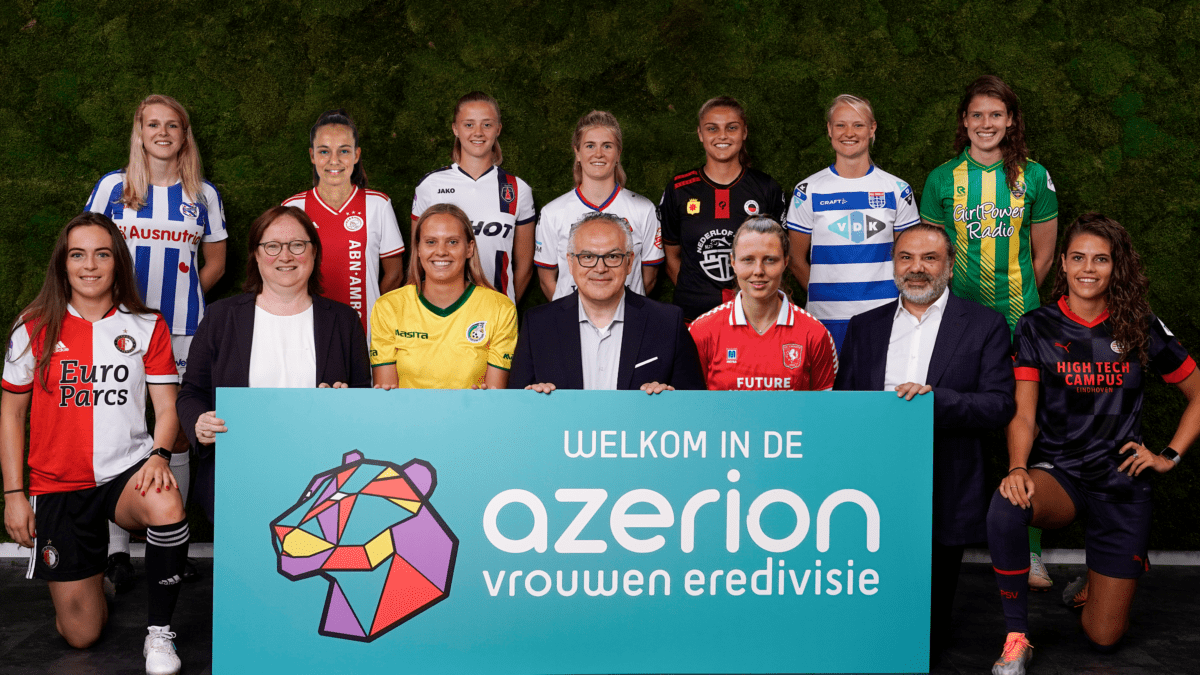
Above: Representatives from the Eredivisie teams in 2022. Photo: Azerion Vrouwen Eredivisie website.
In 2025, the Royal Dutch Football Association (KNVB) announced that the top tier of women’s football in the Netherlands, the Vrouwen Eredivisie, will be reduced from 12 teams to 10 after the 2025–26 season. For some, the decision could be existential. In a guest feature for Impetus Football, Dutch football writer Astrid Karsten examines the collateral damage this move could cause.
In early November, the WerkTalent Stadium is little more than a cold concrete silo at the Prins Clauslaan junction, where cars speed by and the bright stadium lights are drowned out by streetlights. Yet, football happens here, with stands and a field that function despite everything.
On November 2, 2025, a “match of the founders” was played here: ADO Den Haag against FC Twente. These are the only two clubs that have remained continuously involved in the competition since the signing of the Eredivisie Women’s Agreement in 2007.
The match itself isn’t a match. It’s torture. ADO can’t get a grip, can’t settle down, can’t hold on. Barbara Lorsheyd, with the club since the beginning, scores an own goal – a telling sign. The final score is 0-5, but it could easily have been 0-8. No one would have been surprised.
Music blares through the stadium. GirlPowerRadio is a sponsor. In the business area, people are laughing, drinking, and chatting. Losing to Twente is no disgrace. It feels like a perfectly normal competition day. And yet, three more points have been lost here unnoticed.
ADO Den Haag is simply in relegation territory this season. That’s not a moral judgment, it’s a sporting observation. But in a season with aggravated relegation, that doesn’t just mean being at the bottom. It means disappearing: out of sight, out of contracts, out of development opportunities.
The KNVB (Royal Dutch Football Association) has decided this season that at least two clubs will be relegated. Possibly three. The Women’s Eredivisie will go from twelve to ten teams. The goal: strengthen the competition and reduce the gap between the top and bottom teams.
That sounds logical. But nowhere is it explained how. And worse: whether reducing that gap will actually lead to a stronger competition.
Because downsizing isn’t a strategy. Fewer clubs means fewer playing fields, fewer contracts, less room for development. Above all, it means that mistakes are forgiven less. That regions disappear faster. That talent is dropped sooner.
And then, halfway through the season, doubts arise. The KNVB will, once again, “talk” with fourteen clubs. Because there would be ambiguity about the rules. But if there’s one thing that’s clear, it’s the rules.
“Having discussions” while the season is underway isn’t openness. It’s administrative dallying. Clubs, players, and staff don’t have that luxury; they have to deliver every week within the parameters imposed on them.
Halfway through the season, doubting themselves is reserved for the association. The question is whether it’s more than a charm offensive.
After ADO-Twente, stewards clear away cups. The stands are empty. Laughter continues in the cafeteria. Head coach Marten Glotzbach walks by, his jaw clenched. Sixteen days later, he’ll be fired.
Outside, young players thank the handful of spectators. Tears are swallowed. Shirts are exchanged. Iris Remmers. Floortje Bol. Anne van Egmond. Talented, but without prospects. Not because they’re not good enough, but because the system leaves no room for improvement.
If ADO is relegated, Jong ADO will disappear. That’s not a detail; it’s a policy decision. A development line will be severed. This doesn’t just apply to ADO. It also applies to Utrecht, Heereveen, and PEC. Clubs known for their talent development. If relegated, their development teams will also disappear.
Most women’s clubs don’t rely on structural club funding, but on exposure. Airtime. Media. That’s not a luxury; it’s their sole raison d’être. Fewer Eredivisie matches means less money. For clubs, but also for the entire surrounding chain.
Clubs that rely on men’s performances, minimal budgets, and therefore survive on media revenue, almost certainly face a silent end if they are relegated. Financial survival in the Eerste Divisie is virtually impossible.
Making a league more “equal” sounds appealing, but for some, it is not. It’s precisely the stark disparities that make the Eredivisie so interesting. Inequality creates moments of surprise: underdogs making life difficult for Twente, players rising from relegation clubs to the Champions League in a year and a half. These are the stories you lose when you downsize the league.
Perhaps the stories are shifting downwards. To the Eerste Divisie. To clubs with a fighting spirit, local roots, and a sense of urgency. Groningen – Jong ADO Den Haag (!) recently drew nearly 10,000 spectators in the Tweede Divisie.
More than most Eredivisie teams have ever managed, not counting a Champions League match. But even in European matches, attendances exceeding 4,000 are rare. Driven by a loyal fan base, local involvement, and the will to make something of themselves, Groningen succeeded.
So it’s possible. But only if you invest in it. It can’t rest on the shoulders of a few pioneers. And on this matter the KNVB remains eerily silent.
What will the Eerste Divisie become? A training league or a dumping ground? Will it receive structural funding? Media attention? Will there be any protection for relegated clubs? Or will relegation simply disappear?
Shrinkage without a plan isn’t a vision. It’s a gamble. The KNVB’s hesitation reveals this above all: no one has considered what should exist beneath the Eredivisie. The question isn’t whether going back to ten clubs is necessarily wrong. The question is why we’re acting as if that’s a solution in itself.
By shrinking, you might make the center more compact, but you also cut away frayed edges. And that’s where tension, friction, and emotion often arise.
If we really want to go back to ten clubs, fine. But then also say what we’re giving up. And importantly: say what we’re getting in return. What does the First Division look like? Who funds it? Will there be structural investments, or are we simply shelving the problem? What does this mean for career progression, talent development, and the stories we’ll be able to tell in the future?
As long as these questions remain unanswered, downsizing doesn’t feel like policy, but rather treating the symptoms. As if we’re saying: this is too complicated, let’s make it smaller. While women’s football has shown that growth is never neat, never linear, and never comfortable.
Perhaps that’s the real pain in this discussion. Not that we’re going back to ten teams, but that we’re doing so without a vision. Without a plan. Without the courage to say where we want to go, even if that means we sometimes struggle along the way.
The stands in the WerkTalent Stadium are empty, the cups are being cleared away, and laughter is still flowing in the business lounge. But perhaps the league has lost most of all today the stories that make it so unique.
Follow Astrid through her profile Sporting Femme on Instagram, or on Substack.
Follow Impetus on social media:
@ImpetusFootball on Threads, Instagram and TikTok.

 impetusfootball.org