The Uzbekistan dossier

Ahead of next week’s first leg of the Olympic Games Final Qualifying Round tie between Australia and Uzbekistan in Tashkent, Ben Gilby takes a look at what The Matildas can expect (15/2/24).

Above: Umida Zoirova (15) celebrates a goal for Uzbekistan with Aziza Norboyeva (18). Photo: AFC.

Next Saturday, Australia venture to Tashkent to take on Uzbekistan with a place in the Paris Olympic Games the reward for the winner of the two-legged tie. For the Central Asian hosts of the first match, it’s the biggest opportunity in the history of their national women’s side.

Whilst Uzbekistan are yet to qualify for any major international tournament outside of the Asian confederation, they can point to two successive Central Asian Football Association (CAFA) Cup Final victories, five qualifications for the Asian Women’s Cup, and an impressive run of results in the Olympic Games qualification competition so far.

How they’ve got this far

Round One

Whilst Australia received a bye through to the second round of the qualification competition for Paris 2024, Uzbekistan began their task almost 14 months ago in Tashkent. The fourth highest-ranked team in this stage of the tournament, Uzbekistan made short work of their opponents scoring 19 goals in the three games, with none conceded in their successes over Bhutan (9-0), Timor-Leste (3-0), and Jordan (7-0). Diyora Khabibullaeva hit seven goals in the process.
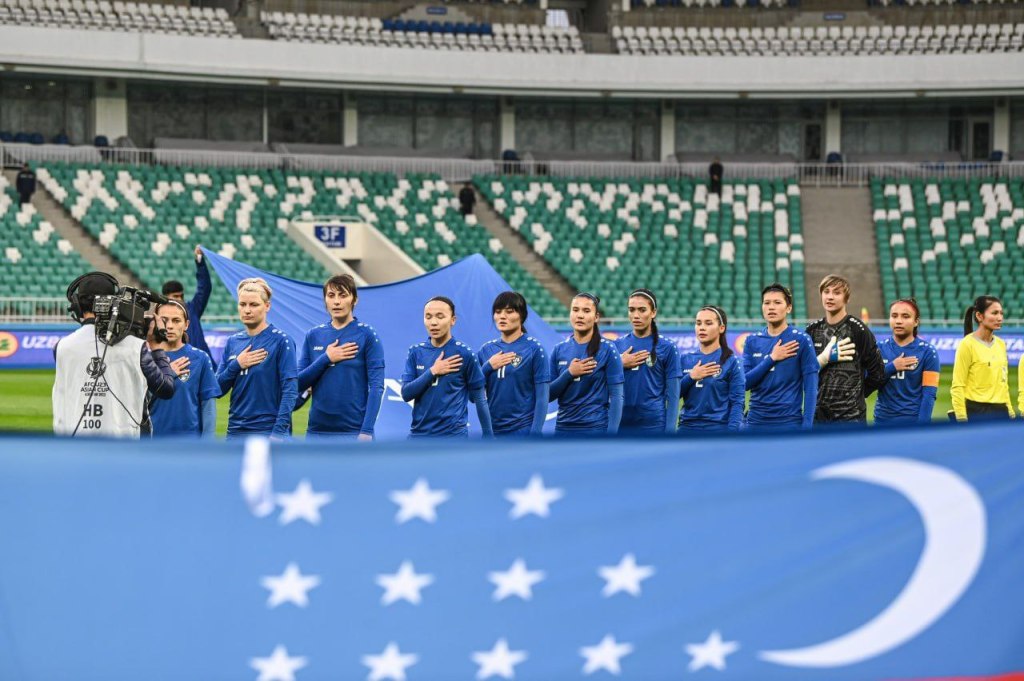
Above: Uzbekistan line up ahead of their 9-0 win over Bhutan in the first group stage of qualifying. Photo: UFA.

Round Two

For the second stage in a row, Tashkent hosted all of the matches in the group stage involving Uzbekistan. They went into the round-robin ranked as the third highest of the four nations competing alongside Japan, Vietnam, and India.

Ranked 50th in the world, Uzbekistan started their second stage group games against World Cup qualifiers Vietnam. Knowing that this opening game could be the key encounter in pushing for a place in the next round, Head Coach Midori Honda selected an attack-minded 4-3-3 formation. Despite Vietnam conjuring the best opportunities of the opening period, it was the hosts who scored the only goal of the game as Umida Zoirova played a one-touch pass to Nozimaxon Ergasheva who won a corner. As the set piece came across, Zoirova played a glorious touch for Khabibullaeva to sweep home what would be the only goal of the game.

Second up for Uzbekistan was a tough assignment against World Cup quarter-finalists Japan, the world’s 11th-ranked side at the time. In a hint as to what Australia could expect line-up and formation-wise, Honda switched to a defensive 5-3-2 setup with Maftuna Shoyimova and Modina Khikmatova adding extra ballast and Nilufar Kudratova replacing hot shot Khabibullaeva up front. The outcome was a 2-0 victory for Japan with Moeka Minami and Remina Chiba scoring within five minutes of each other during the opening quarter of an hour.

The last group game paired Uzbekistan with India, the lowest-ranked nation in their group. A strong victory would ensure the Central Asian nation would progress into the final round of qualifying and Honda responded with the emphasis on attack in a 4-2-3-1 formation.

India offered little resistance and went behind with just two minutes on the clock. Lyudmila Karachik’s corner was turned across the box by the returning Khabibullaeva for all-time record scorer Kudratova to direct into the net. Six minutes into the second half, Khabibullaeva found Zoirova in the box, who threaded a pass through the eye of a needle for captain Karachik to sidefoot home. Seven minutes from the end, a sumptuous team goal sealed Uzbekistan’s passage to the final qualifying round as three rapid-fire one-touch passes around the centre circle saw the ball played out to the right wing before play returned to the central area outside the area, where a further three one-touch passes ended with Karachik to fire home the winner.

The Head Coach
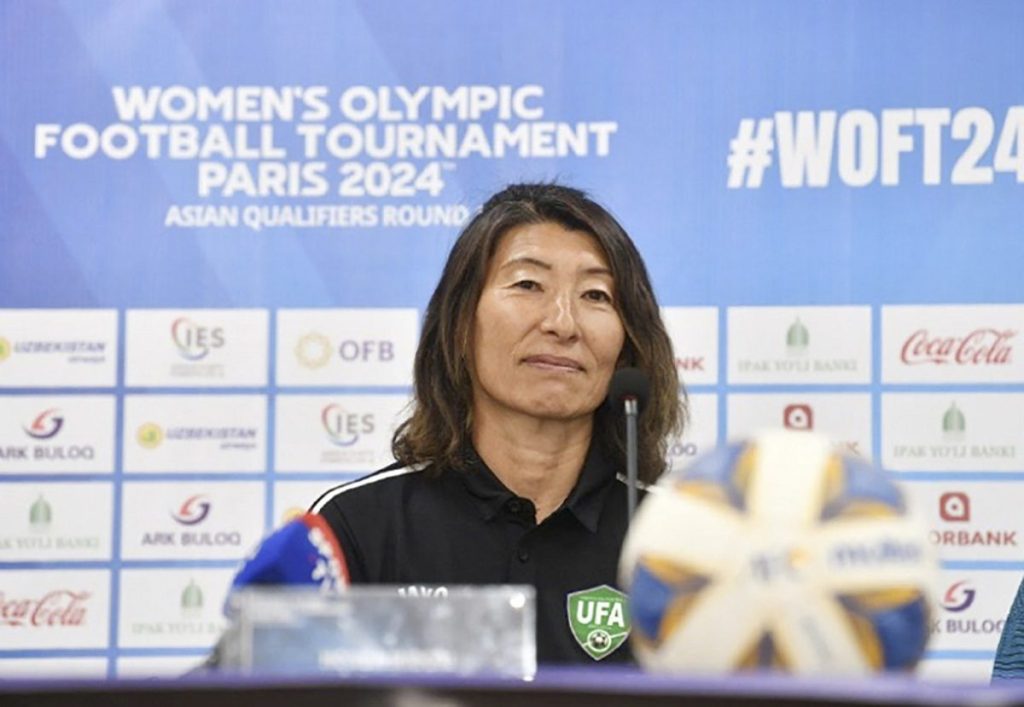
Above: Uzbekistan’s head coach, Midori Honda. Photo: The Japan News.

Midori Honda is a tactically astute head coach who has been in charge of Uzbekistan for two years. A defender throughout her playing career, Honda won a total of 43 caps for Japan having made her international debut at the age of 16 against Chinese Taipei in the Asian Cup with her final appearance coming ten years later at the 1991 World Cup. In her 19 games in charge, Uzbekistan has won nine times and finished fourth in the Asian Games.

Playing style

Uzbekistan are a team able to mix their formation depending on whether in possession or not and with talented midfield and attack weapons, Australia will have to be on the front foot to clinch their spot in the Paris Olympics.

Given time and space, Midori Honda’s side are very comfortable on the ball. Uzbekistan thrive when they are able to play a rapid-fire passing game in the centre of midfield and link up with their wide players. They have midfielders and attackers who are comfortable in possession, full of pace, and have the confidence to beat their defender and look for an incisive pass.

The battle of the midfield will be the key area of this tie – particularly in the first leg as Uzbekistan have a bank of attack-minded threats (see Key players, below) who have excellent footwork and can thread passes between defenders to unlock a backline.

Above: The 34,000 seater Milliy Stadium, venue for the first leg of Australia’s Olympic qualifier with Uzbekistan. Photo: Wikipedia.

This ability was highlighted perfectly with Uzbekistan’s breathtaking third goal in their win over India in the second group stage of qualifying. Three one-touch passes in the centre circle area of the field before the ball was fed out wide were then followed by a further three rapid-fire one-touch passes on the edge of the box leading to Karachik firing home from long range.

Honda’s side are happy to let the opposition have possession in their own half, but when that switches into the front third, the side revert to lines of five and two in front of their last three outfield players. In this situation, Uzbekistan have a tendancy to leave a lot of space between their two centre backs, Nafisa Nabiqulova and Kamila Zaripova, which the Matildas will need to ruthlessly exploit. A combination of perfectly threaded balls between the pair, or balls over the top, can pay dividends.

It is this part of the game that has the potential to bring Australia success. Uzbekistan have conceded 25 goals in their last 10 games – a run that has seen them lose 6-0 and 7-0 to China, plus 8-0 to North Korea since the end of September 2023.

In goal, Maftuna Jonimqulova is an excellent shot-stopper but can find a high ball into the box from crosses, set-pieces challenging on occasion.

Key players

Dilrabo Asadova

The 27-year-old is a tidy defender who is unharried and looks composed on the ball. Asadova started the games against Vietnam and India in which Uzbekistan kept clean sheets to earn their status as the best-placed runner-up in the second round group stage. Asadova is a key link player with Lyudmila Karachik in front of her.

Lyudmila Karachik
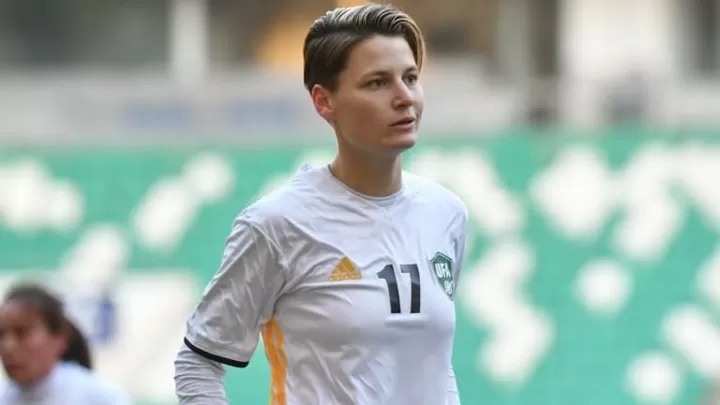
Above: Uzbekistan captain Lyudmila Karachik. Photo: All Football.

This 29-year-old attacking midfielder, who has captained her national side has pace and guile in abundance with excellent footwork out wide to turn and beat defenders. Karachik is a bag of tricks who can drop deep to start moves and looks to initiate one-touch rapid passing in the midfield. A player who loves to beat a defender and accelerate away, Karachik has good close control and a strong awareness of those around her.

Diyora Khabibullaeva
Above: Uzbekistan’s hot-shot striker Diyora Khabibullaeva (right). Photo: UFA.

This 24-year-old striker is sharp and clinical, boasting a superb international record of 27 goals in 25 games, including nine in this Olympic qualification series alone. Khibibullaeva is just three goals away from equalling the Uzbekistan national record of 30 held by Nilufar Kudratova. A creative dynamo who combines an ability to combine both close-range finishing in a poacher’s style with jinking play around the box, Khibibullaeva will be someone that the Matildas defence will have to keep a close eye on.

Follow Impetus ’71 on social media –

Twitter (X): @impetusfootball and @impetus71 TikTok: @Impetus71 Facebook: @Impetus71 

Instagram: @Impetus_71 Threads: @Impetus_71

Blayney reveals U20 Asian Cup squad

by Ryan Miller-Woods at Watermans Cove, Sydney (14/2/24).

Above: Young Matildas head coach Leah Blayney (centre) with squad members (left to right) Claudia Cicco, Zara Kruger, Lara Gooch, and Shay Hollman today in Sydney. Photo: Tiff Williams, supplied to Impetus 71 by: Football Australia.

Ahead of next month’s AFC U-20 Women’s Asian Cup, Young Matildas’ Head Coach Leah Blayney announced her talented 23-player squad that will be headed to Uzbekistan next month.

Blayney knows that if her side can finish in the top two spots in their group which also contains hosts Uzbekistan, South Korea, and Chinese Taipei, they will automatically qualify for the 2024 U-20 World Cup in Colombia in August and September.

If they qualify, it will be the first time they’ll have entered the tournament directly since 2006 – a tournament that Blayney was in as a player.

In what was a real highlight from the squad announcement, 22 of the 23 players are currently plying their trade in the A-League Women with only Milly Boughton, on loan at third-tier English side Ipswich Town from WSL club Tottenham Hotspur being the exception.

Above: Young Matildas head coach Leah Blayney at today’s media event in Sydney. Photo: Tiff Williams, supplied to Impetus 71 by: Football Australia.

In terms of the squad itself and what was the biggest challenge with picking the final 23 players for the upcoming AFC U-20 Women’s Asian Cup, Blayney said: “I think the fact that we have so many talented players across the country right now all competing for 23 spots.

“I definitely had some tough decisions that myself and our technical team did have to make that went down to the wire for some players and essentially we feel we’ve landed on a group that brings a lot of different qualities to bring our playing style to life, getting a lot of high match minutes in their A-League clubs as well as players who are in form.”

When asked what she’s looking for in this camp ahead of next month’s U-20 Women’s Asian Cup, the Young Matildas head coach said: “I’m very much invested in what we look like with and without the ball and then obviously, how we’re going to look to counter-act some of the strengths we know our opponents have in those matches.”

The influx of talent coming through the Australian footballing system, especially in more recent times within the NPLW and the A-League Women with youngsters playing with skill well beyond their years, emphasises what an exciting time in Australian football this is.

With the expanded Future Matildas program and how that has helped develop the Young Matildas, Blayney said: “It’s been excellent, in terms of reaching more players across the country and being able to deliver some of our national team content into them while they are in their NPL clubs and that environment outside of the A-League (Women), just additional touchpoints, additional opportunities for staff to work with a number of players from all over the country.”

Young Matildas Squad for the AFC U-20 Women’s Asian Cup:

NamePositionClub
Alexia ApostolakisDefenderWestern Sydney Wanderers
Tegan BertolissioDefenderCanberra United
Milly BoughtonForwardIpswich Town (on loan from Tottenham Hotspur)
Madeleine CaspersMidfielderSydney FC
Georgia CassidyMidfielderPerth Glory
Claudia CiccoDefenderNewcastle Jets
Indiana dos SantosMidfielderSydney FC
Jynaya dos SantosForwardSydney FC
Gemma FerrisDefenderWestern Sydney Wanderers FC
Tahlia FrancoGoalkeeperSydney
Daniela GalicMidfielderMelbourne City
Lara GoochForwardNewcastle Jets
Sasha GroveDefenderCanberra United
Shay HollmanMidfielderSydney
Kahli JohnsonForwardWestern United
Zara KrugerMidfielderSydney
Chloe LincolnGoalkeeperCanberra United
Tijan McKennaDefenderMelbourne City
Alana MurphyMidfielderMelbourne Victory
Jessika NashDefenderMelbourne Victory
Naomi Thomas-ChinnamaDefenderMelbourne City
Peta TrimisForwardCentral Coast Mariners
Grace WilsonGoalkeeperAdelaide United

Follow Impetus ’71 on social media –

Twitter (X): @impetusfootball and @impetus71 TikTok: @Impetus71 Facebook: @Impetus71 

Instagram: @Impetus_71 Threads: @Impetus_71

A-League Women Awards: Round 16

Members of the Impetus team of contributors covering the competition unveil their choices of player, coach, and event of the week. We’ll keep a tally of all the votes and just before Finals, reveal which player and coach have received the most votes across the season to be named the Impetus A-League Women Player and Coach of the Season 14/2/24.

Player of the week

Kieran Yap

Melissa Barbieri. At 43 her legend is still being written and was the standout player when City held on for a 0-0 draw with Sydney FC. 

There was no way past the former Matildas skipper and current Melbourne City assistant coach even though Sydney tried everything including a penalty kick. 

Ben Carey

Michelle Heyman’s two goals and Sharn Freier’s two assists were certainly up there as top performances this round, but for me its impossible to go past Melissa Barbieri as the very best of the round. Her performance against Sydney FC was out of this world. Seven saves and a penalty save to single handedly keep Melbourne City in the game. At 43 years old, she’s proving that age is just a number.

Coach of the week

Kieran Yap

Robbie Hooker. It wasn’t the Wanderers best performance of this season, but it was essential that they win to maintain their finals push. They were able to avoid a slump in form with a first win in three games. 

Ben Carey

Kat Smith. Her team, Western United, were down 2-1 against a spirited Brisbane Roar at halftime. Smith was able to inspire her players and employ different tactics to not only reclaim a point, but to snatch all three at the death.

Moment of the week

Kieran Yap

Chloe Largazo’s late winner from the penalty spot was the perfect way to celebrate her return to the national team. It also signalled that Western United are approaching peak form as the season nears its final stages. 

Ben Carey

Barbieri’s penalty save against Princess Ibini in the 57th minute. The penalty was placed in the bottom left corner of the goals. Barbieri read it perfectly and pulled out a spectacular diving save to deny Sydney the go-ahead goal.

Follow Impetus ’71 on social media –

Twitter (X): @impetusfootball and @impetus71 TikTok: @Impetus71 Facebook: @Impetus71 

Instagram: @Impetus_71 Threads: @Impetus_71

Norfolk Weekend Wrap

By Darrell Allen 13/2/24

Martham (Pictured) recorded their first ever victory as a women’s team beating Freethorpe 4-1 on Sunday in Norfolk Women and Girls League Division Two. Credit – Martham FC

Fa Women’s National League Division One South East

Norwich City’s trip to Haywards Heath was postponed due to a Waterlogged pitch. 

Eastern Region Premier Division

Wroxham changed their game vs Barking from their usual home at Trafford Park to the 3G facility at The Nest to ensure the match was played and it was worth their while as a goal from Albany Hodgson saw Wroxham take a 1-0 win. It was a much needed win for Adam Race’s team who had lost all three of their league games in 2024 before Sunday’s victory. 

The game between Kings Lynn Town and Bowers & Pitsea at The Walks was postponed due to a Waterlogged pitch. 

Eastern Region Division One North

It was a total wash out in Tier Six as Dussindale’s and Hellesdon’s trip to Biggleswade United, Mulbarton Wanderers visit to Histon plus Fakenham’s home game with Stevenage and Thetford’s visit from Harpenden were all postponed due to Waterlogged pitches. 

Ella Burnley (Pictured) scored the winner for University of East Anglia in Extra time vs Sprowston to send them to the League Cup Final. Credit – Ben Cunningham

Norfolk Women and Girls League Cup Semi Finals

University of East Anglia and Sprowston played out a 1-1 draw after 90 minutes thanks to a Natasha Harvey free kick for UEA and a Breana Rudd goal for Sprowston. The tie was decided late in extra time when Ella Burnley found the net to send UEA into the League Cup Final for the second consecutive season.

Bungay Town also progressed to the final by way of a walkover, their semi final at Aylsham was cancelled due to Aylsham being unable to raise a side. 

Celebrations in the University of East Anglia dressing room after their 2-1 extra time victory over Sprowston to reach the Norfolk Women and Girls Leageu Cup Final. Credit – UEA WFC

Norfolk Women and Girls Plate Cup Quarter Finals

Favourites for the plate cup Tier Seven Mulbarton Wanderers made hard work of overcoming Tier Eight Horsford Harriers thanks to goals from Megan Anderton and Mary-Anne Hoy in a narrow 2-1 victory. 

Elsewhere Bure Valley also progressed to the Semi Finals and will be Mulbarton’s biggest threat to the trophy but they progressed without playing after South Walsham Lingwood were unable to raise a side. 

The tie between Beccles Town Development and Great Yarmouth was postponed due to a waterlogged pitch and will now take place this coming Sunday 18th February. 

The day’s final tie between North Walsham Town and Mundford was also postponed as Mundford have been disqualified from the Plate competition after fielding an ineligible player in their win in the last round vs FC Viking Valkyries. 

Norfolk Women and Girls League Division One

Caister and Thorpe St Andrew faced off in the days only Tier Seven fixture. The game originally scheduled to played at Sir George Morse Park the home of Thorpe St Andrew but this was waterlogged so the game was reversed to Caister’s home The Allendale on Sunday after some quick early morning efficiency from both clubs, Norfolk County FA and the League. 

The game saw Caister take a 6-0 victory thanks to a Hat-Trick from Hazel Saddington, a brace from Rebecca Waters and a single goal from Iola Vanharen. The victory saw Matthew Smith’s side return to the top of the table on goal difference and still with a game in hand. 

Freya Hills was Player of the Match for Caister in their 6-0 victory vs Thorpe St Andrew on Sunday, Long time club sponsor and supporter Dave Roots pictured here presenting Freys her Player of the Match award after the game. Credit – Caister FC

Norfolk Women and Girls League Division Two

With Bure Valley not in action, Stalham Town returned to the top of Tier Eight with a 3-0 victory at Waveney thanks to a Hat-Trick from Abigail Gower. 

In the day’s only other Tier Eigh game, Martham created Norfolk’s football story of the weekend, with a 4-1 victory over Freethorpe. Bethany Shearing scored a brace, with Lucy Ingham and Hayley Bradford getting their other goals. Michaela Stordy scored for Freethorpe. It was an historic day for Martham as this was their first win and points of the season and their first ever victory as a Women’s team. 

Norfolk Women and Girls League 7’s Division One

Dussindale & Hellesdon were 4-0 winners at Loddon United thanks to a brace from Laurs Jenkins and goals from Helen Finn and Katy Pointer. 

Rockland United were 4-0 winners at Waveney thanks to a brace from Rebecca Humphreys and goals from Hannah Godbold and Leanne Warnes. 

Norfolk Women and Girls League 7’s Division Two

It was a wash out in 7’s Division Two as Aylsham vs University of East Anglia, Hockering vs Madra and Yarmouth FC vs Bulldogs were all postponed due to waterlogged pitches. 

11’s Friendly

With both sides not having a competitive fixture CostesseySports from Tier Seven played Bure Valley from Tier Eight in a friendly with Costessey Sports running out 2-1 winners. Abbie Tate and Hannah Campbell scored for Costessey Sports with Willow Nye scoring for Bure Valley. 

Celebrations for Bure Valley after Willow Nye scored for them in their 2-1 friendly defeat at Costessey Sports on Sunday. Credit – Shay Porter. 

Follow Impetus ’71 on social media –

Twitter (X): @impetusfootball and @impetus71 TikTok: @Impetus71 Facebook: @Impetus71 

Instagram: @Impetus_71 Threads: @Impetus_71

Pedro Martínez Losa Names Scotland Squad Ahead of Pinatar Cup

With the Pinatar Cup just days away Pedro Martínez Losa has named his Scotland side who will take part in the competition hoping to secure Scotland’s second trophy in 4 years.

Scotland have done well in recent years when playing in the Pinatar Cup finishing Winners in 2020 and third place in 2023 but this time around the competition is a little more challenging as Scotland faces the Philippines who finished 4th in last season’s tournament in a Semi-Final clash on 24th February and if Scotland was to overcome that task they would have to play either Slovenia or Finland in the Final.

Jane Ross returns to the squad after a 17-month absence due to a knee injury. The striker already has 146 caps to her name and has made a blistering return to the game, scoring 11 goals in 8 games for Rangers. Chelsea Cornet, Leah Eddie and Hayley Lauder also return to the twenty three player Squad.

Jane Ross playing for Scotland before Injury

Amy Gallacher, Abi Harrison, Kirsty Maclean, Emma Mukandi and Rachel McLauchlan have all been dropped from the thirty player provisional squad.

With Scotland going into this tournament as the highest-ranked nation and the favourites a lot of pressure will be on this Scotland side however with the vast experience of players like Martha Thomas, Jane Ross and Erin Cuthbert the task should be fairly simple.

The evolving finances in women’s football

The growth in women’s football is starting to be reflected in transfer fees. But how does this impact the rest of the football economy?

By Rachel Gore 13/2/24

Above: Kaitlyn Torpey broke the Australian transfer record when she was signed by San Diego Wave.

Last week, on February 6, Kaitlyn Torpey signed for San Diego Wave FC for a record-breaking fee. The Australian defender was reportedly sold by Melbourne City for $75,000 that record transfer was almost immediately eclipsed by Lysianne Proulx‘a move to Bay FC. Previously a rarity, the increasing spending on transfer fees have has sparked a conversation on money within the women’s game. 

Recent years have seen numerous transfer records be broken. In the summer of 2022, Kiera Walsh moved from Manchester City to Barcelona having been sold for a rumoured $750,000. This made Walsh the most expensive women’s footballer to date. One year later, in 2023, Jill Roord had a record WSL transfer as she moved from Wolfsburg to City for $580,000.

Seemingly, female players are being sold for increasing sums of money, the first million Euro transfer seems inevitable, which leads us to question how clubs are generating their funding. 

In England many women’s teams are dependent on financial support from their affiliated men’s teams – to a degree these men’s teams have been subsidising the women’s game.

It’s not only men’s teams that are funding women’s football, but also men’s leagues.

In 2022 the Premier League announced financial support for FA Women’s National League clubs. This investment totalled to just under £10 million and had a key focus on the tier 3 and 4 leagues; £3 million was dedicated to supporting their matches and £1.5 million was given for improvements of their stadiums. As part of this, the Premier League also pledged to fund £1.75 million annually for 3 years to the FA’s Girl’s Emerging Talent Centres.

Further to this 2022 scheme, on February 8, 2023, Sky News reported on a loan being approved for WSL and Women’s Championship teams. This £20 million loan, given by the Premier League, is to be interest free and only repaid once thecombined revenue of these leagues reaches £100 million.

To close the gap between the Women’s Championship and the WSL, Championship clubs are also in line to receive 25% of the combined leagues’ commercial income; nearly all of this comes from the WSL.

Clearly new funding has contributed to higher transfer fees. As well as becoming more expensive, women’s transfer fees have also gained more attention in recent years; previously they have not been publicly discussed but now they are spoken about across the media.

Last week, the Daily Mail wrote an exclusive piece stating that Paris Saint-Germain (PSG) is hoping to sign Chloe Kelly, the Lioness who scored the winner for England at the 2022 Euros, with an offer that could make her the best paid player outside of the NWSL. 

This transfer rumour was then posted on the Instagram account SoccerdonnaSoccerdonna has over 80,000 Instagram followers and focuses on women’s football news and transfers, including those that are only speculations.

The newfound attention on women’s transfers is likely due to the growth in the game. 

In 2022 WSL attendance increased by 227%. Following on from this, in December 2023 Arsenal beat the record for the highest ever attended WSL match as over 59,000 fans travelled to the Emirates to watch their game against Chelsea.

Financial company Deloitte has noted how this rising match attendance has led to numerous companies sponsoring women’s teams. They found that 60% of teams in major women’s leagues now have different sponsors on their shirts than the sponsors for the men’s teams at the same club. 

According to Women’s Sport Trust, in 2023 women’s sport had over 46 million viewers in Britain. Matches from the 2023 Women’s World Cup were streamed 25.7 million times on BBC iPlayer, this is a 75% increase in streams from the number at the 2019 World Cup.

Attendance at these World Cup matches was also huge, the average match attendance was 30,000 and almost 2 million fans travelled to the stadiums in Australia and New Zealand to watch their countries compete.

In Australia’s domestic league, spectatorship has also increased. The 22/23 season saw a 13% in attendance at Liberty A-League matches. 

In an ideal world, This increase in spectatorship leads to an increase in money being drawn into women’s football clubs and therefore higher player transfer fees and an improved quality of play. As quality of play improves, more fans attend matches, and the cycle continues.

However, not all leagues are equal and with many of the A-League clubs charging no admission, there are local concerns about the game’s financial growth.

These higher transfer fees are having numerous knock-on effects within clubs as they have become a new revenue source. 

One of these effects is that contract lengths are getting longer. In the past, most contracts were only for a year or less, but now players tend to sign longer term contracts. Another of the effects is that more players are being contracted to clubs. In the Australian A-League 274 players were contracted in the 22/23 season which was a 42% increase from the 17/18 season. 

As they are in the men’s game, women’s transfer fees are becoming apart of club’s revenue strategies both incoming and outgoing expenses, and transfer windows are starting to gain widespread media attention. 

Transfer fees, however, are not the only financial factor being affected by the increase of women’s football fans. 

In a bid to give young girls the opportunity to play football, the UK government and the FA have provided £30 million to fund 30 new state of the art 3G pitches and accompanying facilities. This funding, which was announced in November 2023, will give grassroots women’s and girls’ teams a place to train and play.

Similar funding has been granted in other countries. In Australia, following the World Cup last summer, Football Australia has launched the Growing Football Fund to support the growth of women’s football. This fund gives community clubs and associations up to $5,000 to support programmes that promote women’s or girls’ football.

Although while the game, and the money in it, is growing, a review led by ex-England player Karen Carney in the summer of 2023 found that more is needed to be done. A recent Guardian article also demonstrated that more needs to be done in Australian community football.

Carney spoke on how the FA should be exploring potential partnerships with investors. Having investments in the women’s game will help with the short-term costs of developing the sport until it begins earning the amount of money necessary to fund its own growth.

In 2022 analysis carried out by the BBC found that the average WSL player earns £47,000 a year. At this time the average Wolves footballer that played in the Premier Leagueearnt £4.7 million, making their salaries 100 times more than those of the women’s.

One of the suggestions from Carney’s 2023 review was that a minimum salary should be set for players in the English leagues. Minimum salaries already exist in the US and Australian women’s leagues; in Australia the minimum salary for players is $25,000 and in the US the minimum is $35,000.

In Spain, the top women’s league also has a minimum wage. In September 2023 players in the Spanish league called off a strike after agreements were made to increase the minimum salary to €23,500 (£20,000) by 2025. Prior to this agreement, their minimum salary sat at €16,000 compared to the men’s league minimum of €182,000. Even by 2025 the difference in minimum salaries will be over €150,000, emphasising the financial differences in the Spanish leagues.

While the WSL does not currently have a minimum salary for its players, it does have a salary cap.

Originally, when the WSL began in 2011, the league had a strict salary cap which meant that a maximum of four players in each team could be paid over £20,000 a year. This aimed to keep the most talented and experienced players spread out across all the clubs in the league.

However, in 2014 these caps were softened and currently the WSL salary cap is 40% of the revenue taken by the club. 

In October 2023 the owner of Crystal Palace called for tougher salary control in women’s football. This call echoed the thoughts of many, including Francesca Whitfield who is the head of planning at Manchester United. Whitfield commented on the current WSL cap system; she claims that it is an issue that the 40% cap includes revenue from the entirety of the parent club. 

Larger clubs, with men’s teams in the Premier League, benefit as they earn more revenue and are therefore allowed to spend more on women’s players. This is creating a large gapbetween squads and allowing the league to be dominated by just a handful of clubs. 

Due to the way the current WSL salary cap works, the argument that a stricter salary cap should be reimplemented, and put in place across the European leagues, has emerged – it would ensure that all clubs in the top women’s leagues have access to similar players allowing competition to remain fresh and exciting. 

Salaries in the women’s game have been a point of discussion for years. Top players have had to work alongside playing in the top professional leagues due to the lack of money in the game. 

Star Arsenal and England player Alex Scott spent time during her professional career washing the kits of the Arsenal men’s squad to earn money. 

Sarah Langman, a goalkeeper for Central Coast Mariners, has played for the Australian A-League for nine years and yet still works part time; Langman was not paid for her first season and today commutes for training whilst working as a massage therapist.

According to Professional Footballers Australia 60% of female players in the A-League work alongside playing for their clubs, this compares to only 15% of men. In addition to this, nearly all of Australia’s national team players play abroad in leagues where they can earn better salaries. 

This information about the Australian A-League suggests that having a minimum salary for players is not enough. The A-League, unlike the WSL, has a minimum salary but Australia’s top players are still more likely to move abroad for football. This is partly because there is a high likelihood that they would have to work alongside competing if they remained in Australia. 

Kaitlyn Torpey is one of these Matildas that has now made the move abroad, away from the Australian A-League.

Torpey’s history making transfer to the US has most certainly created intrigue into the finances behind women’s football. Her move to the other side of the world is exciting, and will no doubt be the making of her career, however, it is unlikely that her transfer fee will remain the most expensive one that Australia has seen for long.

The number of fans attending and watching women’s football is only growing, and therefore there are set to be many more record-breaking transfers in the future. Alongside these, we are likely to see higher salaries for players and staff alike. 

The women’s game is an example of how boosts in spectatorship boost revenue and how this leads to not only money for players and their clubs, but also money for communities.

Match Report: Billericay Town 1-1 MK Dons

Photo: Chris Foxwell

James Gibson’s 50th match did not get off to a great start as he was forced into a change in Midfield after Keresha Iton was dropped out of the squad due to an underlying injury picked up against Cardiff City in the last game which meant Zoe Rushen would be making her 150th appearance however new signings Nia Evans and Louise Davis made the bench in their first fixture as Billericay Town Players

2 Changes for MK Dons Mitchell and Wilson coming in for McLean and Attenborough who dropped to the bench.

In a game where both teams needed points to reach their league objectives, we knew that goals would definitely be on the agenda today and with a 1-1 draw earlier in the season this was an opportunity to go one step further for both these sides.


The first dangerous attack came in the fifth minute when Rodgers put a deep free-kick into the MK Dons Penalty area and the goalkeeper and Defender both went for the same ball but Billericay couldn’t react quick enough. Both sides had seen a wide amount of possession but neither side had been able to capitalize on the early action.

In the 10th minute, MK Dons did take the lead with a great bit of passing play across the box all made possible by midfielder Wilson as she played the ball outside to the left side where Wood managed to put a low cross into the box which allowed Puddick to drift in towards the front post and place the ball across the face of the goal beating Billericay Goalkeeper Baker.

Billericay did try to find a reply instantly however the momentum of the game dropped when Billericay’s Goalkeeper Baker went down injured off the ball and needed lengthy treatment from the medical team before being able to continue.

Since the break for the injury, MK Dons started to get on top in the game with plenty of chances coming down the left side through Wood who was looking to find Puddick once again but all shots were being fired at the Billericay Goalkeeper or ended up going wide of the target.

As we reached the 19th Minute in the game things started to become a bit more physical and the battle on the pitch was starting to heat up especially when MK Dons Defender Warren committed a very poor challenge just over the halfway line which earned the Right Back a Yellow Card the resulting free-kick was delivered in by Rodgers once again towards the penalty spot but Biggs couldn’t direct it goalwards and put it over the crossbar.

Although Billericay were struggling with the constant pressure of the MK Dons attack there was parts of the game where Billericay fans could be hopeful of some joy mostly when Thomas made a number of dangerous runs towards the MK Dons defenders but the MK Dons defense remained strong for those periods of the game.

As the clock reached 32 Minutes Billericay almost conceded a second goal this time coming from a lack of concentration on the ball which allowed MK Dons’ threat Wilson to collect the ball just outside of the Penalty area. Wilson decided to pass the ball off to Gould instead of taking the shot which resulted in Baker making a comfortable save.

Just four minutes later MK Dons had a corner Kick which went into a dangerous area and Billericay struggled to clear the ball away fortunately  the Referee awarded a Free-Kick for a foul inside the box by Gould on Rodgers.

As the half was coming to a close and Billericay were starting to take control of the game Billericay had two excellent chances to get back on level score first of all through Zoe Rusheden who had a great chance to cross the ball into the box but her touch was too heavy as she was put under pressure by Warren.

The second opportunity came just a few seconds later as Rodgers delivered a Free-Kick from 35 Yards out towards goal but it missed everyone and went out for a Goal Kick. From that Resulting Gk it went long and Gould tried to get a shot away but it was blocked by Rogers.

With the last kick of the half Billericay had a chance after Thomas made a great run into the box and pulled it back across the box for Bell. But Guy made a great save and the ball went out of play and the referee blew for Half-Time.

Photo: Chris Foxwell

Just like the first half Billericay made a promising start to the half but they still found themselves a goal behind.

In the 49th minute Rodgers played a great free-kick into the area and a corner kick was given after MK Dons dealt with the set piece. From that resulting corner kick the ball was headed out towards the edge of the Penalty area where  Bell had a chance at the goal but it ended up going quite wide of the target.

As the game continued Billericay really forced MK Dons further into their own half and MK Dons were now the team on the back foot and struggling to cope.

MK Dons did manage to take a shot from just inside the box but it took a deflection which gave MK Dons their first opportunity of the half but the corner was poor just like all other set pieces today and Billericay were given a Free-Kick for a foul on Baker.

With Billericay on top but still needing more goal threat they decided to make an attacking substitute as Sealy replaced Rushden in the 57th Minute.

MK Dons did have a great chance when Wilson broke away down the Dons left-hand side but she was fouled by Maddie Biggs 23 Yards out from goal which earned Biggs a yellow card.

With Guy’s distribution in the 2nd half causing problems Billericay were starting to apply pressure further up the field with only one of Guy’s five second half kicks finding a MK Dons player meaning Billericay were looking likely to capitalize on a mistake.

With the game starting to turn in Billericay’s favour it was time for MK Dons to add some fresh legs in the way of Attenborough and McLean who came on to Replace Wilson and Mitchell with just under 20 minutes left to see this 1 goal lead out.

Billericay followed suit and added some fresh energy of their own just a few minutes later as Davies and Evans came on for their debuts but to also give some more attacking options in place of O’Shea and Bell.

Since coming on Attenbrough had been alive down the MK Dons right hand side and was giving MK Dons a much needed lift in the 2nd Half which meant Billericay were still having to be careful they didn’t leave themselves open for a counter-attack.

In the second half Billericay won a lot of the Midfield battles and still looked likely to score but MK Dons remained strong in numbers.

With 78 Minutes on the clock MK Dons were forced into their final substitution as Wood came off with a slight knock and was replaced by Fatuga-Dada.

Up to this point the Billericay subs had not quite made the impact they would have been hoping for and Billericay still found themselves 1-0 down with 7 minutes left to play.

With time running out and the opportunities just not quite falling in their favour Billericay Town elected to make one final change Walsh came off and Doo came on.

With less than 84 seconds of the original 90 minutes left Billericay managed to create an excellent opportunity out of a misplaced pass as Sealey fed the ball through for Doo but Guy made an excellent diving save to concede a corner kick. 

The corner kick was whipped into the front post and there was a scramble of heads to head the ball up into the air and as the ball dropped Maddie Biggs headed home to make it 1-1 although the MK Dons players felt there was a foul by the Billericay player the referee awarded the goal and we were now going to be playing 12 minutes of additional time.

The final 12 minutes were just back and forth passing and both teams losing the ball in the centre of the pitch.

Full Time : Billericay Town 1-1 MK Dons

Billericay Town : Baker, O Smith, Williams, Biggs, Rushen, Bell, O’Shea, Beaufort, Rodgers, Walsh, Thomas
Subs : Jones, Doo, Evans, Sealey, Davis

Scorers: Biggs 89’

Mk Dons: Guy, Puddick, Stovold, Creaney, Warren, Biggadike, Rush, Wilson, Gould, Mitchell, Wood
Subs : Samuels, Hayes, Attenborough, McLean, Fatuga-Dada

Scorers: Puddick 10’


Referee: Ryan Bartlett

Attendance: 187 (52 Away Fans)

Match Report: Arsenal 0-1 Manchester City

Manchester City’s long journey to London ends in a victory in front of a lively and loud crowd swarmed with Arsenal support.

The sun was shining at Meadow Park, ready for the FA Cup matchup that’ll knock a top WSL side out of the competition. Fans can always expect drama in a game between these two sides and this was no different. With impressive saves from both keepers and some tough decisions for the referee in the penalty area, the game was packed with controversy that brought plenty of excitement to the eager fans. Both teams came out fighting, but it was Manchester City that secured a victory and a place in the next round.

Neither side dominated the first 15 minutes and both teams had chances to start the game in the best way possible, but the ball didn’t reach the back of the net at either end of the pitch. Arsenal’s first major chance came from Caitlin Foord who noticed an opening in City’s defensive line, but Khiara Keating was quick off her line to ensure her team stayed level with the Gunners.

Bunny Shaw also tested the defensive line of the home side with two darting headers at D’Angelo, but the Canadian goalkeeper impressively kept Jonas Eidevall’s team level.

Eidevall is soon to lose Canadians D’Angelo and Cloe Lacasse, along with American Emily Fox as they head to represent their national team in the Gold Cup. Fox has been a consistent starter for Arsenal since she joined the club in the January window so this could be a big loss for the team as they are set to face London City Lionesses in the Continental Cup, and Manchester United in the WSL in the forthcoming weeks.

Australian youngster Kyra Cooney-Cross started today’s fixture for the home side and once again was impressive on and off the ball. Arsenal’s 32 has been called up to represent her country, Australia, as the Matilda’s hope for a space in the Olympics in the summer. These matches are to be played in the February international window.

It seemed Arsenal were looking to close down City midfielder Yui Hasegawa and ultimately, this seemed successful. Frida Maanum was rarely spotted away from her and consistently prevented her from progressing with the ball.

A match between these two sides brings a battle or arguably some of the best wingers in the WSL. Katie McCabe and Lauren Hemp love a physical battle on the pitch, and this didn’t go unnoticed today. The pair both had chances themselves and were consistently striking testing crosses into the six-yard box.

Both teams dominated during different times in the first 45 minutes, it would be difficult to justify which side performed best before half time considering neither side managed to score a goal. The teams went into the break completely even and all to play for in the second half.

A big 45 minutes was ahead for the two WSL sides and initially, Arsenal seemed to be the team looking to make a mark on the scoresheet. The Gunners had several chances coming primarily from Victoria Pelova, within the first 10 minutes of the second half and it appeared as if the home side had found energy to try and take the game into their own hands.

Two incredible chances from Manchester City in the 62’ minute but the away side were unfortunate to not find the back of the net. An impressive save from Sabrina D’Angelo and a goal-line clearance from Leah Williamson to keep the Gunners level.

The intensity and physicality of the game continued as Lotte Wubben-Moy successfully kept Bunny Shaw from scoring from continuous set pieces that Chloe Kelly fired into the box. Wubben-Moy put out a firm challenge to prevent Shaw from scoring and in quick succession, Gareth Taylor took Shaw off the field.

Taylor was questioned post-match whether his reason for substituting his top goal scorer was because of this challenge but rather he stated how, ‘Bunny has just been nursing a bit of a calf strain, but fair play to her she really wanted to play in this game today and put herself out there.’

Another Australian international, Mary Fowler, entered the field to replace Shaw in the 67’ minute. Fowler hadn’t been on the pitch for 10 minutes when she assisted Laia Aleixandri in scoring City’s winning goal in the 74’ minute.

The final 15 minutes of normal time became scrappy as Arsenal searched for an equaliser so the team could continue their hopeful run to Wembley for the final. Young England international Khiara Keating kept her team firmly in during this time of high pressure. Two outstanding saves within 5 minutes in a crowded box, just showing off her sublime quality at only 19 years old.

In extra time the Gunners still dominated but had nothing to show for it. The intensity and fight from the players placed four players in referee Stacy Pearson’s book but the home side’s fight ended in heartbreak as they crashed out of the FA Cup in the fifth round for the second season running.

Speaking with Jonas Eidevall post-match he discussed his choices in starting players like Maanum and Cooney-Cross who have typically been used as substitutes for his side: ‘A lot of the decisions in how we made the team was to be good around the ball and play out of the really intense pressure that Manchester City have got and built during the game.’

Eidevall also gave his view on the controversy around Arsenal’s possible goal in the final minutes, a decision that didn’t go his sides’ way: ‘Right now I’m very disappointed with it. Like you say, with the margins in the end, if the ball is over the line or not, if that’s a penalty or not…those are difficult decisions to deal with right now. Our job here now is to control what we can control.’

Arguably the happier manager of the afternoon, Gareth Taylor, expressed how difficult it was to be victorious against Arsenal: ‘It was such a tough game and has probably come quite early in the competition… I said in the press the other day, but it probably felt more like a semi-final or a final. It was a tough game for us no doubt… the second half was difficult. I have to give credit to Arsenal, they were good, probably better than us at maintaining possession in the middle part of the pitch.’

The City manager also had plenty of praise for Keating as she ‘got redemption’ from their previous visit to Arsenal this season, in the WSL, where she conceded a goal at the tail end of the game. ‘She’s been preparing herself all week she’s been telling me, for this. I don’t know what that looks like. Obviously, people have been hurling abuse at her, but she handled it really well today. Arsenal make it a cauldron here, the fans do get behind them and they keep going, they don’t stop.’

City makes it through to the next round of the FA cup which is to be drawn on Monday 12th February.

Arsenal next face London City Lionesses in a midweek fixture in the Continental Cup after it was postponed the previous week. Following on from that, they are set to face Manchester United in an almost sold-out Emirates Stadium. Away side Manchester City secured their place in the next round of the Continental Cup last week after they beat Tottenham. They visit WSL leaders, Chelsea, for their last WSL fixture before the international break.

LINEUPS:

ARSENAL (4-2-3-1): D’Angelo, Fox, Williamson (Codina 77’), Wubben-Moy, McCabe (Catley 66’), Cooney-Cross (Walti 77’), Maanum (Little 83’), Pelova, Mead, Foord, Russo (Blackstenius 66’)

Subs: Zinsberger, Lacasse, Williams

MANCHESTER CITY (4-2-3-1): Keating, Aleixandri, Caparij, Greenwood, Ouahabi, Park (Angeldahl 86’), Hasegawa (Kennedy 90+3’), Coombs, Kelly, Shaw (Fowler 67’), Hemp

Subs: Stokes, Morgan, MacIver, Mace

Scorers: Aleixandri 73’

Referee: Stacey Pearson

Attendance: 3,496

Matildas announce Mexico challenge in April

12/2/24

Above: The Matildas are heading to the USA to take on Mexico in April. Photo: Football Australia.

Australia confirmed today that they will take on Mexico in San Antonio, USA during the April international window. 

In the first meeting between the two nations since 2011, this fixture will be played at Toyota Field on Tuesday, 9 April 2024 (local) / Wednesday, 10 April 2024 (AEST). 

Matildas Head Coach, Tony Gustavsson, expressed his keenness to face an opponent that will keep testing the squad and providing opportunities for individual and team progression.

“When I started with the Matildas we identified the need to continue challenging ourselves against different types of styles, opponents and experiencing high-quality matches that allows us to strive to get one day better,” he said.

Above: Mexico celebrate after defeating Chile in the Pan-America Games Final in November. Photo: REUTERS/Ivan Alvarado

“Every match we schedule is deliberate and are key to our bigger picture of preparing the team for global tournaments and to take on the best teams in the world. With quality players across the park, where many play their club football with top teams, Mexico is certainly an opponent that will offer strong competition, and the knowledge we will gain from the questions they ask will boost our team.”       

Mexico will be the 27th different nation faced by the Matildas from all six FIFA confederations during Gustavsson’s tenure. The current world number 35 completed an undefeated 2023 international calendar which included qualifying for the 2024 Concacaf W Gold Cup and capturing the Gold Medal at the 2023 Pan American Games.

The match against El Tri Femenil forms part of the second annual “MexTour W” which serves as a platform for talented athletes to inspire and pave the way for future generations of women in the sport. The “MexTour W” will see Mexico also take on Colombia in the same international window.`

Australia and Mexico have played on nine previous occasions, with their first meeting back in 2003 where the Matildas have recorded eight wins and a defeat. The last clash in June 2011 saw Australia come away with a 3-2 victory in a pre-FIFA Women’s World Cup (2011) friendly.

Follow Impetus ’71 on social media –

Twitter (X): @impetusfootball and @impetus71 TikTok: @Impetus71 Facebook: @Impetus71 

Instagram: @Impetus_71 Threads: @Impetus_71