Melbourne City’s Emina Ekic spoke to the media ahead of Melbourne City’s big game against their local rivals.
Melbourne City are looking to bounce back for their first win in three matches, and the opportunities do not come much bigger than the Christmas Derby against Melbourne Victory.
Speaking to the media on Thursday, City winger Emina Ekic was excited for the game, and the opportunity to return to the winners list after a loss to Perth Glory and a draw to Brisbane Roar.
“The vibe is great, training has been good and we’re excited about the game, it’s a big game.
“I know emotions are going to run high so that might switch up how we play out football. But we’re just going to go in and do what we do.
“We’re not going to change much. We’re going to play football, try to keep the ball, try to keep possession, and get some good chances.”
That City style of play is one of the reasons that Ekic cited for her return to Melbourne City. She initially joined on loan from Racing Luisville last season, but recently completed a two-year deal at the club that she feels valued her as a person as much as a player.
“I came on loan, and I had a great time. I didn’t know what I was expecting because I grew up playing…club soccer, college soccer, I got drafted, played pro-soccer. So me leaving was the first time I’ve ever left.
“I didn’t know what I was getting into but I fell in love with this place. I loved how much I learned in a short period of time and that really influenced me coming back to grow individually and become a better player.”
Ekic is American born, but has recently been selected to represent Bosnia and Herzegovina. She loves European football and the chance to represent her heritage on the world stage, but does admit that the travel has been difficult, not just for her but also for her teammates.
Rebekah Stott, Naomi Chinnama, and Danielle Galic all spent time abroad during the last international window. With the talent on City’s roster, it is a challenge they have to adapt to, although Ekic is not using it as an excuse.
“It’s been tough,” she says of the travel.
“I travelled myself and it’s short period’s of time in different time-zones and then coming back and readjusting.
“Picking up some sniffles, some sicknesses just because of all the travel, so it has been difficult, but the club takes good care of us.”
But for now, the immediate challenge is Victory. While City have stumbled slightly in recent games, this weeks opponents have now gone six weeks undefeated. As a coach, Dario Vidosic has not defeated their crosstown rivals, but Ekic says that the team are growing together and the manager has been more willing to take risks while staying true to his football philosophy.
“I would say it’s part of the journey,” she says of City’s form.
“I would say that we havn’t peaked and I think we’ve been doing well up to this point.
“Obviously we did get a loss and a tie, but I think we needed that. I think that was the adversity that we needed to be like ‘ok, we need to fix some things.’
“We know it’s not perfect and I think it’s just going to add to our game when we do peak when it’s time at the end of the season.”
City take on Victory on Saturday afternoon at AAMI Park.
Follow Impetus on social media – we’re @ImpetusFootball on Threads, Instagram, X (Twitter), TikTok, and Facebook.
Impetus’Ben Gilby, Genevieve Henry, and Ryan Miller-Woods report on three media conferences from A-League Women’s clubs ahead of round nine (21/12/23).
Canberra United
by Ryan Miller-Woods
Above: Canberra United head coach Njegosh Popovich speaking to the media. Image: Canberra United.
The media heard from Canberra United Head Coach Njegosh Popovich and recently announced signing, Junior Matildas midfielder Lillian Skelly.
The signing of Skelly adds a young prospect with a lot of potential at just 16 years of age.
When asked about his new signing, Popovich said, “Lilian’s an exciting young player. She’s a Junior Matilda, that’s where we identified her. I remember watching her in the NYC, the National Youth Championship, a couple of years ago and she was on the radar at that stage as well. A talented player with speed and a great left foot.”
Popovich was also asked with the squad being such a young group, if Canberra is the perfect place for someone like Skelly to join, to which he said, “I like to think our environment is conducive to helping the younger ones develop and Lillian (Skelly) will just add value to that.”
Being at a club such as Canberra will be very good in terms of Skelly’s development as a footballer, with youngsters commonly getting opportunities to hone their craft and showcase their talent at United.
Above: Talented young midfielder Lillian Skelly shares her thoughts on her recent signing with the press. Image: Canberra United.
When asked about how the opportunity to join United came about, Skelly said, “There was a camp here (in Canberra) not too long ago and I suppose it’s sort of a way of being seen.”
What will be one of the biggest benefits for Skelly being at Canberra is the players that she can learn from such as Michelle Heyman, Maria ‘Cote’ Rojas, Cannon Clough, and Nicki Flannery in terms of experience. As well as that, the culture that exists at United will also be massively beneficial for Skelly.
When asked about her first experience with the squad, Skelly said, “When I first came in they (the players) were so supportive. They took me under their wing (and) showed me everything. It was a really good experience.”
Perth Glory
by Ben Gilby
Above: Perth Glory head coach Alex Epakis speaking to the media on Thursday. Image: Perth Glory.
Perth Glory boss Alex Epakis has emphasised that his team are more than prepared to continue their strong away form as a fully fit squad are set to bounce back from a five-day turnaround when they travel to face last season’s Grand Finalists Western United.
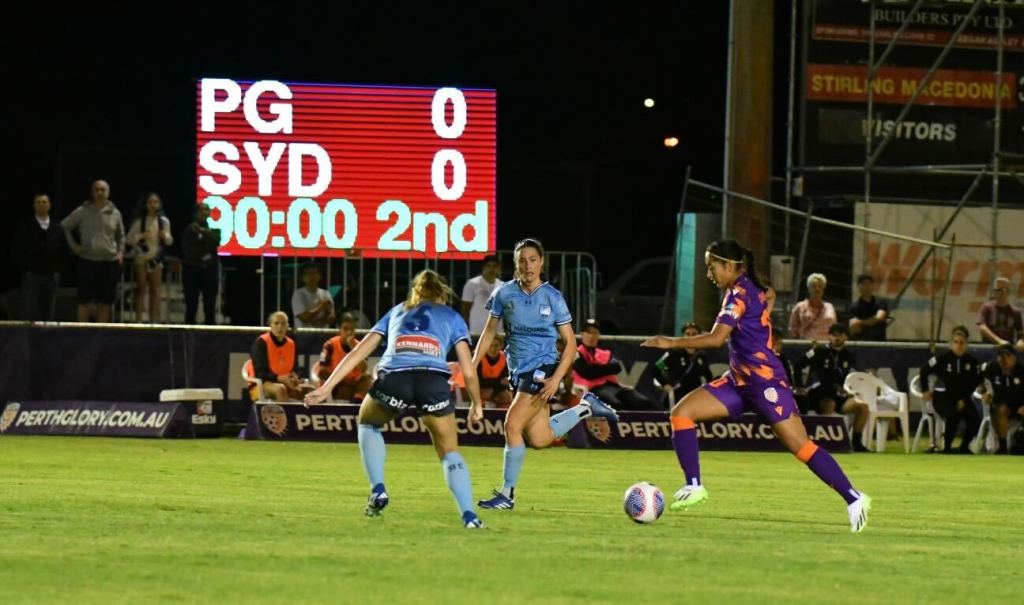
Having held 2022/23’s Grand Final winners Sydney FC to a 0-0 draw at Macedonia Park on Sunday night, the Glory are in Victoria tomorrow to take on a Western United side that Sydney defeated in the season finale last time round.
It’s the latest in a tough run of fixtures for the A-League Women leaders who have shown that they can go toe-to-toe with the competition’s biggest names.
“If you look at the last couple of fixtures (which includes Melbourne City, Sydney FC, and Melbourne City), we’ve played a lot of top-end opposition and learned a lot about ourselves, our character, the way that we play, and how we can compete and that’s given us a lot of satisfaction, but also an ability to look at the bigger picture and say ‘OK, we’re serious about what we are doing and we can compete against the bigger teams.’ It sets us up well for the second half of the season…and what it could look like for us if we continue to work hard.”
Whilst some clubs may be cautious about a five-day turnaround between games that includes a 3,400 km plus journey, Epakis doesn’t see it as a problem. Indeed, he and the players relish it for the opportunities it brings.
“From the moment we finished the last match against Sydney, that was a very taxing effort, the players worked extremely hard…the first few days of the week were focussed on the recovery. We did our first field session yesterday (Wednesday), and we have another one today. The players are very professional. They take care of themselves and that was the emphasis this week.
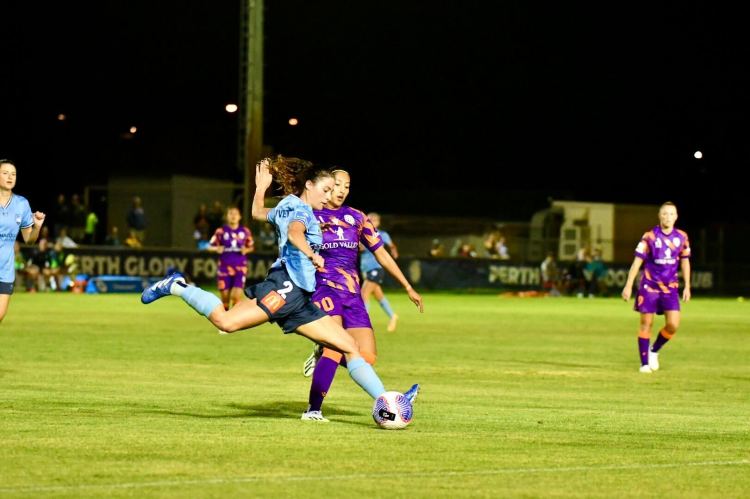
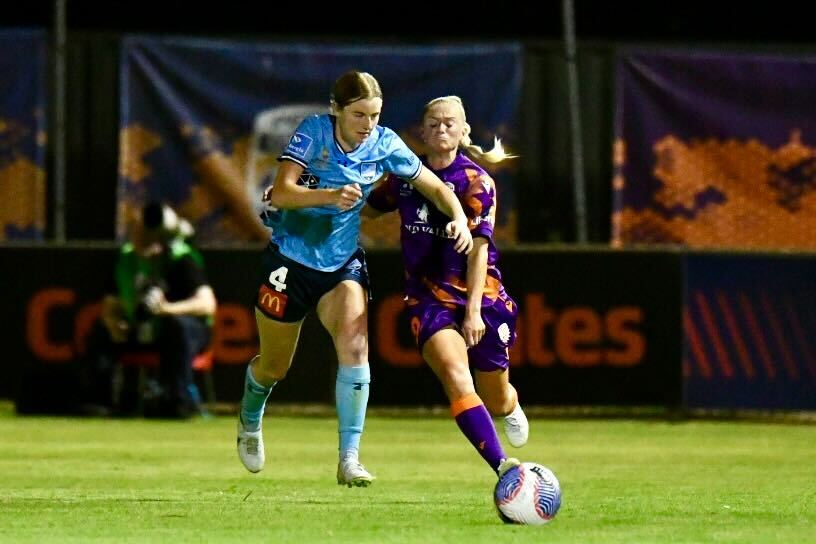
Above: Perth Glory’s young locally produced star Georgia Cassidy (right) in action last Sunday night against Sydney FC’s Cortnee Vine. Photo: Rob Lizzi for Impetus.
“We love the travel. We use it as an opportunity to really lock-in. It gives us a good amount of time to focus, to have team meetings, to have discussions, to prepare really well and focus mentally on the task at hand. I think the players galvanise in the opportunity of being well. They come together. We have a good record away this calendar year and we’re looking forward to continuing that run.”
Whilst Western United have had a mixed start to the campaign – with three wins and four defeats from their eight matches – they have retained the vast majority of last season’s successful side and have added further talent such as the outstanding Grace Maher.
“You look at that squad and they had a fantastic season last season, Grand Finalists. Those players are still there. They are definitely a team we are taking seriously,” the Perth Glory head coach remarked.
“They have some really good parts of their game that we need to be mindful of. Hannah Keane – she is a handful, and (Chloe) Logarzo. They have attacking options that cause any team damage, so we need to make sure that we are structurally really good and sound. With the ball, I want us to be a bit cleaner than we were against Sydney. (We need to) Do more with the possession we have and be more dynamic in the attack.”
That attack is likely to include the return of Grace Jale, who missed last weekend’s home game with Sydney FC. Epakis confirmed that “she is in the squad and travelling.”
In terms of what the Glory boss wants for Christmas, it’s simple. “Three points – stay top, that would be great. It would be just reward for what we’ve done this season, but in football, you don’t always get what you want, or in life. But the reality is we know that if we get three points and we perform well, we give ourselves a good chance of staying at least equal top on Christmas Day.”
Sydney FC
by Genevieve Henry
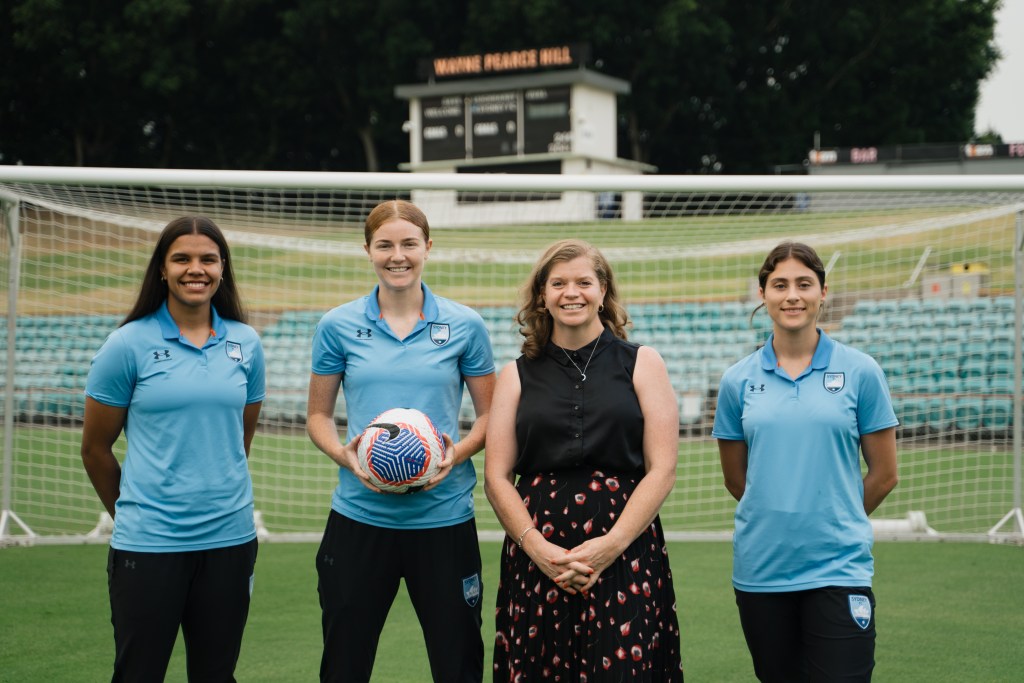
Above: From left to right, Jada Whyman, Tori Tumeth, Leichhardt Councillor Philippa Scott, and Maragaux Chauvet at Leichhardt Oval. Image: Sydney FC.
The media heard from three Sydney FC stars, Jada Whyman, Margaux Chauvet, and Tori Tumeth, ahead of their return to Leichhardt Oval this Friday.
The club announced that they would play all but one of their remaining home games at this ground, giving players and fans alike the chance to turn it into a fortress. A ground with great memories for Sydney, this move may be vital on their road to the finals.
The Sky Blues are set to face Brisbane Roar this week, with a Matildas match-up between Cortnee Vine and Roar star Tameka Yallop sure to entice the crowds to pour into Leichhardt.
Sydney will aim to get back to winning ways after a frustrating draw against a flourishing Perth Glory. Similarly, Brisbane, who are sitting in eighth, will look to win for the first time in six games. Coincidentally, their last victory came against Sydney.
On that previous meeting, which ended 1-0 in favour of the Roar, Whyman said, “Our team at that point wasn’t quite formed and hadn’t gelled as best as we could.” What can the home-ground advantage at this new stadium bring to last season’s champions? Tumeth, a player the fans have quickly fallen in love with, said of Leichhardt, “Eight home games, it’s gonna be massive to us, this pitch. We want to create a kind of fortress and make it really hard for other teams to come and play us at this location.”
Sydney FC goalkeeper Whyman, a player well-acquainted with this ground from over the years, said “I love playing at Leichhardt Oval. It’s fantastic. We’ve had a lot of big games here and a lot of memorable moments.” The shot stopper’s last match at this ground, in February 2022, saw her and the Sydney side break the record for most consecutive clean sheets (eight) in the A-League Women.
Chauvet shared her excitement for the ground, saying, ”The pitch is amazing and I’m excited to see the atmosphere that comes with (it).” Chauvet, who has been thrust into a starting role due to the injury sustained by captain Nat Tobin, shared, “I’m just taking it step by step. I’m just trying to fill that role and help the team in any way that I can.” Tobin’s injury certainly has dampened the start of the season for Sydney, as did all of the departures in the summer, but players like Chauvet have proven their qualities on the pitch to keep their team steady.
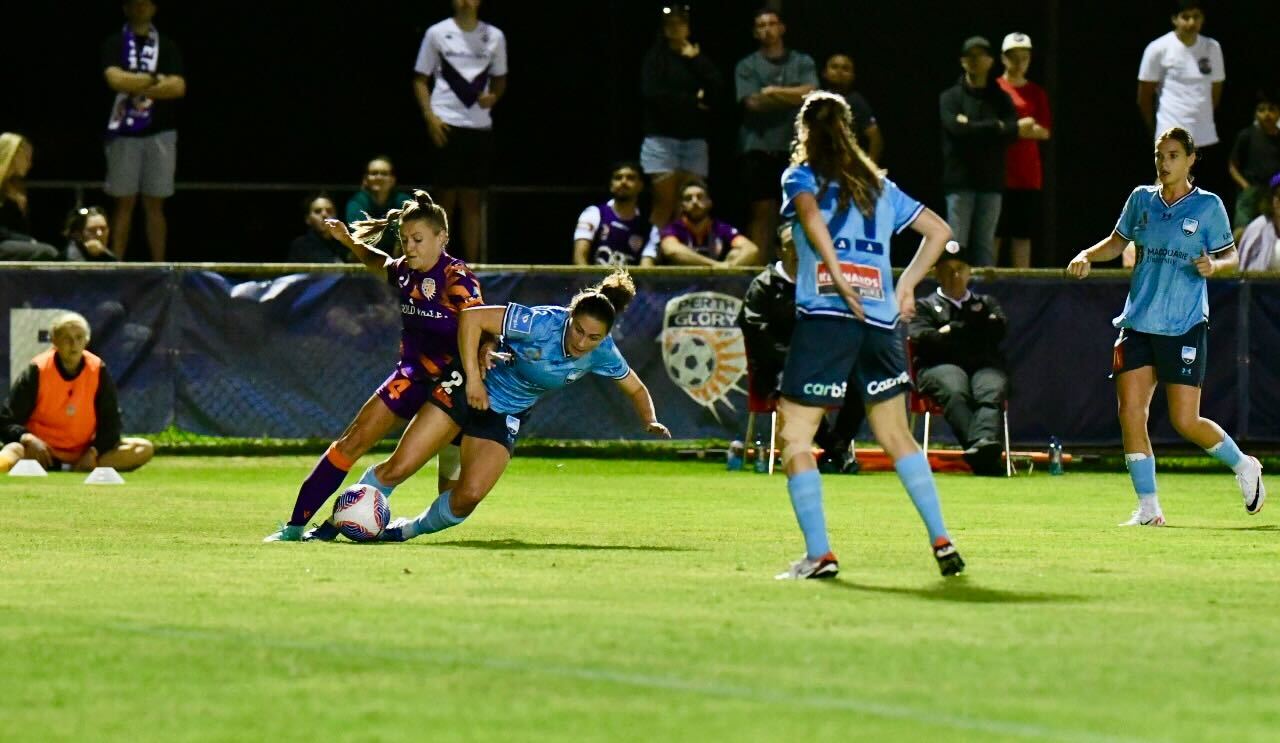
Above: Margaux Chauvet (front) clears the ball last week against Perth. Image: Rob Lizzi for Impetus.
With this new defensive line in front of her, Whyman has had to adapt, but has done so with grace. “Obviously, the whole squad is pretty new, so it’s (about) being able to work together. A lot of us talk off the field about how we do our job and what we want to achieve on the field.” Whyman said the key is putting their words into practice. Tumeth added on, “It’s such a new roster so we just want to build together, and work out how we play together so we can be successful as we have done in the previous years.”
Whyman, considered one of the best keepers in the league for years now, has seen her good form, even behind an ever-flexible backline, rewarded by a spot in Matildas camps.
She shared how Sydney head coach Ante Juric has been a big part of her call-ups, with the club helping her to focus and improve in order to gain this honour. On her experience, she said, “It’s just been amazing to be a part of that group and also work on my game and be around three other great goalkeepers. Hopefully I can push a bit further to be in there a bit more.”
When asked about making the Olympics squad, Whyman approached the issue with understanding, “It’s a tough gig, you’re getting 18 players, so it’s even smaller than what the World Cup roster was. I’m gonna try my best. If I do make it, I’m gonna be ecstatic, but if I don’t, I’m not gonna be too bummed out. I’ve just gotta keep pushing. It’s (a) long-term game for goalkeepers.”
For Sydney to have such quality players in Whyman, alongside the newly returned superstar Vine, is a big drawing factor for the swarths of fans they have seen so far. The importance of crowds was stressed by the players, Tumeth saying, “We just hope that the whole community in this inner west area gets around it and creates that atmosphere that’s gonna drive us on the pitch.”
The home advantage will be imperative for Sydney, Whyman saying, “We haven‘t played at home for a while so it’ll be good just to see all the fans again.” An intimate setting, a packed crowd at Leichhardt Oval could make all the difference for Sydney, with Tumeth saying, “It gives you that extra push.”
Sydney’s journey so far this season has been anything but straightforward, with a trip to play in the group stage of the Asian Women’s Club Championship halting their season and putting them a few games behind, while giving the fresh squad time to meld and bond.
Reflecting on those challenges, Tumeth said, “We’re definitely building, and we’re nowhere near where we want to be, but there are lots of positives that have come from the first few rounds and our experience over in Uzbekistan. There’s so much growth to achieve but we’re really happy where we are at the moment and we just want to keep building on that.”
But even with a new-look team, Juric has taken his team of youngsters to win the Premiership three seasons in a row, so it’s hard to bet against them. The players are confident and hungry to win their manager even more, Whyman saying, “It hasn’t gone the way we wanted it to at the start, but that doesn’t mean we don’t finish off the way we want it to, with a Premiership and a Championship.”
Follow Impetus on social media – we’re @ImpetusFootball on Threads, Instagram, X (Twitter), TikTok, and Facebook.
by Ava-Marianne Elliott and Hannah Chadwick (20/12/23).
Above: Fans holding signs showing support for the Canadian squad during their fight for equal pay. Photo: Her Football Hub.
As 2023 draws to a close, there’s a lot to review looking back at the monumental achievements and events for women’s football across the globe. From the record-breaking World Cup in Australia and New Zealand to the various leagues around the world, this year has seen a huge rise on all fronts for women’s football.
With more teams bringing in new fans to fill seats, more people watching from their homes, and stadiums selling out, there is a cost that comes with the positives of the increase. We’ve seen more backlash towards players on social media, hate directed in their direction, and more entitled behaviour coming from a percentage of the fans that have instilled elements into the stands that have been viewed in different ways. The expectation that is being placed on players is increasing, and they simply can’t keep up with the demand.
From the increasing controversy around fan-made signs to online hate directed towards individual players for not having the time to stop for every awaiting fan in the crowd, there seems to be a growing belief that players owe them something on a personal level.
Above: NWSL fans utilise signs to convey their support to players, who were afraid for their careers if they spoke up against abuse within the league Photo: The New York Times.
Expectations
Recently, it appears that a lot of fans, including parents who have taken young children to games, have unreasonable expectations for the match, particularly for how they expect the players to act. When purchasing a ticket to any fixture, the information clearly outlines that the price you pay is solely to view the match from your chosen seat or stand. In no way, does a match day ticket entitle a fan to a meet and greet like some appear to expect, so why are we seeing so many people treat it as such?
Personally, I think it does tie in with the fact that women’s footballers have been known for their generosity and consideration in acknowledging their fans post-match, rather than heading straight back down the tunnel. Now with the attendances rising and thousands upon thousands pouring into stadiums to spectate, players simply cannot get around to everybody, nor should they feel obliged to due to public shame on social media. It’s disappointing that this topic is something that regularly has to be brought to attention, and that clubs are starting to have to take measures to protect their players.
Football is the players’ career, their job, and their livelihood. Making the time and effort to talk to fans and even occasionally offering their shirt or boots to them, is not something that they have to do.
An occurrence that reflected how entitled some fans are was an incident that happened at the recent Manchester derby fixture. The parent of a young boy took to Twitter to express his outrage that his child’s “childhood crush”, Chloe Kelly, did not stop to say hello to the young Manchester United fan in the home section. What he did not even stop to consider, was that his child was reaching over the barrier there for player safety to grab at the City team as they passed. He included the video of the incident in his tweet, even shaming the team they were there to ‘support’ – “even all the Manchester United women ignored all the kids too. Pretty disappointing, don’t forget where you came from.”
Meeting any player is a privilege, and definitely not something that you are automatically owed for turning up to support a team. It’s entirely a parent’s responsibility to teach their child that they aren’t entitled or guaranteed to meet a player.
The generosity of the players has been taken for granted by entitled fans. Fans’ demands are putting players under pressure. Fans do not have a reason to expect so much from the players. They have played over 90 minutes of football. How is this fair on the players?
The demand of the fans have increased as they are no longer asking for photos or signatures they are now asking for shirts and boots. Players will no longer be able to keep up with the expectations and they shouldn’t have the expectations that fans have put on them.
Above: A huge attendance for the Australia v Republic of Ireland game in the World Cup this July. Photo: FIFA.
Expectations in the men’s game
The expectations from the men’s game differ greatly from the pressure and demand on female athletes. Women’s football culture has grown significantly in recent years, and whilst it’s a huge positive to take away, there are also components we have to criticise when it comes to the biased expectations that vary between the two groups.
One of the biggest differences is men’s football fans have far lower expectations for the players post match.
It does all link back to the massive generosity of female players and how they view their crowd support, which years ago they did not have for fixtures regularly. The attendances may be growing, but often, crowds are still relatively small in comparison to the consistently sold-out matches within the men’s game. I think that despite all of the factors that make women’s football so great, from supporter’s clubs to the community as a whole, it has to be noted that these women are still professional athletes who are just trying to sustain their career.
At the end of a men’s game you see two things, the players walking around the pitch applauding the fans and the fans applauding the players. This is a polar opposite to what we see at the end of a women’s game with fans pushing themselves to the front before the final whistle has been blown.
In recent games, it has been said that fans are starting to come to the front around the 75-minute mark. It is the same sport. It is still football. In the men’s game fans sit at least 10 metres away from the pitch and surrounded by security people. Is this a step that needs to happen to protect the players in the women’s game?
Fan-madesigns
Above: The Matildas star Steph Catley interacting with fans. Behind her, an array of fan-made signs Photo: CommBank Matildas.
Fan-made signs are a very broad and complex part of women’s football that has carried across from football culture within the men’s game. It’s not uncommon now to see a photo on social media of adults and children alike with glittery, bright signs hoisted high above their heads hoping to catch the eye of their favourite player. The content on signs truly does range, and it’s hard to be concise about whether they are a positive or a negative.
Signs have been used in such impactful ways, in terms of protesting against the controversies in the sport – such as showing support for Jennifer Hermoso after the World Cup Final, but we more commonly do see them in use to ask for players belongings. Whilst, understandably, receiving a boot or a shirt from your favourite squad member is a dream for many fans, they in no way are obliged to hand over personal possessions.
Whilst there are always negatives to take away, some signs, typically ones we’ve seen on smaller boards around the A4 size, have been humorous and could potentially be what lifts a player up post-match. Any sign displaying support cannot be defined as a message that has negative connotations, however regardless of how impactful the sign’s message may be you have to consider those around you and how what you perceive to be harmless could affect others in the stands.
With women’s football on the rise, it is becoming more and more common to see fans of all ages holding cardboard signs above their heads since the start of this ‘trend’ for signs that has slowly migrated over from men’s football. At the start of the migration, fans wrote messages supporting the team but the supportive messages relating to the whole team slowly faded out to make way for signs related to specific players which slowly developed into messaging stating the likes of ‘Can I have your shirt?’ or ‘Can I have your boots?’
These signs are classified as begging signs. Although signs that are held with supportive messages on them are ‘okay’ to hold, they do obstruct the view of people in the rows behind which can cause arguments to break out and lead to the potential of fans being removed from stadiums.
Fans holding signs that have messages written on them that are classified as ‘begging’ can cause problems for all parties involved including fans, players, and security staff. The main negative effect of signs is the backlash that players receive if they don’t give their shirt, or boots or even get a picture of a fan. This then causes the players to go through a period of abuse on social media which they do not deserve just because they didn’t meet a fan.
Above: Alessia Russo giving away her shirt to a young fan. Photo: Stylist.
End-of-match behaviour
Recently, there has been a big increase in the amount of fans rushing to pitch barriers long before the whistle has even been blown, usually around ten minutes before, not including any extra time added. One of the main complaints from others, especially from fans that sit in the lower tier, are mostly regarding the fact that the view from the seat they paid for becomes blocked when crowds stand at the barriers. It hinders other’s ability to enjoy and watch the game. It truly is conveying a certain level of disrespect to the others around them.
Although it is perhaps exciting to think that you could potentially be granted the opportunity to meet a player you idolise, it doesn’t entitle you to ruin another person’s experience. It does also imply that perhaps this small (but increasing) percentage of fans are in attendance for motives other than simply expressing their support and enjoying a game of football. When the whistle has blown, the fixture is over and fans begin to pile out of stadiums, it’s slightly more appropriate to stand at the barrier – however, the safety of players still has to be taken into consideration.
For the players, it must be like being in an animal in a zoo with fans pressed against the railings with fans doing everything they can to gain their attention. There have also been occasions where fans have followed players to their cars after games and chasing after them as they drive away. The safety of the players and staff around the grounds should be taken into account.
Above: A group of Lionesses fans awaiting the team’s return from Australia after the World Cup Final. Photo: The Guardian.
Response of clubs, national teams and players
One of the responses that we’ve seen so far had come from the FA regarding the England women’s team, who were met with blatant abuse online from fans fresh off the back of their World Cup tournament. With heartbreak from their failure to find gold and likely exhaustion from months of preparation, training, and matches, nevermind a 24-hour flight back from Sydney, the Lionesses were truly villainised by fans for ‘ignoring’ them upon the touchdown of their arrival back in England at Heathrow Airport.
Groups of fans gathered early on a Tuesday morning, but the Lionesses left the airport through a private exit rather than through a public space. The FA reiterated that neither the men’s nor women’s national teams will go through arrivals after a major tournament, as it’s a matter of security for the squad members. Fans don’t appear to take into consideration these factors, being so blinded by their lack of understanding courtesy of their own emotional investment into meeting players.
Georgia Stanway has been one of the voices amongst the players who have spoken up about just how difficult it can be to interact with as many fans as possible when they get the opportunity. She discussed publicly that “the FA have got a job to look after us and after that flight, they probably just wanted to get us out of the back door and get our heads down as quickly as possible.
The first club to protect the players was Manchester City who have created a ‘fan zone’ where a selected number of fans each home game gets to meet the players. However, this does not help with the abuse that players get at away games if they do not meet all the fans that have travelled. I believe that other clubs need to follow to keep the players and fans safe. England players recently composed a message to be placed on the large screens around the stadium saying the players will not be meeting fans.
Mary Earps has recently responded to the abuse on social media that she has been receiving on social media after she didn’t stop and meet a fan. In her words, she said “It’s something that we as players are experiencing in a very different way with the profile of the game changing. We love to interact with the fans. but it’s at times becoming really difficult to keep everybody happy and to interact with as many people as possible.”
Follow Impetus on social media – we’re @ImpetusFootball on Threads, Instagram, X (Twitter), TikTok, and Facebook.
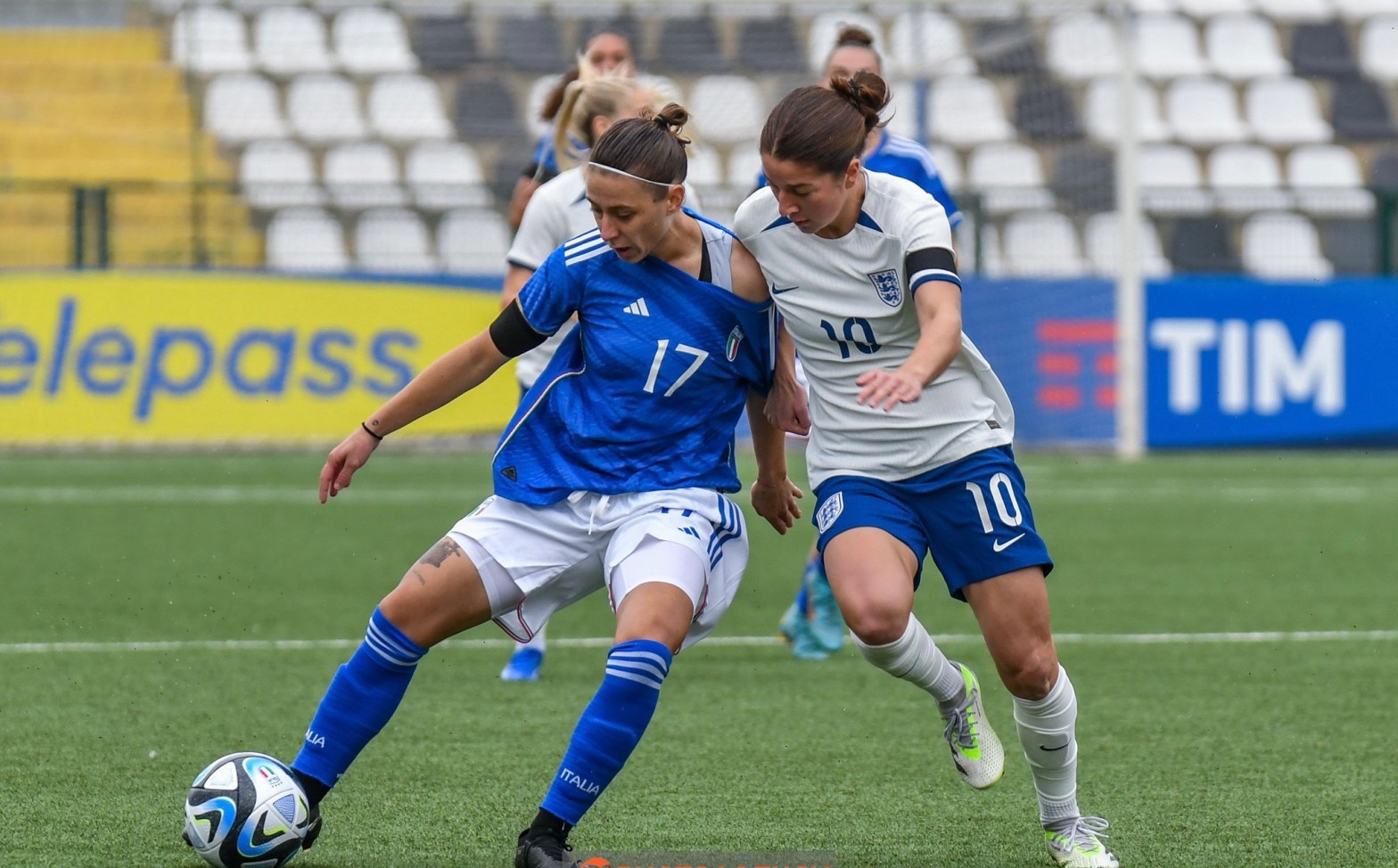
Above: Ruby Grant (right) battling away for England U23s against Italy. Photo: Lionesses.
In the dynamic realm of women’s football, a captivating narrative unfolds – a story not just of individual triumph but emblematic of the seismic shift in the sport’s overall landscape.
As women’s football is claiming its well-deserved spotlight on both domestic and international stages, one example that stands out is the remarkable journey of Ruby Grant. From the hallowed grounds of Arsenal’s youth academy to the challenges of North Carolina’s collegiate soccer and now proudly representing Swedish champions BK Häcken, Grant’s trajectory is a testament to the growing popularity and recognition of women’s football worldwide.
Her narrative seamlessly intertwines with the broader surge of women’s football into the limelight, propelled by the resounding success of the Lionesses at the Euros in 2022 and signalling a transformative era for the sport after years of dedication and determination.
Ruby Grant’s love affair with football began at Arsenal’s youth academy in North London. A captain in the making, she played a pivotal role in the Dallas Cup in Texas with the Arsenal U16s in 2016. The turning point came when – at just sixteen – she made her senior debut for Arsenal in the 2018-19 season, contributing to a decisive 4-0 away win against Everton.
In the following weeks, the North London side excelled, which culminated in being crowned as WSL champions. Alongside this, Grant remarkably juggled her football ambitions with academic pursuits, undertaking A-Levels in Biology, Psychology, and PE – showcasing the same discipline and focus that marked her on-field performances.
Above: BK Häcken’s young English star Ruby Grant. Photo: BK Häcken.
In a bold move that highlighted her commitment to personal and professional growth, Grant crossed the Atlantic at the age of 18 to join the North Carolina Tar Heels: a powerhouse in American collegiate soccer. Amidst the hurdles posed by the COVID-19 pandemic, she made a significant impact, leaving an indelible mark with her debut in a decisive 5-0 triumph over Delaware.
Furthermore, she scored an impressive hat trick during an early-season 7-0 victory against Tennessee. Under the tutelage of coach Anson Dorrance at the University of North Carolina, Grant honed her skills – illustrating the impact of the American collegiate system on her game.
However, after three years of growth and success, she decided to leave the college scene and pursue a professional career. In March 2023, Grant signed her first professional deal with Swedish Damallsvenskan champions BK Häcken. Today as she competes at the top level in the Champions League against the likes of WSL giants Chelsea, at just 21-years-old, Grant’s journey continues to break barriers and redefine what is possible for women in football.
Chosen for the England U23 squad in a recent selection, the midfielder known for adeptly positioning herself in dangerous zones earned her place in pivotal matches against France and Spain in November and December 2023 which solidified her role as a crucial player within the national team setup.
With an eye on the future, Grant’s story encapsulates the essence of a modern footballer: one who takes risks, works tirelessly, and has ambitious aspirations. As she prepares to face formidable opponents on the international stage, Grant embodies the spirit of a new generation of female footballers who are not only breaking barriers but also inspiring a global audience. I eagerly anticipate following her journey in the years to come.
Follow Impetus on social media – we’re @ImpetusFootball on Threads, Instagram, X (Twitter), TikTok, and Facebook.
Above:Smiles all round as Norwich City beat Chesham United 4-1 at The Nest. Credit – Alex Guest. Credit – Alex Guest (Norwich City Women).
FA Women’s National League Division One South East
Norwich City rounded off their 2023 in style with a 4-1 win over Chesham United at The Nest. Natasha Snelling, Ellie Smith, Katie Knights, and Freya Symonds were all on target for the hosts, with Natasha Smith getting the Buckinghamshire side’s consolation in front of a crowd of 342. The win saw Norwich end the calendar year in second, level on points with leaders AFC Wimbledon.
Eastern Region League Cup Third Round
A Hannah Fuller hat-trick and goals from Ella Gambell and Rebecca Russell saw Wroxham win the Norfolk Derby comfortably 5-1 against Dussindale and Hellesdon Rovers at Trafford Park, Isabelle Moore scored for Dussindale and Hellesdon. Wroxham will now face another Norfolk side in the next round when they travel to Mulbarton Wanderers on 28th January.
Above: Action from Wroxham’s 5-1 win over Dussindale and Hellesdon Rovers as Rebecca Russell (blue and white) challenges for the ball. Photo: Ben Cunningham.
Eastern Region League Plate First Round
Fakenham Town were 3-2 winners over Hertford Town. Vicky Lubbock, Holly Walker, and Jessica Bennett all scored for the Norfolk side. Tazmin Symonds Bishop and Charlie Mills scored for Hertford Town.
Eastern Region Premier Division
King’s Lynn Town were beaten 10-1 at Stevenage. Gabrielle Cobb was on the scoresheet for King’s Lynn Town but a hat-trick from Matilda Thomas-O’Keefe plus goals from Lilia Dempsey, Amy Makewell, Molly Green, Kelsey Millen, Jodie Southby, Mathilda Fidler, and Amy Gooderham gave Stevenage a comprehensive victory.
Eastern Region Division One North
Thetford Town ran out 7-4 winners over Histon. Alice Collins, Megan Haynes, and Kamile Omeleviciute each scored two with Hannah Claughton adding one. The Histon scorers were Laura Leyland, Rachel Pearce, Hannah Seymour-Shove, and Carla Penny.
Norfolk Women and Girls League Division One
Mulbarton Wanderers Development produced an excellent performance to beat Long Stratton 7-0. Talya Ewles-Belton scored a brace with Megan Anderton, Emily Escreet, Emma Farmer, Lucy Kean, and Rosie McNarry each adding a goal of their own.
Above: King’s Lynn Town (blue) in action at Stevenage – a game that saw them go down 10-1. Photo: Stuart Cobb.
Norfolk Women and Girls League Division Two
Great Yarmouth Town saw out 2023 in style with a 4-0 win over Hosford Hurricanes through a Lucy Morley hat-trick and a goal from Grace Walker. FC Viking Valkyries were 4-1 winners over Red Rose thanks to goals from Megan Bird, Paige Hill, Charlotte Kenny, and Kayleigh Robb. Chelsea Godden scored for Red Rose.
Stalham Town beat Horsford Harriers 10-1 thanks to five goals from Abbie Gower. Kerri Eke and Charlotte Fisher both scored two, with Amber Mayhew getting the other goal. A Chloe Dobson hat-trick saw Waveney win 3-2 at South Walsham Lingwood. Samantha Wood and Nicola Hazell scored the goals for South Walsham Lingwood.
Norfolk Women and Girls League Sevens Division One
Left Field were 7-2 winners at Loddon United thanks to a hat-trick from Tamsin Leah, two from Alisha Beadle, and goals from Ruth Howes and Hazel Packer. Daizee Tink and Jade Wilson scored for Loddon United.
Mulbarton Wanderers were remarkable 15-0 winners over Horsford thanks to four goals from Molly Ryan, plus hat-tricks from Alice Ladbrooke and Julia Robathan, a brace from Rebekah Lake, one from Emily Ransome-Farmer and two own goals.
Taverham beat Waveney 1-0 thanks to a goal from Bryony Bierley. Rockland were 1-0 winners over Dussindale and Hellesdon. Leanne Warnes was the scorer.
Norfolk Women and Girls League Sevens Division Two
Aylsham and Bulldogs FC shared the points in a 1-1 draw. Hannah Burton scored for Aylsham with Sophie Widdowson scoring for Bulldogs FC. FC Viking Valkyries were 5-0 winners at the University of East Anglia. The goals came from a Kayleigh Ellwood-Shaw hat-trick, and single strikes from Silvia Ribeiro and Lisa Ferdani.
Above: It was a happy day for Fakenham Town as they saw off Hertford Town 3-2 at Clipbush Park to progress in the Eastern Region League Plate Competition. Photo: Ronnie Heyhoe.
Follow Impetus on social media – we’re @ImpetusFootball on Threads, Instagram, X (Twitter), TikTok, and Facebook.
Jean-Pierre Thiesset summarises the eleventh round of the 2023-2024 D1 Arkema season and includes his MATILDAS WATCH of all the Australian internationals playing in the league (19/12/23).
Above: Ada Hegerberg, Lyon, blue shirt near the post, celebrating her eighth goal of this season. Photo: OL website.
Montpellier 2-1 Le Havre

For the first time this season, goalkeeper Katriina Talaslahti, started in the lineup of Le Havre. Talaslahti was transferred from Fleury to Le Havre this season and had not previously had playing time. Le Havre had the first opportunity on eight minutes through Inès Benyahia, but it was Léa Khelifi who opened the scoring for Montpellier on 13 minutes with an unstoppable header. There were two huge opportunities for Le Havre through Zoé Stiévenard on 32 and 45 minutes but still no goal came.

Talaslahti, who was very comfortable with her feet to clear the ball on several occasions, made a great save from Sonia Ouchene to prevent Montpellier increasing the lead on 50 minutes. The goalkeepers continued to steal the show as Maria Petiteau made two great saves for Montpellier on 58 and 70 minutes. Le Havre scored from an indirect freekick given following a Petiteau error. Salomé Elisor put the ball in the net after a very short pass from Inès Benyahia. Montpellier restarted strongly after Le Havre goal and Faustine Robert quickly restored their lead.
At the end of the match, Luna Gevitz was congratulated by all her teammates with a lot of tears because it was her last game with Montpellier. Gevitz, 29 years old, has decided to stop playing football to start to work as an architect and she has just graduated.
Scorers for Montpellier: Khelifi (13’), Robert (75’).
Scorer for Le Havre: Elisor (72’).

Fleury 1-3 Olympique Lyonnais
This week, Selma Bacha and Eugénie Le Sommer joined Delphine Cascarino, Melchie Dumornay and Vicki Becho on Lyon’s injury list, with Wendie Renard joining it during this game.
Lyon pushed and pressed a lot early on and Chloé N’gazi, Fleury’s goalkeeper, had a lot to do, especially on 13 minutes when she had to make a great save from a shot by Ada Hegerberg.
While they were largely on the back foot (around 70% of possession for Lyon), Fleury opened the scoring on 32 minutes on a counterattack finished by Ewelina Kamczyk.
Fleury then pushed harder and it took a quality save by Christiane Endler, Lyon goalkeeper, on 38 minutes to stop them adding a second.
Just before halftime, Lyon equalised with a Damaris Egurrola header from Amel Majri corner.
Lyon started the second half strongly and quickly took the lead through Hegerberg on 47 minutes.

N’Gazi had again a lot of work in second half to prevent Lyon scoring more goals and increasing their lead.

On a great pass from Kadidiatou Diani, Lindsey Horan showed all her skills and talent and scored the third goal for Lyon with a nutmeg of the Fleury goalkeeper. Noteworthy in this game: the performance of Mbock and of Diani who was involved in all three goals Lyon goals and voted player of the match.

Scorer for Fleury: Kamczyk (32’).

Scorers for Lyon: Egurrola (43’), Hegerberg (47’), Horan (80’).


MATILDAS WATCH – Ellie Carpenter (Olympique Lyonnais)

Ellie Carpenter was in the starting lineup for this game.

She gave another good performance, assisting her teammates in attack when needed. The TV commentator on called her “marathon” woman as she seemed to be everywhere running back and forth from defence to attack.


Guingamp 1-1 Dijon

In a game between two teams in the lower half of the standings, it was Dijon who opened the scoring near the end of first half.

Guingamp equalised at the beginning of the second half.

Scorer for Guingamp: Cambot (46’).

Scorer for Dijon: Picard (43’).


Lille 2-5 Reims

Reims had a penalty saved on 32 minutes but took the lead a minute later when Rachel Corboz finished off a very nice move. Noémie Mouchon, ex-Lille, scored their second on 56 minutes.

6 minutes later Oluwatosin Demehin, 21 years old, scored her first goal for Reims making it 3-0 for the visitors.


Lille reacted quickly and opened their account through Maite Boucly one minute later.

Rofiat Imuran scored the fourth goal for Reims only one minute after replacing Mouchon at 78 minutes.

On 86 minutes, Julie Rabanne converted a penalty to score a second goal for Lille and gave a little bit of hopes to her team.

Reims closed game out when Nathalie Chossenote scored their fifth goal at very end of the game.

With this large win Reims consolidated their status in fourth place.

Scorers for Lille: Boucly (63’), Rabanne (86’ penalty).

Scorers for Reims: Corboz R. (33’), Mouchon (56’), Demehin (62’), Imuran (79’), Chossenotte (90’+3).


Bordeaux 1-4 Saint-Etienne

In an important game for both teams struggling at the bottom of the standings, Bordeaux started strongly and opened the score on eight minutes through Hawa Sangaré.

Bordeaux missed a golden chance to pull further ahead before Cindy Caputo fired home to put Saint-Etienne level.


Above: Cindy Caputo, Saint-Etienne, green shirt (18). Photo: ASSE.fr website.


In the rest of first half the ball went back and forth, and both teams had opportunities but without any clear chances to score.

At the beginning of second half, Saint-Etienne took the lead as Faustine Bataillard headed home a corner.

The next goal didn’t come until the 74th minute – Phonetia Browne scoring after Alexandria Lamontagne had hit the crossbar.

After scoring, Browne made the decisive pass for Kess Elmore who scored the fourth goal for Saint-Etienne on 81 minutes.


Above: Saint-Etienne players celebrating their win with their fans. Photo: ASSE.fr website.

This was an important win away from home for Saint-Etienne who climb to eighth place in the table.

Scorer for Bordeaux: Sangaré (8’).

Scorers for Saint-Etienne: Caputo (13’), Bataillard (51’), Browne (74’), Elmore (81’).


Paris FC 1-2 Paris Saint-Germain

The last D1 Arkema game in 2023 saw a derby between the two clubs from Paris.

Gaétane Thiney put Paris FC ahead after four minutes – converting a penalty given for handball.

PSG slightly dominated after the goal of Paris FC but were disjointed and lacking in a cutting edge. They eventually equalised with a penalty of their own scored by Sandy Baltimore.

On 42 minutes, Louna Ribadeira saw one of her shots stopped by Constance Picaud, PSG’s goalkeeper. Two minutes later, Marie-Antoinette Katoto gave the lead to Paris SG on a counterattack.


Above: Marie-Antoinette Katoto, Paris SG (9) Blue shirt (on December 14). Photo: Courtesy of Pauline Figuet.


The second half was more compelling as key players came on for both teams, and there were plenty of chance, although no further goals. This was because of the noteworthy performances of both goalkeepers who both made several great saves.

Paris FC can have regrets because they had at least four clear opportunities to score which were not converted in goals.

PSG has now 22 points and even if they win their two outstanding games, they will still be five points behind leaders Lyon.

Scorers for Paris FC: Thiney (4’ penalty).

Scorers for Paris SG: Baltimore (36’ penalty), Katoto (44’).


MATILDAS WATCH – Sarah Hunter (Paris FC)

Sarah Hunter was in the starting lineup in this game and played 57 minutes before being replaced.


MATILDAS WATCH – Clare Hunt (Paris Saint-Germain)

Clare Hunt was in the squad but did not start. She entered at half time and played the second half.
Members of the Impetus team of contributors covering the competition unveil their choices of player, coach, and event of the week. We’ll keep a tally of all the votes and just before Finals, reveal which player and coach have received the most votes across the season to be named the Impetus A-League Women Player and Coach of the Season (18/12/23).
Player of the week:
Above: Newcastle Jets’ Lauren Allan (left) – received two votes as Player of the Week this week. Photo: Scott Gardiner via Brisbane Roar.
BEN GILBY:Morgan Aquino. A string of superb saves to deny Sydney FC on Sunday night. The Perth Glory goalkeeper is in the form of her life as her team gained a vital point in a game that saw them under pressure at the back.
KIERAN YAP: Lauren Allan. The Newcastle winger scored twice and set up one for Emily van Egmond. There were a lot of contributors in the Jets’ 4-2 win over Western United, but Allan stood out in the most measurable way.
BEN CAREY: Lauren Allan. The Newcastle Jet was on fire this week! She bagged two goals and an assist against Western United. Sensational effort.
Coach of the week:
Above: Jeff Hopkins (right) – Melbourne Victory’s head coach picked up two votes this week. Photo: Melbourne Victory.
BEN GILBY:Jeff Hopkins. The rest of the competition need to beware, Victory are finding their feet, the squad is strong, and Hopkins has his team starting to purr once more.
KIERAN YAP: Jeff Hopkins. Melbourne Victory are slowly getting everyone back from injury and the new signings are gelling with the established players and youngsters alike. The win against Canberra United made it six games since their last defeat, and they’re still improving.
BEN CAREY: Adrian Stenta. He was able to pick his team, Adelaide United, up from the disappointing start to their season, and guide them their first win of the season. It was an incredible win over Wellington Phoenix, one of the most dangerous and in form teams in the league at the moment.
Event of the week:
Above: Emily Condon – her team ethic is recognised in the category this week. Photo: Adelaide United.
BEN GILBY: Newcastle Jets v Western United – a hugely enjoyable watch.
KIERAN YAP: Adelaide United needed a goal, and when Chelsie Dawber ran free behind the Wellington defence it looked certain. But the Reds striker copped a challenge and went down injured, Emily Condon kept her composure to find space and finish a well taken goal, but the best moment was that she immediately checked on Dawber rather than celebrate her first goal of the season. Team effort from the Adelaide playmaker.
BEN CAREY: Rebekah Stott’s goal against the Mariners. Not only was it a sensational goal, but it was also her first A-League goal since March 2020!
Follow Impetus on social media – we’re @ImpetusFootball on Threads, Instagram, X (Twitter), TikTok, and Facebook.
Report by Tom Coopey with EXCLUSIVE pitchside photos from Emma Bull at The King Power Stadium for Impetus (17/12/23).
Above: West Ham United goalkeeper Megan Walsh focused on her distribution. Photo: Emma Bull for Impetus.
It was the final game of the year and until January 21st for both sides, as they looked to finish on a high into the break. With late action at the King Power, the points were shared in the end. It was disappointing for Leicester not to get their first league win since October, but it was another point on the board. It was a huge point for West Ham, moving them out of the relegation zone, and will give them a massive boost of confidence going into the new year.
Willie Kirk made just the one change from the side that drew to Brighton & Hove Albion, with Courtney Nevin coming in for the injured CJ Bott. The Hammers introduced Shannon Cooke and Anouk Denton into the starting 11, after being on the bench in their narrow loss against Everton last Sunday.
Viviane Asseyi had the first effort of the match, pouncing on a mistake at the back, with her deflected strike causing no real harm for Janina Leitzig as it looped into the arms of the German keeper. After 10 minutes on the clock, the Foxes were building some pressure whilst having a healthy spell of possession.
Kirk would have been pleased with the start his side made, apart from a few moments where the players seemed to be on different wavelengths. West Ham had a threatening moment on the counter-attack, with Riko Ueki on the left side, with the Japanese’s cross-come-shot travelling across the face of goal.
Above: Courtney Nevin on the ball looking to create chances for her teammates. Photo: Emma Bull for Impetus.
Leitzig made her first real save of the afternoon, pushing aside Jess Ziu’s effort out for a corner. The visitors were looking more dangerous, with Asseyi appealing for a penalty. Aimee Palmer received a yellow card, after a late challenge.
Ueki was at the heart of the attack once more, with her attempt bending just wide of the post this time. West Ham were in again, as a huge chance for the visitors went begging. Ueki slipped Ziu through, with a nice first touch to set her self up, she looked to slot it into the bottom corner, but it dribbled agonisingly wide.
Chances were coming from either end of the pitch, with this game patiently waiting for an opening goal. Both teams were sharing good attacking spells, but neither could provide that clinical finish. Sam Tierney unleashed a fierce strike towards goal, but it was blocked along the way by Lena Petermann.
The Foxes ended the half on a high, with the Hammers defending nervously. After 11 shots throughout the half, the deadlock was unable to be broken. Going in at the break, it was goalless at the King Power.
West Ham made a bright start to the second period, with the Foxes struggling to catch a break. Asseyi tried her luck with an acrobatic attempt, after Letizig spilled the ball from a floated ball in, with her effort looping over.
Above: Viviane Asseyi’s acrobatic attempt on goal. Photo: Emma Bull for Impetus.
West Ham were unfortunate not to be ahead. Ueki was free at the back post, with her header looking certain to hit the back of the net, but it was blocked superbly onto the bar. The ball eventually fell out to Asseyi, who blazed it over. There was more panic at the back for Leicester, with Letizig misjudging the ball, which struck the outside of the post.
After a frantic start, it was nearly the home side that took the lead. The ball fell out to Aileen Whelan, with her lofted attempt dropping just wide. There was a delay in play, with Sophie Howard down after a clash of heads. Rehanne Skinner made her first move of the afternoon as the clock struck 60, with Emma Harries coming onto the pitch. Howard could no longer continue for the Foxes, with Missy Goodwin coming on in place of the 30-year-old.
Leicester finally found the opening goal of the match, with Petermann finding the finish. A swift move from the Foxes saw Whelan in space, who sent a delightful ball that found the German striker in the middle, who slotted in for 1-0.
The home side were hungry for more after unlocking the deadlock, having a chance cleared off the line and one hitting the side netting. With the Hammers a goal down, Emma Snerle hoped to make a difference as she was introduced.
Thanks to the heroics of Leitzig, Kirk’s teamstill had their lead in-tact. Harries raced through on goal, but the goalkeeper made her self big to get a vital touch before it was eventually cleared. With 10 minutes plus stoppage time left, Leicester looked to be heading towards a big three points if they could hold on.
Skinner had a final throw of the dice, making a double substitution in the 86th minute. Additionally, the Australian Remy Siemsen came on for the Foxes. 10 minutes of additional time were added on, with West Ham looking to find an equalising goal in a last push.
There was late drama in the East-Midlands, as French defender Hawa Cissoko saw red after a clumsy tackle on Siemsen ledto her second yellow in quick succession, with the Hammers having to play the final moments with 10 players.
Above: Courtney Nevin delivers a free-kick. Photo: Emma Bull for Impetus.
Despite being down to 10, West Ham found an equaliser in the eighth minute of additional time. Ademiluyi’s cross found Hayashi at the back post, who bundled it in from close range to find a late leveller.
Ava Baker came on for the Foxes, with Leicester still determined to come away with the three points. The visitors also made a late change, with Jessie Stapleton coming on.
After all the drama, both teams collected a point, which was probably a fair outcome of the game. It was harsh on the Foxes to lose it late on, whereas for West Ham it was a brilliant moment to see them move out of the relegation zone.
Report by Ben Gilby with EXCLUSIVE pitchside photos from Rob Lizzi at Macedonia Park(17/12/23).
Above: Perth Glory captain Tash Rigby (left) under pressure at Macedonia Park tonight. Photo: Rob Lizzi for Impetus.
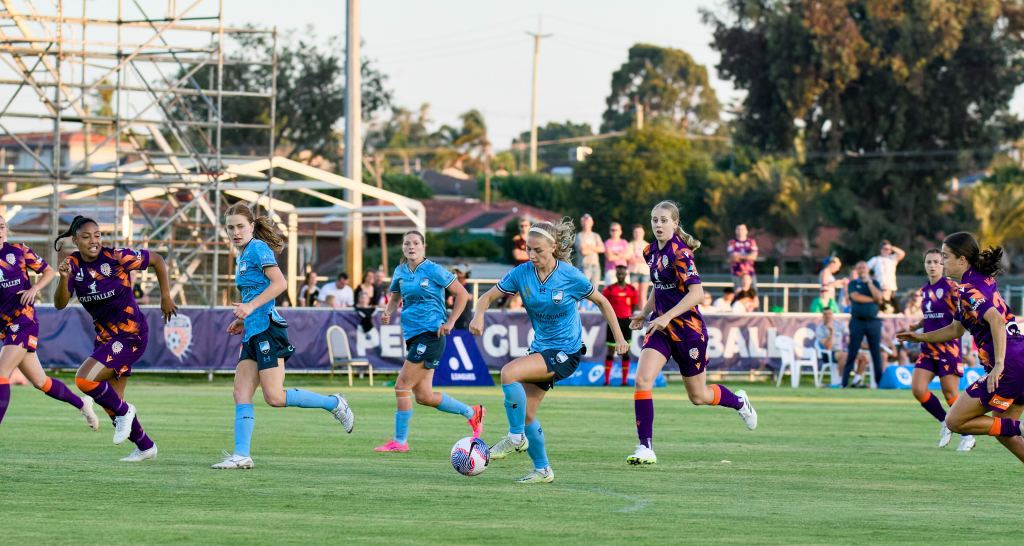
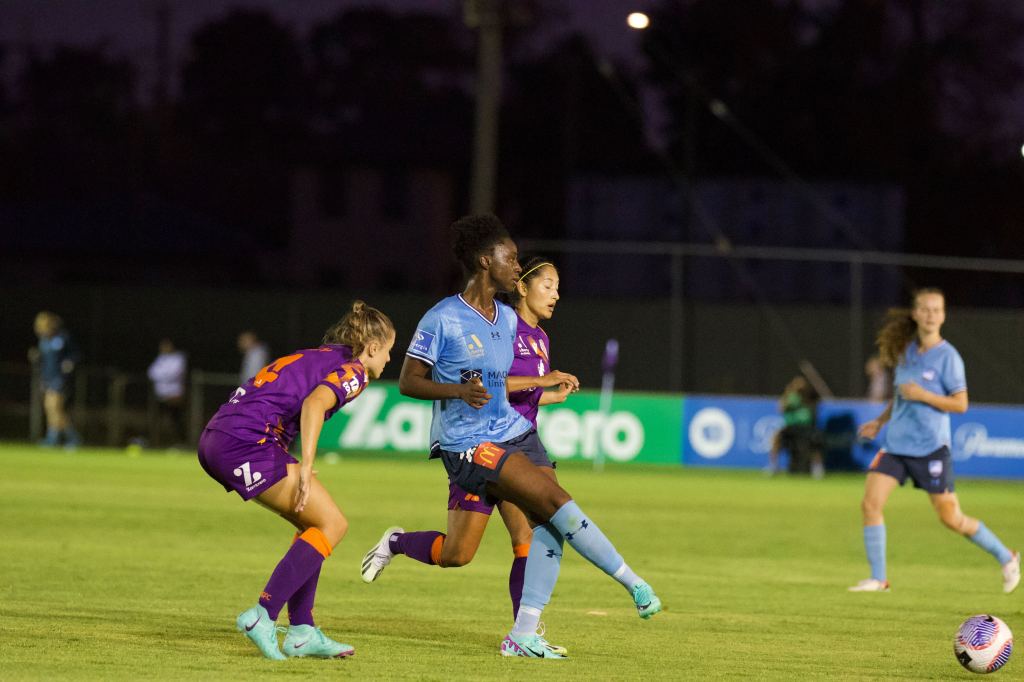
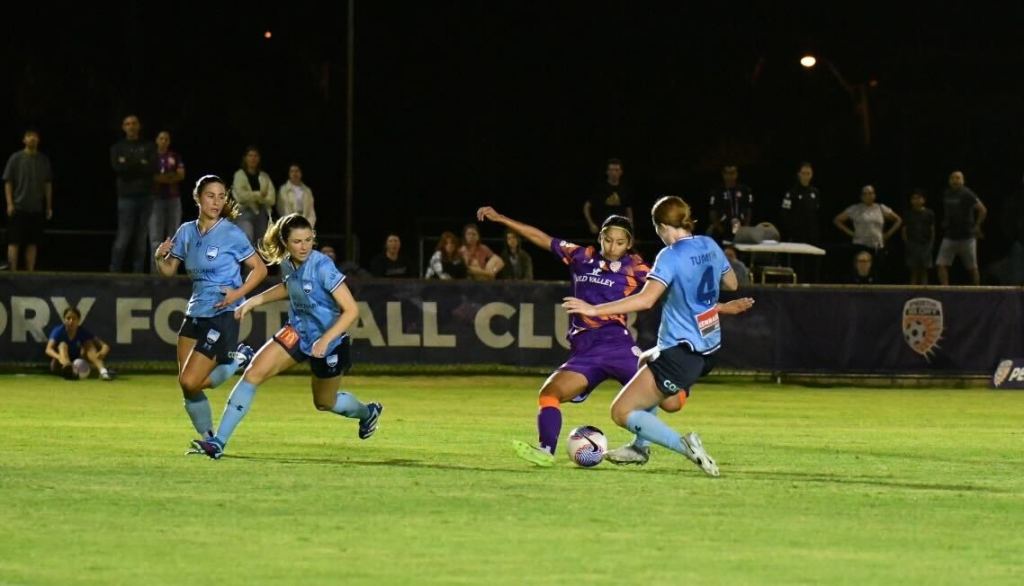
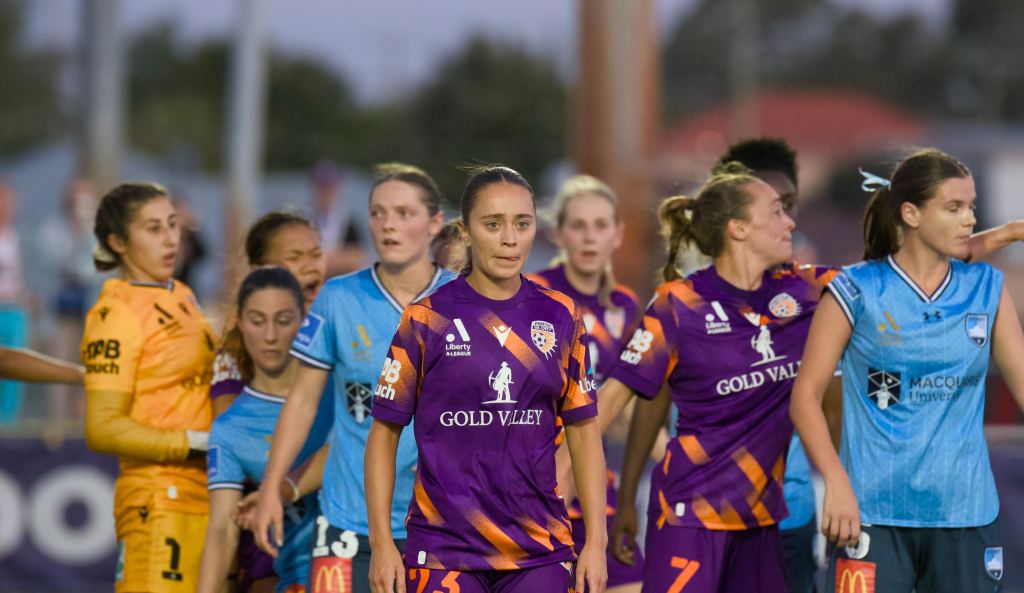
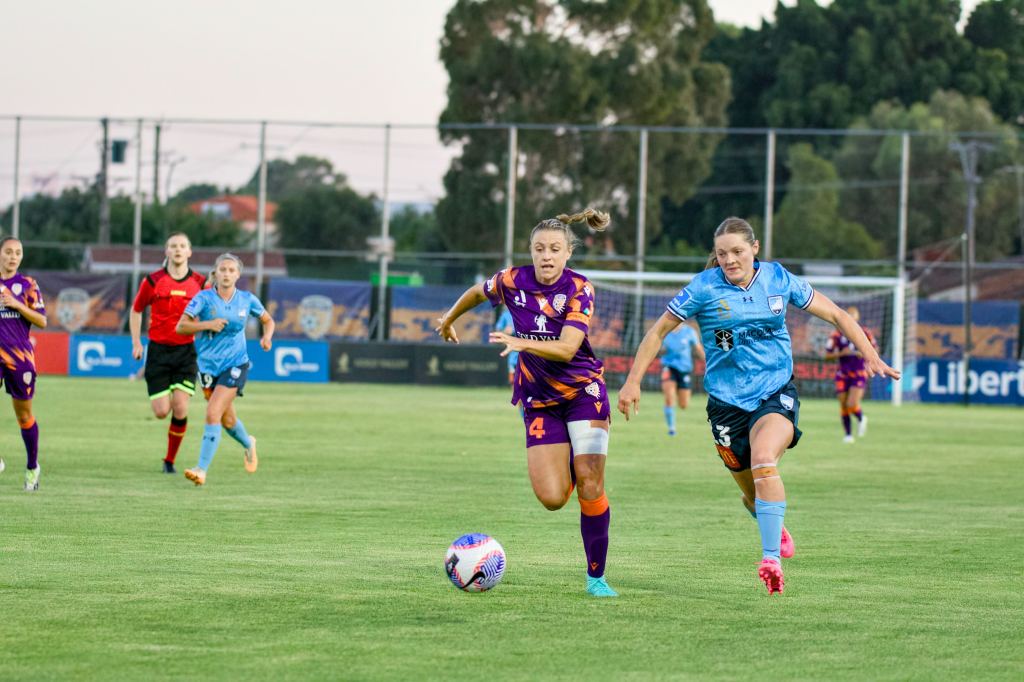
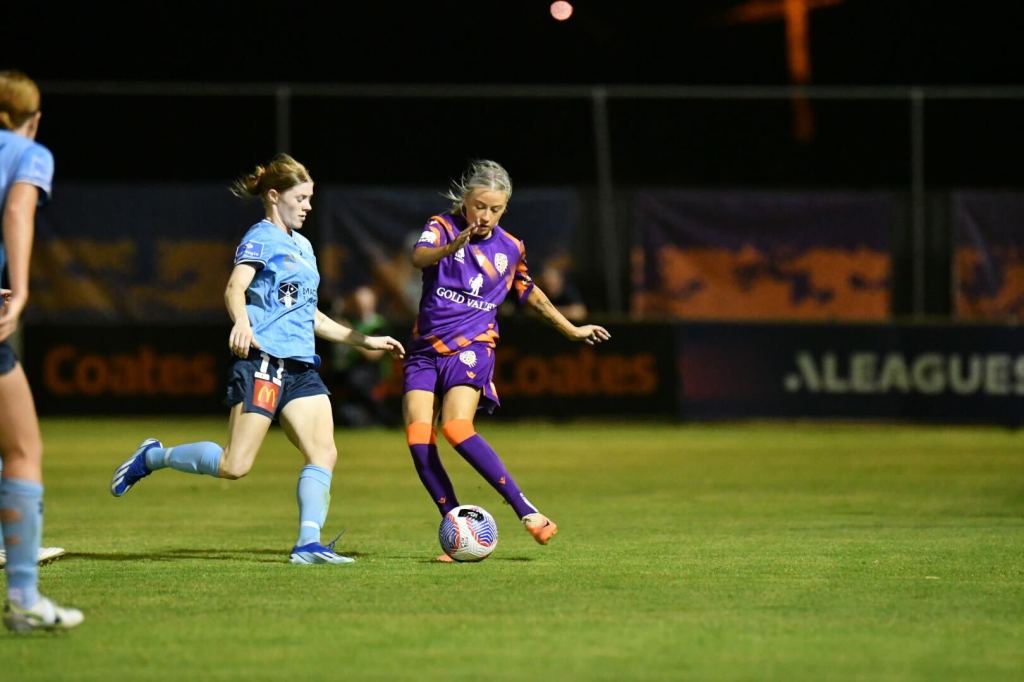
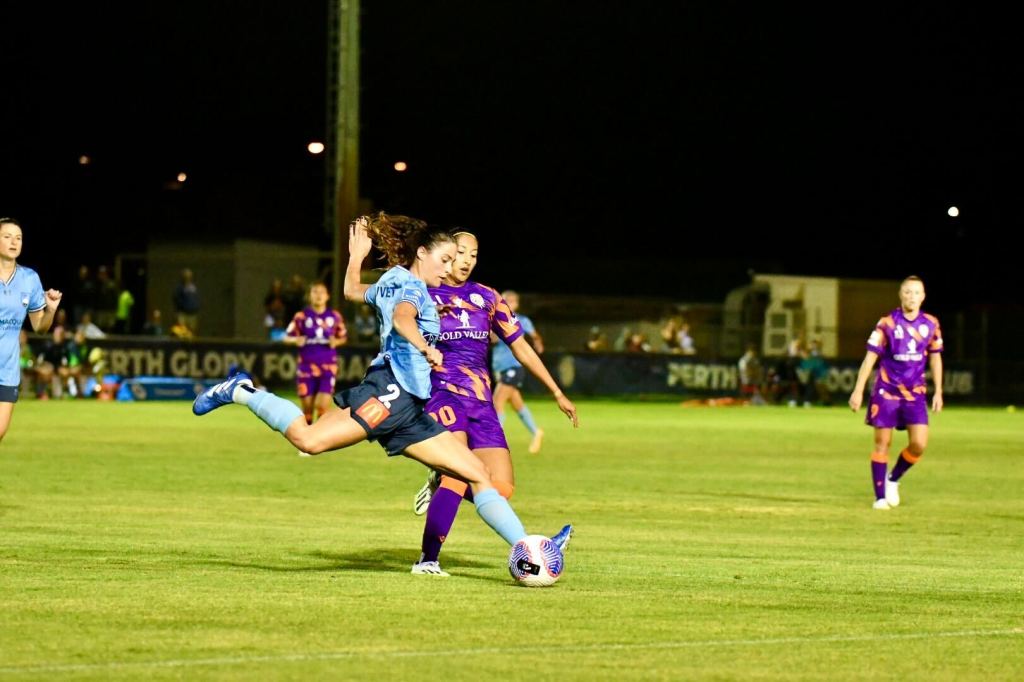
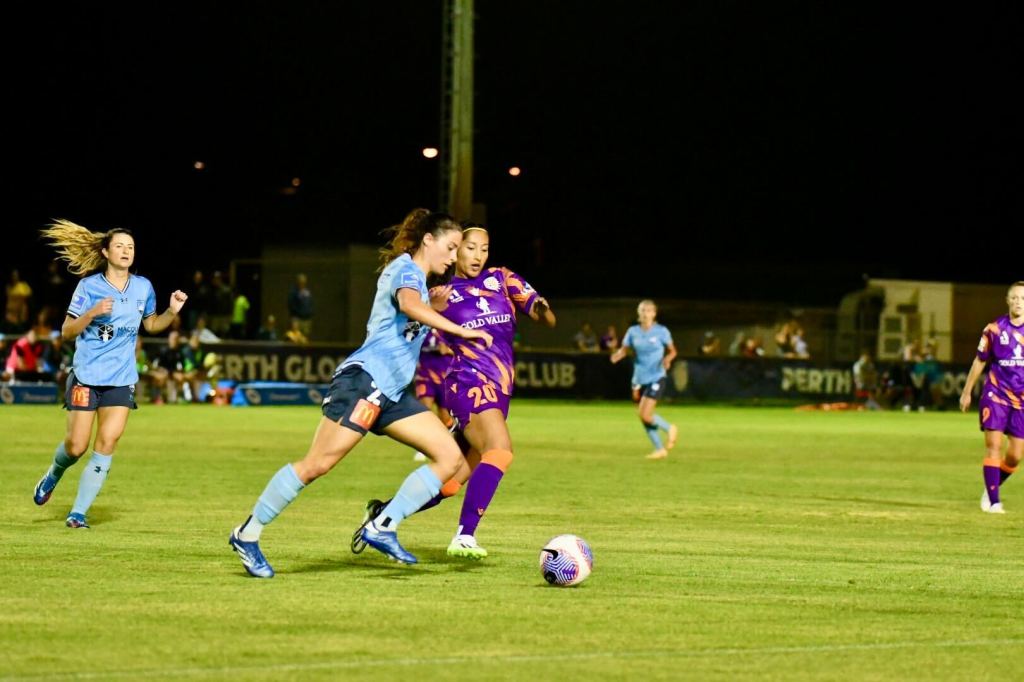
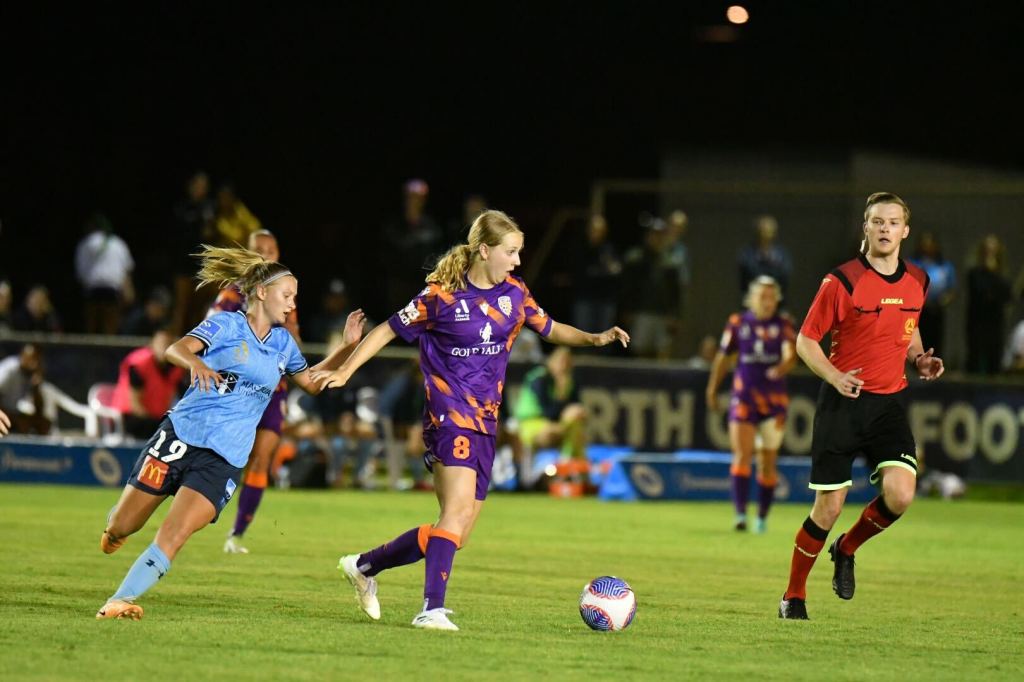
Sydney FC dominated the chances and possession, but the combination of Morgan Aquino in outstanding form and the sheer bloody-minded hard work ethic of Perth Glory ensured that they remain top of the ladder with this point.
Perth welcomed back Claudia Mihocic into the starting line-up after successfully overcoming concussion protocols after she sustained a head knock in the Glory’s game at Wellington Phoenix before the international break. Grace Jale was missing from the matchday squad, with Abbey Green coming onto the bench.
The defending A-League Women champions had their Matildas World Cup star Cortnee Vine on the bench but could still boast Princess Ibini and Fiona Worts up front along with Aideen Keane, a player that Perth Glory know all about from her spell in Western Australia.
Sydney came out firing from the off. The opening exchanges saw a shot from Ibini, and then, with four minutes on the clock Keane linked with Worts on the edge of the box. The Sydney striker chested down and fired a powerful shot that Morgan Aquino did brilliantly to push away.
Above: Fiona Worts breaking through for Sydney FC – she saw a great effort denied by Morgan Aquino. Photo: Rob Lizzi for Impetus.
Just before the 10-minute mark, in-form Glory striker Millie Farrow looked to break through before being taken out on the edge of the box by Charlotte Mclean, who received a yellow card as a result. The free kick, right of centre on the edge of the ‘D’ was nullified by Sydney’s impressive rapid-fire press from Perth’s attempted training ground routine.
With the quarter-hour mark reached, the home side had settled into the encounter with the creative energy of Susan Phonsongkham a key component in this as she began to link up with Hana Lowry. The pair would combine as the latter found the former on the right flank, but the cross-shot just went over the top.
However, with Perth looking less defensively sound than they have otherwise this season, Sydney were still looking threatening offensively. Aquino had to make another stunning save from a looping shot from Ibini that was deflected en route.
Above: Princess Ibini plays a pass at Macedonia Park tonight. Photo: Rob Lizzi for Impetus.
As the half edged closer to its conclusion, Sydney began to dominate the possession and territory once more, with Zara Kruger sending in an increasing number of dangerous corners in the period.
Keane was also an increasing menace for the Perth defence, and it was her curling shot right on the half-time whistle that called Aquino into action once more.
The second half opened with Sydney FC bringing on Matildas star Vine in place of Keane. Despite this, it would be the hosts who had the first chance of the second period.
Above: Cortnee Vine was introduced in the second half for Sydney FC. Photo: Rob Lizzi for Impetus.
Lowry’s freekick from the right-hand side two minutes into the second period found Tash Rigby at the back post, with her stooping header saved by Jada Whyman in the Sydney FC goal.
The Harbour City side were back on the offensive and once more dominated possession and territory. Within seven minutes of coming on, Vine powered into the box and let fly with a powerful effort which brought another superb one-handed save by Aquino.
As the game entered its last 20 minutes, Shea Connors was introduced by Ante Juric and immediately showed her worth with a jet-heeled burst along the left before shooting wide. Ibini missed a golden opportunity shortly afterwards as a high free kick was curled into the box and both Sadie Lawrence and Rigby failed to clear. The Sydney attacker’s finish was well over the top.
Above: Quinley Quezada’s hits her stoppage time shot for Perth Glory. Photo: Rob Lizzi for Impetus.
In this spell, Sydney made claims for a penalty after Ibini went down under a shoulder-to-shoulder challenge on the edge of the area with Jess Cowart, but referee Shane Skinner was unmoved.
A rare second-half entrance into the box area for the hosts saw Quinley Quezada supply a lovely off-load for Phonsongkham, but Sydney snaffled the danger away quickly. Quezada was involved again with a chance in stoppage time, but massed defence and the presence of Whyman denied the Philippines attacker.
Sydney FC are likely to see this as two points dropped for their dominance and opportunities. They were denied by Morgan Aquino in career-best form, and a wider Perth Glory side who battle and scrap to the death for the shirt. Whilst Sydney largely nullified the Western Australian side’s attacking threat, Glory went toe to toe with one of the league’s best and once more came out undefeated.
Rob Lizzi’s EXCLUSIVE photo gallery from Macedonia Park for Impetus:
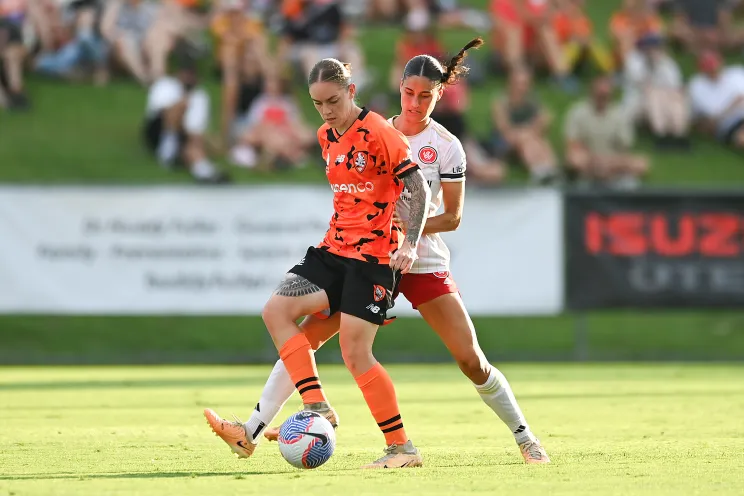
On a piping hot Sunday evening in the Sunshine State, Brisbane Roar and Western Sydney Wanderers traded blows in an exciting, high-energy draw.
The Roar came into the match hoping to overcome a five-match winless streak, which was equal to the longest in their competition history. The Wanderers were hoping to continue their recent vein of rich form. Both teams took a point, but neither left entirely satisfied.
The match started out quite cagey, both teams testing each other out in the midfield. After about 10 minutes, Brisbane began to take it up a notch. They had a number of promising attacks involving the likes of Sharn Freier and Tameka Yallop, but the Roar couldn’t finish the chances off. In the 26th minute, however, good pressure from that pair forced a turnover in an advanced position. Yallop hit a well-measured pass to Corbin, who ran past a few defenders and pulled out a fine finish to slot it past Wanderers’ keeper, Sham Khamis.
Mia Corbin gives us a 1-0 lead after driving into the box and putting it away! 🤩 pic.twitter.com/xOpMZtjTyI
In the 34th minute, a great corner kick from Hollie Palmer found the head of Rebecca Kirkup, who thumped it into the back of the net, but before the Roar could even celebrate, the goal was disallowed because Jenna McCormick was allegedly blocking the run of Khamis. If that is indeed the case, it was a very soft foul, and extremely contentious given the two-goal lead that was on the line.
10 minutes later, it looked as if Freier would erase the pain of the disallowed goal. There was a mad scramble in the Wanderers’ box. Freier took a shot, which hit the woodwork, and there was a goal-line clearance from a Wanderers defender. By some miracle, the visiting side went into the halftime break only down one goal.
The second half started off much the same as the first, with Brisbane Roar on the attack, and Wanderers mostly absorbing pressure. However, the script was flipped soon after the 50-minute mark, when a sensational ball from Caspers in the midfield found an unmarked Sophie Harding inside of the Roar box. Harding’s finish was ice cold, putting it past Roar keeper, Jordan Silkowitz, to equalise.
Six goals in four games 🤯 Sophie Harding just can't stop scoring 👏
The Western Sydney Wanderers star produces the goods once more to level the scoreboard!
After the equaliser, the game became a lot more even. There were a lot of midfield skirmishes and half chances up both ends. Just past the hour mark, the Wanderers attacked the Brisbane goal, the ball deflected off Roar defender Kirkup and hit the underside of the crossbar before being quickly snatched up by Silkowitz. But the Wanderers were a lick of paint away from the winning goal.
The final 20 minutes, saw a lot of player fatigue and resulting cramps and substitutions, understandable given the massive workload most of the players were putting in on a hot and humid day. As a result, space began to open up and there were numerous attacks up both ends of the pitch. Brisbane probably had slightly better opportunities, but neither the home side nor the visitors could convert on any of the chances.
The Roar and the Wanderers have done a bit of a Freaky Friday in terms of form this season. Wanderers lost their first two matches but have now won three out of their last five (and the only one they lost was a tight 4-3 loss to Melbourne City). Conversely, Brisbane won their first two matches, against top teams no less, but since then they’ve now had three draws (all 1-1 draws) and three losses (including the 5-1 drubbing from Canberra last weekend).
Brisbane Roar will have a lot of positives to take away from the match, and many points for improvement as well. Their first-half performance was fantastic, but they needed to be more clinical in front of goal. Freier was sensational today. Despite the cramps all over the park, she kept her energy high the entire game, using her pace and footwork to hurt the Wanderers down the left side.
Yallop put in a good shift too. Her positioning and physicality were wonderful. Corbin was great up front, but perhaps should have put away at least one more goal. The chances were there. The Roar backline performed well for the majority of the match, but allowing someone of Harding’s quality and form to be unmarked in their box is absolutely criminal.
Western Sydney Wanderers will take away very similar positives and learning points to the Roar. Although it was a solid team effort, it was ultimately a story of two key players for them. Harding up front was excellent. She had one thing on her mind, and that was scoring goals. Not only did she score the equaliser, but she took six more shots, several of them testing Silkowitz. Up the back, Khamis was outstanding. She made six saves, including several diving saves and at least one where she tipped the ball over the crossbar.











 impetusfootball.org