Above: Millie Farrow leads the celebrations for Perth Glory at Central Coast Mariners today. Photo: Liberty A-League.
Two goals from Millie Farrow – her sixth in the last five A-League Women games – ensured Perth Glory returned to winning ways against a Central Coast Mariners side who will feel they should have taken something from the encounter.
Perth had the best of the possession in the opening exchanges and tellingly in the opening 20 minutes or so were able to spread the play which allowed their creative midfield weapons to get involved – something that both Western United and Sydney FC had largely shut down in their recent encounters with Alex Epakis’ side.
Glory hit the front with just seven minutes on the clock. The visitors were imposing a high line and it got its just reward. Former Perth keeper Sarah Langman played a short goal kick out to Taren King to the left-hand edge of the box, but under pressure from Grace Jale, King played the ball back towards Langman which Millie Farrow redirected into the net.
Perth’s high press of the Mariners when they were in possession combined with their domination of the possession continued with the home side sitting back and unable to force Morgan Aquino into making a save.
As the half hit the 25-minute mark, the hosts began to get a foothold into the game as they began to look to the flanks to develop their attacks. Rola Badawiya became more involved, and Bianca Galic forced Aquino into a straightforward save. Badawiya was then released by Faye Bryson, but her shot on goal was dealt with by the feet of Aquino.
There would be one further opportunity for the hosts before the break when Bryson was allowed to run through the left of centre channel and crack in a powerful shot that Aquino had to palm away.
The second half started in a similar way with Mariners seeing plenty of the ball and Badawiya calling Aquino into action with a long-range shot. Bryson also fired in an effort from the edge of the box that was blocked. Despite their increasing number of shots on goal and possession, Central Coast were not quite able to summon the necessary extra bit of magic or quality to break through. The threaded passes needed to unlock the Perth defence were missing, with the hosts relying on shots from distance.
Then 12 minutes into the second period, that threaded pass came after a move along the right from Bryson who fed Galic. Perth failed to clear in a short game of pinball around the near post before Badawiya forced the ball over the line, but Paige Haywood was in an offside position when she got an initial touch ahead of Badawiya and the goal was ruled out.
Galic and Bryson’s influence was increasing along the right flank and a further long-range effort rained in from Badawiya. However, the hosts were made to pay for their inability to turn possession into an equalising goal with 66 minutes played.
Six goals in five games! Millie Farrow just can’t stop scoring! 😮💨
The Glory attacker gets her brace against Central Coast Mariners 🙌
Tash Rigby’s throw on the right, parallel with the six-yard box found Jale who turned her way past two markers before returning the favour to Rigby who had acres of space to deliver a high ball towards the back post for an unmarked Farrow to head home.
Yet, just two minutes later, it was game on once more. Langman’s clearance found Bryson who threaded a pass into the stride of Badawiya entering the box to hit a first-time rocket into the net.
That is one filthy strike 😮💨🔥
Rola Badawiya fires in this incredible goal to half the deficit for Central Coast Mariners 🤩
The Mariners pushed for an equaliser with a golden chance coming deep into stoppage time. Despite Peta Trimis’ run along the right and cross to the back pass for Wurigumula, the chance went begging. Overall, they just couldn’t find a telling pass to unlock the Western Australian side’s defence.
This was a game that Central Coast could have won with a bit more quality and creativity. Too many of their shots on goal were from distance and their two major defensive lapses were ruthlessly punished. Perth did something that all championship-challenging teams do – win despite being below their best.
This was an important win for Alex Epakis’ side – but they can’t afford to let future opponents have as many shots on goal as the Mariners did today – other sides will convert them.
Above: The Wanderers celebrate Amy Harrison’s opening goal against Melbourne Victory. Photo: Western Sydney Wanderers.
Western Sydney Wanderers 2-0 Melbourne Victory
Goals from Amy Harrison and Alexia Apostolakis gave the Western Sydney Wanderers a 2-0 win against Melbourne Victory in an impressive and dominant performance.
The Wanderers results may have been inconsistent, but their performances have been consistently competitive this season. At times only bad luck, inexperience or excellent opposition defending has denied them results, but against the visiting Victory it was a fair complete display from Robbie Hooker’s team.
Much of the pre-match talk surrounded Victory. Alex Chidiac’s return to the club filled social media feed and the Julie Dolan medallist was named on the bench by Jeff Hopkins. Lia Privitelli started for the first time this season and Emma Checker was back in the first XI.
To add to the drama, backup goalkeeper and fan favourite Miranda Templeman was withdrawn before the match started. She appeared to be injured in the warmup and hopes will be with her that it is not serious, but she was unable to walk off unaided.
For the home side, things remained comparatively unchanged, but they were able to call on Melissa Caceres from the bench in a squad that is starting to look deeper as their young brigade gain experience by the week.
Victory started the brightest of the two sides. Kurea Okino was able to find space repeatedly behind the Wanderers defence but was unable to trouble Kaylie Collins in goal and was lacking support when cutting the ball back.
Lia Privitelli had the best chance for the visitors when she ran onto an Okino pass, but Collins was off her line quickly to snuff out the opportunity.
Just past the half hour mark, Victory coach Jeff Hopkins made the first change of the afternoon. Okino was withdrawn for Sara D’appolonia. It was not obvious if it was due to injury but the change left the visitors without a recognized centre forward on the pitch for the rest of the game.
The Wanderers struck almost immediately after. An Apostolakis corner kick was met at the back post by Amy Harrison. The Western Sydney skipper buried the goal from close range.
Victory tried to push for an equaliser, Alana Murphy moved the ball forward with her usually efficiency but Victory’s clear-cut chances dried up. D’appolonia’s pressing was energetic, but any advantage gained in that department was cancelled out by the Wanderers having less to worry about without Okino’s presence and movement.
As the game went on, The Wanderers confidence and control increased. Apostolakis struck in the 51st minute to double the lead with a well taken finish after a Holly Caspers played in the Young Matilda.
Caspers was becoming a constant threat to the visitors. Her mobility, pressing and dribbling was causing problems, and she was unlucky not to score one of her own when her left footed effort bounces off the far post with Lydia Williams beaten.
With the situation becoming desperate for the visitors, Chidiac was introduced to the contest. It provided an immediate boost to the morale of watching supporters but came at the cost of Murphy being withdrawn.
Murphy is still only 18, and is being managed carefully by Victory as she grows into her first full season as a regular starter, but had also been Victory’s most dominant midfielder in this game. It would mean another shift in tactics for Hopkin’s side.
Chidiac’s return appearance was encouraging. She was able to link up well with Rachel Lowe and find her usual pockets of space. The addition will no doubt strengthen Victory this season, but she was unable to make much of an impact in the last half hour of this game. The Wanderers remained in control of the pitch for the rest of the afternoon and any chances that Victory did create were snuffed out by a commanding Collins.
Both teams have challenging games next week. Victory will need to be at their best to avoid dropping points against Western United. The Wanderers will travelling to Perth, and a result there might see them surge into finals favouritism.
Above: Deven Jackson in possession for Canberra United. Photo: Canberra United.
Canberra United 1-1 Western United
Canberra United and Western United shared the points with a 1-1 draw at McKellar Park, in a highly entertaining match that could have either way.
Within the first minute of the match Canberra came agonizingly close to opening the scoring via a great cross by Vesna Milivojevic that was directed to Nicki Flannery in the six-yard box but just wasn’t able to be converted. It was a very dangerous opportunity that would have been the perfect start.
Both sides early on were very good on the ball where Western had the majority of possession within the first 10 minutes with 55%. Canberra on the other hand, looked just the more likely to have found the back of the net given the chances that they created early.
In the 23rd minute, Canberra once again came close to a goal with a great cross by Mary Stanic-Floody that found Michelle Heyman in the box but just wasn’t able to have the most ideal contact.
Eight minutes later, Flannery provided an integral through-ball to Sasha Grove on the wing who then crossed the ball into the box for Heyman. Western’s Alana Cerne just made contact with the ball, and it went off the post for the opening goal of the match.
Canberra were dominant in the first half from an attacking perspective. Western wasn’t really able to make many dangerous chances in the final third thanks to Canberra’s defence who had an answer to everything.
In the 57th minute, a massive scrabble with the ball occurred in Canberra’s box. Chloe Lincoln made a very significant save which during all of this. Despite coming close in front of goal during this sequence, Western United didn’t score thanks to the Canberra defence.
As the second half progressed, Western came to life and replicated how they were early on in the match. Most importantly, they were creating more chances that definitely kept Canberra on alert but due to the defence, Western needed to take full advantage of the slightest opportunity available to them.
In the 76th minute, Western’s hard work finally paid off thanks to a great cross by Tyla-Jay Vlajnic. The ball was headed off Hannah Keane in the box and directly to A. Taranto who slotted the ball past Lincoln for her third goal of the A-League Women’s season as Western scored a crucial equaliser.
In the 90th minute, Jaclyn Sawicki almost scored an amazing goal from outside the box that just came off the post. Western thought they’d scored the winner from the rebound, but Hieda was deemed offside.
A special congratulations has to go to Australian international and Western United co-captain Chloe Logarzo achieved the milestone in this match 100 appearances in W-League/A-League Women. A great achievement for a great footballer.
Above: The Australia team lining up before their Olympic Qualifier with Chinese Taipei in Perth on 1st November. Nine of the 11 players shown either currently or have played in the WSL Photo: Kris Goman for Impetus.
Across July and August this year the Matildas co-hosted a home World Cup, where 32 nations competed – the largest number the tournament has ever seen. During the tournament, the Matildas took the Australian nation by storm with the team’s home and away kits flying off the shelves and completely selling out before their semi-final against England. As they progressed in the competition they displayed tremendous skill, dedication, teamwork, but most of all passion and pride.
As Matildas lead up to matches built so did their audience, this saw the team break multiple TV records and create one very important one for Australian history. The semi-final against England saw the team break Australia’s all-time sporting TV viewing record previously held by Cathy Freeman’s historic gold medal run in the 2000 Olympic Games.
The match saw over 11.5 million Australian viewers tune in and watch to help support the Tillies. Multiple more public venues were opened around Australia to allow fans to watch the match and get behind their team. From this tournament, the Matildas impacted the nation, changed the football culture forever, and affected how Australians view women in sport.
Now six months on, the team have just sold out their 12th consecutive home match when Uzbekistan come to the 53,000-capacity Marvel Stadium in Melbourne for the final round of Olympic qualifying. The Matildas have not only influenced football in Australia, but many showcase the ‘Tillies Effect’ weekly in the WSL.
Above: Arsenal’s Steph Catley (left) and Caitlin Foord. They have subsequently been joined in North London by fellow Matildas star Kyra Cooney-Cross. Photo: Arsenal Women.
Twelve Australians currently play across eight teams in the Barclays WSL. Arsenal has Caitlin Foord, Kyra Cooney-Cross, and Steph Catley, Brighton and Hove Albion have Charlize Rule on their books, Sam Kerr is at Chelsea, Everton has Clare Wheeler, Courtney Nevin, and Remy Seimsen are at Leicester City, Liverpool has Tegan Micah, Manchester City has Alanna Kennedy and Mary Fowler and West Ham are captained by Mackenzie Arnold. As the winter transfer window looms, it is expected that more Matildas may make the move over to the Women’s Super League.
The impact the Australians have in the WSL extends far beyond the pitch, as their presence has increased the global visibility of the League. With Australian fans tuning in weekly to watch their favourite national team players in action during their WSL matches with many fans also purchasing their favourite player’s club kit and even some travelling to England to watch them play.
Above: Sam Kerr with her fourth WSL title in May this year. Photo: Andy Wicks for Impetus.
Matildas captain Sam Kerr joined Chelsea ahead of the second half of the 2019/20 WSL season, and ever since then she has impacted the team’s performance and helped them secure the league title for a fourth consecutive year. In just under four years the Western Australian has made over 100 appearances for the club scoring over 80 goals in the process.
Kerr has a habit has scoring last-minute goals for Chelsea helping the team secure three points, or a comeback to draw the game time and time again. Across her time in South London, the East Fremantle-born star has helped Chelsea win four WSL titles, three FA Cups, and two Conti Cups. Kerr has also featured for her club throughout the UEFA Women’s Champions League, making appearances in the final against Barcelona in May 2021 and the Semi-Final against the same Catalan giants in April this year.
Above: Kyra Cooney-Cross (left) fires in a shot for Arsenal in the North London derby at Tottenham Hotspur just before Christmas. Photo: Mariella Prew for Impetus.
Kerr’s national teammate Caitlin Foord has also been on formidable form in the WSL so far this season. In 10 appearances, Foord has two assists and two goals to her name, as well as the handful of chances created and attacking opportunities for Arsenal.
In the 22/23 season, Foord played 19 WSL matches for the Gunners and finished with six goal assists and six goals. Foord’s fellow national teammates Steph Catley and Kyra Cooney-Cross also bring quality and tremendous skills to Arsenal. Catley and Foord often play the full ninety minutes and create many attacking opportunities moving down the pitch through linking well down the left-hand side.
In Arsenal’s match against Manchester City at Meadow Park, Foord assisted Catley to score the match opener. In the post-match interview, Catley revealed that during the match, she and Foord know where the other one is instinctively.
The North London club’s new summer signing Cooney-Cross, has played an increasing role across the WSL and Conti Cup, and has produced stellar performances earning her the WSL Player of the Month award for November. The trio encapsulates Arsenal’s values and constantly demonstrate desire, teamwork, and a high level of versatility which they all show on the international stage for the Matildas.
Follow Impetus on social media – we’re @ImpetusFootball on Threads, Instagram, X (Twitter), TikTok, and Facebook.
Impetus’ Ben Gilby, Genevieve Henry, and Kieran Yap report on four media conferences from A-League Women clubs ahead of round ten (29/12/23).
Adelaide United
by Genevieve Henry
Above: Adelaide United head coach Adrian Stenta at today’s media conference. Photo supplied to Impetus by: Adelaide United.
Ahead of Adelaide United’s meeting with Newcastle Jets on Sunday, the South Australian side’s head coach Adrian Stenta spoke to the press about his expectations for his team.
As Adelaide currently sit in 11th, this game is a must-win for The Reds to keep their momentum going. Having won their last two games, things are looking up, but there is still work to do in the A-League’s most competitive season yet.
One thing that Adelaide will see as a bright spot is the players available for the upcoming game, with a good sized squad in contention to play and travel. Stenta commented, “Just to get a spot is difficult at the moment.”
The competition within the squad should give the United boss a welcome selection headache in order to put out the very best team to face the Jets. For Stenta and Adelaide, things are looking up as “the squad has gotten healthier.”
This availability and competition could turn things around for The Reds. “You don’t want to just be picking (whoever is) available at the time. There are some players who are training really well at the moment that can’t get a look in at the matchday sixteen.”
Stenta shared that it’s a difficult process to pick this team with such competition, and that he feels some players are being hard done by. “They just need to keep working hard and persevering, and when they get their opportunity, make the most of it.”
When asked about what has changed from last season to here, the Adelaide boss said, “We haven’t started well, but the performances have been improving week by week.” His comments showed the contrast from last season, where they seemed to do the opposite. But, as the season is far longer this year, The Reds should be grateful for the growth and opportunity to improve as the season goes on.
Unlike previous seasons, a few bad games at the start no longer dictate how well they can finish. Although there have admittedly been some rough matches for Stenta, there are positives. “The results can sometimes mask the (good) things that are going on.”
On Sunday’s opponents Newcastle Jets, Stenta shared, “It’s always difficult to go play in Newcastle, they get really good home support.” This New Year’s Eve fixture, which has coincidentally been a frequent occurrence between the two sides, could pose some challenges to the improving side of The Reds.
“They’re a side that likes to press high and create chances that way. They’re dangerous on the counter attack, and they have been playing some really good football and scoring a lot of goals.”
One thing that Adelaide will be thankful for is the fact that Emily van Egmond’s guest stint with the Jets came to an end before they faced them, with the Matildas star taking Newcastle to a new level.
However, Adelaide’s opponents are a side that has greatly improved, and they may be able to cause The Reds trouble even without that extra star power. “We’re expecting a really tough game from Newcastle and we’ll need to be at our best if we’re going to get something out of the game.”
With Adelaide just recording their first clean sheet of the season last week against Western Sydney Wanderers, Stenta’s side are starting to feel a little more in the mix. “Our goalkeeper had an outstanding game and we showed resilience to be able to defend in those key moments. It was good to keep a clean sheet and to only need one goal to win a game.
Stenta was full of praise for keeper Annalee Grove, saying that it was her best performance of the season so far, but that she has been doing outstanding work for the long period that she has been with the club. “She’s also being pushed really hard, we’ve got a very even goalkeeping group, and there are two keepers that are currently sitting behind her that also have the quality and ability to start in our team, too. It’s really pushing those players to be at their best, like it is with the outfield group as well.”
With a healthy and competitive squad, Adelaide United will be determined to give a solid performance against a tough side, and hopefully make the long trip home with some points in hand.
Melbourne Victory
by Kieran Yap
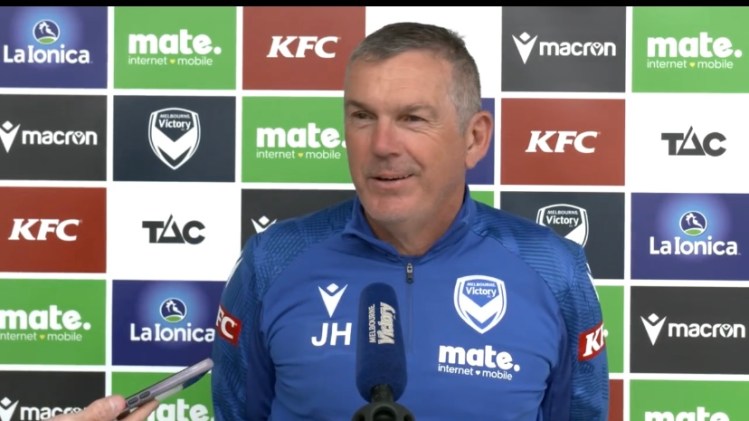
Above: Melbourne Victory head coach Jeff Hopkins. Image: Melbourne Victory.
After suffering their first loss after a six-game undefeated run, Melbourne Victory are looking to bounce back against Western Sydney Wanderers tomorrow.
Jeff Hopkin’s side were denied a merry Christmas after Melbourne City’s win in the local derby. It was a result that could have been worse, although Victory were not without their chances and could easily have escaped with a draw.
“Obviously it hurt us a fair bit, the performance and the defeat,” Hopkins said via the Melbourne Victory website.
“I think the main thing is that everyone’s pulled up really well and I’m definitely looking for a reaction to our performance from last week,” he said.
“The girls have been in pretty good spirits. Very quiet early on in the week, which again, I think is natural. And it’s good that it showed that it did hurt, and it did affect us. I’ve got no doubt that we’re going to bring a much better performance this week and get back to how we were playing up to the City game.”
Victory were approaching some of their best form before that loss, and supporters will hope that it was just a blip rather than a reversal in fortunes. The team was without Ella O’Grady in round nine, but the Young Matildas striker has been included for the trip to Sydney.
The Wanderers have been inconsistent this season, but reliably dangerous. In Sophie Harding they have one of the league’s in-form strikers and only a standout performance from Adelaide United’s goalkeeper denied her more goals last weekend. They are not a side that Hopkins is taking lightly.
“Going to Western Sydney this week is going to be a tough ask for us and we’ve prepared this week for quite a physical affair, to be ready to combat quite a physical style and quite a direct style as well.”
“But also, from our point of view, we’re really looking for a reaction from last week’s performance and maybe a good physical affair might be just what we need this week, just to get us going.”
Perth Glory
by Ben Gilby
Above: Perth Glory boss Alex Epakis speaking to the media today. Image: Perth Glory.
Perth Glory head coach Alex Epakis is looking for a reaction from his team after defeat to Western United last time out as the Western Australian side travel to face Central Coast Mariners on New Year’s Eve.
Reflecting on the display in that 1-0 loss before Christmas, the Glory boss said: “The message was clear, the reality is if we want to be a serious winning team week-in-week-out, we have to perform at our best every week. For us, that’s a mentality thing. We are capable of it, we have shown a high mental standard… but we also can’t afford to take our foot off the pedal for one game.”
“The disappointment of last week will still be fresh in their (the players’) minds, and the opportunity to now go and play and put that disappointment behind them is something that will really drive the players…we’ll get a response and we’re really relishing a chance to go and do it.”
The loss in Victoria also saw the Western Australian side fail to find the back of the net for a second successive game, Epakis believes he has put his finger on the reasons behind that.
“I think there are a combination of factors. Some are out of our control, but there are some things in our own build-up, our attack, that weren’t as fluid and quick as we’d like them to be as well. We have to find ways to score goals and to be a threat in front of goal whether that be through general play or set pieces.”
Perth will take a fully fit squad to Gosford, but their task to get back on the scoresheet will not be made any easier on Sunday, with opponents Central Coast Mariners having conceded just nine goals all season – only Sydney FC have let in fewer. Epakis recognises the challenge.
“Central Coast have players there who really want to compete hard with or without the ball. I can understand why they haven’t given away many goals or many chances, but for us, we have to be better regardless. They (Central Coast) have a style of play that really fits with their players and they are doing well to compete with teams in their first season.”
Reflecting on 2023, Perth’s head coach said: “The calendar year as a whole has been a really strong year for the team, and I am really happy with the last 12 months. I think the team has made some big inroads on and off the pitch.
“We have had some good successful stories and some really great performances at the back end of last season and the start of this season. Overall, I’m pleased with the direction we are heading in as a group on a broad scale, but it’s about the week-by-week that we need to focus on.”
Western United
by Ben Gilby
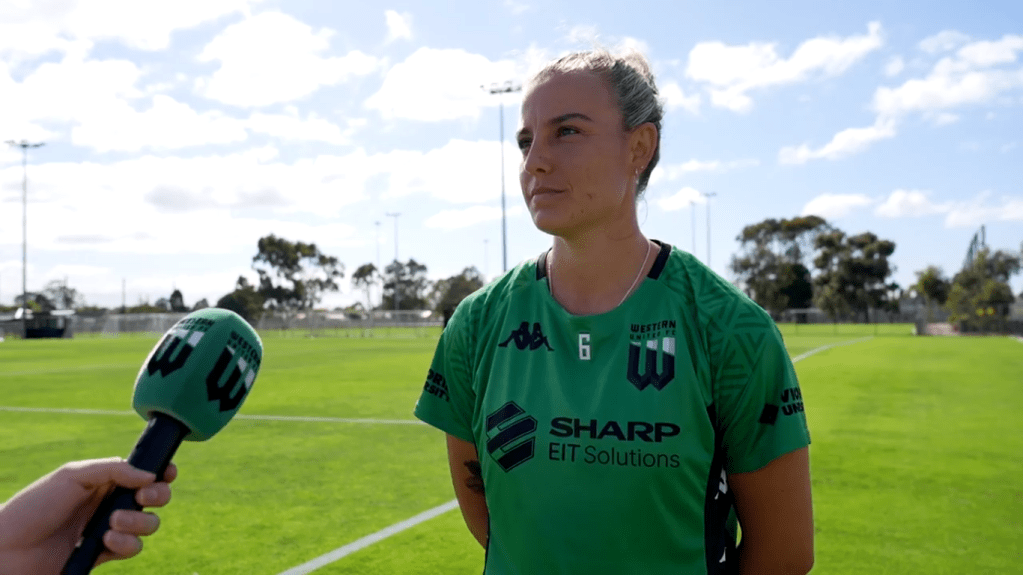
Above: Chloe Logarzo speaking to the media ahead of her hundredth W/A-League Women game. Image: Western United
Western United’s Chloe Logarzo is preparing to play her hundredth W/A-League Women match tomorrow when her side host Canberra United.
Speaking to the media today ahead of the milestone, the Matildas star said: “I feel privileged reaching a hundred games at a home game and at an older age as I think I appreciate it more.”
Logarzo made her debut at the age of 17 for Sydney FC in their 4-1 win over Newcastle Jets on 12th November 2011, and she reflected on the growth of the competition in the period: “I’ve seen the growth and development of the league over the years, and with it going to 22 rounds this season, it will become a lot easier to hit a hundred games for the young ones. It’s been incredible to see how far its come and after the World Cup, if we can keep expanding like this, we can be up there with the best leagues.”
Whilst over 70 of Logarzo’s appearances in the competition were with the Harbour City club, she is proud to be reaching the hundred mark with Western United, saying: “I feel extremely privileged. I came here at the start of last season to help the club with their inaugural season and they welcomed me back with open arms. I hope I can leave a legacy here. Sydney FC was home for a very long time (a total of seven seasons in two spells) but I feel very welcome here.”
In terms of the Matildas star’s most memorable match of her 99 to date, she has no hesitation in nominating Sydney FC’s 3-1 Grand Final win over Melbourne Victory in January 2013 in both her and the league’s second season.
“(There were) a lot of incredible footballers (in that Sydney team) – a lot of Matildas and senior players in that team, and for me at that age, it really sparked professional football for me, and I was really grateful for the season we had with that team.”
Looking back over her own progression in the league, Logarzo said: “My first season I was awarded an injury contract, so it was just for fun, and then it went into the career I’ve had for the last 10 or 11 years, mostly in Australia with my friends and family has been amazing.
“I’m just trying to enjoy football again. I’ve had a tough couple of years with injury and I’m trying to find the love again, play like I used to play, and enjoy the moment.”
Above: Kat Smith sets the scene ahead of tomorrow’s A-League Women home game with Canberra United. Image: Western United.
Western United head coach Kat Smith believes her side is building momentum towards a push for the upper reaches of the ladder under her stewardship.
Ahead of tomorrow’s game with Canberra United, Smith looked back on what her coaching team have done since replacing Mark Torcaso at the helm of the Victoria side: “We’ve been trying to instill our principles, it was always going to take some time for the girls to overcome some challenges and new concepts, but I think it’s about being able to translate from the training pitch to the match, and we’ll see more consistency over the coming weeks.
“We want that consistency with our performances and hope that consistency leads to results, but we know how things work in football sometimes. Never get too high, and never too low.”
Looking ahead to the challenge set by Canberra United, Smith isn’t fooled into a sense of false security despite the capital city side currently being bottom of the ladder. “(There have been) inconsistent results for them…but they are a team who were very close to Finals last season, so you can’t discount any team this season with how they can turn their form around.”
With the match being Chloe Logarzo’s hundredth appearance in the league, the Western United head coach emphasised the influence of the Matilda, and that of her other experienced players.
“Her impact is significant, we’ve seen that on the pitch over the past couple of weeks, but more importantly off the pitch with her leadership. A hundred games – with that comes lots of challenges, lots of highs in terms of what she has achieved and had to endure as a player.
“There’s a winning mentality and that comes from having the experience of winning. There are ups and downs, and it’s knowing how to get through different phases of the season, and those experienced players bring that from wherever they’ve been around the world.”
Follow Impetus on social media – we’re @ImpetusFootball on Threads, Instagram, X (Twitter), TikTok, and Facebook.
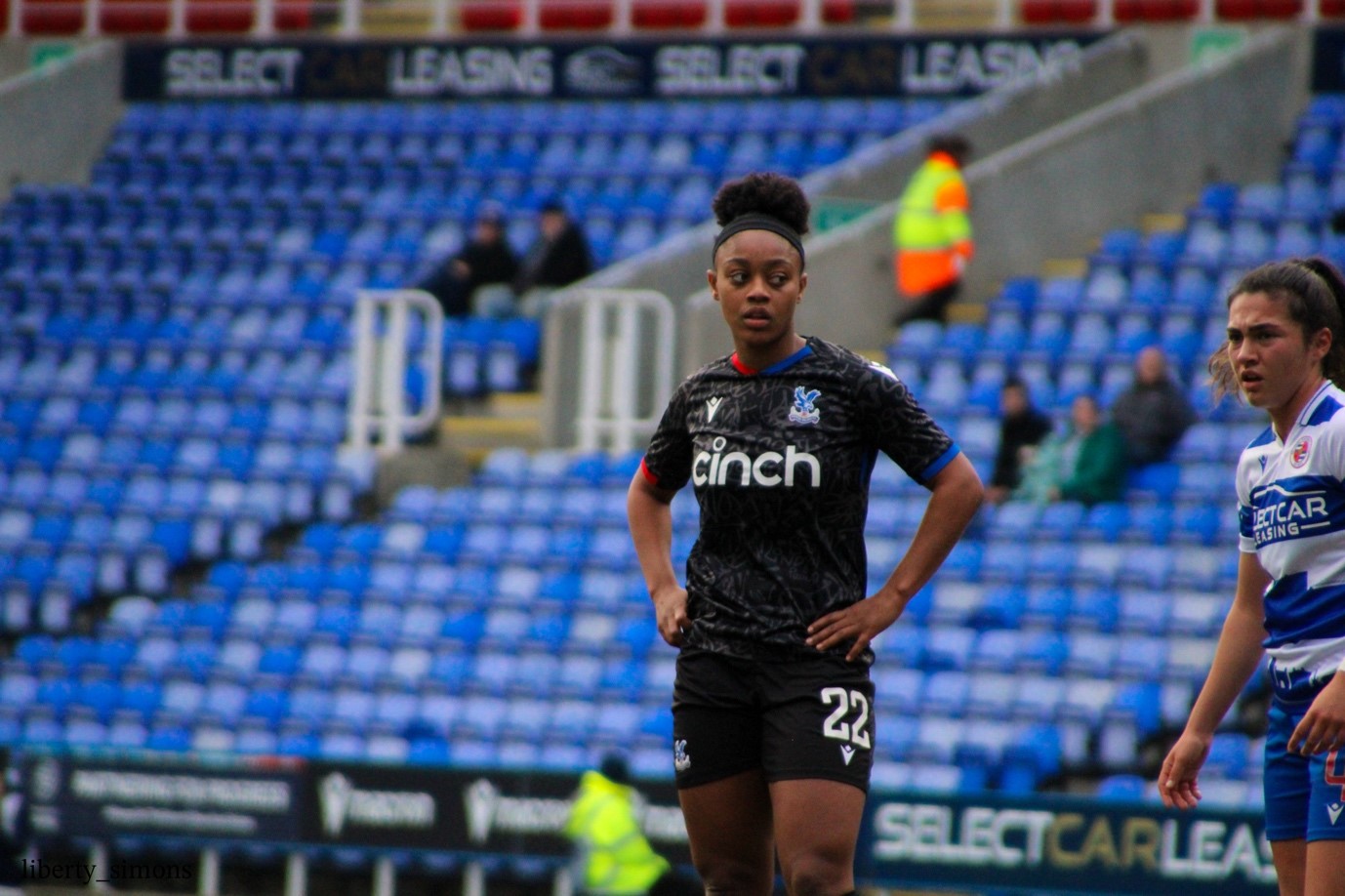
Above: Araya Dennis (centre) in a thoughtful mood for Crystal Palace at Reading prior to Christmas. Photo: Liberty Simons for Impetus.
Araya Dennis is a 17-year-old footballer with a lot of potential. An exciting Arsenal academy product, the youngster has displayed a range of talents for the teams that she has represented.
Dennis has enjoyed time at both Watford and Crystal Palace in the Championship recently, showing her great talents for the sides and providing some outstanding moments. A young talent that has previously flown under the radar, her 2023 so far has shown she is well on her way to being one of the best in the game.
What did 2023 hold for the up-and-coming star?
Club
Currently on dual registration with Arsenal and Crystal Palace, Dennis has played a vital role in the Eagles’ strong start to the 2023/24 season.
Most often playing as a winger for the South London club, she has contributed across the pitch for the side, scoring screamers and putting in incredible last-ditch tackles. Her natural stance in attacking from the right has been amplified, and her work rate across the pitch has shone a light on the player’s versatility.
Palace’s Head of Women’s Football, Grace Williams, has described Dennis as “one of the most exciting young talents in England.” The youngster is an asset for the side, linking up well with her teammates, creating chances, and putting them away.
Dennis has proven her talent as a winger in a myriad of ways. One example includes the way she gets out of tight spaces with ease, speaking volumes about the potential this footballer has.
Despite her age, Dennis has had no problems coming up against experienced, powerful players. In Palace’s 4-3 defeat against Southampton, she was relentless and caused a tough opposition big problems. Dennis displayed her talents in this fixture to her full extent, running the channels, drawing opposition towards her, and creating issues for the defenders.
As well as her quick thinking in the final third and ability to pick out other key players and create opportunities, she is fearless when it comes to defending, and unafraid to commit to a challenge.
Her outrageous goal from the corner against Charlton Athletic in the Championship this season displays the lethal nature of her right foot. The corner was cleared out to Dennis who was positioned far outside the six-yard box. She controlled the ball and took the shot. Her ability to not only see and execute the shot but also to understand how to manipulate the ball to see it pass over the crowded penalty box displays an intelligence of the game way beyond her young age.
It’s a move she has displayed before. It was seen during her time at Watford last season in the tier three FA Women’s National League Southern Premier. Dennis picked up the ball in the middle of the park and dribbled it into space outside of the box before converting the shot. This continued reassurance of her ability to make these shots worth it for any side she is a part of shows true promise for the future.
Above: Araya Dennis in possession for Crystal Palace at Reading. Photo: Liberty Simons for Impetus.
Country
Dennis’ recent footballing adventures include helping to secure an unbeaten run for the England Under 19s.
The young talent was a prolific goal scorer in the most recent international break for the Young Lionesses. From her club minutes at Arsenal, Watford, and now Crystal Palace, Dennis has demonstrated an exceptional ability to add value to any team she is a part of, slotting in and making a number of contributions up and down the pitch when her sides have needed them most. Her outstanding form was only solidified further as she earned more game time on the international stage.
The combined impact of starting and scoring for both club and country on Dennis’ game is unmatched. She has thrived this year, having been put to the test in playing alongside the other top players in her age group, as well as with more experienced opponents at club level.
These experiences are pushing her forward in what looks set to be a stellar career. The way Dennis appears to bring a sense of composure to the pitch at just 17-years-old is telling of her wider role as a player, which goes far beyond just goal-scoring.
What’s next?
For the youngster, the sky’s the limit. Competing in the Championship is no easy feat, especially for a player of her tender years. The league is extremely competitive, especially at the top of the table, where Dennis is helping Palace to reach their full potential.
Goal difference can be so important in this league, so to have a player like her in the squad is a source of confidence for Palace’s manager, Laura Kaminski. The second tier of English football has seen rapid development over the course of the last few years, with more teams going full-time. It is the perfect place for bright academy products like Dennis to hone their skills and gain invaluable match experience.
These loan or dual-registration deals are good for the clubs, too, as youthful energy and technique can help drive them towards the top-flight. Crystal Palace and Dennis have benefitted in improving during their time together, and the results and performances are showing it. Dennis is making the most of her time in the Championship and it’s only a matter of time before she applies this trade for Arsenal.
Follow Impetus on social media – we’re @ImpetusFootball on Threads, Instagram, X (Twitter), TikTok, and Facebook.
Above: Sydney FC match winner Jynaya Dos Santos(facing camera, eyes closed) celebrates with her sister Indiana today. Photo: Liberty A-Leagues.
Sydney FC, featuring returning star Mackenzie Hawkesby, earned an important three points with this win over Wellington Phoenixthanks to teenager Jynaya Dos Santos’ first-ever A-League Women goal in just her second appearance.
Each team made a few changes from their previous fixtures, with Michaela Foster returning to her common defensive position and Macey Fraser dropping back into a midfield position for the visitors. Sydney brought in Mackenzie Hawkesby to start in the midfield, just hours after the announcement of her return from Brighton and Hove Albion in the WSL. Also for the hosts, Shea Connors and Fiona Worts both missed out due to injury. Jordan Thompson got her first start at centreback and Aideen Keane got the start up front.
It was a back-and-forth first few moments of the game with Wellington holding the majority of the possession and passing the ball comfortably. However, the counterattacking lead by Princess Ibini and Cortnee Vine kept Sydney FC in the game on the offensive end of the field.
Hawkesby struck an effort over the bar from just inside the box at the 15-minute mark, firmly announcing her return to the A-League with positive play and energetic bursts forward. This was soon followed by a very similar attack leading to a wide-deflected effort from the fullback Kirsty Fenton.
Foster cleared a Keane effort off the goal line at the 20-minute mark, a noted defensive supplement to the returning young goalkeeper, Brianna Edwards. This was again set up by a wandering Fenton who cut it back to Keane who was unlucky not to open the scoring.
Above: A tussle for possession at Allianz Stadium today. Photo: Sydney FC.
The first half also saw an audacious effort from Ibini narrowly missing as she spotted Edwards off her line. Keane and teenager Zara Kruger also had shots on goal that missed the target which meant that the first half finished scoreless.
Michaela Foster had two key deflections on the defensive end, with Edwards also improving as the half moved along in terms of positioning. The Phoenix defence was resolute in a Sydney-dominated first half, but a couple of shots on goal from Macey Fraser meant that the Phoenix finished the half with more shots on target than Sydney FC.
As soon as the second half began, Wellington had another quality chance as a quick burst forward from Isabel Cox almost set in Kate Taylor in the middle who had instigated the move after a quality tackle in midfield. Cox’s pressing and hold-up play was a welcome boon to the Phoenix who controlled the first portion of the second half.
After the hour mark, Sydney peppered the goal, or rather the defenders in front of the goal with shot after shot from Keane, Vine, and Hawkesby. Resolute defence from Mackenzie Barry and Rebecca Lake blocked a number of goal-bound shots, protecting the 20-year-old keeper playing behind them.
At the 76th minute, fed in by a beautiful cross-field pass by Taylor Ray, Vine rounded Edwards for a chance at an open goal. However, the rushing Phoenix keeper and the ever-present Foster were able to prevent the Matildas star from scoring, the attacker instead finding the side netting.
The very next moment, however, substitutes Ray and 18-year-old Jynaya Dos Santos combined to open the scoring in the 78th minute. A beautifully weighted delivery from the right wing to the edge of the six-yard box allowed Dos Santos to finish with a headed effort into the left side of the goal. In just her second appearance in the league, Dos Santos was able to open her account at a crucial moment.
Around the 80-minute mark, Isabel Cox almost equalised with a well-driven effort to the bottom right corner. Whyman was hyper-aware at the moment of the strike and was able to direct the effort away to preserve her clean sheet.
At the 89th minute, on the six-yard line, Mariana Speckmaier headed over the bar after a terrific delivery by Cox. This was Wellington’s best chance to salvage a point away from home but were unable to get the finish.
Cox had a snapshot at the edge of the box go over the bar during injury time. Fraser also had a shot from outside the box which was saved by Whyman, marking the last of the Phoenix’s attacks in their close defeat.
Wellington were slightly unnerved by the physical style Sydney implemented in this one, particularly down the right side of the defence with Ibini and Fenton playing very physically, looking to target the attack in on Hailey Davidson. Davidson eventually was subbed due to injury concerns and Wellington played a more physical style in the second half.
The Phoenix’s attacking potency comes from the fluid approach they usually take to their football which they later did manage to reintroduce in the second half, albeit without many chances to show for it. While their midfield were very strong with Taylor, Fraser, and Annalie Longo all working very hard, they were partly let down by an attack that was unable to take advantage of attacking moves and take shots on goal.
On the other hand, it was a clear point of emphasis for Sydney to have a more attacking approach in this fixture. Hawkesby, Keane, and Vine were relentless in their pursuit of a goal and the work rate of Ibini and Hollman was something to behold throughout the 90 minutes.
Whyman was excellent in goal and helped by a solid left side of the defence with Fenton and Charlotte Mclean showing their defensive prowess. The main difference maker however was the extremely impressive Ray who came on in the second half to create chance after chance, one eventually being converted by Dos Santos.
Teams: SYDNEY FC (4-1-4-1): Whyman, Tumeth, J. Thompson, McLean, Fenton, Hollman, Kruger, Vine, Hawkesby, Ibini, Keane. Substitutes: Franco, Chauvet, I. Dos Santos, J. Dos Santos, Ray.
Emily Evans concludes her series profiling the leaders of each of the Championship clubs(28/12/23).
Tyler Toland
Blackburn Rovers
Above: Tyler Toland signs on the dotted line for Blackburn Rovers earlier this year. Photo: OneFootball
Toland, a 22-year-old Irish midfielder, joined Blackburn Rovers in 2023, after being at Levante for the 2022/23 season. However, during her time in Spain, she didn’t play a lot of games and so came to a mutual agreement with them to leave, despite having previously signed a two-year contract. Another one of her past clubs is Manchester City, which she signed for in 2019. She made four appearances before unfortunately sustaining an ankle ligament injury and so accepting the offer to go on loan to Glasgow City.
Since 2017, she has been part of the Republic of Ireland squad, so far having 15 caps and one goal. She has also represented them at the U17s level, once again having 15 appearances and one goal for the girls in green. She was first called up to the senior team in 2017 for the 2019 FIFA World Cup qualifiers, coming on as a substitute against Northern Ireland. As a result of this, Toland became the youngest senior player for the Republic of Ireland.
Sophie Barker
Sheffield United
Above: Sheffield United skipper Sophie Barker pictured at the club’s Bramall Lane stadium. Photo: Sheffield United
The 33-year-old Barker was named captain ahead of this season, can play in two in defence or a midfield. She first joined Sheffield United in 2018, before going to Leicester City from 2020-23. In the 22/23 season, she went on loan to the Blades, before returning permanently this summer. Some of her other previous clubs include Lincoln Ladies, Doncaster Rovers Belles, and Notts County Ladies FC.
Her coach Neil Redfearn has said, “Barks is vastly experienced. She’s got out of this league several times, with Doncaster Rovers Belles and Leicester City. I think she’s still at the height of her powers playing-wise.”
Lois Joel
London City Lionesses
Above: Lois Joel captaining her side this season at home to Watford. Photo: London City Lionesses.
Joel, 24, is a former squad member at West Ham United, who moved to London City Lionesses in July 2022. She started off her journey playing with the academy teams at both Arsenal and Watford before moving to the United States to play college football. Joel played two seasons with West Virginia Mountaineers before transferring to North Carolina Tar Heels in 2019, where she made 25 appearances for the club. During her time with the Tar Heels, they won the 2019 ACC regular season and the 2019 ACC tournament.
Lily Woodham
Reading
Above: Reading captain Lily Woodham. Photo: Reading FC.
The 23-year-old Welsh left-back was announced as Reading’s new captain at the start of the season, after singing a two-year contract with the club the year before. Woodham has previously played for clubs such as Bristol City and Charlton Athletic (a loan deal in 2019). Her leadership skills came into play when she led her team to a 0-0 draw against her former South London club at the start of this season. The defender has made over 68 appearances for Reading, and when being made captain, she stated, “it’s an honour to be trusted with the role of captain. I’m going to do my best for the girls both on and off the pitch, and hopefully learn a lot on the way.”
Woodham has represented Cymru at many different age groups, including under 17s, under 19s, and then joined the senior squad in 2020. As it stands, she has 11 senior appearances for Cymru and has scored a goal for her county in the UEFA Women’s Euro 2022 qualifiers.
Rhian Cleverly
Lewes
Above: Lewes skipper Rhian Cleverly. Photo: Lewes FC.
Cleverly, 28 is a Welsh footballer who plays as a defender and a midfielder. She joined the Sussex side in 2019, making 11 starts during the 2019/20 season. Her first goal for Lewes was scored against Coventry United on 27 September 2020, securing them a 1-0 win. She has previously been at clubs such as Bristol City where she made one appearance, and also French side Le Harve where Cleverly made a total of 20 appearances for the club.
The Lewes captain has represented Cymru in the U16s, U17s, and U19s, playing at the 2013 UEFA Women’s Under-19 Championship. Her first senior cap for Cymru was earned in July 2014.
Megan Chandler
Watford
Above: Megan Chandler in action for Watford this season. Photo: Watford Women.
Captain Megan Chandler, 30 joined Watford in August of 2019, and since then has gone from playing as a midfielder to being a key part of their backline. In the 2022/23 season, Chandler won the Player of the Season award and took on the role of captain after Watford and Cymru legend Helen Ward’s retirement in 2023.
The defender wore the armband on several occasions last season, showing off her leadership skills, and leading the Hertfordshire side promotion back to the Championship. Upon being made captain of Watford, she said: “It’s a surreal feeling to be honest…I got a little emotional because the club means a lot to me.”
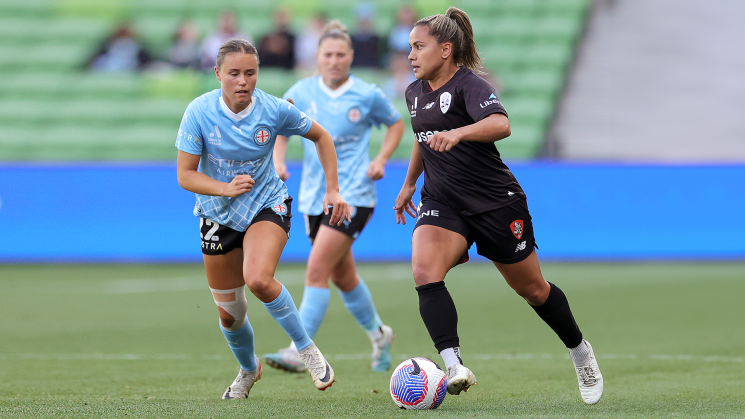
Above: Brisbane Roar’s Ayesha Norrie (black shirt) protects the ball from Melbourne City’s Bryleeh Henry. Photo: Brisbane Roar.
A hat-trick and an assist from Emina Ekic helped to steer Melbourne City to a dramatic win over Brisbane Roar at AAMI Park today as Round 10 of the A-League Women opened with an eight-goal thriller.
Brisbane got off to a lightning-fast start against their hosts, scoring their first goal in just the fourth minute. An excellent ball into the box from Sharn Freier found the feet of Mia Corbin – her first shot was blocked by a defender, but her follow-up went in and gave her team an early lead over the league leaders.
.@brisbaneroar take the lead against the ladder leaders inside 4 minutes! 😮⏱️
Mia Corbin caps off a fast start from the Roar with her fourth goal of the season 👏
The Roar were only able to hold on to the lead for a mere 15 minutes before a sloppy pass coughed up the ball to Ekic in a dangerous area and she slotted it past Jordan Silkowitz to level the game. The City star scored another just two minutes later after a cross from Kaitlyn Torpey found the feet of Daniela Galic. Galic’s shot was saved by Silkowitz, but the ball fell to Ekic, who tapped it home.
A 100-second brace! 🤯⏱️🔥
Emina Ekic scores two goals in as many minutes to turn this game on its head and fire @MelbourneCity into the lead at AAMI Park! 👏
Ekic was involved in yet another Melbourne City goal about 10 minutes later after she whipped in a wicked corner that found Hannah Wilkinson, who was able to tuck it past Silkowitz. City went into halftime with a 3-1 lead.
Roar had a great start to the second half with Jenna McCormick scoring a brilliant header from a well-measured corner from Hollie Palmer. They were now within striking distance once more.
The perfect start to the second half for @brisbaneroar! 🔥
Jenna McCormick heads home from a corner to bring Brisbane back within a goal!
But Ekic was not having any of it. In the 52nd minute, some great build-up play from Melbourne City resulted in Ekic having the ball in the box. She outfoxed the Roar defenders using some fancy footwork and then completed her first-ever professional hat-trick, which restored City’s two-goal lead.
Emina Ekic has a 𝐡𝐚𝐭-𝐭𝐫𝐢𝐜𝐤!🎩🪄🔥
The @MelbourneCity star with another brilliant finish to restore her side's two-goal advantage.
But Brisbane were still not done. In the 72nd minute, City committed an error playing out from the back, and Matildas legend, Tameka Yallop, stole the ball and passed it to Corbin, who scored her second of the day and once against put the Roar within striking distance of the hosts.
𝟕 𝐠𝐨𝐚𝐥𝐬 𝐢𝐧𝐬𝐢𝐝𝐞 𝟕𝟏 𝐦𝐢𝐧𝐮𝐭𝐞𝐬! 🤯
It's an absolute goal-fest at AAMI Park! Mia Corbin has her second and @brisbaneroar are back within a goal!
Sadly, for the Roar fans, City was awarded a penalty late in the game, which Rhianna Pollicina converted. Melbourne City would close out the match with a 5-3 win over the visitors.
Teams:MELBOURNE CITY (5-3-2): Proulx, Torpey, Chinnama, Stott, Otto, Grosso, Galic, Hughes, Pollicina, Ekic, Wilkinson. Substitutes: Barbieri, Roestbakken, T. McKenna, L. McKenna, Henry.
Impetus’ Ben Gilby reports on Sydney FC‘s media conference with defender Kirsty Fenton, whilst Ryan Miller-Woods heard the thoughts of Wellington Phoenix‘s new signing Tiana Jaber and head coach Paul Temple ahead of the A-League Women encounter between the two sides tomorrow (28/12/23).
Above: Kirsty Fenton speaking to the media today ahead of Sydney FC’s game with Wellington Phoenix tomorrow. Image: Sydney FC.
Sydney FC defender Kirsty Fenton outlined the huge importance of the next three weeks for her team as they begin a run of seven league games in 31 days at home to Wellington Phoenix tomorrow.
With the defending champions having played two games fewer than the majority of teams in the A-League Women due to their AFC Women’s Club Championship group stage games, it’s catch-up time, on top of the regular schedule. It means that the Harbour City club will be playing twice a week between now and the end of January.
Whilst the load will be heavy, Fenton believes the club are well positioned to deal with it: “We don’t get as much rest, but once we get into the groove of it, and the momentum starts going forward and hopefully winning those games, we’ll be into the structure. We have the right facilities and the right staff to help us get through those games.”
After a period off over the Christmas period, when Fenton returned home to have some time with her family, all focus is now on tomorrow’s game with third-placed Wellington Phoenix. “After Christmas, we got straight back into it,” the defender said. “Mindset straight back into the game. Wellington are a good side, so we know that we need to really switch on, and switch off holiday mode!”
Sydney come into tomorrow’s game on the back of two successive draws – away to Perth Glory and at home to Brisbane Roar. To begin their serious push into the higher reaches of the table, Fenton knows that these draws need to be turned into wins, but that there is no immediate need for concern.
“It’s important (winning games) for the long-term goal of finishing on top and reaching the Grand Final…we wanted those draws to be wins, but we have games on hand, and future games coming up and we know we can capitalise on them…Anything’s possible, it only takes some teams to lose and for us to keep winning. We have a bit of a gap from the top of the table, but we have games in hand.”
The 20-year-old also believes that the real depth in strength in the Sydney squad will stand them in good stead over this busy period: “It’s good to have healthy competition, you want to be starting. It’s nothing against each other, as a player you want to be starting and having the 90 minutes. It definitely helps to push each other…to the best of their ability.”
Fenton and her Sydney teammates return to Allianz Stadium for tomorrow’s showdown with the Phoenix. It’s an arena that holds fond memories for the defender who scored there against cross-city rivals Western Sydney Wanderers: “Scoring at any stadium is such an amazing thing, and it was the opening goal against (Western Sydney) Wanderers as well, and I don’t get to score often, so it was pretty special for me.
“The field is amazing, that helps us a lot. It’s home ground, home crowd. The fans bring so much energy to help us push. We just want to keep winning no matter what the stadium is.”
Above: Wellington Phoenix’s new arrival Tiana Jaber, seen here with Newcastle Jets last season. Photo: Newcastle Jets.
Wellington Phoenix new signing Tiana Jaber’s arrival brings with her valuable A-League Women’s experience having played for Western Sydney Wanderers, Newcastle Jets, and most recently Western United as of last season.
Coming into the side as an injury replacement player for Marisa van der Meer in the backline, Jaber is a player who can play both as a centre-back and as a full-back which is a massive positive having someone who’s versatile, especially within the defence.
When asked about how the opportunity came about to sign for Wellington, Jaber said: “It was about last week. I got a call from my manager and he was saying that Wellington (Phoenix) need a player, they’ve been looking at me and were really happy with me to sign if I wanted to take the opportunity.”
The defender joins Wellington at a very important time of the season with the run of games that the Phoenix have for close to the next month where they are currently third on the A-League Women’s ladder.
Jaber revealed that the team’s style of play was a major attraction for her to sign on the dotted line. “I love how they play football,” she said.
Nix head coach Paul Temple outlined the process that led to the defender’s arrival in New Zealand. “We really wanted to get in somebody that was a centre-back who has got A-League (Women’s) experience, which wasn’t easy (to find at this time). Tiana is somebody we looked at in the off-season before we even started. So we kind of had her on our radar for a while.”
Wellington’s strong start to the season has been will be severely tested in the coming weeks with their next four matches being contested outside of New Zealand. So far, Wellington has won once away this season against Western Sydney but then suffered defeats in their next two away matches against Central Coast Mariners and Adelaide United respectively.
When asked about the next few weeks which could be season-defining for the Phoenix, Temple admitted: “The test for us is winning on the road. We’ve come up short at (Central Coast) Mariners and at Adelaide (United). In both games, we felt like we could have won, especially at Adelaide, we should have won. So, I think we kind of need to prove to ourselves really that if we want to stay in that top end of the table, we have to be able to go on the road and win.”
Follow Impetus on social media – we’re @ImpetusFootball on Threads, Instagram, X (Twitter), TikTok, and Facebook.











 impetusfootball.org