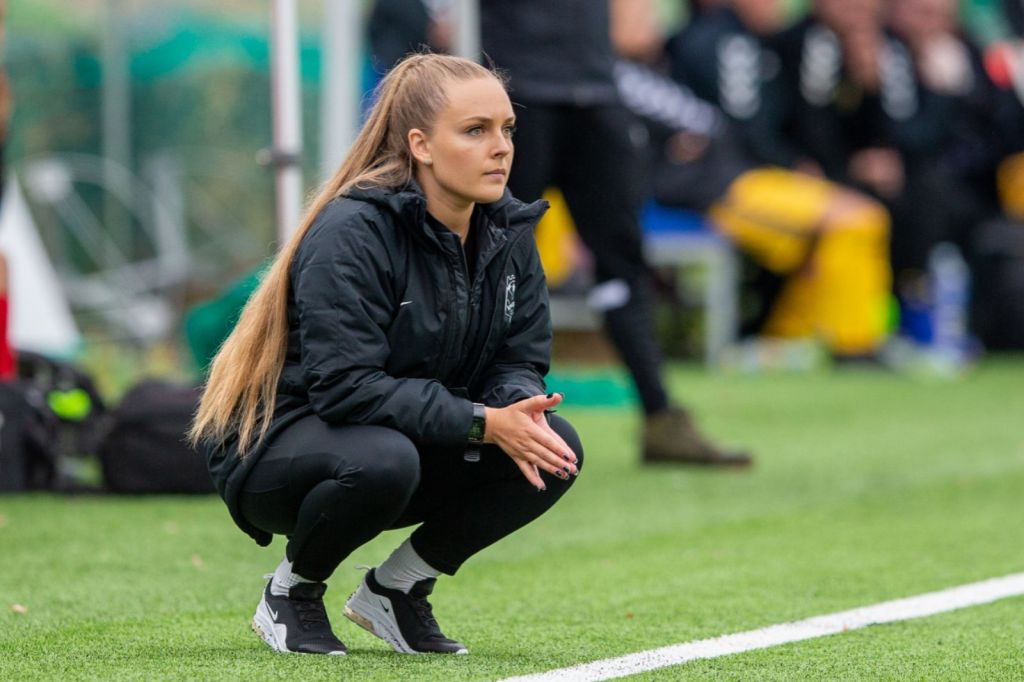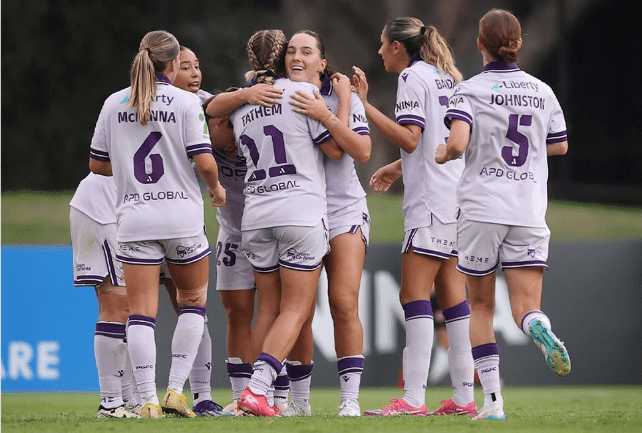
Above: Tijan McKenna speaks to the press. Image: Perth Glory.
By Ella McShane (22/1/26)
The girls in purple come into the weekend off the back of a shared point with last years league champions Central Coast Mariners, a welcome change from both last season and the early stages of the campaign. Head coach Stephen Peters and defender Tijan McKenna spoke to the media.
“There’s a good bit of confidence with the football and we’ve generated some good competency with our defence,” said Peters.
McKenna was named A-Leagues December player of the month, despite having filled in at centre back out of necessity over the past several weeks. McKenna described the accolade as a pleasant “shock”.
“It’s definitely helped me as a player, playing out of position, in multiple spots. Just developing me even more”
“I think she’s found a bit of a home [at centre back]..It’s really good, I am really proud of her.” Peters commended the young defender.
Looking to the opponent, the respective sides come into the weekend with a mere three weeks separating the last match up.
“It’s unique, for us we don’t want to go away from things that you did well, but you also want to make tactical adjustments,” stated Peters.
Reassessing City’s threat, Peters reaffirmed the ever-present attacking danger posed by Holly McNamara, while also emphasising the strength and depth of the squad as a whole.
Above: Peters talks to the press. Image: Perth Glory.
“You’ve got to be on your guard. But Leah Davidson gave three assists in that particular game. Thats the quality that they possess, if it’s not Leah, it’s Laura Hughes, if it’s not Laura Hughes it’s Leticia McKenna. They’ve got a very good side.”
“They’re a very consistent side they’ve got similar actions from the first whistle to the last whistle.”
Peters reflected on the previous match-up, saying, “We made errors at crucial moments that hurt us, but our overall approach play was strong.”
Peters also pointed to a key positive, adding, “We’re the only team in the competition to have taken the possession statistics away from them, so we’ll take confidence from that.”
The A-league table grows tighter as the season progresses with a mere 4 points currently separating Glory from their league leading opponent.
“Every game is becoming a finals game because of how close the competition is becoming.”
Megan Wynne and Natalie Tathem are inching closer to a return to the pitch following ACL injuries, with Tathem in full training and Wynne following closely behind
Peters also revealed that caution will be exercised the following weeks to consider player loading.
“We’ve got to look at a bit of a load management situation with the two games so close together.”
“We will most likely delve into the squad for the next two games.”
Follow Impetus on social media:
@ImpetusFootball on Threads, Instagram and TikTok.
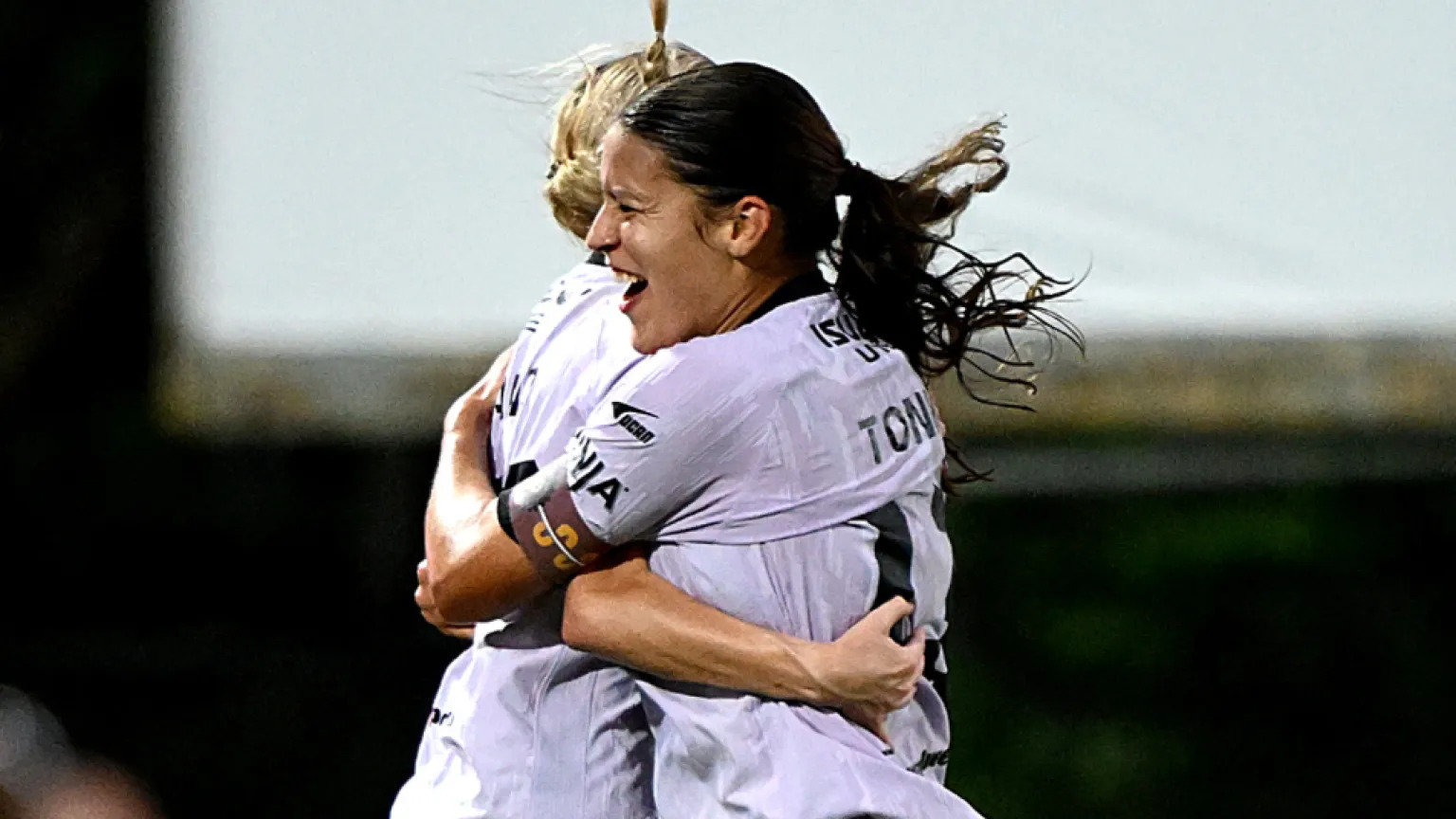
Above: Terland celebrating her goal Photo: Manchester United FC
Elisabeth Terland’s first half goal was enough to secure Manchester United’s place in the Subway Cup final, as they visited Meadow Park.
The Action
The game started with a promising run from Olivia Smith, who crossed for Frida Maanum. The Norwegian’s header was grabbed by Phallon Tullis-Joyce, as Arsenal asserted themselves on the game from the off. Moments later, Arsenal got their first corner taken by Katie McCabe. Jayde Riviere and Alessia Russo battled for the ball, before the English striker sliced the ball out of her feet.
Manchester United started to take control throughout the first 20 minutes with Jess Park being key for them to hold onto the ball as she linked up everything.
Mariona Caldentey took a corner, which ended with the vicious clash between Anna Sandberg & Alessia Russo, who both ended up on the floor.
As the game progressed, Manchester United proved why they belonged in the semi-finals, showing a more aggressive side of their game following a measured last game against Arsenal in the WSL. Mark Skinner will be happy with the adaptation he saw from his side.
In the 32nd minute, from a McCabe free kick, Maya Le Tissier stamped her authority on the game with a strong clearance.
Into added time at the end of the half, and Anneke Borbe tried to be a bit too cute in clearing the ball, eventually leaving it to Elisabeth Terland who was able to find the goal.
Momentum build up
Arsenal returned to the second half eager to even the score after Terland’s goal, as they cautiously but tactically passed the ball round, avoiding Man United’s defensive structure. Frida Maanum then went for the goal, but was too high.
Lotte Wubbon-Moy, as Arsenal’s captain for the game, really pushed through showing her expertise. Following that initial pressure, Arsenal spent a lot of time around the box, intimidating the visitors.
Victoria Pelova soared the ball over to Russo, who went for the goal, but dragged her shot wide. On the hour mark, Olivia Smith was given a second yellow, hampering Arsenal’s chances to level the game.
New Beginnings
New star signings for both teams made a name for themselves during this Subway Cup semi-final. Ellen Wangerheim and Smilla Holmberg both put in a performance to excite the fans about their future. Holmberg tried an effort on goal after a pass from Mariona Caldentey, but it flew over the bar. Still, her effort to reach the ball brought a roar from the fans.
United continued to create chances of their own, with Russo and Holmberg having to defend from Terland late on. Neither team could add to the score however and it finished 1-0 to Manchester United.
63’ H. Lundkvist for A. Sandberg, 64’ L. Naalsund for S. Awujo, 72’ M. Malard for J. Z. Olme, 90’ L. Schüller for E. Terland
Above: Grace Clinton pushes forward, with Sandy Baltimore covering.Photo: mancity.com
A header from Wieke Kaptein secured a 1-0 victory for Chelsea over Manchester City, sending them through to the Subway League Cup final after a tightly contested semi-final at Joie Stadium.
Early Game Overview
The match began at a paced tempo, with both sides evenly matched in the opening five minutes before Chelsea gained the upper hand. Sonia Bompastor’s team pressed aggressively, closing space quickly and forcing Manchester City into early mistakes. A loose diagonal pass from Rebecca Knaak inside three minutes allowed Chelsea to launch a sharp attack, with Sam Kerr and Alyssa Thompson repeatedly threatening behind the defensive line.
Chelsea’s midfield played a more central role than usual, moving the ball efficiently and winning key duels through Erin Cuthbert, Wieke Kaptein, and Sjoeke Nüsken. City attempted to bypass the press with long balls to Khadija Shaw, while Grace Clinton impressed with her work rate and defensive positioning. Both teams played directly and looked to attack, but clear chances were limited in the opening phase. Chelsea’s pressure paid off in set pieces, winning their first corner inside seven minutes and five by the 14th. Sandy Baltimore found space on the edge of the area, though Vivianne Miedema blocked the effort. City defended well from corners, winning second balls, and staying organised.
Manchester City threatened in the 11th minute when Shaw isolated Millie Bright before Naomi Girma intervened. Momentum swung briefly towards City from the 16th minute as their pressing forced a turnover and a dangerous break, with Lauren Hemp releasing Shaw, only for Baltimore to recover. Despite these moments, Chelsea’s physicality, pressing, and control of possession kept them in charge of the first 20 minutes.
Tactical Battle and Momentum Swings
After the opening 20 minutes, City began to control possession, winning a free kick following a foul on Hemp. Alex Greenwood’s curling attempt was comfortably saved by Hannah Hampton, and Chelsea started to lose the ball more often, with clearances falling straight to City players.
Between the 25th and 35th minutes, City used their full-backs effectively, combining with wingers to stretch the play. Kerstin Casparij pushed high on the right, leaving City with a back three, while Clinton drifted wide. Chelsea dropped deeper to protect space, making City’s press harder to execute. City’s midfielders moved well, winning second balls and dictating the tempo, while Chelsea took more time on the ball and slowed their build-up.
City created a chance in the 31st minute when Millie Bright fouled Shaw on the edge of the box. Greenwood’s free kick struck the wall, with Yui Hasegawa’s follow-up effort wide. Chelsea briefly relieved pressure when Ellie Carpenter won a sixth corner, but it came to nothing.
In the final ten minutes, pace became a key factor. Thompson raced against Jade Rose, while Hemp stretched Chelsea on the left. City combined well through Greenwood and Hemp, with Laura Blindkilde-Brown delivering a superb pass to Shaw. She redirected the ball to Miedema with Hampton off her line, but the strike hit the side post, the closest either side came to breaking the deadlock before three minutes of added time. Similar momentum swings and play are seen throughout the second half.
Turning Points and Winning Strikes
The opening goal came in the 41st minute when Kaptein converted a corner from Baltimore. Baltimore had been delivering excellent set pieces all game, and Chelsea capitalised on a recycled ball that City failed to clear. Kaptein timed her leap perfectly, while Ayaka Yamashita could have reacted more sharply. In stoppage time of the first half, Blindkilde-Brown delivered a superb pass to Shaw, who redirected it to Miedema with Hampton off her line, but the effort struck the side post.
Chelsea created early chances in the second half. Cuthbert attempted a strike from the edge of the box, but City blocked it, while Casparij hit the woodwork with a half- volley five minutes in. Hemp won possession and led attacks, and Hasegawa dominated the midfield. Hampton tipped a Shaw header over the crossbar, although she was offside, and Hemp supplied another dangerous cross that Clinton narrowly missed.
Chelsea’s defence remained composed under pressure. Kaptein slipped under challenge, allowing Hemp to drive forward, but Hampton recovered. Hasegawa threaded a pass through to Miedema near the 60th minute, only for Hampton to make a vital save. James struck powerfully from a Thompson pass in the 65th minute, but Yamashita denied her. Three minutes later, Hasegawa shot from the edge of the box, with Hampton tipping it over the bar, producing one of the game’s standout moments.
City continued to push in the final quarter. Baltimore forced a save from Yamashita around the 75th minute, while Casparij picked up a yellow card in the 80th. Hemp attempted to break through several times but was crowded out, and Thompson tested the defence with a cross across the goalmouth. A late strike from Hemp led to a corner, and in the 93rd minute, a near-miss from Miedema and Hemp could have levelled the match. City pressed until the final whistle, but Chelsea’s composure and defensive organisation held firm.
Kerr’s Influence, Fowler’s Return, and Chelsea’s Semi-Final Triumph
Sam Kerr started as the right-sided striker, with Alyssa Thompson on the left, and impressed in hold-up play and link-up combinations. Rebecca Knaak marked her closely, but Kerr’s off-ball movement between City’s centre-backs created space for teammates.
She frequently dropped into a central “number ten” role when Thompson stayed high, helping Chelsea control possession and press effectively. Kerr’s physical presence and timely runs disrupted City’s build-up, forcing errors, and keeping the defence stretched. Her positioning near the box allowed her to threaten on the ball and support wide attacks. Overall, Kerr’s movement, pressing, and hold- up play were crucial to Chelsea’s attacking rhythm.
Meanwhile, Mary Fowler’s return from an ACL injury appears on the horizon, with her recent training sessions suggesting she could be ready to feature soon. The prospect of Fowler joining a forward line led by Shaw adds an exciting new dimension to City’s attack.
Manchester City moved well in wide areas, with Hemp and Greenwood combining to create chances, and Hasegawa controlling midfield. They pressed effectively but struggled to convert possession into clear opportunities. Defensive lapses on set pieces and failure to track runners, particularly Kaptein, proved costly. Overall, their dominance was undermined by finishing and organisational errors, leaving them short in attack and defence.
Chelsea are through to the Subway League Cup final after their 1-0 semi-final win over Manchester City, who exit the competition. They will face Manchester United, who beat Arsenal 1-0, at Ashton Gate Stadium in Bristol on Sunday 15th March. Chelsea go into the final with confidence, aiming to retain the trophy and complete back-to- back victories.
Above: Kyah Simon earned her first start and a hat trick for Diijon. Image: Dijon.
On January 21, 2026, in her first start for Dijon, Asutralian striker Kyah Simon scored a hat trick in the first half during the French Women’s Professional Football League Cup (Coupe Ligue Féminine du Football Professionnel) versus Reims.
Dijon went on to win the game 4-0 and finished first in their qualifying group. Dijon will play at home their quarter-final versus Nantes on February 4th/5th.
Simon’s first goal was in the 11th minute on a cross from Meriame Terchoun.
The second one was with a header in the 22nd minute on a cross from Chengshu Wu.
The third one was with another header at the 30th minute on a cross from Margaux Vairon.
It was a great start for Simon. It will likely be the first of many starts to come if she maintains fitness.
Follow Impetus on social media:
@ImpetusFootball on Threads, Instagram and TikTok.
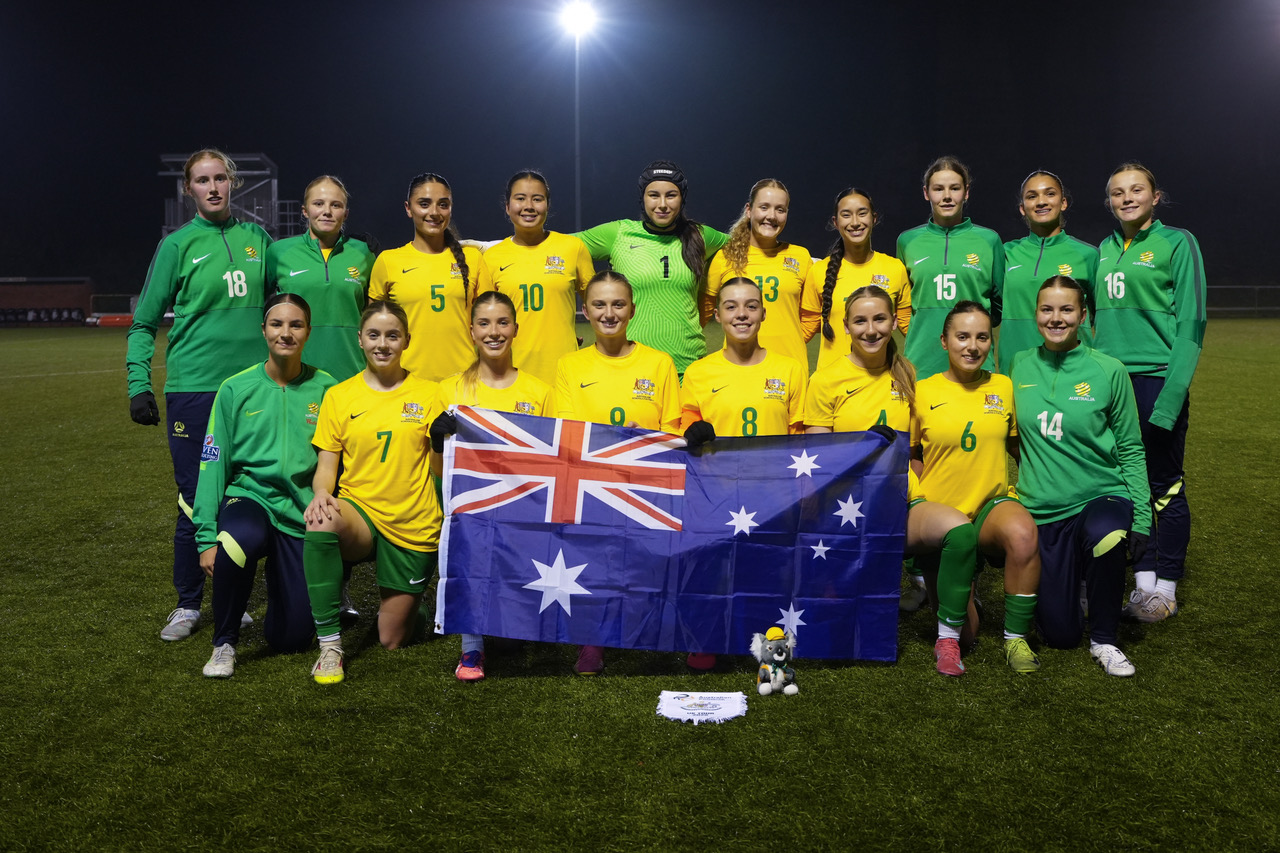
Above: Stina Blackstenius and Kim Little celebrating the opening goal Photo: @cozphotos on instagram
A goal and assist from Arsenal captain Kim Little secured Arsenal a 2-0 victory over Aston Villa, who put up a strong defensive display to keep the game close throughout the fourth round tie.
The Teams
Arsenal centre back Leah Williamson missed out with a calf injury, while Slegers opted for the Russo-Blackstenius combination to start. For Villa, a few injuries hampered their team with Missy Bo Kearns stepping into the role of captain.
The Action
After a good initial spell on the ball from Aston Villa, it was Arsenal who began to dominate possession. With a free kick and corner, they were presented with two chances, but Stina Blackstenius couldn’t connect with Kim Little’s cross, and Ellie Roebuck made a save to keep the game goalless.
The defensive determination of Natalia Arroyo’s side began to show, as they held firm around the box – cutting off those crucial passing lanes and forcing the Arsenal attack into uncomfortable positions. Kearns and Lucy Staniforth in midfield were particularly impressive.
With a concussion, Emily Fox was forced to leave the game, allowing Smilla Holmberg to make her second appearance for Arsenal. From a corner, the visitors’ first chance arose – with Missy Bo Kearns firing wide.
Another save from Roebuck, this time keeping Russo’s header out and a crossbar hit from Beth Mead stopped Arsenal, keeping the score level at half time.
After a defensive first half, it didn’t take long until the first goal went in. Just after 50 minutes, Stina Blacksteinius scored a thrashing goal, after being found by a Kim Little cross. 10 minutes later it was the turn of Little to score herself. Following a corner, the ball bobbled around and eventually rebounded off the bar – it was Little who reacted first, smashing the ball home to extend the advantage.
In response, Arroyo made two changes, bringing on Georgia Mullett and the debuting Oriane Jean-Francois. They both come on with the clear goal trying to win back that possession, as they looked to push on and score. With only being on for about 60 seconds, Jean-François received a yellow card not a great start for her Villa debut.
For one last throw of the dice, Villa replaced defender Noelle Maritz with striker Ebony Salman, while Arsenal brought on new legs with more conventional player-for-player substitutions. Ultimately, the Arsenal defence held strong, securing a win – but it was a valiant defensive performance from Aston Villa.
Arsenal will host WSL2 side Bristol City in the fifth round of the FA Cup, while Aston Villa’s focus can be fully of league success from now on.
Teams: ARSENAL (4-3-2-1): Borbe, Fox, Wubbon-Moy, Catley, McCabe, Little (c), Caldentey, Mead, Russo, Smith, Blackstenius. Substitutes: Holmberg (for Fox 22′), Foord (for Smith 71′), Maanum (for Russo 71′), Pelova (for Caldentey 84′), Codina (for Little 84′).
Above: Melissa Taranto and Ilona Melegh. Photo: Adelaide United
Adelaide United have taken home the win, after defeating Newcastle United 2-1 at No.2 Sports Ground. The victory follows 90 minutes of end-to-end action, and uncertainty, and marks Adelaides first win in Newcastle in almost five years.
In early action, Adelaide United had two good chances within the first few minutes, both coming from a high press from Fiona Worts. A free taken by Paige Zois gave the visitors yet another early chance to open the scoring. Although Adelaide kept possession in their attacking end at the start, they couldn’t get through the Jets defence.
The Jets came close to the net following a corner in the 10th minute, that resulted in a scramble inside the box, however a goal was not to be found, despite momentarily seeming it was inevitably going over the line.
It seemed that Sophie Hoban had opened the scoring for the Jets with an excellent wide range shot on target, that looked as though it had gone in, inciting momentary celebrations from the home fans. The ball however was just wide, although it seemed to push the hosts to chase the openibng goal, as they began to put a real foot in the attacking end.
Emma Dundas had another close shot, that just bounced off the cross bar, putting Newcastle even further in favour of scoring the opener, as it appeared to be only a matter of time, until the hosts found a goal.
Despite early promise from Adelaide, the reds struggled to break through for the majority of the first half, as Newcastle dominated, holding the possession, creating continual chances, and capitalising on them with 6 shots within 25 minutes, while Adelaide had none.
Unavoidably, Newcastle Jets took the lead in the 26th minute with a power shot from captain Cass Davis, that flew through Adelaides defence, and could not have been halted by the hands of Ilona Melegh.
There was some response from Adelaide, as they seemed to regain the determination they had at the start, with a good chance from Condon, followed by a Paige Zois corner, that could have easily recreated her recent olympico against Melbourne Victory, if not hit away by Anna Leat.
A corner in the final minutes of the first half regulation gave the Jets a chance to extend their lead before the break, but despite efforts, the scoreline remained 1-0 at halftime.
Adelaide managed to take control of the ball again at the top of the second half. While they had no real chances, they held off the Jets’ attack, as Melegh had little to do for the first few minutes.
Newcastle was only held off for a few minutes, as they broke through to the attacking end with a promising attempt from Kelli Brown, which didn’t really amount to a chance, but got the Jets back in their attacking end. Brown got another huge opportunity just minutes after her attempted volley, striking in close range from the side of the box. The shot was ultimately saved by Melegh, but swung the game back in the hosts’ favour.
The 60th minute saw an equaliser from Erin Healy, who cleverly shot right through Tash Prior and Claudia Cicco, sending the ball straight to the net, with no real chance to be saved.
Healy got dangerously close to scoring a potential match-winner and netting herself a brace just minutes after her goal, with a strike from distance that was well saved by Leat, as it cleared the defence.
With the score remaining equal, and stoppage time running out, it became quite unclear how the game would go, as another goal seemed inevitable, but chances were fairly even at both ends. That was until Adelaide became the ones to capitalise, and break the stalemate, as Carina Rossi netted her first Ninja A-League goal.
With 15 minutes of regulation left, it seemed quite possible that the Jets would score an equaliser, and bring the final score to 2-2, while Adelaide could have just as easily extended their lead even further, as the end-to-end action continued.
Melina Ayres shot the ball into the back of the net following a run from Lauren Allan, which was called offside. The flag remained up, and the goal was not awarded, as the score remained the same in the final minutes of play.
The five minutes of added time were action-packed, with Newcastle desperately trying to find an equaliser in the nick of time. Both Malina Ayres and Lauren Allan got dangerously close to earning the Jets a goal, but all shots were saved by Melegh. Despite efforts, the hosts could not break through, and the Reds took home the points.
Newcastle Jets head into a 10-day break, as they have a bye week next round, while Adelaide will head over the ditch to take on Wellington Phoenix at Porirua Park over the weekend.
Above: Ashlyn Miller celebrates her goalPhoto: Brisbane Roar.
Ashlyn Miller has rescued a point for Brisbane Roar in a very late comeback against Melbourne City.
Holly McNamara scored from the spot to give the visitors a first half lead after Aideen Keane was awarded a controversial penalty, and City looked set to leave Spencer Park with three points until Miller’s goal secured a draw in the final minutes.
In the continued absence of Leah Davidson and Laura Hughes, City started Karly Roestbakken in midfield. With Danella Butrus missing through concussion protocol, Bryleeh Henry returned to the starting lineup following her full return to fitness.
Despite the missing stars, City still controlled the early stages of the game, although Kijah Stephenson gave the visitors a scare when she almost skipped clear of Alexia Apostolakis.
A series of cross from City threatened Brisbane’s defence, but to no avail and Momo Hayashi responded with a long range effort that Milena Mieres was able to comfortably collect.
The game changed in the 41st minute when Aideen Keane turned on the edge of the area and Aimee Medwin made faint contact. The referee pointed to the spot despite the protests of the home side and McNamara took the chance to send her side into the break with a 1-0 lead.
Brisbane enjoyed more attacking play in the second half, but both sides defences were able to hold firm. The introduction of Kiera Meyers and Miller added some extra spark for Roar. Miller’s volleyed attempt brought the crowd to life, but Leticia McKenna was in the right place to block the goal bound effort.
Brisbane’s support were in uproar when a flicked effort on goal appeared to have struck a City defenders hand. To their frustration the call was denied and the score remained at 1-0, but the home side had the momentum as the match entered the final 10 minutes of regular time.
When the goal finally arrived, it did not feel undeserved, but City might feel unlucky nonetheless. Alicia Woods forced the ball forward and Miller got the short away. It squirms through the outstretched hands of Mieres to level the scores in the 87th minute.
The drama was not over as City surged to regain the lead. Shelby McMahon fashioned the best chance with a cross that fell for McNamara and then Danielle Turner, but Chloe Lincoln was aggressive off her line to clear.
The result feels like an escape for Brisbane, but they may feel aggrieved over the harsh penalty. For City, it will feel like a missed opportunity to re-establish themselves as league leaders after a disappointing result last week against Newcastle at home.
Brisbane have three days to resset before they host the high flying Canberra United. Melbourne City have an extrs days rest, but face the long trip to Perth, where they face a resurgent Glory side that has become formidable at home.
It is in the best interests of the APL to support the Ready For Takeoff vision presented by the A-League Women players and the PFA.
Last week, the PFA launched their vision for the future of women’s football in Australia. It is an almost inarguable, thoroughly researched and exciting proposal to rapidly catch up with the rest of the world and re-establish the A-League Women as a top league in the world.
On top of that, it holds the keys to saving the domestic sport in this country and getting the local professional game to where the APL has always claimed it should be, and not just for the women. This plan holds the key to filling stadiums and making this league a destination for the top players, and the full professionalism of the women’s league can overcome the hurdles faced by the APL in the past.
Ready For Takeoff features four pillars to launch the sport beyond where it has ever been and where it should be.
Pillar One is Fit For Purpose Governance, Pillar Two is Effective Fan Engagement, Three is a Reformed Football Economy and Four is Suitable Matchday Infrastructure.
There are shortcomings in the current A-League Women setup, and they are detailed and remedied in the proposal.
The majority of players do not view the A-League Women as the best playing destination. The pay is unsustainable, at just over $25,00 per year it only reaches minimum wage in Australia through some creative and cynical interpretations of time.
What would full-time professionalism mean for players in the A-League Women?
"𝐈𝐭 𝐰𝐨𝐮𝐥𝐝 𝐜𝐡𝐚𝐧𝐠𝐞 𝐀𝐋𝐋 𝐨𝐮𝐫 𝐥𝐢𝐯𝐞𝐬."
PFA Executive member @DylanHolmes08 discusses the current state of the women's game and how going full-time would be a life changer for her and… pic.twitter.com/twGyAaMYuW
Additionally, A-League women are employed by the same privately owned business to do the same job, yet are paid on average a quarter of what the men receive. To be blunt, there is nothing to support a pay discrepancy this large, it is wrong and needs to be rectified.
Another issue raised is a glaring lack of visibility.
A-League Women’s fans report being unaware of match broadcasts and kickoff times, as well as a lack of promotion of players, something that The Matildas have excelled at and shown good, measurable results from.
A key thing that Ready For Takeoff points out is that the APL Board does not have a sufficient focus on women’s football, either in the make up or track record.
The A-League Women has no independence from the men’s side of the game, meaning in effect it is often an afterthought at best, and openly seen as a charity case at worse.
Former Mariners owner Richard Peil was quoted in Code Football as saying, “If I spend $50,000 on a 17 year old female player, the reality is there is no transfer…I’ve put $700,000 into the women’s game in my first season and I’m never going to get that back.
“There is no mechanism for me to benefit from that. Whereas Football Australia benefits from us developing players because they can make money from The Matildas.”
This is a disappointing statement from Peil and it went largely unchallenged. It is self-defeating, and shows that nobody at the APL is showing owners that money can be made for this game. There is no evidence so far for a vision for it, or yo have it as a top priority.
Transfer fees in the women’s game are booming worlwide, Australian players are still highly sought after by numerous leagues, and our domestic record has been broken multiple times in the last three years.
Ours is a competition that has produced three Ballon D’Or nominees, four UEFA Champions League winners, and in Melbourne City, a team of Asian Champions League finalists at the first time of asking. Australian footballers are among the best and most marketable in the world.
England’s professional women’s leagues and the NWSL in the United States both have independence from the men’s game, and in Germany the clubs have taken steps to follow suit. They see where the game is headed and want to keep up.
Germany’s women’s game is making a power move 🇩🇪
All 14 Frauen-Bundesliga clubs have voted to take control of the league from the DFB, aiming to close the gap to England’s WSL and unlock new commercial growth ahead of the 2027–28 season. pic.twitter.com/ulQ2KrnObH
The APL has shown no indication that it plans to offer any sort of independent governance to the women’s competition. It is a strange stance. Could anybody really say with a straight face that Australian football is better run, or has had better ideas than England or the USA in how to operate a professional league?
On this issue, they seem to think they have the answers. Which is strange because they have implemented no real strategy beyond the big move of changing the name of the competition four years ago.
Ready For Takeoff presents a clear business case to invest in this league. Each club would require an extra $1 million per season. It sounds like a lot for a cash strapped league, but the PFA have shown that this can essentially pay for itself with rapid growth of the women’s game and subsequent commercial opportunities that would follow.
The A-League Women presents a unique opportunity that the APL simply cannot afford to miss. The PFA will stop short of saying this, but it is the best chance for a commercially successful, mainstream football competition in Australia.
The APL yearns to return to the days of regularly filled stadiums, clubs outgrowing their venues and mainstream media coverage (of the positive kind.)
The A-League Women can achieve this.
It is a long road back to mainstream cultural relevance for the men’s league. The media has been unfairly harsh, the support in stadiums have been over-policed and the casual fans have come, gone and do not look like coming back while the die-hards seem to have hit their peak.
The women’s league presents the APL with a chance for a fresh start. While partipation rates are no indicator of who can turn up to game (mostly because of time commitments) it does show that there is interest in women’s football.
"𝐓𝐡𝐞 𝐭𝐢𝐦𝐞 𝐢𝐬 𝐧𝐨𝐰. 𝐖𝐞 𝐜𝐚𝐧'𝐭 𝐰𝐚𝐢𝐭 𝐚𝐧𝐲 𝐥𝐨𝐧𝐠𝐞𝐫."
Ready for Takeoff was launched at Ultra Football yesterday in Melbourne, which showcased how a full-time professional A-League Women is Australian sport's biggest opportunity.
The Matildas are described by PFA CEO Beau Busch as the economic engine of Australian football, and while national teams have always been more strongly supported than club sides even in sports like Cricket, the potential is there for the A-League Women to be something similar for the APL.
None of the pre-mentioned drawbacks apply to the A-League Women, and while the Australian sporting public can be fickle to a product deemed “less” than Europe, the A-League Women is already of very high playing standard now, and with proper and affordable investment it can be just as strong a league as anywhere else. It was once, less than a generation ago, but the decision makers in charge do not seem to see what the fans and players do. Nor do they appear to understand how the game is changing around the world.
A liveable minimum wage can make this a destination for some of the world’s top talents. Instantly, it can become the top league in Asia.
The lack of transfer fees is a largely self- inflicted issue by the clubs because too many players are on short-term contracts.
A player like Peta Trimis is sure to attract overseas attention, but a suitor will likely wait until her current deal is up. Melbourne City were rewarded by faith in Kaitlyn Torpey and have recently signed Danella Butrus to a three year contract. Do not be surprised to see them receive a fee for her before then.
This 18-year-old seriously pulled off a rainbow flick in just her FOURTH game 😮💨🌈
A growing league that is a regional powerhouse can not only sell players, but sponsorship opportunities and broadcast rights.
The NWSL and FA WSL were free to watch online not too long ago, but have recently been repackaged and sold to subscription services. There are brands that would be eager to invest in a women’s league.
The APL is leaving money on the table, and claiming to have all the answers, but still ponders aloud why it’s struggling . Previous chairmain Danny Townsend claimed ambitions to making this a top league in the world and keeping it that way, but never took any tangible, measurable steps to make that happen, like the ones outlined by the PFA.
It was akin to claiming to planning on making a fortune on the stock market without ever buying shares in anything. You have to invest to see returns.
Australian domestic football has struggled with many issues in the past, but the A-League Women presents only opportunity. More than that, the players deserve it. This is a professional league, and while the men have always been paid well on the hope they will turn a profit, the women seem to need to prove they can be profitable first before any investment arrives.
This is the opposite of every business venture in existence, like a restaurant refusing to purchase any food to serve until the customers have come in and paid already. It is an absurd way of doing business and leaves the A-League Women underpaid and unable to grow, while being held to an impossible standard of financial prosperity that is never applied to the men.
The Dub is where the money is, there’s gold in these hills and so far, the APL has refused to look for it. Worryingly Stephen Conroy had an almost immediate response to the men’s PFA report, but was silent on the women’s.
The biggest question after reading the PFA’s proposal was why the APL did not do this level of market and economic research themselves since it is clearly in their interest.
This is the future, and recommendations in Ready For Takeoff can save the women’s league, but also the entire game in Australia and the APL as a business.
In the past five years, APL have splurged $140 million, signed ex-ex-ex premier league players, hired pop stars to write songs for a single season, changed the name from The W League and tried multiple broadcasters. They’ve also tried moving the Grand Final to Sydney.
None of these schemes have been the answer.
It is beyond time to try fully investing in the women and now is the time to fully support Ready For Takeoff.
By Gethin Thurlow for Impetus at Broadwood Stadium 19/1/26
Above:Contrasting emotions as the full time whistle blewPhoto:@RangersWFC on X
Rangers took advantage of Kirsten Reilly’s red cardto claim an important victory in the SWPL, keeping themselves seven points off top and extending the deficit to Hibernian to nine points.
Teams
After what’s been a positive start to the window, Leanne Crichton was able to name a full strength team, with new signing Callie Brookshire and recently returned Lily Boyce on the bench to impact the game later. Young forward Laura Berry got the start on the right wing, while the McLearly-Cruft partnership in the middle was restored.
For the visitors, it was a much less simple story. Still suffering from an injury crisis, this time captain Siobhan Hunter wasn’t able to make the squad, leaving midfielder Ellis Notley to fill in at centre-back. Kathleen McGovern’s return to the bench was a positive for the Hibees though, joined on it unusually by left back Stacey Papadopoulos. 16 year old Jess Ramsey got the call in attacking midfield, while in-from Tiree Burchill was nowhere to be seen.
The Action
Rangers started on the front foot, calling Noa Schumacher into action early with a couple of long balls, drawing her out. It was a Hibs team that looked a bit disjointed, especially on the ball, which is not surprising considering the changes in personal and manager they’ve endured in recent matches.
While Hibs found themselves unable to effectively pass through the Rangers midfield, it was actually from the pressing that they threatened most. Some loose touches by the back four and a miskick from Fife only empowered this belief from the Hibees, as they had a spell on top.
One interesting tactical change from the Grant Scott era was the interchange of fullbacks and wingers. Quite often we see the wingers swapping sides for a few minutes if they end up like that from a set piece. This time however, it was wingers Tegan Bowie on the left and Rosie Livingstone on the right swapping places with their fullbacks behind them – Rachel Boyle and Lauren Doran-Barr respectively. Clearly, she trusted those wingers in defence enough, and for moments of the game it felt like Bowie spent more time in the back four than Boyle.
After 25 minutes, the game opened up. An ambitious Hibs cross was attacked unsuccessfully by Boyle, before Katie Wilkinson won the ball on the edge of the box and lifted it to the open Mia McAulay, who found the post.
Merely seconds later, Laura Berry controlled a goal kick from Fife, and Reilly went in to win it back. Unfortunately for the Hibs midfielder, she got no ball and her studs caught the thigh of the young attacker. In the end, it was a needless challenge to make and it forced her team to lose a midfielder, essentially handing over control to that ultra strong Rangers three.
This had an immediate impact, and Rangers started to dominate. Using the extra space in midfield to their advantage, it the right hand side of Eilidh Austin and Laura Berry who got in repeatedly, creating lots of chances within a five minute period. After one of her shots was blocked and another went wide, it was inevitable that eventually one would go in, and with a well-aimed effort the hosts took the lead in the 40th minute.
The Hibees were still in chaos mode five minutes later as Rangers continued to pressure. Shin-Ji pushed down the left this time, and pulled the ball out to May Cruft on the edge of the box. As she shot towards the goal, the ball rolled agonisingly past Schumacher who probably won’t be wanting to watch that back on the replay.
Looking to assert some dominance in the middle again, Joelle Murray withdrew both full backs, bringing on defender Papadopoulos and midfielder Ciara Grant. This allowed them to switch to a 3-2-3-1 formation, giving them that triangle in midfield that has been so successful – with Jess Ramsey sitting ahead of Grant and Jess Fitzgerald.
This prompted a shape change from the Glasgow side, with their wingers sitting in a front line, meaning one defender was marking each of them.
The red card had certainly spiced up what is a rivalry in the women’s game, and after Scarlett Herron picked up a yellow for a cynical foul, tensions between Wilkinson and the Hibs backline threatened to boil over.
Frustration was evident throughout the away team, and much of this was thanks to the aggressive pressing of Rangers. While the new formation reset the midfield balance, it took away a defender and this hampered Hibs’ buildup. Crichton’s team were able to commit a player to each Hibee, and they were absolutely set on giving no time or space up.
This forced long, desperate balls from the Edinburgh side, and they lacked that quality needed to make anything of these rare chances.
While they defended well, Rangers would’ve wanted to put the game to bed earlier. Laura Berry missed a sitter, while Wilkinson fired into the hands of Schumacher again.
It was a dismal attacking showing by Hibernian, with every cross easily heading to keeper Fife, constant miscommunications and poor touches. With virtually the last kick of the game, McGovern took a half-hearted long-range shot, which was heading slowly into Fife. Somehow, the bounce caught the goalkeeper out, and it bounced in off her arms. Luckily for her, Hannah Jordan’s volley a few seconds later flew over and the whistle did finally sound.
Player of the Match Eilidh Austin
She really impacted the game in defence and attack. When Rangers really took control of the game during that period from the red card to half time, it was the right-hand side that all the prominent attacks flew down – with the running of Austin crucial for this. She kept putting good balls into the box, eventually getting the assist for the opening goal. Playing in behind Laura Berry – who’s naturally more of a striker, Austin thrives off having that width to herself and it really worked to cause this Hibs team issues.
Defensively, she gave Tegan Bowie an absolute nightmare. Never have I seen Bowie play like that. Frustrated, inaccurate with her crosses, unable to dribble through the Rangers right back, it was truly astonishing stuff from Austin. A lot gets made of Rangers’ attack and number of goals they score, but they have a solid defence as well, and with a visit to Glasgow City next weekend they’re going to have to be right on it if they want to close down the gap in the title race.
Where this leaves the teams
It was a massive win for Rangers. They hadn’t beaten Hibs in the league since 2024 and had a poor record against the other top sides apart from Celtic this season. Even with some injuries, this is still a top team to face, and they really limited the Hibees throughout the 90 minutes. Whilst Celtic did beat them twice in the last two games, this felt more dominant – and the last second goal, coming from a huge goalkeeping error misrepresents the game.
There’s a massive month now before the split in the SWPL. Rangers and Celtic travel to Petershill Park over the next three weeks, and with them both sitting seven points back right now, City’s lead could be anymore from nothing to 10 or more. This was a massive win, but for Leanne Crichton it has to be the start of a run. In only her first season as the boss, it seems like they have gone through the adjustment period – but the real test of that is next week.
Just brutal for Hibernian. Since November 2nd, their only win is against third tier Dryburgh Athletic, losing four and drawing two in that time. Injuries are an issue yes, but they shouldn’t be so bad even when you take that into account. Dealing with a shock managerial change will also have been difficult, but this is a side that won’t the league last year in such magical fashion.
The most concerning aspect of today was the attack. Defensively, they were dealt a tough hand and did exceptionally not to concede in the second half. Only three shots all game – two of them coming after the 93rd minute, a goal that would’ve only gone in once out of 100 times, and really just a lack of communication and that cutting-edge precision. Hamilton Accies visiting next week is exactly what they need to try and get any confidence and put something together, but this looks like a team that would struggle to get through them at the moment.
Joelle Murray isn’t under any pressure yet and it’s hardly been a run-of-the-mill two opening fixtures to a career, but she’ll want this one to be the exception, not the rule going forward.
Above: The Central Coast Mariners celebrate after Peta Trimis’ equalising goal. Photo: via the A-Leagues
The Central Coast Mariners and Perth Glory could not be split, as the two sides played out an enthralling one all draw to close out the weekend’s A-League Women’s action.
In overcast conditions in Gosford, Susan Phonsongkham’s first half stunning goal was ultimately cancelled out by another stunning goal from Peta Trimis in the second half.
Although Perth had the first shot at goal, it was not long before the Mariners locked the ball in their attacking third and started to build the attacking pressure.
The youth of the Mariners’ forward cohort were switched on early, with the likes of Trimis, Annalise Rassmussen and Izzy Gomez causing plenty of headaches for the Glory defence early. However, as hard as these forwards tried to bend their shots into the back of the net, the angles just were not quite working in their favour.
Perth was not without its opportunities, but those chances were not anywhere near as dangerous as Central Coast’s.
Despite momentum not being in their corner, it was Perth who broke the deadline just after the half hour mark. Bronte Trew pounced on some inattentive work from the Mariners defence, who then crossed the ball into Phonsongkham right in front of the goals, who converted truly off the volley.
Despite going behind on the scoreboard the Mariners kept trying to find that elusive goal, and maintained their dominance of attacking time. However, no matter how hard they tried they just could not find the back of the net.
The half time stats really showed how much Phonsongkham’s goal was against the run of play.
Possession was even between the two sides, but the Mariners had nine shots on goal (with five of them on target) compared to Perth’s five (with only two on target).
The second half began in much the same way the first half had played out, with the Mariners doing a lot of the attacking play but unable to convert any of their chances.
That was until just over the hour mark, when Trimis scored an Olympico from the harder side of the pitch for a right footer, and the Mariners finally converted a chance.
The Mariners almost then took the lead about 15 minutes later when Trimis lined up Rasmussen, but the league’s Golden Boot leader was narrowly offside.
As the second half progressed both sides certainly had plenty of chances to take the lead for themselves and players continued to fight hard right until the end, but ultimately the teams could not be split.
There were a number of hard fought battles in the middle of the park, with the likes of Isobel Dalton, Grace Johnston and Greta Kraszula in the thick of the action.
Neither side will be satisfied with the result, but will no doubt be grateful they came away from proceedings with at least a point.
Teams: CENTRAL COAST MARINERS (4-2-2-2): Grove, Thew, Martin, Gomez, Prakash, Rasmussen, Kraszula, Dos Santos, King, Trimis, Baumann. Substitutes: Barwick-Grey, Farrow, Levin, Quilligan, Buchanan, Varley.