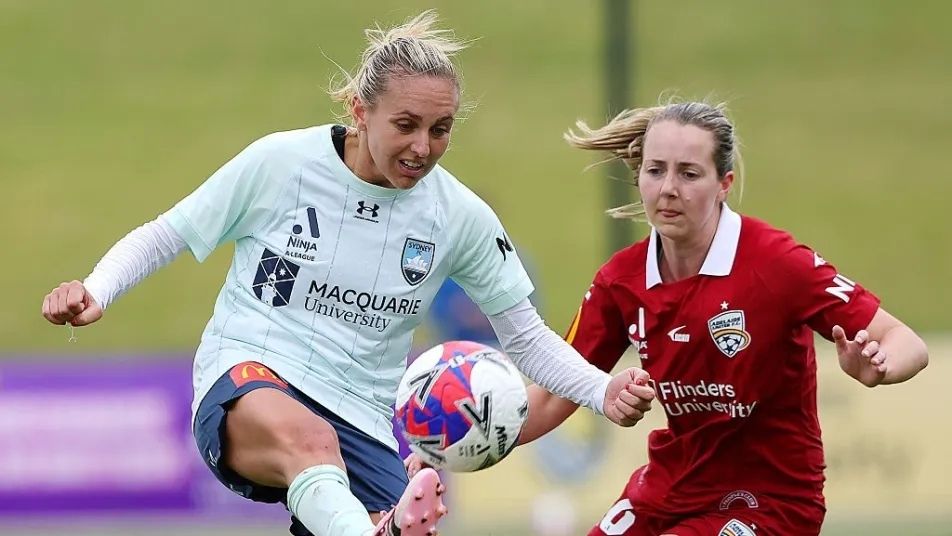
Above: Mackenzie Hawkesby (left) and Dylan Holmes (right) battle it out.Photo: via A Leagues
For the first time ever in the almost 20 year history of the A League Women’s competition, Adelaide United and Sydney FC have played out a draw, with neither side able to find the back of the net this afternoon. After playing in at times windy conditions in Adelaide, it will be Sydney who will come away from the match happier of the two sides as Adelaide dominated attack for the majority of the match but just could not convert that dominance into any score.
Despite the visitors kicking off proceedings, it was Adelaide who had the first promising attack, with Erin Healy creating plenty of strong drive through the middle of the park.
For much of the first half, those in red could be forgiven for feeling a sense of déjà vu from last week as Adelaide held the majority of possession and did the majority of the attacking, but just could not get a shot on target.
Adriana Taranto, Dylan Holmes and Carina Rossi provided a lot of attacking run, but Adelaide’s through balls just were not quite connecting, and combined with some strong defending from the likes of Tori Tumeth and Kirsty Fenton meant that only a tiny percentage of Adelaide’s shots were on target, and none of them went in the back of the net.
Sydney did have a couple of promising attacking plays, but the number was tiny in comparison to Adelaide’s. Amber Luchtmeijer impressed in attack for Sydney, trying hard to generate something for her side.
The windy conditions favoured the Reds in the first half, with a number of promising crosses from Emily Condon and later Holmes going within centimetres of scoring, but kept hitting the corssbar.
For much of the first half there was a feeling of despite Adelaide not registering too many shots on target, the Reds were doing so much attacking that it was a matter of when not if they would score.
However that did not come to reality in the first half, with both sides failing to score in the first half.
The second half started much like the first half had ended, with Adelaide again on the front foot early. The Reds had a really good opportunity within the first 15 seconds of the half when Healy found herself in ample space in the middle of the park, but ultimately could not get her header past Heather Hinz in the Sydney goal.
However Sydney was looking more promising in attack in the second half, deploying a higher press and as such was able to actually look threatening in attack.
Although the overall possession was still skewed from the first half, in reality the second half felt a lot more even possession wise than the first had been.
One of Sydney’s first substitutions of the match saw Caley Tallon-Henniker enter the match, and she did not waste time trying to give her side a spark, creating a lot of dangerous run on the right wing and generating plenty of crosses into dangerous areas.
The final stages of the match saw both sides going very close to scoring, but some unlucky bounces undid Sydney’s attacks and some strong some strong Sydney defending undid Adelaide’s, and in the end the half time score also turned into the full time score.
Teams: ADELAIDE UNITED (4-3-3): Jenkins, I. Hodgson, McNamara, Murray, Tonkin, M Taranto, Holmes, Healy, A Taranto, Condon, Rossi. Substitutes: E. Hodgson, Makris, Zois, Dawber, Worts, Melegh.
Above: Holly McNamara (far left) celebrates after scoring against the Central Coast Mariners.Photo: via A Leagues
Melbourne City have taken the points at ctrl:cyber Pitch this afternoon, in a heavyweight clash against Central Coast Mariners. The last time the reigning champions faced City was in a heated semi-final, where the Mariners beat the previously undefeated premiers to the grand final in a 1-0 defeat, causing the biggest upset of the season.
Melbourne City look to take home their first win of the season, as they came on to the pitch with full force, with something to prove, taking the first touches and holding the ball in the opening minutes.
The possession stayed fairly even across the pitch at the start, with Melbourne City slightly dominating; however, the Mariners did not make it easy for the hosts to cut through.
In an early opportunity, Malena Mires sent a dangerous ball to Taylor Otto, which looked like it may open the scoreline in favour of City, before Isabella Coco-Di Sipio snuck in behind and made a block before anything could come of the link-up.
A long-distance launch from Coco-Di Sipio almost saw the opening goal from the Mariners, which fell extremely close, but ultimately outside the net. The attempt lit a fire under the Mariners, as they immediately took more control of the ball.
Melbourne City got their first chance when Leticia McKenna took a free kick in a dangerous area, but it was headed away by Elizabeth Barwick-Grey.
Avaani Prakash has been impressive in her time so far with Mariners – remaining a standout this match following an excellent debut last week – as she made a number of blocks to hold off Melbourne City’s dangerous attack.
Aideen Keane took her chance in a challenge with keeper Sarah Langman, just one of many opportunities created by the 23-year-old, who has had an outstanding start to her Melbourne City campaign.
There was a lot of action and near misses on both sides, with excellent chances from Aideen Keane and Peta Trimis; however, the defensive line at both ends was too strong for either to break through, That was until the scoring was opened by Holly McNamara in the 32nd minute, as the golden boot winner netted her first goal of the season.
Alexia Apostolakis sent the ball deep from a corner, with a first attempt from Rebekah Stott being blocked by a sea of yellow shirts. When the ball hit McNamaras’ feet among the chaos, it was bound to reach the back of the net.
Keane looked to extend City’s lead with a shot from just outside the box; however, the angle was slightly too tight to cause any real danger for Langman.
As the first half was coming to a close, Langman made an excellent save after McNamara sent the ball to Laura Hughes, in what could have been City’s second goal of the afternoon.
During the one minute of stoppage time, Shelby McMahon sent the ball to the back of the net, assisted by McNamara, as Melbourne City takes the lead 2-0 at the break.
There was drama early in the second half, as Leticia McKenna took a knock just a minute into play. She quickly recovered and took a free kick, which was ultimately blocked.
A few good passes put the Mariners back in contention, however a loss of footing across the pitch – likely due to the wet weather – meant no real opportunities could be made as they attempted to gain dominance over City.
Central Coast did manage to hold the possession for a period of time, as City was unable to intercept the smooth passes of Prakash and Peta Trimis’s footwork.
McNamara made a dangerous run towards the box, but was taken down in the penalty area by Baxter Thew, and awarded a free kick, which awarded Melbourne City a third goal of the meeting, as the ball flew past Langman to the back of the net.
McNamara quickly went in for a hat-trick, with an extremely close shot outside the box, that was saved by Langman, on the keeper’s 100th A-League appearance.
The Mariners made a number of changes in an attempt to respond to City’s lead, with Blake Hughes, Annalise Rassmussen, and Tamar Levin coming into the action.
An excellent cross from Trimis was almost dangerous for City, until it was headed away by Otto.
The 65th minute saw McNamara make way for Deven Jackson after the brace scorer showed some discomfort in her knee.
McMahon took her second goal of the match, and third of the season, flying past the Mariners’ defence, booting the ball to the back of the net, leaving Melbourne City in an even further lead as stoppage time approached.
A late attempt from Rassmussen gave the Mariners a dangerous opportunity to get a goal back, however the ball just bounced off the post and the scoreline remained intact.
Although the Mariners fought hard in the final minutes of play, desperately looking for a response, Melbourne City’s defence shut down any opportunities the visitors managed to create, taking a 4-0 win at home.
The win is not only one of great satisfaction following last season’s major upset, but it is also a historic one, as it marks the first time Melbourne City have ever beaten the Mariners.
Above: Marisa van der Meer taking a shot for Wellington Phoenix Photo: via Wellington Phoenix
Wellington’s new coach Bev Priestman was looking to get her team off to a flying start in what’s already been an exciting opening to the season. But the Phoenix were met by a very determined Canberra United team who made life difficult for the hosts, looking to bounce back from a defeat.
The game started tentatively, with not much of a chance coming until the fourth minute when Canberra United won a free kick just outside the box. Nanako Sasaki took the free kick and drove a shot directly at goal, but it was too high to trouble Victoria Esson in goal.
At six minutes, Wellington created a great chance with Grace Jale driving a shot at goal from just inside the box. Sally James proved worthy of the effort and was able to keep the game scoreless. Jale was the best creator for the Phoenix through the first 15 minutes.
Canberra United enjoyed the majority of possession and positive territory in the first 10 minutes, but they were not yet able to create another meaningful chance since the Sasaki free kick.
At 12 minutes, Canberra United gave the ball away after some eager pressure applied from Sabitra Bhandari won her a one on one opportunity against James. Bhandari struck early but the effort was not too powerful and allowed James to steer it behind for a corner. The subsequent corner created another opportunity for Bhandari but the leg of her own team mate Grace Jale was not enough to direct the effort on target.
Wellington played a much faster and more positive pace when they were in possession, cheered on by their crowd and assisted by relentless pressing from the Phoenix forwards and midfielders. Canberra on the other hand played a high line to try and keep control of field position in the first half.
A break down the left side of the field from a Michelle Heyman hold up led to a determined Josie Aulicino picking up possession after a battle with the Wellington defence. Aulicino’s cross was driven in and actually managed to thread the needle between defender and keeper, opening the scoring. Aulicino’s first goal of the season gave Canberra an unlikely lead after absorbing a lot of pressure from Wellington.
The Phoenix created one or two half-chances through the middle period of the first half but were unable to get a shot on goal due to solid defensive effort from Hayley Taylor-Young and the rest of the Canberra defence. James also showed great awareness in her sweeping efforts if a ball was ever played or deflected behind.
The Phoenix’s offensive opportunities were often created by the talented Alyssa Whinham who was constantly sending in crosses or cutting inside herself to keep Wellington on the front foot while they tried to equalise against a stalwart Canberra side.
An in swinging corner from Lara Wall at the 39 minute mark tested James at the near post, with the ball being deflected off of the keeper and Bethany Gordon defending at the near post. The rebound fell to Marisa van der Meer on the volley and she was able to drill the ball over the goal line for the equaliser.
An added time corner at the end of the first half from Canberra almost led to a goal, with an Emma Robers header bringing out the very best from Victoria Esson who made the save to her left and kept the game even at half-time.
Considering the run of play from about 15 minutes in, Wellington will have felt a little hard done by going into half-time only even, but Canberra was well organised defensively, and looked dangerous, particularly when Aulicino and Kiara De Domizio were on the ball.
A long range effort began the second-half for Canberra with De Domizio trying out a half volley from 30 yards out. The wind in the stadium almost led to the ball dipping into Esson’s goal but it ended up being too high to be on target.
Canberra created another chance soon after, with Bethany Gordon running forward and firing a shot on goal from just outside the box. Esson was well-positioned and collected the ball at the first time of asking.
Bhandari was showing her superstar pedigree when Wellington got forward, driving two dangerous crosses into the Canberra United box in the 53rd and 54th minutes, but there was no recipient to either delivery and Canberra kept the score at 1-1 after 10 minutes of the second half.
In the 62nd minute, Wellington Phoenix created the best chance of the half after Alyssa Whinham weighted a delicate through ball to Samba who took an early shot on goal. Unfortunately for the Phoenix, the shot itself was somewhat tame and James was able to collect.
At 71 minutes, Bhandari worked some magic to loop in a floating cross to the back post after showing great strength and skill to hold onto the possession. Manaia Elliott was unable to direct the resulting header at goal, but the Phoenix continued pushing to take the lead.
Gordon won a free kick for Canberra United in a dangerous position and the strike from the Ava Briedis free-kick forced a good save out of Esson. The subsequent corner led to some more trouble for Wellington as a low cross nearly found its way toward Esson’s near post. The keeper was able to clear the line again and the attack eventually faded into nothing for Canberra United.
Neither team looked content to settle for a draw as the game entered its last 10 minutes. Heyman finally got a chance with a free header at the far post, but her effort was driven straight into the waiting hands of Esson, who played very well during this period of Canberra attack.
Emma Main took a stretching shot after a Phoenix counter-attack, but was unable to get enough power behind the strike to test James in the 85th minute. Both keepers proved very capable throughout this match-up.
This action packed game went down to the wire, and showed why both teams feel that they’ve improved heading into this season. Some of the last few touches or shots were a little below the standard the teams would have expected but provided a promising platform to go forward as the spoils were shared.
When Aston Villa head to Manchester ahead of Saturday’s duel with Manchester United, it will be with a point to prove. The Villains have been a force to be reckoned with at times this season – such as in the strong draw away at the Emirates – but have also disappointed on occasion, such as last week’s late concession that allowed Everton to rescue a draw.
For their part, United are still unbeaten in the league. Despite an uncharacteristically sloppy defensive performance last time out against Brighton, the Red Devils are on good form, scoring 10 goals in their last five WSL games. Impetus Football’sCatherine MacKenzie heard from Villa head coach Natalia Arroyo ahead of the game.
Dealing with United’s high press
United have won plaudits for their ability to press their opponent, giving them no space to breathe and forcibly taking possession in dangerous areas. Arroyo indicated that her team are aware of this, highlighting the importance of United’s physicality.
“Man United were one of the best teams out of possession last year. They are so aggressive in their high press. They are so physical and they are so committed. In the hard work, they don’t want to stay defending lots of periods of the time and they are so aggressive to win the ball back,” she said, stressing that attacking United will be hard to do.
Villa may look to set pieces as their main outlet, focusing on an area where they’ve already found success this season rather than trying to outpress United.
“I think the key thing inside this is to have a good takers and to read the positions and to have good players in the box – and we are finding goals and that’s good,” she said, noting that “we knew that was definitely a part that that we were not very good at last year, so we worked as many things as possible and in this case we are being successful with it”.
The ability to win the ball back deep into the opposition’s half means United are disciplined and physical off the ball – which Arroyo admires, likening it to how she likes her own teams to play.
“I really admire the way Man United are playing out of possession, and of course, in possession. But the out of possession was one of the teams that were closer to my idea. It’s not that I’m copying them, but definitely I admire the work that Marc and his players are doing.”
Learning from Everton
Villa’s last game included a last-minute equaliser from Everton. Arroyo fielded a young team against the blues, and has won plaudits for giving opportunities to young players. Lucia Kendall is a prime example, starting four of five WSL games and putting in performances that meant she received her first call up to the senior England team. She followed that up with her first start and a player-of-the-match performance against Australia.
Her club manager is aware that moments like that last minute equaliser will come as her young players continue to adjust to the level of the league, concluding that focusing on progress rather than disappointment is key.
“It was a normal week focusing on on the different lessons that we can take from Everton, with our full attention on some actions especially at the beginning,” she said, referencing the early moments in the game that saw Everton take the lead. She continued, “we were too passive maybe and we were like too basic in possession. So we were talking about that and about our performance to try to to show that it was just an accident.”
Dealing with United’s threats
Villa’s last competitive game against United was in March 2025 and saw United dominant. They were three goals to the good before half-time, and Villa struggled to escape their own half until the end of the game. Arroyo suggested this game is playing on her mind as they approach United again, particularly their tendency to start the game with a high tempo.
“When Man United visited Villa Park I was already here. They destroyed us in the first half. I know that can happen because they are so strong,” she said, remarking that “we need to not give them the chance to destroy us as they did then.”
Although the Everton result was disappointing, Villa have taken confidence from two good performances against top four-sides Chelsea and Arsenal, who they held to a 1-1 draw away from home.
“It’s just if we can be like closer to the version that we showed against Chelsea, Arsenal to pick, like, maybe two good examples, that’s them. That’s the ambition, that’s the bravery that we, that we want and to be ready for everything.”
England duo Jess Park and Ella Toone have been in electrifying form this season. Toone’s physicality and Park’s ability to play through small pockets of space have given United much more creativity going forward. Asked how she plans to disrupt the duo, Arroyo was coy, focusing on the threats United pose as an eleven.
“I remember Villa Park, they destroyed us with wide combinations, they can do that. And then, with the addition of [Fridolina] Rolfö, and [Melvine] Malard can play on a wide channel, just going in to create an overload in the middle. That’s a strong thing.
And I think they, they have grown in my opinion. They they are just adding pages and slides to their game model and how they play centrally is also really strong.
It’s just it’s reducing the volume of success of their combinations because yeah, they built a good relationship. They play in short distances. They connect quick passes, and you’re out. So we need to be smarter, be a little bit more solid and use everybody to defend better.”
Although Villa want to surprise United, Arroyo is aware of the need for clarity and consistency, particularly with a young squad.
“The key thing is that in your search of being unpredictable, you are not unpredictable to yourself”
Manchester United v Aston Villa kicks off on Saturday 8th November at 12:00 noon UK time. It will be broadcast on Sky Sports+ in the UK and the WSL Youtube elsewhere in the world.
Above: Bente Jansen (centre) celebrates with her Brisbane Roar team mates after scoring one of her two goals against Perth Glory. Photo: via A Leagues
Bente Jansen’s brace helped Brisbane Roar edge Perth Glory 3-2 in a thrilling Round 2 opener at HBF Park. Despite a late goal from Ella Lincoln, the hosts couldn’t find an equaliser as Brisbane held on to all three points.
The game began at a steady tempo, with both teams looking to establish control but neither creating any clear early chances. Brisbane Roar struck first in the 20th minute through Grace Kuilamu, whose effort from just outside the box took a deflection off Onyinyechi Zogg and slipped past Perth goalkeeper Alyssa Dall’Oste to give the visitors the lead.
Perth Glory’s response was almost immediate. Rola Badawiya, full of confidence after scoring in Round 1, brought her tally to two goals in as many games with a superb curling strike that found the top corner, drawing the hosts level.
The equaliser lifted the tempo as Perth began to grow into the game. Tijan McKenna delivered a dangerous ball across goal to Emma Tovar, who narrowly missed with her attempt, while Gabby Hollar continued to test the Roar defence with powerful efforts from distance. Hollar looked especially lively late in the half, bringing about a couple of half-chances as Glory pressed for a second.
Despite a promising spell of pressure from the home side, neither team managed to get ahead before the whistle. The opening 45 minutes ended with the scoreline locked at 1-1, a fair reflection of a tightly contested first half that promised plenty more action to come after the break.
It was Brisbane who struck first in the second half.
In the 51st minute, Dutch youth international Bente Jansen continued her fine start to life in the Ninja A-League, scoring her second goal in as many games. Sharn Freier provided the assist, the pair combining neatly in what is fast becoming a dangerous attacking partnership for the Roar.
Just two minutes later, Jansen doubled her tally and extended Brisbane’s lead to 3-1 in a moment of horror for the Glory defence. A loose ball rolled agonisingly across the line after a scramble in the box, leaving goalkeeper Dall’Oste unable to intervene. Freier nearly added a fourth soon after but sent her effort just wide of the right post.
Perth refused to fold though, and looked to claw their way back into the contest. Rola Badawiya came close amid a goalmouth scramble, only for Marianna Seidl to clear with a clean header, while Brisbane survived a series of dangerous corners in the final stages.
The Glory pressed hard in the dying minutes, with captain Izzy Dalton driving forward to create one of their best second-half chances, only to be denied by the Roar defence. Brisbane appeared intent on managing the clock, but Perth’s persistence finally paid off in the 92nd minute when Ella Lincoln produced a brilliant solo run to slot home her second A-League goal, reducing the deficit to 2-3 and setting the game up for a tense finish.
Zogg came close to equalising moments later but sent her effort just wide, and Susan Phonsongkham had the final chance of the game, though her shot lacked the power to trouble Chloe Lincoln in goal. Despite a late surge from the home side, the visitors held firm to secure a hard-fought victory.
Sometimes football is more than a game. There is a power in team sports that cannot be replicated elsewhere: it brings people together, and success only comes for the teams that work together as one. Football also has the power to make a statement: it transcends borders and languages, and can bring attention to important issues in ways that few other platforms can.
Whether it’s through protests on the field, powerful messages on the back of shirts, or players using their platforms to promote issues that are meaningful to them, football has a unique ability to spotlight global humanitatian issues on a large scale. Afghan Women United player Nilab Mohammadi has said that football is “not just a sport — it represents life and hope”.
Earlier this autumn, Impetus Football reported on the FIFA Unites: Women’s Series tournament ahead of its commencement in October. Whilst the tournament in that iteration did not go ahead due to the United Arab Emirates rejecting visas for the Afghan team, the games were instead played in Morocco, with the Tunisian national team taking the UAE’s place in the competition. They were joined by Chad and Libya to round out the tournament.
As we reported then, the aim of the tournament was to provide a platform: the Afghan Women United players aspire for FIFA to officially recognise them as Afghanistan’s national women’s team – which would enable them to compete in sanctioned international competitions. Chosen following three summer trials held in Australia and England, the players representing Afghan Women United came together quickly under the guidance of Scotland’s Pauline Hamill and South Africa’s Shilene Booysen.
More than a game: Afghan Women United
When Afghan Women took to the pitch on the 26th of October, the air felt heavy – and not just because of the dewy Moroccan weather. With Chad their opponents, the game marked the team’s first outing in four years – it meant far more than a normal game of football. It represented a statement of solidarity and fight against oppression; their footsteps on the grass something nobody took for granted.
“Everyone was telling me, ‘We won’t get it,'” defender Mursal Sadat told USA Today about their fight for an Afghan team. “But I said, ‘We will still fight this fight, because it’s not about us, it’s about all the women in our country. It’s about being a voice for them.”
Reflecting on the occasion, captain Fatima Haidari said there was “a real mix of emotions” among the team. “I cried because we are back after many years, after all the moments that we suffered out of Afghanistan, far from our families … but we are still here,” said Haidari. “We are fighting, and we had that spirit to be together and to strongly go ahead and just play the match.”
That opening moment on October 26th was followed swiftly by the tournament’s opening goal – an electric moment for Haidari and her team as striker Manozh Noori smashed a penalty calmly into the center of the net. Although Chad eventually ran out 6-1 winners, the jubilation of that moment was clear as the bench erupted with celebrations from players and staff.
This was followed by a 4-0 loss to Tunisia, before a resounding 7-0 victory against Libya that saw Nazia Ali and Nilab Mohammadi each score a brace. Although the tournament was about far more than football for the Afghan team, their performance against Libya was one to be proud of.
FIFA President Gianni Infantino attended their final match, commenting that the tournament would mark “the beginning of a beautiful, beautiful story that you are writing for yourselves, for your families, for so many girls and women all over the world.”
Chad set the standard
Following the round-robin, Chad emerged victorious, with three wins from three. They scored 23 goals whilst conceding only one, beating Libya 16-0, Afghan Women 6-1, and Tunisia 1-0 despite a red card on the hour mark. This means they will make a first appearance in the official world rankings, alongside Libya.
Above: Chad celebrate their win. Photo: FIFA.
Perhaps unlikely champions, Chad set a high standard beginning with the opening-day win over Afghan Women, though it was their final match against Tunisia that showed their mettle.
On paper, the 1-0 win is surprising: Tunisia are ranked 96th in the FIFA World Rankings, and participated in both the 2022 and 2024 Women’s Africa Cup of Nations. Unranked, that Chad achieved the result whilst down to ten players for over half an hour was even more remarkable.
Next steps: progress and unity
Whenever a step like this is taken, there is a danger that those in positions of the power to enact change will see it as ‘job done’. If this happens – even temporarily – there is a serious chance that the developments made over the months leading up to the tournament will have been in vain.
Afghan activist and former player Khalida Popal has called on organising bodies to grant Afghan Women United recognition as a national team and an independent national soccer federation “to actually govern the teams, to make sure girls are not silenced.”
“Our players have been fighting for that right for so long,” Popal said. “Of course, there’s not governance in this initiative and the pilot, but we would love to have it in the future.”
For Afghan Women United, the experience of the tournament should only be the beginning; Hamill should now be handed the resources and the support to work with the team – and more Afghan players around the world. The process to begin identifying and mentoring younger Afghan girls abroad to build a pipeline of future talent will require resources and staff.
Regular training camps with a consistent set of players may be more difficult as they have sought refuge across the world, and it would take time and money to ensure everyone is in the same place. There are ways around this: hubs in more accessible locations, working with smaller groups of players at a time.
As Popal highlighted, the most significant development is institutional – for FIFA to grant official recognition, which can open pathways to future international fixtures. Afghan Women United and those behind them have done the hard work of gathering a team and making a stand – now it is time for the global football bodies to get behind them.
Full replays of the FIFA Unites: Women’s Series tournament are available on FIFA+.
Above: Head Coach Stephen Peters talking to the media. Image: Perth Glory.
By Ella McShane (5/11/25).
Perth Glory take on Brisbane Roar at the grandest soccer stage in the west this Friday, in a double header under the lights. Head coach Stephen Peters and Gabby Hollar preview what is bound to be an ambitious afternoon at HBF park, with everything to play for.
Each respective side carry an encouraging 3 points coming into round 2 of the Ninja A-League season, Stephen Peters commended the three points as a result of travelling well and putting “a few things in place that we were pretty happy with, and I think that laid the platform for us”. Peters subsequently commended his sides management of weather delays that were widespread across the league in its opening weekend.
Coming into the weekend, the side carry a renewed sense of belief having remained winless away from home since December 2023. Peters stating “I think that was probably the issue in why it went so long, that mentality piece, but I think this group we’re pretty switched on…I think we did everything right.”
The side face an undoubtedly quality Brisbane outfit, with the north east side carrying a viable attacking threat to the west’s defence. Peter’s expressed confidence in his side defence, expressing that; “it is going to be a tough ask for our defenders, no doubt. But I think if we show that resolve that we’ve had, there is no reason why we cant pose a threat to them”.
Glory intend on carrying a “quiet confidence” into Friday, reiterating that “it is one win and Brisbane are very good side and I think Alex [Smith] is going to have them ready to go and we’ve got to be ready for that”.
Tactically, the side are committed to “finding the balance early” with a relationship between adaptability and internal strength and mentality seeking, highlighted as key features in a prospectus night under the lights:
“You’ve got to make tactical adjustments given what the opposition is going to throw at you and the quality. But I think that we can’t go away too much from the principles that we’ve been working on and what we feel our strengths are. But you have to be wary of what they pose. It is a different style that they’re playing versus last season, we’ve also got to be ready that.” Stated Peters.
Above: Gabby Hollar speaking to the media. Image: Perth Glory.
Looking at the bigger picture, round two nurses a growing rivalry between the west and east, with points between the two sides having to be earned with grit in previous matches. Gabby Hollar reflected on the excitement with “how [Glory] got the three points last time [Roar] came here”. “But the game before, we all still have a bitter taste in our mouth about how that went. So it is just, can we capitalise on them coming here?”
The match kicks off at 16:00 AWST at HBF Park Perth/Boorloo available to stream on Paramount+.
Above: Feyenoord women celebrate their emphatic victory. Photo: FeyenoordV1 on X.
Following the October international break, the Netherlands’ top tier of women’s football continued. In round six of the Women’s Eredivisie, several top sides recorded convincing victories over clubs that continue to lag behind in investment. The growing contrast reflects both the progress at the top and the stagnation among the rest of the league.
ADO Den Haag 0-5 FC Twente
FC Twente Women have made it abundantly clear this season: they dominate the Eredivisie and look ready to make strides internationally. Averaging 3.66 goals per match and matching Ajax’s goal difference, the reigning champions once again showcased their attacking power. Against ADO Den Haag, they produced a commanding 0–5 victory — another display of pace, precision, and power.
It didn’t take long for Twente to set the tone. Alieke Tuin opened the scoring with a stunning 20-meter strike to make it 0–1. Moments later, Sophie Te Brake came close to doubling the lead, but keeper Barbara Lorsheyd made an excellent save. Lynn Groenewegen and Sophie Proost also had chances, while ADO just about managed to hold on.
Above: ADO Den Haag v FC Twente. Photo: Eric de Wit / ADO Den Haag.
At the other end, Diede Lemey had to intervene once against a shot from Anne van Egmond — a key save, as Jaimy Ravensbergen made it 0–2 shortly after with a brilliant solo effort, cutting inside and firing into the near corner. Just before halftime, Van der Vegt hit the crossbar, but Twente entered the break in full control.
After the interval, coach Corina Dekker made two substitutions — Danique van Ginkel and Charlotte Hulst — and the change paid off immediately. Within a minute, Van Ginkel scored with her first touch: 0–3. Twente kept pressing and extended their lead through another Tuin goal (0–4) and a late strike from Jill Roord, who had yet to score in the league this season, sealing a resounding 0–5 win.
With their fifth straight league victory, FC Twente reaffirm their status as title favorites. The team’s confidence, collective strength, and attacking balance make them a force both domestically and in Europe — exactly as Dekker envisions: a club whose name resonates internationally.
HERA United 0-5 Ajax
The Amsterdam city derby is back — but for now, it’s still Tom Thumb vs. Goliath. In the first-ever official meeting between Ajax and HERA United, the reigning champions wasted no time asserting dominance. After just 15 minutes, Ajax were 3–0 up, and the game was essentially over. HERA’s defending was shaky, and they had no answer for Ajax’s fluid, creative attacking play.
Above: Ajax celebrate. Photo: Ajax.nl.
After five minutes, Ilayah Dostmohamed opened the scoring, capitalizing on a defensive error. Soon after, Bo van Egmond doubled the lead from a Sherida Spitse cross, and two minutes later Jade van Hensbergen made it 3–0 with a precise strike off the inside of the post — her first official goal for Ajax. Amber Visscher then added a fourth before halftime with a thunderous shot from a rehearsed corner routine: 0–4 at the break.
The second half slowed down somewhat, but Ajax stayed in control. Twenty minutes from time, Dostmohamed was brought down by goalkeeper Kelly Steen, and captain Sherida Spitse converted the penalty to seal the 5–0 win.
The derby, for now, was more symbolic than competitive — Ajax showed class, HERA showed courage, but the gap remains enormous. Still, something promising has been reborn in Amsterdam: a city rivalry with potential, even if it’s currently one-way traffic.
PSV 2-0 AZ Alkmaar
For PSV, Sunday’s match at De Herdgang was a crucial test: could the Eindhoven side continue to beat the mid-table contenders and stay in the title race? The answer was a firm yes. Against AZ Women, Wouter de Vogel’s side won 2–0 in a match where efficiency made the difference.
Above: PSV v AZ in action. Photo: AZ.nl.
AZ started brightly and had a golden chance to take the lead through Desiree van Lunteren, but the experienced striker was denied by the keeper. PSV struck at the other end a few minutes later — Riola Xhemaili once again proving her worth as the team’s finisher, calmly slotting home for 1–0. The Swiss midfielder is fast becoming the key player in PSV’s title pursuit.
AZ continued to play well but couldn’t break through PSV’s solid defense. The home side were more clinical in front of goal and sealed the win in the second half when veteran Renate Jansen doubled the lead with a composed finish: 2–0.
The result confirmed that PSV can perform not only against direct rivals but also against strong mid-table teams like AZ. They remain firmly in the chase behind Twente and Ajax, ready to pounce if either of the leaders slip up.
Excelsior Rotterdam 2-4 FC Utrecht
FC Utrecht beat Excelsior 4–2 in a match that had many faces — and mixed emotions across the lines. Both teams were shaky in defense but dangerous going forward. Ultimately, Utrecht’s superior quality made the difference.
Lobke Loonen and Nikita Tromp are the driving forces in an otherwise youthful Utrecht side. Tromp stood out with two excellent goals to give Utrecht a 2–0 lead. That scoreline flattered the hosts somewhat, as Excelsior regularly created danger and exposed Utrecht’s fragile defense. Homan and Hendriks showed that Excelsior’s attack has improved significantly since last season.
Above: The battle between Utrecht and Excelsior. Photo: VrEredivisie on X.
In the second half, poor defending from Gera op den Kelder allowed Van Speijk to press high and score after rounding goalkeeper Bastiaen: 2–1. Utrecht responded quickly — in the 56th minute, after a clever move by Tromp, Van Straten provided the assist for Loonen to make it 3–1. Moments later, Loonen added another, lobbing the keeper with confidence after a perfect through ball from Tromp.
Utrecht kept pushing, and Tromp nearly completed her hat-trick after hitting both posts before the ball rolled harmlessly into the keeper’s hands. Hendriks scored the goal of the game late on, curling into the top corner after winning the ball herself: 4–2.
Excelsior can take confidence from their attacking display and should win more games playing this way. But for now, the chemistry between Tromp and Loonen sets Utrecht apart. If they want to challenge the top sides, though, their defending must improve — attack alone won’t be enough.
Feyenoord 6-1 SC Heerenveen
Feyenoord did their homework. They knew Heerenveen struggled with defending set pieces — and they exploited it perfectly at Varkenoord. All six of Feyenoord’s goals came from corners. That says it all: tactical awareness on one side, defensive chaos on the other.
The match itself wasn’t one-way traffic. Heerenveen started brightly, with Inessa Kaagman testing Jacintha Weimar inside two minutes. The visitors played well early on, combining neatly and creating chances through Kaagman and Elfi Maass, but their finishing let them down.
After ten minutes, Feyenoord struck from their first corner — Ella Van Kerkhoven headed in for 1–0. Heerenveen equalized through Kaagman, but before halftime, Akari Takeshige restored the lead — again from a corner.
Above: Feyenoord v SC Heerenveen. Photo: FeyenoordV1 on X.
The second half got worse for Heerenveen. Esmee de Graaf made it 3–1, and Celainy Obispo added two more, all from corners. In stoppage time, Mao Itamura completed the rout at 6–1.
Heerenveen showed flashes of good football, but until they fix their defending on set pieces, results like this will keep haunting them. One thing is clear: defensive work is urgently needed.
PEC Zwolle 4-0 NAC Breda
PEC Zwolle continue to be this season’s revelation. Despite injuries to youth internationals Schilder and Zuidberg, Joran Pot’s side are flying high, strengthening their grip on fifth place with a 4–0 win over NAC Breda — their biggest league victory since December 2023.
After a scrappy start, Ilvy Zijp broke the deadlock in the 14th minute with a crisp strike after fine work from Hanna Huizenga. NAC’s Brigitte Franken missed a good chance to equalize, while PEC began to dominate possession. Just before halftime, NAC hit the post through Franken, but Zwolle went into the break 1–0 ahead.
Above: PEC Zwolle v NAC Breda. Photo: NAC.nl.
NAC started the second half strongly, but PEC punished them on the counter. A quick transition down the left led to the 2–0, and soon after, Huizenga made it three with a composed finish. Late in the game, Judith Roosjen sealed the final score at 4–0.
With this victory, PEC Zwolle cement their reputation as the league’s biggest surprise package. The team plays brave, positive football and shows resilience despite setbacks. NAC, meanwhile, look increasingly in trouble and must fight hard to stay in the Eredivisie.
By Gethin Thurlow at Meadowbank for Impetus(2/11/25)
Above:Ellis Notley celebrates with Ciara Grant and Tiree Burchill Photo: @HibernianWomen on X
Fresh from her fourth straight start and second goal for Scotland in the international break, Melissa Andreatta’s favoured striker Kathleen McGovern scored a brilliant header as Hibs eventually overcame a strong Partick Thistle defence, with Ellis Notley starring for the reigning champions.
The Teams
After a week off, Hibs went for a fairly standard team, with the normal back line, Grant, Notley and Adams. Kirsty Morrison was given the start on right wing ahead of Livingstone, with Bowie and McGovern completing the lineup.
The visitors went unchanged from their last game, which meant Scottish hero Jo Love missed again through injury. Ex-Hibee Lia Tweedie and attacker Erin Rennie would carry the main goal threat for Partick.
The Action
It was an open game early on, with Thistle trying some direct balls and successfully getting in for the first couple chances. Hunter and Taylor are a centre back duo that can be exploited in behind, so the degree to which Grant Scott’s side sit with the entire team in the opposition half is often managed.
As is normally the case, Hibs focused their attacks down the wings, with the attacking-minded full backs offering some relief and overlapping runs. Jeni Currie was called into action early on, as Papadopoulos’s cross was met by Kirsty Morrison from the right side of the box. Currie got down to save that one, but when a corner was cleared out, Siobhan Hunter floated a challenging ball in, Grant and Currie came for it, made contact and the ball fell to Morrison who smashed it in.
In particular, the host were finding a lot of success down the left side, with Papadopoulos pushing high, meaning that while Slater was marking Bowie, the Australian left back had space to play with, and vice versa. Partick’s central back three headed just about every cross away, giving McGovern and Adams no sniff of a headed goal.
Hibernian continued to heave crosses into the box, with Caley Gibb miscuing a few efforts from the right-wing position. Ellis Notley also enjoyed the opportunity to take a few wide free kicks and corners, but Thistle’s defence stayed strong.
Something that did work for Hibs was limiting their opponents’ goal threat. The high press of Adams and McGovern, with the help of Grant and Notley gave Partick no out-ball, meaning they were suffocated before they could try and attack.
At half time, Hibs were well in control of game but only had a one goal lead – and a narrow lead that didn’t deserve to be bigger.
In the second half, Hibs clearly came out with a new plan. Moving through the middle and getting the ball to the feet of Kathleen McGovern and Eilidh Adams as much as possible. On one such occasion, Notley quickly rolled it across to the fan favourite ‘McGov’, but the training-ground routine could not fool Jeni Currie. She also dived to save a long shot from Adams as the Hibs shot count started to rise.
In a rare moment of Partick Thistle pressure in the second half, a slightly underhit back-pass from the Hibs defence gave Schumacher limited time to clear, and her clearance hit an oncoming Rachel Donaldson, bouncing up and allowing Robinson a free shot at goal. Saving the American keeper’s blushes, she scuffed it and Hibs stayed in the lead.
The home team still dominated the ball however, and David Elliot’s team could not muster another opportunity. The introductions of Burchill and Livingstone on the wings and Fitzerald in midfield forced Hibs to focus more on dribbling rather than playing long balls in behind.
As the end of the match approached, Ellis Notley had yet another corner. She picked out Kathleen McGovern at the front post, who flicked her header into the roof of the net to essentially guarantee the three points.
That extra goal seemed to relax Hibs and they played with much more freedom. Noa Schumacher absolutely launched a ball forward, which beat the defence and Rachel Boyle latched onto it. She found Adams with a through ball, who laid it off for Notley to lace it into to bottom corner from outside the box.
The final kick of the game was a free kick by Linzi Taylor, who curled her effort into the outside of the side netting – something which the home fans didn’t realise initially. Regardless, the whistle blew instantaneously.
Player of the Match Ellis Notley
Above: Ellis Notley scoring a head v Hamilton earlier in the year Photo: @HibernianWomen on X
She’s had to cover injuries in midfield and defence this year, but with Kirsten Reilly’s absence she has made that defensive midfielder role her own. Stepping into corner and free kick-taking duties, Notley has been racking up goals and assists recently. Today however, she was in control of the entire match.
In what was physical battle all game long, Notley held her own, winning the ball and protecting it from a hungry Partick midfield. Notley took up positions all over the pitch, dropping deep at points, as well as providing some width. She took all 13 corners and the majority of 19 free kicks too. Never earning too much attention for her performances in green and white, Notley has been a quiet hero of Hibs’ title push this year.
Where this leaves the teams
Grant Scott will be relatively satisfied with the result, although there is some concern to be had over the difficulty they faced trying to break down Partick in the face of a stout aerial defence. The goals did come in the end, and they really embraced the mantra ‘defending from the front’, which cut off any Partick Thistle resistance. They stay second in the league and ensure Glasgow City didn’t get any further away in their dominant 5-0 victory at the same time.
It was a rather spirited defensive effort from David Elliot’s squad in the face of a tough run. Currently sitting in ninth place in the league, Partick have been a step below the other competitors for that sixth place, and they will be disappointed with that fact.
This game was always going to be on where points were difficult to achieve, but with a solid back five and a dominant performance in the air, there are some building blocks for Thistle to push off of as they look for clean sheets and wins against other teams in and around them to avoid that ninth-place playoff.
Above: Gago celebrating her first goal with Maz Pacheco. Photo: Everton Women on X.
Everton managed to gain a point against Aston Villa in match week seven of the WSL thanks to a late Kelly Gago injury time volley.
The visitors had to claw their way back into the game twice despite taking the early lead.
Gago opened the scoring early on and it seemed the first half was the Toffees, but Georgia Mullett grabbed an equaliser deep into injury time.
The second half saw Kirsty Hanson giving the Villans the lead before the hour mark, substitute Hikaru Kitagawa equalising with a stunning curling shot, an own goal and finally Gago’s second goal of the game.
The Action
Aston Villa’s coach Natalia Arroyo made five changes to her side that beat Bristol City 3-0, whilst Everton boss Brian Sørensen named three changes to his side that drew 1-1 against Nottingham Forest in the Women’s League Cup.
The visitors started the game at a faster tempo than the hosts as Everton dominated the opening exchanges.
Rosa van Gool had two early shots, threatening the Villa defense, but it was Gago who gave her side the lead in the 10th minute. Fernández laid the French international the ball inside the box and Gago struck the ball well from the left side of the box, finding the far-right bottom corner.
Everton continued to mount pressure on the women in claret, but they could not find that clinical touch again.
Aston Villa began to grow into the game as they had their first effort on goal in the 40th minute– a shot that flew over the bar from inside the box. They found the back of the net in the eighth minute of injury time with a cross from the right side of the box by Noelle Maritz finding Mullett at the back post.
Everton made a half time substitution involving Elise Stenevik, as she was replaced by Rion Ishikawa.
On the stroke of the hour mark, the hosts took the lead. Mullett was played through and she made a good pass to Kirsty Hanson inside the six-yard box. She did well to get a foot ahead of her marker and poke it into the bottom right corner.
Now with the lead, Villa made a double substitution. Maritz was replaced by Sarah Mayling whilst Hanson was replaced by Ebony Salmon.
Five minutes after conceding, Everton made a triple change as Yūka Momiki, Hayley Ladd and Kitagawa replaced Toni Payne, Honoka Hayashi and Mayumi Pacheco.
Sørensen’s substitutions paid off as Kitagawa made an instant impact. In the 70th minute, Fernández laid the ball off to Kitagawa just inside the box and the substitute struck the ball cleanly, finding the far right inside netting.
The hosts made their final change of the game as Rachel Daly replaced Miriael Taylor.
Villa’s third goal came in the 74th minute, just a minute after that last substitution as a short corner from the left side of the pitch found Salmon. She crossed the ball towards the front post, with Ruby Mace getting to the cross first, her clearance actually was sliced, and she found the back of her own net.
Everton was not dead and buried by the goal though, hitting the crossbar in the 85th minute.
Their persistence was finally rewarded as a bit of good fortune found Gago in the fourth minute of added time. A cross from Ornella Vignola found Gago in the centre of the box. An initial header from Gago was blocked well, but it fortunately fell back to her, and she volleyed the ball into the back of the net levelling the game for the third and final time.



















 impetusfootball.org