In this, the first of our post-season catch-ups with Impetus’ sponsored players and partner clubs, Lisa Topping of FA Women’s National League Division One North side Chorley spoke to Ben Gilby(2/6/22).
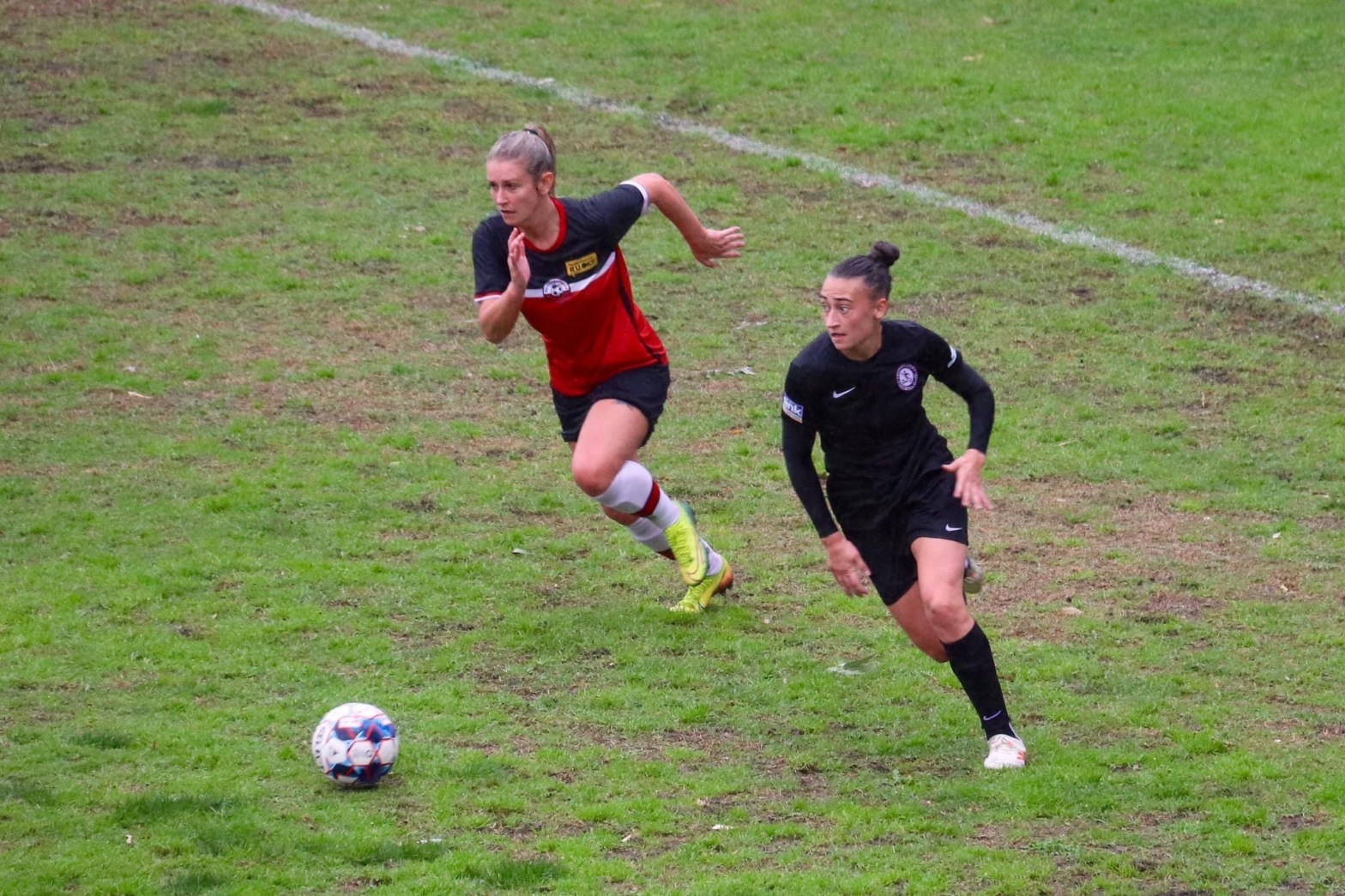
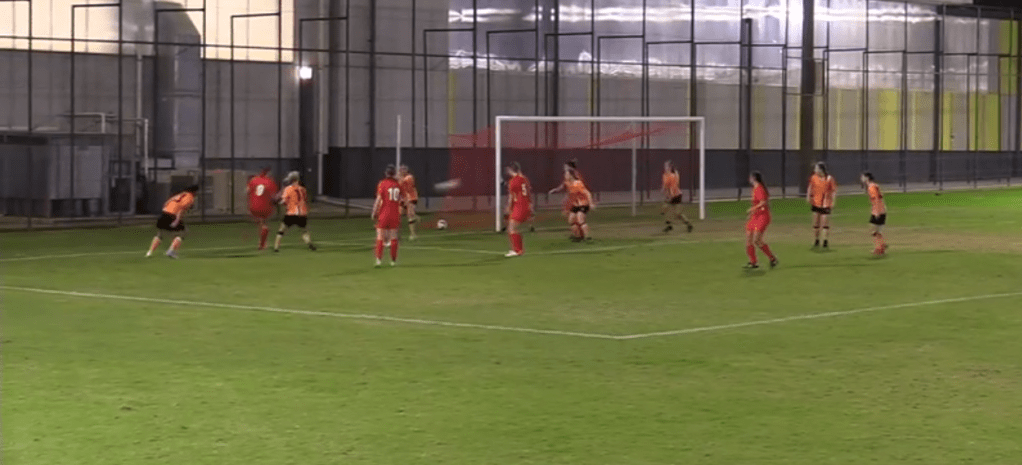
Above: Lisa Topping (right) in action for Chorley against Newcastle United this season. Photo: John Shirras.
For the second season running, Impetus sponsored Chorley defender Lisa Topping. The Lancashire side has had a superb season in league and cup. Only four league defeats all season and a marvellous run in the FA Cup, defeating higher league opposition along the way. Lisa was overjoyed about so many elements of the season.
“Yes, absolutely, we did have a very successful season. We managed to take valuable points away from big clubs in the league, including an amazing win over Newcastle United towards the end of the season, who were fighting for top spot and we had a really good run in the FA Cup. But above all that, we’ve seen young talent come through the development and reserve teams into the first team squad which is fantastic to see.”
The former Liverpool defender believes that Chorley probably haven’t had the attention they deserved this season as a result of their impressive sequence of results.
Above: Lisa clears the ball for Chorley at FC United of Manchester. Photo: John Shirras.
“We only had four losses in the league this season which is a very low number and demonstrates how hard it is for teams to play us and get an easy result. One thing about Chorley is that teams will always have to work hard to take anything from us.
“Chorley is a real family club and always has been. But, this season the camaraderie between the players and amongst the coaching staff has been a different level. We all fight for each other and we’re all striving for the same goals for the team and the club.
“We want to be there and we want to train hard. In terms of training too – everyone has been improving this year and that’s down to Ben (Gooden, head coach) and the coaching staff’s time, commitment and focus.
“In general, we’re all tight as a team which is fantastic. We’re good at welcoming in new players and having fun at training and on game days. But, our skipper Laura Walker plays a key part, without a doubt. She’s a fantastic captain and a worthy leader of the Chorley team. She checks in with everyone and makes sure we’re all always focused on what we need to achieve.”
In such a fantastic season, there were so many potential high points, but for Lisa, it was their astonishing FA Cup game with higher level Middlesbrough that stands out.
Above: Lisa in possession for Chorley at FC United of Manchester. Photo: John Shirras.
“It was a fantastic moment for the club to beat a team in the higher league and progress to the next round when all the odds were against us. There was a buzz around the club for weeks. It went one way then the other and then to penalties!
“There was one other highlight for me. Scoring the opener against Leeds United away in the league. I don’t score very often but that one was a special goal and on YouTube too! My Grandma passed away a few weeks earlier so I was able to dedicate that one to her.”
Lisa has been happy with her performances this season, highlighting: “I’ve been a part of a team and backline who has not allowed many losses and I’ve managed to get my name on the score sheet a couple of times. As a left back, I always try to be hard to beat regardless and enjoy getting forward into the attack too and I think I’ve done that.”
Whilst the season now at an end, the defender is still focusing on keeping in good shape ahead of the new campaign.
“I’ve signed up for a gym now that the season is over. For me, it’s important to not lose all of the fitness I’ve gained so I’ll go straight into fitness work in preparation for next season.
Above: Chorley FC 2021/22. Photo: John Shirras.
“Personally, it’s a nice time to have full weekends back for a little bit and not have Sundays booked up, so I’ll go on lots of camping trips or walking over the weekends and make use of the spare time.”
Lisa believes that Chorley’s mix of exciting youngsters and experienced players puts them in a really good place to experience more success in 2022/23.
“Next season is going to be exciting and I can’t wait. The blend of players that we have puts us in a really good position to build on this past season and push on further towards our goals.
“The group that we have is extremely special with a good work rate and a tough attitude that makes us hard to break down. Another pre-season together will allow us to fix a few things and come back stronger.”
Above: Pride Park midfielder Bleu Lewis-Wilson challenged by Borrowash Victoria’s Tebble. Photo: Shaun Hardwick.
By Doug Outt (2/6/22).
The curtain fell on Pride Park’s 2021/22 season in the tier seven Derbyshire Ladies League Divison One with an away match at Borrowash Victoria, which was ultimately won by the hosts. With runners-up trophies waiting for the team at full time it was already a successful season regardless of the result.
The home side were boosted with a much bigger bench than usual and were in search of a draw or a win to see them leapfrog Sandiacre Town into third place in the league. They started the brightest, opening the scoring within a minute as Nat Eley latched onto an under-hit back pass and made no mistake after rounding Jade Howell.
After that rude wake-up call, the match evened out, with Vics enjoying the lions’ share of possession but not creating many chances. The two best sights of goal were for Pride Park, with Summer Evans seeing a shot blocked at the last moment, and Maja Znamirowska finding the back of the net with a tidy finish, but was called offside – a very tight decision.
It was Borrowash that found the net next though, as a long ball from midfield went straight over the backline and was volleyed home from inside the box by Eley for her second.
It had been a disappointing scoreline at half-time as although Pride Park kept Borrowash at bay, the goals that were conceded were sloppy and life hadn’t been made difficult enough for the home side when they were on the ball.
Above: Summer Evans scored the Pride’s goal and finished the season as top scorer with 15. Photo: Shaun Hardwick.
The second half started much brighter, and within five minutes Pride had pulled a goal back. Evans did well to hassle a midfielder and win back possession high up the pitch and lay the ball off to Znamirowska on the right-hand side. She returned the pass and Evans swept the ball home for her 15th goal of the season.
Much like the first half, there were not too many chances for either side, although Borrowash were able to make it 3-1 with 15 minutes to go, Scott – on as a substitute – coolly finishing a one-on-one opportunity.
With nothing to play for in the league, there was an opportunity to experiment a little with players in different positions.
Ultimately it was not the result Pride wanted to round off the season, but everyone involved should be proud of their efforts throughout the year, having secured the highest league finish since 2017/18.
In the latest of our WA on Wednesday series of interviews with NPL WA Women players, Fremantle City captain Mikayla Lyons spoke to Impetus’ Ben Gilby about her footballing journey, leadership experiences, and the challenges that the women’s football scene in Western Australia has to both confront and overcome(1/6/22).
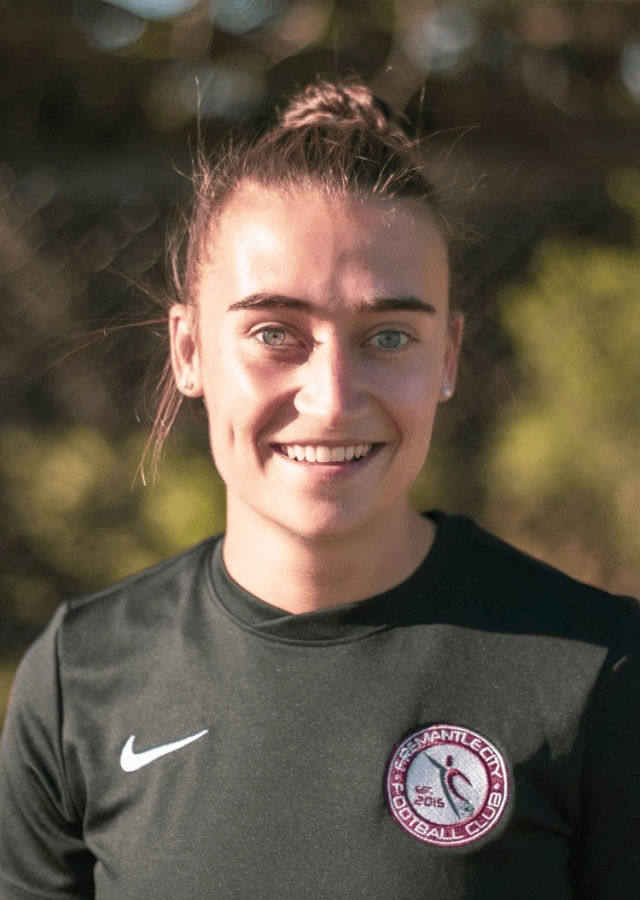
Above: Mikayla Lyons (black kit) in possession for Fremantle City. Photo supplied by: Mikayla Lyons.
Whilst she is an integral part of the Western Australian footballing scene now, Mikayla Lyons made the switch to the sport at a relatively late age.
“I actually grew up playing tennis as my main sport until I was about 12/13,” the Fremantle skipper revealed. “Funnily enough, my journey in football started at the same club that I’m currently playing for, albeit under a different name – East Fremantle Tricolore, who are now Fremantle City.
“Although I enjoyed playing football informally at school and in local five-a-side competitions, it wasn’t until I played my first year at Tricolore in an organised format that I really fell in love with the game.”
Once she caught the football bug, there was no turning back for Lyons who quickly earned representative honours.
“At 13/14, I was lucky enough to get selected into the WA State team and travel over to Coffs Harbour to compete in the National Youth Championships each year following that,” Lyons said. “At 15, I entered the NTC pathway and stayed there for three years before moving into the NPL competition where I’ve been playing ever since.”
Over her period in the game, Lyons has seen many changes and the challenges that come with it as a leader.
“Most of my biggest challenges in football have probably stemmed from large off-field changes – coaching changes and player movement. As a leader, it’s always challenging trying to keep the core of the group together and feeling supported and represented, particularly when there’s a divide in opinions.
“It goes without saying that having a tight-knit squad always helps but ensuring there’s immediate and open communication between all players has been the key so far.”
It is the qualities of a leader that define the Fremantle captain who admits to being: “Extremely passionate and competitive both on and off the field.” In terms of her best qualities as a player, Lyons identified “my acceleration and speed which helps me get into good attacking positions. I’m a lover of short-sharp ball movement, defending from the front, and guilty of doing anything possible to avoid an aerial contest.”
Last season saw Fremantle City finish fourth which saw them qualify for the Top Four Cup. A 2-0 loss to Perth SC in the semi-finals may have been a disappointing way for the season to end, but Lyons sees nothing but positives looking back.
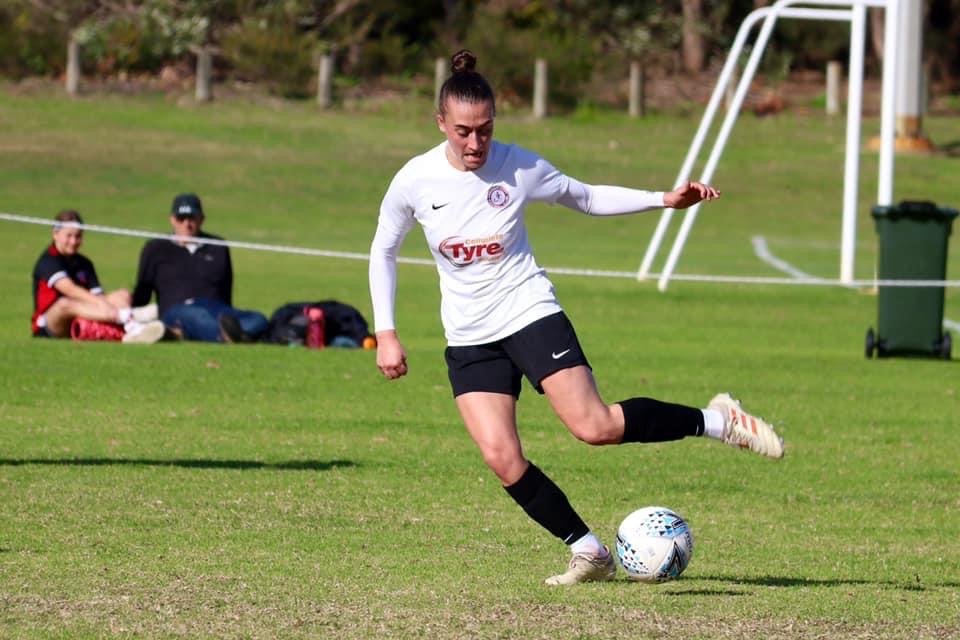
Above: Mikayla Lyons in action for Fremantle City. Photo supplied by: Mikayla Lyons.
“Considering some of the disruptions we faced last season, I was very proud of what we were able to achieve as a squad. The biggest highlight for me was having so many of our young players make their NPL debuts in what was a very unconventional season.
“The confidence and character that they showed on and off the field provided that extra bit of motivation leading into each game, and I think we’ve been able to continue with that this season. It’s obviously never nice to bow out in a semi-final, particularly when you’re expecting to go further, but we’ll use that as extra fuel this time around.”
The Freo star believes that the secrets of their consistent place among the top sides in the NPL WA competition is down to the bond and fitness that the players have.
“We have a special squad at Fremantle City,” Lyons said. “Off the pitch, we’re all very close friends which helps with our performances on the pitch. I think we’ve created a unique environment at Fremantle where players are encouraged and supported by one another. We’re all extremely passionate and competitive, but also like to have a laugh and enjoy playing together.
“On the field, we like to play fast, attacking-style football. We’re a very fit squad and have quick players throughout all three lines, so we like to utilise that as much as possible. We’re a relentless side, and I think we’ve shown that in a few games already this season coming back from being 2-1 or 2-0 down.”
With most teams having played each other at least once and Fremantle well positioned in the top three, things are looking good for the team. But Lyons is not resting on her laurels.
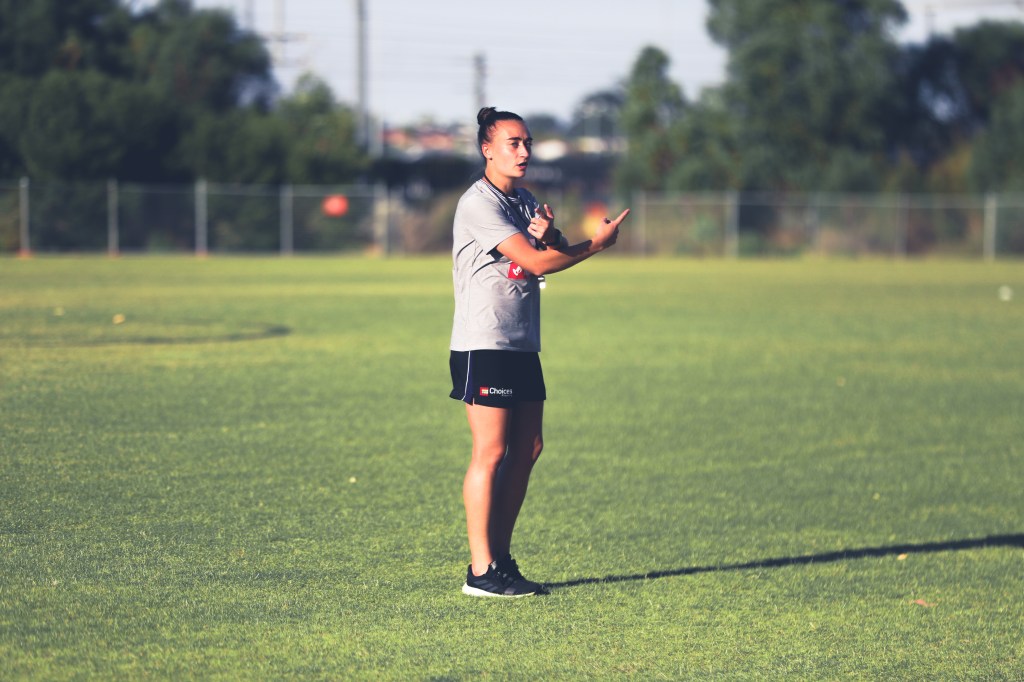
Above: Mikayla offering some words of advice in training. Photo: Mikayla Lyons.
“Personally, my goal this season is to contribute to the team’s success via more consistent on-field performances. As a team, we’re pushing for the title this year, and we know that’s only going to be realistic if we have every player putting in consistent work. We’ve had a few unexpected changes to our squad over the past few weeks, so we’ve had to adapt quite quickly but I’m confident we can push through and achieve what we’ve set out to do.
“As I mentioned previously, we’re a very tight-knit squad and we have great connections with and respect for our coaching staff, so we’re in the right environment. With that, I have no doubt we can make the club and our supporters proud this season.”
As the league starts to shape, Fremantle’s captain believes that there is a gap starting to form in the competition, with equal development of talent potentially becoming an issue.
“I do think there’s still quite a big divide between the top six and bottom two teams this year. In saying that, the gap is definitely closing which is a credit to the new clubs who have come in, experienced some turbulent times, and pushed through.
“I may ruffle some feathers here, but I do think the spread of talent has stayed stagnant at best over the last few years within the NPLW in WA. I don’t think there’s one specific reason or cause, but with more teams coming in, and more players moving away to pursue opportunities elsewhere, there’s only so much growth that can happen within.
“From my experience, NPLW players are extremely competitive. With that, it’s important for players to feel challenged within their training and playing environments to truly enjoy what they’re doing. For those who are aspiring to play at a higher level, there’s the added importance of making sure they’re developing and learning within their NPL club environments, and when the time is right – the best players need to be able to see a clear pathway into the A-League competition or youth national teams for the younger players.
Above: Mikayla drives in a corner for Fremantle City against Subiaco. Photo supplied by: Mikayla Lyons.
“In my opinion, we’re still behind in all of the areas mentioned above in Western Australia, and as a result, some of our best players are moving overseas and over east to chase what we’re currently failing to offer them.
With Lyons identifying the importance of strong foundations for Western Australian based players to develop, I asked her if she still harboured hopes of an A-League Women contract at Perth Glory.
“In short, no. I’m happiest when I’m enjoying my football in a competitive, yet social environment, and that stems from training and playing with some of my best mates each week. For me, keeping football as a hobby is important.
“We have some extremely talented players currently playing in the WA NPLW competition who I think are more than worthy of an opportunity to prove themselves at an A-League club, like Perth Glory. In saying that, I’m not a talent scout or coach, so I won’t comment on the identification process, but it would be good to see some more local talent within the Perth Glory squad in the next few seasons.”
Away from football, Lyons is kept busy by PhD studies at Notre Dame University as well as working as a strength and conditioning coach for Fremantle Dockers in the AFLW.
“Yeah, I currently work as a strength & conditioning coach with the AFLW team and absolutely love it,” she enthused. “The staff and players are all incredible, and the environment they’ve created at the club is second to none. I’ve probably raised my expectations a bit at Fremantle City since working at the Dockers, from both an on-field and off-field perspective.”
With someone of the character of Mikayla Lyons wearing the armband, Fremantle City are always going to be driven towards success. It’s now down to her and her teammates to chase down Perth RedStar and deny the high-flying league leaders silverware later in the season.
Kieran Yap provides his weekly round-up of all the action from the Victoria NPLWomen’s competition. As usual, there is a detailed report on one game and a wrap of all the other matches along with photos(1/6/22).
Above: Calder United (green) battle it out with FV Emerging at the weekend. Photo: Jack Dilks/171819.
MAIN REPORT OF THE WEEK:
South Melbourne 9-0 Bayside United
South Melbourne FC made their slow start to the NPLW season seem like a momentary blip with a 9-0 thrashing of Bayside United.
It took less than three minutes for the home side to score. Kiara Hronopoulos won the ball back quickly when Bayside were looking to counter. After Janne Lawson was played into space, she opted to cross instead of shoot. Hronopoulos had continued her run and met the ball at the back post for an easy finish borne of effort.
After setting up the first, Lawson scored the second. Kat Goff brushed aside the Bayside defence on the left and had the vision to find Lawson unmarked in the middle. Her composed finish was her fourth in as many games. Lawson’s form in front of goal has coincided with South’s recent improvement.
The third goal was one that Bayside’s goalkeeper Kelsey Quinn would prefer to forget. Lawson was able to charge in from the right flank almost unimpeded. With a crowd of attackers and defenders arriving in the middle, she opted to shoot. Quinn blocked the initial strike, but the ball squirmed under her and it was scrambled over the line. South Melbourne had a 3-0 lead in the seventh minute.
It was credited as an own goal to Quinn, but that feels harsh on the goalkeeper. Lawson’s shot was on target and the ball was crawling over the line before the final touch amid some goal-line chaos.
South Melbourne’s fourth goal drew muted celebrations from their own players. It was another attack within far too much space for Bayside’s liking. With three defenders to stop three forwards, the ball was kicked almost directly into the net for an own goal. Quinn got a hand to it, but could not prevent the ball hitting the back of the net.
South Melbourne scored their fifth goal on the edge of half time. Grace Taranto timed her run and jumped highest to head powerfully from a corner kick. It was a textbook finish and a move right from the training ground.
The former Calder United, and Adelaide United player is surely on the radar for A-League Women recruiters for the next season. This goal was a good reminder of her ability.
South Melbourne had time to add a sixth before the whistle. Kat Goff delivered a perfect cutback after another aggressive run on the left. Gough took an extra touch that narrowed her angle but put her into more space. South Melbourne had outnumbered Bayside in the box and Caitlin Picket left Quinn with no chance.
Above: By the break, South Melbourne had already built up a match-winning lead against Bayside United. Graphic: South Melbourne FC.
After setting up two, and causing constant problems on the left-wing, Goff scored one herself.
It was another brutally fast attack from South Melbourne, Goff raced onto a long through ball from midfield and ran as close to goal as possible before calmly sliding the ball past Quinn at the near post.
It was a hattrick of assists to Goff and a first for Francesca Iermano for South’s eighth goal. Goff collected a ball at the back post and cut it back. Iermano connected well off her left foot and was too close to goal for Quinn to be able to do much to stop it.
South Melbourne’s ninth and mercifully for Bayside, final goal came from Caitlin Pickett. Her brace was notched up after some strong wing play on the right. It was a simple finish but an exhausted Bayside offered little resistance to the attack.
South Melbourne won this game by outnumbering Bayside in their own penalty area. For most of the goals, there were at least as many attackers as defenders.
Bayside is a young squad and there is not much to gain in the long or medium-term by parking the bus. However these huge losses are mounting up and after offering a much-improved performance in Round Eight, this feels like a step back.
Above: South Melbourne were clear winners against Bayside United. Graphic: South Melbourne FC.
South Melbourne has their swagger back. The start to the season was uncharacteristically slow, but they have now hit form, both individually and as a team.
They face Alamein in the next round as they attempt to climb the table further. After sitting bottom two weeks ago, South Melbourne are now ninth and improving.
Above: Action from Box Hill United (blue) against Bulleen Lions. Photo: HD Creative.
Across the rest of the games, Box HillUnited impressed against Bulleen Lions. The favoured Bulleen hit the lead through Alana Jancevski’s 77th-minute penalty. The home side hit back in the 84th minute through substitute Emma Langley.
Above: Heidelberg United go on the attack against Alamein. Photo: Sally Tsalikidis.
HeidelbergUnited continued to assert themselves as the team to beat at the top of the table. Their 2-1 win over Alamein puts them a point clear of Calder United. Sidney Allan opened the scoring for Alamein but two very late goals by Sophie Papalia and Danielle Wise secured the points for the league leaders.
Above: Calder United on the ball against FV Emerging. Photo: Jack Dilks/171819.
Calder United kept the pressure on first place with a 5-0 win over FV Emerging. Goals to Alana Cerne, Melissa Taranto, Harriet Withers, and a brace to Adriana Taranto made for a dominant performance by a team that all A-League Women observers should be keeping a close eye on.
Ben Gilby rounds up all the action from the Svenska Cupen Final as well as this week’s Damallsvenskan and Elitettan action (31/5/22).
Above: Rosengård lift the Svenska Cupen after defeating BK Häckenafter extra-time. Photo: FC Rosengård.
SVENSKA CUPEN FINAL
The battle of the top two teams in Swedish women’s football went Rosengård‘s way as they defeated BK Häcken 2-1 at their Malmö Idrottsplats home on Thursday evening.
Häcken came out of the blocks strongest with a high pressing and high-intensity game. They went in front after just seven minutes when Hanna Wijk’s long ball found Johanna Rytting Kaneryd who finished confidently. The key for this final was that, despite being so strong in the opening half-hour, Häcken could not add to their lead.
Above: FC Rosengård’s Charli Grant (14) keeps her eye on the ball in Thursday night’s Svenska Cupen Final. Photo: BK Häcken.
The second half saw the momentum switch towards Rosengård. Jelena Čanković got a stranglehold of the midfield. Eventually, the goal came as Bea Sprung’s shot went in off the crossbar. As the game ticked towards extra time, BK Häcken created a golden opportunity as Filippa Curmark was only denied by a sensational save by Rosengård’s Australian international goalkeeper Teagan Micah who pushed the ball onto the bar.
The outcome was eventually decided amidst huge controversy in extra time. A corner came in and Rosengård’s Stefanie Sanders nudged the ball goalwards which Häcken goalkeeper Jennifer Falk dived on. The assistant referee ruled that the ball had crossed the line. Despite protestations to the contrary from Häcken, the goal was given.
So, a 2-1 victory and it was Rosengård who ended the night lifting the trophy in front of 1,839 fans.
Above: Rosengård players celebrate after the final whistle. Photo: FC Rosengård.
DAMALLSVENSKAN
Above: Dramatic goalmouth action in the game between BK Häcken and Djurgården. Photo: DIF.
Round 11 kicked off on Friday night as KIF Örebro hosted Eskilstuna United in the El Gnällico derby. In a key game between two upper mid-table teams, it was the hosts who ran out 1-0 winners in front of 512 fans. Amanda Rantanen held off Matilda Plan and found Emma Östlund whose shot came off an Eskilstuna player for an own goal after 35 minutes.
Above: KIF Örebro celebrate their win over Eskilstuna United. Photo: Johan Bernstrom/Bildbyrån
BK Häcken‘s winless run stretched to a third straight Damallsvenskan game after they were held to a 0-0 draw at home to a Djurgården side who have only won four of their opening 11 fixtures. 516 fans watched on as Häcken’s recent form means that have taken just two points out of the last nine available and now sit third on the table, four points behind leaders Rosengård.
Above: BK Häcken (yellow and black) battle it out for possession against Djurgården. Photo: DIF.
Vittsjö are fourth after a 3-0 win over IF Brommapojkarna. Matildas star Katrina Gorry was influential once more for her new team in this success in front of 717 fans. Elisabet Klinga played in Kayla Adamek to put the hosts ahead after 36 minutes. Sarah Stratigakis doubled the advantage just past the hour mark. Matters were settled when Gorry fed Linda Sällström to seal the victory.
Above: Action from Vittsjö’s win over IF Brommapojkarna. Photo: Jessica Gow/TT.
Hammarby‘s improved form continued as they gained a 5-1 win at an IFK Kalmar side who are now just above the drop zone. Alyssa Walker gave the home side the lead with 26 minutes gone, but the second half was all about the visitors. Madelen Janogy was immense. The national team star smashed a hat-trick, with her second and third goals coming within 120 seconds of each other. If that wasn’t enough, she also provided an assist for Australian international Courtney Nevin with 53 minutes played. Ellen Gibson scored the other for the Stockholm-based side.
Above: Courtney Nevin celebrates after putting Hammarby 2-1 ahead at IFK Kalmar. Photo: Hammarby.
AIK suffered another defeat as their tough start to the campaign continued, going down 4-0 at home to high-flying Linköping. The visitors took the lead just before the half-hour mark thanks to Therese Simonsson, who added a second ten minutes later. Four minutes into the second half Yuka Momiki made it 3-0. With 73 minutes played Alva Selerud completed the scoring. Life is not going to get any easier for the rock-bottom Solna-based side when they travel to nearby Hammarby this coming weekend – a team who are in form.
Above: Linköping celebrate their win at AIK. Photo: Linköping.
Kristianstads continued their good run of form which has seen them take 13 points out of the last 15, with a 2-0 win at Umeå IK. Mia Carlsson’s strike seven minutes before half-time was added to by Gabrielle Carle with 13 minutes remaining to seal the win in front of 1,950.
Above: The scenes post match in the Kristianstads dressing room. Photo: Kristianstads DFF.
The final game of the round came on Monday night, and there was real drama at Malmö Idrottsplats where leaders Rosengård needed a goal in stoppage time at the end of the game to see off the challenge of Piteå in front of 558 fans. It should be no surprise that the visitors would prove tough opponents as, despite sitting ninth in the Damallsvensan with only four wins, they held BK Häcken to a draw last week. The home side went ahead just after the hour mark when Katrine Veje provided the assist for Loreta Kullashi. With ten minutes remaining, Piteå were level when Hlin Eiríksdóttir converted a penalty. Then came the late drama, and Stefanie Sanders netted the winner for the home side to scenes of huge joy. The win sees Rosengård go two points clear at the top of the table – but they face a huge game this coming weekend away to second-placed Linköping.
Artwork: OBOS Damallsvenskan.
ROUND 12 FIXTURES: Djurgården v IFK Kalmar, Linköping v Rosengård, Eskilstuna United v Vittsjö, IF Brommapojkarna v BK Häcken, Kristianstads v KIF Örebro, Piteå v Umeå IK, Hammarby v AIK.
Table From: Svensk Fotboll.
ELITETTAN
Above: Melissa Davin – who put Alingsås FC United ahead in their top-of-the-table clash with Lidköpings FK. Photo: Alingsås FC United.
The top two sides faced off this weekend in front of the round’s highest crowd of 252. Those gathered at Framnäs IP Bävervallen saw previous leaders Lidköpings FK dethroned after a 2-0 defeat at home to Alingsås FC United who are now top as a result. After a goalless first half, the visitors took the game by the scruff of its neck with two goals in 17 minutes thanks to Melissa Davin and Olivia Sultan.
Växjö are second after a 4-0 win at bottom side Älvsjö AIK FF. Mimmi Strömgren put the visitors ahead with 21 minutes on the clock. Right on the half-time whistle, Älvsjö keeper Wilma Stenman saved Elin Nilsson’s penalty to keep the hosts in touch. However, two goals in nine second-half minutes eventually settled matters as Evelyn Ijeh and Dessislava Dupuy and both found the net. Olivia Mattsson completed the scoring with 73 minutes played in front of 178 fans.
Above: Dessislava Dupuy, on target again for Växjö. Photo: Playmakerstats.
IK Uppsala missed a chance to go top after being held 1-1 at Ifö Bromölla IF. The home side took the lead thanks to Patrycja Jercak’s goal. The prolific Nicole Robertson leveled for Uppsala with seven minutes to go in front of 85 fans.
Above: Ifö Bromölla IF goalscorer Patrycja Jercak. Photo: Kobiecy Futbol.
IFK Norrköping are fifth after a 3-0 win at Bergdalens IK. Lovisa Gustafsson set the scoreboard moving after just five minutes. The other strikes came in a five-minute spell towards the end of the game. Sabina Ravnell and Emelie Johansson were on target.
Above: Success for IFK Norrköping at Bergdalens IK. Photo: IFK Norrköping.
Round Nine: Lidköpings FK 0-2 Alingsås FC United, Mallbackens IF Sunne 4-0 Team TG FF, Sundsvalls 1-2 Jitex BK, Bergdalens IK 0-3 IFK Norrköping, Ifö Bromölla IF 1-1 IK Uppsala, Älvsjö AIK FF 0-4 Växjö, Gamla Upsala SK 3-0 Rävåsens IK Karlskoga.
Table From: Svensk Fotboll.
Round 10 (Fixtures): Team TG FF v Bergdalens IK, IK Uppsala v Älvsjö AIK FF, Jitex BK v Mallbackens IF Sunne, Växjö v Lidköpings FK, Rävåsens IK Karlskoga v Ifö Bromölla IF, IFK Norrköping v Sundsvalls, Alingsås FC United v Gamla Upsala SK.
Jean-Pierre Thiesset summarizes the 21st round of D1 Arkema(31/5/22).
Above: Olympique Lyonnais celebrate their D1 title after beating rivals Paris St. Germain. Photo: OL Feminin.
Olympique Lyonnais sealed their 15th D1 Arkema title after defeating closest rivals Paris St. Germain 1-0 in the capital. Whilst PSG had more possession (59%), Lyon were very strong in midfield and defense which meant that despite creating opportunities, the home side were not able to score. The deciding goal came early for Lyon. With three minutes played, Selma Bacha fed Catarina Macario who netted. It was another impressive display from Bacha, who was outstanding in the recent UEFA Champions League (UWCL) Final against Barcelona. The same player also topped the assist charts for the UWCL with nine. Lyon’s victory in Paris sent them eight points clear, confirming the D1 title ahead of Paris SG. Lyon are able to boast the league’s best attack with 75 goals scored and best defense with only eight goals conceded from their 20 wins and one draw in 21 matches. Goal for Lyon from: Catarina Macario (3).
Paris FC won 4-1 away from home against Bordeaux. This game was slightly dominated by Paris FC (55% possession). Even if Bordeaux scored first at the 20th minute, they were never really in a position to win this game. Goals for Paris FC from: Gaëtane Thiney (35 penalty, 43), Ouleymata Sarr (45+1, 82). Goal for Bordeaux: Melissa Herrera (20). Red card for Taimara de Souza da Silva (85) for a second yellow.
Soyaux won 2-0 at home against Guingamp. In a game dominated by Guingamp (61% possession), Soyaux was more efficient and scored twice with the same number of shots on target (three). With this win, Soyaux can still hope to stay in D1 Arkema next year specially as fellow relegation battlers Issy will play in Lyon for their last game and Soyaux face Saint-Etienne. Goals for Soyaux from: Camille Colin (66), Fadimatou Aretouyap Kome (74).
Above: Montpellier players celebrate their 5-2 win at Issy. Photo: Montpellier HSC.
Reims gained a point from their trip to Dijon which ended in a 2-2 draw. In a game dominated by Reims (57% possession), Dijon twice led, but Reims responded both times. Goals for Reims from: Kethna Louis (44), Melchie Daëlle Dumornay (72). Goals for Dijon from: Léa Declercq (2, 49).
Montpellier won 5-2 away from home against Issy. With this loss, Issy remain on 13 points along with Soyaux but as they will play Lyon for the last game, they will probably be in trouble. Goals for Montpellier from: Nérilia Mondésir (7, 63), Cyrielle Blanc (12), Lena Petermann (38), Mary Fowler (90+1). Goals for Issy from: Adélie Fourré (27), Batcheba Louis (66).
Fleury won 4-2 at home against Saint-Etienne. Despite Saint-Etienne leading 2-0 after 20 minutes, it was always felt that Fleury would come back to win. Nikola Karczewska hit a hat-trick as the hosts settled matters in the final four minutes. Goals for Fleury from: Nikola Karczewska (47 penalty, 60, 86), Julie Piga (89). Goals for Saint-Etienne from: Juliette Vidal (9), Kelly Gago (23).
Above: Olympique Lyonnais fans send a message of support to Ellie Carpenter, who injured her ACL in the Champions League win over Barcelona. Photo: Damien LG/OL Feminin.
The ParaMatildas star, who earned a runners-up medal in the recent World Cup, speaks exclusively to Impetus’ Ben Gilby abouther sporting experiences, an incredible fortnight at the World Cup, and the ParaMatildas’ ability to inspire disabled children around the world (30/5/22).
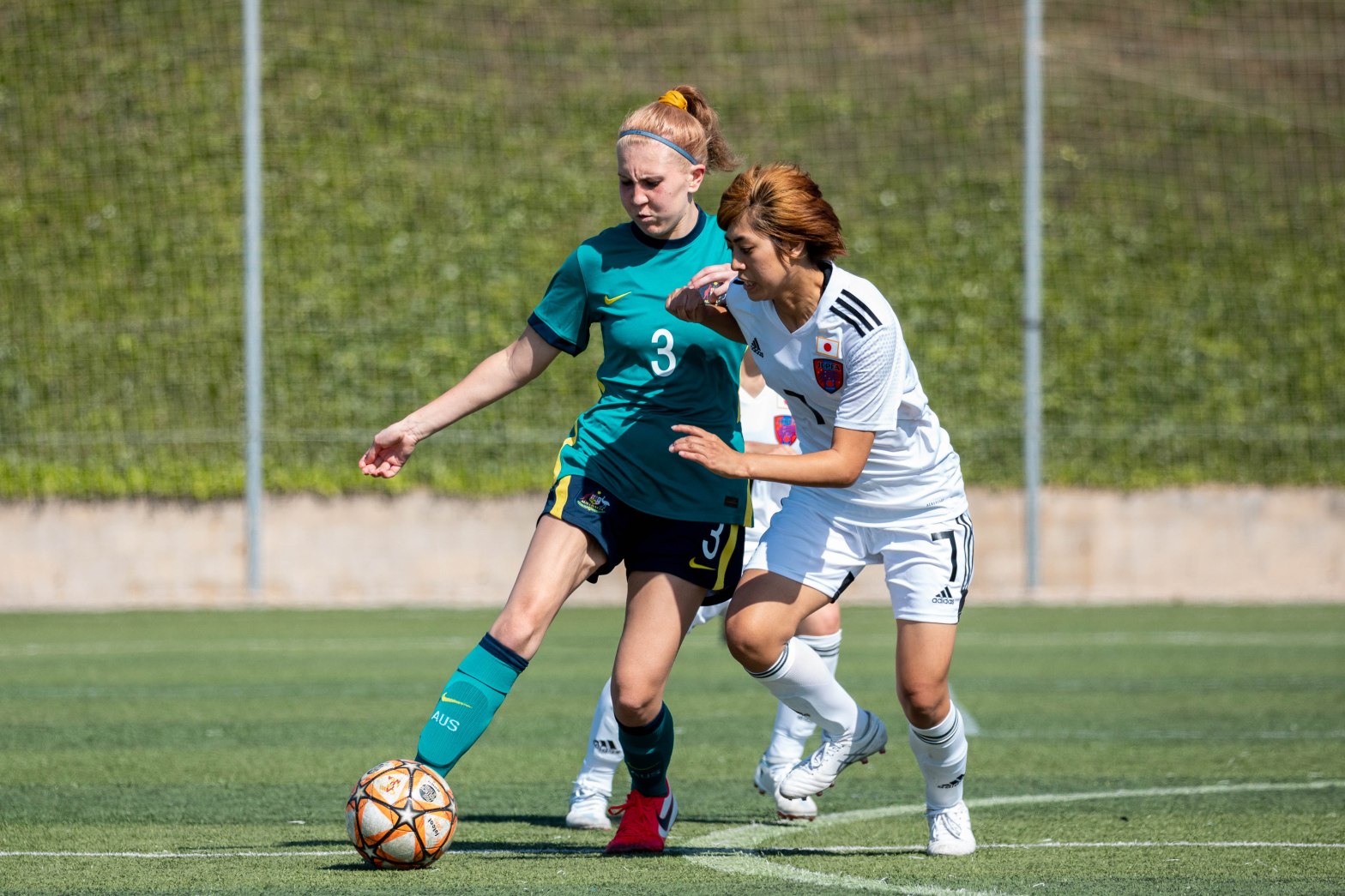
Above: Tahlia Blanshard (3) in action for the ParaMatildas against Japan in the recent World Cup. Photo: Marianna Galanopoulos/Football Australia.
“My biggest inspiration has been thinking about younger me, and all the other children with disabilities across the world. I am excited and driven by the dreams of what we have the power to create – especially the new pathways and opportunities that are being created at every level of sport.”
Tahlia Blanshard, ParaMatildas World Cup silver medallist.
Tahlia Blanshard has been playing football for only three and a half years, but in that time she has gone from being an absolute beginner to a World Cup silver medallist.
Whilst football is a relatively new sport to her, she has had great success in other sports, as she explained to me.
“I have been involved in Parasports, mostly swimming, for many years but my footballing journey only began a few years ago. I had been swimming since I was 13. In 2018 I had the opportunity to represent Australia at the Cerebral Palsy (CP) World Games, where I won multiple medals in the pool, and in 2021, I trialled for the Tokyo Paralympics, where I missed the qualifying time in the 50m Butterfly by just 0.10 seconds.
“In December of 2018, a couple of my friends convinced me to attend a football ‘come and try’ day in Sydney. I was really nervous as I knew nothing about football. I didn’t have football boots or shin pads and didn’t know many people there, but they all invited me to play and I had the best time.
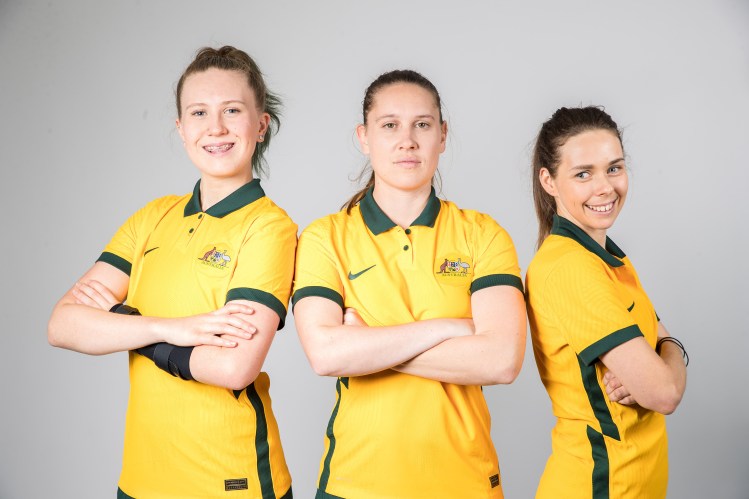
Above: Tahlia pictured before the tournament (left) with team-mates Georgia Biekhoff and Tilda Mason. Photo: Football Australia.
“From there, things moved really quickly. I was inspired by the Australian Pararoos (men’s team) players, so wanted to learn how to play, improve my skills and spend more time with my new friends. In the meantime, the dream to make that inaugural ParaMatildas squad only grew.
“I attended every development day, training camp, and gala day I could find in my state, which resulted in me being one of only five girls who were chosen to play with the men’s teams at the CP Football National Championships in 2019. It was at this event that I truly realised how important football was to me, and that I was determined to put in the training to be there on that first women’s team.”
Whilst Blanshard has been on a thrilling upward journey in the game, the difficulties and negativity she faced in the past still linger in her memory.
“I have faced many big challenges in sport. Exclusion and discrimination were prominent challenges through my younger years, and I believe they are major factors in why I only found my way to football at the age of 18.
“I have spent my whole life living in a small rural town on the Central Coast of NSW. This limited my opportunities in sport, and led me to have to travel long distances to pursue CP Football. Some weekends I would travel up to a five-hour round trip just to attend a training session in Sydney. I am so grateful for my parents’ support, as without them I couldn’t have attended any of these programs.”
Above: Tahlia lines-up with the ParaMatildas squad (back row, right) before a match in Spain. Photo: Football Australia.
Despite attending all those training and gala days in pursuit of a place in the inaugural ParaMatildas squad, the New South Wales resident faced a real race against time to make the World Cup.
“Leading into the World Cup, my biggest challenge was recovering after needing multiple major jaw surgeries. I spent much of the eight weeks leading up to the tournament in hospital unable to eat or walk around, rather than being on the field training, and this was really difficult for me both physically and emotionally, as all I wanted to do was make that team, but I knew how important it was for me to be at my peak performance.
I was, unfortunately, unable to attend the selection camp in Canberra as I was recovering from my surgeries. This definitely made me even more nervous as I had no idea what the coaches would decide, or if I would even be recovered in time. When I found out I had made the team, I had only just recently arrived home from hospital. It is definitely not how I imagined my first team selection to go, but it made me more motivated than ever to put in the effort to recover and prepare in the best ways I could.
“Despite everything, I never gave up. As soon as I could get up, I would do whatever I could to train and prepare. There were tears shed as I doubted my chances of making it to Spain, and even more, but out of happiness, once I was on that bus to the airport with the rest of the ParaMatildas team.”
Once her selection was finalised, it began to sink in for Blanshard that she would be following in the footsteps of her Australian football heroes who have represented the nation in the World Cup, as she explains.
Above: Tahlia in possession for the ParaMatildas in the World Cup. Photo: Marianna Galanopoulos/Football Australia.
“I’ve always loved watching the World Cup. I grew up watching videos of the Socceroos and Matildas, and in more recent years, the Pararoos too, representing Australia at the World Cup. I would be mesmerised watching them standing proud on that field, and would scream loudly at every goal.
“I envisioned myself walking out on that field for months leading up to the World Cup, but the emotions of walking out as part of the starting five in our first ever game, was something greater than I ever imagined. I will admit to tearing up a little bit when I first stepped on the field, but simultaneously you could not wipe the smile off my face. The full meaning of what we achieved in Spain is something I cannot fully describe, and I don’t think we will even know the true impact for many years.”
The buzzword around the ParaMatildas camp relating to the World Cup experience was “surreal”, and this is something Blanshard agrees with. A team who had been only officially announced as existing two months previously were playing their first match together at a World Cup.
“It was an amazing couple of weeks in Spain,” she reflected. “It featured busy days of emotional highs and lows. The environment was both exciting and stressful, but we were all in it together. It was intense making our debut at a World Cup – it is very rare for a team to play their first game together at the highest level in their sport, but that’s why it was so important we were there to support and motivate each other. We needed to make sure everyone was able to relax and have a laugh and not let that stress take over.”
The tournament schedule had rapid turnarounds which meant that the ParaMatildas played their five matches in a spell of just seven days. There were three matches in successive days at one point. Blanshard highlighted the huge impact that took on her and her teammates.
“It was not easy to back up for those games on consecutive days. The nature of my CP means that I fatigue a lot faster than other people may, and my muscles take longer to recover. For me, pool recovery after every game was the most important thing to ensure I was ready to perform my best at the next game.
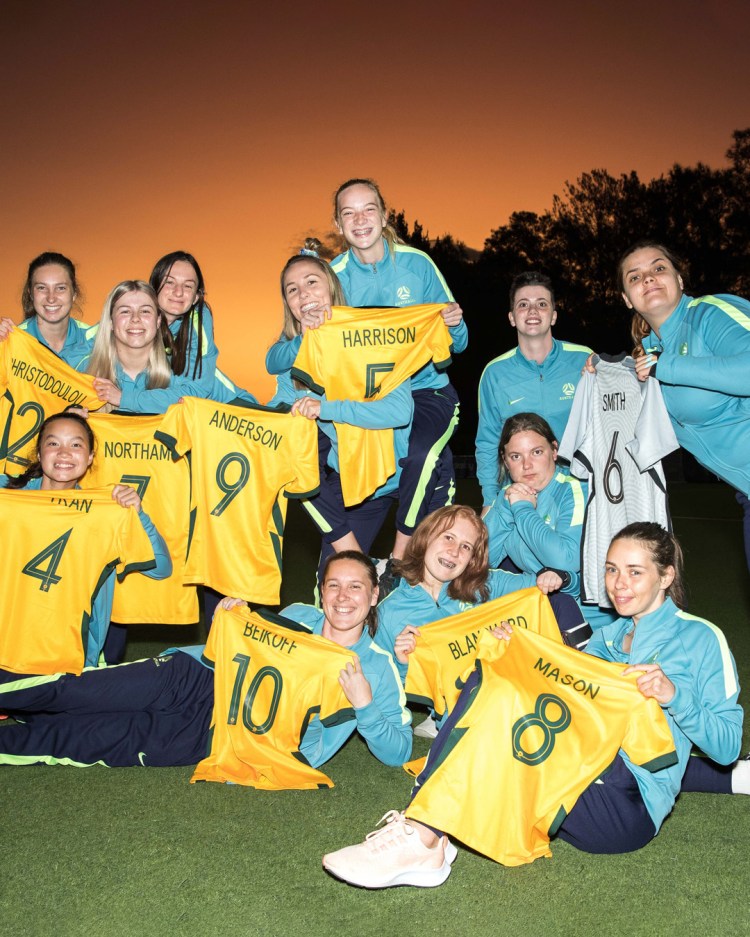
Above: Talia (bottom right) with her ParaMatildas teammates ahead of the competition. Photo: Football Australia.
“I also had to ensure I was getting the correct nutrition and sleep during the tournament, and that I took time to myself to debrief and mentally recover after every game, often involving having some alone time, or talking to my family and partner who were back home in Australia.”
With the huge highs of their World Cup achievements behind her, Blanshard is not resting on her laurels. Instead, she’s ready for her next challenges and determined to become better than ever.
“From here, I’ll continue training, and work even harder to prepare for the potential opportunities to come next year and further in the future. I definitely have many areas to improve my skills before the next tournament, and most importantly, I want to enter the next competition cycle far more confident in my ability to play football. I’ll return to playing with my local team here on the Central Coast, and I will prepare for selections for the 2022 National CP Football Championships.
“While there aren’t any games planned yet for the ParaMatildas, I am hopeful there will be as we prepare for future tournaments.”
The ParaMatildas story has been one that has inspired people of all ages around the world, and Blanshard is more than aware of her role in ensuring that youngsters can see that in this team there is something to aspire to.
“My biggest inspiration has been thinking about younger me, and all the other children with disabilities across the world. I am excited and driven by the dreams of what we have the power to create – especially the new pathways and opportunities that are being created at every level of sport.
“As a young, disabled kid, I didn’t see many people ‘like me’ in media, and especially not in elite football, but I know that from now on, children across the world will be able to watch us, and know that they too can pursue football.”
Tahlia Blanshard, ParaMatildas World Cup silver medalist.
This is the latest in Impetus‘ series of interviews with the ParaMatildas. The others in the series can be viewed by clicking on these links:
Ben Gilby provides his weekly round-up of all the action from the Western Australia NPLWomen’s competition. As usual, there is a detailed report on one game and a wrap of all the other matches along with photos(30/5/22).
Above: Balcatta Etna (white) battle it out at Murdoch University Melville on Friday night. Photo: JASP Photography.
MAIN REPORT OF THE WEEK:
Perth SC 1-2 Hyundai NTC
Above: Perth SC prepare to take a gree-kick at home to Hyundai NTC on Saturday afternoon. Photo: NPL.
The NTC gained arguably the league’s result of the season by defeating Perth SC at Dorrien Gardens on Saturday afternoon thanks to Tanika Lala’s penalty and a sensational long-range effort from Grace Johnston.
The home side went into the game having only lost once all season, a start which had only seen them concede only three goals. They also knew that a win would put them just a point behind Fremantle City with a game in hand in the race for second spot.
Conversely, despite playing some excellent football during the opening two months of the season, the NTC had only won once and conceded 17 goals.
In sunny, but breezy conditions at the home of the Azzurri, both teams created in the earliest exchanges. With just over 30 seconds on the clock, NTC’s Sophie Meaden cruised up the right-hand flank and showed great footwork to beat her marker to find Abbey Woolley. Her cross in was met by a flick header from Tanika Lala at the near post which went narrowly wide. Perth SCresponded and earned a corner a minute later, which the visitors cleared.
Above: Rebecca Bennett in the Perth SC goal stretches to reach the ball after Tanika Lala’s early flick header for the NTC at Perth SC. Photo: NTC
The teenagers from the NTC continued to focus their attack along the right-hand side with Meaden continuing to produce some teasing balls in. Yet it was the hosts who earned the better of the corner count, with four in the opening quarter alone.
Promising efforts continued for both sides. Zoee Spadano saw an effort come back off the bar after she intercepted an NTC passing movement just to the right of centre. For the visitors, Georgia Cassidy saw an angled lofted shot go just wide from 30 yards.
Whilst the NTC continued to impose their fast-paced passing movements on the game, the Azzurri were alive to the patterns and forced several turnovers in dangerous positions just outside of the box. As the game hit the 20-minute mark, the only thing missing from a Perth SC point of view was a telling final ball for their plethora of dangerous attackers to get onto in order to concern Lilly Bailey in the NTC goal. On one of the relatively few occasions that she was called in to make a direct save in this period, Bailey did well to contain an effort from Spadano atpoint-blank range.
The home side were working hard at containing the threat of the visitors’ razor-sharp young star Tanika Lala, who is capable of outrageous skill and packs a powerful punch in attacking positions.
There was one further chance to break the deadlock before half-time, but an angled shot from the edge of the box from NTC went just over.
The visitors had the best of the play at the start of the second half, but were unable to force the ball over the line. Perth responded by trying to take the sting out of the game with slower passing exchanges, however, just before the hour mark the opening goal finally arrived.
Above: Tanika Lala puts Hyundai NTC ahead from the penalty spot at Dorrien Gardens. Photo: NPL.
A ball through from the centre found NTC substitute Mia Britton, who was brought down and, to the audible disappointment of the home crowd, referee Michal Jasinski pointed to the spot. Lala stepped up to roll the ball into the net.
The dangerous NTC attacker had a chance to double her side’s lead shortly afterwards when Perth SC coughed up possession in a dangerous position just outside of their box which allowed Lala to hit a shot that rebounded off of an Azzurri defender before being cleared.
Above: Jaime Duncanson levels for Perth SC. Photo: NPL.
Perth SC looked to hit back and got on level terms with 13 minutes to go. With a home player on the receiving end of what looked to be a clear foul on the edge of the box, Jaime Duncanson didn’t wait for the referee to whistle, but instead turned and lifted a shot into the net.
An expected onslaught from the home side never quite materialised, and instead, four minutes later, the teenagers of the NTC regained the lead in sensational style. Defender Wilma Thodland threaded the ball through to her captain Johnston who turned and hit an outstanding shot into the net from over 25 yards.
The visitors game management in the closing ten minutes belied their tender years as they remained controlled in possession and looked to fizz the ball around.
Above: Grace Johnston fires home her stunning winner for Hyundai NTC at Perth SC on Saturday. Photo: NPL.
Perth SC had three chances to hit back in the final stages. Thodlana repelled the first two both for the icing on the cake of an eye-catching personal display. First she put in a perfectly timed slide tackle as the trigger was about to be pulled, and then deep into stoppage time at the end of 90 minutes, slid in again to get a touch on a goal-bound effort to ensure that it went wide.
The final chance came from a corner just before the final whistle. Azzurri goalkeeper Rebecca Bennett came up and got a powerful header on the set-piece, but her opposite number Bailey saved to seal the NTC’s three points.
Above: Phoenix Brownlie (white shirt) about to put Subiaco ahead at Fremantle City on Friday night. Photo: NPL.
This was the first week of the season since Round Two that all eight teams were able to play their scheduled matches due to COVID, and Round Nine began with two games on Friday night. First, at Wauhop Park, Fremantle City hosted Subiaco.
Fremantle are involved in an arm-wrestle with Perth SC for second place on the ladder, and were therefore disappointed to go behind after only 12 minutes on the clock. Ingrid Gomez Basallo won a throw-in on the right which Lilly Bassett took. The ball found Phoenix Brownlie who danced through the middle before curling a sumptuous side-footed shot into the bottom right-hand corner.
Despite winning five corners in the period between the goal and half-time, Freo could not respond before the break. Six shots on target in the opening nine minutes of the second period set the tone, and finally, at the hour mark, the home side were on level terms. A delightful threaded pass from Kayla McCulloch found substitute Kate Nolan who took a touch, beat two defenders, and hit a low shot into the far corner of the net. This was just the start of a hugely eventful and influential evening for Nolan who would have a hand in all her team’s goals.
Above: Jessica Darmago (far left of group) celebrates with her teammates after putting Fremantle City ahead. Photo: NPL.
There was a dramatic explosion of action in the final eight minutes when the scoreboard operators were called into a flurry of duty. First, Nolan was played in down the left and her low cross in was met with a thumping finish at the back post from the onrushing Jessica Darmago.
Four minutes later, Nolan was involved once more as she eventually profited from Subiaco losing possession deep in the Freo half after the visitors earned a throw. Nolan beat her player before releasing Siobhan Longmore with a perfectly judged inside pass. Longmore took a touch and dispatched a shot across Zara Board and in for 3-1.
Above: Siobhan Longmore (left) smiles after increasing Fremantle City’s lead to 3-1 with four minutes to play. Photo: NPL.
From the resulting kick-off, Longmore dispossessed Subi and released Nolan who took the ball out onto the left-hand wing and, in a similar outcome to Freo’s second goal, put a low cross into the box for the incoming Darmago to dispatch into the net from close range. It was a frustrating outcome for Subiaco who, with eight minutes remaining were heading for what would have been an excellent point.
Above: An aerial battle in the box between Murdoch University Melville (red) and Balcatta Etna on Friday night. Photo: JASP Photography.
Also on Friday night, Balcatta Etna got their top-four hopes firing after sealing a 1-0 at Murdoch University Melville. The only goal of the game came just after the hour mark. Monique Godding got free along the left and pulled a cross into the box which evaded everyone. However, Lauren Continibali gathered and put a high ball back into the mix from the opposite flank which bounced high and over the heads of two for Monique Prinsloo to get a touch that Meghan Hulsman could only direct into her own net.
The victors are now fifth, two points behind the NTC, but with a game in hand on the teenagers who are one place above them. It’s been a challenging start to the campaign for Balcatta and after a tough start to the season fixture-wise, plus a stop-start schedule due to COVID, the side from Grindleford Reserve will be out to make sure they stay there.
Above: Balcatta Etna celebrate their winning goal at Murdoch University Melville. Photo: JASP Photography.
In the final game of the round on Saturday evening, it was top against bottom as unbeaten leaders Perth RedStar welcomed a Curtin University side that were still looking for their first win of the season.
RedStar maintained their seven-point cushion at the top with a ruthless first-half performance. They took the lead with five minutes played as they gathered possession after a Curtin throw and broke rapidly down the field for Sarah Carroll to square into the box for Larissa Walsh to finish.
Above: Sarah Carroll (2) puts Perth RedStar 4-0 up over Curtin University on Saturday evening. Photo: NPL.
With 11 minutes on the clock, the home lead was doubled when the ball was poked through for the finish under visiting goalkeeper Stacey Cavill. Within six minutes it was 3-0 as another rapid move up the right ended with a low cross into the mix which was comfortably turned in.
Curtin University were under constant pressure and with 25 minutes played, a throw on the right saw possession find its way out to Jay Coleman who played in Sarah Carroll to shoot across Cavill and in. Within four minutes, it was 5-0 with a goal that totally encapsulated the class of this RedStars team. Shawn Bilham, again on the right, cut a pass inside the box and an intelligent diagonal run from Walsh saw the competition’s top scorer meet the ball and turn it home into the net. It was almost telepathic.
Above: Despite not adding to their tally in the second half, Perth RedStar still put Curtin University under pressure. Photo: NPL.
Six minutes before the break, Cavill cleared the ball in the Curtin goal, but possession found its way back to the home side and after a display of classy one-touch passing, Coleman rolled home the sixth. From the resulting kick-off, Carla Bennett in the centre played the ball outside her to Walsh who had all the time she needed to roll a low shot into the net.
Whilst the 7-0 scoreline at the break emphasised the control that Perth RedStar had during the game, the overall shot count of 16 on target to Curtin’s zero just served to emphasise the total domination of Carlos Vega Mena’s team. Whilst there were no further goals in the second half, that first half achievement alone will be enough to give opposition coaches headaches in the weeks to come. The question remains, can anyone stop Perth RedStar this season?
P
W
D
L
F
A
Pts
GD
Perth RedStar
8
8
0
0
41
4
24
+37
Fremantle City
8
5
2
1
23
10
17
+13
Perth SC
7
4
1
2
13
5
13
+8
Hyundai NTC
8
2
3
3
9
18
9
-9
Balcatta Etna
7
2
1
4
5
8
7
– 3
Murdoch University Melville
6
1
2
3
3
8
5
-5
Subiaco
7
1
2
4
8
26
5
-18
Curtin University
7
0
1
6
8
31
1
-23
Round 10 Fixtures: Murdoch University Melville v Hyundai NTC, Curtin University v Perth SC, Balcatta Etna v Subiaco, Fremantle City v Perth RedStar.
Impetus is delighted to welcome back Post To Post Sport‘sCiarán Duffywho will again be providing us with a weekly round-up of the action in Ireland’s top domestic league as the competition reaches Round 12 (30/5/22).
Above: Rebecca Cook celebrates as Bohemians clinched a historic win over Peamount United. Photo: Mick O’Shea.
We’re at the stage in the season where the table really starts to take shape. Early momentum has either turned into consistent form or proven to be an early patch of form, good or otherwise. Two more rounds to go until the midseason break and the 2022 league is at the stage where onlookers can start to envision the final standings. All teams have played the same amount of games, let’s take a look at how round 12 went.
Shels Continue To March On
GOAL ⚽️ | Cork City 0-2 Shelbourne
It’s a second for Shelbourne, Saoirse Noonan with the finish to extend their lead!
— Women's National League (@LoiWomen) May 28, 2022
Having lost the reverse fixture 7-0 at Tolka Park earlier in the season, CorkCity fans could be forgiven for fearing the worst when defending champions Shelbourne got off the mark with just five minutes gone. Abbie Larkin got her first goal of the season when she turned the ball home after it came out to her from City keeper Maria O’Sullivan. Credit to Cork, their heads didn’t drop and they denied Shels many clearcut chances until former player Saoirse Noonan doubled the lead for the league leaders.
In the second half, Shelbourne would add two more goals late on through Noelle Murray who had seen her penalty hit the post earlier, and Lia O’Leary, who became the third youngest player to score in the WNL, after Joy Ralph on the opening day of the season for DLR Waves, and Ireland captain Katie McCabe when she played for Raheny, who have since merged with Shelbourne.
Shelbourne have only dropped points once this season and look like clear favourites to retain their title. Some positives from this game for Cork who were competitive in the second half. Cork City 0-4 Shelbourne.
Wexford End Athlone Winning Streak
Above: Wexford Youths celebrate against Athlone Town. Photo: Wexford Youths.
Athlone Town went to Ferrycarraig Park on a winning streak that saw them climb to third in the table. Wexford Youths have been the closest title challengers to Shels this season. This came was highly anticipated and did not disappoint.
The first half was tense and nervy with Orlaith Conlan giving the home side the lead. In the second half, Ireland’s young sensation Ellen Molloy did what she has made a habit of doing this season and found the net to double the hosts’ advantage. Athlone would reply instantly as they went down the other end and Róisín Molloy chipped the ball in. Athlone pushed for an equalizer but Wexford held out, with Maeve Williams continuing her impressive form in goal. Wexford Youths 2-1 Athlone Town.
Massive Win For Bohs
Above: Bohemians’ Rebecca Cooke, who scored both her sides goals in a historic win over Peamount United. Photo: LOIWomen.
Bohemians stunned last season’s runners-up Peamount United to earn their first-ever win against them.
Rebecca Cooke was the hero as her two goals helped Bohs come from behind in this Dublin derby.
Peamount had gone ahead early through Ireland legend Áine O’Gorman. Bohs keeper Rachel Kelly had to be on form to stop them doubling their lead through Jetta Berrill. The home side would equalize in the second half with Bronagh Kane finding Cooke with a cross. Cooke scored again late on the ensure a famous win for Bohemians at Dalymount Park. It’s a rotten run of form for Peamount United who drop to fifth having gone five games without a win. Bohemians 2-1 Peamount United.
Galway Jump Up To Fourth
Above: Galway (blue and white) in action at DLR Waves, where they earned an excellent win. Photo: Women’s Soccer Photos.
There wasn’t much to separate the sides at the UCD Bowl until a late strike from Chloe Singleton gave the away side all three points. Galway goalkeeper Abbiegayle Ronayne had an impressive game and had to work hard in the first half to deny Rachel Doyle and Sarah McKevitte, while Jenna Slattery had Galway’s best chance. The game was a back and forth affair, with Galway getting the edge in the race to finish in the top four with Singleton scoring from a tight angle. DLR Waves will be disappointed to lose a second home game so early in the season, while Galway are now just a point off third spot. DLR Waves 0-1 Galway.
Nothing To Separate Sides In Limerick
Above: Sligo Rovers gather together. Photo: Sligo Rovers FC.
Bottom of the table Treaty United could have gotten all three points from their game against new addition to the league Sligo Rovers at Markets Field, but will be happy to finally pick up their first point this season.
Amy Madden came close to putting the home side ahead, with Treaty also hitting the crossbar twice. It was an off day for a Sligo side that have been impressive for a new team, and Treaty may see this as a missed opportunity. Treaty United 0-0 Sligo Rovers.
Table
Pos
Team
PLD
W
D
L
GD +/-
Pts
1
Shelbourne
12
11
0
1
31
33
2
Wexford Youths
12
8
2
2
11
26
3
Athlone Town
12
7
1
4
12
22
4
Galway
12
6
3
3
5
21
5
Peamount United
12
6
2
4
15
20
6
DLR Waves
12
5
2
5
7
17
7
Bohemians
12
3
4
5
-4
13
8
Sligo Rovers
12
4
1
7
-7
13
9
Cork City
12
2
0
10
-33
6
10
Treaty United
12
0
1
11
-37
1
Upcoming Fixtures
Saturday June 4th
Sligo Rovers vs Wexford Youths (12:00)
Athlone Town vs Bohemians (17:00)
Peamount United vs Cork City (17:00)
Shelbourne vs Galway
Treaty United vs DLR Waves (17:00)
Thursday June 9th
DLR Waves vs Bohemians (19:45)
Sunday June 11th
Galway vs Athlone Town (14:00)
Shelbourne vs Wexford Youths (14:00)
Sligo Rovers vs Peamount United (14:00)
Cork City vs Treaty United (17:00)
Remember to follow @PostToPostSport on Twitter and Instagram for coverage football from the Republic of Ireland. This season we are raising money for Ireland’s National Autism Charity As I Am, you can view our fundraiser page and donate here.
Darrell Allen started attending FAWSL games regularly for the first time this season, making 300+ mile round-trips to Kingsmeadow. He shares his experiences from the campaign below (30/5/22).
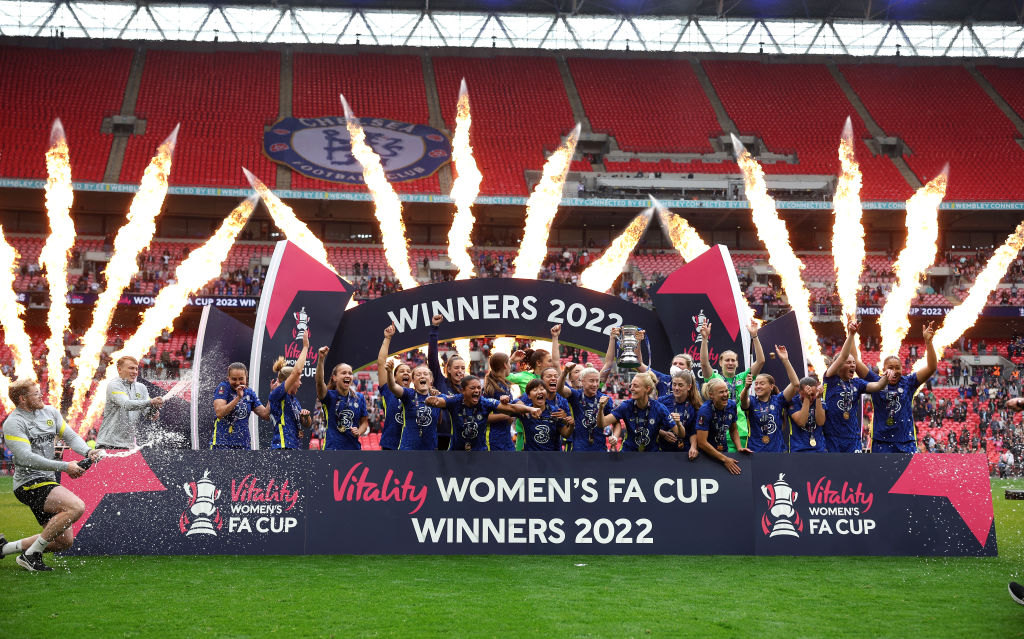
Above: Chelsea lift the FA Cup at Wembley to cap the end of Darrell Allen’s first season watching them at Kingsmeadow. Photo: Vitality Women’s FA Cup.
That was certainly some season to be attending regular Women’s Super League games, a Chelsea league title success and turned into a cup double with the extra time success over Manchester City at Wembley. Just those two events alone come with enough memories for a lifetime.
In the heart of summer 2021 just as Covid restrictions had been lifted and society was returning to normal, despite living 169 miles from Kingsmeadow, I made the decision to journey regularly through the season to watch some of the world’s best players.
The first trip would be for Chelsea’s game with Brighton and Hove Albion on Saturday 2nd October. In hindsight, probably not the greatest of decisions with kick off moved to Saturday at 11.30am for television and weather conditions were also as dire as they could possibly be.
Above: Chelsea and Brighton and Hove Albion players await a corner at Darrell’s first Kingmeadow match. Photo: Ben Gilby.
My first experience of seeing Chelsea live was just incredible and seeing all the names you associate with greatness in front of your eyes was a moment to behold. It wasn’t Chelsea’s best performance but a 3-1 win with Sam Kerr and Beth England adding to Guro Reiten’s opener made it a memorable afternoon and a good start to my trips to Kingsmeadow.
My second trip of the season came in February when I attended the Friday night game against Arsenal billed as arguably the FAWSL title decider. This was a day that will live long in the memory as I had the privilege of meeting Emma Hayes and see the players arrive.
Above: Darrell with Emma Hayes prior to Chelsea’s huge clash with Arsenal at Kingsmeadow. Photo: Luca Mangili.
The game itself was something special, with fans of both teams rammed into the stands together with only enough room to just stretch your arm. A closely fought 0-0 with both sides denied a stonewall penalty was my second offering.
Just two weeks later I returned for the Fifth Round FA Cup tie with Leicester City. Chelsea took care of business with a stunning 7-0 win thanks to braces from Pernille Harder and Kerr with Ji So-Yun, Aniek Nouwen, and England adding a goal each to complete the success.
Above: Pernille Harder and Sam Kerr celebrate during Chelsea’s 7-0 FA Cup win at home to Leicester City. Photo: Ben Gilby,
Two weeks later and the league game against Aston Villa. This was a surreal day as the ground was bare and no programmes or merchandise for sale due to the restrictions imposed by the government. However, it was a privilege to be there to see Hannah Hampton produce one of the greatest goalkeeping displays I have ever seen but Sam Kerr eventually found a way through with a dramatic stoppage time winner to spark wild scenes on the terrace. Another trip certainly well worth it.
This day I particularly thought was the decisive one in the direction of the title race, Chelsea had Hannah Hampton in the way of everything in the Aston Villa net, a crowd limited due to the aforementioned restrictions, and this game was heading for two dropped points until Sam Kerr found a way and got the stoppage time winner. Kerr was continuously trying to raise the crowd, as well as continuing to remain calm when opportunities were squandered but the incredible movement in behind Villa’s defence was going to catch them out eventually and so it proved.
Above: Sam Kerr scoring Chelsea’s stoppage-time winner against Aston Villa. Photo: Ben Gilby.
A player who is priceless, a goal that was priceless and a day that I believe gave Chelsea the forward momentum to that would eventually see them go on to win the FAWSL title.
My final visit of the season was for the final day clash against Manchester United. Chelsea knew a win would guarantee them the title and what followed was an extremely enjoyable afternoon as Chelsea came from 2-1 down at half time to win the FAWSL title 4-2 thanks to goals on the day from Erin Cuthbert, two specials from Sam Kerr and Guro Reiten with the other. The title celebrations, speeches, and trophy lift will stay with me forever.
Above: Sam Kerr celebrates after scoring THAT goal against Manchester United on the final day of the FAWSL season. Photo: Ben Gilby,
If that wasn’t enough, the following Sunday was Chelsea against Manchester City in the FA Cup Final at Wembley. Seeing Chelsea win the trophy in dramatic style thanks to a Sam Kerr extra-time winner was a special day in itself but nothing compares with the close, tight knit family atmosphere and feel that Kingsmeadow provides.
There has been a lot of talk over the season as to why Chelsea did not play any games at Stamford Bridge this season, and Sunday 8th May at Kingsmeadow for the game with Manchester United proves why.
Fans close to the pitch, a ground packed to the rafters and a great atmosphere being created. I believe Chelsea won the title because this match was at Kingsmeadow. The players needed the fans to help inspire the second half turn around and they did just at. Had it been at a likely half full Stamford Bridge at best then the Chelsea players would have found it very difficult to feed off an atmosphere that at Kingsmeadow inspired that second half comeback. Long may it continue that Chelsea use Kingsmeadow.
Above: Fans packing out Kingsmeadow – a contributing factor to Chelsea’s success in Darrell’s eyes. Photo: Ben Gilby,