Following being named women’s club of the year at the Ballon d’Or awards earlier this week, Arsenal face a must-win clash with Aston Villa.
Arsenal return to the Emirates Stadium this weekend aiming to maintain their defensive solidity after conceding just two goals in the first three WSL games this season. They will face Aston Villa, who inflicted a 5-2 defeat on the Gunners at Villa Park last April.
Villa come into this match following a 0-0 draw with Tottenham Hotspur in the Women’s League Cup on Wednesday, which they eventually lost 7-6 on penalties.
What should fans expect?
Arsenal head coach Renée Slegers emphasised the need for consistency and adaptability.
“We want to be consistently consistent. We need to bring that in every single game, so that’s no different. But we know that we’ll have to bring that on Saturday. We respect Aston Villa.”
Reflecting on last season’s loss, she notes:
“I think teams found ways against us last season. In preparation for that game, you go through different scenarios. We expected them to do something and maybe they didn’t fully do that thing that we expected them to do. Still, it’s on us to find the solutions, but that’s what we always need to keep in the back of our heads. We need to be versatile, flexible. We need to be able to change things because we can expect teams to change things against us.”
Slegers expects Villa to be aggressive and disciplined.
“They have certain strengths in the team. Again, they have a strong belief in how they play. If they will do what we expect them to do, they will be very aggressive against us. We will have to find the solutions.”
“It will be a tough task. It will ask a lot from us, from a presence perspective. Are we technically present? Are we psychologically present in the game? Because we expect to be under pressure and we expect to have to find solutions against Villa on Saturday.”
Team news
Leah Williamson remains unavailable as she continues her recovery from injury, however updates on her progress are expected soon, which could be a boost for Arsenal’s back line.
Slegers was also asked about Jenna Nighswonger. The defender has yet to make an appearance this season. Signed in January 2025, Nighswonger had a strong pre-season, leaving fans and pundits puzzled by her absence: against West Ham, Slegers opted for two goalkeepers in the squad rather than include her. This has drawn criticism – particularly from pundits. Slegers commented that against the Hammers, the decision was tactical:
“All players are performing really well and working really hard in training. Jenna is one of them. We felt like we wanted an extra goalkeeper in that game because of other reasons.”
Pressed further on decisions over team selections, Slegers asserted that she needs to make these decisions, but does not find the process easy.
“When the whole squad is fit, we have so many options. I will only be able to start 11 players and I will only be able to change a maximum of five players.
“That’s the rules within the game that I have to work with, even though it hurts me as well. That’s the rules of the game and at the end of the day it’s my job, so I’ll have to carry that. I’m not saying that I don’t find that hard, but that’s part of it.”
Difference makers
Katie Reid has impressed this season, stepping up confidently in the centre-back position alongside the experienced Steph Catley. Reid’s composure under pressure and ability to read play will be key against Villa’s aggressive attack.
Reid will likely be coming up against Villa forward Ebony Salmon, who has netted Villa’s sole goal so far this season and will be one to watch.
Slegers underlined the importance of flexibility in defence.
“We need to be versatile, flexible. We need to be able to change things because we can expect teams to change things against us.”
“They are aggressive, they are front-footed, they have a lot of physical qualities with speeds up top for example and they look very disciplined as a team.”
Arsenal face Aston Villa at 12pm UK time on Saturday. The match will be broadcast on Sky Sports Premier League and Sky Sports Go.
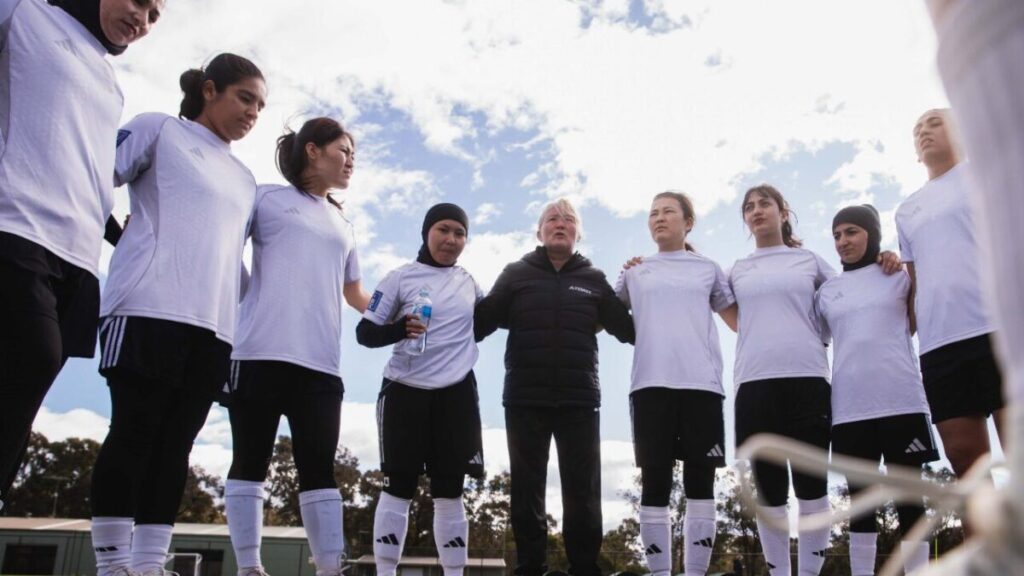
Above: The Afghan women’s refugee team led by Pauline Hamill. Photo: FIFA.
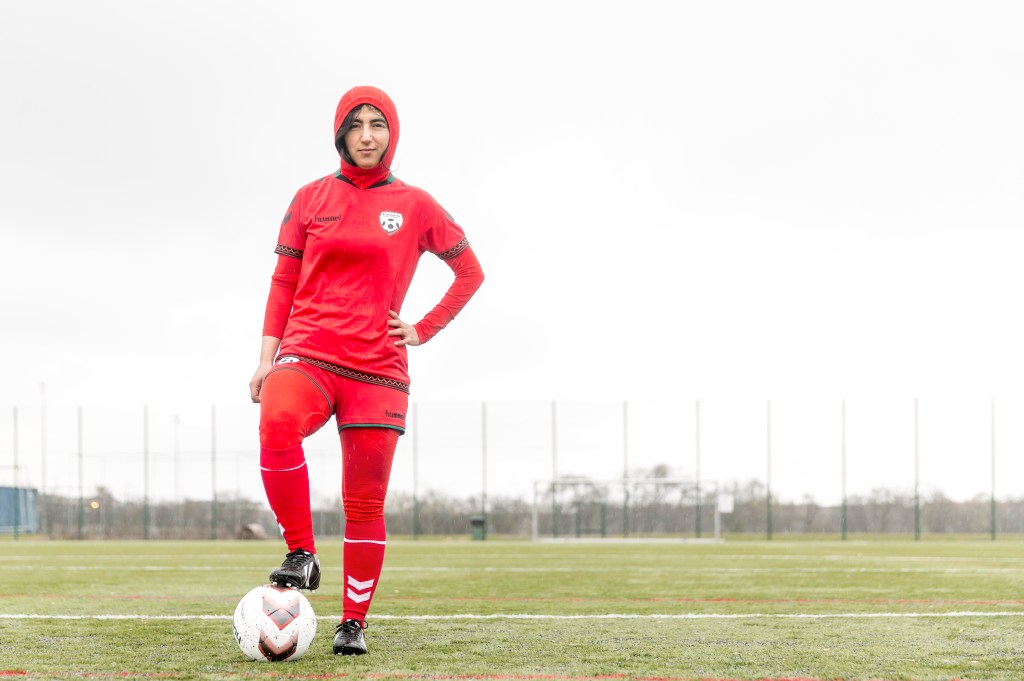
In May of this year, FIFA formally approved the Afghan women’s refugee team. Following the Taliban takeover in 2021, women’s sport in Afghanistan – already subject to violent oppression – was increasingly restricted. The progress made by Khalida Popal – from organising intra-school tournaments for girls to working with the government to form the women’s national team – was suddenly under immense threat.
The Afghan women’s team have not taken part in a competitive match since 2018, and in 2021 many of its players fled the country through fear of persecution. Popal, residing in Denmark as a refugee, helped 500 players and their families evacuate the country, using the power of football to unite players with their new communities: “When you lose your home, the pitch becomes your home”
Encouraging the refugees she helped to continue with their football journey and use it as a way of integrating was paramount for Popal. With a government-sanctioned women’s national team off the table, she worked closely with FIFA to ensure these players – now living across the world – had the chance to continue their national legacy by representing Afghanistan with a national team.
This was the basis for the Afghan women’s refugee team. More than 70 players attended camps in Sydney and London to aim for a spot on the 23-player squad that would be coached by former Scotland international Pauline Hamill. The former winger earned 141 caps for Scotland, and became the first female football coach at Rangers football club when she was appointed to a youth development role in 2003. Accepting the role, Hamill said:
“Every player involved has a story to tell about their personal journey in football, and it’s incredible to be part of something that shows them that their dream and ambitions in football still exist. They’ve had to leave their country, they’ve been displaced as refugees, and now all of a sudden there’s this amazing opportunity to come together in this project. It feels bigger and deeper than anything I’ve done before, and that really excites me.”
Above: Pauline Hamill. Photo: FIFA Website.
That Hamill understands the potential emotional impact of displacement is highlighted in her assertion that the role feels deeper than anything I’ve done before; this compassionate approach will be paramount in achieving success.
What success looks like will likely become clear later. Visibility, connection, and growth are all words that are commonly used to describe the team’s aims, athough for now the team are focusing on enjoying being able to play football. Player Najma Arefi recently spoke about what the opportunity to continue playing football means:
“Everyone loves football, the feeling of being free, the feeling of sisterhood, the feeling of joy – forgetting everything behind and you’re just enjoying it and being in the present. That’s why I kept playing.”
Support for players will not end with the 23 players selected to form the squad: FIFA will provide long-term support to play football in ‘safe and inclusive environments’ for all Afghan players living in exile. This will include access to educational pathways, coaching, and counselling.
FIFA Unites: Women’s Series
The squad recently completed a talent ID camp at St. George’s Park in England, where the England women’s national team train, and have their first tournament on the horizon – FIFA Unites: Women’s Series.
The event will take place in the United Arab Emirates – near enough to Afghanistan that the heat will be familiar but far enough to ensure security. Alongside the Afghanistan women’s refugee team, the UAE, Chad and Libya will take part in a round-robin competition with each team playing three matches.
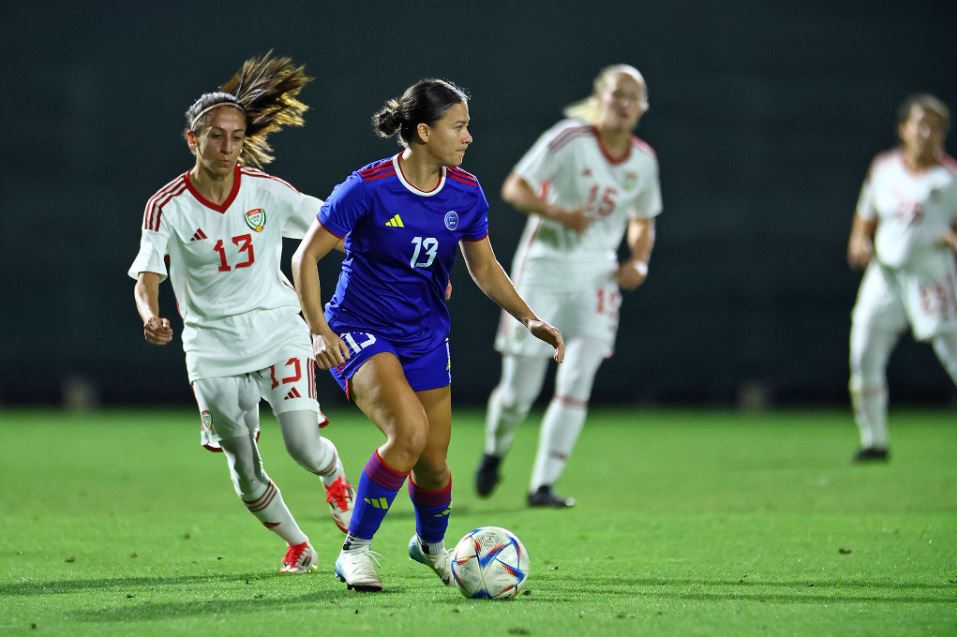
Above: UAE ( in white) earlier this year. Photo: Handout/PFF-PWNFT.
That the competition will be held in Dubai is unsurprising: whilst the UAE is also an authoritarian country, it is regularly considered the most liberal in the Middle East, and Dubai the most liberal of its seven Emirates.
As the host nation, the UAE – coached by veteran Dutch coach Vera Pauw – will be looking to build on recent progresses, such as the 2023 launch of the Women’s Football League. For Chad and Libya, the tournament will provide an opportunity to further grow and develop their international talent, and provide visibility to promote growth.
For the Afghan contingent, the tournament is an opportunity but by no means a solution. The ongoing discrimination by the Afghanistan Football Association still means the games will not count towards the team’s official global rankings. As player Mursal Sadat says:
“We have already lost the chance to compete in two World Cups, and this will not change that. We urge FIFA and all its Member Associations to take all measures necessary to stop enabling the ongoing gender discrimination against the Afghanistan Women’s National Team, and to use their power to ensure the women and girls still living in Afghanistan are not forgotten.”
The FIFA Unites: Women’s Series tournament is scheduled to kick off on the 23rd October, lasting until the 29th.
Above:Linzi Taylor and Amy Gallacher battle for the ballPhoto:Cynic Women
Kathleen McGovern and Lisa Rodgers continued their fine seasons as Celtic and Hibs played out an entertaining draw, which saw both teams slip further behind Rangers and Glasgow City in the SWPL.
The Teams
Elena Sadiku opted to stick with the team she has played throughout the season, although Hannah Luke came in for her debut at left back, allowing Lisa Robertson to move into her preferred position of centre midfield. She has covered effectively at left back, alongside Momo Nakao and Natalie Ross in the middle of the pitch Celtic sought to expose Hibs’ two holding players.
Grant Scott named a very strong side, containing lots of the players who played most of that mid-week Inter Milan game. Tegan Bowie came back in on the left, and Eilidh Adams once again started in attacking midfield, behind striker Kathleen McGovern.
The Action
It was indeed that midfield mismatch which defined the game. Celtic’s trio overpowered Grant and Notley, so while Hibs were able to move the ball down the wings, genuine chances evaded them early on and Celtic instead carried the greater threat on the counterattack.
Ross, Nakao and Robertson moved around fluidly in the centre of the pitch, and they were able to take advantage of some sloppy Hibs passes and touches, quickly turning up and the pitch, looking to feed Cross and McAneny on the wings.
It was also clear that Celtic had observed Schumacher’s recent play; long balls, forcing the American to come out of the box were tried a few times. On one such occasion, Schumacher comically ran into defender Linzi Taylor, taking both players out, but luckily for Hibs the ball fell to Hunter who subsequently cleared.
On the ten-minute mark, Celtic’s wingers connected well inside the box, and McAneny’s played a delicate cross into the middle, with Natalie Ross beating Hunter to the ball and blasting her header through the hands of Schumacher.
As Hibs looked to fight back into the game, it was basic errors and miscommunications that let them down. Ciara Grant had a notably frustrating day, with many of her passes finding empty space or being off target. As the half-time whistle blew, it was Sadiku’s side with the advantage, but they could not be entirely happy with the performance.
As the second half developed, Celtic started to dominate the ball a bit more, and even bringing on new signing Jess Fitzgerald could not stop Hibs’ players failing to be on the same page.
Where Hibs did have some success was players making individual dribbles, with Rosie Livingstone, Tegan Bowie and Caley Gibb all moving effectively down the wings and manouvering past many Ghirls’. Lisa Rodgers was always there to make any saves, while Walsh combined well with Clark at the back for Celtic, snuffing out any easy chances for the duo of Adams and McGovern.
With the game heading the hosts way, Grant gave the ball an ugly hack, bouncing high into the box. Neither Clark nor Walsh fully committed to taking responsibility for the clearance, which allowed McGovern to expertly spin through the middle of both players, while switching the ball to her left foot, allowing her to inch the ball low past the oncoming Lisa Rodgers, just catching the inside of the post.
From a relatively weak position, Hibs were back level and this goal suddenly sparked both teams into life. Celtic stopped time wasting and keeping the ball at the back, while Hibs started to believe again.
The introduction of Rachael Boyle at left back really helped inspire this Hibernian response, and she was able to cause Emma Lawton some issues, cutting inside to combine well with Bowie, who preferred to stay wide and provide a crossing threat with er deadly left foot.
Celtic continued to push the ball into the box, and Hibs were fully committed to breaking with speed and direct passing. McGovern found herself running through on goal in the dying seconds, but was denied by a strong and brave Lisa Rodgers, the ball bounced back to Morrison twice, but somehow Rodgers topped her last-second performance versus Hearts here with a triple save.
Player of the Match Momo Nakao
Nakao was part of that brilliant Celtic midfield which was able to frustrate Hibs’ midfield in a way most others cannot. Regularly winning the ball back, and reading the game well enough to take advantage of Hibernian’s mistakes, Nakao ensured her opponents had to produce moments of magic to get in behind this defence.
She was also a big threat in attack. Hovering towards the left side of the pitch, Linzi Taylor and Caley Gibb were tasked with limiting the threat of the Japanese midfielder as well as winger McAneny, which ultimately proved too much for them.
Often an unsung hero for Celtic, Nakao is not the frequent goalscorer, or an obvious playmaking threat, but in this game she was central to Sadiku’s attacking and defensive plans.
What this means
With Glasgow City and Rangers both winning, it puts each side two points further away from the top. Celtic stay in third place, with 13 points from six games, three behind Rangers and two behind City. However, Glasgow City do have a game in hand. While they will not be fully satisfied with a draw, after a loss in the derby a couple of weeks ago and a nervy win over Aberdeen last time out it was important to avoid a loss in this game.
The top of the table is still within reach, and all teams have shown vulnerability so far. Sadiku’s side look no less able to win the title than anyone else, and this performance showed an ability to play with the lead which they lacked last Sunday.
For Hibs, they are a further three points adrift of Celtic, although they also have a game in hand on the Ghirls and Rangers. It has been a tough start to the season, having to play four European games already, which is more than anyone else, and they have faced better opponents than City did too.
Despite this, they have kept themselves well in the title race and a point on the road against Celtic – having been knocked out of the Europa Cup mid-week – is a very respectable result. While Grant Scott won’t appreciate falling behind Rangers and Glasgow City, he knows all too well of this team’s ability to come from behind in the title race.
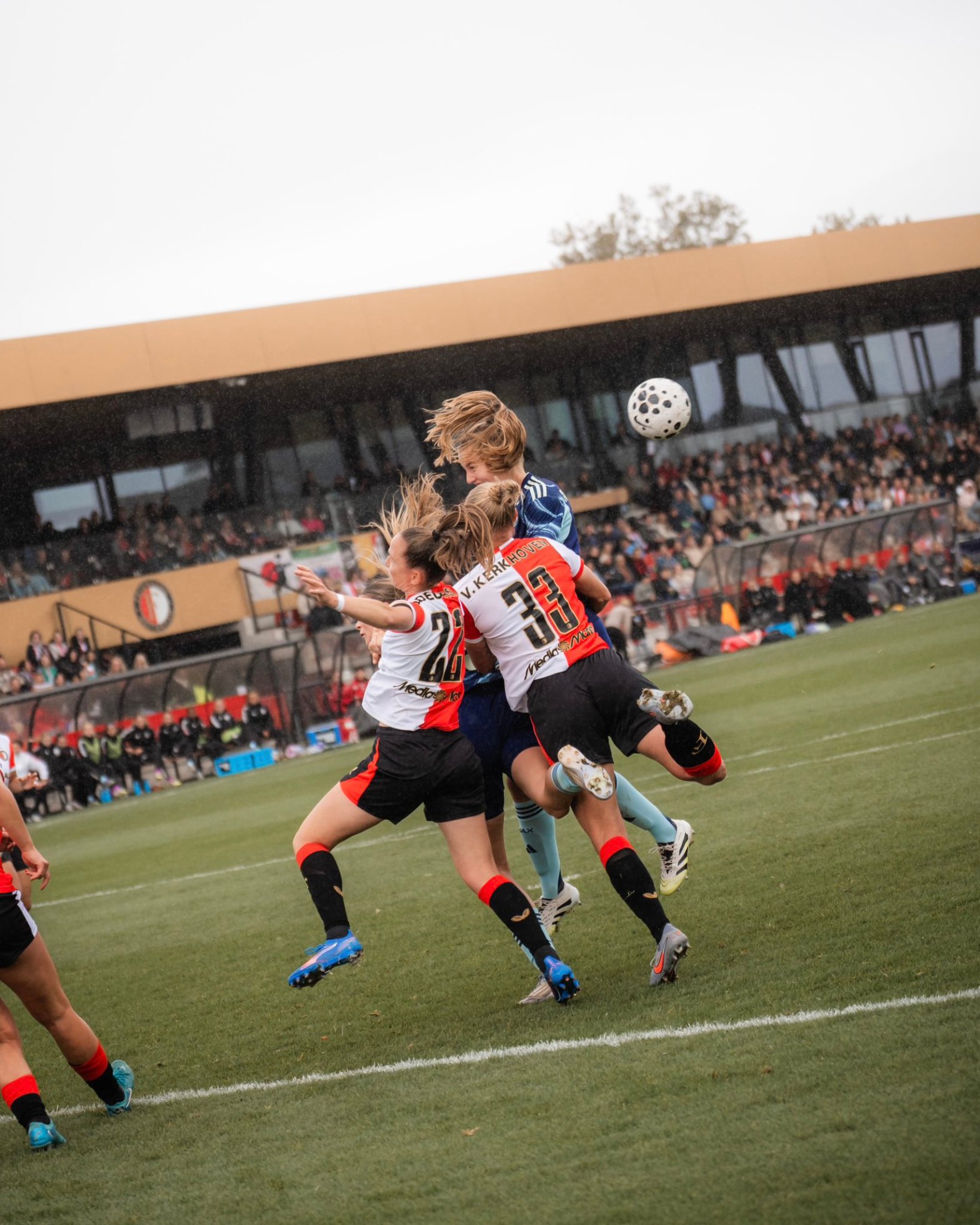
Above: Feyenoord v Ajax. Photo: VrEredivisie on X.
In the second round of the Eredivisie Matches, the difference between the title contenders and relegation potentials is beginning to become clear. In his weekly round-up for Impetus Football, Jan-Keese Joosse looks back at an entertaining weekend of Dutch women’s football.
AZ’s Fieke Kroese steamrolls Excelsior in five minutes
Excelsior Rotterdam 1 – 3 AZ
Excelsior briefly seemed on their way to causing an upset but ultimately lost 3-1 to AZ. The Rotterdam side took an early lead through former PSV player Janneke Verheijsen, scoring Excelsior’s first goal of the season.
Above: AZ v Excelsior. Photo: VrEredivisie on X.
The plan to park the bus worked less effectively than it had against PSV, since this time Excelsior also pushed forward more often. AZ sensed opportunities and found their key player in striker Fieke Kroese, who turned out to be in surprisingly excellent form. Within five minutes, she overturned the deficit with two goals, putting the Alkmaar side ahead.
The second half remained tense as AZ failed to secure a safe margin. Only in stoppage time did Ellouzi, playing against her former club, seal the victory with the 3-1.
With this win, AZ claimed their first three points of the season. The team looks strong enough to stay clear of the relegation zone but will need to show more quality if they want to compete for a top-five spot and pick up points against the top clubs PSV, Ajax, and FC Twente.
For Excelsior, it promises to be a difficult season: the side still lacks clear ideas on how to turn possession and defense into attacking play. Simply defending for a draw is proving to be a risky strategy in Dutch football.
Ajax’s struggle against Feyenoord highlights dangers of squad turnover
Feyenoord Rotterdam 0 – 1 Ajax
In the Eredivisie Women, Ajax scraped together three points on Sunday in the so-called “Klassieker” against Feyenoord: 1-0. While the marketing promotes the fixture as the great rivalry of women’s football, competitively it remains a one-sided affair. Feyenoord have never finished higher than the top five, while Ajax have been among the elite for years. Still, this edition provided tension right up until the final whistle.
Above: Feyenoord at kick off. Photo: FeyenoordV1 on X.
Ajax opened the scoring early. In the fourth minute, Danique Tolhoek fired a powerful shot on goal, and 19-year-old breakthrough star Mirte van Koppen reacted quickly to slot in the rebound. It was her third goal of the season, once again proving the value of Ajax’s youth academy.
After that, Feyenoord defended surprisingly well and left a much stronger impression than in their earlier defeat against NAC. Celainy Obispo, Jade van Hensbergen, and Danique Tolhoek all picked up yellow cards, underlining the high tempo and intensity of the match.
In stoppage time, Feyenoord unexpectedly had the chance to equalize when they were awarded a penalty. Lont, however, sent her effort wide of the target – to Ajax’s relief.
Ajax can breathe a sigh of relief after securing three points, while Feyenoord, despite the loss, can take confidence from their strong defensive display and the narrow margin against one of the title contenders. Ajax are still looking for stability after a plethora of players leaving their squad. It’s kind of crazy that the 21-year old Danique Noordman and 19-year old Danique Tolhoek are the leading forces in the team next to Europe’s most internationally-capped player Sherida Spitse. Still their performances are quite impressive, so they don’t have to worry yet.
PSV struggle again at FC Utrecht, but force a controversial win
FC Utrecht 1 – 2 PSV
In the Eredivisie Women, PSV battled to a hard-fought 2-1 win over FC Utrecht on Sunday. The Eindhoven side started brightly, showing plenty of creativity in the opening stages, largely thanks to Chimera Ripa, who repeatedly put pressure on the Utrecht defense.
Above: PSG v FC Utrecht. Photo: VrEredivisie on X.
PSV pinned Utrecht deep in their own half, but the home side could count on an excellent performance from goalkeeper Femke Bastien, who kept her team in the game with several saves. Offensively, Utrecht struggled: the departure of Nurija van Schoonhoven to Ajax was clearly felt.
Where Utrecht had once been known for bold, attacking play, this time they fielded mainly physical battlers. Even so, the home team surprisingly took the lead when Gera Op den Kelder headed in with ease after defender Nina Nijstad was completely caught off guard.
After the break, PSV hit back. A stroke of bad luck for Utrecht occurred when Boremans went down head-injured during an attack, creating confusion in the defense, because the referee was supposed to blow the whistle. GoalKeeper Bastien briefly lost concentration, and Xhemaili capitalized, finishing off a pass from Renate Jansen to level the score. Shortly afterward it went downhill for Utrecht, Lena Mahieu was forced to bring down a breaking Ripa, earning herself a red card and leaving Utrecht further weakened.
With the extra player, PSV piled on the pressure. Once again, Xhemaili Ripa struck—this time with a header for her second goal of the afternoon, almost unchallenged by Utrecht’s depleted defense.
PSV saw out the victory but will be concerned about their unconvincing display—especially after their earlier struggles against Excelsior. If they truly want to compete for the title this season, the playing style will have to rise. FC Utrecht, meanwhile, will need to inject more freshness and attacking spark if they want to make good on their ambitions for European football, but so far they and Feyenoord seem like the teams to make life difficult for the regular top three teams.
PEC show HERA that organisation makes the difference
HERA United 2 – 3 PEC Zwolle
PEC Zwolle kicked off the new Eredivisie season in style with a 3-1 victory over Hera. While PEC looked organized and solid, Hera’s defense left much to be desired, perhaps unsurprising given the many changes in their squad, but still disappointing for an opening match.
Above: PEC Zwolle celebrate. Photo: PECVrouwen on X.
Early in the game, Ilvy Sijp put PEC ahead with a sharp finish. Hera quickly hit back through Vis, who completed a swift counterattack to level the score. PEC, however, stayed composed: Judith Roosjen capitalized on a defensive error to restore the lead, before Hannah Huizinga extended the margin. On that goal, Hera’s defense looked shaky, and coordination with the goalkeeper appeared lacking.
Despite their defensive struggles, Hera produced a surprising moment of brilliance. Kira stunned everyone with a strike from around forty meters, beating the PEC goalkeeper who was caught too far off her line. It was a spectacular goal that briefly gave Hera hope, but they couldn’t sustain that level.
After the break, the pace dropped and no further goals were scored. PEC Zwolle controlled the game and professionally saw out the win. With these three points, PEC have shown they can be a serious mid-table contender this season, capable of challenging teams like ADO, Heerenveen, and perhaps even AZ. Hera, meanwhile, will need to improve defensively if they want to present themselves as a more attractive and stable side for supporters and sponsoring.
NAC Breda’s Naïvity and Ravensbergen’s brilliance seals win for the Tukkers
NAC Breda 0 – 6 FC Twente
FC Twente cruised to a comfortable 6-0 victory over NAC in Breda. The home side paid a heavy price for naïve defending, giving the reigning champions all the space they needed to strike.
Above: NAC v Twente. Photo: NAC.nl.
Early in the match, Twente’s smallest player, Lynn Groenewegen, was left completely unmarked to head in the opener. Not long after, more poor defending led to the second goal: captain Danique van Ginkel found herself so free that she could score with ease.
After the break, things got even more painful for NAC. Rising talent Rose Ivens netted what was perhaps the easiest goal of her career when a corner from Jill Roord dropped right at her feet. Moments later, the NAC defense put the ball into their own net, further shattering their confidence.
Twente had no trouble pressing on. Last season’s league top scorer Jaimy Ravensbergen (profiled here) intercepted a shot from the eager goalgetting Jill Roord and made it 5-0, sparking a teasing laughter from Ravensbergen to Roord. Eva Oude Elberink came on as a substitute and eventually sealed the final score at 6-0.
For Twente, this emphatic win is important in terms of goal difference, which proved decisive in last season’s title race. NAC, on the other hand, will need to regroup quickly if they want to survive in the Eredivisie, as they offered the champions no resistance in this match.
ADO Den Haag take steps forward, Heerenveen work to keep them at bay
ADO Den Haag 2 – 2 SC Heerenveen
In the Eredivisie Women, the match between ADO Den Haag and Heerenveen ended in a deserved 2-2 draw. Both teams proved evenly matched and showed they have enough quality to stay clear of the relegation zone without too much trouble.
Above: Ziva Henry opens the scoring. Photo: ADODHVrouwen on X.
ADO Den Haag took the lead in the first half through a strong run in behind from Ziva Henry. Attack-minded Heerenveen, however, stayed composed and equalized through Fenna Meijer. With the score at 1-1, the teams went into halftime – a fair reflection of the game.
The balance continued in the second half. Around the hour mark, Senna Koeleman put ADO back in front, but ten minutes later Aymee Altena leveled things once again.
Both sides displayed Eredivisie-level experience and the ability to grind out points, which will serve them well in the battle to avoid the lower end of the table. For ADO, the attacking play that was missing against Ajax will be an encouraging sign. Heerenveen, meanwhile, will need to tighten their defense if they want to start turning draws into wins.
Follow Jan for all the news about Dutch Women’s Football on www.fcleeuwinnen.nl. Read news about the star players, get strong point of views from our columnists and discover all about upcoming Dutch talents.
Above: Arsenal celebrate scoring against West Ham in 2024/25 Photo: Jay Patel/SPP
Ahead of an early narrative-setting matchup in the WSL, Rachel Gore spoke to Arsenal’s Renee Slegers and Katie Reid
Context
Manchester United and Arsenal sit in first and second place respectively in the WSL table. Both sides have earnt six points so far, but United lead on the goal difference. Sunday’s match will determine which team takes the top spot and set a precedent for what’s to come in the WSL.
What should fans expect?
This clash between the current top two teams in the WSL will be an extremely competitive fixture, and Slegers is anticipating that United are “going to play with a lot of intensity”.
Matches between title-challengers, such as United and Arsenal are crucial for the overall table, but also for mentality. Despite knowing how significant Sunday’s match is for Arsenal, Reid suggested that the North London side will view this match as they do any other fixture. The young defender said:
“You don’t want to make it into this huge, big deal because you don’t want to put too much pressure on yourselves. We’re just going to go out there and play the way we know we can play and just compete and fight for the result, but we believe we can do it and there’s no doubts in everyone’s minds. We’ve got our fans as well; we’ve got a thousand fans coming with their support.”
The 1,000 Arsenal fans that Reid mentioned were also spoken about by Slegers. The manager knows that Leigh Sports Village is “a setting with a big crowd” full of “loud” United fans, but she insists her team “will feed off of” their travelling support.
Slegers’ summarised what these travelling fans, and those watching online, can expect from Sunday’s match in one simple sentence: “I’m sure it will be a very tight game on Sunday with momentum shifts as well, but again, we’re trying to control as much as possible.”
Team news
Arsenal fans will be pleased to hear that Chloe Kelly has been “in big parts of training this week” and the possibility of her return “looks very positive” having been absent from Arsenal’s last matchday squad due to a knock.
Form
Both teams have been prolific in attack throughout their opening two matches, scoring nine goals. Speaking on Arsenal’s performance in the WSL so far this season, Reid said:
“The most important thing is we’ve got two lots of three points from the past two games. I think we’ve scored lots of goals and we’ve got lots of different goals scorers as well.”
The bulk of these goals have occurred in the latter stages of matches. When asked about this emerging pattern, Slegers challenged her team to build into games “earlier and quicker.“
She emphasised the idea however, that getting results was more important than anything else, stating:
“If we can score goals early, then we’ll do it. If they come late, then we’ll go for it as well. Every game has its own story, momentum shifts.”
Looking at the hosts, their goal-scoring output has perhaps been more surprising than that of Arsenal. In previous years, the side’s defence has been relied on to get Mark Skinner’s team over the line, but in 2025/26 their attack has shone.
Speaking on United’s form this season in comparison with the last, Slegers said:
“I still think they have a similar identity to last year, but of course every team is trying to work on the details and add to their squad.”
She added:
“There’s a lot of identity in their game connected to their game out of possession and they have a lot of quality both as a team and as individuals in possession.”
This week, United also secured their place in the main draw of the UEFA Women’s Champions League for the first time. They become the third English team to be playing in this years competition. When asked about the importance of having another English team playing in the Champions League, Reid said:
“I think it’s so important. I think it shows how big the WSL is becoming and even the WSL2. The growth and the money being invested nowadays is so good for the English game. I think it’s a real positive.”
Difference makers
One Arsenal player that has stood out this season is Reid, who has played every minute of Arsenal’s two WSL games so far.
Reid has come through the ranks of Arsenal’s academy and has “a lot of qualities” that Slegers believes Arsenal “need” in their squad. For Slegers, Reid’s standout quality is her mindset: “how she wants to learn, how she’s humble, how she takes things on board, how she communicates”.
Reid’s resilient mindset was evident in Arsenal’s opening fixture against London City Lionesses. Haven given away an early penalty which cost her team the lead, she did not get overwhelmed and played out a solid game, earning her spot in the starting team for the next week.
Reid works on the backline with some extremely experienced players, such as Steph Catley, Emily Fox and Katie McCabe. When asked about what she learns from her teammates, Reid said:
“I learned so much from them, just their communication on the pitch as well, like they’re constantly talking. And even the girls off the pitch; I learn so much from Lotte (Wubben-Moy), Codi (Laia Codina) and all the centre backs because they all have different attributes which are their strengths.”
One of the forwards that Reid and her fellow defenders will face is Melvine Malard, who has already scored four WSL goals for United this season. Malard is strong under pressure with quick footwork and a great first touch. She’s a forward who can play as a central striker or on the wing and therefore she poses as a great threat to Arsenal.
Elizabeth Terland comes into the game with a midweek hat-rick under her belt, having scored all three goals to see United through Champions League qualifying. Reid and the rest of the Arsenal backline will need to be on top form to keep United out. bb
Manchester United v Arsenal kicks off at 14:50 BST and will be broadcast on BBC One.
Above: NPLW WA top scorer for 2025, Renee Leota of Perth RedStar. Photo: Rob Lizzi.
We assembled a panel of five people – Tommy Doleman, Kelechi Osunwa, Ben Gilby, Ella McShane, and Max Parris, who have been covering the NPLW WA this year – to come together and nominate players for the Impetus NPLW WA Team of the Season for 2025. Once all the nominations were made, a starting XI and a substitutes list were put together. It took a whole week of discussions back and forth, but here’s what we eventually decided upon.
Goalkeeper
Dayle Schroeder (Perth SC)
Above: Dayle Schroeder gets across her goal in Perth SC’s home game with the Football West Academy in August. Photo: Rob Lizzi.
It’s been an incredible season of stats for Schroeder, who has had a phenomenal first year at Dorrien Gardens after making the move from Fremantle City. In 23 NPLW WA league and Top Four Cup ties, the shot-stopper kept nine clean sheets and only conceded 17 goals across those games. To emphasise how impressive these numbers are, the next fewest number of goals let in by a NPLW WA goalkeeper was more than double, at 35. The only goalkeeper to earn a nomination for Impetus‘ NPLW WA Player of the Month awards (in July), Schroeder and the defence in front of her were a key reason for Perth SC’s first-ever NPLW WA title.
Defenders:
Epril Nossent (Perth SC)
Above: Epril Nossent (left) battles against Perth RedStar in August. Photo: Rob Lizzi,
A long-held reputation as one of the league’s toughest defenders to beat, Epril Nossent had a powerful season as part of Perth SC’s brick wall-like defence. With her ability to combine a strong physical and aerial presence, allied with a desire to push forward along the flanks to assist her team’s attack, Nossent has been superb and has earned her second successive spot in our team of the year selection.
Kim McCartney (Perth SC)
Above: Kim McCartney (17) sends another curling free-kick towards the goal for Perth SC against the Football West Academy last month. Photo: Ben Gilby for Impetus.
A defender who has led the way for whatever side she has represented, Kim McCartney has delivered a season of class performances that have played a major part in her team’s NPLW WA championship win. McCartney, a nominee for the Impetus NPLW WA Player of the Month award in May, has that rare ability of being both a powerful defender and someone who has a phenomenal ability from long-range free-kicks. In Perth SC’s 23 NPLW WA league and Top Four Cup matches, the defender scored five times. Each one was a classic curling free-kick to add to her ever-bulging scrapbook.
Annabelle Leek (Fremantle City)
Above: Annabelle Leek in possession for Fremantle City this season. Photo: Denyse RM Photography.
Despite a strong second half of the season, Fremantle City missed out on Top Four Cup football, but a succession of influential displays by Annabelle Leek was a central part of the port city side’s campaign. An elegant ball player surrounded by an air of calm and collectiveness, Annabelle Leek is the only player to have made all three of our Team of the Season selections since they began in 2023, and her selection once more cements her status as one of the competition’s standout players.
Violet Longmore (Perth SC)
Above: Violet Longmore strides through for Perth SC against the Football West Academy last month. Photo: Rob Lizzi.
It has been an extremely impressive first season after ageing out of what was then the Football West NTC squad for Violet Longmore. The youngster from Margaret River got off to a powerful start, earning a nomination for April’s Impetus NPLW WA Player of the Month award, and the year got better and better. Longmore’s battles with some of the league’s best attackers were riveting viewing each week, and she won far more than she lost. An ability to stride forward to get attacks going as well were just the icing on the cake of a strong 2025 for Longmore.
Midfielders:
Daisy McAllister (Perth SC)
Above: Daisy McAllister flying down the wing for Perth SC at Perth RedStar in August. Photo: Rob Lizzi.
A player with a strong work ethic who knows how to not only beat defenders with excellent footwork, and deliver accurate passes that dissect the opposition, Daisy McAllister has provided some exciting moments throughout the season. Weighing in with 10 goals, the midfielder has shown an ability to fire in some stunning long-range rockets, efforts that have curled into the top corner, as well as penalty box finishes.
Lacey Heys (Football West Academy)
Above: Lacey Heys (left) shows her joy after scoring against Perth SC at the end of August. Photo: Rob Lizzi.
What a season it was for the teenage side, who played some sparkling attacking football on their way to clinching third place on the ladder and returning to the Top Four Cup. One of the Academy’s talented starlets in 2025 was Lacey Heys. A player who has caught the eye of the Western Australian football fraternity for a number of years despite her tender age, Heys earned a nomination to the Impetus NPLW WA Player of the Month in April and hit a total of four goals across the season, providing a key link-up with her side’s attack.
Abbey Meakins (Balcatta Etna)
Above: Abbey Meakins (right) – a hugely influential season for Balcatta Etna. Photo: Denyse RM Photography.
Abbey Meakins emphasised why she has been one of the league’s best players for such a long time, producing arguably one of the great individual displays in a Top Four Cup Final, which ended Perth RedStar’s reign with her four goals in Balcatta’s 5-1 win in the season finale. Whilst her Grand Final display will naturally take all the headlines, Meakins had a superb campaign. A nominee for Impetus‘ NPLW WA Player of the Month in both May and June, the Balcatta star hit a total of 17 goals in her side’s 24 league and Top Four Cup games in 2025 as she earned her second successive selection in our Team of the Season selection.
Strikers:
Jamie-Lee Gale (Balcatta Etna)
Above: Jamie-Lee Gale – a hugely influential figure in Balcatta Etna’s season. Photo: Denyse RM Photography.
It’s been another strong campaign for this flying attacker. All year long, Gale’s darts along the flank have played an integral part in her side’s best-ever season in the NPLW era. A total of 16 goals across 24 league and Top Four Cup games, plus countless assists from the quality of balls she supplies into the area, or threads through, the former Perth Glory player was so influential in Balcatta’s year that started with a dominant Night Series campaign and a nomination for Impetus‘ NPLW WA Player of the Month for April, and ended with that relentless second-half display in the Top Four Cup Final, in which Gale was on target.
Renee Leota (Perth RedStar)
Above: Renee Leota, who played her 300th game for Perth RedStar during the season. Photo: Perth RedStar.
Renee Leota’s sheer class and influence remain undimmed. The former New Zealand international, who recorded an incredible 300th appearance for her club in 2025, was a standard bearer for Chris Atturo’s side. Finishing top of the scoring charts with a total of 22 across RedStar’s 23 NPLW WA league and Top Four Cup games, Leota’s final strike of the campaign put her side ahead in the Top Four Cup Final before Balcatta Etna’s second-half response. The winner of Impetus’ NPLW WA Player of the Month for May, Leota looks like she has many, many more games and goals in her as her side looks to hit back in 2026.
Jess Flannery (Perth SC)
Above: Jess Flannery on the march for Perth SC against the Football West Academy. Photo: Rob Lizzi.
Whilst other attackers in the league may have scored more than Flannery’s tally of 11, the Perth SC star has such a well-rounded game that she would not just be a deadly finisher, but provide assists and cover for the defence if this squad ever took to the field in battle. Flannery won the Impetus NPLW WA Player of the Month for June, and was a nominee in August. Coming back into the Azzurri side at the start of the season after missing a large chunk of 2024 through injury, Flannery’s thrilling wing play, ability to thread centimetre-perfect passes through to her attacking team-mates, and desire to drop back to assist in defence mark her out as one of the league’s most exciting players to watch.
Substitutes:
Above: Theodora Mouithys, who scored the Junior Matildas’ winning goal in the ASEAN U16 Championships. Photo: Football Australia.
Rebecca Bennett (Balcatta Etna)
Alyssa van Heurck (Balcatta Etna)
Matilda Böhm (Perth SC)
Sofie Osborne (Fremantle City)
Sophie Meaden (Fremantle City)
Theodora Mouithys (Football West Academy)
Caitlin Doeglas (Perth RedStar).
Check out our NPLW WA Team of the Season for previous years:
Above: FC Twente celebrate reaching the UWCL league phase. Photo: FCTwenteVrouwen on X.
Dutch women’s football has enjoyed a dream week on the European stage. PSV, Ajax, and FC Twente all delivered strong results, keeping their continental ambitions alive.
PSV stun with sensational comeback
PSV seemed to be out of the Europa League play-offs after a 3-0 defeat in Norway against Rosenborg. But in Eindhoven, the team turned the tie around with a stunning 4-0 victory — a result few had expected after some lackluster performances in recent weeks. This time, all their potential shone through, and the leaders stepped up.
Chimera Ripa opened the scoring early with a sharp cut-in finish, Renate Jansen doubled the lead after a fine assist from young talent Chibani, Nina Nijstad powered in the third from a well-worked corner variation, and Xhemaili sealed the deal after the best flowing attack PSV have shown all season. Thanks to this historic comeback, PSV will compete in the Europa League this season — a massive confidence boost.
With Aniek Nouwen and Fenna Kalma still recovering from injury, PSV’s European future suddenly looks brighter than expected. The Eindhoven side will face FC Minsk in the play-offs.
Above: PSV celebrate. Photo: NOS Sport.
Ajax dominate Sturm Graz and prove consistency
Ajax also impressed on the European stage, defeating Sturm Graz twice by 2-0 to comfortably advance to the second round of the UEFA Women’s Europa Cup.
Striker Danique Tolhoek, just 19 years old, continues to show remarkable movement and work rate, always finding the right positions to score. On the wing, Bo van Egmond punished defensive errors and seems ready to step into the role left behind by Lotte Keukelaar, who recently signed for Real Madrid.
With Yohannes moving to Lyon, Keukelaar to Real Madrid, Kardinaal to London City Lionesses, and Van Gool to Everton, Ajax’s conveyor belt of talent once again proves how much potential the club holds. But these transfers also raise the question: how will Ajax build a recognizable and reliable squad after so many ins and outs?
From the starting XI that played the Champions League quarter-final just 18 months ago, only goalkeeper Regina van Eijk and captain Sherida Spitse still wear the Ajax shirt.
This turnover opens the door for a new generation of exciting teenagers, such as Ranneke Derks, to make their mark. Ajax will head back to the Alps to face GC Frauen in the final play-off round before the knockout stage begins.
FC Twente storm into the UWCL league phase
FC Twente, led by Jill Roord, have booked their place in the league phase of the UEFA Women’s Champions League with an emphatic 8-1 aggregate win over GKS Katowice. After a 4-0 victory in Poland, the Dutch champions finished the job at home with a commanding 4-1 win in Enschede.
Roord once again proved why she is the heartbeat of this team, scoring twice in the first half and setting the tone for Twente’s dominance. Danique van Ginkel added another with a precise strike, before Sophie te Brake capped the night in stoppage time with a spectacular long-range effort.
Above: Jill Roord for FC Twente. Photo: FCTwenteVrouwen on X.
A quieter evening for the Eredivisie’s 2024-25 top scorer Jaimy Ravensbergen in terms of goals, however the 24-year-old showed again why Netherlands fans want her to be given a chance in the national team. Pressing high and with agression, Ravensbergen pulled the Katowice defense out of position, allowing Roord and van Ginkel the space to move. For more about Ravensbergen, the striker has been profiled here.
With their qualification, Twente looks even more dangerous than last season. The squad has remained largely intact, added valuable experience from their previous group-stage campaign, and now enters the league phase with greater maturity and cohesion. Facing Europe’s elite later this year, Twente will be eager to prove it belongs among the continent’s very best.
In the group stage, Twente will host Chelsea, Real Madrid, and Atlético Madrid, while traveling to face Arsenal, OH Leuven, and Benfica.
On Sunday, Birmingham City face Newcastle United in their second home game of the season.
Birmingham City Head Coach Amy Merricks revealed that her team “want to respond” after securing a difficult point away at Sunderland last weekend. Their fixture against Newcastle United is a great opportunity, as both teams are potential title contenders this year.
The fixture promises to be a huge clash, as Birmingham City are currently unbeaten and sit in third place in the league, and Newcastle United are fifth. Fans can look forward to seeing new signings in action for both sides.
In some ways, Birmingham City’s 1-1 draw with Sunderland at the Stadium of Light last weekend was disappointing, as the Blues had several good opportunities throughout the game. Head Coach Amy Merricks described how the team “want to respond from Sunday’s performance.”
There were plenty of positives from the game too, and Merricks commented on having “really good opportunities in the game” however the Blues were “not sharp enough in the final third” and the “biggest piece (to work on) is in the box” and “being clinical”.
Merricks also praised the mentality, work rate and hunger of the Blues. She said that as soon as the final whistle went on Sunday, they already wanted to respond and they are a “really hungry group, I don’t need to say a lot to them as they’re very driven”.
The team’s hunger and drive will be hugely important on Sunday, with Newcastle United also being unbeaten in the WSL 2. Birmingham City’s signings from the summer are also settling into the squad well, and this will only boost the Blues further.
Amy Merricks also spoke about how important the fans will be on Sunday too. She said that they “want the fans behind us again” and described the fanbase as “incredible and very special.” She also described wanting to create a “fortress feeling at St Andrews”, as the team experienced in their first game of the season, which was an emphatic 5-1 home victory against Bristol City.
Merricks also described how this fortress feeling and support from the crowds will go hand in hand with the kind of performance that fans want to see. She told us that the fans will want to see a team that is “competitive” and “on the front foot”.
Birmingham City will face Newcastle United on Sunday 21st September at St. Andrew’s.The match will be broadcast on WSL2’s Youtube channel.
Above: United’s Elisabeth Terland celebrates her third goal. Photo: ManUtdWomen on X.
Manchester United made history on Thursday evening as they overturned a 1-0 deficit to reach the UWCL proper for the first time, beating SK Brann 3-0 at Leigh Sports Village thanks to a hat-trick from Elisabeth Terland.
The context
Manchester United had the opportunity to do something they have never done before: reach the first round of the UEFA Women’s Champions League. Two years ago, they had the same chance but faced a foe at the top of their game in PSG, failing to qualify for the competition proper. United feel they belong in the UWCL – as head coach Marc Skinner said:
“We’re constantly improving, and playing in the Champions League is part of that growth. It’s a platform to test ourselves and push to the next level. We’re not just here to compete; we want to progress and show that Manchester United belongs at the top.”
Skinner’s side controlled the first leg in Norway last week but trailed on aggregate ahead of the return match. Against the run of play, Ingrid Stenevik struck a 76th-minute header to hand Brann the lead. United had a number of chances, with goalkeeper Selma Panengstuen delivering an impressive performance to deny them. They needed more composure up front – and to get around Panengstuen – to overcome the deficit.
For Brann, it would be their second appearance in the UWCL. The Norwegian club made it to the quarter-finals just two years ago, falling to FC Barcelona. They sit top of their domestic league, which runs until November, and remain favourites for the title. At the helm is Leif Smerud, who took charge after Martin Ho departed to join WSL side Tottenham Hotspur.
The teams
Marc Skinner made two changes to the Manchester United lineup following their win against London City Lionesses over the weekend. Dominique Janssen replaced the injured Millie Turner, while Celin Bizet was absent due to a minor issue. As a precaution, Bizet was left out of the squad. Elisabeth Terland returned to the starting lineup.
The Brann team that triumphed 1-0 over United in Norway last week saw just one change. Monica Isaksen was brought into the starting lineup, taking the place of Dilja Zomers, who moved to the bench.
The action
Brann are known for playing aggressively in their domestic league, however started against United with a low block. They were clumsy in the opening minutes, giving the ball away in their own half, insisting on building up from the back with short passes that were easy for United to intercept.
In contrast, United flew out of the block, immediately pressing with aggression. Brann were defending in a narrow shape which gave the home side plenty of space on the wings to cross balls in. It did not take long for United to take the lead: Norwegian Elisabeth Terland won the ball in the penalty area, passing to Jayde Riviere on the wing. Riviere put a well-weighted cross back in which found its way to Terland who fired a powerful shot into the top corner. Terland got her second five minutes later as she latched on to Julia Zigiotti Olme’s corner, sending a header flying past Panengstuen.
The rest of the half persisted in a similar vein: United pressing aggressively and Brann sitting in a deep block with eleven players behind the ball. Throughout the half, the visitors insisted on continuing to play out from the back – which gave United numerous opportunities to The Red Devils did well to find the spaces between the lines but couldn’t quite break the Brann defense down throughout the rest of the half, and Brann survived the rest of the half without further damage.
Following the break, Brann showed a sense of impetus that had been missing for the first half of the game. They pushed their wide players forward, giving United more defensive work to do – a few corners later, United broke out of the press and got the ball back into Brann’s half. United will be pleased that after a half with no work to do, the back line maintained their concentration enough to deal with the team in front of them.
Following a string of chances, Terland completed her perfect hat-trick: the first was scored with her left foot, second with her head, and third with her right foot. The goal came from some neat link-up play between the Norwegian and Melvine Malard. Malard drove forward, and Terland made the overlapping run to latch onto the through ball and poked it past Panengstuen.
Above: Terland celebrates. Photo: ManUtdWomen on X.
Where does this leave the teams?
United made history by reaching the UWCL proper for the first time, and will compete alongside the best teams in Europe. The achievement is both expected and exceptional: United are most often a club that makes headlines due to off-pitch scandal rather than on-pitch achievements. The question now is whether the team have enough depth to sustain runs in a number of competitions – something Skinner has admitted will need to be addressed in the January transfer window.
Brann will be disappointed with how quickly their lead disappeared – they will now take part in the inaugural Europa Cup. However, it is not all negative – head coach Smerud should end the season with the league title, and his team will be strong contenders for the Cup.
TEAMS: MANCHESTER UNITED (4-3-3): Tullis-Joyce, Sandberg, Le Tissier, Toone, Park, Malard, Terland, Riviere, Janssen, Zigiotti, Miyazawa. Substitutes: Middleton-Patel, Rendell, George (for Sandberg 66′), Rolfö (for Malard 66′), Griffiths, Naalsund (for Riviere 78′), Williams (for Terland 83′).
By Gethin Thurlow at Easter Road for Impetus (18/9/25)
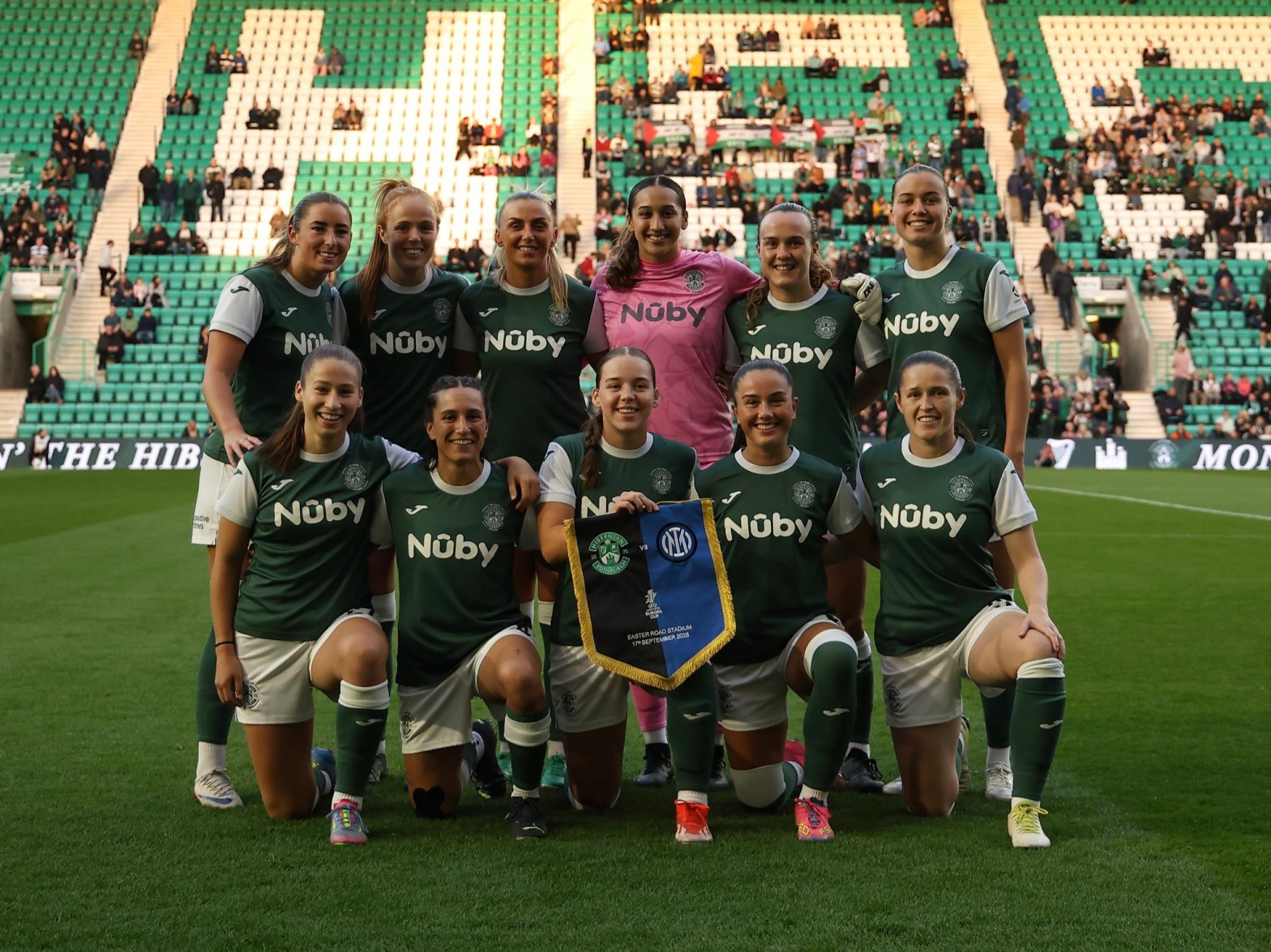
Above: The Hibs starting lineup in Edinburgh Photo: @HibernianWomen on X
Hibs were knocked out of the Europa Cup after a 1-0 defeat to Inter Milan at Easter Road. Coming into the game trailing by three, Hibs played with intensity in attack and stayed solid at the back, and were unfortunate to come away with a loss on the night.
The Matchup
Inter took control of this tie in the first leg, which was in Italy. Scoring two goals within 10 minutes, they asserted themselves on the game from the start. A very spirited response from Hibs brought the game to close at 4-1, with Eilidh Adams grabbing their only goal, scoring from the edge of the box
This presented a mammoth task for the Edinburgh club in the second leg, and different game plan possibilities for Inter Milan to consider. Going into a game three goals up is very different to starting from scratch, and taking advantage of that that was probably the only hope that Hibernian had of causing a shock.
The Teams
Grant Scott made a number of changes from the 5-0 blowing-away of Montrose that his team delivered on Sunday. Particularly notable was the absence of Tegan Bowie, the left winger who provided assists for three of those goals, with Rosie Livingstone and Tiree Burchill preferred on the wings instead.
Rachel Boyle being on the bench was another boost for the hosts, as she has missed the last few weeks with an injury picked up in Champions League qualifying.
Inter Milan meanwhile went full strength as they looked to keep that European run going. They managed to win 4-1 even without Belgian superstar Tessa Wullaert in the first leg, so her return to the starting 11 gave the Italian team even more confidence that they could advance to the next round of the Europa Cup.
The Action
The difference in what both teams needed from the game was clear to see from the off. Hibs were showing clear intent, pushing aggressively forward, going in for every tackle, leaving it all out there essentially. While Inter were not overtly time-wasting, it was clear they were more interested in keeping the ball rather than creating lots of chances.
It was however the visitors who got in early. Papadopoulos held firm to deny Magull, after the Italian side counter attacked from a corner, and Schumacher did well to save a shot from Wullaert as she was played through on goal moments after.
Hibernian had clearly learnt from the first matchup, and were very disciplined in holding a defensive line, catching the Inter Milan attack offside six times in the game.
They knew that good defending couldn’t eradicate a three-goal deficit and began to get more creative in attack, trying anything that could get them a goal and bring that glimmer of hope. Siobhan Hunter attempted a cheeky chip from the halfway line, after McGovern was fouled, but Iceland international Runnarsdottir was not to be caught out.
Chances did come though for the Hibees. Eilidh Adams received an inch perfect pass from Ciara Grant, which allowed her to move past Runarsdottir, but her touch was too big and by the time she shot the angle to the goal was closing and her momentum was taking her away, which resulted in a very easy effort for Inter to defend.
Hibernian also looked in at one point, with a four-on-four counterattack situation, but some indecisiveness from Burchill allowed the defence to take shape again, and Rosie Livingstone miscued a difficult volley from the ensuing cross.
The game looked to have flipped on its head in one single moment when Adams was played behind the defence and Runarsdottircame sprinting out of her box. Lunging in, she missed the ball and Adams went down but the referee remained unmoved, and replays showed that was the correct choice, as they were never contact between the two.
Above: Kathleen McGovern chased the ball around all night Photo: @HibernianWomen on X
Hibs were just three 50-50 moments away from being level but ultimately had not made dent into the gap by half time.
Despite the scoreline, there was no panic from Hibs and at half time they stuck with the players which had challenged the Inter team in the first 45.
Hibs did start to dominate the game and were able to control the ball in the visitors’ half throughout the first 20 minutes of the second half. In key moments however, Livingstone, Adams, Grant and Burchill all failed to provide the quality needed to get Hibs on the scoreboard.
As the minutes ebbed away, it was clear how much effort Hibernian had put in, and that the whole team were completely physically and mentally exhausted. They still pushed all they could, but any hope of putting together an attack and having enough quality to score was gone.
The end of the match was overshadowed by Noa Schumacher receiving a red card. Ellis Notley badly underhit a back pass, forcing Schumacher to come out of her box. She clattered down Glionna as the ball ran past; however, Linzi Taylor was behind Schumacher, meaning the goalkeeper was not the last line of defence anymore and that a red card was not necessary.
With a number of mistakes in that Champions League qualifier against Fortuna, it has been a very Jekyll-and-Hyde European campaign for Schumacher. She has made plenty of impressive saves, showing off her flexibility and diving ability, while at the same time making some really costly errors in situations where she’s coming out to meet players, and dealing with crosses.
17-year-old Rowena Armitage was thrust into the action and could do nothing to stop Tomasevic’s strike to give Inter the lead, which did a disservice to the full performance from Hibs.
Overall, Hibs can be proud of a very valiant display, where they never gave up the fight against a very good Inter Milan side. The final result was certainly not a reflection of the entire game, in which there wasn’t much between the sides. While the context of the scores did affect how Inter approached the game, they still pushed hard and would have preferred to wrap up the win before they eventually did.



















 impetusfootball.org