Above: There was plenty more for Wroxham to celebrate on Sunday. Photo: @WroxhamWomen.
The Yachtswomen made it four wins out of four with a hard-fought victory at Bedford on Sunday afternoon.
Going into the game without leading scorer Grace Birchall, a change in formation saw Lauren Bullard leading the line with Holly Walker playing on the left flank in place of Birchall and it was Walker who got Wroxham off to the perfect start, dispossessing a defender and sliding the ball past the home keeper.
The visitors buoyed by the early success pushed forward, and Walker was in the action again with Bedford forced to concede a corner from a dangerous cross into the goal area.
Bedford were looking dangerous on counterattacks and once such move forced a rash back pass to Fullbrook, who was left no alternative but to punch the ball clear to prevent a goal, with the referee awarding an indirect free-kick to the hosts. However, Wroxham were able to clear the danger.
The visitors continued to push forward looking to extend their lead with Amber Cantwell acting as a catalyst to the attack and forced a couple of corners in quick succession. However, a mistake playing out from a goal-kick allowed the visitors to equalise.
Wroxham had a golden chance to regain the lead just before the break when Cantwell was upended in the penalty area, but she saw her penalty come back off the post with the keeper well beaten as the sides went into the break level.
The early pressure in the second half came from Wroxham, with the home keeper saving at the feet of Naomi Cooper, then Cooper played inside to Bullard who in turn fed Becky Russell only to see the latter’s shot deflected for a corner.
However, the pressure paid off seven minutes into the half, with Cantwell latching onto a cross and guiding the ball past the keeper to give Wroxham a 2-1 lead.
Cantwell hit the post for a second time after beating a defender and saw her shot from the rebound go just wide of the post, before Gracie Squire saw an effort go narrowly past the post.
With just over 10 minutes remaining, Alice Parker hit a rasping shot from 30 yards into the top corner after Bullard played the ball into her path.
Above: Wroxham’s Amber Cantwell receiving her player of the match award. Photo: @WroxhamWomen.
The visitors comfortable saw out the remaining minutes to consolidate their second place in the league and five points ahead of their nearest rivals.
Teams: BEDFORD: Teamsheet not supplied.
Scorer: Unknown.
WROXHAM: Fullbrook, Strauss, Parker, Horn, Meers, Scully, Holloway, Russell, Walker, Cantwell, Bullard. Subs used: A Long, N Cooper, G Squire.
Above: The Brighouse Town team that defeated Middlesbrough 4-1. Photo supplied by: @btafcwomen.
Brighouse Town continued their bright start to the season with an empthatic 4-1 win against Middlesbrough.
The first half saw Town miss two guilt edge chances when one v one with Boro keeper Rosie Todd who was in fine form all afternoon. Danielle Whitham had a header cleared off the line as Brighouse started really strongly but couldn’t find a way through.
The second have saw the introduction of Amy Woodruff and the game sprang in to life. It took the forward four minutes to open the scoring capitalising on a mistake to finish off the post.
Middlesbrough where then reduced to 10 players for a push off the ball, but this didn’t faze them who seemed to draw strength from adversity and began to fight back. The North-Eastern side were rewarded when a penalty was dispatched by Laura Robson.
Middlesbrough continued to push but it was Town who took the lead, Woodruff again broke free and smashed a shot in to the top corner. She completed her hat-trick with another finish off the post before Impetus sponsored Leah Embley made it four from all of 40 yards as she fired in to the unmarked goal. Another excellent result for Town who now sit on seven points from four games. Player of the match was captain Annabelle Cass who was immense throughout.
Jean-Pierre Thiesset summarizes the second round of D1 Arkema, French women’s football’s topflight and adds a focus on Lyon.
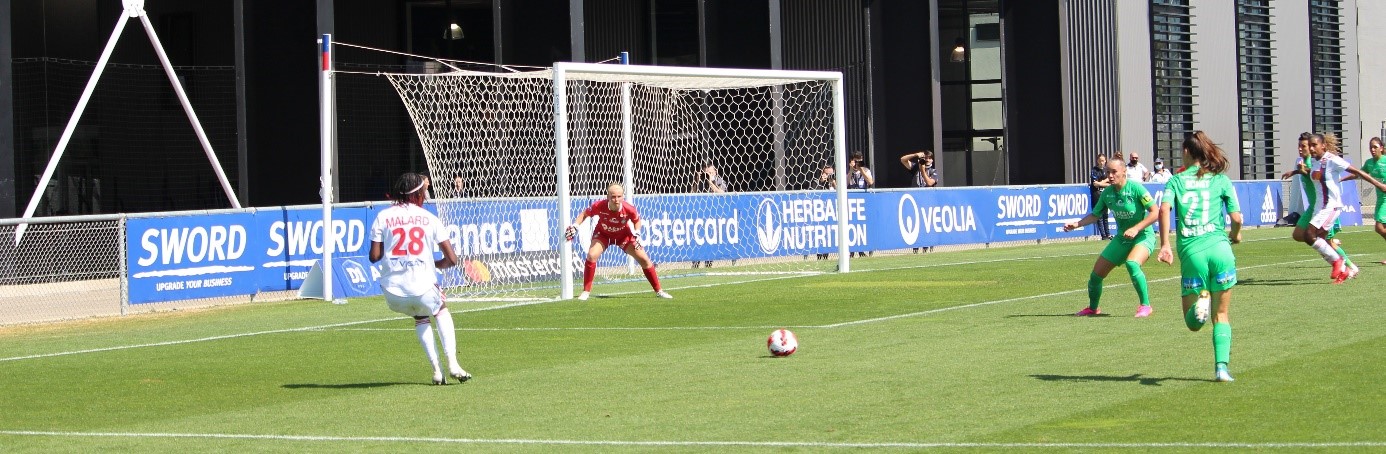
Above: Melvine Malard (28) crosses into the box. Photo: Jean-Pierre Thiesset, exclusively for Impetus.
Paris Saint Germain won 1-0 away from home against Montpellier. PSG’s sole strike came from Sara Dabritz after eight minutes from the penalty spot. It was difficult for the visitors on a pitch which didn’t helping the players to produce good quality football. PSG dominated the game with 70% of possession and they had more opportunities (15 shots, 4 on target) than Montpellier (4 shots, 2 on target). Montpellier tried hard to impose their game on the Parisians but were only just able to prevent PSG adding to their tally with their 5-4-1 formation.
Fleury lost at home against Paris FC 1-0. The goal for Paris FC came Coumba Sow after 43 minutes. An even game could have ended 1-0 for Fleury or a draw; there were only four shots on target for each team.
Dijon won away home against Issy 2-0. Goals for Dijon came from Léa Declercq (20) and Desire Oparanozie (49). This is Issy’s second straight defeat.
Bordeaux at home won 6-0 against Soyaux. Bordeaux’s strikes came courtesy of Sisca Folkertsma (2), Malia Nicole Berkely (29), Andréa Lardez (36), Mélissa Gomes (43), Mickaella Cardia (79), and Katja Snoeijs (81). After a draw at Saint-Etienne last week, Bordeaux reacted strongly and never gave Soyaux a chance to win this game.
Reims, at home, was not able to do better than a draw 0-0 against Guingamp. Grace Rapp of Reims had a red card at the sixtieth minute, leaving her teammates at 10 players for 30 minutes did not help them. However, they were able to keep their goal clean.
Olympique Lyonnais their derby at home against newly promoted Saint-Etienne 6-0. Goals for Lyon came from Catarina Macario (18), Amel Majri (28), Melvine Malard (42), Emelyne Laurent (53), Damaris Egurrola (56), and Selma Bacha (84). Lyon were dominant throughout with 68% of possession, 24 shots (17 on target), 10 corner kicks compared to Saint-Etienne’s two shots (one on target), and a single corner kick.
Above: Amel Majri (7) scoring Lyon’s second goal. Photo: Jean-Pierre Thiesset, exclusively for Impetus.
After their difficult win at Levante, Lyon made a better job against, it must be said, a much weaker team, especially in defence. We saw several good build ups by Lyon, like with the goal on the 28th minute when Malard on an attack down the left, crosses back to Majri which shots on the right on the goalkeeper.
Darrell Allen brings us his weekly round-up of the best action from two of the tier five leagues as tables start to take shape.
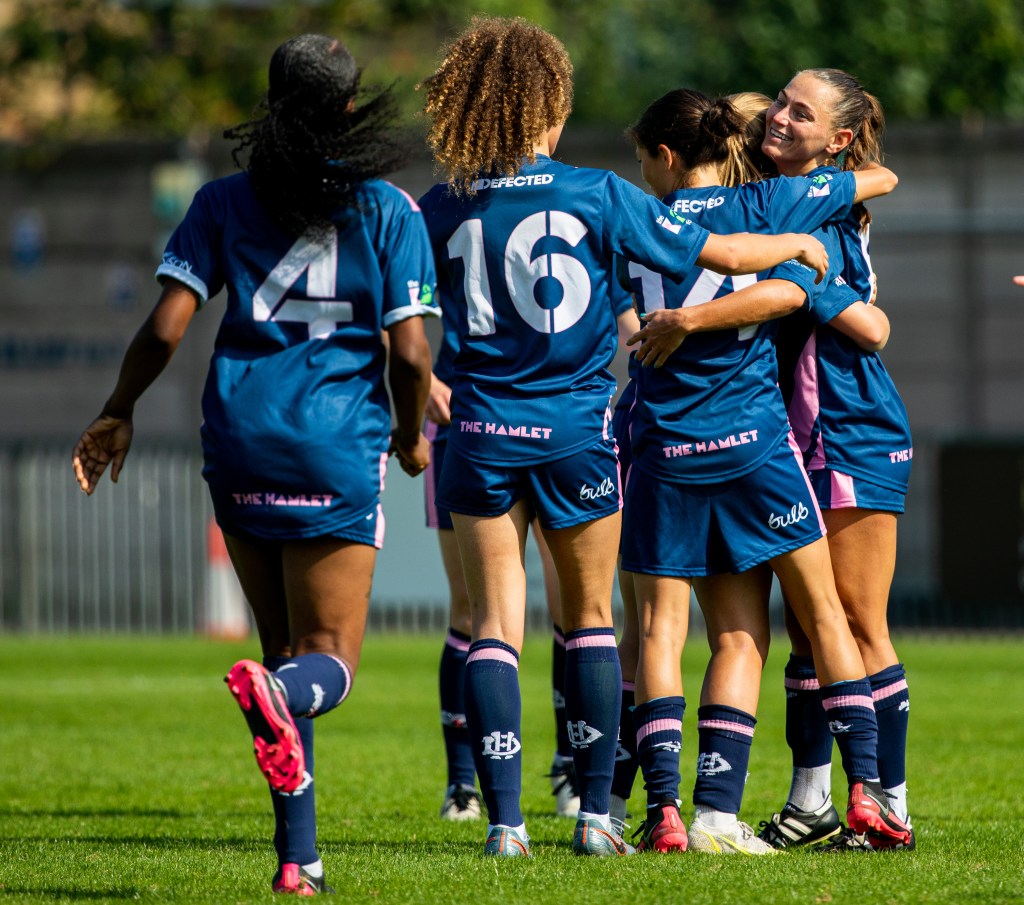
Above: Joy for Dulwich Hamlet as they open their LSE Premier campaign with a 6-0 win in front of another huge home crowd. Photo: Liam Asman.
Another big day in the Eastern Region Women’s Football Premier Division saw the division’s Norfolk clubs making all the headlines on an afternoon that saw 16 goals in the division’s five matches.
Above: Chelsea Clarke (right) on the ball for leaders Wymondham Town at home to Luton Town yesterday. Photo: Neil Dady.
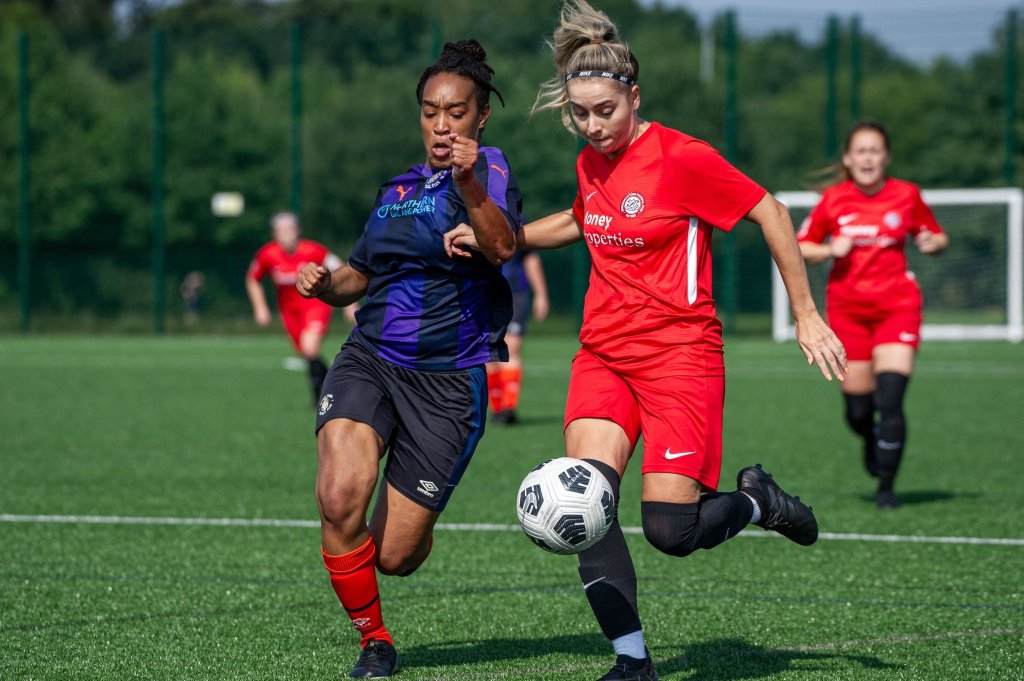
Leaders Wymondham Town maintained their 100% record on their return to their home town to face Luton Town at Ketts Park, after their previous home game took place at the FDC. It was another comfortable afternoon for the hosts with goals from Laura Nicholls, Hannah Waters and Francesca Catchpole securing a 3-0 win. Chelsea Clarke claimed Town’s player of the match award in a fantastic performance where she contributed to two of the goals with assists.
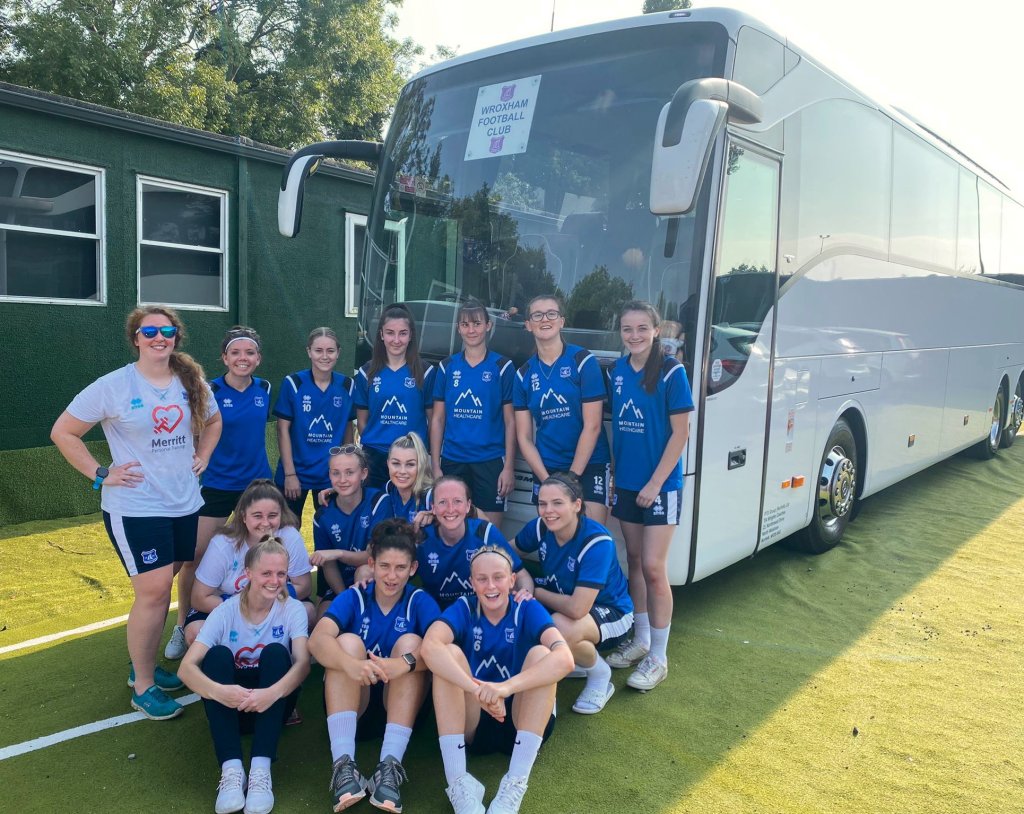
Impetus partner club Wroxham secured a magnificent 3-1 victory on the road at Bedford. The strength and depth of the Yachtswomen came to the fore with three of the club’s new summer signings all scoring. Holly Walker scored opener after six 6 minutes before Bedford equalised at the mid point of the first half period. The unbeaten visitors were awarded a penalty before the break but couldn’t convert. The second half saw Wroxham’s quality shine through with new signings Amber Cantwell and Alice Parker scoring the goals to claim a very impressive away win and the 100% record continues for The Yachtswomen. A big statement from Rebecca Burton’s team with the additions that strengthened the squad in the summer being critical to the victory at Bedford. Amber Cantwell also put in a stunning performance to claim the club’s player of the match award.
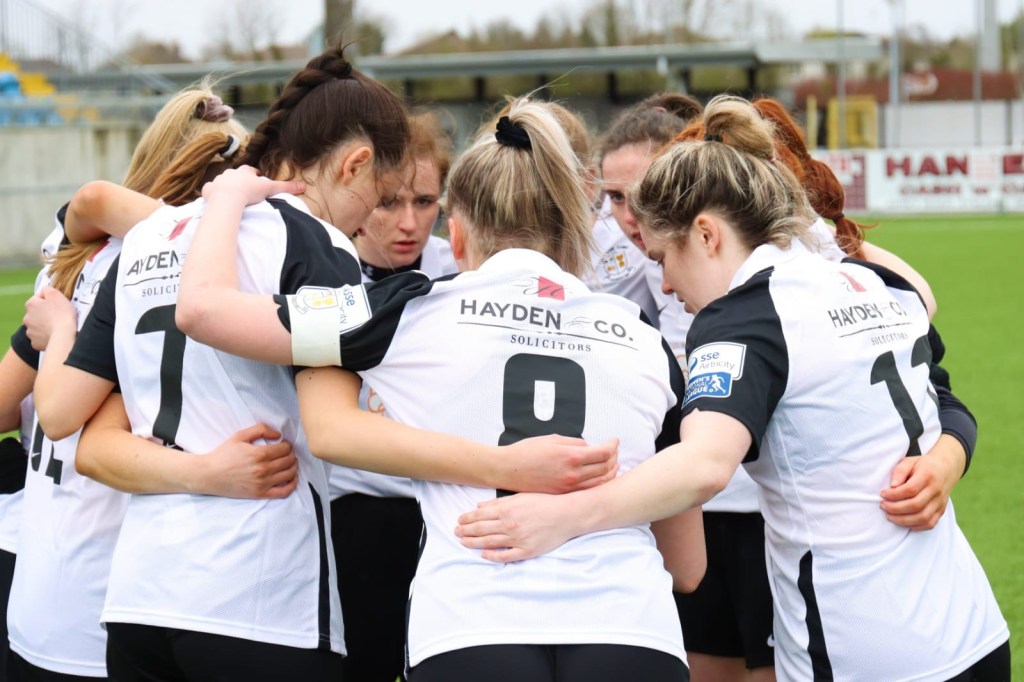
Above: Wroxham gather together after another important victory yesterday at Bedford Town. Photo: @WroxhamWomen
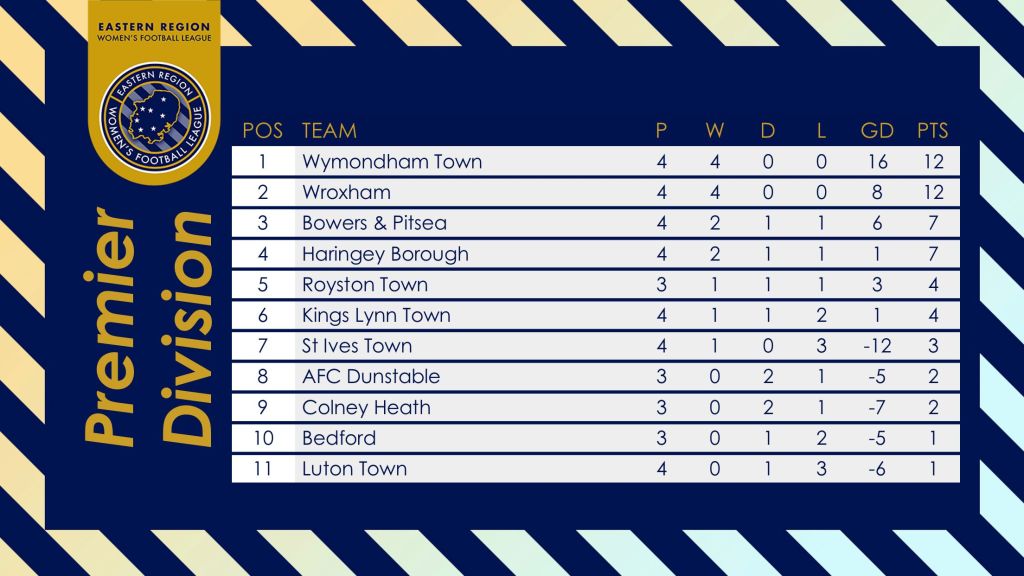
Both Wroxham and Wymondham have started the season with four wins out of four. The two giants of Norfolk Football are set to meet at Trafford Park on Wednesday 6th October 2021, Kick off at 7.45pm. One not to be missed for any readers in Norfolk and beyond.
The good news kept rolling in for Norfolk Football yesterday with Kings Lynn Town hosting another fixture at The Walks and this time recording their first win as a tier five women’s club beating St. Ives Town 5-0. Tiffany Forshaw with a brace and further goals were added by Amy Magnus, Oksana Imanalijeva and Ella Gavaghan, Manager Joe Simpson was delighted with the victory and praised the girls on getting the victory that performances across the season have deserved so far. A massive three points for the Linnets on a historic day for the club.
Elsewhere, Bowers & Pitsea continued their good start to the season moving up to third with a 2-0 win over RoystonTown thanks to goals from Talisa Bruton and Holly Moore.
In the day’s final game, the heroic Haringey Borough undertook their away fixture at AFC Dunstable with just ten players. Kylie Manktelow giving the visitors the lead, which they held until the 80th minute before AFC Dunstable got the equaliser. It was an incredible performance from Haringey Borough and one that shows the character and togetherness of their squad.
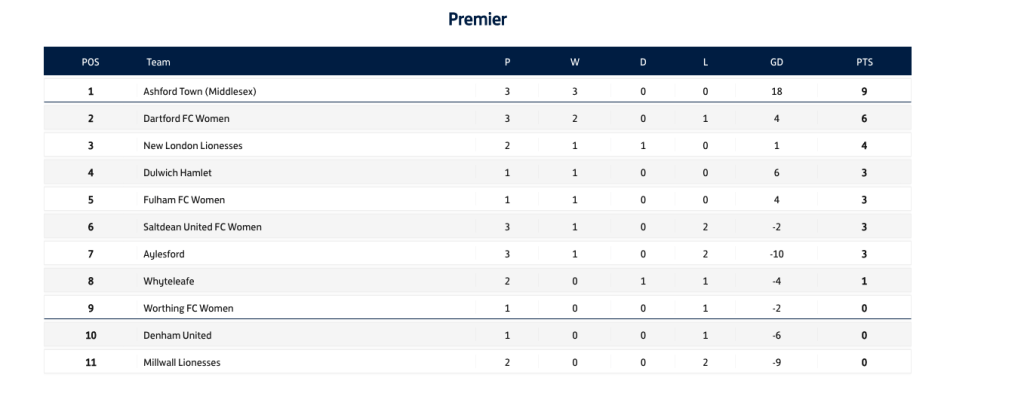
Table From: Eastern Region Women’s Football League.
London & South-East Premier:
It was also a bumper day of action in the London & South East Premier Division with four games producing an amazing 21 goals.
Above: Niamh Anderson (left) on the charge for Saltdean United at home to Ashford Town (Middx) Photo: @nonleaguesnappa
In the day’s headline game between two teams favoured to be among the promotion chasers, Impetus sponsored players Paige Walder of Saltdean United and Ashley Cheatley of Ashford Town (Middx) went head to head. In a incredible first half that saw six goals, Ashford led 4-2 at the break thanks to goals from Ashley Cheatley, Alissa Down, Jade Johnson and Kalani Peart with Georgia Bridges scoring a first half brace for the hosts. It was a calmer second half but there was still time for Ashley Cheatley to add her second which brings her tally for the season to an hugely impressive six goals in three matches. It was a stunning game and performance from Ashford that saw them maintain their place at the top of the league.
In the day’s other games, it was a fantastic afternoon for Dulwich Hamlet beating Denham United 6-0 in front of a traditionally big Champion Hill crowd of 284. Sophie Manzi grabbed an incredible four goals with Brit Saylor and Asia Harbour Brown adding the others.
Above: Plenty to celebrate for Dulwich Hamlet yesterday. Photo: Liam Asman.
There was also a cracking game at Victory Academy that saw Aylesford beat MillwallLionesses 3-2. The home side’s goals came from Charlotte Cresswell, Gemma Cumby and Milly Penfold with Mya Graham and substitute Ellie Hinkleyon the scoresheet for Millwall.
In the day’s final game, newly promoted New London Lionesses beat Dartford 2-1. Amy Green with the goal for Dartford but it was not enough to see a return of any points with New London Lionesses running out winners by the odd goal.
I would like to also say thank you for the positive reaction to those who have contacted me to say they enjoyed last week’s round up and thank you the clubs and players who have contacted me to provide information.
The round up will once again return next week and I will also be on the road on Sunday for my latest in “A Day Out At” series as I take in a game in the Eastern Region Women’s Football League, details will be revealed on Impetus’ social media later in the week.
Jon Foster is one of the lead presenters of Manchester United Women’s YouTube show ‘All For United Women’. He writes exclusively for Impetus about his experience of the first game back at Leigh Sports Village for fans since the pandemic.
Above: Members of United’s ‘Barmy Army’ fan group pre game. Photo: @ManUtdWomen
Scrolling back through your photo gallery, checking your twitter notifications and drinking plenty of hot liquids to help soothe the throats of many United supporters would have been top of the agenda Saturday morning. Friday 3rd September was a landmark evening for Women’s football in England.
Sky Sports aired their first game of the season parallel to fans returning to the Leigh Sports Village (LSV) to watch their team play there for the first time in eighteen months.
Above: Players and fans united as one at the Leigh Sports Village on Friday night. Photo: @ManUtdWomen
So what were the standout moments throughout the match day for fans who attended and for the armchair supporters?
Over 50 fans met with friends and family at the Whistling Wren pub located next to the stadium to have a pre game meal, whilst some fans chose to get photos of players getting off their coaches on arrival. Meanwhile, on Sky Sports, former head coach of Manchester United’s women’s team, Casey Stoney, was giving her opinion on the very first WSL programme to hit Sky this season.
Anticipation began increasing, fans had their digital tickets at the ready as they entered the stadium and the songs soon began. New chants were being trialled and tested to support those players who had signed during the fans absence and they went down a treat. Players acknowledged their personalised songs by waving, clapping and laughing in the warm up.
Above: There was plenty for the United players and fans to celebrate on Friday night. Photo: @ManUtdWomen
Marc Skinner, known to the fans by his energy and excitement, also couldn’t hold back from reacting to the songs that were aimed at him. His massive smile and his positive analogies are currently winning over the majority of the fan base before a ball had even been kicked, the Skinner chants got louder and louder throughout the game.
On exit, fans didn’t want to leave. Songs were just as loud, if not louder once the game had ended. Unable to hear the interviewer ask her questions, new full back Hannah Blundell had to give up trying to hear in her interview, whilst player of the match Kirsty Hanson kept breaking into smiles not able to hold back her own excitement of being drowned out by the United crowd.
The day was a step forward for women’s football both on and off the field. Sky’s tactical analysis by experts and former players was able to educated and engage both new and old fans. The return of fans who many described the atmosphere to be, “electric” has set the bench mark for other clubs throughout the rest of the season.
With UEFA Women’s Champions League action in midweek and important domestic league games last weekend, there has been a lot going on in Swedish women’s football. @DandalBs updates us.
Above: Filippa Angeldahl grabbed two goals in her final appearance for BK Häcken before moving to Manchester City. Photo: BK Häcken.
UEFA WOMEN’S CHAMPIONS LEAGUE NEWS:
Rosengård‘s second qualifying round first leg tie at home to TSG 1899 Hoffenheim ended in disappointment after a 3-0 loss. Belgian international Tine de Caigny opened the scoring for the German side just before the half hour mark. Laura Weinroither grabbed a second with 20 minutes to go and Chantel Hagel made it 3-0 in stoppage time.
There was better news for BK Häcken who returned from Oslo with a 3-1 win over Vålerenga. Filippa Angeldahl scored twice on her final appearance for the club ahead of her move to Manchester City and Stina Blackstenius made it 3-0 after 64 minutes. Rikke Madsen gave the Norwegians some hope for the second leg with a goal eight minutes from time.
DAMALLSVENSKAN:
Djurgården, in their first game under their new coach Magnus Pålsson, earned a vital 1-0 win over Växjö thanks to a goal from Julia Walentowicz after just ten minutes to the delight of the crowd of 541.
Above: Julia Walentowicz, scorer of Djurgården’s winner over Växjö. Photo: Djurgården IF.
BK Häcken gained a thumping 5-1 win over Hammarby. Hammarby took an early lead through Hanna Lundkvist after just three minutes. However, goals from Dilya Yr Zomers, Mille Gejl Jensen (2), and Filipa Curmark (2) saw the home side clinch the points in front of 895 fans. The margin of victory emphasises the gap between really is a big difference Häcken and Rosengård at the top and the rest of the league as Hammarby are one of the candidates battling it out to finish third.
EskilstunaUnited earned a 3-0 win over struggling Piteå. Mia Jalkerud, Paulina Nyström, Felicia Rogic Summer signing Jalkerud looks like exactly what Eskilstuna needed when they battled replace all the players that they lost in the transfer window. She scores, assists, and links up well with others. The vast majority of the 897 fans went home happy.
KIF Örebro ended their seven match run without a win after they earned a 2-1 win over visitors Linköping. Amanda Rantanen put the hosts ahead just after half-time before Emma Lennartsson levelled. Jessie Scarpa came on as a late sub for Örebro after 84 minutes and scored the winner two minutes into stoppage time which sent the 365 fans into raptures.
Above: KIF Örebro celebrate their dramatic late winner over Linköping Photo: Örebro Tribune.
Vittsjö suffered a 4-0 defeat at home to leaders Rosengård. Ria Öling, two from Sanne Troelsgaard and Minnie Larsson scored the goals in front of 325.
AIK and Kristianstad played their Round Fourteen fixture a fortnight ago (see Swedish Scene from two weeks back) for details. It ended 1-1.
Table From: Svensk Fotboll.
Round Fifteen Fixtures:
Vittsjö v Eskilstuna United
Rosengård v AIK
Växjö v KIF Örebro
Piteå v BK Häcken
Kristianstads v Hammarby
Linköping v Djurgården
ELITETTAN
Above: Klara Andrup – on the scoresheet for IF Brommapojkarna as they moved up to third. Photo: HIF
Umeå IK got back to winning ways at the top of the table in some style with a 7-2 thrashing of fourth placed IFK Kalmar on the road. Sarah Mellouk (2), Monica Jusu Bah (2), Lisa Bjork, Henna Riikka Honkanen and Alexandra Sandstrom were on target. Minnie Asperot got both of Kalmar’s efforts. Second placed IK Uppsala also earned a big win away from home with a 5-0 win at Borgeby FB. Marika Lundin, Moa Ohman, Angelina Thoreson, Ellen Toivio and Hanna Persson were on target. IF Brommapojkarna went third after a 2-1 win at Bollstanäs SK. Emma Lund gave the home side an early lead before two goals from Klara Andrup within six minutes of each other in the last quarter sealed Bromma’s win. Morön BK are fifth, but could have taken advantage of IFK Kalmar’s thrashing if they had gained more than just a point against mid table Mallbackens IF Sunne. They took the lead through Irvina Bajramovic but Hildah Magala’s strike three minutes from the end earned Mallbackens a draw.
Latest Results: IFK Kalmar 2-7 Umeå IK, IFK Norrköping 1-1 Älvsjö AIK FF, Lidköpings FK 1-1 Sundsvalls DFF, Borgeby FB 0-5 IK Uppsala, Bollstanäs SK 1-2 IF Brommapojkarna, Morön BK 1-1 Mallbackens IF Sunne, Alingsås FC United 0-1 Jitex Mölndal.
Next Fixtures: IK Uppsala v Alingsås FC United, Mallbackens IF Sunne v IFK Norrköping, Sundsvalls DFF v Bollstanäs SK, Älvsjö AIK FF v IFK Kalmar, Jitex Mölndal v Morön BK, Umeå IK v Lidköpings FK, IF Brommapojkarna v Borgeby FB.
Table From: Svensk Fotboll.
NEWS ROUND-UP:
Swedish international Kosovare Asllani confirmed on her Instagram page she has tested positive for COVID-19 and missed the first leg of Real Madrid’s UWCL tie on Tuesday against former club Manchester City.
Nilla Fischer, Sweden’s 37 year-old veteran defender, says she wants to play with the national team again. She didn’t go to the Olympics after getting an addition to the family this summer, but would, if selected, love to play the Euros in England next year.
Rosengård‘s Scottish international Fiona Brown suffered a left knee ACL injury in training last Wednesday. This is the second similar injury in a few weeks following new Danish signing Frederikke Thøgersen suffering one in the friendly against Linköping a few weeks ago.
Above: Fiona Brown, Rosengard’s Scottish star who has ruptured her ACL. Photo: Wikipedia.
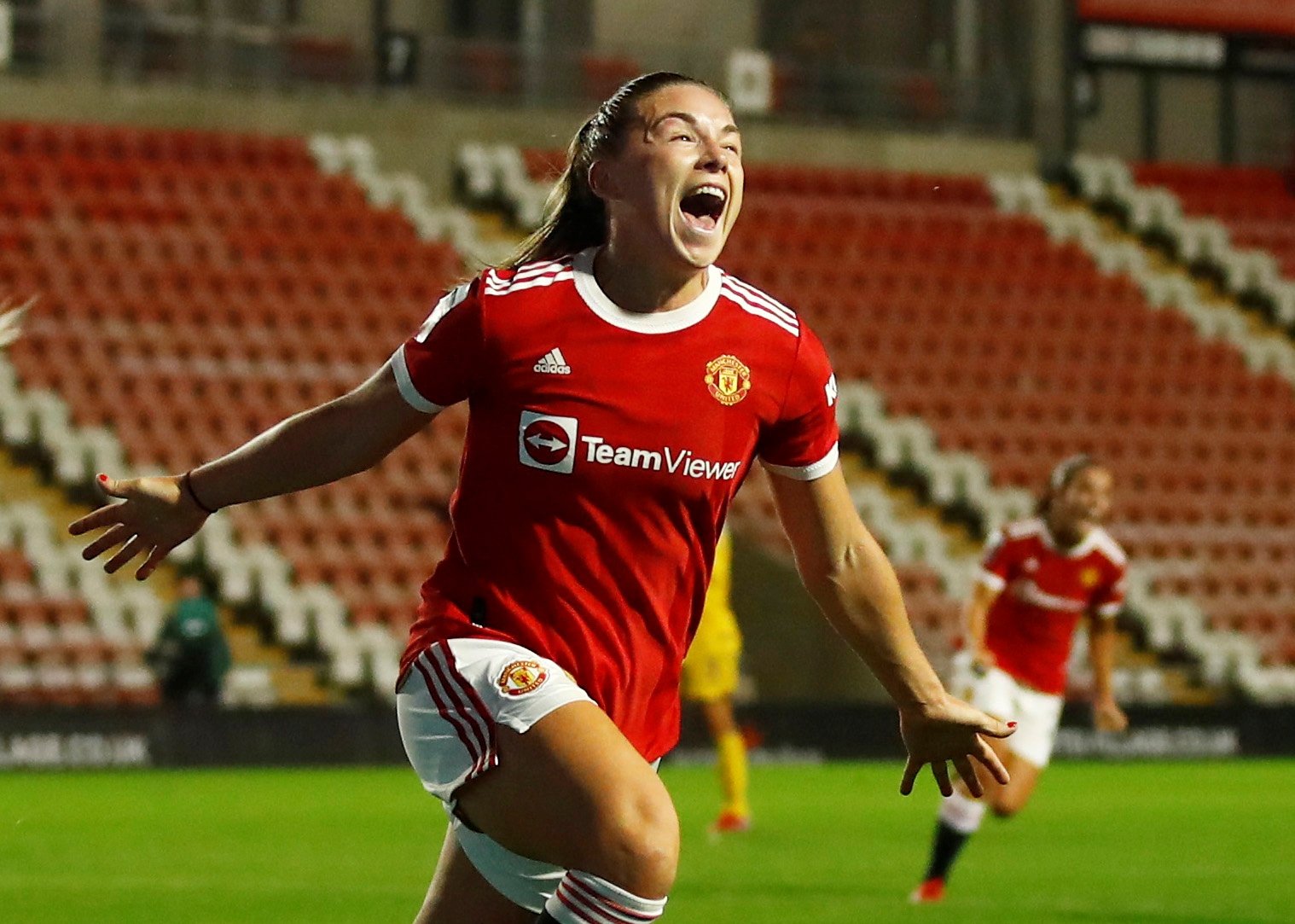
Above: Ona Batlle celebrates after scoring Manchester United’s second. Photo: Reuters.
The opening match of any season is always a big affair. This year’s first FAWSL clash even more so. With the beginning of the Sky Sports era, the first women’s domestic match on the broadcaster was always going to be a hugely important game.
Manchester United was hosting Reading Football club at their home stadium, the Leigh Sports Village. Known for its atmosphere since United reformed as a club in 2018, the first match with fans back in 18 months promised to be a vibrant evening.
The game marked the beginning of a new era for the Red Devils. After the departure of their first head coach Casey Stoney at the end of last season, it was now Marc Skinner’s turn to put his stamp on the team. Coming off a season where they finished fourth, just one point behind a Champions League qualification spot, and where they lost a number of talented players, the Manchester United fans are hoping this year will continue to be one where the team remains competitive at the top of FAWSL.
Reading for their part are also starting a new era, one which does not include newly-retired Fara Williams. With some turnover in the offseason, the Royals arguably recruited well to replace players who had departed. Having a smaller budget than some of their bigger FAWSL competitors, continuing their style of tenacious play which has kept them as mid-table contenders for a few seasons is a realistic target.
Manchester United’s first clash against Reading was always going to be a good first test for both teams. The Royals have always been known for their ability to pull off surprising wins despite their mid table status over the last few campaigns. One of these surprises last season was their beating of United at home by a margin of 2-0, the only team to achieve this in the 2020-21 FAWSL season.
In his starting line-up, Marc Skinner chose to give United career starts to three new signings, Aoife Mannion, Hannah Blundell and Vilde Bøe Risa. Kelly Chambers did the same with Reading’s Gemma Evans, Faye Bryson and Chloe Peplow.
Despite being the away team, Reading came out hard, initially controlling possession and dictating the play. After the Royals’ Brooke Chaplan took a shot from distance which sailed over the crossbar in the fifth minute, United started to enter the match. The Red Devils did well to contain Reading, limiting their movement largely to their own half and progressively started to take control of possession.
Manchester United’s first real attempt on goal occurred in the 22nd minute of play. A shot into the box by Lucy Staniforth was not dealt with by Reading goalkeeper Grace Moloney, who was under pressure. The deflection found Leah Galton whose half-volley was too high and partially intercepted by Faye Bryson.
The intensity in the match only seemed to pick up after this with United gaining more confidence. New acquisition Vilde Bøe Risa and Hannah Blundell both showed their qualities, each with a number of sequences that demonstrated to the United supporters why they were signed by the club.
However, it was United original players that broke the deadlock. Receiving the ball midway through her half, Ella Toone supplied a magnificent through ball pass to Kirsty Hanson who found the back of the net in the 39th minute.
United came out in the second half with much more intensity and focus than the first. The first scare of the half though was curtesy of Reading. Lily Woodham supplied a great cross into United’s box who badly cleared it. It found the feet of Brooke Chaplen who took a rocket shot on goal. Her strike hit the crossbar and in the replay seemed to bounce inside the goal before deflecting out. No goal was given.
Three minutes later it was United on the attack. A great give and go started with Ona Batlle passing to Ella Toone just inside the box. She then passed it back to Batlle whose shot found the top corner of Reading’s net. The Red Devils found themselves with a two goal lead.
Two goals were not enough though for United. Now having fully found their confidence as a squad, they largely dominated the last third of the match with continued pressure on Reading’s defence.
The Royals did have a short spell of dangerous crosses, shortly after the introduction of Gae-ul Jeon, but the combination of good Mancunian defence and a lack of point person in front of goal resulted in no real threats. As the game continued they seemed to fade. In the end it was to be United’s day.
While Reading started well, ultimately it was great strikes from United, a number of defensive errors from the Royals and a lack of a target striker to threaten the goal that precipitated the visitors downfall.
The addition of Natasha Dowie, not available for this match, should hopefully help with Reading’s future threat. However, as a team they will find more offensive strides and create clearer chances going forward to remain competitive. Not fading as the match progresses will also be essential, something they fell victim to this game.
For United’s part, despite a slow start into the game, once they found their stride they were able to control the match and create a number of threatening offensive plays. Those who were worried about the form of the team after the off-season changes will be somewhat relieved by the form shown in the match.
While Reading have shocked United in the past, they were not going to repeat this on the season’s opening night.
It’s been a busy few days of announcements in Australia as the APL announce expansion for the W-League, and a joint men’s and women’s clubs championship table. If that’s not enough, the Matildas have just confirmed their first post-Olympics friendly and there’s yet more W-League signing news.
Just eight months after the APL confirmed their control of the A-League and W-League, and as part of a strategic expansion plan, APL have announced the planned addition of three teams – Wellington Phoenix, Central Coast Mariners and Western United FC – to the competition ahead of the FIFA Women’s World Cup in 2023.
The timetable for expansion will be finalised and announced in the coming weeks and will mean the W-League will provide more games and more opportunities for the nations’ elite female footballers, with the addition of the first new women’s teams since Melbourne City FC joined in 2015.
The W-League Finals Series will be expanded with the addition of a Preliminary Final – rewarding the teams that finish first and second on the league table with an extra chance to reach the Grand Final, as well as giving fans more drama-filled finals football.
A brand new ‘Club Championship’ has also been launched by APL – meaning that the club (not the team) with the most combined points at the end of the men’s and women’s seasons wins the Club Championship. The new trophy is designed to bring together fans of the men’s and women’s games, and ally the club teams in partnership.
Meanwhile, a long-term collective bargaining agreement is being finalised by APL and Professional Footballers Australia (PFA) to drive up standards across the game and provide for an immediate and significant investment by the clubs in their players.
Above: Last season’s W-League champions Melbourne Victory. Photo: Jenny Evans/Getty Images.
Danny Townsend, MD of APL, said: “This is just the beginning of a sustained investment programme in women’s football – we announced unbundling just eight months ago, and are already bringing more games, more players, better broadcast, improved employment conditions and enhanced footballing pathways.
“We want to unleash football’s potential in Australia and this is a significant step forward in delivering the future that the game deserves.”
Kate Gill, Co-CEO of PFA was delighted about the changes: “The expansion of the competition is an important step forward and illustrates the confidence in the women’s game and the solid foundations that have been built.
“The players have been vocal advocates for the growth of the competition and positively APL’s women’s football strategy will not only provide additional employment opportunities and match minutes for our talented players but delivers a healthy boost to the W-League in the lead up to the FIFA Women’s World Cup 2023.”
Sarah Walsh, Head of Women’s Football, Football Australia, saw wider benefits as a result of the news: “Women and girls now have more choice than ever when it comes to selecting a sport to play in Australia. It’s imperative that Football continues to progress and evolve when it comes to providing greater access and opportunity for women and girls in football.
“With the W-League entering its 14th season and a commitment to broader expansion of the league, I am confident that we are taking the right steps forward as a game to ensure that football is the number one sport of choice for women and girls as we strive for 50:50 gender balance by 2027.”
“Football has always provided women in football with a clear and accessible pathway to play for the Commonwealth Bank Matildas and junior women’s national teams. W-League expansion not only broadens these existing pathway opportunities, it additionally strengthens our national team aspirations for the FIFA Women’s World Cup Australia and New Zealand 2023™ and beyond.”
Matildas Back In Action:
Above: Back together – The Matildas. Photo: Getty Images.
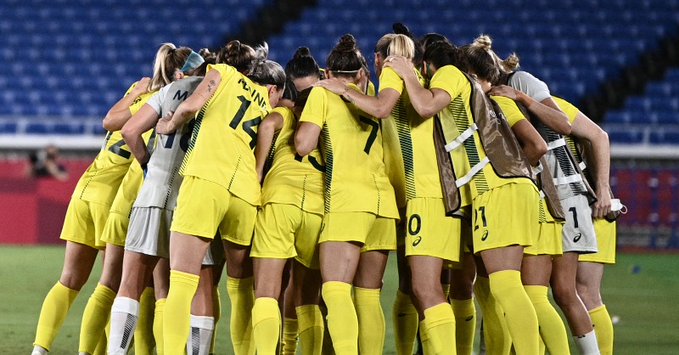
Australia will face the Republic of Ireland at Tallaght Stadium as they return to action following a history making campaign in Tokyo.
Set down for 22 September 2021, with a 7pm kick off in Dublin, the international friendly will be the first meeting between the two nations in a women’s international fixture.
Head Coach Tony Gustavsson conveyed his eagerness to re-unite the team following the conclusion of the Games.
“Like the rest of the country, I was proud of the way the team represented the nation in Japan,” said Gustavsson.
“The level of motivation and commitment displayed by the players over the campaign really excites me for what lies ahead, as we work towards the FIFA Women’s World Cup Australia and New Zealand 2023TM.
Above: Dublin’s Tallaght Stadium, venue for the Matildas’ clash with the Republic of Ireland. Photo: Shamrock Rovers.
“Every time we play an international match, it is an opportunity for this team to reinforce our foundations and truly become one day better. We made a lot of positive strides in our last assembly, and I can’t wait to come together once again.
“The last couple of years have demonstrated the impressive growth of women’s football internationally and that every nation presents a different challenge that we can learn from. It’s vital that we continue to focus on our own progression as a team and every match is key to that mission.”
The Republic of Ireland will be Australia’s 12th international match this year, with opponents spanning four different FIFA confederations.
With a roster of high quality nations already secured for home matches, Football Australia is continuing detailed discussions with Federal and State Governments to complete the remainder of the Commonwealth Bank Matildas 2021 international fixtures on home soil for the first time in 18 months.
Melbourne City Announce Pollicina and Davidson:
Artwork supplied by: Melbourne City
Rhianna Pollicina has signed for Melbourne City ahead of the upcoming W-League season.
A former Young Matilda, Pollicina has made 16 W-League appearances. She played all but one game for the Newcastle Jets last season and scored twice on her way to being named the club’s Player of the Year.
The playmaking midfielder will add experience in the middle of the park and can also provide an attacking threat in the front third, adept at getting in behind defenders.
Speaking about his new signing, head Coach Rado Vidosic said: “We’re looking forward to welcoming Rhianna to the Club this season.
“She’s a competitive midfielder and strong with both feet. I expect her to fit well into our playing style and play an important role for us.”
Rhianna Pollicina was hugely excited about the move: “I’ve heard great things about City and how professional the environment is at the Club. It’s something that I’m really excited to be a part of.
“I’m looking forward to getting over to Melbourne and meeting all the girls. Hopefully I can score a few goals and excite the fans this season.”
Artwork supplied by: Melbourne City
The Sky Blues have also announced that they have re-signed Leah Davidson until the end of the 2022/23 season.
Davidson made the move from Brisbane Roar in 2020 and didn’t take long to make her mark in Melbourne.
The hard-working midfielder played all but four minutes of City’s 2020/21 season, and was one of the club’s most important players, showing great instincts and positioning throughout the campaign.
With 12 clearances and 16 interceptions – along with nine key passes – Davidson consistently made her presence felt all over the pitch.
Having made a strong impression on the coaching staff during her first season in City blue, she claimed the Coaches Award at the 2020/21 Player of the Year Awards.
The 20-year-old has amassed 23 W-League appearances already and having signed on for the next two seasons, City fans will no doubt be excited to see Davidson continue to develop and help the team move back up the W-League ladder.
Head Coach Rado Vidosic was pleased with Leah’s re-signing: “We’re very happy to have Leah return to the Club and sign on for the next two seasons.
“She had a strong first season with us and I’m looking forward to watching her continue to improve and refine her game.
“Leah will again be an important player for us this season and no doubt will be motivated to take her game to the next level.”
Leah Davidson revealed that she had no hesitation in signing again: “I don’t really see myself playing anywhere else and I can’t wait to play in front of our fans again.
“I loved my time at Melbourne City last season, so it was quite an easy decision to return and I’m just so excited to be a part of such an amazing Club for another two years.
“We’ll be striving for a better result than last season. I think that having that core group back means we will jell more on the pitch and I think that will reflect in our results.”
Hughes Extends Stay With Canberra United:
Above: Laura Hughes in action for Canberra United against Perth Glory in last season’s W-League. Photo: Canberra Times.
Canberra United announced the re-signing of Laura Hughes for the upcoming W-League season.
The fan favourite has committed to her fifth season in green, and is the third player to be announced for Canberra United.
In 2016, 15-year-old Hughes began her W-League career with Canberra, going on to be named the club’s University of Canberra Rising Star the following season.
After playing with Thróttur Reykjavík FC in Iceland during the W-League off season in 2020, Hughes returned to Australia’s capital with fire in her belly and more experience under her belt.
The midfielder made a huge opening statement in the first match of the 2020/21 season, scoring the match winner in extra time, much to the jubilation of her teammates and fans. From there, she continued her solid form, playing an influential role in every match.
Hughes then became a step closer to realising her dream of representing Australia, selected for a Matildas Talent Identification Camp in May.
“I’m so excited to be returning to Canberra United this season,” Hughes said.
“I love playing for my hometown and more importantly for a club that has nurtured and supported my football career from the start. I cannot wait to get preseason started and kick off the season with a bang!”
Head Coach Vicki Linton said she is “glad to re-sign Laura for another season for Canberra.”
“I look forward to seeing how she builds on that this season and will enjoy having the positive energy and exuberance that she brings to the group.”
Wanderers Add Hunt:
Above: Clare Hunt, pictured in her Canberra United days. Photo: Canberra Times.
Western Sydney Wanderers FC have confirmed the signing of defender Clare Hunt for the upcoming W-League season.
Hunt returned to the W-League last season with Canberra United after a two-season lay-off due to injuries.
The 22-year-old had a breakout first two seasons with Canberra prior to that and comes to the Wanderers with a point to prove and stronger than ever.
The defender has 12 W-League matches to her name and will be looking to add on more in her first season at the Red & Black.
Head coach Catherine Cannuli welcomed Hunt to the club: “It is great to have Clare with us. It has been a very difficult couple of years for her career,” said Cannuli.
“It was fantastic to see Clare return to the pitch in the W-League last season and we are so excited to see her don the Red & Black hoops for the upcoming season.”
Hunt said she was ready to immerse herself in a positive and intense training environment at the Wanderers. “I am extremely excited to have my first season at the Western Sydney Wanderers.”
“I was drawn to the Wanderers knowing of the professionalism of the club and the dedication of coaching staff to offer strong support and resources.
“Being at the Wanderers this season will give me an opportunity to pursue work and study, while immersing myself in a positive and intense training environment.
“This season I want to develop as a footballer and take in as much of this experience as I possibly can. For me, this looks like consistency in performance and utilising the endless resources to develop myself and players around me.”
Norrie Returns To Brisbane:
Above: Ayesha Norrie – back in Brisbane. Photo: Brisbane Roar.
Brisbane Roar have made midfielder Ayesha Norrie its ninth confirmed W-League squad member for the 2021/22 campaign.
The Queenslander returns to the Roar for a fifth season in orange, bringing almost 50 games worth of top-flight experience into Garrath McPherson’s side.
“I’m pretty stoked about it,” Norrie said. “It’s my hometown, so it’s good to get back to where it started. With the majority of Matildas away at the moment it’s going to be a different league, but I think that’s a positive thing as well. “For the young ones coming through and myself coming back, it will be a challenge to step up.”
Norrie made her original Roar debut as a 16-year-old in November 2013, playing alongside the likes of Clare Polkinghorne, Katrina Gorry, Tameka Yallop and Kim Carroll. She started for Brisbane in that season’s Grand Final and was also part of the team that won the Premiership in 2017/18.
“When I was younger, playing with those big names was definitely a highlight,” the former Young Matilda said, “It was a daunting time starting so young, but they took me under their wing and prepared me for the W-League.”
With six NPL Queensland goals for Gold Coast United this term, Roar Head Coach Garrath McPherson said Norrie had been a “standout performer” in the local competition.
“It’s wonderful to have Ayesha back in orange for the upcoming W-League season,” McPherson said. “Ayesha is a Queensland NTC graduate whose quality has been recognised by her involvement in junior and youth national team environments.
“She has a winning mentality that will allow her to compete against any opponent she comes up against and has shown all season an ability to score goals from midfield. Ayesha is another example of the pathway to the W-League that our state competition provides and I encourage the community to get along to an NPL Women’s game to see her in action.”
Ben Gilby runs his eye over all of the FAWSL clubs in detail ahead of the new season kicking off tonight and makes some predictions about what might happen.
ARSENAL:
Above: Steph Catley will be like a new signing for the Gunners in 2021-22. Photo: Getty Images
Ground: Meadow Park, Boreham Wood Capacity: 4,500 Head Coach: Jonas Eidevall
Transfers Out: Jill Roord (VfL Wolfsburg, Germany), Leonie Maier (Everton), Ruby Mace (Manchester City), Danielle van de Donk (Olympique Lyonnais, France), Lisa Evans (West Ham United)
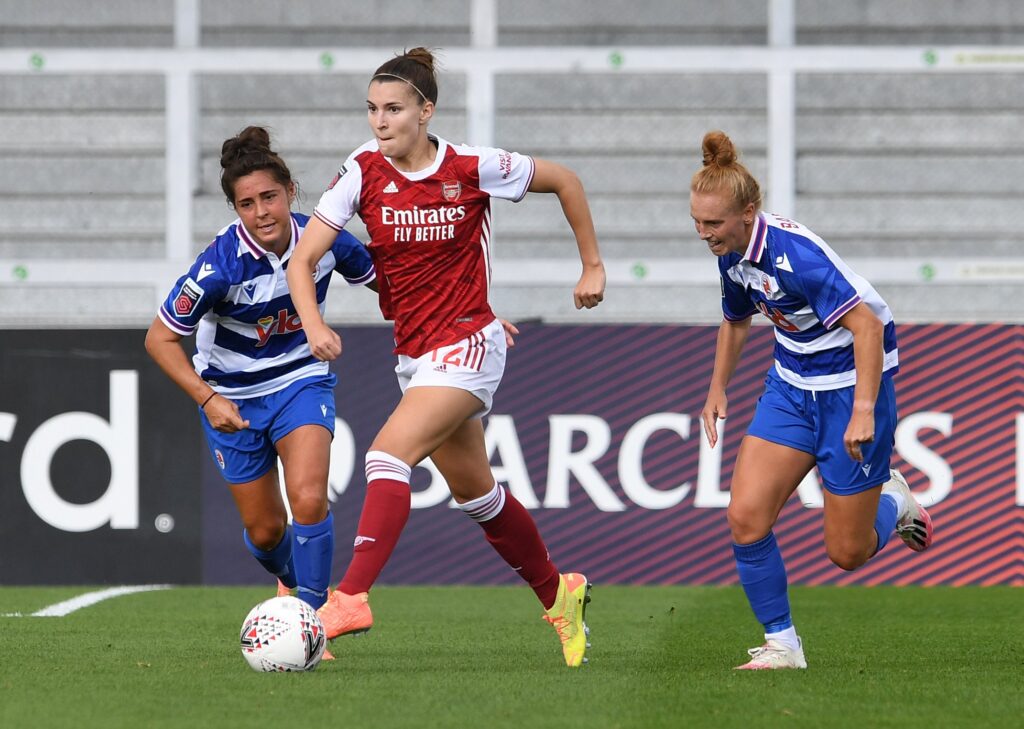
There’s been some quite big changes during the summer at Arsenal, and whilst the arrival of Tobin Heath, Mana Iwabuchi and Nikita Parris are impressive, the North London side will really feel the loss of Dutch pair Jill Roord and Danielle van de Donk. One positive for the Gunners though will be the return of a fully fit Steph Catley; injury has robbed fans in England of seeing the Steph Catley that we all know and love for the Matildas, and she will be effectively another “new” signing for the club.
The concern for Arsenal remains strength in depth: as soon as they start getting two or three injuries, you start to see a number of young teenagers on the bench. For this very reason, it would have been very disappointing to lose talented youngster Ruby Mace to potential title rivals Manchester City. It is this continued lack of depth in the Arsenal side that makes them vulnerable to missing out on Champions League football next season.
Prediction: 4th
ASTON VILLA:
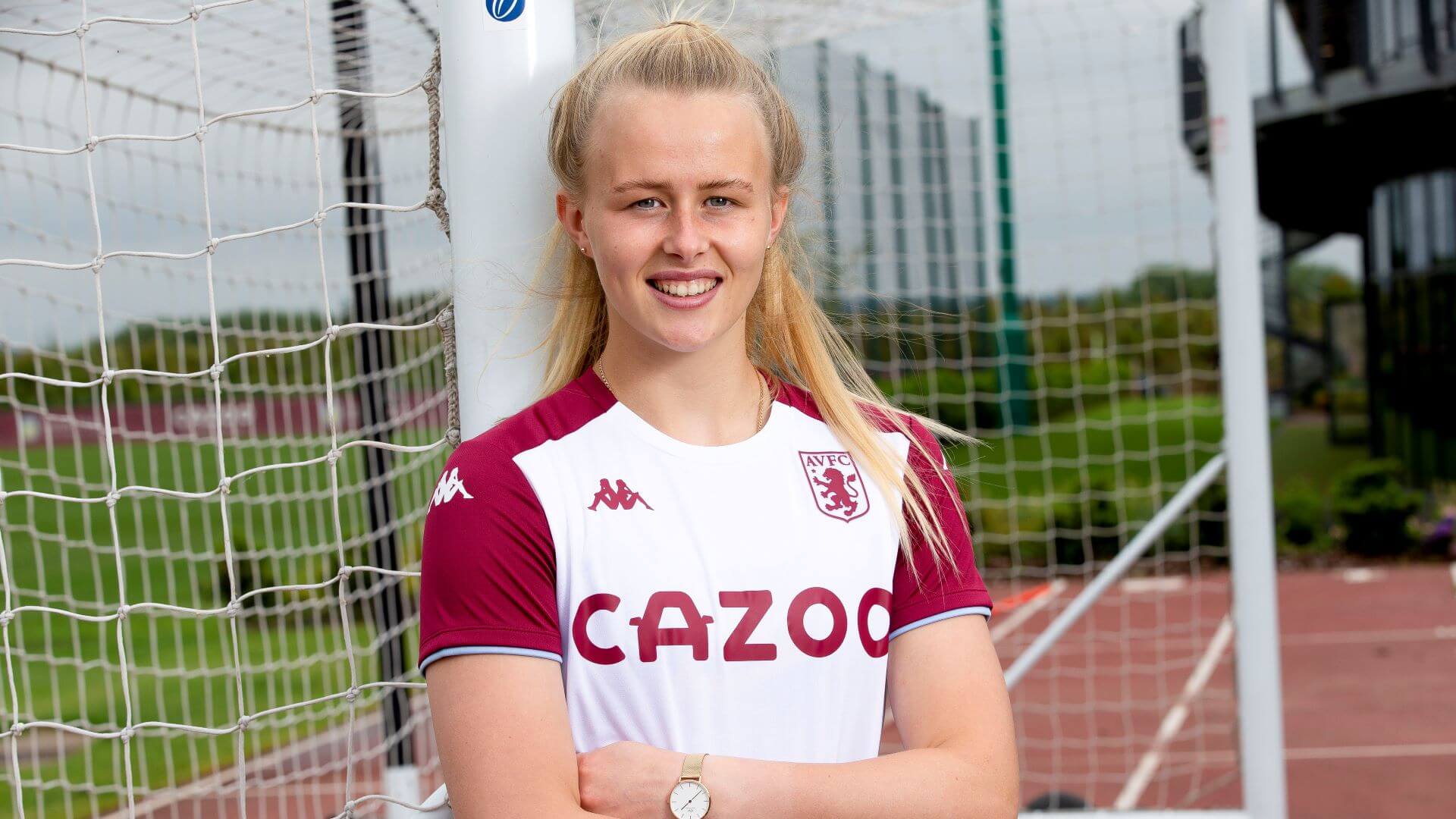
Above: The arrival of Hannah Hampton, one of England’s best young goalkeepers, is a big boost for Aston Villa. Photo: AVFC.
Ground: The Banks’s Stadium, Walsall Capacity: 11,300 Head Coach: Carla Ward
Transfers In: Alisha Lehmann (West Ham United), Remi Allen (Leicester City), Sarah Mayling (Birmingham City), Chantelle Boye-Hlorkah (Everton), Meaghan Sargeant (Bristol City), Hannah Hampton (Birmingham City), Maz Pacheco (West Ham United), Emily Gielnik (Vittsjo), Ruesha Littlejohn.
Transfers Out: Ella Franklin-Fraiture (released), Emma Follis (Charlton Athletic), Amy West (Nottingham Forest), Caroline Siems (Bayer 04 Leverkusen, Germany), Diana Silva (Sporting CP, Portugal), Mana Iwabuchi (Arsenal), Nadine Hanssen (released), Stine Larsen (BK Häcken, Sweden), Asmita Ale (Tottenham Hotspur).
The Villains did well to avoid an instant drop back to the Championship and they have made some solid signings over the summer in addition to the hugely impressive Carla Ward as head coach who crosses England’s second city to take charge. Ward has brought the excellent young keeper Hannah Hampton with her from Birmingham City along with Sarah Mayling. Ward’s fantastic qualities as a coach plus the arrival of the likes of Alisha Lehmann and Chantelle Boye-Hlorkah should mean a more comfortable season than last time round. With Lehmann an excellent creator and Emily Gielnik a great goal getter, things look positive for Villa offensively, but defensively may be another issue.
Prediction: 10th
BIRMINGHAM CITY:
Above: The appointment of Scott Booth as head coach is one of few positives for Birmingham City over the past eight months. Photo: Sky Sports.
Ground: St. Andrews, Birmingham Capacity: 29,409 Head Coach: Scott Booth
Transfers In: Jade Pennock (Sheffield United), Louise Quinn (Fiorentina, Italy), Lucy Quinn (Tottenham Hotspur), Sarah Ewens (Celtic, Scotland), Libby Smith (Leicester City), Cecilie Sandvej (Fleury 91, France), Emily Ramsey (Manchester United – loan), Lisa Robertson (Celtic, Scotland).
Transfers Out: Heidi Logan (Lewes), Hannah Hampton (Aston Villa), Sarah Mayling (Aston Villa), Claudia Walker (West Ham United), Mollie Green (Coventry United), Abbi Grant (Leicester City), Emma Kelly (Sunderland), Sophie Whitehouse (Bristol City).
Birmingham City were a club in crisis last season with players openly criticising their parent men’s club on social media for the appalling lack of facilities and inequality at the Blues. In addition to this, they were playing at Solihull Moors FC, a men’s fifth-tier club ground which seemed to be permanently waterlogged. Put all this together and positives were thin on the ground in England’s second city.
The departure of their hugely respected head coach Carla Ward was another massive blow, although the club have attracted a replacement with an outstanding track record. Scott Booth led Glasgow City to the 2020 UEFA Champions League Quarter-Finals and to six successive Scottish Premier titles, which included four trebles.
A move away from Solihull to the men’s venue of St. Andrews is another positive, but given this is a side who narrowly avoided relegation last season and whose squad has seen many of their better players depart, beating the drop this time round will be a staggering achievement.
Prediction: 12th – relegated
BRIGHTON AND HOVE ALBION:
Above: Danielle Carter’s arrival in Sussex from Reading was the first time that the seaside club have paid a transfer fee for a player in their history. Photo: Brighton Argus.
Ground: The People’s Pension Stadium, Crawley Capacity: 6,134 Head Coach: Hope Powell
Transfers In: Danielle Carter (Reading), Rinsola Babajide (Liverpool – loan), Lee Geum-min (Manchester City)
Last season was hugely successful for the Seasiders with Hope Powell’s side the only FAWSL team to defeat Chelsea. They may have only brought in three players in the summer, but each of them are real quality: the arrival of Danielle Carter from Reading marks the first time in the club’s history that they have paid a transfer fee, while Bringing Rinsola Babajide back to the FAWSL was also an inspired move, adding some potency to the Seagulls attack.
Brighton and Hove Albion have slowly improved since they arrived in the FAWSL and are now rapidly approaching the status of being among a team that should be looking to push into the top half of the table. The only thing which might stop them this time round is the potential quality that West Ham United have added over the summer.
Prediction: 8th
CHELSEA:
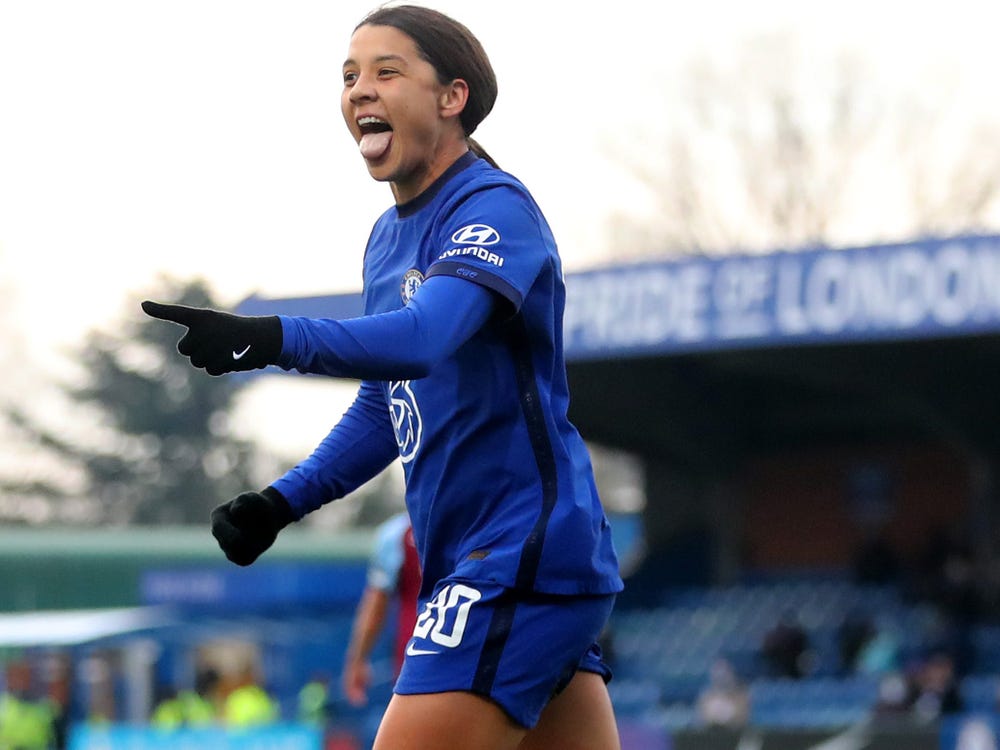
Above: Sam Kerr will be hoping to have plenty more to celebrate at Chelsea this season. Photo: James Chance/Getty Images
Ground: Kingsmeadow Stadium, Kingston-Upon-Thames Capacity: 5,000 Head Coach: Emma Hayes
Transfers Out: Jamie-Lee Napier (London City Lionesses), Hannah Blundell (Manchester United), Emily Murphy (University of North Carolina, USA), Agnes Beever-Jones (Bristol City – loan), Charlotte Wardlaw (Liverpool – loan), Emily Orman (Crystal Palace – loan)
Chelsea were deserved FAWSL champions last season, but the joy of that plus the Continental Cup final demolition of Bristol City was lessened somewhat by the way Barcelona totally dismantled the South-West London based club in the Champions League Final.
The women’s football fraternity and even some of Chelsea’s own fans have long expressed concerns about the team’s lack of depth defensively compared with the huge number of quality players in the goalkeeping, midfield and striking roles. That came back to haunt them against the Catalan side.
It is a real surprise therefore, that Emma Hayes has not moved to significantly address this over the summer as the arrival of Dutch defender Aniek Nouwen from PSV has been offset with the departure of Hannah Blundell to Manchester United.
Chelsea’s defence should be good enough to see off the top FAWSL sides, but when they compete with the best of the best in Europe, they are likely to be found wanting again. With the club becoming increasingly focused on Champions League glory, the inability to add defenders over the summer could well lead to much hand wringing among the hierarchy at Stamford Bridge.
Prediction: Champions
EVERTON:
Above: Hanna Bennison, Everton’s record breaking summer signing, who tops off a stunning summer of business for the Merseyside club. Photo: Everton FC.
Ground: Walton Hall Park, Liverpool Capacity: 2,000 Head Coach: Willie Kirk
Transfers In: Kenza Dali (West Ham United), Toni Duggan (Atletico Madrid, Spain), Anna Anvegård (Rosengård, Sweden), Nathalie Björn (Rosengård, Sweden), Leonie Maier (Arsenal), Courtney Brosnan (West Ham United), Aurora Galli (Juventus, Italy), Cecilía Rán Rúnarsdóttir (KIF Örebro, Sweden), Hanna Bennison (Rosengård, Sweden)
Transfers Out: Ingrid Moe Wold (retired), Chantelle Boye-Hlorkah (Aston Villa), Georgia Brougham (Leicester City), Maeva Clemaron (Tottenham Hotspur), Tinja-Riikka Korpela (Tottenham Hotspur), Molly Pike (Leicester City), Hannah Coan (Blackburn Rovers), Anna Pedersen (London City Lionesses), Abbey-Leigh Stringer (West Ham United), Elise Hughes (Charlton Athletic), Hayley Raso (Manchester City)
Everton have arguably had the best summer transfer window of all FAWSL clubs culminating with the club paying a six-figure transfer fee for the hugely talented Swedish teenager Hanna Bennison.
It is a major statement of intent by Willie Kirk and the Merseyside club. There is no doubt that the departure of Hayley Raso – particularly to one of Everton’s North-West and Champions League qualification rivals – is a big blow for them, yet there is more than enough quality in the team for it to probably not impact their likely finishing position in the FAWSL.
Everton’s opening two games will go a long way to showing everyone just how big a threat they could be, as they host Manchester City at the club’s traditional home Goodison Park before travelling to Kingsmeadow to take on Chelsea the following weekend.
Prediction: 3rd
LEICESTER CITY:
Photo: Jess Sigsworth – a summer signing for newly promoted Leicester City from Manchester United. Photo: LCFC
Ground: King Power Stadium, Leicester / Farley Way Stadium, Quorn Capacity: King Power Stadium: 32,261 / Farley Way: 1,400 Head Coach: Jonathan Morgan 2020-21: Promoted – 1st, FAWC
Transfers Out: Remi Allen (Aston Villa), Charlotte Fleming (London City Lionesses), Grace Riglar (Coventry United), Lia Cataldo (released), Freya Thomas (Nottingham Forest), Aimee Everett (Crystal Palace), Millie Farrow (Crystal Palace), Olivia Fergusson (Coventry United), Libby Smith (Birmingham City), Holly Morgan (retired).
Last season’s Championship winners make their first visit to the FAWSL and given the impressive summer business they have done, they are likely to make it more than just a single season in the top tier.
The East Midlands club turned professional last season for the first time, and it was inspired timing as, due to the disarray at last season’s relegated FAWSL team Liverpool, the one promotion spot was going to be hotly contested. Leicester saw off the spirited challenge of Durham to make it into the promised land.
This is a club who look like doing things along the lines of Brighton – adding a few good FAWSL players bit by bit to give them quality that the teams likely to be around them at the bottom don’t have. Jess Sigsworth and Abbie McManus are particularly good signings by Jonathan Morgan and Leicester are likely to be a tough opponent, particularly on their own patch.
Prediction: 11th
MANCHESTER CITY:
Above: Hayley Raso was unveiled as a major summer signing for Manchester City. Credit: MCFC
Ground: City Academy Stadium, Manchester Capacity: 7,000 Head Coach: Gareth Taylor
Transfers Out: Sam Mewis (North Carolina Courage, USA), Rose Lavelle (OL Reign, USA), Gemma Bonner (Racing Louisville, USA), Megan Campbell (Liverpool), Aoife Mannion (Manchester United), Lee Geum-min (Brighton and Hove Albion), Tyler Toland (Celtic, Scotland), Abby Dahlkemper (North Carolina Courage, USA)
Last season was a bit of a strange one for Manchester City – s hugely disappointing start led to some questions being asked about Gareth Taylor, and the playing of Rose Lavelle out of position was baffling as well.
Yet City finished the season in some style, but were not able to get the better of Chelsea, largely due to not being able to defend against the sheer quality of the South-West London based side’s attacking players in their league encounters.
Taylor has added some impressive names over the summer – Jamaican international Khadija ‘Bunny’ Shaw is an outstanding goal scorer, and she could set the FAWSL alight this season and the arrival of Hayley Raso is fantastic for all lovers of the Matildas. City are likely to be Chelsea’s closest challengers this season with the league likely to be decided in the two games between the sides.
Prediction: 2nd
MANCHESTER UNITED:
Above: Vilde Boa Rise, Manchester United’s main capture of the summer, seen in action for Norway. Photo: Lynne Cameron/The FA.
Ground: Leigh Sports Village, Leigh Capacity: 12,000 Head Coach: Marc Skinner
Transfers In: Vilde Boe Risa (Sandviken, Sweden), Hannah Blundell (Chelsea), Sophie Baggaley (Bristol City), Aiofe Mannion (Manchester City), Martha Thomas (West Ham United).
Transfers Out: Jess Sigsworth (Leicester City), Jane Ross (Rangers, Scotland), Tobin Heath (released), Christen Press (Angel City, USA), Amy Turner (Orlando Pride, USA), Lauren James (Chelsea), Abbie McManus (Leicester City), Megan Hornby (Blackburn Rovers), Emily Ramsey (Birmingham City – loan), Fran Bentley (Bristol City – loan).
It has been a summer of frustration bordering on anger among the Manchester United fan base who are never backwards in coming forwards at the best of times.
The loss of Casey Stoney, citing, among other issues her huge disapproval with the poor facilities that her players have to use, plus the long wait for the announcement of a new head coach and associated lack of signing news to stem the flow of a torrent of big name departures makes the present situation at United exceptionally challenging.
The announcement of Marc Skinner, who achieved great things with Birmingham City (albeit a very different standard of Birmingham City than presently exists) was not exactly universally approved of.
The club have now begun to bring in new players ahead of the season, but as yet they do not replicate the quality of those departed.
Prediction: 5th
READING:
Above: Former W-League favourite Natasha Dowie has signed for Reading. Photo: RFC
Ground: Madejski Stadium, Reading Capacity: 24,161 Head Coach: Kelly Chambers
Transfers In: Natasha Dowie (AC Milan, Italy), Gemma Evans (Bristol City), Faye Bryson (Bristol City), Chloe Peplow (Tottenham Hotspur), Deanne Rose (University of Florida, USA)
Transfers Out: Fara Williams (retired), Angharad James (North Carolina Courage, USA), Lauren Bruton (Charlton Athletic), Molly Bartrip (Tottenham Hotspur), Kristine Leine (Rosenborg, Norway), Erin Nayler (released), Danielle Carter (Brighton and Hove Albion), Silvana Flores (Tottenham Hotspur).
It will be a new look Reading this season after the Berkshire side lost three key players with the retirement of the iconic Fara Williams, Angharad James’ move to the USA, and Danielle Carter’s departure to Brighton and Hove Albion – a particularly big loss to a team who are likely to be in a similar league position to Reading this season.
On the plus side, Kelly Chambers has acquired Deanne Rose who looked impressive for Canada throughout the Olympics. Tash Dowie, a W-League star of the past is an interesting signing but the jury is out as to what sort of impact she may have in the FAWSL at the age of 33.
The Royals are likely to be too strong against the bottom three or four sides to be dragged into a relegation battle. Instead the key games for them will be against the likes of West Ham United and Brighton and Hove Albion with a place in the top half of the table a reward.
Prediction:7th
TOTTENHAM HOTSPUR:
Above: Matildas star Kyah Simon was Tottenham Hotspur’s headline summer buy. Photo: THFC.
Ground: The Hive, Edgware Capacity: 6,500 Head Coach: Rehanne Skinner
Transfers In: Cho So-hyun (West Ham United), Maeva Clemaron (Everton), Tinja-Riikka Korpela (Everton), Molly Bartrip (Reading), Tang Jiali (Shanghai Shengli, China), Gracie Pearse (Crystal Palace), Chioma Obogagu (Real Madrid, Spain), Asmita Ale (Aston Villa), Kyah Simon (PSV Eindhoven, Netherlands), Eleanor Heeps (Liverpool), Silvana Flores (Reading).
Tottenham Hotspur are one of those clubs who you feel should have a women’s team in the FAWSL. Yet they are not performing anywhere near as strongly as perhaps they could be. Last season they suffered with the double curse of conceding too many goals too often, and looking blunt in attack, seldom taking advantage of chances when they had momentum in games.
This does not look like changing for the new season. Kyah Simon’s arrival is impressive; having been strongly linked with Aston Villa, West Ham United and Manchester United, it was a bit of a surprise when she signed with Spurs. Simon is likely to have her work cut out as even at her creative best, she does not have a goal scoring team mate to convert all the chances that she will manufacture in white and navy.
Spurs’ season is likely to be decided by how they get on against the trio of Midland based sides – Leicester City, Aston Villa and Birmingham City. They will probably just do enough to remain in the FAWSL – just.
Prediction: 9th
WEST HAM UNITED:
Above: After an outstanding Olympic Games for the Matildas, Tameka Yallop has moved to West Ham United. Photo: Getty Images.
Ground: Victoria Road, Dagenham Capacity: 6,078 Head Coach: Olli Harder
Transfers In: Tameka Yallop (Brisbane Roar), Zaneta Wyne (Glasgow City, Scotland), Claudia Walker (Birmingham City), Melissa Filis (London Bees), Abbey-Leigh Stringer (Everton), Lucy Parker (Kansas City, USA), Anna Leat (Georgetown University, USA), Lisa Evans (Arsenal).
Transfers Out: Courtney Brosnan (Everton), Kenza Dali (Everton), Leanne Kiernan (Liverpool), Cecilie Redisch (Sandviken, Sweden), Martha Thomas (Manchester United), Laura Vetterlein (Zürich, Switzerland), Emily van Egmond (released), Alisha Lehmann (Aston Villa), Cho So-hyun (Tottenham Hotspur), Maz Pacheco (Aston Villa).
West Ham were the ultimate enigma wrapped up in a mystery last season. On paper, they had a very strong team, yet ended up only avoiding relegation in the final fortnight of the season. Indeed, if Bristol City had started picking up points a week or so earlier, then the EastEnders would be playing Championship football this season.
Whilst it was disappointing for Hammers fans to see Emily van Egmond leave (how good would it have been to see her link up with Tameka Yallop this season!), there are still some decent signings coming in.
Zaneta Wyne was a success at Glasgow City and deserves a shot at the English top fight. Then, of course there is Tameka Yallop. Having been in sensational form for the Matildas at the Olympics, it’s clear the English media don’t realise what a potential superstar will be plying her trade in East London this season. If Yallop brings her form from Tokyo to the FAWSL then West Ham are going to be a real threat.
Whilst the Hammers confirmed to everyone last season that football is not played on paper, it seems inconceivable that a team with the players that they have cannot have two such poor seasons back to back. Therefore, I can only see big positives in the East End this season.
Impetus’ Abi Ticehurst rounds up all the action from Week Twenty of the FAI Women’s National League as the top three of the table gets ever tighter.
Above: Cork City celebrate Nathalie O’Brien’s goal against Shelbourne. Photo: Salem Photos.
Cork City 1-3 Shelbourne
Shels will have had one eye on the Peamount United v Wexford Youths game whilst they took on Cork City in this game week 20 fixture. Such is life that Emily Whelan was of course on the scoresheet first for the Shels after an Alex Kavanagh assist. Goals from Noelle Murray and Ciara Grant secured the three points to push the Reds top of the table. Nathalie O’Brien denied Shelbourne a clean sheet with a goal for Cork.
Wexford Youths 1-1 PeamountUnited
The most exciting clash of the weekend and Wexford proved it’s not a two horse title race. Alannah McEvoy gave the visitors the lead after a scramble in the box saw the ball roll across the line, but they found it difficult to establish any real rhythm, potentially due to game intensity having played in the Champions League. Aoibheann Clancy levelled the field when she scored the equaliser as she converted a penalty just before half time. Just six points separates the two top three at this point in the season. Peamount are now two points adrift of leaders Shelbourne in second place, but still hold a game in hand.
Above: Athlone Town in the huddle. Photo: @AfcAthlone
Arguably, Athlone’s best game of the season which jumped them two places in the table. Emily Corbet was on target as she struck a convincing penalty to put Athlone one up, however Gillian Keenan was able to put Treaty back in the game as she equalised for the visitors. An evenly matched fixture throughout, but Town were able to nab all three points as O’Haodha fizzed one in from close range to make it two.
Galway WFC 0-0 Bohemians
A game for the keepers in this encounter, neither side pressed too hard, which is reflected in the score line. Leah Hayes Cohen and Courtney Maguire were both able to collect shots comfortably to deny either side a chance to take all three points. Both sides will likely be happy to maintain their mid table spots as a result.
In other news
Ground-breaking news as the FAI confirm an equal pay deal has been struck with both the Women’s & Men’s squads ahead of their World Cup qualifiers. They will receive the same match fees on international duty. A reminder that the women are currently ranked 33rd in the world, whilst the men sit in 47th.
Republic of Ireland announced a home friendly against Olympic semi-finalists Australia on Wednesday 22nd September at Tallaght Stadium, Dublin.
Above: The EVOKE.ie FAI Women’s Senior Cup last eight takes place this weekend. Photo: @LoiWomen
A league break will take place next week as the EVOKE.ie FAI Women’s Senior Cup Quarter-Finals take place for the squads.
Peamount United exited the Champions League having been defeated 5-2 by, professional team and 10 times league winners, Spartak Subotica of Serbia.
It was confirmed midweek that Shelbourne midfielder Jamie Finn has made the transfer to Women’s Super League side, Birmingham City.
























 impetusfootball.org