Overnight, news broke of Rebekah Stott‘s return to Melbourne City, the culmination of one of the toughest years of the New Zealand international’s life.
Above: Rebekah Stott in action for Melbourne City against Perth Glory. Photo: Daniel Pockett/Getty Images.
Rebekah Stott has re-joined Melbourne City FC. The 28-year-old will make her return to the W-League this season after successfully battling Hodgkin’s Lymphoma.
The inspirational Stott was a member of our inaugural W-League squad and has pulled on the City shirt on 62 occasions for the Club, tied with Steph Catley at the top of the appearance list.
A true fan favourite of both the Club and the league, she won four Championships and two Premierships in her time at City from 2015-2020.
She returned to Australia in February this year for treatment and is now in complete remission – her comeback to W-League football providing an inspiration during a tough period.
On March 29 2021, Stott participated in the Leukaemia Foundation’s World’s Greatest Shave to raise awareness and much-needed funds for cancer research. She raised a huge $38,900 for charity – smashing her target of $25,000.
Stott’s return to City’s defence will provide Rado Vidosic’s squad with an added sense of experience and leadership, while there is no doubt that fans will be thrilled to see her return to the Club.
Stott also has 71 caps for New Zealand and has scored four goals since making her international debut in 2012.
Speaking of her excitement at returning to City, Stott said: “It’s an incredible feeling for me to have football back and I definitely didn’t realise how much I’d missed it until I got back on the pitch.
“Dr. Nick (Club doctor) has been with me from the very first appointment to the last and the Club has always been behind me and supported me, so it’s great to be back.
“The W-League is such an amazing league that I always have a great time playing in and I can’t wait to pull on a City shirt again.
Head Coach Rado Vidosic spoke of how pleased he was to have Rebekah Stott back. “It’s exciting to be announcing our squad for the new season and we are thrilled to have Stotty returning.
“Most importantly, it’s great to see her happy and healthy, but I also can’t wait to see her back on the pitch doing what she loves.
“Our squad this season will be a mix of experience and youth so to have a player of her quality and leadership back amongst the group will be a huge benefit as we look to improve on last season.”
Above: Fans gather for The Women’s Cup. Photo: Dash Photography
The upcoming week will see two National Women’s Soccer League clubs host two major invitational women’s cups. The first, The Women’s International Champions Cup, will be held in Portland, Oregon to crown the world’s best club. The second, the Women’s Cup, will be held in Louisville, Kentucky.
Both tournaments follow very similar formats, including the days the matches will be disputed. They are a great opportunity not only to see fantastic European teams play NWSL American teams, but also to see diverse styles of football facing off.
Women’s International Champions Cup The Women’s International Champions Cup is in its third year of competition. It was first held in 2018, although suspended last year due to the coronavirus pandemic, and aims to crown the world’s best club.
This year it has invited four teams to participate. The first two are European teams, the 2020 and 2021 UEFA Women’s Champions League winners Olympique Lyonnais and FC Barcelona. The other two are American clubs, the 2020 and 2021 NWSL Challenge Cup winners the Houston Dash and the Portland Thorns.
Portland, and its stadium Providence Park, will be the host for this year’s WICC. The stadium is the home ground of Portland Thorns, who have the highest average attendance of any women’s club team in the world. Over 20,000 individuals regularly pack into its 25,218 capacity stadium.
The first two matches will be held on Wednesday, August 18. It will start with both European teams meeting at 8:30PM ET (Thursday, August 19 at 1:30 AM BST in Europe) followed by both American teams facing off at 11PM ET (Thursday, August 10 at 4 AM BST in Europe).
The third placed game will occur between both first match losers will occur on Saturday, August 21 at 7:30 ET (12:30 AM BST on Sunday, August 21 in Europe. It will be followed by the final between both first match winners at 10PM ET (3 AM BST on Sunday, August 22 in Europe).
— Women's International Champions Cup (@iccwomen) August 12, 2021
It should bode to be a very competitive tournament. FC Barcelona are coming off a season in which they earned 99 points in the Spanish top flight. l’Olympique Lyonnais have responded to a disappointing campaign by their own high standards by going on an ambitious recruiting drive, the Portland Thorns lead the NWSL by five points and the Houston Dash, while eighth in the league, are behind the second place team by only three points and will be bolstered by a number of returning Olympic medallists.
The Women’s Cup The second invitational tournament of the week will be the Women’s Cup. Hosted in Louisville, Kentucky, it will follow the same four game format as the WICC. French Division One champions Paris Saint Germain, German Frauen-Bundesliga champions FC Bayern Munich, NWSL club the Chicago Red Stars and host NWSL club Racing Louisville will be the four teams participating.
The losers of both games will then meet during the weekend for the third placed game at 3PM ET (8PM BST) followed by the winners of both previous games at 6PM ET (11 PM BST) to determine the Women’s Cup champions. This will occur on Saturday, August 21.
The first match should prove to be a competitive one. Bayern Munich are coming off a good pre-season preparation, one that has seen them win the AMOS Women’s French Cup where they beat both Olympique Lyonnais and Roma. Paris Saint Germain’s preparation has not gone as well, losing all three of pre-season matches so far. However, they will have the return of a number of Olympians for this tournament.
Racing Louisville and the Chicago Red Stars have met once prior to their opening tournament match. Racing won the match 3-0. Both have teams fully capable of good creative play. However their teams have also proved inconsistent at times this year. Broadcasting for The Women’s Cup will be available on Paramount+ in the US, PSG and BM networks in France, Germany, Austria and Switzerland and on atafootball.com elsewhere.
Impetus will be covering both tournaments in detail, so keep an eye out on our social media (@ImpetusFootball on Twitter, Facebook and Instagram) for Catherine Paquette‘s articles over the coming days.
There’s a new head coach at Brisbane Roar, three players announced by Adelaide United andtwo by Newcastle Jets. Impetus brings you up to date.
Brisbane Roar have announced Garrath McPherson as its new W-League Head Coach on a multi-year deal.
The appointment marks a welcome return to the Roar for the 38-year-old, who previously spent three seasons with the team as an assistant to Mel Andreatta.
That period included the Premiership-winning 2017/18 campaign and McPherson has continued to build considerable experience since contributing to that success.
He heads up the state’s National Training Centre program and coaches the Queensland Academy of Sport side in the NPL Women’s competition, positions that have seen him play an integral role in the development of many of this season’s squad members.
“Excited is the first word that comes to mind,” said McPherson, a former Male Champion of the Year nominee at the annual rebel Female Football Awards.
“I’m looking forward to reconnecting with players I’ve worked with previously, players who have come through our development systems and programs.
“It’s exciting for me to lead the next step in the Club’s mission, which is to give Queenslanders – whether they’re adopted Queenslanders or born and bred here – opportunities to play at the top level and continue progressing towards national team representation.
“I feel honoured to be able to continue the hard work that has been done by so many great people over the past decade.
Above: New Brisbane Roar head coach Garrath McPherson. Photo: @garrathmc
“The club has always been extremely supportive, back when I was with the team previously and now with providing this opportunity.
“I cannot wait to get on the pitch with the players and staff and get stuck into our preparations. Queensland has always had an incredibly strong footballing community and it’s going to be awesome to see everyone in the stands on our first matchday.”
Roar CEO David Pourre said the Club identified McPherson as the ideal candidate to drive the strong Queensland focus that has strategically been adopted in the run-up to the FIFA Women’s World Cup in 2023.
“I’m very pleased to welcome Garrath back to Brisbane Roar at this really exciting time for our W-League program,” Pourre said.
“Garrath knows what it takes to be successful in the W-League, having worked closely with Mel Andreatta for many years, and he’s someone we trust to set those standards.
“At the same time, we think he’s incredibly well-credentialled in player development environments.
“That’s going to be very big for the Club, and very important for football in Australia given the wonderful opportunities ahead of our game.
“There is so much to look forward to and so many talented players in this state. We want to reward their hard work and give them a platform to play at the top level.
“We look forward to seeing Garrath harness that potential as part of a team that will make our fans and Queenslanders very proud.”
Adelaide United continue to announce additions to their roster for 2021/22 with the news that Emily Condon, Annalee Grove and Miranda Templeman have all been signed up.
Condon will remain with the Club until the end of the W-League 2022/23 season after signing a two-year contract.
Emily Condon lies equal first in the Club’s all-time appearances list with 72 games and 12 goals to her name since joining the Reds ahead of the 2013/14 campaign.
In 12 starts last season the 22-year-old was extremely impressive, scoring a career-high four goals and registered a further four assists.
Condon has spent the offseason with Salisbury Inter in the SA NPLW and has scored six goals in 13 matches in all competitions so far.
Speaking about entering her ninth season with the Club, Condon said: “I’m very happy to commit my future to Adelaide United.
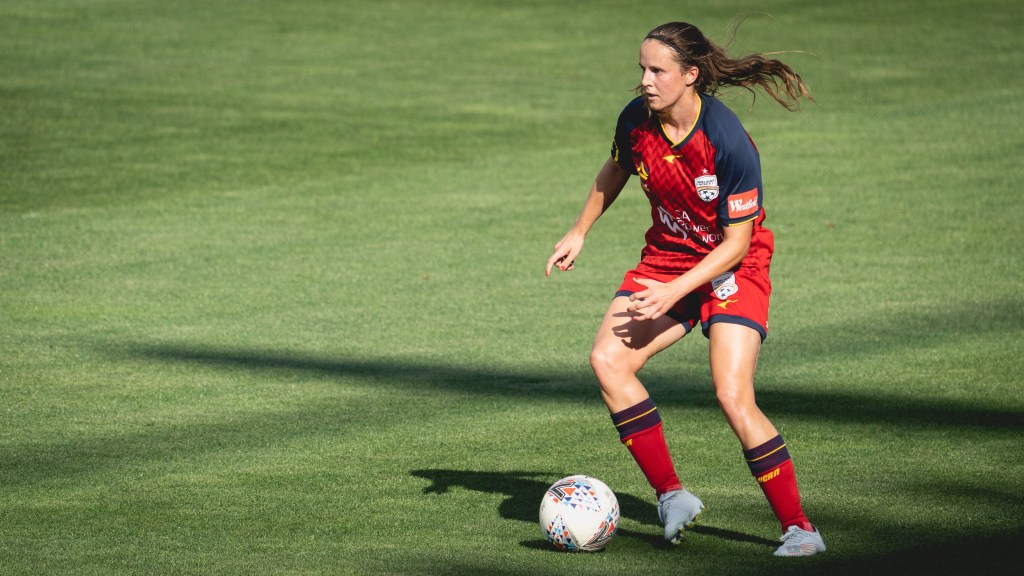
Above: Emily Condon will return to Adelaide United red for the next two seasons. Photo: Adelaide United.
“We took great strides forward last season and I think we can only improve on the progress we made as we aim to play finals football.
“I’m really enjoying playing for Adrian (Stenta) and I’m excited for another season together with a great group of young footballers.”
Adelaide United’s W-League Head Coach, Adrian Stenta, said: “Emily enjoyed probably her most consistent season to date last year with Adelaide United and took her game to another level.
“It’s pleasing to know Emily will be with us for the next two years because she’s an integral player to our team and one of the most talented midfielders in the competition.
“Our squad is coming together quite nicely and fans should be looking forward to another strong and competitive season from our exciting, young group.”
The South Australian club have also announced that goalkeepers Annalee Grove and Miranda Templeman, have signed with the Club for the W-League 2021/22 season.
The pair are considered two of the best young shot-stoppers in the country.
Grove returns to the Reds where she made her W-League debut last season against Canberra United.
The 20-year-old, who has represented the Junior and Young Matildas, spent the offseason in Sydney with Bankstown City Lions in the NSW WNPL.
After re-signing with Adelaide, Grove said: “I’m really delighted to be back at Adelaide with this amazing team.
“I feel like we have unfinished business because of how close we came to reaching the finals last campaign.
Above: Annalee Grove returns to Adelaide United. Photo: Adelaide United.
“Last year I was fortunate enough to make my Reds debut and now I feel like I’m ready for that number one role if I keep working hard and stay focused.”
Meanwhile, Templeman arrives at the Club with a substantial amount of potential.
Originally from Perth, the 18-year-old is part of the Future Matildas program and previously represented Australia at U16 level.
Templeman, too, has plied her trade in the NSW WNPL during the offseason, but with FNSW Institute.
Speaking about joining the Reds, Templeman said: “I’m so excited to be moving to Adelaide.
“Growing up and playing the sport I love, my goal has always been to play professionally and, to now have that opportunity, my determination to make that dream a reality has only intensified.
Above: Young Western Australian Miranda Templeman joins Adelaide United. Photo: Miranda Templeman Facebook.
“I believe Adelaide is one of the best teams I could join for my development because of the opportunities it gives young players, which is exciting for me.
“Hopefully we can put together a solid season and secure a place in the finals.”
Adelaide United’s W-League Head Coach, Adrian Stenta, said: “We’re really happy with these two signings.
“Annie was obviously with us last year and got to experience playing at the W-League standard and I’m convinced she’ll only improve.
“Miranda is a really talented goalkeeper and arguably the best for her age in the country.
“She is still really young, but has all the necessary attributes to play at this level and it’s definitely going to be exciting to see these two provide competition for each other over the course of the season.”
Across in New South Wales, Newcastle Jets have announce that striker Sophie Harding and goalkeeper Claire Coelho have re-signed with the Club for the 2021/22 Westfield W-League season.
22-year-old Harding made her W-League debut for the Jets last season, making 11 appearances.
“I’m super pleased to be re-signing with Newcastle this year, it’s an awesome club and I’m excited to get to work with the girls and the coaches to build on last season,” Harding said.
“I’m honoured to be given the opportunity to come back for my second season in the W-League, and I’m looking forward to putting in the work to get some great results for the team and club.”
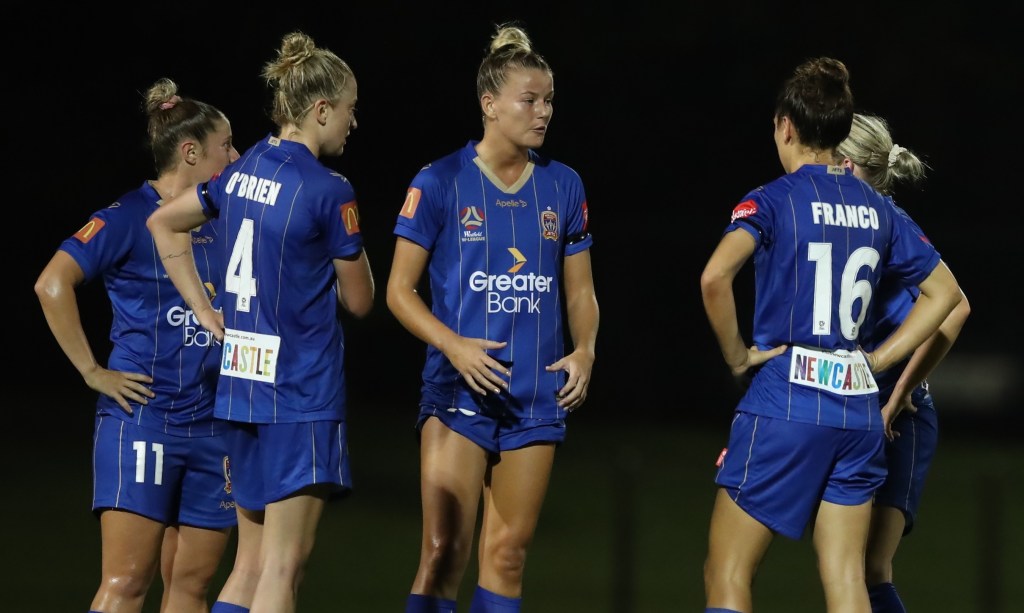
Above: Sophie Harding (centre, facing camera) is back at Newcastle Jets for another year. Photo: Newcastle Jets.
Coach Ash Wilson said; “Soph had a positive impact last year both on and off the pitch in her first ever W-League season.
“She has a clear weapon in terms of her speed and poses a serious threat to other teams. But she also has a strong desire to learn and develop which is pleasing.
“I’m looking forward to seeing what Soph can do in her second season and I know she is going to positively contribute to our team performances and style of play.”
Joining Sophie Harding at the Jets for another season is goalkeeper Claire Coelho.
The 25-year-old Port Macquarie product has been part of the Jets’ W-League set-up since 2013.
With 34 W-League games to her name following 11 starts last season, Coelho is excited to have secured her future and build on last year.
“The club is moving in a positive direction, so to re-sign and be a part of this new chapter is exciting,” Coelho said.
“I’ve been fortunate enough to train with the Jets Academy boy’s teams this off-season and coming into my ninth W-League season, it’s helped me feel ready for the challenge ahead.”
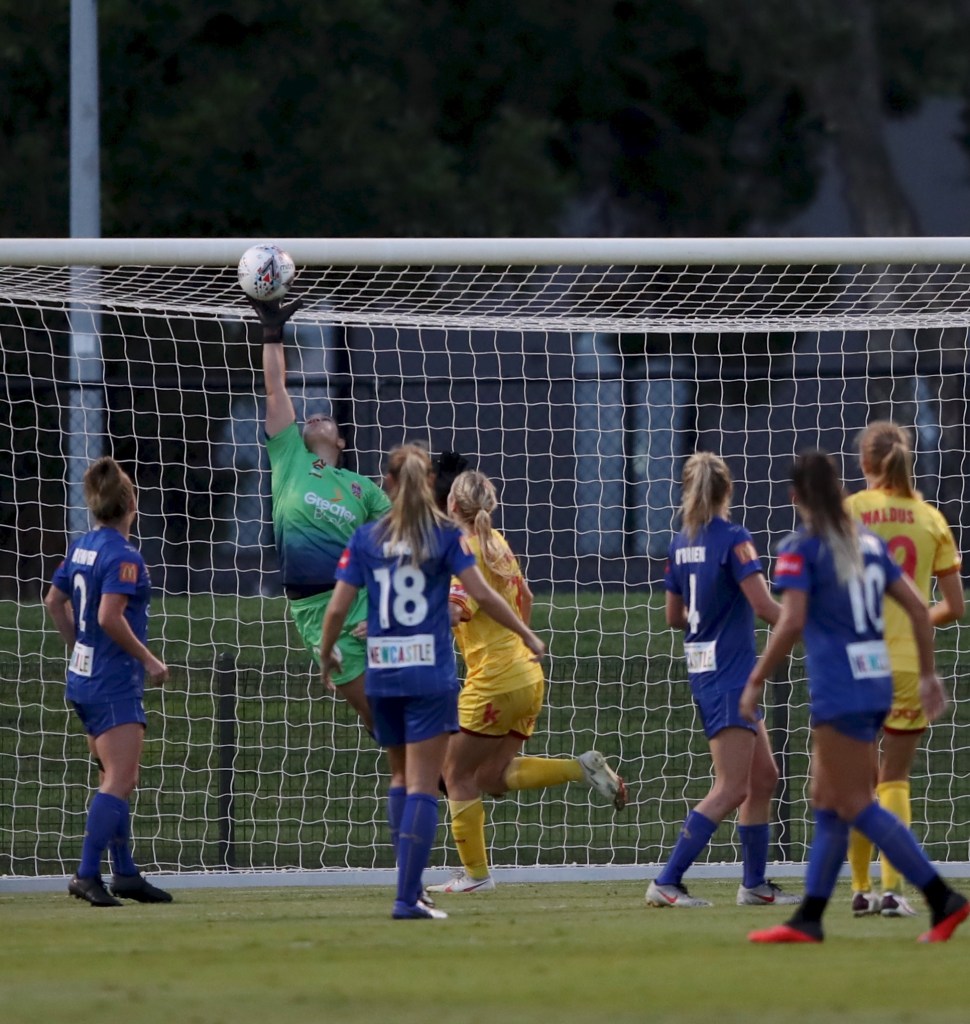
Above: Claire Coelho, seen here making a save against Adelaide United, has signed up for another year with the Jets. Photo: Newcastle Jets.
W-League Coach Ash Wilson said, securing Coelho is an important part of her roster puzzle.
“Claire continues to prove herself in the W-League,” Wilson said.
“She has been an integral member of the Jets W League squad for a number of years and I’m looking forward to seeing her step up again this season.
“Her communication, bravery and shot stopping abilities will be important to this team coming into the 2021/22 season.”
Impetus’ North American Women’s Football expert Catherine Paquette brings us up to date with all the action from the NWSL.
Above: England star Jodie Taylor who made a big impact for Orlando Pride in the latest round of matches. Photo: Orlando Sentinel.
Five National Women’s Soccer League matches were disputed last weekend. As has been the situation for a few weeks now, Portland Thorns entered the weekend top of the table with seven points separating them from the rest of the league. The second to eighth placed teams were separated by only four points. Racing Louisville was in ninth place with 14 points and Kansas City were bottom of the league with 4 points, still chasing their first franchise win.
All of teams had played 12-14 of their 24 regular season matches, with the league entering the final third of its 2021 season. The battle is therefore intensifying. Under the new 2021 league changes, the top six teams make the play-off rounds. All are therefore within a reasonable range of reaching of that goal with the exception of Kansas City. They would arguably have to win nearly all games remaining, a difficult ask considering their record.
The first match occurred on Friday between the Houston Dash and the Washington Spirit. At seventh and eight in the league, both teams were just below the play-off positions. The game marked the 150th regular season appearance of Tori Huster, the only member of Washington’s squad to have been with the franchise since it started in the NWSL in 2013. It was her team that were first to find a goal. In the eight minute of play Paige Nielsen received a deflected ball off a corner and then struck a fantastic curving shot into the net.
Nielsen then went from goal scorer to goal saver several minutes later when she headed wide a ball being crossed into the box. While both teams had chances in the rest of the first half, fans had to wait until the 54th minute for a second goal. Huster celebrated her appearance milestone by taking the ball, making an impressive run and then sending a rocket shot into the net to put the Spirit up 2-0.
As is often said in football, the worst lead is being up 2-0. This was the case for Washington on Friday. Six minutes after the second goal, the Dash got their first of the evening when Veronica Latsko put in a ball off a corner. The highlight of the night though came courtesy of Michaela Abam. A product of the Dynamo & Dash Youth soccer club, Abam is the first homegrown player to have been signed by Houston.
Eleven minutes after her debut for her hometown club, Abam stole the ball off a Spirit defender and proceeded to take a successful shot on goal. Her equalizer was the last goal of the game and helped save a needed point for the Dash. It ended 2-2.
The second match of the weekend occurred on Saturday between the Orlando Pride and the Portland Thorns. It was the third meeting this year between both clubs, with each having won a previous game 2-1. The Pride had announced that Alex Morgan would be unavailable for the foreseeable future, after having picked up an injury during the bronze medal match of the Olympics. The mid-season signing of striker Jodie Taylor last month was therefore not just a good move on the part of Orlando, but also an essential one at this point in their season.
It paid off 13 minutes into the game. Courtney Petersen, who has been one of the principal sources of creation for the Pride this year, made a fantastic cross into the box which Taylor expertly headed in. The Thorns did not let this deter them though. A team known for not enjoying being on the back foot, they started a series of attacks on Orlando’s goal. Ashlyn Harris, who has been in spectacular form this year, made a number of key saves to keep her team in the lead.
🧱🧱🧱Wow! An incredible save by brick wall @Ashlyn_Harris.🧱🧱🧱
The Pride for their part also went on the offence again with Petersen being the primary creator of chances. However, it was her Thorns counterpart Megan Klingenberg who stood out. Klingenberg has had a fantastic 2021 season, placing herself amongst the top players in the league for progressive passes, passes into the box, expected assists, progressive runs and crosses.
In this game latest game, she was the best player on the field. It was her fantastic set piece into the box that set up Simone Charley’s equalizing header. The match finished 1-1, ending Portland’s four match winning streak.
Another view of the Thorns' equalizer by @SimoneCharley.
The second Saturday match was between Kansas City and the OL Reign. The meeting was between a winless franchise in KC, who had recently acquired new talent, and a talent packed team in the Reign, who had been successful of late but inconsistent during the year. It was their first match under new manager Laura Harvey who had previously been with the club for the first four years of its existence.
The game was an intense one, not reflective of what can be a dominant team meeting a winless one. The change in KC formation, their new players and their loud home fans, bolstered their attack. While they were more direct in their forward progression than l’OL, KC had a very offensive night. Lo’eau Lobonta had one of her best games of the season, looking seemingly free on the right hand side of the pitch. Despite having less possession than the visitors, KC registered more shots.
The home team contained the Reign by stopping their transition, playing a very physical game, where the OL midfield were given little space and time, thus restraining the Reign from playing in their usual fluid passing style. It paid off. In the 72nd minute a deflected KC free kick found Victoria Pickett who scored the only game of the match. Kansas City finally got their first franchise win.
The first match on Sunday was between NJNYGotham FC and Racing Louisville FC. Racing were the ones to open the attempts on goal. Ebony Salmon had a tremendous shot that hit the crossbar in the seventh minute. Not long afterwards, she received a pass into the box from Cece Kizer and instead of being selfish and taking a shot on goal she passed it to Nadia Nadim who scored against her former club.
Salmon nearly made it two in the 26th minute but was stopped by returning Canadian gold medalist goalkeeper Kailen Sheridan. Gotham for their part were also offensive. Ifeoma Onunomu, who has been a real attacking threat for NJNY all season, made a great pass in the box in the 36th minute that met Elizabeth Eddy’s head. It was deflected away though.
Onumonu would have to wait until the 83rd minute of the game to find an equalizer with a rocket shot in to the top goal. The game would end 1-1. The player of the match though for Gotham was Allie Long. The midfielder had a 98.3% pass accuracy off 60 passes.
The last match of the weekend was between the North Carolina Courage and the Chicago Red Stars. The game was originally delayed nearly an hour due to weather and took place in very wet conditions. The only goal of the match came in the 40th minute. North Carolina were awarded a penalty off a Chicago Red Stars handball. New player Amy Rodriguez confidently put it in.
While the Courage had a greater percentage of possession and greater pass accuracy throughout the match, the Red Stars were fully capable of attacking. The best performer for North Carolina was arguably their goalkeeper Casey Murphy. Despite the wet conditions she made a number of key saves to keep her team in the lead. She deserves to share the player of the match award with the fans, who stayed out in the rain for more than 90 minutes.
So after this weekend some things have changed in the NWSL. Several teams moved up in the table, the Thorns’ lead has been minimized and KC are not winless. The upcoming week will see four games disputed. Three will occur next weekend between the North Carolina Courage v Kansas City, the OL Reign v Gotham FC and the Washington Spirit v the Orlando Pride. One midweek game will occur this Wednesday between Racing Louisville and the Chicago Red Stars. The game will also double as a match in The Women’s Cup exhibition tournament. Prior to it, Paris Saint Germain will face FC Bayern Munich. The losers of both matches will face each other in a third place game on Saturday, followed by the winners of both matches in the Cup’s first placed game.
The Portland Thorns and the Houston Dash will face l’Olympique Lyonnais and FC Barcelona in the Women’s International Champions Cup in the coming week. Like the Women’s Cup it will start this Wednesday with both teams European teams facing each other followed by both American teams. Again like the Women’s Cup the losers of both matches will face each other in a third place game on Saturday followed by the winners of both matches in the WICC’s first placed game.
Brighouse Town Women started their first ever campaign in the FA Women’s National League Northern Premier with narrow 3-2 defeat to title favourites Derby County.
Town found themselves 1-0 down mid way through the first half, and nearly went 2-0 down soon after but for good work from Kayleigh Bamforth to prevent a tap in at the back post.
Brighouse responded excellently. Danielle Whitham smashed the equaliser in the top corner after excellent work by Amy Woodruff. They soon found themselves in the lead when Darcie Greene found sister Drew with a long diagonal pass. Drew caught the Derby keeper out with a clever finish to put Town 2-1 up before the break.
After the interval, Brighouse should have made it 3-1 on a couple of occasions, the first was a bullet header from Woodruff from a Leah Embley cross and the second a bizarre sequence of events found Woodruff through on goal, the linesman had his flag up from a clear offside but the referee waved play on, Woodruff reacted too slowly and a missed opportunity went begging.
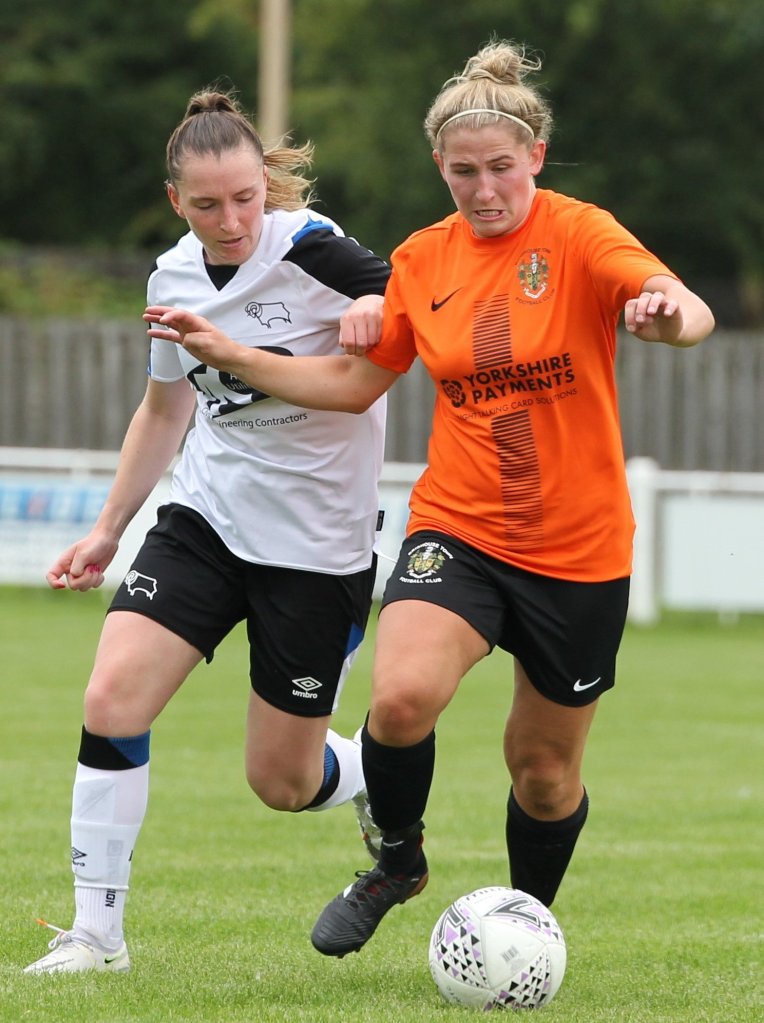
Above: Brighouse Town player of the match Danielle Whitman in possession against Derby County on Sunday. Photo: Munro Sports Pics.
As the game entered it’s final stages, it looked as though Town could do the unthinkable and looked in control, however, a long hopeful ball caught Becky Gompertz out leaving Derby’s Sophie Domingo one on one with debutant keeper Imogen Maguire. Maguire brought Domingo down resulting in a penalty, it was emphatically executed in the the top left hand corner despite Maguire’s best efforts.
Derby then dealt the killer blow and a real sucker punch with a quickfire goal to make it 3-2 with 10 minutes remaining, Town huffed and puffed but couldn’t find the equaliser their play so richly deserved.
Lessons learnt as they made the step up in the top National League division as they prepare to travel to Hull City this coming Sunday. Hull managed to pick up a point away at Loughbrough but threw away a 2-1 lead in the 94th minute. The game will be played at Haworth Park, please follow @btafcwomen on Twitter for all the info or live updates.
Above: Last season’s Champions League winners Barcelona list the trophy. Photo: David Lidstrom/Getty Images
The UEFA Women’s Champion’s League starts this week. Under changes by UEFA, it will now follow a different format compared to previous years, transforming how the competition will occur.
The competition will start with a group stage qualification for the competition, split into two rounds. Winners of the first round will be included in the group of teams that will be competing in the second round. The winners of the second round proceed to a six match group stage followed by knock out rounds.
The group stage qualification will follow two pathways: the champions path and the league path. The different pathways were conceived to ensure that at least ten countries are represented in the sixteen team group stage. Where each team enters depends on how they qualified, either as champions in their individual country or further down the league table in countries with more than one UEFA Women’s Champions League place, as well as their UEFA country coefficient.
The first of the two rounds starts midweek in the form of mini-tournaments. Forty-three teams are entering this stage under the champions path, being split up into 11 groups of four and one group of three. A draw decided which teams would meet for the first match in each group. The losers of the two matches in each group will then meet in a third place game. The winners of of the first matchups in each group will meet to determine the first placed team.
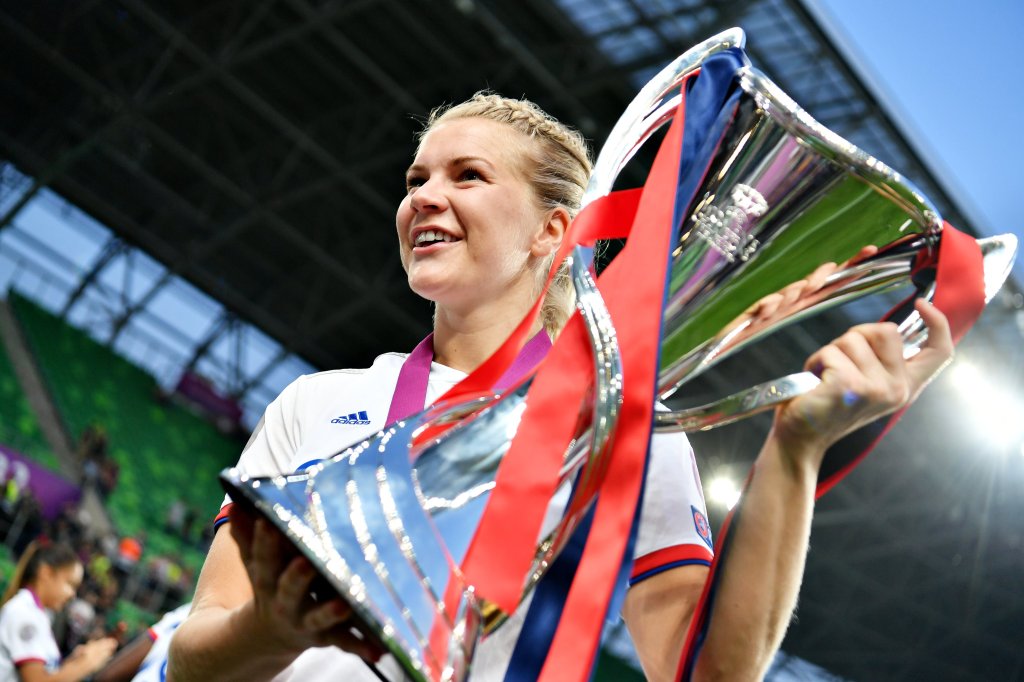
Above: Ada Hegerberg with the UEFA Women’s Champions League trophy. Photo: @UWCL
The league path will be nearly identical to the championship path. Sixteen teams have been split into four groups and drawn for the first match. The losers will also play for third place while the winners of the first match will play in the first-place game. The eleven winners of the championship path and the four winners of the league path then proceed to round two of the group stage qualification.
Round two will start at the end of August. It will comprise of the eleven round championship winners, as well as three other country champions who enter directly in round two. They will be drawn for two-legged ties, with the seven winners proceeding to the group stage. The four round one league winners alongside six other league path teams enter directly into round two. They will also be drawn and play two-legged ties with the five winners proceeding to the group stage. Four more country champions will also join the twelve round two winners in the group stage.
The group stage will split the sixteen teams into four groups of four. All teams will play each other in home and away games this autumn for a total of six group stage games per team. The top two teams in each group then proceed to the quarter final knock out stages. The knock out phase will remain unchanged with two-legged home and away matches prior to a one game final.
⚽ “The world’s best women’s club competition will get both the platform and visibility it deserves.”
Impetus’ relationship with Wroxham Women dates back to the end of 2020 when the Eastern Region Women’s Football League Premier Division side became our first partner club and their defender Harriet Meers became the first player that the site sponsored ourselves. Shortly afterwards, we also linked up with their local girls club Bure Valley Youth. Due to the pandemic we’ve hadn’t been able to get up to the Norfolk Broads to meet the clubs in person. Until yesterday. Impetus editor Ben Gilby reports.
Above: Wroxham Women and Bure Valley Youth pictured together after yesterday’s match. Photo supplied to Impetus by: Bure Valley Youth FC.
Yesterday was the opening round of the 2021/22 East Region Women’s Football League Premier Division (Tier Five) and Wroxham Women, consistently one of the top sides in the competition welcomed fans back to their well appointed Trafford Park ground for their game against Luton Town.
Impetus’ features on Wroxham over the past eight months have revealed an exceptionally warm, friendly and welcoming club to our readership across the world. Yet when you are able to experience it in person, that friendliness was emphasised several hundred times over.
Above: Alice Parker plays another centimetre perfect cross-field pass. Photo: Ben Gilby
The Yachtswomen have strengthened well over the summer with players such as former Norwich City and West Ham United Academy defender Alice Parker and Cambridge United star Amber Cantwell being added to an already impressive squad.
Bure Valley Youth team were at the game, with their youngsters gleefully walking hand in hand with Wroxham players as the teams came out onto the pitch. The old saying says that “You can’t be what you can’t see.” Yesterday, the Bure Valley girls experienced the connection they have with the senior Wroxham Women team. They saw what they can be and dreams were made plus future ambitions stored away.
Above: Olivia Abraham heads Luton Town in front. Photo: Ben Gilby
The game opened with Wroxham having plenty of the ball but not quite managing to penetrate the Bedfordshire side’s backline, a frustration added to when Luton took the lead when Fiona Constable’s corner was met with a powerful header from Olivia Abraham.
But this Wroxham side showed character and determination. With Impetus‘ sponsored Harriet Meers strong in the tackle and in the air, Parker finding some impressive cross-field passes and the Yachtswomen’s hugely impressive striker Grace Burchall showing a consistently exquisite first touch, the home side became ever more prominent in the game as the vocal support from the ‘Blue Wave Band’ in the covered terrace went up a notch.
Above: Grace Birchall (right) was a thorn in Luton Town’s side all afternoon. Photo: Ben Gilby
Burchall hit a hat-trick, with her third goal being a particularly impressive effort. If it was not for three outstanding saves from Luton keeper Hannah Payne the score-line could easily have got beyond the Hatters.
Luton captain Jess McKay was then shown a straight red by referee Ryan Starkey for a tackle on Burchall. If anything this inspired the visitors to rally and Abraham brought it back to 3-2 with her second of the game.
Above: Lauren Bullard, who scored Wroxham’s fourth goal, gets a shot in. Photo: Ben Gilby
Wroxham finished the game stronger and gained a fourth goal which made the score line feel a bit more representative on the balance of the game. Once more Birchall was involved with the ball squared across to Lauren Bullard who took a couple of touches before shooting home.
Above: All smiles for Wroxham at the end. Photo: Ben Gilby
Post match, the Bure Valley youngsters loved the opportunity to mingle with the Wroxham players and have photos taken. It was a day that two hugely important parts of the #ImpetusFamily came together and showed just what the ties of women’s football can achieve.
Above: Grace Birchall receives her Player of the Match Award from Impetus editor Ben Gilby after the game. Photo: Kate Pasque
If you are ever on holiday in the Norfolk Broads, then there is no better way to spend a Sunday afternoon than at Trafford Park to watch the Yachtswomen. You are assured of a friendly welcome.
Above: Impetus‘ sponsored player Harriet Meers pictured with Ben Gilby after the game. Photo: Kate Pasque.
Impetus’ North American Women’s Football expert Catherine Paquette brings us up to date with all the action from the NWSL both on and off the pitch
Above: Fifteen year-old Olivia Moultrie, who made her NWSL debut for Portland Thorns last weekend. Photo: Equaliser Soccer.
It has been a busy week and a half in the National Women’s Soccer League. After the dismissal of Gotham FC general manager Alysa LaHue last month, the NJ/NY based club announced former player Yael Averbuch West was named as interim GM and head of soccer operations last week.
This week saw the suspension of Washington Spirit head coach Richie Burke. The club had originally announced this Tuesday that Burke had stepped down from his position due to health reasons and had been moved to the front office. However, a further announcement from the Spirit organization occurred on Wednesday stating that Burke had been suspended.
The second announcement came after the Washington Post reported alleged long standing abusive behaviour by Burke against present and former players. The Post’s article stated that Burke had a pattern of behaviour which included insults, tirades, abusive treatment and racist and homophobic language. An inappropriate contact incident in last weekend’s game against one of his players, Ashley Hatch, has also come to light.
One former Spirit player, Kaiya McCullough, has since come out publicly to discuss the verbal and emotional abuse which she suffered at the hands of her former coach. The abuse was so great that McCullough said she lost all her love of soccer and it ultimately led her to retire from the sport last fall.
SB Nation’s Black and Red United reported that this abusive nature may have predated Burke’s hire at the Spirit. When first appointed head coach in 2019, the publication wrote of several incidents of inappropriate behaviour. The first occurred while Burke was a youth coach with FC Virginia. Another player also came forward from their time with the DC United U-23 PDL 2015 squad. They both stated alleged abusive incidents by Burke which included insulting, homophobic, sexist and violent outbursts.
The U-23 PDL player in question stated that Burke’s then assistant-coach Tom Torres witnessed this abuse and did not act upon it. Torres went on to coach with Burke at the Spirit until last year, when he left to pursue other interests. The Athletic though have reported that this departure had been preceded by intoxicated inappropriate comments directed at players at a post-NWSL Challenge Cup party.
Above: Richie Burke – suspended by Washington Spirit. Photo: Black and Red United.
Both the Washington Spirit and the NWSL have since stated they have opened a pending investigation into the allegations against Burke during his time with the capital region club. The Spirit have since put Kris Ward and Paul Crichton, both current assistant coaches, as interim head coaches while they start a search for a replacement.
While the recent incidents may seem bleak, NWSL player’s association director Meghann Burke stated their importance. Speaking of the incident she told The Athletic “What we are seeing this season is the beginning of a reckoning. The Players Association will continue to work towards creating an environment in the NWSL that is worthy of the people who play in and support it.”
The following is a resumé of last weekend’s matches.
The first match of last weekend’s NWSL was between NJNY Gotham FC and the North Carolina Courage. In the tight league table, both teams were looking for a win to try to catch up to the first placed Portland Thorns.
The first part of the match was a good two way game between both sides. While the Courage had slightly more possession, neither team threatened in the final third. This changed in the 38th minute. Carson Pickett provided a great cross into the box. After a block from the goalkeeper, Meredith Speck put it in for her first NWSL goal. A few more chances occurred on both sides, however neither team was able to convert. The Courage won the match 1-0.
North Carolina’s Carson Pickett deserves a mention not just for her contribution in the last match but also for her form this year. Joining the Courage from the Orlando Pride prior to this season, she has gone on to flourish with her new side. In a team packed with talent, she has become not just the Courage’s but one of the league’s most effective attackers. So far this season, she leads the NWSL in progressive passes, with 70 more than any other NWSL player, and passes into the final third. This past weekend she also played the full 90 minute despite picking a serious injury to her thumb that will require surgery. Pickett is proving that development, progression and grit are alive and well in the league.
The second match of last Saturday was between the Washington Spirit and the Portland Thorns. 15-year-old Olivia Moultrie, the youngest player to ever play in the league, started her first NWSL match for the Thorns. It proved to be an inspired decision. Despite her young age and professional inexperience, she showed her attacking abilities. Her first shot on goal came just six minutes into the match and narrowly wide of Washington’s net. She then supplied a fantastic ball into the box in the 29th minute which was headed in by Simone Charley.
The Thorns’ defensive capabilities were also on full display in the last match. While their offensive prowess and creativity are often mentioned, Portland’s defence has been an equal strength this season. This defensive force starts with their press and goes all the way to their back line. Just this past game, they won 62% of all duels, 11 shots and 64% of all tackles. Spirit attackers Ashley Sanchez and Ashley Hatch, who have both had a fantastic month while international players have been away at the Olympics, were relatively restrained this past weekend.
It is this defensive capability that has ensured Portland’s stay at the top of the league. This past match also saw perhaps the best demonstration of defensive heroics this season. When it looked like Trinity Rodman would put it in for the Spirit, The Thorns’ Christine Westphal came flying in to block her shot. The match ended 1-0 for Portland.
A close call for Portland. Trinity Rodman nearly puts it in only to be denied by @Cwestphal20! Wonderful play from the defender.
The final Saturday match was between the OL Reign and the Houston Dash. The Reign started their 2021 season slowly. After registering just three wins in their first ten games in which they found the back of the net only six times, they have changed their fortunes in the last three weeks. Their talent-packed squad started to find their attacking power and have scored nine goals in three consecutive victories.
The latest game can only be described as a Reign first half goal fest. Bethany Balcer opened the scoring account in the sixth minute of play. Sofia Huerta doubled the score several minutes later. The Dash were able to get one in though. Shea Groom showed some fancy footwork, beating off her defender, before taking her shot on goal. It was deflected off Alana Cook before going in to make the score 2-1.
Eugénie Le Sommer then made it 3-1 for the Reign when she was able to put her own blocked rebound in. The goal of the game then came courtesy of Jess Fishlock. She picked up the ball just inside the Dash’s half before striking an amazing long range effort into the net. Balcer made it 5-1 several minutes before the first half ended. This was the final result.
⚽️It is Reigning goals in Tacoma! @JessFishlock with a rocket to make it four!
Sunday saw two games being played. Racing Louisville met KC in the first match. Louisville were looking to turn around their form after a month of July with three losses and one draw. KC for their part, were still looking for their first franchise win.
Louisville dominated the first 15 minutes with the majority of the possession. However, it was KC who registered the first shot on goal. Despite this fact, Racing were the more attacking side. They were able to get ahead in the 43rd minute.
The wonderful team goal started in the Racing half. Savannah McCaskill made a run with the ball out of her box. She then passed it in to Emily Fox, who passed it back to McCaskill as she was making an overlapping run. McCaskill made a one touch pass to Nadia Nadim who passed it back to McCaskill as she continued her run. The play ended with McCaskill sending in a cross which was then deflected in by Ebony Salmon.
KC were able to get a goal just before the half ended. Kiki Pickett, who has been one of the bright spots for KC, put in a cross. After a rebound, Darian Jenkins equalized. Upon her return from the half, McCaskill produced another bit of brilliant work when she was able to fight off her defender and send in a cross that found Nadim. She headed it home to put Louisville in the lead. The final goal of the match was another Racing spectacle. Cheyna Matthews stole the ball off a KC defender, beat goalkeeper Rowlands and then walked the ball into the net. Racing won the game 3-1.
Racing’s person of the match was Savannah McCaskill. A terrific creative force, McCaskill has often been inconsistent during her time in the NWSL. However, she seems to be settling in well with Louisville. This game was her best one for her new side. Not only did she dictate the play for her team and wreak havoc for KC but she also took chances on goal as well. Racing will be hoping that this becomes her permanent form.
The last match of the weekend was between the Chicago Red Stars and the Orlando Pride. The Red Stars started the game by attacking. The Pride were able to gain some control after the 15th minute. For the second week in a row defender Ali Krieger provided a fantastic ball in for her attacker, this time Jodie Taylor, to finish and score.
⚽️Goal for the Pride 🦁. For the second week in a row @alikrieger with a wonderful ball gives an assist. This week it is to Jodie Taylor who beats her defenders and puts it home.
However, the Red Stars did not give up. Morgan Gautrat’s wonderful 2021 form continued. The vision, creativity and passing capabilities that lead her to the USWNT when she was still in college have been on full display. She was able to give one of those great passes to Mal Pugh in the first half who then turned and shot on goal. Ashlyn Harris, who has also had terrific 2021 form, showed her goalkeeping skills by stopping it. Sydney Leroux was able to double the Pride’s lead late in the second half. Erika Tymrak provided a great pass in for Leroux to finish. Putting in her seventh of the year, she became the leading NWSL goalscorer. The Pride won it 2-0.
The game though was overshadowed by poor refereeing. Two players from Chicago, Danielle Colaprico and Morgan Gautrat, were forced to leave the field after bad tackles. Like too many NWSL games, the referee never had a grasp on the game nor the proper judgement to reprimand dangerous tackles.
With these results, Portland have increased their lead at the top of the table with 28 points. Only four points separate the second placed North Carolina Courage from the eighth placed Houston Dash. KC are still winless at the bottom. Five matches occur over this coming weekend.
Derbyshire based Pride Park are one of Impetus’ partner clubs. Earlier this summer they ran a Young Sports Writing competition for their youngsters. We’re delighted to publish below three of the entries.
First, this piece by under-eights player Edie:
“I couldn’t wait to get back into the routine of getting dressed and going to football. Everything started well, with a brand new kit. Wearing this on Saturday made me feel smart, proud and thrilled. I was once scared of the ball. Feeling nervous on Saturday, however, I scored my first goal on Saturday. This made me feel more confident and I was proud to do it with my teammates. The match was good and I was rewarded with a sausage cob back at home with my family. I love football because its fun, joyful and I learn new skills with my teammates.” Edie U8
Yumi, from the under-tens submitted this entry:
“The return to football kept me on my feet for one whole week. I was so excited for the matches, training and to see all my teammates again!. In the lockdown, I had missed getting up on the morning of a match and putting on my leather, black boots, ready for a run on the pitch.
“Now, I would be doing that once a week; getting back on the field and playing for my team. What a fabulous feeling to be able to assess – in a match – the progress I have made from training every week on a Tuesday with our coaches at Moorways and at the weekend with my Dad in the garden.
My energy before a match on a Saturday is incredible, no matter who we play, the result or the weather. However, on Saturday 3rd April 2021, my nerves were taking over, it was our first match in a few months! We would be playing against a team we had played a few times before so I knew exactly how well they played and that was overwhelming…
“Though I was anxious for the coming game, I was equally thrilled to get back into play! But I reminded myself that playing football with myself and my team is very enjoyable, we all work together so well as understand the positions we have to be in order to play well in defence and attack whether in an actual match or in a practice at training. This reassured me.
“In addition, I always look forward to football as it takes my mind off things. The cold breeze thatblows in my hair, when I run strategically, ready to either ‘pass, run, dribble or shoot’ as my coach always says, is such a nice sensation.
“The night before we went to our first match was so exciting. I couldn’t wait to see the freshly cut grass of the pitch again, or to hear the loud, supporting audience’s voices fading as I would get further and further away from our half!
“Although I was nervous, my eagerness was starting to overpower the butterflies in my tummy. I couldn’t help but think that the game be even, as it was the first one for both teams; we would have all lacked formal practice. Soon, I was running down the wing, tackling, passing and releasing all the energy that had accumulated in my body the past few months. I even scored! I felt proud to be part of Pride Park under 10s.
“I love the team spirit at the end of a match, whatever the end result is. We will always cheer each other up if down or upset. We will always sing the fun, made up songs that we eagerly rehearse at the end of training. We are a GREAT team! I really hope that is the end of the restrictions. I don’t want the football spirit to be taken away from me again.” Yumi U10
Finally, this piece by Lucy from the U10s
“I have been doing extra goal keeping sessions with my coach, Andy. At first I let a lot in, but as I had more sessions I started to get better. I was doing a lot of drop kicks and managing to get them quite far.
“Eventually, my first training session in a long time with my teammates came, I felt so happy to finally do it again! Our coaches Andy and Chris worked us hard so we were ready for the match on Saturday. On Friday we had another training session at the park. We did a new passing exercise and it was very fun. We all rested well on Friday night ready for the match the next day.
“Finally the first match back came. I was in goal and I felt really nervous about what could happen, it could either go really well or terribly wrong. I tried my hardest and made some amazing saves. When I was having extra goal keeping sessions with Andy he told me to look scary and intimidating, but that didn’t work because it’s really not my thing!
“The first match back felt amazing and everyone was fully committed to the team. I didn’t quite manage to save all the goals but Andy said it didn’t matter. During the match my teammates Polly and Yumi did a great job running down the wing! During the match I felt well protected because I had such great defenders! After the match everyone said I was amazing and Andy wouldn’t stop saying how pleased he was with the whole team. Our team was unstoppable that day.”
Lucy U10s
Here at Impetus we think the writing produced by the Pride Park youngsters is fantastic and really captures the sheer passion and joy the girls have for playing football. We look forward to following Pride Park’s season at all levels from the first team down to the youngest girls side.
This week saw the transfer window close and the second tier Elitettan return along with some friendly matches between Damallsvenskan sides. @DandalBs rounds up all the action.
Photo: Julia Olsson, newly signed by AIK. Photo: Jesper Zerman/Bildbyrån
NEWS ROUND-UP:
AIK have continued their signing spree with the arrival of 24 year-old defender Julia Olsson, who graduated at Embry-Riddle Aeronautical University in Florida this spring and then returned to IF Brommapojkarna. She has joined the Solna based side for the rest of this season.
The club have announced that their 19 year-old defender Clara Härdling has left to study and continue her footballing development at the University of California, Los Angeles and UCLA Bruins. She has 26 caps for Sweden from U15 to U19.
Mia Jalkerud, formerly a prolific forward with Djurgården has joined EskilstunaUnited. The 31 year-old most recently played in for Arna-Björnar in Norway where she scored five goals in nine matches.
Above: Mia Jalkerud (left) in action for Djurgården. Photo: Maxim Thoré/Bildbyrån
EskilstunaUnited have taken a second person from Arna-Björnar with the arrival of 36 year-old Gudbjörg “Gugga” Gunnarsdóttir, who was also previously at Djurgården player, as a new goalkeeper coach.
Following Melina Loeck’s hand injury, Kristianstad has decided to bring back goalkeeper Moa Olsson who was on loan at third tier side Lörby IF.
Synne Skinnes Hansen, who left Linköping last week, has signed a two year deal with top Norwegian side Rosenborg.
Hammarby have loaned out Jonna Ståhl to Elitettan side IF Brommapojkarna. The 26 year-old is coming back from injury and needs playing time.
Vittsjö‘s promising 20 year-old forward Pauline Nyström has gone out on loan to Eskilstuna United for more playing time.
DAMALLSVENSKAN:
Whilst the Damallsvenskan is still on a break until 20th August, several friendly matches have been played in recent days.
Last Friday, hosts Hammarby lost 2-1 to Rosengård despite going ahead thanks to Nina Jakobsson’s goal after nine minutes and the home side kept the lead until Stefanie Sanders equalised on 64 minutes and grabbed the winner in injury time.
Above: Stefanie Sanders, who scored for Rosengård in their win over Hammarby in a friendly. Photo: Rosengård
AIK draw 1-1 at home with KIF Örebro last Sunday. Newly signed Kaisa Collin scored the opener for AIK in the first half, with Elli Pikkusjämsä levelling for Örebro in the second period.
On Tuesday, Djurgården went down 1-0 at home to EskilstunaUnited thanks to goal by Elise Stenevik after just six minutes.
Also on Tuesday, Vittsjö went down 3-0 at home to BK Häcken. The goals came from Julia Zigiotti Olme, Stine Larsen and Julia Karlernäs. Michella de Jongh played her first game for Vittsjö since returning from France with Tove Almqvist and Ebba Wieder also back for the home side.
Table From: Svensk Fotboll.
The Damallsvenskan is presently on a break for the Olympic Games and returns on 20th August with the set of fixtures below:
Round Thirteen Fixtures:
Växjö v Vittsjö
Hammarby v Eskilstuna United
AIK v Djurgården
Piteå v Linköping
Rosengård v KIF Örebro
Kristianstads v BK Häcken
ELITETTAN
Above: Umeå’s Monica Jusu Bah, scorer of two goals in their 5-1 win over Borgeby FK. Photo: Pelle Börjesson /Bildbyrån
The Elitettan returned from its short break last weekend. Leaders Umeå IK are four points clear at the top after a comprehensive 5-1 win over Borgeby FK in front of 245 fans. Monica Jusu Bah hit two goals with Lisa Björk, Alma Uvell and Alexandra Sandström all on target. Borgeby’s effort came via an own goal. Morön BK are second following their 3-0 win at Sundsvalls DFF. The three goals came in a sixteen minute spell from the 67th minute onwards thanks to strikes from Carla Portillo, Villemo Dahlqvist and Michaela Kovacs. IK Uppsala edged out fellow challengers Älvsjö AIK FF 3-2 in a real rollercoaster of a match watched by 272 supporters. Uppsala were 2-0 up after just 18 minutes thanks to goals from Maria Poli and Angelina Thoreson. Yet midway through the second half, Älvsjö were level thanks to two goals from Alice Ahlberg. It only stayed 2-2 for five minutes as Ellen Toivio hit Uppsala’s winner. The consequences of that defeat for Älvsjö are that they are now highly unlikely to maintain their promotion challenge as they are now six points outside the top three. IFK Kalmar lost a chance to go second when they could only draw 1-1 at home to Alingsås FC United. The visitors took the lead on 25 minutes when Rebecca Cameras netted. An own goal on 56 minutes earned Kalmar a point.
Latest Results: IF Brommapojkarna 2-0 IFK Norrköping, Bollstanäs SK 0-0 Jitex Mölndal, IFK Kalmar 1-1 Alingsås FC United, IK Uppsala 3-2 Älvsjö AIK FF, Mallbackens IF Sunne 1-1 Lidköpings FK, Sundsvalls DFF 0-3 Morön BK, Umeå IK 5-1 Borgeby FK.
Next Fixtures: Morön BK v IF Brommapojkarna, Borgeby FB v Sundsvalls DFF, Alingsås FC United v Mallbackens IF Sunne, Älvsjö AIK FF v Umeå IK, Bollstanäs SK v IK Uppsala, Lidköpings FK v IFK Kalmar, IFK Norrköping v Jitex Mölndal.














 impetusfootball.org