Above: AFC Portchester (orange and black) compete with Gosport for a header. Photo: Lewis Millington.
It was back to business for AFC Portchester Ladies on Sunday as they hit ten past visitors Gosport Falcons, in a Hampshire County Women’s Football League game that was abandoned after worrying scenes where an ambulance was required to support a player who had collapsed. My impressions were the player was OK after treatment on the pitch but regardless it was the right decision to suspend the game, player safety is always the priority after the scenes we all witnessed in Copenhagen at the Euros.
Prior to this though we were treated to a goal fest. Although Portchy, performance wise, took longer to get into gear than they would like by their trademark high standards, chances were still created from the get go. Laura Streeter must have thought she had put the home side 1-0 up after two minutes, although her header was ruled out for an offside.
The legitimate breaking of the deadlock came about on 17 minutes. A lofted ball from the back by the fans’ player of the 2020/21 season, goalkeeper Roxy Roberts, found teenage talisman Ella Wilson. Wilson then knocked the ball past the defender in the box before passing the ball calmly into the net.
Gosport came back at Portchy with attacks from the right hand side, but an injury to Lillie Thomas and organised defending from the back line kept the visitors at bay.
Portchy almost got their second after 22 minutes. A great cross sailed across goal from the right found Michelle Niven, who was industrious with her runs all afternoon. However she hit her first time volley over from close range.
Nevertheless the net rippled for a second time three minutes later. A fantastic piece of play from new signing from Portsmouth Women, Eilidh Currie, where a Cruyff turn in the centre of the pitch left the surround players for dead. Driving forwards, Currie played a beautifully weighted through ball onto a plate for Wilson, who rounded the keeper to slide the ball in from the angle.
Above: AFC Portchester bring the ball forward. Photo: Lewis Millington.
Wanting to make sure she made her mark on the game, Laura Streeter got the third goal on the 35 minute mark. Streeter drove into the box from the right and slapped the ball into the bottom right corner.
Wilson made it four for her hat trick on 40 minutes, a curled effort into the right of the net. Wilson clearly picking up where she left off last season, with her performances earning her managers player of the season.
Most sides might power down at this score line, but it was clear Portchy were still going up the gears – finding their rhythm and settling into a controlling short passing game which could quickly transition into direct attacks down the flacks.
A good passing phase led to Portchy’s fifth on 42 minutes. Captain Lynsey Crewe received the ball at 30 yards out before hitting a peach of a curler into the top right hand corner, giving the diving keeper no chance.
Portchy then managed to take their tally to seven during added time, with Currie grabbing two goals of her own in quick succession. The first came when a low cross from the left by Niven was collected by Currie, where she mercurially drove the ball into the far side of the goal. Two minutes later she had her second from a fantastically whipped free kick from 35 yards, ensuring the game was beyond reach for Falcons before the break.
Three more goals came in the second half. Gosport started the half with a few chances, forcing Roberts to come out of her box to sweep away a loose touch which could of led to a goal.
Above: AFC Portchester working together for another season of success after a fantastic campaign last time out. Photo: Lewis Millington,
However, Portchy transitioned the ball back up the field to win a corner. The curled corner then found Crewe in the box, where she dispatched a volley from close range to get her second and Portchy’s 8th of the day.
Portchy then made it 9-0 on 53 minutes. Smart play by ball playing centre back TJ Hewitt put Laura Streeter through on goal, where she confidently finished powerfully past the keeper for her second.
Showing no signs of slowing up despite a wave of substitutions, Portchy hit double figures on 62 minutes. A sprint down the right wing from Shannen Woods put her in on goal, where she then hit her shot too close to the keeper. However, the power in the shot was enough for the ball to ricochet back into the six yard box, where Currie was on hand for her hat trick with a tap in.
In the end, this was the final action. As emergency medical attention was needed for the Falcons player and the referee understandably called time on the game. Thoughts certainly go out to the player in question, Portchy now go into their next match full of confidence with that display.
Impetus’ North American correspondent, Catherine Paquette details the quite staggering arrangements for this year’s NWSL Championship Final which has been saddled with arguably the least player and fan friendly kick-off time of any major women’s football match ever.
All leagues conclude their season with a team as their champion. For the National Women’s Soccer League (NWSL), this champion is selected in a slightly different manner to European football.
While a trophy is awarded to the team who accumulates the most points in the NWSL’s 24 game season, a championship game and trophy at the conclusion of a short post-regular season playoff also exists. One could easily argue that that the regular season trophy, known as the NWSL Shield, is more difficult to achieve than the championship trophy as it requires greater consistency and success over several months and not just a few post-season games.
However, for the NWSL’s clubs, players and fans it is the Championship that is the real prize. Four teams have previously won it: the now defunct Western New York Flash and FC Kansas City, and the still existing North Carolina Courage and Portland Thorns. This season’s championship was meant to be its most exciting one to date, with a longer post-season play-off structure expanded to include six teams and three rounds, thus making the route to the championship game also more difficult than ever.
Last week, less than two months away from the end of the regular season, NWSL commissioner Lisa Baird appeared during the half-time show of the CBS’s live coverage of the Orlando Pride-Houston Dash game to announce the hosts, date and time of this year’s championship game.
Above: Providence Park, Portland. The venue for the NWSL Championship Final for the third time in nine years. Photo: footballgroundguide.com
The first part of her announcement, the championship game’s hosts, should have been the main cause of annoyance or controversy with NWSL players and fans. Again the game will take place in Portland, who have already hosted the championship game twice in the previous eight years it has been held.
While it has now been reported that the Portland Thorns were the only club to submit a final bid to be hosts, due to venue restrictions of other clubs, fans of opposition teams are rightfully annoyed at the idea of the Thorns once again possibly having a home advantage.
Moreover, NWSL players who have long been advocating for better playing conditions including the elimination of any matches on turf playing surfaces, are dissatisfied with this selection. Portland’s Providence Park stadium is one of two artificial surfaces that remains in the NWSL, the other being the Washington Spirit’s part-time home at Segra Field.
However, it was the latter part of commissioner Baird’s statement that created the real controversy. The championship game for the winner of this year’s 2021 season will take place at 9am local time. Yes, you read that right, at 9am.
Once again, for those unfamiliar with the NWSL post-season structure and the championship game’s importance to North American sports, this championship game is meant to be the epitome of the season. It is meant to be the year’s top occasion, its crowning moment, its Super Bowl.
The NWSL currently has a broadcasting deal with CBS and it has been reported that the 12pm eastern time slot, 9am local on the west coast where the final will be held, was previously agreed upon. CBS also covers college American football in the autumn, with those games monopolizing the afternoon Saturday schedules starting at noon on the east coast, the same start time as this match. The college games have long been scheduled across most of the broadcaster’s multiple platforms & channels.
Above: The 2019 NWSL Championship Trophy. Photo: Fran Stuchbury.
Sean McManus, the chairman of CBS Sports, stated when discussing the 9am kick-off: “Yeah, I think the location should be taken up with the NWSL. We didn’t choose the location, and we’re trying to make sure that we can give the most exposure that we can to the championship game, and that happens to necessitate a noon start. So, you know, I understand the dissatisfaction out there.
“That is the hand that we have been dealt and we’re going to make the most of it. But we have a program schedule that is pretty full. It’s not that we don’t value women’s soccer, I think our commitment to women’s soccer, especially with the broadcast window that we’ve given the league, I think, is pretty illustrative of the fact that we do value it. But as far as the location, again we didn’t we didn’t chose the location, the NWSL did.”
With this broadcast scheduling limitation, one has to ask why the initial television deal did not include an assurance of an appropriate time for the final depending on host selection. It is difficult to imagine any men’s professional league being given a 9am start, especially for their championship game. Television is important, but again, one has to question why they could not do better.
NWSL players have not played at 9am since they were children, for the obvious reason that no elite or professional athlete should be asked to compete at their optimal performance so early in the morning.
This start time will result in a pre-game wakeup at 5am, a pre-game meal at 6:30 am, a stadium arrival at 7:45 am and a pre-game warm up at 8:15 am On a day where the sun is expected to start rising at 7:17am, just imagine the crews preparing the stadium, under the floodlights, because it is just too early to see anything.
Above: North Carolina Courage’s Jessica McDonald has taken to social media to speak of her astonishment at the announcement of the venue and kick-off time of this year’s NWSL Championship Final. Photo: Lewis Gettier/ISI Photos/Getty Images.
Baird’s announcement has prompted players and managers from all around the world to question the decision and to call for a change. World Cup winner and North Carolina Courage striker Jessica McDonald stated:
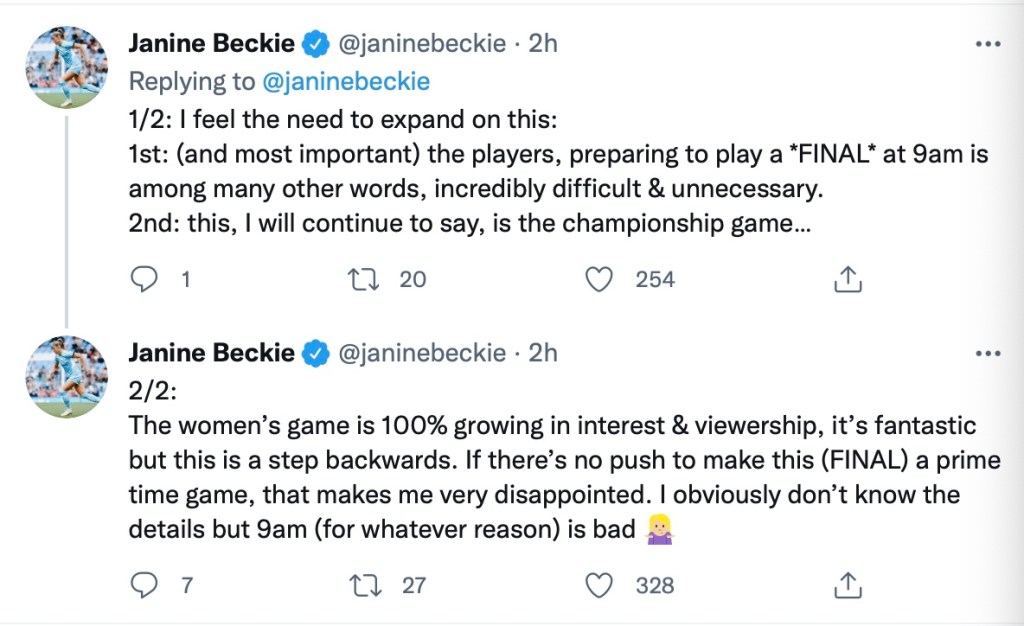
Olympic gold medal winner and Manchester City attacker Janine Beckie also tweeted of her astonishment at the arrangements for the final:
Paul Riley the manager of the North Carolina Courage, who are the current NWSL Shield and Championship holders, simply stated:
“There’s not one league in the world that will play a championship game at 9am but unfortunately we are. Two teams are going to be in it playing at 9am which is sad when you consider what a big league it is in the world and how it is revered and stuff like that. But anyway, that’s probably for another day.”
To be ‘fair’ to the NWSL’s current scheduled time, this is not the first top women’s football competition scheduling blunder this year. The women’s Gold Medal match of the 2020 Tokyo Olympics was originally supposed to take place at 11am local time.
The same concerns over player performance, combined with concerns over player welfare as the temperatures were meant to be in the high 30os (100oF), were raised. The inequity with the men’s time, who were scheduled to play at a more suitable 8:30pm, was also questioned. The game was eventually moved to 9pm that night.
A number of UEFA Women’s Champions League first round group stage qualification games were also given early starts this year, as early as 11am local time – during the working week. Again this was not ideal, but it was also not 9am.
Above: The NWSL’s decision for a 9am Championship Final kick off has led to widespread anger. Photo: Getty Images.
It is also not be the first time a major women’s final will take place around this time. The 2003 Women’s World Cup final, held in the United States, was scheduled at 10am. It was a fantastic match between Sweden and eventual winners Germany. But this isn’t 2003. The world has moved on and seemingly progressed.
This current 9am start shows that it hasn’t progressed enough. If the women’s game is to grow it must be given the circumstances to do so. One cannot expect the best product to arise, or for it to be profitable, if it is not scheduled at times that are optimal for both players and fans.
Clearly discussions still need to be had about the respect that women and those who support them should be given. These are professional athletes and their gender should not result in them playing at the same time as young Sunday league players. A 9am start is insulting to players who have spent ten months building to a championship game as well as to the fans that have supported them along the way.
Women’s football and women’s sport deserves better. If that cannot be given by the broadcaster in question, and supported by the league, then changes need to be made in leadership so that basic respect for proper competition can be a primary driver of those in NWSL decision making positions.
Until that happens it is difficult for proponents of the National Women’s Soccer League to state it is one of the best league in the world. The 9am start proves they are far from this.
Above: Adriana Leon celebrates after putting West Ham United ahead after just eight minutes.Photo: Sky Sports.
Dagenham is turning on the good weather for this important early-season game. Both teams with a lot to prove today but a draw gets them each a point in a hard-fought game with West Ham unable to break their long-standing hoodoo of not winning at home.
West Ham dominated in the first 20 minutes but once Aston Villa settled into the match, it was a much more even affair.
It’s Emily Gielnik’s debut for Villa in this match. Up against her Matildas teammate, Mackenzie Arnold, who is in goal for West Ham. A lot is expected of the dynamic Australian forward, coming off a successful Olympic campaign.
Five minutes in, Dagny Brjynarsdottir sends a ball central to Adriana Leon from the left but Leon’s shot goes wide to the left of the goal.
Most of the possession is with West Ham early on and there is a sustained attack. Lisa Evans ran onto a ball into the box, beating Anita Asante, to pass back to Leon who flicks the ball past the keeper, Hannah Hampton, on the left. West Ham score after just eight minutes.
Above: All smiles for the Hammers after Adriana Leon’s early goal. Photo: @WestHamWomen
A badly timed pass back to the keeper, Hampton, sees her well off her line in a race with Leon. They both get to the ball at the same time and it bounces towards the box into the open. Villa defenders got back in time to save it but could have been disastrous for the visitors.
West Ham is on fire with another run into the box by Brynjarsdóttir. She passes to Leon who crosses. The ball is then bouncing around in the box narrowly avoiding another goal. It goes out and comes back in culminating with a shot by Brynjarsdóttir across the goal.
Almost immediately afterward Lisa Evans gets a shot on goal collected by Hampton.
It’s been all Irons until about 18 minutes in and Gielnik gets the ball, turns on it, and shoots. It’s high over the crossbar but it’s the first action she’s seen and the first time Villa looked threatening.
Villa get a free kick just outside the box after captain Remi Allen is literally bowled over. It goes straight to Arnold in a wasted opportunity.
The second city side’s first serious attack sees Alisha Lehmann bringing the ball down the right and passing to Gielnik. After a quick one-two in the box, Gielnik shoots and is denied by Arnold in her first on-target save of the match. The resulting corner floats over everyone as Villa miss another opportunity to score.
Above: West Ham’s Claudia Walker looks on as Ruesha Littlejohn clears the ball for Villa. Photo: @AVWFC
A long ball to Lehmann sees her dance around the top of the box before shooting. It’s safely in Arnold’s gloves but some nice moves by Lehmann and Villa are looking much more engaged after the early domination by West Ham.
42 minutes in and Allen takes a long-range shot on goal that goes a tad high but at this stage, Villa seem to be a lot more in control and on the front foot. Soon after Chaney Boye-Hlorkah brings the ball into the box and takes a shot that sails across goal and out.
As they come back on from halftime, things are looking pretty even. 49 minutes in and Gielnik passes to Lehmann who takes it into the box and then goes down. She calls for a penalty but it’s not forthcoming.
Sarah Mayling sends a lovely ball through to Gielnik but she’s offside and Arnold has the shot covered anyway.
A long ball down the right to Leon sees her cross to Brynjarsdóttir who heads the ball directly into Hampton who somehow manages to stop a certain goal by being in exactly the right place at the right time.
64 minutes in, Abbey-Leigh Stringer is tackled by Maz Pacheco and Allen and grabs Pacheco as she goes down. Allen is complaining about it and when Stringer gets up, she gives her a good shove. Ruesha Littlejohn runs into the melee trying to calm things down and Stringer gets a yellow for her troubles and the decision goes the visitors way. Almost immediately afterward Littlejohn and Stringer contest a ball. Stringer gets ahead and Littlejohn grabs her around the throat and brings her down. Stringer is livid understandably and Littlejohn gets a yellow for her act of revenge. Gotta love a bit of biffo in this game.
Above: Adriana Leon (19) tries to escape from Villa’s Ruesha Littlejohn. Photo: @AVWFC
After a thwarted West Ham attack, Villa get a shot on goal that’s easily stopped by Arnold. West Ham launch another attack through Leon down the right. Her cross goes straight to Hampton though. Claudia Walker takes another shot shortly after from a distance but its also gathered safely by Hampton.
Immediately after, Petzelburger gets a shot that hits the right post and Gielnik sends the rebound out on the right.
At 74 minutes, Walker is off to be replaced by Lois Joel for West Ham. At 83 minutes Littlejohn comes off to be replaced by Shania Hayles as Villa take a free-kick. It gets to Allen in the box but she kicks it straight to Arnold who has it safe.
Shortly after, a ball comes into the box for Hayles. She rounds Lucy Parker and shoots but Arnold gets a hand to it and it’s out for a corner in a very close call. The corner bounces around and is finally sent out wide by Pacheco.
With two minutes of normal time to go, Hayles gets a corner with a deflection off Gilly Flaherty. It goes to the far post and Asante takes a shot that’s cleared. It’s eventually out for a goal kick. The pressure is definitely on.
There’s four minutes of added time. With two of them left, things get crazy in the box. It’s bouncing around from a throw-in and Petzelburger gets it across to Allen to head it past a wrong-footed Arnold for the equalizer. Wild scenes as it’s 1-1 with 90 seconds left. The final whistle goes and it’s a draw between pretty evenly matched teams.
Above: West Ham’s Abbey-Leigh Stringer (4) battles with Aston Villa’s Chloe Arthur. Photo: @AVWFC
West Ham are left still looking for that elusive home win but both teams can take a lot away from this match. Solid defence and keeping on both sides. Good attacking but finishing needs a little refinement as a couple of genuine chances went begging. Aston Villa recomposed themselves well after the early West Ham goal. This made for a very entertaining match.
Teams: WEST HAM UNITED: Arnold, Wyne, Stringer, Flaherty, Evans, Walker, Longhurst, Parker, Filis, Leon, Brynjarsdóttir. Subs: Leat (GK), Joel, Cairns, Garrard.
Ben Gilby rounds up all the week’s news from the Champions League, Damallsvenskan and Elitettan.
Above: Johanna Rytting Kaneryd, scorer of BK Häcken’s third goal against Vålerenga that sealed their spot in the UEFA Women’s Champions League group stages in midweek. Photo: Expressen.
UEFA WOMEN’S CHAMPIONS LEAGUE NEWS:
BK Häcken made it through to the group stage after their midweek 3-2 win over the Norwegians Vålerenga completed a 6-3 aggregate win. Once more Stina Blackstenius was on the scoresheet, with a brace and Johanna Rytting Kaneryd grabbed the third. Two goals in the last seventeen minutes from Synne Jensen and Katie Stengel gave the score line a more pleasing look from the Vålerenga perspective.
Rosengård‘s hopes are over despite gaining a creditable 3-3 draw away from home to 1899 Hoffenheim. The damage was done in their 3-0 defeat in the home leg. Laura Reinroither increased the German side’s aggregate lead to four goals after just eight minutes before Jelena Cankovic got the Swedes on the board. Sarai Linder put Hoffenheim ahead once more before Mimmi Larsson levevlled on the night with 25 minutes to go. The two sides exchanged goals once more with Jule Brand on target for the hosts and Loretta Kullashi scoring for Rosengård. 1899 Hoffenheim progress to the group stage 6-3 on aggregate.
DAMALLSVENSKAN:
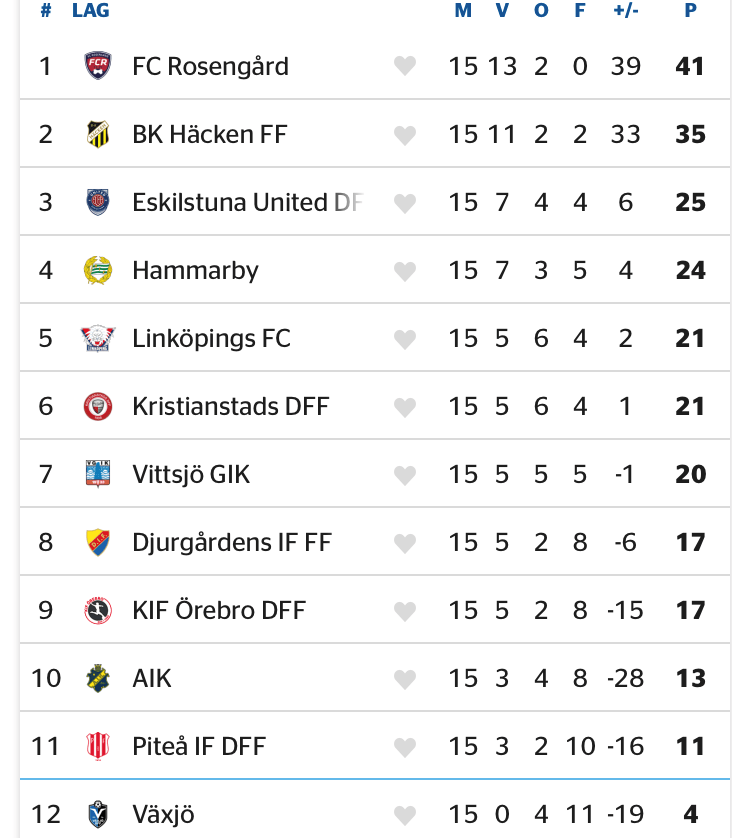
Vittsjö gained an excellent 1-0 victory on the road to third placed Eskilstuna United. They had to thank Sandra Adolfsson for the three points as she scored the only goal just before half-time to the delight of the 371 gathered fans. The visitors will now look to go on a positive run of results in order to keep their own top three hopes alive.
Rosengård continued their imperious form up with a 3-0 dismissal of AIK in front of 300 fans. It took the home side longer than they would have hoped to break through, but once Jelena Cankovic put the league leaders ahead just before the hour mark, there was no turning back. Gudrun Arnardottir and Olivia Schough scored four minutes apart to keep their team six points clear at the top.
Above: Olivia Schough and Mimmi Larsson in celebratory mood for Rosengård. Photo: Walter Luger.
BK Häcken remain second, but they made very hard work of getting a win at struggling Piteå in front of 523 fans. Mille Gejl Jensen scored the only goal after 48 minutes. The midweek exertions in the UEFA Champions League certainly did not help the second placed Gothenburg based side, but ultimately getting three points was all that mattered.
KIF Örebro gained a vital win at bottom side Växjö to avoid being drawn into the dogfight themselves. Wilma Ohman’s goal with just over 15 minutes left sealed their win in front of 176 fans.
Hammarby took advantage of Eskilstuna United’s slip up by coming from behind to win 2-1 at Kristianstads – another side involved in the battle for third place. Delaney Pridham gave Kristianstads the lead to the delight of the 460 strong crowd. Emilia Larsson levelled after 67 minutes with Emma Jansson hitting the winner seven minutes later.
Linköping joined the pack of five clubs battling for third place after a 3-1 win over Djurgården in front of 567 fans. Two first half goals from Cornelia Kapocs, after the Stockholm based side’s Portia Boakaye was sent off, put Linköping on the road to victory. Uchenna Kanu made it three just after the break before Nellie Lily hit a late consolation for Djurgården.
Table From: Svensk Fotboll.
Round Sixteen Fixtures:
Djurgården v Vittsjö
Hammarby v Rosengård
Kristianstads v Linköping
Eskilstuna United v Växjö
BK Häcken v KIF Örebro
AIK v Piteå
ELITETTAN:
Above: Umeå’s Henna-Riikka Honkanen was on target again last weekend. Photo: Pelle Börjesson/BILDBYRÅN
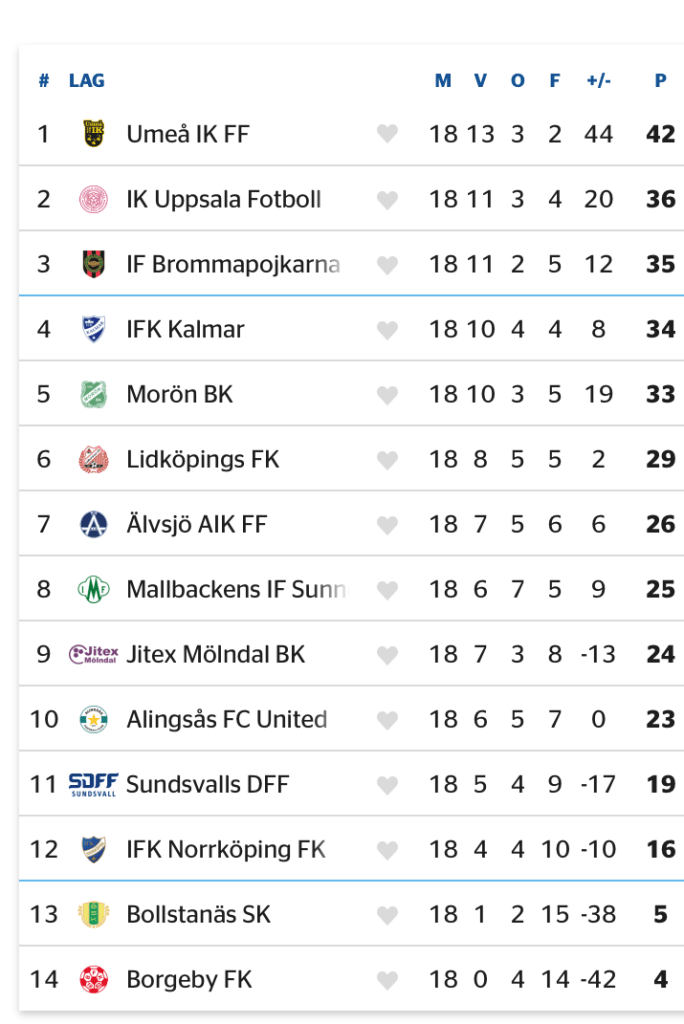
Umeå IK extended their lead at the top of the table to six points after a 4-0 win at home to Lidköpings FK. Two goals in the first 35 minutes from Henna-Riikka Honkanen set the hosts on their way and a brace from Lisa Bjork in nine second half minutes completed the scoring to the delight of the 249 fans. Second placed IK Uppsala suffered a disappointing 3-2 loss at home to tenth placed Alingsås FC United. The visitors were 2-0 up after less than half an hour with Alma Oberg and Rebecca Cameras on target. Ida Stromblad gave Uppsala hope, but Stine Jensen’s strike with sixteen minutes left sealed the points. Moa Ohman’s late goal for Uppsala was nothing more than a consolation as her side’s hopes of overhauling Umeå IK suffered a significant setback. IF Brommapojkarna’s run up the table continued after they thrashed Borgeby FB 5-1. Daniella Famili got the ball rolling with a ninth minute penalty and Sara Eriksson doubled the lead two minutes later. Kajsa Arthursson got a goal back for Borgeby early in the second half, but two goals in the last 13 minutes from Mathilda Johansson and a penalty from Jennifer Sjosten ensured that Bromma are now just a single point behind second placed IK Uppsala. IFK Kalmar remain fourth thanks to a 3-2 win at Älvsjö AIK FF. The visitors raced to a 3-0 lead thanks to goals from Tabby Tindell (2) and Kristen Schnurr. Two second half goals in ten minutes from Älvsjö gave the side from Stockholm’s suburbs hope, but they couldn’t quite get an equaliser. Morön BK are fifth, but only two points behind second place, after a 3-0 win at Jitex Mölndal. All the goals came in the first 33 minutes thanks to Ellen Shampoo, Hildah Magaia and Lova Andersson’s goals.
Latest Results: IK Uppsala 2-3 Alingsås FC United, Mallbackens IF Sunne 0-0 IFK Norrköping, Sundsvalls DFF 2-1 Bollstanäs SK, Älvsjö AIK FF 2-3 IFK Kalmar, Jitex Mölndal 0-3 Morön BK, Umeå IK 4-0 Lidköpings FK, IF Brommapojkarna 5-1 Borgeby FB.
Next Fixtures: IFK Kalmar v Mallbackens IF Sunne, IFK Norrköping v IK Uppsala, Lidköpings FK v IF Brommapojkarna, Sundsvalls DFF v Umeå IK, Bollstanäs SK v Älvsjö AIK FF, Borgeby FB v Jitex Mölndal, Alingsås FC United v Morön BK.
Table From: Svensk Fotboll
NEWS ROUND-UP:
Danish national team midfielder Frederikke Thøgersen, who recently signed for Rosengård, has suffered a cruciate ligament injury and will miss the rest of the season.
Above: Frederikke Thøgersen – Rosengård’s new signing is out for the rest of the season. Photo: FC Rosengård.
Melbourne City, Western Sydney Wanderers, CanberraUnited and Brisbane Roar have all announced significant additions to their W-League squads this week. Impetus hears from all of the players and head coaches involved as the big kick-off gets ever closer.
Three additions by Melbourne City:
Artwork supplied to Impetus by: Melbourne City.
This week, the Sky Blues have announced three major players for their 2021/22 squad list with the arrival of Kaitlyn Torpey from Brisbane Roar as well as the news that Tori Tumeth and Naomi Chinnama have re-signed at the club after being key players last time round.
A former Young Matilda, Torpey made 43 appearances for Brisbane Roar since making her W-League debut as a 16-year-old in 2016.
The hard-working fullback will add attacking threat to Rado Vidosic’s squad this season, as she joins the likes of Emma Checker, Rebekah Stott, Tori Tumeth, and Chelsea Blissett in what is shaping up to be a strong defensive unit.
Having mainly been deployed as a right-back throughout her W-League career, Torpey’s attacking instincts from defence will see her fit in well at City.
Head Coach Rado Vidosic was delighted to obtain Torpey’s signing: “Kaitlyn is a player that will fit well into our style of play and really help us improve this season.
“We know she’ll be working hard to make her mark on the team, and she’ll also bring plenty of W-League experience, despite still being just 21-years-old. We look forward to her joining us this pre-season and seeing her develop into the player we know she can become.”
Kaitlyn Torpey spoke of her excitement to be joining the club: “City’s reputation and history is amazing and I’m so excited to get over to Melbourne and be a part of it.
“It’s a big change but I’m really looking forward to getting to work and I think it will be a lot of fun. I’m not going to stop running, I’m not going to stop working and I just want to be that player who brings plenty of energy to the group.”
Artwork supplied to Impetus by: Melbourne City.
Melbourne City FC also announced the re-signing of 17-year-old defender Naomi Chinnama for the next two seasons.
Starting as a train-on player last pre-season, Chinnama impressed the coaching staff to earn a contract on the eve of the season.
Despite being just 16 at the time, she continued to develop and impress, so much so that she was handed her W-League debut in February’s Grand Final re-match against Sydney FC.
After impressing Head Coach Rado Vidosic in her 20-minute cameo off the bench, Chinnama would then start every fixture for the remainder of the season.
Having now gained valuable W-League experience at such a young age, expect Chinnama to continue to develop and improve over the next two years at City.
Head Coach Rado Vidosic said: “Naomi really impressed us in her first W-League season so it’s great to have her back for the next two years.
“Despite her age, she looked comfortable at the level and gained some invaluable experience. She still has so much room to grow and improve, so we are really excited to keep working with her and to watch her continue to develop.”
Naomi Chinnama spoke of her appreciation for the opportunities that City have given her: “I went into the season with no expectations and hoped that by working harder each day I might eventually get a bit of game time. I’m still in a bit of shock as to how everything turned out. I appreciate Rado and the Club for believing in me and giving me the opportunity.
“The decision could not have been easier. Melbourne City is a top Club and the support from management, Rado and the coaching/technical teams has been phenomenal.”
Artwork supplied to Impetus by: Melbourne City.
The final addition to the Sky Blues squad was 20-year-old defender Tori Tumeth who accepted a new two year deal.
Tumeth made the move from New South Wales in 2020, appearing in every fixture of her inaugural season at Australia’s top level.
After making her W-League debut in Round One against Brisbane Roar, Tumeth went on to start in all but one game.
Her versatility as a player was key to her success. Head Coach Rado Vidosic initially deployed Tumeth at the heart of the City defence before playing her as an attacking wing-back.
The former Junior Matildas captain was one of the bright spots for City in season 2020/21 and will continue to develop her craft over the next two seasons in Melbourne.
Head Coach Rado Vidosic spoke of how easy a decision it was to offer Tumeth a new deal: “Tori was one of our shining lights last season so it’s great to have her returning to Melbourne for the next couple of years.
“She showed a great willingness to learn in her first W-League season and as a result, continually improved her game and was an important part of our team. Tori’s a versatile player and we look forward to watching her continue to develop over the next two seasons.”
Tori Tumeth spoke of her development at the club last season: “I really enjoyed my first season of W-League with City and I was extremely grateful to be given the chance. I am excited to get back to the Club and continue working and building for the next two years.
“I definitely feel like I grew a lot last year under Rado and the rest of the coaching staff, and I really started to understand and implement the City style of play. When Rado introduced me to wing-back, I was able to get wider and higher up the pitch and thoroughly enjoyed learning the new position. I think being versatile is extremely important and ultimately, I want to offer as much to the team as I possibly can.”
Wanderers Re-Sign Three Key Players:
Above: Caitlin Cooper, who captained Western Sydney Wanderers last season is back for the forthcoming season. Photo: Mark Evans/Getty Images.
Western Sydney Wanderers FC announced the re-signing of defender Caitlin Cooper, and forward Erica Halloway plus the return of goalkeeper Sham Khamis for the upcoming W-League season.
A Wanderers legend in her own right, Cooper is set to play in her eighth season in the Red & Black in 2021/22.
The veteran defender has been part of the W-League competition since its inception and continues to bring experience and leadership qualities to the club.
Cooper featured in every Wanderers match last season, making 34 clearances, eight blocks, and 21 interceptions.
Such impressive performances saw her called up to the Matildas for a national team camp prior to the Olympics this year as well as being crowned the Wanderers Medal winner for Player of the Year and Members’ Player of the Year.
Western Sydney Wanderers CEO John Tsatsimas was proud of Cooper re-signing with the club.
“Caitlin sets an example beyond what it means to be a footballer at our club,” said Tsatsimas. We have seen through her football journey her determination and work ethic to give her all for the Red & Black and wider Western Sydney community both on and off the field.
“We welcome back Caitlin for another season which we hope to see more special moments and records broken.”
Head coach Catherine Cannuli said there was a strong synergy between Cooper and the Wanderers values.
“Caitlin and the Wanderers share very similar values which is why she is a wonderful example of who we want our Wanderers players to be and represent,” said Cannuli.
“Caitlin has played an instrumental role in not only pushing the team in striving to be at their best in every training session and every match, but also in helping to create a positive culture and learning environment at the club.”
Cooper said she was “Very happy to be re-signing with the club for what we expect to be a big season for us in the W-League,” said Cooper.
“We have high hopes and lots of goals that we want to achieve together, and I believe that we will be able to go all the way this season.
“Having been at the Wanderers now for the majority of my football career, I have seen first-hand the growth of women’s football both on-and-off the pitch and I couldn’t be prouder of what we have achieved together so far.
“I’m counting down the days now until we return to the Wanderers Centre of Football next month to start training with the team to push for a massive season ahead.”
Above: Back in Red and Black: Erica Halloway. Photo: Getty Images.
A one-club player and Wanderers legend, Erica Halloway will play in her seventh season with the club having signed back in 2015.
Six years later and Halloway has played in close to 60 matches in the Red & Black and scored seven goals.
The forward returned to competitive football last season after recovering from an Anterior Cruciate Ligament (ACL) injury during the 2019/20 season and went on to make four appearances.
Western Sydney Wanderers CEO John Tsatsimas was delighted with Halloway’s re-signing.
“Erica’s belief and loyalty to the club over the last six years cannot be understated,” said Tsatsimas.
“It was a very hard-road back to the W-League for Erica following her injury, but we were so proud to see her back on the pitch last season. We are even more proud to see her re-sign and don the Red & Black hoops for another season. Erica has been a fantastic role model for our club for a number of the years, both on the pitch and the community where she has been a leader in that space.”
Head coach Catherine Cannuli welcomed back Erica for another season. “Erica’s belief, loyalty and passion for the club has been incredible,” she said.
“She is a true leader, calm and confident in her ability to help the team on the pitch and help shape the next generation of Wanderers and we are very proud to have her back for another season with the club.”
Erica Halloway spoke about what an honour it was to continue her football journey at the club.
“The Wanderers are a family to me and it means the world to me to be able to represent the Red & Black,” said Halloway.
“I have always said I will only ever play for one club so I’m delighted to re-sign for my seventh season. We’re expecting a big season at the club under Catherine Cannuli and I can’t wait to get to work with the team to achieve the goals we have set out for ourselves.”
Artwork: Western Sydney Wanderers
Sham Khamis previously played for the club back in 2014 and featured in three matches before seasons at Sydney FC, Canberra United and more recently, Melbourne Victory.
The experienced goalkeeper has been a regular in the domestic football scene and has played 50 games between the sticks in the national competition.
Head coach Catherine Cannuli spoke of her pride in the Western Sydney local’s return to the club. “It’s fantastic to welcome Sham back to the club as she understands what it means to represent the region with pride and passion.
“Sham brings with her an abundance of experience and a winning mentality that we look forward to having in the team this season.”
Khamis said she was delighted to once again represent the region where she grew up. “I’ve grown up in Western Sydney, it is my home and it’s only fitting that I finally return and put the Red & Black on,
“I know I have so much left to give, especially to a club that continues to grow and establish themselves in the league. I can’t wait for this season to get started because I know my values and passion aligns with what the Wanderers stand for.
“I had last season off , so for me personally it’s about getting back into playing at this level and enjoying the environment and intensity at which we train and play at.
“For the club, we want to make Finals. We’ve made the Finals once in our history, so this year we want to make sure we start strong and make the Top Four. I believe we have the squad to do so.”
Big Signing For Canberra United:
Artwork: Canberra United.
Canberra United announced a significant addition to their squad with the news that striker Allira Toby will be joining the lime green machine for upcoming W-League season.
The 27-year-old joins Canberra from Sydney FC, where she made 14 appearances in 2020/21, helping the side reach the W-League Grand Final.
In 2016, the Queenslander made her W-League debut with Adelaide United before heading to Brisbane Roar where she was awarded the club’s Golden Boot in their 2017/18 Premiership winning campaign and again the next season.
Toby said signing with Canberra is an exciting new journey for her as a player. “I’m happy to be in green this season and I can’t wait to be a part of everything that the team, club and fans represent,” Toby said.
“As a team, I hope we have a consistent season and a spot in the finals. Individually, honestly, I just want to be playing well, scoring goals and helping the team in whatever capacity I can.”
“Canberra just seems like the right fit. It’s a great opportunity for me to be able to grow and learn, both on and off the field. I can’t wait to meet my new teammates and get stuck in for the upcoming season.”
Canberra United Head Coach Vicki Linton said she’s looking forward to Allira coming to the national capital: “I am really pleased that Allira will be joining Canberra for the upcoming season,” she said.
“She brings W-League experience and is a renowned goal-scorer. I am excited to get her into the training environment and see how she combines within our team.”
Toby will join the team for preseason next month.
Brisbane Roar Add Another Queensland NPLW Star:
Artwork: Brisbane Roar.
Brisbane Roar have signed Japanese midfielder Rie Kitano.
The NPL Queensland star makes the step up after consistently impressing in the state’s top women’s competition, scoring 31 goals in less than three full seasons.
“Roar is the squad that everyone wants to be a part of so I’m really happy to be involved,” Kitano said.
“I wasn’t thinking about it when I came to Australia, but after a year here I started to look for an opportunity to play in the W-League. “I just can’t wait to get started!” Kitano played for Okayama Yunogo Belle in Japan’s Nadeshiko League before relocating to Australia in early 2019 to link up with Gold Coast United.
The 29-year-old, who moved on to Souths United this year, got to face her new W-League side as part of the NPL All-Stars team that took on the Roar in an exhibition match last December.
“From my perspective, Rie has been a standout performer in the NPL Women’s competition across the past few seasons,” said Head Coach Garrath McPherson.
“She is a creative midfielder who is exciting to watch from the sideline. She has assisted and scored some amazing goals already this year and I encourage people to get along and watch her in action across the last five rounds. I have also been really impressed with Rie’s work rate and effort in defending moments this season.
“She is a competitor who further strengthens our winning mentality in the midfield. Like Shea Connors and Mariel Hecher, Rie is another example for players in our NPL Women’s competition of the pathway that exists into the W-League.”
There has been talk about a New Zealand-based club joining the W-League for quite a while. Wellington Phoenix, who initially looked like joining last season were finally announced overnight as the newest club for 2021/22. We hear from the APL, Phoenix officials and also discover further expansion plans for 12 months time.
Artwork: W-League.
The W-League will grow its number of matches by more than a quarter next season, with the introduction of Wellington Phoenix as the competition’s 10th team.
As the strategy for the growth of women’s football announced by the Australian Professional Leagues (APL) last week immediately comes to life, Phoenix will become the first new team in the competition since 2015.
The removal of byes from the draw and an extra round of finals means the competition will grow from 57 games to 74 next season, immediately widening opportunities for players less than two years before the FIFA Women’s World Cup 2023 to be held in Australia and New Zealand.
Western United FC and Central Coast Mariners have both stated their intention to join the W-League in 2022, whilst discussions continue with Macarthur FC, as APL delivers on its promise to invest significantly in women’s football and fulfil its commitment that each A-League Club has a W-League team. Under the terms of Wellington’s women’s team joining the W-League, at least seven players must be Australian, while up to four more can be visa players.
The team will be run as a partnership between Wellington Phoenix and New Zealand Football. It is likely to be based in New South Wales for the early stages of the coming season, until the resumption of the Trans-Tasman travel bubble.
Above: Wellington Phoenix’s W-League ambitions have finally come to fruition. Photo: APL/New Zealand Football.
“We promised we would move quickly to implement the vision contained in our strategy for the growth of women’s football, and having Wellington join the W-League next season immediately creates more games and more football,” said Greg O’Rourke, APL Leagues Commissioner.
“It comes hot on the heels of a groundbreaking collective bargaining agreement that immediately lifts standards across all our clubs, particularly for the players in the W-League teams.
“We would like to thank both Football Australia and New Zealand Football for their part in helping us to expand the W-League. This is an exciting day for APL but is just one more step in our bold plans for the growth of the game.”
Wellington Phoenix General Manager David Dome paid tribute to the recent work that led to this expansion announcement.
“This is the culmination of years of hard work and perseverance to make a professional women’s football team in New Zealand a reality,” said Dome.
“Thanks must go to APL and the incredible work they have done since taking control of the A-League and W-League eight months ago; their strategic focus on providing more games and more opportunities for the nations’ elite female footballers – across both sides of the Tasman – is vital to the growth of the game.”
Ted McCarter is the chairman of Bure Valley Youth, one of Impetus’ partner clubs. He spoke to Ben Gilby to bring us up to date with everything that has been going on at the Norfolk club since spring.
Above: Bure Valley youngsters pictured with their player pathway senior neighbours Wroxham – both teams have content partnerships with Impetus. Photo: Bure Valley YFC.
“It’s been really busy! Through lockdown I was bombarded with emails and messages from new parents looking for activities for their children. Covid and Lockdown has seen parents look at all options to keep their children occupied and busy. As a result we welcomed loads of new faces to the club enabling us to consider new teams in varying age groups. Our Covid protocols have always been strict, parents seemed reassured by this and kept coming through the gates.”
Once the green light was given for junior football to recommence, Bure Valley were quick to return to action as special competitions were organised, as Ted outlines:
Above: Bure Valley U13 Wildcats. Photo supplied by: Bure Valley Youth.
“The Norfolk Women’s and Girls’ Football League (NWGFL) decided to end the league season and instead ran a Champions League style cup competition. This was extremely popular and stretched the season out for a few extra weeks. Teams obviously started back relatively cold with little or no preparation but most took it in their stride and gave it a go. Our teams enjoyed the competition and made five finals.
“Our U9 Kittens lost to Gorleston, U12 Leopards lost to Thetford, U13 Wildcats beat Waveney, U14 Wildcats beat Sprowston and our U15 Wildcats lost to Aylsham. All great games and fantastic experiences.”
The impact of Covid has hit Bure Valley hard from a financial perspective too, as Ted explained. “Our club coffee shop has remained closed for well over a year so a total loss of valuable revenue. Bills still need to be paid but we’ve obtained some small grants to help plus our fantastic parents continued to pay subs, amazing support. We’ve survived and look forward to reopening the coffee shop in September.
“Despite this, we’ve formed new teams. A new U8s and U9s, plus an additional U11s too. We’ve also started an U7 boy’s team that has come through from our very successful Mini Kickerz. As with most clubs we’ve lost coaches and gained new ones, volunteers are always difficult to find, people’s lives are very busy these days and committing fully to grassroots football is a big deal.
“We’ve improved our facilities with a new car park surface and trees cut back – all boring jobs but have to be done. Hopefully everyone enjoys a visit to us!”
Ted outlined the club’s aims for the coming season. “Pretty simple. Keep as many children playing football as possible. Enjoying the game whilst having fun. Smiles on faces are what we want to see.
Above: Bure Valley youngsters pictured with one of their favourite players, Wroxham’s Amber Cantwell – both clubs are linked by a player pathway and Impetus are also partner clubs to both. Photo supplied by: Bure Valley YFC.
Results are pretty much irrelevant, yes it’s nice to win some matches but it’s not the main objective. Success is not judged by the amount of trophies you win. If we can keep sticking to our ethos I’m sure we’ll continue to grow.”
The Scottish Football Partnership Trust pictured here at Hampden Park today with a cheque for £100,000. Photo supplied by: Scottish Women’s Football.
An anonymous benefactor has donated a further £100,000 to The Scottish Football Partnership Trust (SFP Trust) in support of Scottish Women’s Football (SWF). This donation will help strengthen the infrastructure and capacity of SWF to drive forward the priorities of increasing commercial revenue, audience numbers and participants. A previous donation of £100,000 in July 2020 helped directly support SWF Championship clubs during the COVID-19 pandemic.
The SFP Trust, established in 2014, is dedicated to supporting the grassroots level of the game in Scotland with funding opportunities for initiatives which assist in encouraging and sustaining greater participation in football.
This funding will be utilised directly by SWF to support the whole girls’ and women’s game. This includes the creation of a new Commercial role who will be responsible, alongside the Commercial Director, for attracting and activating new partnerships and sponsors for the game.
Scottish Women’s Football Chair, Vivienne MacLaren, said: “We are delighted to receive a further donation from this generous anonymous donor, and sincerely thank them for it. Their previous donation significantly helped SWF Championship clubs and I have no doubt, supported their sustainability ahead of the new 2021/22 season.
“This new award will help us strengthen the infrastructure and capacity of SWF which will support our members as we seek to increase commercial revenue and grow the numbers of those playing the game. This funding will help us to better support clubs and ensure more girls and women can enjoy football.
“I want to thank the donor and the Scottish Football Partnership Trust – by working together we are maximising the impact of this significant donation.”
James Clydesdale, chair of SFP Trust, said: “We are delighted to receive this donation and to have the capacity to invest further in Scottish Women’s Football. With an increased staff base, SWF can further develop and enhance participation opportunities in the game for girls’ and women across Scotland. This is a key area of interest for the SFP Trust”.
Above: The Matildas group are coming back together later this month. Photo: Football Australia.
Matildas Head Coach Tony Gustavsson today announced the finalised 25‑player squad to take on the Republic of Ireland on 22 September 2021 at Tallaght Stadium, Dublin.
The September training camp and international friendly marks the beginning of a new international cycle that will include the 2022 AFC Women’s Asian Cup, a home FIFA Women’s World Cup in 2023 and the Paris 2024 Olympic Games.
Gustavsson and his coaching team have already commenced the work of setting the foundations for the next three years.
Above: Australia head coach Tony Gustavsson. Photo: supplied by Football Australia
“While there were many aspects of our Tokyo campaign that we were proud of, I share the strong sentiment of the playing group that there is still unfinished business,” said Gustavsson.
“It is what makes our whole team extremely motivated and energised for the next phase of this journey towards the World Cup. We have analysed our performances and have some great insights for us to work with.”
“However, as we keep working to improve all areas of our game, we will ensure that our aggressive pressing game and our attacking mindset will always remain at the heart of who we are.”
For the training camp and international friendly match against the Republic of Ireland, 18 players from the Tokyo campaign will return. A cohort of defenders have been added with Emma Checker and Jenna McCormick recalled, while W-League Championship winning captain Angela Beard, W-League Young Player of the Year nominee Jamilla Rankin and her former Brisbane Roar teammate, Winonah Heatley, have been invited to test themselves in the national team environment.
Above: Jenna McCormick is given her first call-up under the reign of Tony Gustavsson. Photo: Football Australia.
Midfielder Elise Kellond-Knight and defender Karly Roestbakken will also join the camp in the opening days to undergo assessment from Football Australia’s Sports Science and Sports Medicine team. Meanwhile forward Caitlin Foord will remain in England to continue her rehabilitation from injury.
Gustavsson told the assembled media that his selection was focused around his review of the team’s performance in the Olympic Games where the Matildas finished fourth. He explained the need for a 25 player squad for a single friendly due to wanting the opportunity to look at players who, although may not be ready for international football, are part of the long term plan for 2023 and beyond.
He went on to say: “The next phase presents a fresh start for all players – whether they are plying their trade in Australia, Europe, Asia, the United States or elsewhere. We have a long runway to 2023 and we want to utilise every camp, every match, every moment possible to become one day better.”
“We have previously stated the importance of presenting players with opportunities to experience the national team environment and, with our scouting network, we will look to continue to do so in a measured manner.”
The squad will start to come together over the weekend ahead of next week’s camp.
The match against the Republic of Ireland takes place on Tuesday 21st September local time with a 7pm KO in Dublin. On AEST, kick-off is 4am on Wednesday 22nd September.
Above: There was plenty more for Wroxham to celebrate on Sunday. Photo: @WroxhamWomen.
The Yachtswomen made it four wins out of four with a hard-fought victory at Bedford on Sunday afternoon.
Going into the game without leading scorer Grace Birchall, a change in formation saw Lauren Bullard leading the line with Holly Walker playing on the left flank in place of Birchall and it was Walker who got Wroxham off to the perfect start, dispossessing a defender and sliding the ball past the home keeper.
The visitors buoyed by the early success pushed forward, and Walker was in the action again with Bedford forced to concede a corner from a dangerous cross into the goal area.
Bedford were looking dangerous on counterattacks and once such move forced a rash back pass to Fullbrook, who was left no alternative but to punch the ball clear to prevent a goal, with the referee awarding an indirect free-kick to the hosts. However, Wroxham were able to clear the danger.
The visitors continued to push forward looking to extend their lead with Amber Cantwell acting as a catalyst to the attack and forced a couple of corners in quick succession. However, a mistake playing out from a goal-kick allowed the visitors to equalise.
Wroxham had a golden chance to regain the lead just before the break when Cantwell was upended in the penalty area, but she saw her penalty come back off the post with the keeper well beaten as the sides went into the break level.
The early pressure in the second half came from Wroxham, with the home keeper saving at the feet of Naomi Cooper, then Cooper played inside to Bullard who in turn fed Becky Russell only to see the latter’s shot deflected for a corner.
However, the pressure paid off seven minutes into the half, with Cantwell latching onto a cross and guiding the ball past the keeper to give Wroxham a 2-1 lead.
Cantwell hit the post for a second time after beating a defender and saw her shot from the rebound go just wide of the post, before Gracie Squire saw an effort go narrowly past the post.
With just over 10 minutes remaining, Alice Parker hit a rasping shot from 30 yards into the top corner after Bullard played the ball into her path.
Above: Wroxham’s Amber Cantwell receiving her player of the match award. Photo: @WroxhamWomen.
The visitors comfortable saw out the remaining minutes to consolidate their second place in the league and five points ahead of their nearest rivals.
Teams: BEDFORD: Teamsheet not supplied.
Scorer: Unknown.
WROXHAM: Fullbrook, Strauss, Parker, Horn, Meers, Scully, Holloway, Russell, Walker, Cantwell, Bullard. Subs used: A Long, N Cooper, G Squire.