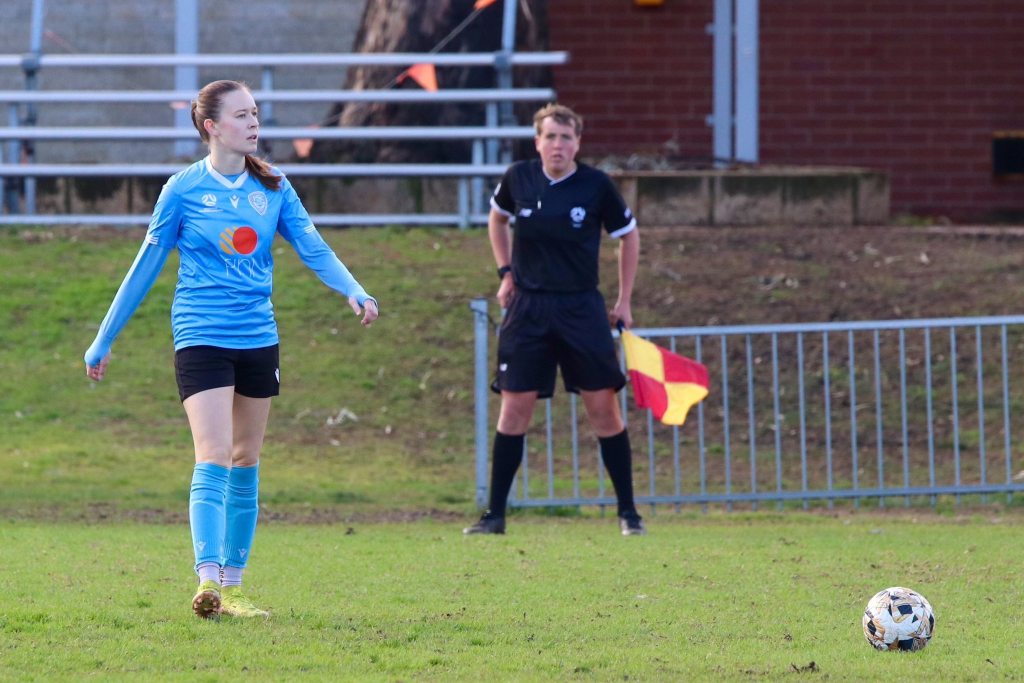
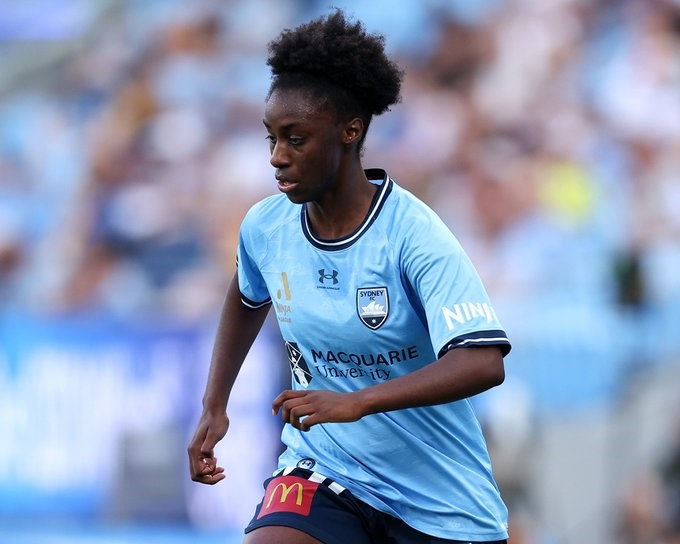
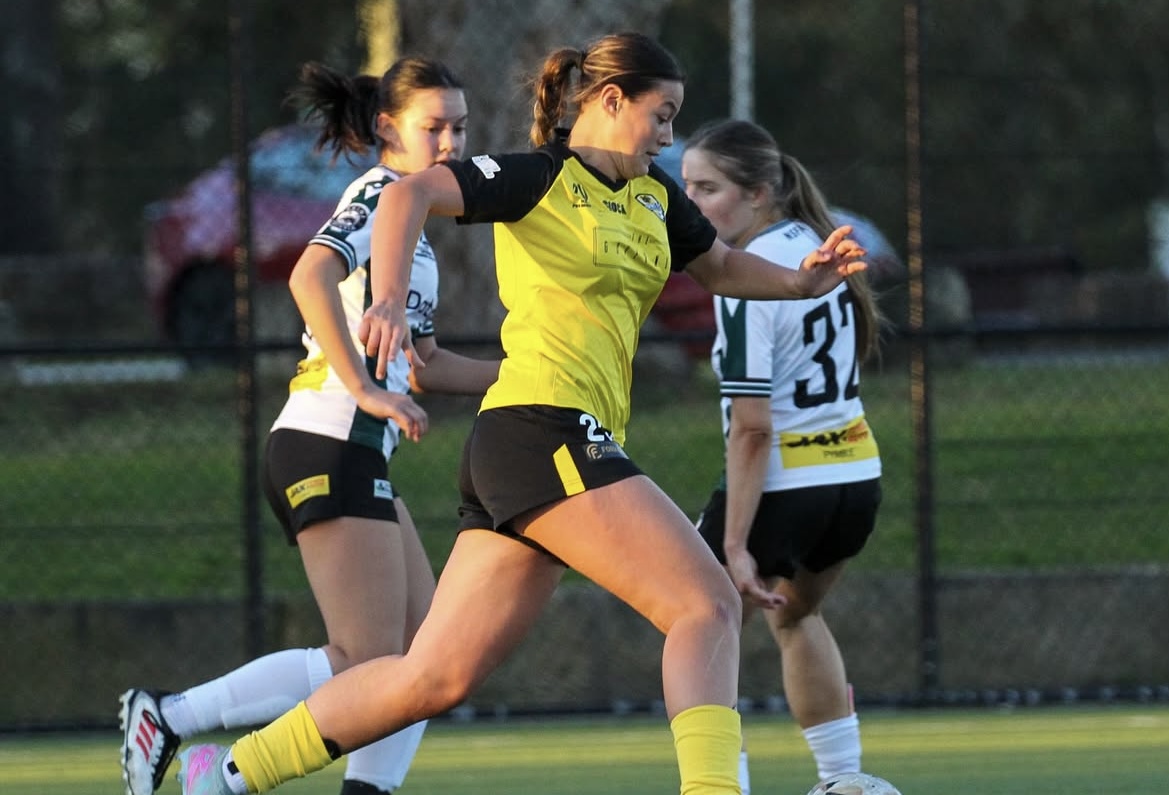
Above: Matilda Böhm (azure shirt) puts in a tackle against Balcatta Etna during the month. Photo: Rob Lizzi.
28/8/25
We’ve assembled a group of people who are watching the competition’s matches especially closely to identify the league’s most consistent players each month. For August, Ben Gilby, Kelechi Osunwa, and Tommy Doleman produced a shortlist of players, from which the winner was selected.
The shortlist
Cate McAuliffe (Football West Academy)
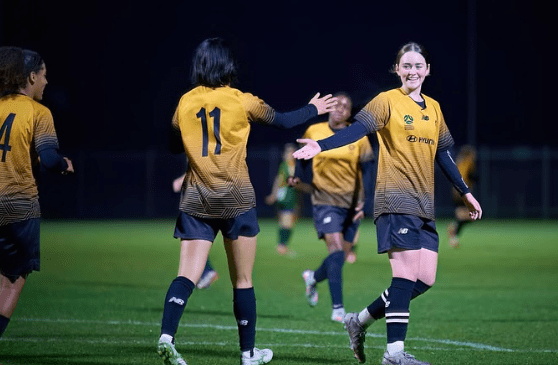
Above: Cate McAuliffe (facing camera) – has been superb for the Football West Academy this month. Photo: U18sNPL
The Football West Academy has confirmed a spot in the top four after a tough month that has seen them overcome a backlog of matches due to their participation in the Young Matildas Championships in New South Wales and the weather, which necessitated the rearranging of their State Cup Semi-Final with Fremantle City.
Whilst results haven’t gone the way the teenage side would have liked during August, with the exception of an impressive win over Perth RedStar, Cate McAuliffe has been a real standout throughout the games.
The midfielder scored three times (against Fremantle City in the State Cup semi plus league strikes against Murdoch University Melville and Perth RedStar) and was a hugely influential presence in her side’s ever dangerous attack as evidenced by her superb assist for Lacey Heys’ opening goal at Perth SC in Round 21.
Whilst dropped points put a major spanner in the works of their hopes of a top two finish, it has been a strong month for McAuliffe, and her side will be confident of defeating anyone during the Top Four Cup.
Jess Flannery (Perth SC)
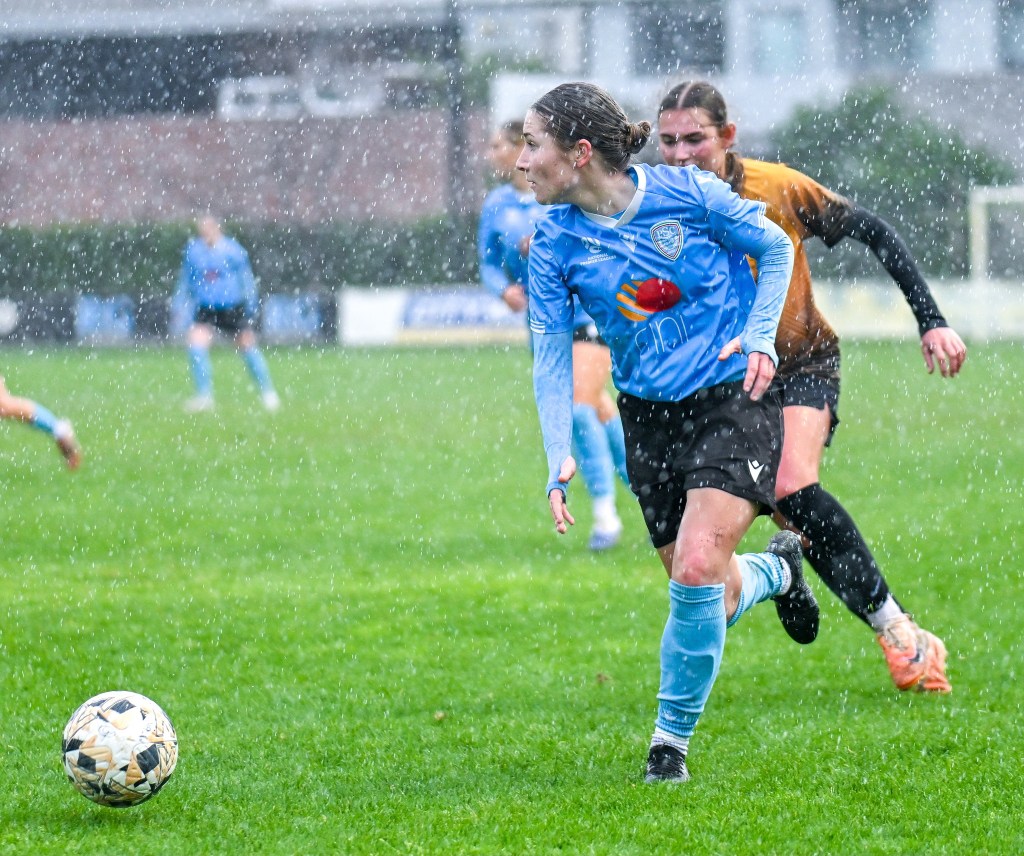
Above: Jess Flannery (azure shirt) looks up as she breaks through against the Football West Academy in Round 21. Photo: Rob Lizzi.
The June winner of the Impetus NPLW WA Player of the Month award has had another strong set of performances in August.
Flannery caught the eye with an intelligent performance at Perth RedStar, where she was not only a key part of the attack, but also got back to support her defence in the second half when RedStar began to put the pressure on in a crucial game in the championship race.
Across the month, her runs into space, support to her teammates, and devastating attacking play have marked her out as a real danger player.
The attacker has been on target twice during the month in her side’s wins over Subiaco and Balcatta Etna.
Leyna Wood (Fremantle City)
Above: Leyna Wood (black shirt) in action at Subiaco earlier this season. Photo: Denyse RM Photography.
It is a second consecutive nomination for Fremantle City’s American attacker, who has been a key part of her side’s push for a place in the Top Four.
Once well-adrift of the leading clubs, Freo embarked on a superb run of results which had them breathing down Balcatta Etna’s neck for that last spot in the September action, as well as clinching a State Cup Final slot against Pete Rakic’s side this coming weekend.
Wood has become a major handful for the league’s defenders, and added five goals to her tally during the month following braces against Perth RedStar and UWA-Nedlands, with the other strike coming against Subiaco.
Impetus NPLW WA Player of the Month for August 2025:
Matilda Böhm (Perth SC)
Above: Matilda Böhm – Impetus‘ NPLW WA Player of the Month for August. Photo: Denyse RM Photography.
Matilda Böhm has had an outstanding month. Part of a Perth SC defence that has only conceded 14 league goals all season, the German is not only a key part of the Azzurri‘s brick wall, but she has such cultured footwork that brings those in front of her into the game.
Bohm’s brilliance has been seen in the month’s big games against fellow top four sides Perth RedStar, the Football West Academy, and Balcatta Etna, where her side earned 10 points from a possible 12 that ensured they clinched a first-ever NPLW WA championship.
On the money perfectly weighted passes that dissected opponents’ midfield to play in her team’s attackers were crucial aspects in Perth’s unbeaten run during the month, as well as her continued strength in defending.
Impetus NPLW WA Player of the Month Roll of Honour 2025 season
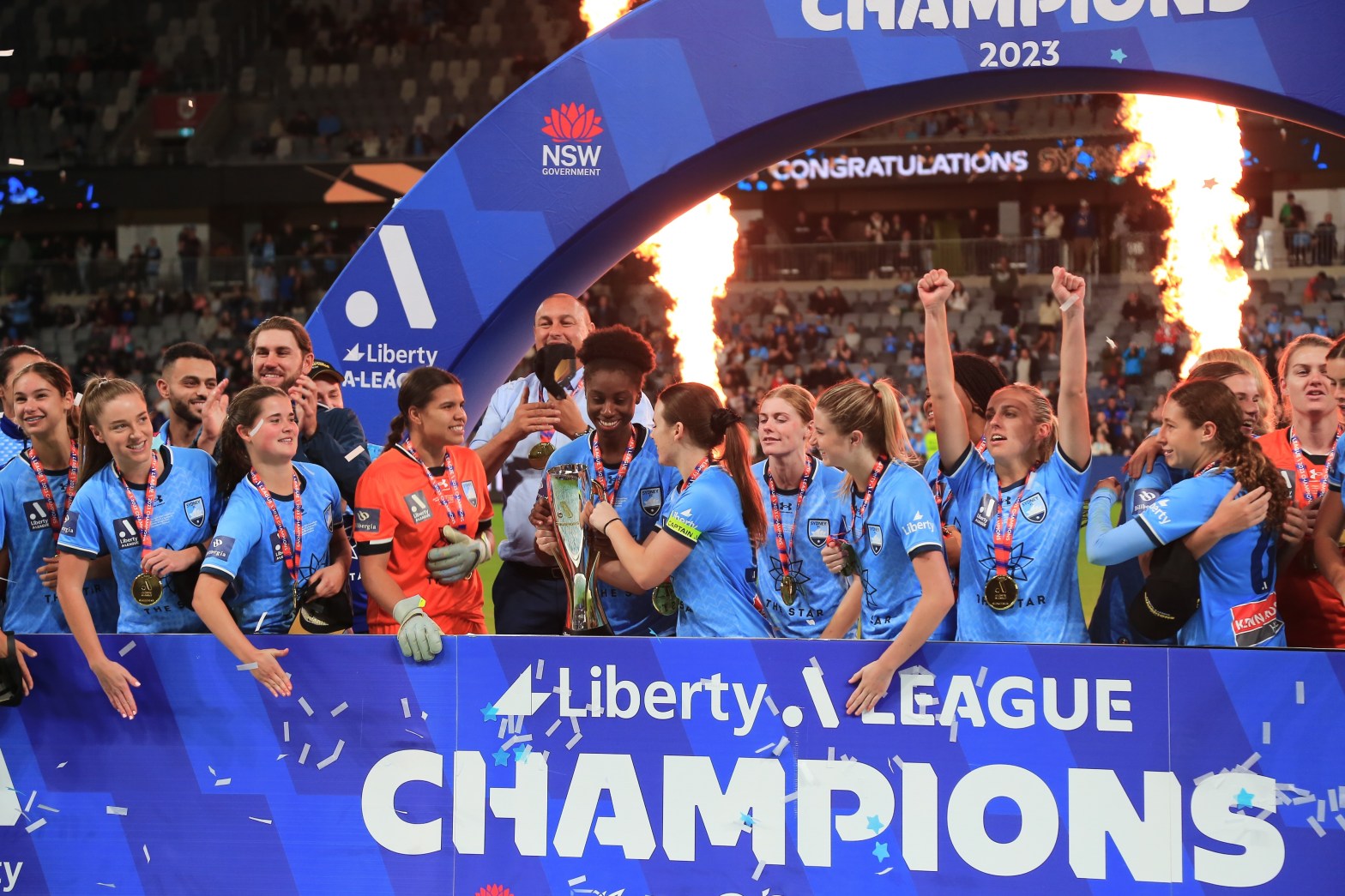
Above: Princess Ibini lifts the 2023-24 A-League Women Championship Trophy. Image: Kris Goman for Impetus.
By Genevieve Henry (28/8/25).
One of the greatest Sky Blue and A-League Women players of all time in Princess Ibini is departing Sydney FC for an unnamed overseas opportunity. Her absence will be mourned as head coach Ante Juric called her the “heart and soul of Sydney for the past ten years.”
At just 25 years of age, Ibini will leave as the most capped Sydney Women’s player of all time with 163 appearances. She holds many impressive records, including being the only player–man or woman– to appear in 8 Grand Finals. Her honours include three Championships (2018–19, 2022–23, 2023–24) and three Premierships (2020–21, 2021–22, 2022–23), as well as being part of the first A-League All Stars Women Team in 2024. She was also recognised when she was awarded the Sydney FC Rising Star Award in 2018–19.
Her 31 goals certainly paint a good picture of her contribution, but do little to represent the full story of her time in Sky Blue. Ibini’s presence as a leader on and off the field have been vital during the continuous changeover of players, providing a constant presence.
“She’s a fierce competitor, a wonderful teammate and has contributed massively to our success with her goals, assists, and leadership,” said Juric, who expressed nothing but gratitude and pride to see her take this next step.
Ibini started her career as a 15 year-old, making her debut in Canberra in 2015. After a decade with her hometown club, it’s finally her time to embark on a new adventure.
Above: Ibini during one of many ALW appearances in Sky Blue. Image: Sydney FC.
“I’m so thankful to Sydney FC for believing in me as a 15-year-old and giving me the chance to live out my dream,” Ibini said. “It’s been an incredible journey — to play so many games, win so many trophies, and to make friendships that will last a lifetime.”
Juric has seen Ibini grow immensely over the years and was full of praise for the striker. “Princess has been the heart and soul of Sydney FC for the last ten seasons,” he said. “She joined us as a young teenager and grew into one of the most consistent and reliable players this league has seen.”
For fans of the A-League Women, Ibini will be sorely missed. She has been not just a star, but a staple of the league for so long that many cannot imagine the league without her. But, as the ALW has often been seen as a jumping off point, most will be thrilled to see her ply her trade abroad. Juric’s thoughts likely reflect the group sentiment of the entirety of the Australian women’s football community, saying, “We’ll miss her dearly, but we’re incredibly proud to see her take this next step.”
“This club will always have a special place in my heart, and I’m excited to see what the future holds.” Ibini continued, “Wearing the Sky Blue shirt has been one of the greatest honours of my life, and I leave full of pride in everything we’ve achieved together.
Above: Dominique Janssen for the Netherlands national team. Photo: @oranjevrouwen on X.
After a summer packed with international tournaments, club football takes center stage again. This year, Manchester United aim to build on just their second-ever top-three WSL finish. Ahead of the 2025–26 season kicking off on September 6th, Impetus Football’s Catherine MacKenzie sat down with United and Netherlands defender (and occasional midfielder) Dominique Janssen.
So I thought I would just start by just asking how you are. You’ve been in Manchester at United now, for a year. So how that’s been?
DJ: Now first of all I am doing good, it has been a good pre-season so far. Gradually trying to just get, you know, started on the real work, with the Champions League qualifications coming up next week, so that’s that’s very exciting. I’ve been here now for one year, I think time just generally flies. Even though there are always times where you feel that you have a bit of a tough time, it’s normal, you know, moving away to a new country.
But obviously I’ve done it before, but I mean moving here just building your life again. It’s you know, once you get older your values are more and more to have the right people around you. But yeah I settled in well and I’m just really looking forward now to the next season. I just think it’s crazy. How quick the time goes and that now already one another great season is done and we go into the next games into the next season again.
I was reading up and you were at Wolfsburg for five years. What’s the transition been like, and have you noticed a load of changes within the standard of the WSL?
DJ: Yeah, generally, I just feel like the attention. You know, for the games and the media attention has grown massively like obviously England is a country made for football. So it’s just really fun to see that they keep those standards high obviously. It’s nice that everyone gets a lot of exposure. Um, and of course, when the national team is being successful this year again, that’s a massive push for the league as well. So it’s nice to see that.
It’s just been pushing forward and we want to generally push forward in the women’s game and I think it’s important that it comes with success. England’s having some successes and you can see how many people want to go to England and play in the English league. Now again, how many big players are coming to the WSL? It shows that everyone wants to play here. Everyone wants to compete here. Everyone wants to get some prizes here.
I was actually going to ask about that because there’s a lot of Dutch players in the league. What do you think makes Dutch players fit in so well, because you came across and you seemed to seamlessly kind of fit in and I know you had prior experience in England, but we’re seeing the same with other Dutch players.They come in and it just seems like they’ve always been here. Do you think there’s something special within like the two countries, how we both perceive football or styles of play?
DJ: I just think generally we as Dutch people, we are very good at adjusting because we are a small country. Obviously, we are close to Germany, Belgium. Most of the people can speak a little bit of German, because we’re so close to the German borders. Then we all can speak very well English. So when people go to a country, you know, I think that we are just very flexible and we’re really good at adjusting and just want to really get to know the culture the country that we are in. So I think that’s also what makes it easy.
And and also we as Dutch people, I think the development that we have – we want to play football. So I think the English style of football is maybe different than the Dutch style but because we learn to play football very technically from when we are young, that obviously helps. When you go to a league where the speed is going to be higher than in the Dutch League, for example. I think that’s also one of the reasons why so many people just come here and they adjust so easily. So I think it’s really, you know, nice to see that and nice to hear as well that you’re saying. It seems like you guys just come in and it seems like you’ve never been anywhere else. Yeah, so I just take that as a compliment.
And I was just going to ask about the Bundesliga as well. Uh, kind of how that compares to the WSL. Not which one is better, but kind of any similarities or major differences between between the two leagues.
DJ: I also think it depends on what team you play for. Because I remember when I was playing at Wolfsburg, we are most of the times the favourites, because Wolfsburg won so many prizes in Germany.. You have everything to lose and you just want to win every single game because that’s the standard there is. Um, we just had a lot of the ball there attacking a lot. You’re the favourite in every game. And here in England it’s….if you’re playing for a big club, even if you play for Chelsea, or even Arsenal, and for us Man United…everyone wants to beat you and you have so many good teams that even the, I guess the top four with Man City or Chelsea, we we all want to beat each other as well.
We all want to become Champions so there’s so much competition going on and if you compare it to Germany, I think now as well they are improving. Like there are more teams that also stepping up at this point and making it the big teams difficult. In England, it is like if you have one bad day, you can even, you know, lose against or drop points against maybe someone that’s about to relegate. And I think that’s just a massive difference if you just compare it to the German league and the and the WSL.
It’s like I still think that they are also at a really good level because the WSL, I noticed that I feel like it’s way more physical. There is way more speed involved and that’s like a very important aspect. Germany obviously is also yeah it’s important that you know your physical and stuff but I don’t know, I feel like the attention is way more on that here in England than it was in Germany.
Above: Janssen at Wolfsburg. Photo: Wolfsburg website.
I was gonna ask if it’s different because when you were with Wolfsburg, like you said, you’re the favourites.So you kind of have Wolfsburg and Bayern always competing for first. Now you’ve got challengers, you’ve got Frankfurt coming in sometimes challenging. United are very much one of the challengers, like, you’re always pushing Chelsea. Is that a different mindset, like is that a different way of thinking about things?
DJ: Uh yeah I think that’s definitely different. You know, like you said in Germany, if you have one team that you really have to beat, you know, you have to do your job every single week, but then it’s important that when you play for example, Bayern Munich, you have to make sure you win that game because that could be a decider. And England is just completely different because you have so many top teams and I was… well, even London City Lionesses is coming up, but seeing what type of players they are signing….Yeah, I think it was very interesting to see how this is gonna go because they can also be a surprising team and just make teams, you know, have a hard time.
So I think that’s the very exciting part and that’s also what draws so many players to England. Because even if you play for, let’s say Aston Villa, where I know some Dutch players, or the London City Lionesses or whatever, those teams can still surprise and get some points off you. Yeah but I think that’s just very exciting.
Uh I have to let you go in a minute, but I just wanted to ask about preseason, how important is it. And I know that you are a big advocate of well-being and looking after your well-being. So how important is it ahead of a new season? Kind of how to get your yourself ready?
DJ: Yeah, I think now it’s extra challenging because obviously we had the Euros and players are having less time off, you know, to really switch off than if you just don’t have a big tournament in the summer. But I think the club has been pretty good. They have been giving us all some some time off which after a big tournament after being away for so many weeks with the with the national team. I think it’s important that you you have some time to just switch off and just do whatever feels good for you in the moment.
If you’re, you know, if you go to the Euros, it’s every day. You just have to go go and there’s not really time to think or not really time to rest. Um, personally, to be honest, I decided this time also after the Euros to just stay at home, just be at my mom’s place. And just every day, I just felt like, okay, today this feels good to to do for me. So I’m gonna do this, but maybe another day I plan to do something another day I plan to do nothing.
So for me, it was just very important to just do whatever felt right in the moment, because there are so many emotions, so many things happening in your head and you just need to really be able to switch off where after, having two weeks off. This point where you feel like, okay now is the right time to go again. Um, so that was that was a nice feeling because sometimes you feel like, okay, I’m never gonna be ready to start a whole new season all over again. But you need the time to be able to switch off to then get that new energy and actually get that new excitement to start another season because if I think about it I’m 30. Now I’ve had 12 seasons behind me in professional level and that’s actually insane if you think about it.
Above: Janssen started all three of the Netherlands’ games at WEURO2025. Above against England. Photo: Oranje website.
You left the Netherlands, when you were, I looked it up. I think you were 17. So you were very young when you started playing for Essen.
DJ: I was 18 yeah.
Wow. One, two more questions actually quickly. What do you do to switch off?
DJ: Um, if we’re talking about the importance of switching off, Um, well, this time I decided to spend loads of time with uh, with my family. I spend lots of time with my mum. I spent lots of time with my, my brother and my sister and their kids. Their kids are amazing. And so it’s nice to just play with them and just be a little bit yourself basically. So um just trying to fulfil my auntie duties because obviously I’m not uh there so often. I was really enjoying it, so that gives me a lot of energy and a lot of you know, time to switch over, not think about football. Um, so that was for me this summer really, really nice. To have so much time with them and just really enjoy it.
And then, lastly, I’m going to be sneaky and quickly ask about your book because I know that you wrote a bookwith your sister. Um, can I ask whether there’s any plans to translate into English at all?
DJ: Um, well, it started off as a really good idea, I think. And then we did it, but I feel like we haven’t pushed it as much as we wanted to. So we’re just trying to figure everything out. What we want to do before actually seeing if we want to expand it. Yeah, yeah, so that’s something that’s for now. It’s sort of on a hold. You know, you never know what’s going to happen in the future, so maybe one day we will, of course.
Well, thank you so much for talking to me. Sorry, I couldn’t be there in person. I really wanted to be.
DJ: That’s fine. Thank you as well.
Manchester United kick off their WSL campaign at home to Leicester City on Saturday 5th September.
Manchester United face Dutch opposition as they open their European campaign, facing PSV Eindhoven in the second qualifying round of the UEFA Women’s Champions League (UWCL).
United managed a third-place finish in the 2024-25 WSL season, meaning they enter UWCL qualifying in the second round. They have a huge chance to reach the competition proper for the first time, but face tough Dutch opposition in a side that pushed FC Twente to the final day of last season’s Eredivisie title race. Whilst they eventually lost out on goal difference, PSV’s record in the 2024-25 season was impressive.
Although it is difficult to compare across leagues due to the difference in competitiveness and strength of the opposition, comparing PSV and United in terms of goals scored and goals conceded ends in two wins for the Dutch team. Whilst United conceded 16 and scored 41 in 22 games, PSV conceded 13 and scored 58 in the same number of games.
A deeper statistical comparison isn’t possible, as far less data is available for the Eredivisie. While United’s numbers are clear (2.8 big chances and 13.3 shots per game), there’s little equivalent data to measure against.
PSV in the UWCL
Their first appearance in the UWCL was in the 2020–21 season, after finishing second in the league. They entered in the qualifying rounds and reached the Round of 32, where they were eliminated by FC Barcelona 8-2 on aggregate. In 2021-22, they were eliminated 3-1 by Arsenal, and did not qualify again until this season, finishing second in the league, behind FC Twente on goal difference.
PSV are generally a tough team to break down: their style of play emphasizes compact defending and quick transitions, making them dangerous on the counter. In the Eredivisie, they often line up in a 4-3-3 or 4-2-3-1, pressing high and using wide players to stretch opponents. In their previouus UWCL forays, they have tended to sit a lot deeper, but it will be interesting to see how they face United.
Players to watch
PSV have been dealt a huge blow this season, with captain Gwyneth Hendriks out for the rest of the year with an ACL injury. They are also missing Veerle Buurman, who completed her transfer to Chelsea this summer – the teenager had a standout season last time out, which led to her becoming a consistent starter for the Netherlands national team.
Whilst missing players defensively, PSV have a range of options in attack. There is the experienced Netherlands international Renate Jansen – the 34 year old scored 13 goals in 22 league games last season. On the wing, there is the 22 year old Swiss International Riola Xhemaili, who scored 10 goals last season and stood out during the European Championships this summer.
In January, PSV acquired Fenna Kalma from VfL Wolfsburg, bringing the Dutch player back to the Eredivisie. She was the first player to score 30 goals in a single Eredivise season (for FC Twente), and has experience of the UWCL from her time with the German side.
PSV Technical Manager Maud Roetgering has lauded Kalma’s attacking talent: “She has proven time and again how effective she is. Her shots rarely miss the target and she is also a constant threat in the air. We are enormously looking forward to seeing her in action.”
Above: Fenna Kalma for PSV. Photo: Vrouwen Eredivise website.
Manchester United in the UWCL
United have the chance to get through UWCL qualifying for the first time – their only previous experience in Europe’s top competition came in 2023, when they lost their qualifying two-legged tie against PSG 4-2 on aggregate. Asked in his pre-match press conference how his team have changed since their previous qualifying campaign, United head coach Marc Skinner suggested experience will be key for the Red Devils: “I have no doubt we will be more prepared in terms of experience,” adding that “I believe in this group of people”.
Players to watch
Ella Toone is in electric form following her return from injury earlier this year. The midfielder scored five goals and notched two assists in the second half of the league season, alongside two goals and two assists in England’s triumphant Euros campaign. With a hattrick against Manchester City and a brace for England in a friendly against Jamaica, Toone is on fine form heading into the UWCL qualifiers.
United have had a quiet summer transfer window, with only two incomings – Swedish internationals Fridolina Rolfö and Julia Zigiotti Olme. The duo regularly play together for Sweden, and it will be interesting to see if their existing relationship on the pitch can be utilised by United. In addition, both are experienced in the UWCL – Rolfö even scored the winning goal in a UWCL final, securing the title for FC Barcelona against former club VfL Wolfsburg in 2023.
Speaking about Rolfö, Skinner said: “She has the quality not only with the ball but off the ball as well to do exactly what we want of her, so we see her as an attacking threat and one that we are looking forward to unleashing.”
Above: Fridolina Rolfö for FC Barcelona. Photo: FridolinaRolfo on X.
Prediction
It is always difficult to predict such fixtures because of the lack of concrete data from the Eredivise. On paper, United have the stronger team and should be able to win with relative ease, particularly given the changes to PSV’s backline. However, PSV tend to be well organised and pose an offensive threat; they have the potential to pose an upset.
Manchester United v PSV takes place on Wednesday 27th August 2025 at 11:00 BST, in Stockholm, Sweden. It will be broadcast on MUTV.
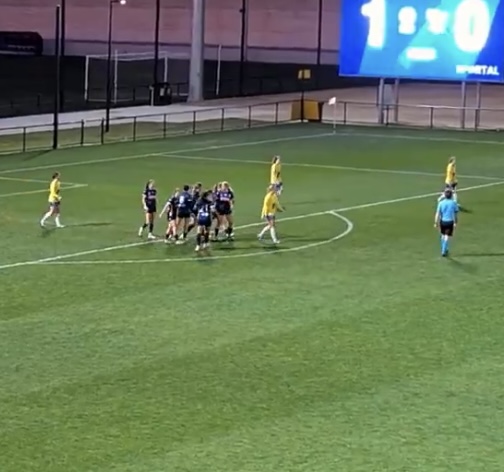
Above: FV Academy celebrate their second goal against Boroondara-Carey Eagles
FV Academy won their fourth game of the season with a 3-1 result against Boroondars-Carey Eagles. A virtuoso performance from Poppy O’Keefe, first half brace to Jasmine Millar and Emily Rutkowski’s late goal decided the game.
In front of Matildas senior coach Joe Montemurro, and just days after a midweek match against Spring Hills FC, FV Academy put on their best performance of 2025.
Despite the absences of key attacking stars like Kaya Jugovic and Clancy Westaway, they controlled the majority of the match against tough opposition and scored three past Matildas and A-League Women legend Melissa Barbieri.
The itent was clear from the outset. FV Academy pressed hard, moved the ball quickly and remained organised despite the relentless pace they had set.
Fiorina Iaria enjoyed plenty of space on the left, and used it to menace the Boroondara defence. Her early run and shot helped set the tone.
Chelsea Biggs joined Poppy O’Keeffe in midfield and the pair controlled the game. O’Keeffe was busy throughout as she pulled the strings for most of th FV Academy’s best moves, and Biggs was able to get forward and help the attack.
The opening goal came in just the 14th minute, when Millar nodded home the rebound from close range following excellent, composed buildup play through midfield. ‘
Emily Rutkowski put in another excellent performance, joining fellow Melbourne Victory youth player O’Keeffe in making yet another strong case for elevation to a senior A-League squad.
Rutkowski’s linked up with Iaria to create another great opportunity, but Boroondara were able to clear the lines temporarily.
O’Keeffe’s driving run and well-weighted pass set up FV Academy’s second goal. Millar timed her run well, but still had plenty to fo and cut inside the last defender to finish beyond Barbieri right before half time.
FV Academy began the second half in the same style as the first. Once again, a long, threatening run from Iaria almost resulted in a goal, but the finish was just slightly too wide.
Boroondara eventually grew into the game and gave themselves a lifeline through Saki Nagai’s 63rd minute finish. A rare error in defending a set piece gave her the chance and she grabbed it to bring the scorte back to 2-1.
Buoyed by that goal, Boroondara began to apply pressure to the FV Academy defenders and forward Rachel Stirton became more involved. With The Eagles hunting for an equaliser, Charlotte Hrehoresin was called into action, making an excellent and game changing stop when a goal looked likely.
To their credit, FV Academy did not break under pressure and regained control of the match. O’Keeffe’s sliding tackle and calm forward pass best epitomised and encapsulated the team’s performance. They were all willing to put in the gritty work but also showed class when they won the ball.
Jasmine Millar remained hatrick hunting, but her shots could not beat Barbieri and Rutkowski’s back post finish put the game to bed in the 87th minute. It was the versatile fullback’s third goal of the season and the perfect way to cap off another excellent performance.
FV Academy play their final game net week against Bentleigh Greens, and will hope to end on another high before the program closes down and A-League clubs form their own NPLW sides. Despite the struggles of running a state federation academy, they have routinely produced high quality players and have always been compulsory watching each season.
In Round 21 of the 2025 NPLW season, they put in a performance that every player who has come through the program would have been proud of and yet another reminder of what the states best youngsters are capable of at senior level.
Joe Montemurro would have been impressed.
Around The Grounds
FV’s midweek opponents Spring Hills FC had a much tougher weekend. They travelled to face the in-form and still improving Box Hill United.
A 57th minute goal to Josephine Aulicino was all that separated the sides on the scoresheet. But even with returning U23 International Sofia Sakalis on the bench, Box Hill were in control for most of this game.
Rhianna Pollicina was once again a standout performer for the Victors, but it was rising star Georgia Karaparidis who proved too much to handle. The winger’s tricky footwork and shot off the post provided Aulicino with an easy finish in the second half.
Bulleen Lions four goal game rained on Heidelberg United’s victory parade.
Water is wet, the sun rises in the East and Bulleen are a threat from set pieces are just three laws of nature.
Isabel Dehakiz opened the scoring for Bulleen from a corner in the 10th minute and an excellent solo effort from Ava Briedis doubled the advantage.
Dehakiz scored a second from another corner to make it 3-0 in the second half, before Sawa Matsuda pulled one back for Heidelberg with a brave header.
A comeback looked unlikely with Bulleen really needing the win to secure second place on the table, and any doubt was put to rest when Holly Massie took full advantage of a defensive error to make it 4-1.
Olivia Wood’s first half goal looked to be a sign on Essendon Royals continued late season surge, but South Melbourne rallied in the second half and ended the round as 2-1 winners thanks to Olivia Bomford’s equaliser and a late winner from Raquel Derales.
South Melbourne cannot make the top four but sent a reminder that The Royals can be beaten despite their imposing recent form.
The loss sees Essendon drop from a possible second to fourth.
Rebecca Saber returned to haunt her former club with a brace for Bentleigh Greens against Alamein FC.
Anna Liacopoulos conceded an own goal for Bentleigh’s third with Maximillia scoring a second half equaliser for Alamein.
Brunswick Juventus and Preston Lions walked away with a 0-0 draw in the only scoreless game of the round.
Brunswick now face the challenge of playing Bulleen in the final game of the season and will hope to end a difficult campaign on a high note in Round 22.
Round 24 delivered statement wins, late drama, and a finals picture that got a little sharper—and a little messier. Here’s how it all unfolded.
Match of the Round — Manly United 2–0 Illawarra Stingrays (Cromer Park)
This was a must-win for Manly and they played it like one. After an even first half, the hosts leaned into set-piece quality and front-foot pressure. Sienna Dale’s 53rd-minute header—attacking a wicked free-kick—was the payoff for a spell where Manly pinned the Stingrays back and forced mistakes. Alexia Forner then split the game open late with a clever early ball in behind, letting Tegan Biasi ice it on 86’.
Tactically, Manly were compact between the lines and denied Stingrays the central combinations they’ve thrived on. Brianna Edwards made saves to keep the visitors alive, but Manly’s discipline and speed in transition were the difference. A proper “season-on-the-line” performance that keeps their finals push real; a stumble for the Rays when they could least afford one.
Macarthur Rams 4–2 Bulls FC Academy (Lynwood Park)
A wild second half, and a reminder that Lynwood can swallow you whole if you switch off. Rams went from cagey to ruthless after the break: Sakura Nojima and Lola Sossai landed a one-two to make it 2–0, Nojima added a third late, and even a penalty from Isabella Coco-Di Sipio plus a stoppage-time spark from Jynaya Dos Santos couldn’t flip the momentum. Tea Mucenski’s dagger settled it at 4–2.
Big takeaway: Macarthur’s press and directness rattled the Bulls’ build, and the Rams’ senior heads managed the chaos better. For the Bulls, it’s a reality check for a top-two side that’s been flying.
Northern Tigers 0–2 NWS Spirit (North Turramurra)
Spirit arrived with nothing to lose and played with exactly that freedom. Bethany Gordon dictated tempo and delivered the pass of the night—an arcing ball for Skye Halmarick’s composed opener on 13’. The second came from Gordon’s set-piece craft, forced over the line via an own goal on 77’.
Credit to Tiahna Robertson for a huge first-half save on Lily McMahon that preserved the platform. For Tigers, plenty of grit but not enough incision in the final third; for Spirit, a clinical away job that keeps them humming as spoilers in the run-in.
Sydney Olympic 0–3 APIA Leichhardt (Valentine Sports Park)
This was the APIA machine in familiar, ruthless mode. Teal Kilbride poached the opener from a corner scramble (36’), then a trademark set-piece routine freed Ashlie Crofts for a near-post bullet (70’). Crofts doubled up three minutes later after Sophie Hoban pounced on a loose clearance and fed her nine.
APIA’s set-piece threat is basically a weekly cheat code, but their control without the ball is just as impressive—compressing space, forcing turnovers, striking from rehearsed patterns. Olympic’s revival earlier this season has stalled; APIA look every inch a title contender on form alone.
Western Sydney Wanderers 2–2 Mt Druitt Town Rangers (Wanderers Football Park)
A game that said plenty about both sides. Rangers were on top early and got their reward via Ena Harada’s skidding free-kick (45+3’). Wanderers answered after the break—Nikkita Fazzari reacting quickest after a sharp initial save (67’)—before Rosaria Galea won and buried a penalty to restore Rangers’ lead (73’).
Then came the sting: Isabella Sultan smacked a free-kick off the post and Olivia Vanderlaan roofed the rebound in stoppage time. A point that Wanderers richly earned with second-half energy; for Rangers, it’s two dropped in a tight top-four race.
Newcastle Jets 1–2 UNSW (Lake Macquarie Regional Football Facility)
UNSW showed top-four steel. Angelique Hristodoulou capitalised on an early error for 1–0 (5’), Alexis Collins equalised with a savvy chip after timing her run to perfection (39’), and then came the late-late punch: down to ten after Aaliyah Kilroy’s second yellow (89’), UNSW strung together a rapid restart sequence that ended with Chloe Smith tapping home at the near post (90+1’).
That’s big-game temperament—recovering from the red, then landing the last blow. The Jets’ counterpunching was lively, but UNSW’s poise in chaos keeps them right in the hunt.
Gladesville Ravens 3–1 Sydney University (Christie Park)
Ravens were efficient and then some. Allyssa Ng Saad finished off an early route-one break (10’), Morgan Roberts produced the strike of the round with a disguised “cross” that dipped into the far corner (35’), and Roberts added a stoppage-time tap-in from Eliza Familton’s persistence (90+1’). Maddie Caspers grabbed a late consolation (90+2’) but the points were long gone.
Ravens looked fast, direct, and ruthless on turnovers—an encouraging template to carry into 2026. Uni had moments but were punished whenever their last line stretched.
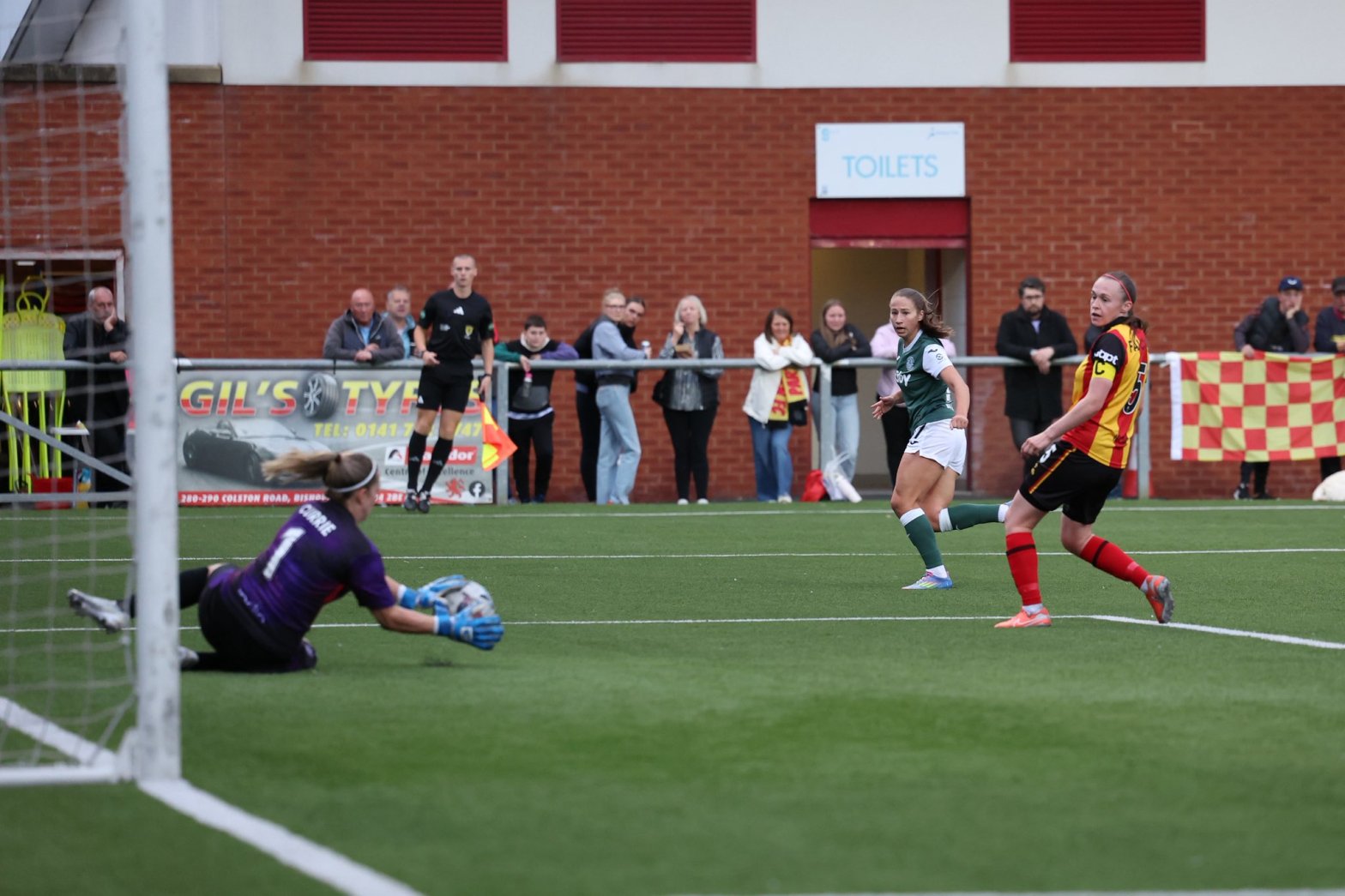
Above: Tiree Burchill’s shot is saved by Partick keeper Jeni Currie Photo: HibernianWomen on X
Braces from newbie Tiree Burchill and Eilidh Adams helped Hibs eased past Partick Thistle to move top of the SWPL, piling pressure on the other contenders to keep up with them; before attention turns to their Champions League qualifier on Wednesday night.
Hibs manager Grant Scott had an eye on Wednesday’s Champions League action with his team selection, as Ellis Notley came into the defence for Siobhan Hunter and young prodigy Tiree Burchill got her first start on the wing, while Kirsty Morrison moved inside to replace Michaela McAlonie.
The hosts pressed Hibs’ defence in a way the Edinburgh side is not used to and were able to gain the ball in some compromising positions. This was a good tactical decision, especially as that defensive configuration weren’t used to passing the ball out together as a unit. While they could not test Schumacher in the Hibs goal, it showed positive intent, while at the same time not committing too many players forward and risking the defence being left exposed.
As the game settled down, it was Hibernian that dominated possession and were able to hold that possession around the Thistle box. However, Dave Elliot’s team stayed disciplined in defence. The wingers held back to double-up alongside the fullbacks as they tried to limit the crossing threat of Hibs. The centre backs were also able to draw several fouls whenever balls did make their way into the box.
As half time approached, it looked as though questions would need to be asked of the Hibees’ attack. With Adams, Bowie and McAlonie all part of that crucial title-winning front four missing out for various reasons, their replacements were failing to make a mark up to this point.
In injury time though, Rosie Livingstone got past Hannah Robinson for the first time, sprinting to the by-line before rolling the ball across the goal to Burchill, who smashed it home for her first goal for the club. Just as the action looked over for the half, the ball once more fell to Burchill at the edge of the penalty area and she emphatically slid the ball into the bottom right corner past Currie in the Partick net and put Hibernian well in control of the game.
Above:Hibs’ Stacey Papadopouos and Rosie Livingstone after thier opeing day victory over AberdeenPhoto:HibernianWomen on X
The freedom of that lead combined with the extra space provided by a more attacking Partick side allowed Hibs to really dictate the game, attacking in the way they wanted to. While the clinical edge was not there for most of the night, they began to dominate Thistle’s backline at this point.
The Introduction of Caley Gibb and Tegan Bowie on the left-hand side improved things further for the Hibees, as they both sat wider on the pitch than the starters in their position had, giving Hibs a different angle to attack from and introducing a new challenge to Partick. This came to fruition in the third goal, as Bowie played Gibb in, who was approaching the goal from wide on the right, which gave her the space and time to compose herself and slot the ball past Jeni Currie.
In the 88th minute, a delightful run from Gibb allowed her to pick out Adams in the middle who subsequently headed in and got off the mark for the season. The final goal was peak Grant Scott-Hibs, as Ciara Grant played a perfect outside-the-boot through ball to Adams, who was somehow able to pick out the corner with her first touch to while sliding to the floor to secure a two-minute brace.
Grant Scott will have some thinking to do as Hibernian fly out to Cyprus for a Champions League qualifying appearance on Wednesday. Caley Gibb and Tegan Bowie added a new dimension to the left when they were brought on, while striker Adams staked her claim for a start in a rare off day for Kathleen McGovern, who just never got into it enough. Overall, the main aim for Scott was getting through with three points and as healthy a squad as possible. This all worked out for he will be very satisfied with her it turned out.
Dave Elliot can reflect on what was a perfectly executed first half game plan; until injury time in the first half of course. While it did not work out for them after that point, competing with a professional team in that manner shows that this team can adapt and be solid under new management, so they can still take some confidence.
Above:Turner with her Goal of the Month Trophy for Aston Villa.Photo: Aston Villa
Impetus profiles the new Melbourne City signing who comes with experience and an impressive highlight reel.
In women’s football, consistency is gold.
Few players embody that standard better than Danielle Turner, a seasoned English fullback whose career trajectory reflects resilience, adaptability, and a quiet but commanding leadership presence.
Known primarily for her long stint at Everton Women, Turner has carved a reputation as a dependable defender who combines tactical discipline with the grit required to marshal the left side of the pitch.
Career Overview:
Turner’s football journey had been deeply tied to Everton, where she not only developed as a player but also grew into the club’s captaincy role.
Her tenure at the club; across the FA Women’s Super League (WSL) and FA Women’s Championship, made her one of the most recognizable faces in the team.
After over a decade of service, she moved on to Aston Villa Women, continuing to ply her trade in the top flight of English football.
Her experience across both tiers of the English women’s game gives her unique insight into the pressures of promotion battles, relegation fights, and high-stakes WSL clashes.
Playing Style:
Turner is a left-sided defender, comfortable playing as a fullback or wing-back in systems that emphasize width and defensive compactness.
Her game is defined less by flashy flair and more by reliability,she closes down opponents quickly, tracks runners with tenacity, and rarely shirks a defensive duel.
She thrives in transitional phases of play, pushing up to overlap when the opportunity arises while maintaining the defensive discipline to recover quickly.
Tactical analyses frequently highlight Turner’s positional awareness, like her ability to time midfield drives perfectly for Everton’s overload schemes. And at Aston Villa, she excelled in duels, winning 65.5% on the ground and 61.6% in the air, making her a problem solver before being a tackler.” A pivotal part of the advantages she brings to Melbourne city.
Strengths
Leadership & Experience: A natural organizer on the pitch, Turner has captained at the highest level and provides vocal guidance to younger teammates.
Defensive Solidity: Excellent in one-on-one situations, particularly against tricky wide players. She times her tackles well and maintains composure under pressure.
Positional Awareness: Rarely caught out of shape, she reads the game effectively to intercept passes and track diagonal runs.
Work Rate & Tenacity: Tireless up and down the flank; she presses high when needed but also drops deep with discipline.
Weaknesses:
Attacking Contribution: While Turner can overlap and deliver crosses, she isn’t as attack-minded as some modern fullbacks, limiting her offensive threat.
Pace Against Elite Wingers: Quick, explosive wingers can occasionally stretch her, particularly in wide open systems.
Limited Versatility Beyond the Left Flank: Although consistent on the left, her impact is reduced when shifted centrally or to the opposite side.
The Bigger Picture
Danielle Turner represents a generation of players who straddle the evolution of women’s football, from semi-professional struggles to the fully professional WSL era. Her longevity and adaptability are testaments to her work ethic and football intelligence and at Melbourne City, she will add to their squad, coherence, confidence and on-field leadership.
For those who watch closely, Turner’s value lies in her intangibles: the calm under pressure, the bark of instructions to her backline, the unseen adjustments that prevent danger before it even materializes and all these traits will be crucial to Melbourne’s stride to compete for the Ninja A-league.
Signing a thirty-three-year-old defender who has spent most of her playing time in England might be a great risk but if her 23/24 goal of the season is a sign, then Australian football fans are in for a great time.
From 2026, Melbourne Victory and Melbourne City will field teams in Victoria’s NPL Women’s (Senior U23) and U20 competitions, while Football Victoria refocuses its Academy to U15 and exits senior state leagues.
Football Victoria (FV) has confirmed a major restructure of the female talent pathway in the state, with A-League Women clubs Melbourne Victory and Melbourne City entering the NPL Women’s (Senior U23) and U20 competitions from 2026. Western United has also expressed interest, with a decision to come in the coming weeks.
Under the new model, the FV Academy Girls program will concentrate on players up to U15. From the age of 16 onwards, athletes will graduate into club environments which will be A-League academies, established NPLW programs, or other advanced pathways—while FV shifts its role to talent identification and state team selection. Promotion and relegation in NPLW will remain unchanged, with the league expanding to accommodate the new entrants and provide more minutes for players.
What it means for Melbourne Victory
After more than a decade lobbying for entry, Victory has been issued intent for NPLW Senior (U23) and U20 licences from 2026—marking the first time an A-League Women club will be represented in Victoria’s top state competition.
“This is an incredible step forward for Melbourne Victory and our Women’s Academy,” Managing Director Caroline Carnegie said. “Obtaining an NPLW and U20 license is an important part of achieving our goals for our wider Academy and pathway programs… We expect the senior teams to integrate seamlessly within our existing programs, creating exciting new opportunities for women and girls.”
Director of Football John Didulica framed the move as the missing piece in a truly professional pathway. “Elite Victorian players will now… have access to a cohesive 52-week program where their development will be prioritised in a fully professional environment. This can only help Victoria create more national team representatives.”
What it means for Melbourne City
Melbourne City will launch its first Women’s Academy and enter NPLW and U20 from 2026, basing the program at the City Football Academy in Casey Fields. Players will access the same facilities and high-performance environment as the club’s A-League squads. The Academy formalises a pathway that mirrors the men’s side and complements City’s Football Schools and Female Select Squads.
“This is a historic moment for our Club,” CEO Brad Rowse said. “By creating a clear pathway from grassroots to elite, we can now provide young female players with the same opportunities their male counterparts have enjoyed for years… We’re excited to help nurture the next generation of City stars.”
City points to recent national-team debuts for Holly McNamara, Leah Davidson, and Laura Hughes as evidence of its development track record that a formal Academy can now scale.
What changes at Football Victoria
From 2026, FV will:
Focus the FV Academy Girls on U15 and below.
Exit both the NPLW and U20 team participation, instead supporting player transitions into club programs.
Maintain responsibility for talent identification and state teams, building a comprehensive player database across clubs.
Keep promotion/relegation in NPLW intact while expanding the competition to create more matches and minutes.
FV Interim CEODan Birrell acknowledged the impact on current Academy players while emphasising broader opportunity. “We understand this news will be disappointing for the impacted players who have proudly called the FV Academy home. But while this chapter is closing, a new one is beginning… to create greater and additional opportunities for more Victorian players to grow, compete and excel at the highest level.”
Why it matters
For players 16–23, the introduction of A-League Women academies into NPLW plugs the development gap between youth programs and the professional game. For clubs, it aligns coaching, sports science, and playing style across a full pathway, potentially lifting standards week-to-week and reducing the jump to A-League Women. For the league, it should deepen competition without altering the merit principles of promotion and relegation.
There are still details to land—competition format with expansion, integration timelines, and Western United’s final position—but Victoria’s pathway is set for a significant reset: FV nurturing the pre-academy years, and A-League/NPLW clubs driving the senior development runway into professional football.
Above:Holly Furphy after scoring for Australia. Photo: Football Australia
Australia’s U23 side has won the ASEAN Championships for the first time since 2008 after beating Myanmar 1-0 in Halphong. Holly Furphy’s second-half goal was enough to secure Australia the trophy and seal the votes for the Melbourne Victory striker to win player of the tournament.
Myanmar were the side that almost ended Australia’s ASEAN Championships campaign before it really started. The 2-1 win in the first group game was clearly no fluke as the defensively disciplined yet high scoring side earned their way to the top of the group and an eventual place in the final.
Despite that early and somewhat surprising setback, Australia found their groove. After the loss, coach Joe Palatsides pointed out that the Aussie team had only one training session before the tournament but still had confidence they could find form and survive the group.
They did so with grit and style. A gusty win over the Philippines was followed up by a dominant display against Timor Leste and then an entertaining victory against host nation Vietnam.
This final was a meeting between the two best sides of the tournament, and although Australia were a different proposition than in game one. Myanmar had every reason to be confident, not least the fact that they boasted the tournament’s leading scorer Win Theingi Tun as their captain.
Australia controlled possession early. Georgia Cassidy was particularly dominant in midfield. Her passing range, close control, and determination saw her become the standout player in the opening stages.
Despite this control, Australia struggled to carve out chances against Myanmar. Although goalkeeper Mya Nyein Myo was called into action to stop efforts from Cassidy and Alana Jancevski, both of them were from range. An early corner looked destined to be scrambled in, but Myanmar somehow managed to clear.
Sasha Grove looked at her best at left back, and her slaloming run ended with a shot on target despite the attention of four defenders, but Australia went into the break without a goal. Myanmar would have been justified in thinking that they may have created the better chances. Chloe Lincoln was well-positioned and strong in goal to repel a few moments of danger.
When the goal eventually arrived, it was all class. Jancevski picked up the ball deep in the central area. She found Aideen Keane out on the left, and the Canberra United forward’s decisive cross was met by Furphy’s well-timed and aggressive run.
The finish was a slight touch, but it was very deliberately directed away from the goalkeeper and into the corner of the net. It was a stylish goal born of instinct and class from all three forwards. Australia’s individual quality has risen when needed most during this tournament, and the final was no exception.
That goal was enough to divide the team,s and Australia’s defence stood strong against the quick and dangerous Myanmar counter-attacks. Tori Tumeth and Alana Cerne were rock solid at centre back, with the latter’s ability to pass through midfield and find the wingers a real asset.
Claudia Cicco was excellent at right back. The versatile Newcastle Jet can play almost anywhere on the pitch and was good on the ball, while being just as aggressive in the tackle as she was in her runs and passing.
There were no bad performers on this squad; there cannot be to win a tight final. Although this is not considered a major trophy, it is not a friendly or manufactured competition. This is a serious title with two senior World Cup sides featuring, although the Philippines were missing the likes of Angela Beard and Jaclyn Sawicki.
It is hard to be truly objective in reporting a trophy win. This was glorious by the Aussie U23’s. This tournament has not been won in 17 years, and that is mostly due to the quality of the opposition over that time and the fact that it is a real challenge for a youth side to face hardened, organised senior teams.
The real purpose of an U23 program is to help prepare prospective senior Matildas or to see if any are ready to step into one of the world’s most high profile sides.
On the strength of this tournament, almost all of them can be trusted to do a job if called on by Joe Montemurro. Jancevski backed up a career-best A-League Women season with a nod from ASEAN as the Rising Star of The Tournament. She was highly impactful in every game, and her brilliant solo goal against the Philippines was one of the best of the tournament.
Leticia McKenna did not feature in the final, but the Melbourne City playmaker was one of the A-League Women’s best players over the last season and was in spectacular form in the high-pressure semi-final against Vietnam.
Cassidy is a real find as a box to box midfielder, with a similar passing style to Kyra Cooney-Cross, while Isabel Gomez was close to Australia’s most consistent player. Her senior Matildas opportunities have been scarce, but she definitely put her hand up as an option for a Montemurro midfield.
Grove remains a marvel. A combative fullback with sparkling footwork and an enviable engine. Opposition coaches seem to always try and isolate her because of a perceived height advantage, but it has never really worked. The best case scenario for the opposition at club or national team level is their centre forward is nos out wide and up against an excellent and experienced one-on-one defender.
Grove’s positioning, acceleration and willingness to make her opponent earn every touch mean she is a dependable presence at the back. Her pace and natural attacking instincts forged as by years as a forward in Canberra’s youth system mean she is almost the complete footballer. To compare her to another former Canberra United defender, if you give me eight Sasha Grove’s and two Ellie Carpenter’s I will give you the World Cup.
Grove, along with Cicco on the other flank, had to be at their best for Australia to win this, and both were excellent against a side that player-for-player looked faster than the Aussies.
It meant that Australia only really needed to take one chance to win this game, and the front three delivered.
Furphy’s goal was the product of teamwork and individual excellence. She is hungry in front of goal in a way that few players are. Furphy will attack the space, the ball, and run through anybody that stands in her path on the way to getting the most delicate and intricate finish.
She can score headers, which is surprisingly rare for a nation that develops so many excellent wingers and can operate on the wings or hold the ball up with her back to goal. She is a rare striker who has pace, height, and technical ability. She fits into almost any tactical system imaginable, and her performances in this tournament have her positioned as one to watch ahead of the Asian Cup.
There are stories all over this squad. Naomi Chinnama earned her ticket to Vietnam through consistent performances with Perth Glory, but has also risen through the ranks of the national youth teams, and it is wonderful to see her continue to progress in the system.
Jancevski is one who has long been a fan favourite. After narrowly missing selection in an U20 World Cup squad in 2022, she grasped this chance and took responsibility in attack. Jancevski is sometimes at her spectacular best when the game is at its hardest, and her goal against the Philippines, a curling left footer after a brilliant solo run, changed the course of the tournament.
Aideen Keane was consistently dangerous in attack, Sofia Sakalis was able to carry her impressive NPLW form into the national team setup, and Emila Makris was finally able to taste success in the Green and Gold after injury heartbreak in the 2024 Asian Cup and following the U20 World Cup.
There was a lot to be excited about in this tournament. It speaks to the quality in the domestic league and the next generation of rising Matildas. Many factors will determine if any of these champions will play in the Asian Cup next year, but they have all proven they can deliver when called upon.
More than that, they gave us at home a reason to cheer loudly at 1am and return that winning feeling to Australian football that has felt somewhat lost since the heights of the World Cup.
This was a victory for the players, the A-League Women, and the National Premier Leagues. It was a mature performance from a very young team. One that has provided real excitement for the future while giving us something to celebrate right now.
Congratulations to Australia, the 2025 ASEAN Champions.
MYANMAR: Myo, Lin, Oo, Phyu, May, Wai, P. Win, Thaw, Yu, T. Win, Tun. Substitutes: Ei, Hnin, Myrat, W. Win, May, Nan, Than, Zu, Shwe, Khin, Yoon, Khin.









 impetusfootball.org