Above: Teagan Micah signs for OL Lyonnes.Image: Instagram.
In a huge move, Teagan Micah has signed with French giants OL Lyonnes until 2026. The Australian goalkeeper departs Liverpool after making 19 appearances for the Reds over her two year spell in Merseyside.
With the number one spot for the Matildas firmly on lock, Micah’s move to such a strong club makes sense on paper. However, Lyon’s lineup will be tough to break into with Tiane Endler between the sticks for the 18-time French champions. Micah will also be in competition with young French keeper Féerine Belhadj; but one would infer that Micah will assume the role of first back-up due to her experience and reliability.
With just a one-season contract with OL, Australian fans will hope Micah has the opportunity to prove herself, either leveraging herself into a new contract or a move to a club where she will be guaranteed the number one shirt.
The 27-year old has multitudes of experience, playing for UCLA in the US college system, four different clubs in the A-League Women, two in Norway, and Rosengard in Sweden, where she was a crucial player in two successful seasons. At Liverpool, she was the backup to Rachel Laws, but nonetheless impressed during her spell. Her trajectory has been consistently rising, so it’s only fitting she will reach the pinnacle of women’s football.
OL would have many reasons to bring Micah in. Simply, the club needs a backup for Endler. With the sheer amount of games OL plays between Ligue 1, the French Cup, and the Champions League, rotating keepers is a must. Micah can likely expect to see the pitch the most in the Cup or against lower ranked opponents in the league, although Australians will hope she can get some UWCL action. She has big game experience and if the OL coaching staff were to trust her with the responsibility, she could easily play in critical matches.
Above: Teagan Micah in Matildas training session during the SheBelieves Cup. Image: Genevieve Henry for Impetus.
Micah has a plethora of valuable goalkeeping skills, with her shot-stopping from close range like no other. Her distribution is consistently good, as well as her decision making. Most importantly, Micah can play out from the back, which fits Lyon’s possession based style.
Behind a transitional Lyon defence, Micah’s vocality could be a huge asset, able to read the game and organize the backline in stressful situations. With the departure of compatriot Ellie Carpenter, OL will have to integrate a new right-back into the system, as well as a likely shift away from Wendie Renard, who is possibly nearing the end of her career, and towards the likes of Alice Sombath in the heart of defence.
Ultimately, though she may not be taking the gloves from Endler, Micah’s fantastic signing with OL Lyonnes will push her to improve in the highly competitive environment. Her reliability will be crucial to the French powerhouse as an excellent second option. As she reaches her prime, this is a great position for Micah to be in.
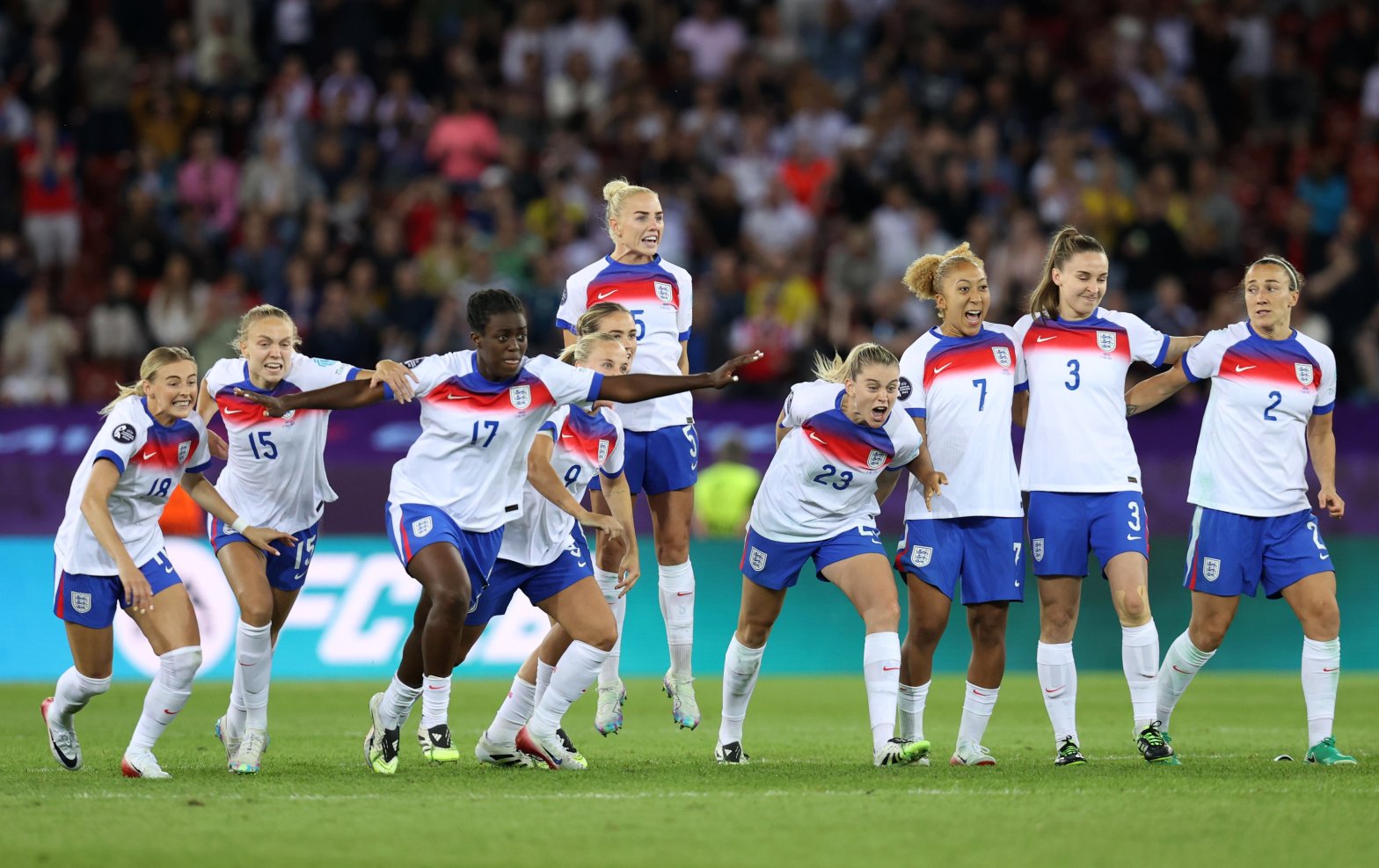
Above: England celebrate a dramatic comeback win against Sweden. Photo: Lionesses on X.
England are through to the semi-finals of Euro 2025. The Lionesses produced an impressive comeback win, after going 2-0 down to Sweden in the first half. They then drew level in the second half, taking the game to extra time at 2-2. The tie then went all the way to a remarkable penalty shootout.
The stage was set for an exciting match-up between Sweden and England, who are currently ranked as the fifth and sixth in the world. The two nations had previously met in the semi-finals of Euro 2022, with England producing a convincing 4-0 win. However, the circumstances were very different before this match. Sweden were on a winning streak of 15 matches, whereas England’s form had been much less consistent. However they had recently had two emphatic wins at the tournament, against the Netherlands and Wales.
It was not long after the whistle that Sweden put themselves ahead, with Kosovare Asllani scoring her 50th goal for Sweden with less than two minutes on the clock. Asllani capitalised on a defensive mistake from Jess Carter and put her country 1-0 up. Sweden continued to pile the pressure on England, with Leah Williamson making a crucial block in the fifth minute, to prevent Stina Blackstenius from putting Sweden 2-0 up.
The opening 15 minutes of the game were reminiscent of England’s first game of the tournament, against France, with England struggling to effectively maintain their defensive shape against Sweden. Blackstenius was able to capitalise on England’s defensive mistakes and inaccurate passes and scored Sweden’s second goal of the evening after outpacing Carter.
Above: Stina Blackstenius celebrates. Photo: WEURO2025 on X.
Sweden went into half-time with a two-goal advantage over England, leaving the Lionesses with a mountain to climb in the second half. Hannah Hampton had been called into action on multiple occasions before the half-time whistle and England had struggled to create any clear-cut chances.
Sweden were significantly stronger in transition phases than England, moving the ball up the pitch faster, and they were also quick to capitalise on the occasions that England gave the ball away in the midfield. Blackstenius stood out as one of Sweden’s strongest players, holding the ball up and making driving runs that England’s defenders struggled to shut down, despite many of them having played either with or against her in the WSL.
However, England came out for the second half with determination and grit, and they piled the pressure on Sweden from the start of the second half. Ella Toone had a chance in the 49th minute, and England began to get their attackers further forward on the pitch. Lauren Hemp also had several chances but was unable to get England back in the game.
It was not until Sarina Wiegman made her substitutions after the 70th minute that England got themselves back into the game. Wiegman made a strong attacking change, bringing on Esme Morgan, Michelle Agyemang, and Beth Mead for Jess Carter, Georgia Stanway and Ella Toone. She then brought on Chloe Kelly for Lauren Hemp, whose performance was crucial in England’s victory. Sweden also made changes at this point, having already brought on Smilla Holmberg for Hanna Lundkvist, and Lina Hurtig and Madelen Janogy replaced Asllani and Fridolina Rolfӧ.
Above: England head coach Sarina Wiegman applauds fans. Photo: WEURO2025 on X.
Kelly’s impact was evident as soon as she came off the bench, scoring an assist within two minutes of making her way onto the pitch. She provided the cross to Lucy Bronze, who headed the ball into the back of the net in the 79th minute, starting England’s comeback. Kelly then sent the ball into the penalty box within three minutes of England’s first goal, for Mead to head it to Agyemang, who made it 2-2. Kelly brought an energy in England’s attack which had previously been missing, and Wiegman’s substitutes proved to be the difference which sent the tie to extra time.
Bronze’s determination and resilience shone in extra time of the game especially. Williamson had to be substituted due to an ankle injury, after which Bronze took the armband. Neither Sweden nor England were able to settle the tie in the additional 30 minutes, with both goalkeepers being tested. The game then went to a penalty shootout.
England started the penalty shootout, with Alessia Russo scoring England’s first penalty. Filippa Angeldahl was unable to bring Sweden level, with Hampton saving her penalty kick. Lauren James took the next spot-kick for England; however her effort was saved by Jennifer Falk.
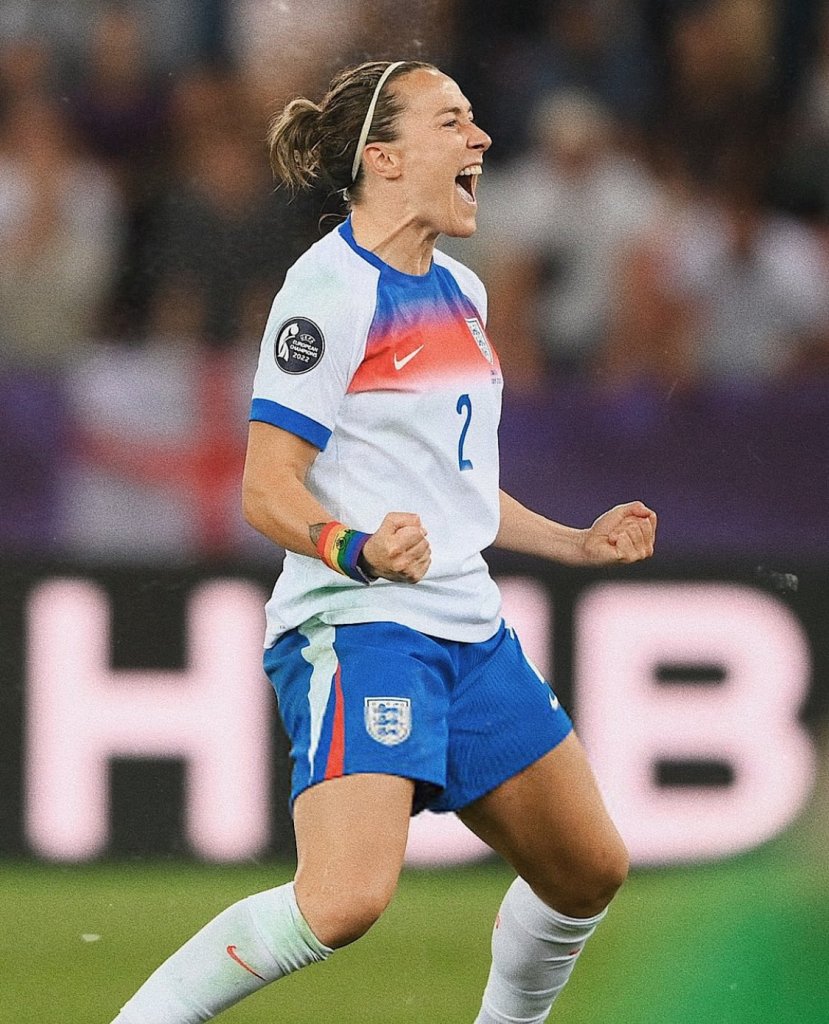
Mead, Alex Greenwood and Grace Clinton all had their penalties saved, whilst Zigiotti Olme scored for Sweden, but Magdalena Eriksson, Nathalie Bjӧrn, Falk and Sofia Jakobssen were not able to send Sweden through. Kelly scored her penalty kick for England, before Bronze heroically sent her penalty into the roof of the net. Holmberg then put her effort over the bar, sending England through to a third consecutive semi-final.
Above: Lucy Bronze celebrates. Photo: Lionesses on X.
England will face Italy on Tuesday 22nd July at 20:00 BST.
ENGLAND (4-3-3): Hampton, Greenwood, Carter, Williamson (c), Bronze, Stanway, Walsh, Toone, Hemp, Russo, James. Substitutes: Agyemang (for Stanway 70’), Beever-Jones, Charles (on for Williamson 105’), Clinton (for Walsh 104’), Keating, Kelly (for Hemp 78’), Le Tissier, Mead (for Toone 70’), Moorhouse, Morgan (for Carter 70’), Park, Wubben-Moy.
Above: Girelli heads Italy into the lead. Photo: Azzurri_En on X.
Italy beat Norway through a brace by captain Cristiana Girelli with the winner scored in stoppage time. The win sees Azzurri through to a first Women’s European Championship semi final since 1997.
Italy looked like a totally rejuvenated team compared to what we saw in the group stages. Having placed 15th in possession throughout the group stage, they played rings around a lacklustre Norway side, particularly having success down the right. Azzurri had a number of chances during the first 45 minutes, with Severini and Di Guglielmo hitting wide from inside the box.
Italy came out even more fired up and connected in the second half, with Girelli shooting into the bottom left corner to finally give them that deserved lead. Throughout the group stage, Norway relied on surviving through difficult periods then hitting back later, and this would come to fruition again.
Rather than pushing on for second, it seemed Italy were satisfied with a one goal lead and sat back, doing what they could to hold on. After Hegerberg put a penalty wide (that looked to have an offside in the build up anyway) she was played in by a long ball by Mjelde. Guiliani in the Italian goal hesitated and 2018 Ballon D’or winner Hegerberg had her redemption.
The entire rest of the game it always looked like Norway that would score the winner, yet Italy managed to hang on and the game looked like it was heading to extra time. Taking advantage of a lapse in concentration from Norway on the transition, Italy found themselves on the attack, and when Sofia Cantore put a well-weighted cross into the box, Girelli was on hand to head home once again.
Above: Girelli celebrates. Photo: FIFAWWC on X.
Italy go on to face the winner of England v Sweden. Given how well they competed with world champions Spain in the group stage, they are not to be taken for granted and will be the semi finalist with the least amount of pressure on them.
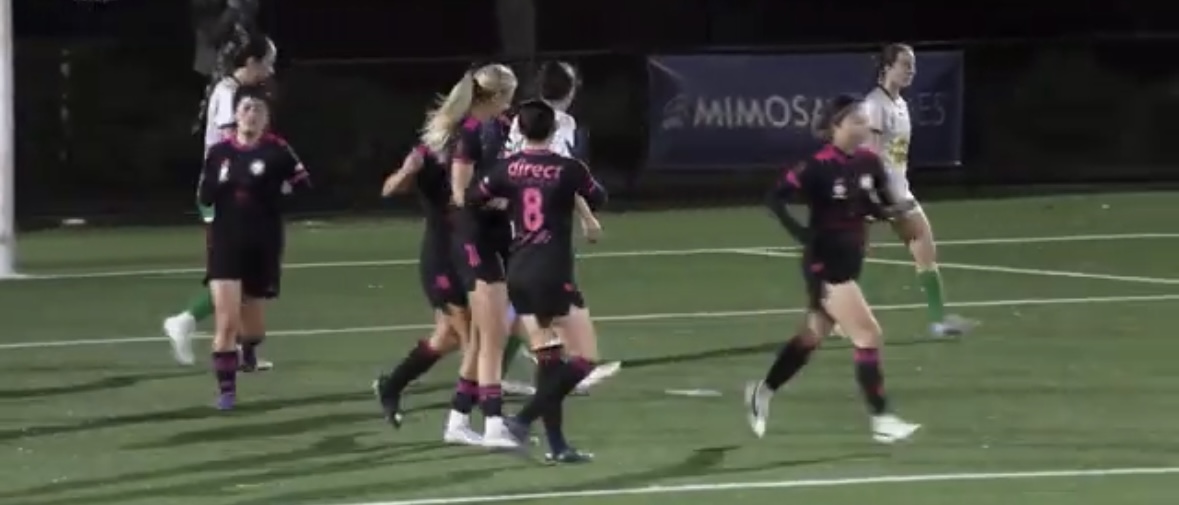
Above: Maja Markovski celebrates with teammates after the opening goal
Brunswick Juventus took the points off South Melbourne, Essendon Royals scored five against Bulleen and Heidelberg United extended their lead at the top on an emotional day at Olympic Park. Over at Spring Hills FC, Maja Markovski’s strong return to the league continued with a brace against Bentleigh Greens.
Spring Hills began their home match against Bentleigh on the front foot. Their forwards pressed hard and high up the pitch, while fullback Montana Matthews looked to get forward at every opportunity.
Some promising link up play through the centre of the pitch resulted in Markovski’s strike from range forcing Natalie Picak into a diving, low save.
That resulted in the first corner of the match, which Matthews delivered to perfection. Markovski was positioned on the edge of the six-yard box and backpedalled slightly to angle the header into the net and open the scoring.
The Canberra United striker has always had quick feet and a thunderous shot. She has added work rate and sometimes frightening pace to her game in the last season, and if she has added a consistent arial threat to her game, the league’s defenders best chance is to hope she is having an off night.
Bentleigh Greens looked to respond quickly. Sidney Allen’s solo run opened up the Spring Hills defence. Her pass released Olivia Ingham who lofted the ball over Jenna Ibrahim to level the scores.
If the threat of Markovski and Julia Budiongo was not enough for Bentleigh to deal with, Aleks Sinclair took charge early in the second half to restore the lead. She won possession high up the pitch and was fouled as she cut into the penalty box. Markovski confidently scored from the spot and celebrated in what looked to be a pre-planned routine with some fans behind the goal.
Sinclair’s trickery continued to torment the Green’s defenders. Her weaving run and rapid acceleration drew another foul on the edge of the box, but in a lucky escape for Bentleigh, the shot did not trouble Picak.
Eri Narita almost added as third for Spring Hills after Markovski’s long pass set her clear in on goal. She had only Picak to beat, but the Bentleigh goalkeeper was quick off her line, closed the angle and the shot skimmed wide of the far post.
Montanna Matthews eventually delivered an important third goal for the home side. Her set piece delivery had been dangerous all night and in the 61st minute a free kick from the wing sailed into the net. It looked to be aimed at Markovski once again, but there was no denying the celebrations and Matthews had more than earned a goal for her performance on the night.
Sidney Allen ensured a tense finish with a goal from the edge of the box in the 89th minute. with the score at 3-2, Bentleigh seemed to sense an upset and surged forward in added time in hunt of an equaliser. It was not to be, and the Spring Hills defence held strong for the dying moments with Natasha Dakic in particular standing tall when the pressure was on.
The win keeps Spring Hills within touching distance on a finals spot. When their attack if firing, anything is possible with this team. Sinclair’s ability and experience gives them a chance in any game. Next weekend, they face a tricky opponent when they host the in-form FV Academy who missed this round with a postponement.
Bentleigh remain at the bottom of the table, but with a winnable match against Preston Lions in Round 17. That is easier said than done with the Lions eager to bounce back from a 3-0 defeat to Boroondara-Carey Eagles.
Around The Grounds
Candela Ferreyra-Bas delivered a brilliant individual performance to help Boroondara take all three points in convincing fashion on the road against Preston Lions. Goals to herself and Drew Dempsey gave the visiting Eagles a comfortable lead heading into the main break with speedster Priya Savarirayan adding a third on the 77th minute.
Essendon Royals came from 2-0 down against Bulleen Lions to eventually win 5-3 at The Veneto Club. Sarah Cain scored twice in the first 10 minutes for Bulleen with a pair of opportunistic strikes, but Grace Maher scored with a trademark long range effort to pull one back for the visitors before half time.
The Royals took control in the second half. Fijuwara Airi levelled the scores after rounding the goalkeeper before Essendon winger Deven Jackson scored with her third goal in two games after finishing a swift counter attack.
Maher made it 4-2 from the penalty spot and Alana Cerne provided the two goal buffer to give Bulleen a mountain to climb with about 10 minutes remaining.
Nia Salleh provided the home team with a lifeline in the 83rd minute. The winger cut inside from the left and shot powerfully from distance on her right foot to score an almost identical goal to her winner in the Nike FC Cup Quarter Final.
The loss could have been costly for Bulleen, but fortunately for them they remained in second place on the ladder. Essendon’s sudden rise in form has coincided with Maher and her world class left boot. Jackson’s pace gives them an immediate advantage over most defenders. Essendon attacked Bulleen quickly and tried to get their centre-backs isolated, which resulted in two goals.
Perhaps the biggest surprise of the round was Brunswick Juventus defeating South Melbourne FC.
Mary Stanic-Floody opened the scoring in the 27th minute with Natalia O’Leary doubling the lead in the 39th minute. Raquel Derales gave South Melbourne some hope right after the break, but O’Leary’s second in the 88th minute meant that Alexis Pantazopoulos’s late effort was only for goal difference.
The win against a side seven places above them on the ladder was an excellent response to the defeat against FV Academy last round. Stanic-Floody’s opener was typically spectacular. The Young Matilda and Canberra United playmaker will be crucial for Juve’s quest to avoid the drop.
In an emotional day at Olympic Village, Heidelberg United won their game against Alamein FC 4-1. The home side held a memorial for Keely Lockhart before the game and honoured her with a win on the pitch.
Zoe Houghton gave Alamein an early lead, but Tamar Levin levelled the scores in the 13th minute. Sawa Matsuda scores yet again before half time in what is starting to feel like her compulsory weekly goal and Asuka Miyata (excellent throughout) added a third on the hour mark.
Above: Sydney University prior to their match against APIALeichhardt.
With finals fast approaching, Round 19 delivered some huge results—and plenty of ladder movement.
Bulls FC Academy 2-1 NWS Spirit A massive top-four clash at Northbridge Oval, with Bulls edging out Spirit 2-1. Goals from A-League players Jynaya Dos Santos and Amber Luchtmeijer sealed it for Bulls, with Kayla Osborn netting a quality equaliser for Spirit. Tiahna Robertson’s saves kept Spirit in it, but Bulls’ quality showed. The result sees Spirit drop to sixth, while Bulls strengthen their grip on a top-four spot.
APIA Leichhardt 4-3 Sydney University A seven-goal thriller at Lambert Park, and one of the games of the round. Ashlie Crofts scored a hattrick for APIA, while Talia Kapetanellis bagged a brace and caused constant problems for APIA’s defence. Solid performances from Estelle Fragale, Sophie Hoban, Jess Seaman, and Jordan Jasnos helped APIA see it out, while Uni’s efforts from Amelia Feeney, Maddie Caspers, Talia Kapitanelis, and Sofia Fante weren’t enough to turn the result. APIA jump to fifth and now look like serious finals contenders.
Gladesville Ravens 1-1 Mt Druitt Town Rangers The Khamis sisters derby ended in a 1-1 draw at Christie Park. Leena Khamis opened the scoring against her sister Shamiran with a brilliant solo goal, before Miku Sunaga equalised for Ravens. Ravens extended their unbeaten run to five games, while Mt Druitt—still top of the table—probably won’t be too worried, with three games in hand.
Northern Tigers 5-1 Macarthur Rams Northern Tigers snapped their four-game losing streak in style with a dominant 5-1 win over Macarthur Rams. Charlotte Mortlock opened the scoring, with Savannah Murray adding a thunderbolt, before three second-half goals sealed it. A statement win for Tigers as they return to form at the perfect time.
UNSW 1-0 Western Sydney Wanderers UNSW got back to winning ways with a narrow 1-0 victory over Wanderers. Abbey Lemon scored the first-half winner, with UNSW controlling much of the game and defending well to hold onto the result. Wanderers’ winless run continues.
Illawarra Stingrays 1-0 Newcastle Jets A tight contest at Macedonia Park, with Alexia Karrys-Stahl scoring the only goal to secure three points for Stingrays. The result keeps them firmly in the top four, while Jets remain stuck near the bottom.
Manly United 2-2 Sydney Olympic A proper game of two halves at Cromer Park. Olympic led 2-0 thanks to a Tiana Fuller brace, but Manly fought back with goals from Sarah Yatim and Sienna Dale to rescue a point. Manly stay second but will be frustrated to have dropped points at home.
Above: Record-breaking Swiss fan march. Photo: Keystone/Jean-Christophe Bott.
The group stage of the 2025 Women’s Euros has concluded and the stage is set for the quarterfinals this week. Defending champions England secured their place and will play Sweden on Thursday, whilst Spain, Germany, France, Norway, Switzerland, and Italy also booked their places in the final eight.
The group stage had it all – own goals, red cards, press conference arguments, and some standout moments on and off the pitch. Impetus Football’sGethin Thurlow, Catherine MacKenzie, Eloise Smallbone and Hannah Chadwick break down their favourite moments from the group stage below.
Group A – Switzerland, Finland, Iceland, Norway
ByGethin Thurlow
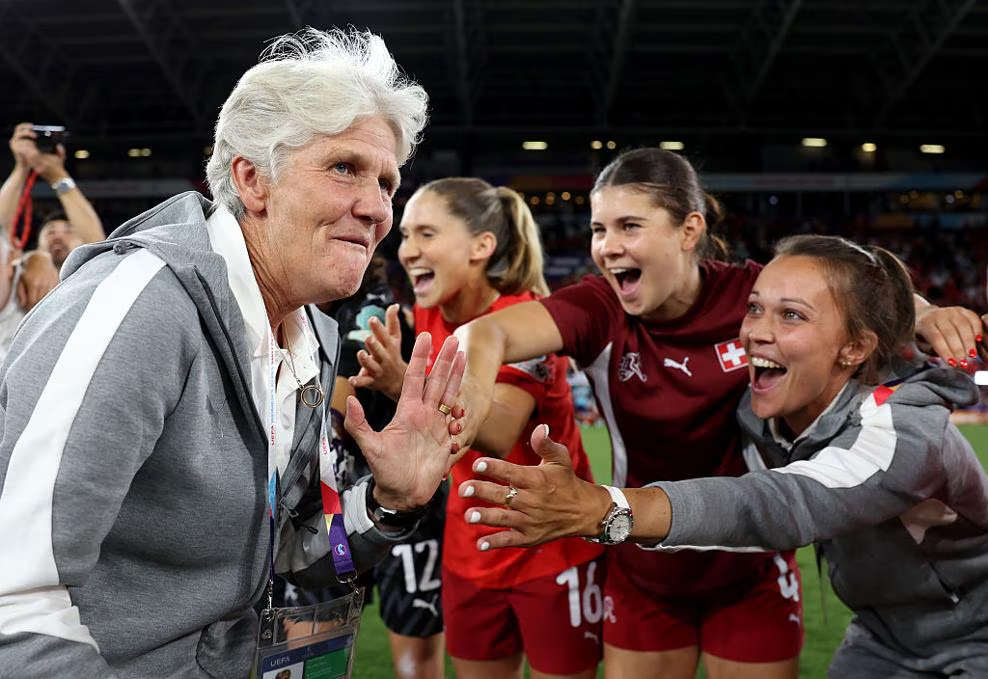
Above: Switzerland head coach Pia Sundhage celebrates reaching the quarterfinals with her team. Photo: UEFA website.
Being lucky enough to report on a group that had the hosts in, seeing all the build up and excitement towards that first game between Switzerland and Norway was incredible. That Switzerland put such a strong first half performance in was also really special. Another highlight was the effort and resilience of Finland. Coming into the tournament with almost no eyes on them, they claimed an underdog win over Iceland in the first match and this was a well earned victory. What impressed me even more was how they played in the Norway loss and Switzerland draw. Despite the results going against them, they looked nothing like a team ranked 30th in the world and were only goal difference away from a quarter final appearance.
Final group standings:
Norway (Q)
Switzerland (Q)
Finland
Iceland
Group B – Spain, Belgium, Portugal, Italy
ByEloise Smallbone
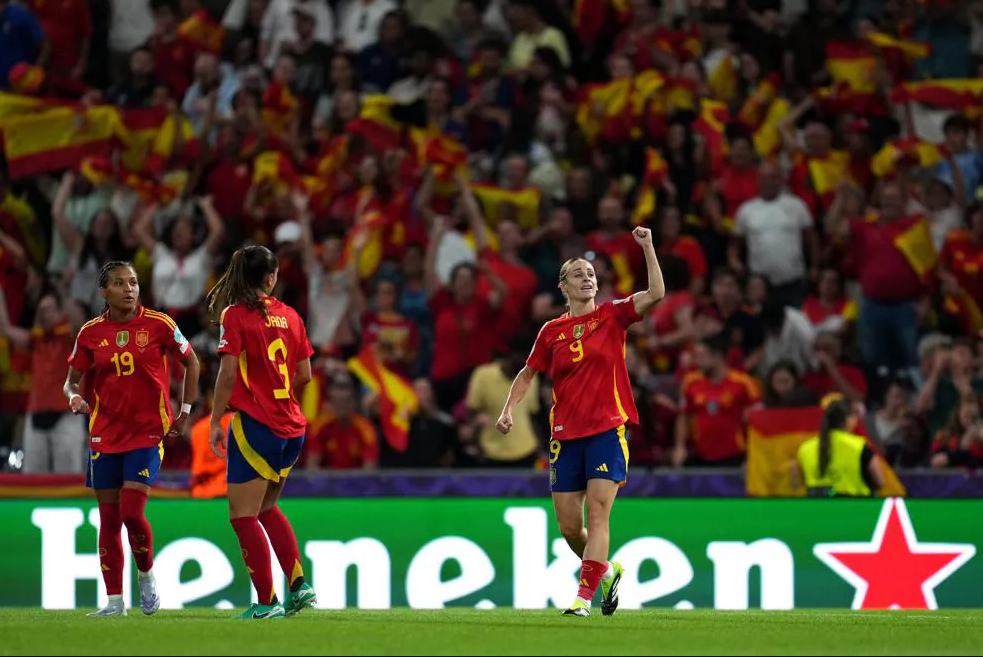
Above: Spain celebrate. Photo: UEFA website.
Group B has seen some incredible performances as well as spectacular goals, particularly from Spain, who topped the group with an unbeaten record. A highlight of the group stage was Spain’s 6-2 win against Belgium, with six standout goals from five different scorers. Seeing two-time Ballon d’Or winner Aitana Bonmatí recover from viral meningitis in time to come on as a substitute in Spain’s first game was also a highlight of the group stage. Belgium winning their final group stage game despite already being eliminated was a significant moment too. The Red Flames put up a fight against both Spain and Italy, building momentum against two top sides, and scoring twice against the tournament favourites, Spain. Hence, seeing them get their first win of the tournament was a highlight too, and was thoroughly well deserved.
Final group standings:
Spain (Q)
Italy (Q)
Belgium
Portugal
Group C – Germany, Sweden, Poland, Denmark
ByCatherine MacKenzie
Above: Sweden’s Rolfo celebrates reaching 100 caps. Photo: UEFA website.
A group with an unexpected winner in Sweden, the standout match has to be the final game, between Sweden and Germany. Many had predicted the Germans to top the group, but an unconvincing defence following a major injury to captain Guilia Gwinn meant they finished in second. Ahead of that final game, nobody would have predicted that Sweden would dismantle Germany 4-1, but the Swedes showed their attacking power. Another highlight was the game between Poland and Denmark, which saw Poland get their first ever major tournament win, beating Denmark 3-2 including a goal from legend Ewa Pajor. Simply getting to the Euros was an amazing feat for the Poles, but getting an unlikely win on their way out will be something remembered for years to come.
Final group standings:
Sweden (Q)
Germany (Q)
Poland
Denmark
Group D – England, France, Netherlands, Wales
By Hannah Chadwick
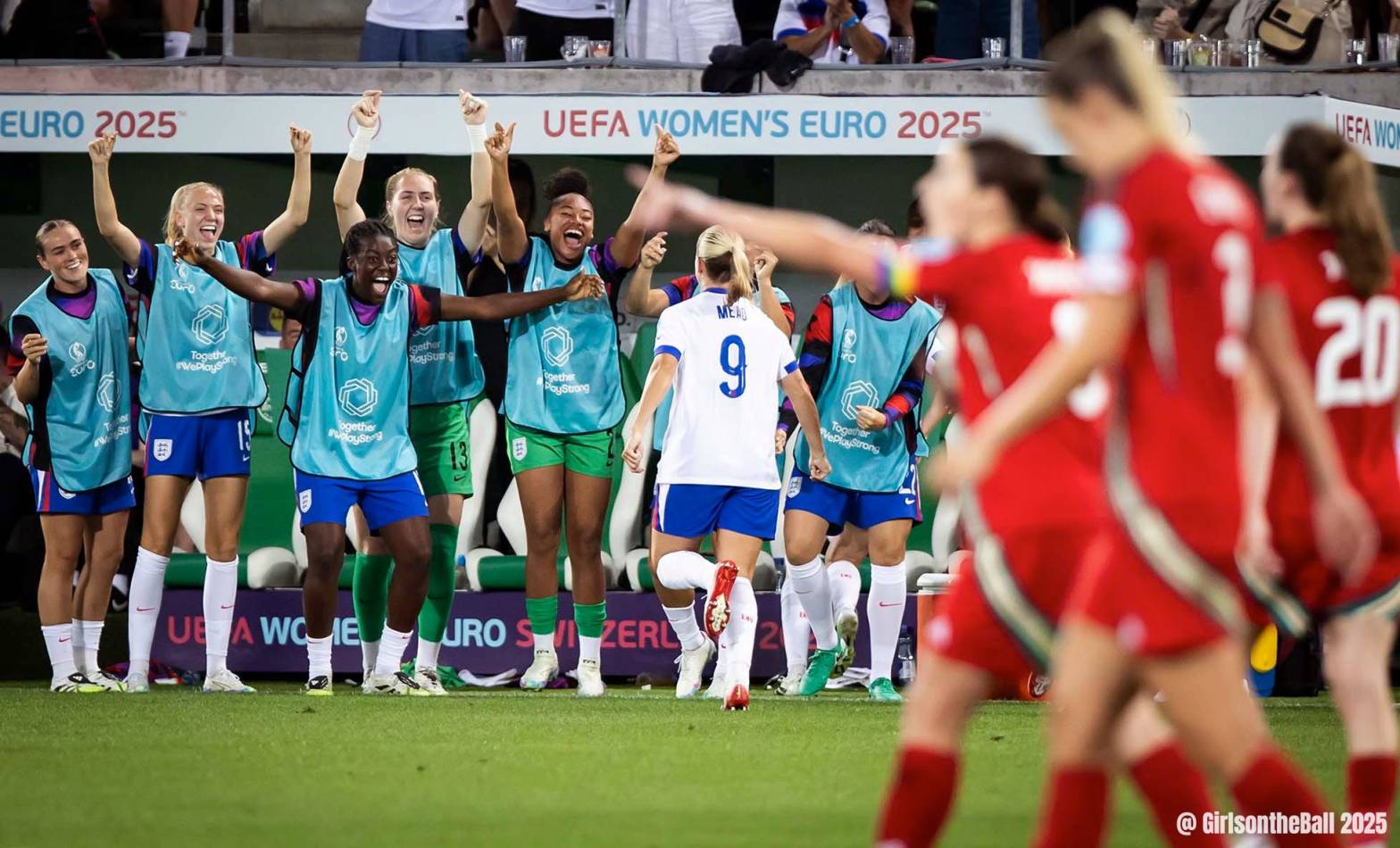
Above: England’s bench celebrates their 6-1 win over Wales. Photo: Rachel O’Sullivan / Girls on the Ball.
Group D was nicknamed the group of death for a very good reason, with England the current champions, 2017 champions the Netherlands, and France, who are looking to make history and win the competition for the first time. They were joined by tournament newcomers Cyrmu. Highlights include Cascarino’s goal against the Netherlands and Pelova’s goal against France, alongside the re-emergence of English star Lauren James following injury. The Dutch said a goodbye to Danielle van de Donk who has possibly played in her last major tournament. From a Cyrmu perspective they had a good tournament considering this is their first ever major tournament and they where drawn into the most challenging group, managing to score against two world class sides in England and France. This tournament will give them something to build on and hopefully lead to more recognition back home in Wales.
Above: England’s bench celebrate their win. Photo: Girls on the Ball.
England 6-1 Wales
Team news and context:
Sarina Wiegman named an unchanged starting 11 from England’s win over the Netherlands. For Wales, Olivia Clark returned between the sticks after losing out for the France game. Ahead of the game, both teams were technically able to qualify for the quarterfinals depending on what happened in the other group D match.
Cymru started the game strong, successfully holding the England attack at bay. That was until Stanway was challenged in the box — the VAR decision was a penalty, which Stanway stepped up to take. Clark went the right way but couldn’t stop it. A defensive mistake from Cymru, alongside the inability to clear their lines, meant the ball fell to Russo, who laid it off to Toone. Her first shot was denied, but her second was not. It was a scramble in the box for the Cymru defenders.
There was hope for Cymru as Fishlock worked her magic and laid the ball off for Angharad James, who sent her shot in, but it was saved by Hampton. England got their third as James made the run, found Toone, who sent the cross in to Hemp — but Clark couldn’t make the save.
England were relentless as James and Stanway both had shots on target, but Clark managed to keep them out. A lapse in concentration from the Cymru defence meant that Toone linked up with Russo and beat Clark to the post. Wales got their chance from a corner as Rowe slammed her effort narrowly over the bar. A lack of concentration from Hampton meant she passed the ball straight to Fishlock, who sent her shot wide.
A switching of players around in the formation caused some confusion as Park was left unmarked in the box, and Clark managed to get her fingertip to it. England continued to press high and remained hungry for more as Beever-Jones found Mead, who sent her shot past Clark.
After being dropped to the bench following a poor performance against France, it seemed Mead had just solidified her place in the lineup for the quarterfinals.
There was joy for Cymru as Fishlock broke through the midfield before finding Cain, who sent a powerful strike past Hampton — Cymru’s second goal of the tournament. Although this goal opened up some issues for England, especially at right back, with Bronze being out of position, just like she was for the French winning goal. Charles came on soon after to replace her, potentially testing out a new formation for the quarterfinals. Charles soon created some action — she picked up the ball in space and found Mead, who successfully sent her cross to the head of Beever-Jones, who sent the ball into the roof of the net.
Player of the match: Ella Toone
Ella Toone was a constant star for England in this game, linking up with Russo on multiple occasions and successfully penetrating the Cymru defence.
Cymru goalkeeper Clark also had a tough game but made some impressive saves.
What next for the teams:
England will play Sweden in the quarter-final, and Wales will take this experience and build their squad. They will also start planning for their next tournament qualifiers, determined to make history again.
Netherlands 2-5 France
Team news and context:
After seeing a slightly different squad when France played Cymru — with several first-team players rested — they were looking to maintain their 100% win record in the tournament. Both teams could still qualify for the quarterfinals, setting the stage for a tense encounter. Depending on the outcome, it would also be Netherlands head coach Andries Jonker’s last match in charge of the OranjeLeeuwinnen.
An early chance came for the Dutch as Pelova’s shot from distance forced Peyraud-Magnin into a save. France went on the attack, meaning Van Domselaar was forced into a double save to send Karchaoui’s effort around the post. The Netherlands looked promising as Chasity Grant forced Peyraud-Magnin to make a save, but could only watch as Pelova connected with the ball outside the box and sent it home.
There was a lot of back and forth between the two teams as Les Bleues broke forward and Pelova brought down Baltimore to keep France at bay. Bacha’s free kick was easily claimed by Van Domselaar.
It was a nightmare moment for France as Bacha made a defensive error and cleared the ball into her own net. The Dutch ignited the fire and were all over the French.
France came out of half-time all guns blazing as Katoto was found in a sea of white shirts, and Van Domselaar was unable to save it. France stayed on the attack as Cascarino danced past orange shirts and sent a strike into the top corner to score her second of the game.
The Dutch continued to crumble under pressure as Casparij brought N’Dongala down in the box and Karchaoui converted from the spot.
Player of the match: Delphine Cascarino
Cascarino was the standout player after her second-half performance. She was always looking for her next goal, and her first was arguably the goal of the tournament so far. Pelova also deserved a mention for her consistent overall performance; she was the best Dutch player on the pitch today.
What next for the teams:
France will play Germany in the quarter-final, while the Netherlands will begin their journey home and prepare for the arrival of their new head coach, Arjan Veurink, who is currently England’s assistant coach.
Moment/player of the day
Has to be Cascarino’s performance for France and her two goals. She had an excellent game and will be hoping to shine against Germany.
Above: Theodora Mouithys (7) breaks through en route to scoring Football West Academy’s dramatic late winner yesterday. Photo: U18sNPL.
Football West Academy 1-0 Balcatta Etna
by Ella McShane
The Football West Academy (FWA) hit a late winner to bring Balcatta’s run of eight league wins in a row to an end, and reignite their own top-two hopes.
Theodora Mouithys’ goal as the clock entered the 90th minute ensured that the teenage side got back on the horse after losing their first against second clash 4-0 to Perth SC last weekend.
This fiercely contested Saturday afternoon encounter was defined by intensity in every area of the pitch. Sturdy defensive lines and a congested midfield made progression into the final third a challenge for both sides throughout the match.
The first breakthrough for the FWA came at the 17-minute mark when the midfield congestion was released by Xuri Dalton, the ball crossed to Lacey Heys on the charge was then passed to Klaudia Houlis on the wing. The home side’s captain made a break into the box, crossed it to Heys, now in prime shooting position, but the effort found the hands of Balcatta keeper Rebecca Bennett rather than the net.
Equally applicable to both teams, the remainder of the half saw many long balls in attempts to disperse a congested midfield and create attacking chances, which often broke down due to tight marking or were intercepted following careless passes.
The second half was introduced with the same intensity, but both sides were calmer and more collected in their approach. Balcatta initiated a threat within two minutes when an ever-busy Alyssa van Heurck cleared a high cross from the left wing. The ball found the head of a lurking Jaime Duncanson, whose attempt struck the crossbar.
With the game still neck and neck in the final quarter of an hour, the hunger for three points became palpable. This part of the game produced more chances than the previous 75.
In the end, it was Theo Mouithys who put the game to bed in the FWA’s favour. In possession, Emily Garnett’s surging run down the right wing created space for a dangerous Mouithys to charge down the midfield and struck the ball clean into the top of the net to seal a huge three points for the teenage side.
Above: Jess Flannery, who put Perth SC ahead at Fremantle City today. Photo: Rob Lizzi.
The Azzurri are two points clear at the top of the NPLW WA after a hard-earned 2-0 victory at Hilton Park this afternoon.
Both teams were without key players, with Abbey Green out for the home side and Tijan McKenna for Perth.
It was a real attritional battle of an opening half, and clear-cut chances remained at a premium with neither goalkeeper called into direct action often during the opening half.
The best chance of the opening 45 came in the 14th minute when Ella Lincoln was played in, but just as she was about to pull the trigger, a superb last-gasp tackle from Freo defender Annabelle Leek denied the Azzurri hotshot.
However, it would take just two minutes of the second half for Perth to hit the front. Lincoln dispossessed Janice Kiama on the edge of the box and curled a shot that came crashing down off the crossbar. Flannery followed up with a header that Megan Phillips in the Fremantle goal repelled, but the rebound came back to the Azzurri attacker, who placed a side-footed volley into the net from close range.
They would double their lead on 56 minutes when, after a Fremantle throw in on parallel with the penalty area, a long clearance from the Perth defence eventually fell for Daisy McAllister to beat a group of three Freo defenders and play a perfectly weighted pass through for Lincoln to dispatch the ball into the top left hand corner.
There were two further opportunities for the Azzurri to extend their lead further. First, when Flannery turned on the edge of the box and hit a shot that Phillips held, and then with six minutes remaining, when substitutes Ruby Marshall and Maja Archibald combined, with Archibald hitting a shot that Phillips did well to get a glove to and push out for a corner.
This would be a pleasing three points for Perth, who had to work their way through the first-half challenges that Fremantle posed. They never looked back once Flannery put them ahead and earned the reward of another week at the top of the NPLW WA ladder.
Above: Renee Leota, who hit a hat-trick for Perth RedStar yesterday at UWA-Nedlands. Photo: Perth RedStar.
Perth RedStar returned to winning ways with this comprehensive victory at a UWA-Nedlands side who are now without a win in five games.
The defending champions were red hot out of the blocks, hitting the front after just two minutes when they won turnover ball along the right, allowing Sarah Carroll to cross in for Renee Leota to tap in.
Just five minutes later, it was 2-0 as Caitlin Doeglas looked up to see home goalkeeper Madison Large off her line, and curled a stunning lofted shot in from over 30 yards.
There were 43 minutes played when RedStar got their third of the afternoon. UWA-Nedlands found it hard to complete a defensive clearance, allowing Doeglas to lay a pass off for Jay Coleman, who put in a low cross for Leota to beat Ginger Cain and lash the ball home from close range.
The visitors stepped on the gas in the middle part of the second half – a spell which saw them score four goals in just six minutes.
First, with 66 minutes on the clock, Carroll pounced after a UWA-Nedlands mis-hit free-kick fell at her feet and the former Perth Glory star advanced to fire home from a central position on the edge of the box.
The home side presented RedStar with another opportunity three minutes later as a throw out from Large went straight to Doeglas, who laid a pass off to Carla Bennett. Her exquisite ball that was lifted in allowed Leota to turn the ball home to complete her hat-trick.
It would be 6-0 shortly afterwards as Quyen Doan played a first-time high ball into the box from the right flank. UWA-Nedlands’ defensive clearance landed perfectly for Lauren Continibali to lift over Large and in.
From the resulting kick-off, RedStar scored again after with Bennett claiming another assist with her ball in for Jayna Ridley to turn home from close range.
UWA-Nedlands’ luckless afternoon continued when Samara Riches’ penalty was saved comfortably by Gabby Dal Busco.
Above: Marianna Tabain (white shirt, smiling) hit a late winner for Subiaco at Murdoch University Melville today. Photo: Denyse McCulloch.
Subiaco ended their six-match winless streak as they came from behind to emerge victorious at Besteam Stadium this afternoon.
Murdoch University Melville (MUM FC) are becoming harder to beat as the season enters its final third, and with Ella Mastrantonio back at the club, they can point to major steadying experience as well as big game know-how.
The home side took the lead with 19 minutes on the clock when Caitlin Symons’ throw on the right deep inside her own half led to Isabella Baldin gaining possession and finding Lucie Hotchin, who drove along the flank and squared the ball. Amalia Caceras couldn’t hold it in the Subi goal, and another of MUM FC’s experienced players, the former Perth Glory attacker Ellis Glanfield, put the ball into the net.
Ten minutes before the break, Subiaco levelled when Greta Bailey advanced and hit a shot that flew into the right-hand corner.
Any hopes that the home side had of a second successive point were dashed with four minutes remaining when Marianna Tabain was released and took the ball round the onrushing Jemma Skinner and smashed the ball home for a Subi victory.
SUNDAY: Balcatta Etna v Fremantle City, Perth SC v Murdoch University Melville, Subiaco v UWA-Nedlands. Football West Academy v Perth RedStar rearranged for 13th August.
Above: Aggie Beever-Jones and Maya Le Tissier. Photo: The FA / Getty.
Read the comments underneath every social media post announcing the starting lineup for a Lionesses game, and you will undoubtedly see several comments complaining that young players are not being given a chance. This has been a consistent trend throughout head coach Sarina Wiegman’s tenure, and some journalists have even suggested that failure to integrate youth could be the Dutchwoman’s downfall as England manager. We have seen before that narratives surrounding England are not always what they seem – so is this even true? Do England really have a problem with bringing young players through, or is this just another narrative that has come out of nowhere?
Is there a problem?
It is arguable that the issue some people have with this is not down to age but rather experience. The backbone of the squad that won the Euros in 2022 and reached the final of the World Cup in 2023 is still in place – with captain Leah Williamson, Alex Greenwood, Jess Carter, and Lucy Bronze making up the defence, Georgia Stanway and Keira Walsh holding down the midfield, and Alessia Russo, Ella Toone, Lauren Hemp, Chloe Kelly and Beth Mead going forward. Only three of these players are aged 30 or over – Mead recently celebrated her 30th birthday, Bronze is 33, and Greenwood is 31. The rest are all in their mid-20s; reaching their peak in the football world, yet they feel like they have been around for a while.
It is the fact that we have seen them for a couple of major tournaments now that is arguably giving the impression that they are aging – whilst Lauren Hemp is a deceptive 24 years old, and Toone and Russo are 25 and 26 respectively.
The average age of an England starting lineup also tends to be similar to their opponents’. Against France in their Euros opener, the Lionesses’ average age was 27, compared to 26 for the French. Against Spain in the Nations League defeat, the average ages were equal at 27 for both countries. Against Portugal in the Lionesses’ 6-0 win at Wembley, the England team was a younger one with an average age of 26 compared to 29 for Portugal. The loss to Belgium in Leuven was another occasion where England fielded a younger team than their opponent – 27 compared to 28.
Maya Le Tissier
A focal point for these frustrations is defender and Manchester United captain Maya Le Tissier. The Guernsey native has had a stellar season for United and has played every minute of the last few WSL seasons. A centre-back for United, Wiegman has said England see her as more of a right-back. Whilst the reasons for this are debateable, it is likely in large part due to the need to develop the player who will eventually succeed Lucy Bronze – and there is not a lot of competition for the role.
Le Tissier is the most obvious choice and faces far less competition for the right-back role than she would at centre-back. This is true even if first-choice pairing Leah Williamson and Alex Greenwood are not available – there are still a variety of options including Jess Carter, Esme Morgan, Lotte Wubben-Moy, Lucy Parker, not to mention Millie Bright when fit.
Above: Maya Le Tissier. Photo: Lionesses on X.
It is difficult to truly compare statistics across WSL players because of the variety of playing styles on offer. For example, Arsenal play a much more total-football influenced possession-based game, particularly under Dutch head coach Renee Slegers. Chelsea like to dominate possession but are also fond of going more direct using the distribution of England number one Hannah Hampton. In contrast, Manchester United are known for their defensive displays, however they finished the season as one of the best pressing teams in the league.
Comparing Le Tissier’s statistics to Bronze – who she is being prepared to eventually usurp at England – is therefore difficult and should only be taken lightly. Bronze played three less games than Le Tissier (19), scoring two goals and registering three assists, whilst Le Tissier scored three goals. They had a similar number of touches per game (79 compared to Le Tissier’s 76), and their passing accuracy is very similar (79% for Bronze, 80% for Le Tissier) – Le Tissier is slightly ahead in long balls (46% compared to 39%, although this could be partly explained by how the two teams prefer to play), and they are both accurate in 33% of their crosses.
For England, Bronze’s dominance combined with the disagreement over position – Wiegman preferring Le Tissier at right-back – mean the Guernsey native’s opportunities have been more limited than fans would like. Her last minutes for England came against Portugal in the Nations League, where she replaced Lucy Bronze and played 36 minutes at right-back.
Her last opportunity before then was in England’s series of winter friendlies in October – December. She started two of the games (against Switzerland and South Africa), once at right-back and once in an improvised midfield role. She also played fifteen minutes of the Lionesses’ loss to Germany at Wembley, coming on for Bronze. There were also the friendlies in February 2024 against Austria and Italy. Le Tissier started the game against Austria, playing the full 90 minutes and notching an assist.
In terms of competitive games, aside from the half-hour against Portugal, her last outing came in July 2024, when she played the full 90 minutes as England faced the Republic of Ireland in Euros qualifying. Bronze was rested for this match (without injury), indicating that Wiegman wanted to see Le Tissier in action.
Aggie Beever-Jones
Aggie Beever-Jones tends to be another player fans want to see starting. Understudy to Alessia Russo, Beever-Jones has had an incredible season for Chelsea. She only started half of Chelsea’s games yet managed to notch nine goals, for a return of 0.4 goals per game or a goal every 124 minutes. She has an average of two shots per game, with one being on target. Over the season, she created two big chances and had an 81% passing accuracy. On her first Wembley start, Beever-Jones scored a hattrick against Portugal within half an hour.
Comparing WSL statistics, Russo started 19 matches, scoring 12 goals with a frequency of a goal every 141 minutes. Russo had more shots per game, more on target per game (3.5 and 1.6 respectively) and notched two assists, creating seven big chances with an 83% passing accuracy.
Above: Aggie Beever-Jones in training. Photo: Lionesses on X.
The primary difference between Beever-Jones and Russo is in their work-rate off the ball. When England faced Belgium in Leuven, Russo was injured and Nikita Parris played in the number nine role with Beever-Jones on her left (Lauren Hemp was also missing through injury). During that game, England struggled to cope without Russo tracking back and covering all areas of the pitch; this highlights the many facets of Russo’s gameplay.
Part of the struggle was that with neither Beever-Jones nor Parris tracking back, there was little in the way of support for Niamh Charles against the pace of Tessa Wullaert. However, it is worth noting that tracking back and helping out the defence is not something Beever-Jones is often tasked with at Chelsea, particularly if playing on the left. With Parris also being a recent reintroduction to the squad, there was little time to create a cohesive attacking unit which would not have helped either – but it does highlight the benefit of having Russo as a more multi-faceted striker.
At twenty-one and already capped with the senior team, it is likely only a matter of time before Beever-Jones has a bigger role within the England squad. Whilst Ellen White was the first-choice striker in 2022 with Russo as her backup, Russo’s time to shine came and so too will Beever-Jones’.
The impact of the Nations League
It is arguable that a major barrier to incorporating youth in senior teams is the emergence of the Nations League (UWNL). Before the Euros in 2022 and World Cup in 2023, there were no competitive games, so England (and other nations) had more opportunities for friendly matches – where the bulk of experimentation tends to happen.
Despite a popular narrative being that Wiegman rarely rotates her squad even for friendlies, the only senior player in the starting lineup against Switzerland was Millie Bright – the 10 other starting players had a combined cap total lower than Bright alone. Grace Clinton, Jess Park, Ruby Mace, Laura Blinkilde-Brown, Le Tissier and Esme Morgan were all on the team-sheet that evening, constituting ten changes from the previous match. Against South Africa the previous window, Le Tissier, Jess Naz, Park and Morgan all started.
The inaugural UWNL occurred mere weeks after the World Cup final in 2023, playing a role in the seedings for the qualifiers for the 2025 Euros. The aim of the UWNL was to increase the number of competitive matches for countries still at early stages of developing women’s football, to increase the standard of the game across Europe. With the league system in operation, in actuality this has meant teams playing each other numerous times – for example, Belgium, Portugal and Spain were in the same group for the 2025 Nations League and then for the 2025 Euros, so they will have played each other four times this year alone.
Whilst these games are often referred to as ‘glorified friendlies’, the fact remains that they are competitive games that impact how a nation qualifies for the next major tournament – winning is important, so there is little room to take risks. Having less time for friendlies means there is less room for experimentation, and less time to bed in younger players. However, some countries did overhaul their squads at the time – Germany for example – at the expense of short-term results.
Protection from expectations
Using the UWNL and qualifying games to incorporate younger or new players is acceptable if you continue to win. Germany suffered friendly defeats last autumn – to Italy and Australia – alongside competitive games in last summer’s Olympics, including a chastening 4-1 loss to the USA. Given the reaction from fans and media if England’s Lionesses lose or have a poor performance, it is likely that our expectations would not allow for this kind of experimentation in competitive games.
For example, the team that lost 4-3 in a friendly against Germany in October 2024 was changed significantly for the following game against South Africa, including a number of younger players – Le Tissier, Naz, Clinton, Park, and Morgan all coming in. Whilst the Lionesses won the game 2-1, the reaction was overwhelmingly negative due to the fact that they had not dominated the game. Sky Sports claimed the win was “unconvincing” in their review, and the Guardian referred to the Lionesses as “sloppy”, showing that the expectations for this team – no matter which players are in it – are extremely high.
Given the expectations that come with winning a major tournament and advancing to a World Cup final, it is perhaps understandable that England choose to take a measured approach to incorporating new players. There is an expectation that new players will have a major impact on first showing, particularly if they have been impressing at club level.
In an interview with the Guardian earlier this year, Beever-Jones acknowledged this, saying: “Last year was a bit of a whirlwind. Having the season I had and scoring a lot of goals, there was a bit of pressure that I wanted to match it. At the start of the season, I maybe got in my own head a little bit, but if I’m playing with a smile on my face and with confidence, then I believe everything else will fall into place.”
Whilst some do manage to have that impact, such as Michelle Agyemang scoring 41 seconds into her debut against Belgium, it should not be the expectation, and carefully introducing young players to the senior team should be the norm – particularly as England have an established and successful under-23s programme.
Predictions
It is likely that Manchester United having Champions League football next season will give Wiegman major headaches when it comes to Le Tissier and Clinton. If the duo sustain their good form in the face of some of the best teams and players in Europe, it is almost certain that they will needle their way into the Lionesses’ starting lineup. For Beever-Jones, her chances likely hinge on the fitness and form of Russo – but at twenty-one, there is still a lot of time to come.
It remains to be seen what further impact England’s young players will have this summer. Agyemang impressed in a cameo against France, and Beever-Jones made a strong showing in a cameo against the Netherlands. These small opportunities are likely all there is for now, but come the World Cup in 2027, the picture may be very different.
Above: Belgium celebrate their first and only win of the tournament. Photo: UEFA.
Portugal 1-2 Belgium
Above: Janice Cayman celebrates her goal. Photo: UEFA website.
Team news and context:
Belgium were already eliminated from the competition before facing Portugal, however Portugal’s fate was also out of their hands to a certain extent. Portugal could have progressed as Group B’s runners-up if they beat Belgium and Italy lost to Spain, subject to goal difference. Portugal and Belgium both only made one change to their starting line-ups from their previous games: Ana Borges, who was sent off against Italy, was replaced by Catarina Amado for Italy, and Hannah Eurlings was replaced by Jassina Blom for the Red Flames.
Tessa Wullaert, the Red Flames’ top scorer, put her side ahead early on, scoring her first goal of the tournament. However, Belgium were on the receiving end of two goals being overturned by VAR later in the game. The first was Toloba’s goal, which was disallowed for a foul in the build-up, and Portugal were given a free kick. They later had a second goal disallowed for offside.
Telma Encarnação scored an equaliser for Portugal in the 87th minute, when she fired the ball inside the near post, however it wasn’t enough to beat Belgium, and potentially send Portugal through to the knockout stages.
Another key moment of the match was Jassina Blom suffered an injury in the first half. She was stretchered off after medics being on the pitch for few minutes, after making her first start for Belgium at the tournament.
Player of the match: Tessa Wullaert
A goal and a would-be assist had Toloba’s effort not been offside, she provided pace down the right wing for Belgium and was the most potent Belgian threat.
What next for the teams:
Belgium had already been eliminated before Group B’s third matchday, however securing their first win of Euro 2025 was a monumental moment for the team.
The loss meant heartbreak for Portugal who finish third in the group and are eliminated from Euro 2025, after having the opportunity to potentially go through to the quarter-finals if they had secured the win.
Italy 1-3 Spain
Above: Spain celebrate their win. Photo: UEFA website.
Team news and context:
Before the start of Matchday 10, Spain had already secured their place in the quarter-finals. Italy had the opportunity to go through to the knockout stages as group winners, if they were able to beat Spain. However, they also knew there was a scenario that would stop them going through: if they were defeated by Spain and there was a six-goal swing between them and Portugal. Spain made six changes to their starting line-up, with Aitana Bonmatí making her first start of the tournament. Laia Aleixandri and Ona Batlle were rested, likely because if either of them received a yellow card against Italy they would be suspended for the quarterfinal.
Scorers: Elisabetta Oliviero (10’), Athenea del Castillo (14’), Patri Guijarro (49’), Esther Gonzalez
Highlights:
Elisabetta Oliviero opened the scoring in the 10th minute of the game, with her first ever international goal. However, it didn’t take long for Spain to equalise, with Alèxia Putellas providing the assist for Athenea del Castillo, to bring Spain level. Patri Guijarro then put Spain ahead in the 49th minute.
It looked like Italy may have had the chance to equalise, when Irene Paredes dived to head the ball, but it made contact with her arm. VAR looked at the penalty call, however, this wasn’t given as Sofia Cantore was offside before the penalty incident.
Spain sealed the win, and the top spot in Group B, with a goal from Esther González in stoppage time, with Putellas securing another assist.
Spain also equalled England’s record of goal involvements in a Euros group stage, with 14 goals.
Player of the match: Alexia Putellas
With two assists, the natural choice. She assisted both del Castillo’s goal and González’s goal, picking up the right positions for her teammates in the penalty box. She has equalled the record for goal involvements in a Euros group stage, which was previously set by Beth Mead in Euro 2022.
What next for the teams:
Both teams have proceeded to the knockout rounds of the competition. Spain have finished top of the group and will face Switzerland in their quarter-final, on Friday 18th July. Italy will face Norway on Wednesday 16th July, after making it out of the group stages for the first time since 2013.
Moment/player of the day
The moment of the day was Cayman’s goal for Belgium, which turned out to be the match winner. Belgium were previously unable to secure a victory at the tournament, despite causing problems for both Spain and Portugal, and what the victory meant to Belgium’s players, fans and staff was evident at the full-time whistle. Cayman’s winner felt special for Belgium within the game itself too, after having two goals previously disallowed for offside.
















 impetusfootball.org