Above:Megan Campbell executing one of her trademark long throw ins. Photo:via RTE
By Alyce Collett (15/10/2025)
The changing of the guard in the Republic of Ireland senior national team is continuing, with Megan Campbell the latest Girl in Green to hang up the boots.
Campbell earned 57 senior caps for the Republic of Ireland, after first making her senior debut in August 2011. She went on to get her first senior start in a Euros qualifier loss to France the following month and scored her first international goal against Northern Ireland in March 2013/
Campbell also played a crucial role in helping the Irish qualify for their first ever major tournament – the 2023 Women’s World Cup – but heartbreakingly missed the tournament proper due to injury.
She also had an accomplished international career at underage level, playing an important role in a historic run for the Girls in Green at the 2010 Women’s European Under-17 Championship. Campbell scored the only goal in the semi final of that tournament which saw the Republic of Ireland beat Germany to reach the final, but unfortunately for the Irish they lost the final in a penalty shoot out to Spain.
On the domestic front Campbell’s career began with St Francis before joining Raheny United in the League of Ireland. Campbell’s career took her all over the world, spending time in the college system in the United States before heading over to England to play for Manchester City, Everton, Liverpool and then London City Lionesses. She had been without a club for a few months after leaving the Lionesses post helping them get promoted to the Women’s Super League.
The hard nose defender played across both centre back and outside back throughout her career, and developed a reputation for not only the way she defended, but for legendary throw ins.
Thanks to her hypermobility, Campbell has the ability to do throw ins that can reach the heart of her side’s attacking penalty box.
This ability also led her to officially break a World Record in April this year when one of her throw ins was officially recorded as having gone 37.55 metres.
Her retirement announcement comes off the back of a number of other big Irish names retiring in the League of Ireland over the weekend, with Campbell’s former Ireland team mates Áine O’Gorman, Karen Duggan and Rianna Jarrett also all hanging up the boots.
Reflecting on her decision to retire while speaking to Irish broadcaster RTE, Campbell said “It’s been a while coming, but it’s something that I’ve struggled accepting for a long time now.
“Football has been my life for over 25 years. It has given me so many amazing opportunities, allowed me to travel the world and to meet some of the best people. It has helped me to become the person I am today.
“Unfortunately, I knew that playing the sport I love, and have given everything to, would have to end some day. I just never wanted to believe that it would have come this soon.”
Above: The WSL logo. Photo: WSL Football / BBC Media Centre.
The Women’s Super League introduced new kickoff times at the start of the season. Impetus surveyed fans to find out how they feel about the changes.
The Women’s Super League (WSL) is arguably one of the strongest leagues in women’s football, both commercially and athletically. Since this season, the majority of WSL matches kick off at 11:55 or 12:00 pm UK time on Sunday afternoons.
Last year, a new broadcasting deal was announced for the years 2025 until 2030. In the UK, Sky Sports broadcasts the WSL on their different channels and also offers a Multiview channel, where fans can watch all ongoing live games on one screen.
Impetusunderstands that Sky Sports and the WSL want to drive Appointment to View, a consistent window for fans to watch the league in. That window is the 12pm Sunday slot.Impetus also understands it is part of a wider strategy to drive visibility of women’s football and tell wider narratives to grow the game.
The BBC also broadcasts one match each game week, and some matches are also available on YouTube. For overseas fans, it depends if broadcasting rights have been bought by a broadcaster in their country. If not, games are shown on the WSL’s YouTube channel.
How do the new kick off slots, broadcasting rights and simultaneous kickoffs impact fans? We conducted a survey of 303 WSL fans, based both in the UK and overseas, both match going and non-match going. We also spoke to three fans via a Zoom call for a more in-depth understanding of their experiences.
The majority of UK fans dislike the new schedule
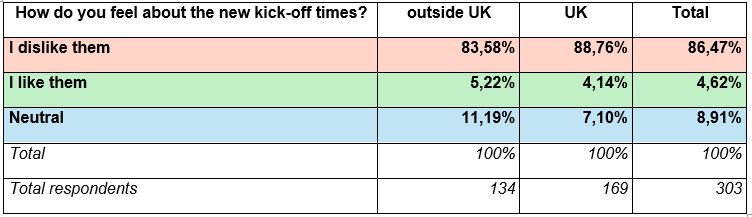
The table below shows that the kick-off times are controversial, with a majority (about 87%) of our respondents disliking the new kick off times. There is a slight difference between UK residents and fans from outside the UK, as UK residents are slightly more unhappy about the times.
Respondents from outside the UK are more likely to feel neutral about the change. It’s more likely that UK fans are match going fans, so we will look at that more in depth below.
Implications for match going fans
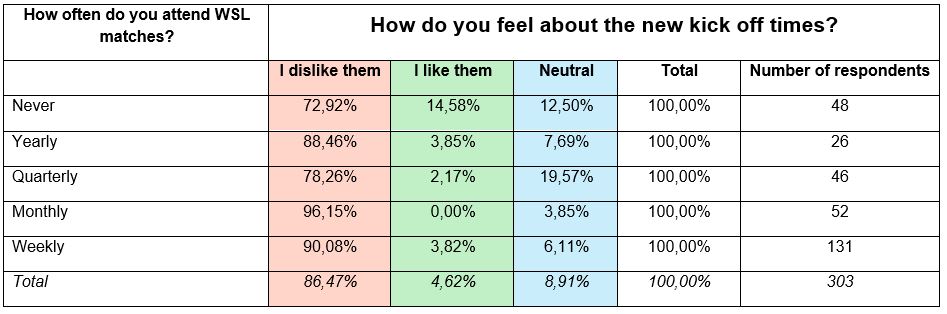
We see a big difference in discontent between match going and non-match going fans, see the table below.
Fans who never go to matches are more likely to enjoy the new kickoff times, whereas match going fans are represented above average when it comes to disliking the new format. Interestingly, the group that frequents matches monthly is the unhappiest with the new format. It could be that these fans would like to games more often, but can’t because of the new format. We checked this, as fans were asked to elaborate on their answers.
A lot of the fans in this group mentioned not being able to travel to (mostly away) games anymore because kick off is too early to allow them to catch trains in time. Trains are not readily available on a Sunday morning and they usually don’t start until relatively late in the morning.
Another issue mentioned by fans is grassroots football mostly taking place on Sunday mornings, excluding a key audience from attending matches: families with children. As one fan mentions in the survey:
“Midday kick offs are the worst. Having two children (8 and 13) they are regularly forced to pick between their own sporting commitments and watching the WSL. In Essex it’s common for grassroots training to happen on a Saturday and matches Sunday so it doesn’t matter which day the league picks. These are normally done by midday so a 2pm kick off, whilst tight is doable.”
Attendances were already dropping across the league last season, compared to the 23/24 season. With the Lionesses Euros win in the summer, this season could have been a good opportunity for further growth in attendances. The Foxes Trust, an organisation representing Leicester City fans, told us on X: “Our attendances have pretty much halved! It’s killing the chance to grow our audiences.”
Many fans in our survey have mentioned a decline in atmosphere in the stadiums due to the earlier kick offs. People do not have time to meet up to build up the atmosphere before matches. Fans also mentioned that the noon kick off slot isn’t as suitable to drink pints or other alcoholic beverages before or during the game. The vibes around football matches are a big part of what makes football, football, for many.
TV picks are generally announced about four weeks prior to the month the fixtures take place in. This causes issues for travelling fans, especially international fans attending fixtures. They need to book and plan their travel, but that is hard if the fixtures are not set in stone. If the date or time of the match changes, travelling fans could face extra booking fees if they have already gone ahead and booked. Booking closer to the date is generally more expensive too. An international fan (female, 34 years old) tells us:
“I have to book a few months in advance for prices not to be too high on trains or flights. But they don’t announce the kickoffs until very close to the match. It’s now sometimes cheaper to stay the whole weekend in London so I can catch a match in any case than to book close to kickoff, but it’s still not ideal.”
Fans watch less games
TV scheduling is a very intricate process, with Sky also showing Premier League matches and the availability of stadiums also a factor. The 12pm window was picked to avoid as many clashes with Premier League matches as possible.
When fixtures do clash, fans are forced to choose between their women’s team and men’s team. One of our Zoom interviewees, Jacob, and other fans think fans will opt for ‘the familiar’ (men’s matches in this case) and thus women’s matches lose out.
According to the Women’s Sport Trust Visibility Report published in June 2025, WSL matches had a bigger TV audience during men’s international breaks. Similarly, they also found that Manchester United women’s matches had more viewers when there were no fixture clashes with the men’s team.
Simultaneous kick offs are not only applied in the United Kingdom in the WSL. ESPN in the Netherlands have done the same thing for the Women’s Eredivisie from the start of this season where one match is being played at 12:15 and the others at 16:45 on Sunday. ESPN also holds broadcasting rights for the men’s Eredivisie, so probably faces the same issues and decisions Sky do.
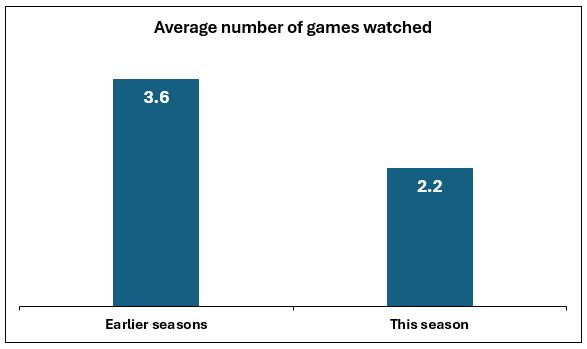
The current format unfortunately means fans can’t watch as many matches as they used to, as we can see in the graph below.
On average, fans watched on average 3.6 games each round last season or the season before, compared to 2.2 games this season. This means that fans watched 1.4 games on average less each game week. Most mentioned the simultaneous kickoffs as the main reason they watch less games, like this 29-year-old female, who explains:
“Once the scores for the games I’m not watching have been spoiled it makes me not want to watch them. I much preferred staggered kick off times, I miss a whole day of football on Sunday.”
She is by far not the only one calling for staggered kick off times. Sky offers fans who want to watch more than one game a solution: the Multiview option, where they can watch all games that are on, on one screen.
What about Multiview?
As for the Multiview channel Sky offers, most of our respondents do not use it as they are either abroad or feel the feature is too overwhelming. Like a 19-year old female tells us:“No, I don’t use it. It’s too confusing and hard to keep up with, I end up missing more because it’s impossible to watch 4 games simultaneously”.
Another point made by fans is the lack of excitement on the Multiview channel. Many feel a Multiview channel can be exciting when there is a lot riding on the matches that are on, like during the final games of a season, but not during the majority of the season.
We spoke to 24-year-old Jacob, a Tottenham Hotspur fan from London, through Zoom. He thinks the multiview channel is a good idea but does not like to use it when his team is playing. “As a Spurs fan, if we’re playing, I don’t want to watch four other games. I just want to watch our game”, Jacob tells us.
Many UK based fans mentioned they can not afford Sky so don’t have access to the Multiview channel.
What do the numbers say?
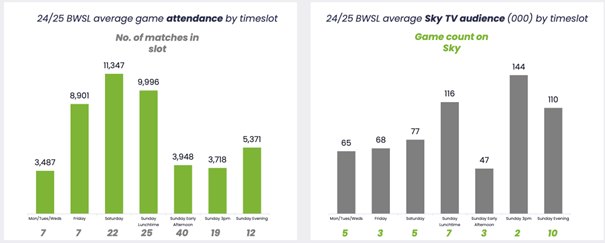
According to the Women’s Sport Trust Visibility Report, the Saturday matches had the highest average attendances in the 24/25 season, followed by Sunday lunch time. So the 12pm Sunday kick off was the second highest attended on average. At the same time, TV audiences were also second highest on average in this slot.
Women’s Sport Trust Visibility Report
Will the new schedule grow the league?
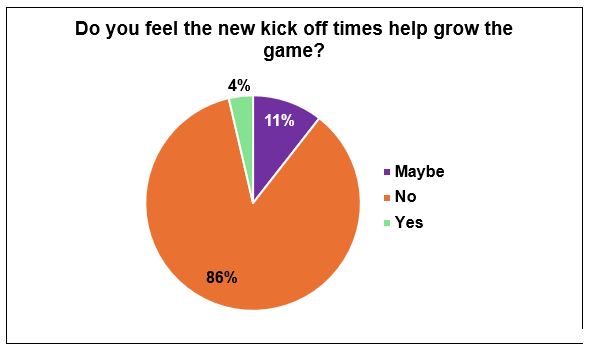
A vast majority, 86 percent, of surveyed fans says they feel like the new format does not contribute towards growing the league. Fans were asked to elaborate on their answer.
They mostly touch on the points already discussed above. A 32-year-old female asks: “How do you want to grow the game if people can’t watch as many games as they want?”
A 29-year-old male links the lesser atmosphere in the stadiums to the broadcasts, saying:
“By playing early in the day you end up making it so much less easy for people to get to games. It also means that the atmosphere is a lot poorer from those who can go. All this does is degrade the product Sky are providing on tv, and empty seats/bad atmosphere make people less likely to want to tune in”
Lower table teams or teams with a smaller following will be impacted by the new format the most. With multiple teams playing at the same time, most fans will probably choose their own team or the most ‘exciting’ game to watch, which would most likely be a game of one of the bigger teams.
Laura Marie, an international fan from Germany highlighted this point in her interview on Zoom too. She says: “Naturally, if there’s four at the same time, you would tune into Arsenal, Chelsea, United or Manchester City. You wouldn’t watch Leicester City, Everton, whatever, if you’re not a fan of that club.”
Out of the group of eight fans who feel like the new format does help grow the game, four mention the fact that the WSL kick offs do not clash as much with the Premier League any more. This in turn allows men’s football fans to tune into the women’s matches ahead of the men’s fixtures kicking off, they think, which will grow the audience and the game.
If it were up to the fans, then…
We asked our interviewees on Zoom how they would shape the broadcasting slots, if it were up to them. They all gave similar answers.
They would prefer one or two games on Saturday and then three or four games on Sunday, with both days having staggered kick off times. Friday nights are up to debate though, with Jacob, a match going fan, saying it wouldn’t be ideal for people having to make kick off after a work day. Laura Marie, an international fan (who does go to matches occasionally) told us she would like to watch matches on Friday nights, but understands that some match going fans would not prefer the slot.
It’s definitely not all bad
Fans from Australia and Asia are generally supporters of the new kick off times, as they will fall in the early to mid evening in their respective time zones, as opposed to late at night or even way past midnight. And luckily there are morning people who also quite like the new format. Like Leontine, one of the 3 people we spoke to in depth, says: “I can do other things after the matches with these earlier kick offs”.
When asked by The Halfway Line about the new kick off times, Tottenham Hotspur coach Martin Ho explained that he was happy with them. “It doesn’t really affect how we do things,” he said. “You have to work around the kick off times and prepare your team as best as possible. I actually think it’s a good thing. It makes it more unique now to the league and obviously everyone is talking about it, so it’s definitely made a hit within women’s football. I think having a bespoke time makes a big difference, but also enables us to get more eyes on it commercially, which will definitely help it grow.”
A zero-sum game?
To summarise: a large majority of surveyed fans is unhappy with the new kick off times format. Fans watch less games on TV or in person each game week, because of multiple games kicking off at the same time. Supporters mention not being able to go to matches because of the early kick offs, either because they can’t get to the game by public transport, or they or their children have grassroots football matches going on. The majority also doubts that the new kick off slots help growing the league.
WSL Football Ltd, who run the league, face a conundrum. Do they opt for further commercialisation by prioritising the broadcaster’s needs and maybe, potentially lure in a new audience? Or do they prioritise the existing fans, both match going and non-match going ones, by accommodating their wishes for staggered kick off times, and later starts to matches?
It is up to WSL Football Ltd to pan out the development of the Women’s Super League in the future, while trying to keep existing fans happy and meanwhile appeal to a new audience.
Above: Riola Xhemaili with a header. Photo: VrEredivisie on X.
In the fifth round, FC Twente dropped two points in a thrilling draw against FC Utrecht. With a winning Ajax against Excelsior, the two title contenders are level on points and goal difference. PSV and Feyenoord are just one point behind them. The Eredivisie is showing more and more competition, which is a healthy sign for the league.
FC Utrecht show signs of growth against FC Twente
FC Twente 1-1 FC Utrecht
Above: Twente v Utrecht. Photo: VrouwenEredivisie.nl
FC Twente dropped their first points of the Eredivisie season after a draw with FC Utrecht, in a match defined by two brilliant goals. Twente now sit on 13 points in the league, level with Ajax. Following their impressive result against Chelsea in the Champions League, the team struggled to maintain the same level of focus and intensity as in previous games. Ironically, Twente ended up resembling Chelsea in that match: they dominated possession, spent plenty of time around the penalty area, but lacked clinical finishing.
FC Utrecht gave Twente a taste of their own medicine by defending with great discipline, using a deeper block and tracking back with their attackers. It wasn’t until after the break that Twente started to ramp up the pressure. Utrecht, who had also played a midweek match against Feyenoord, began to show signs of fatigue.
Jill Roord, with her match fitness and the mental sharpness that comes from playing two games a week, became Twente’s biggest threat. But goalkeeper Bastiaen, Gera op den Kelder, and Marthe Munsterman were excellent defensively and kept the door shut. As a result, Twente were forced to play more long balls than they usually prefer.
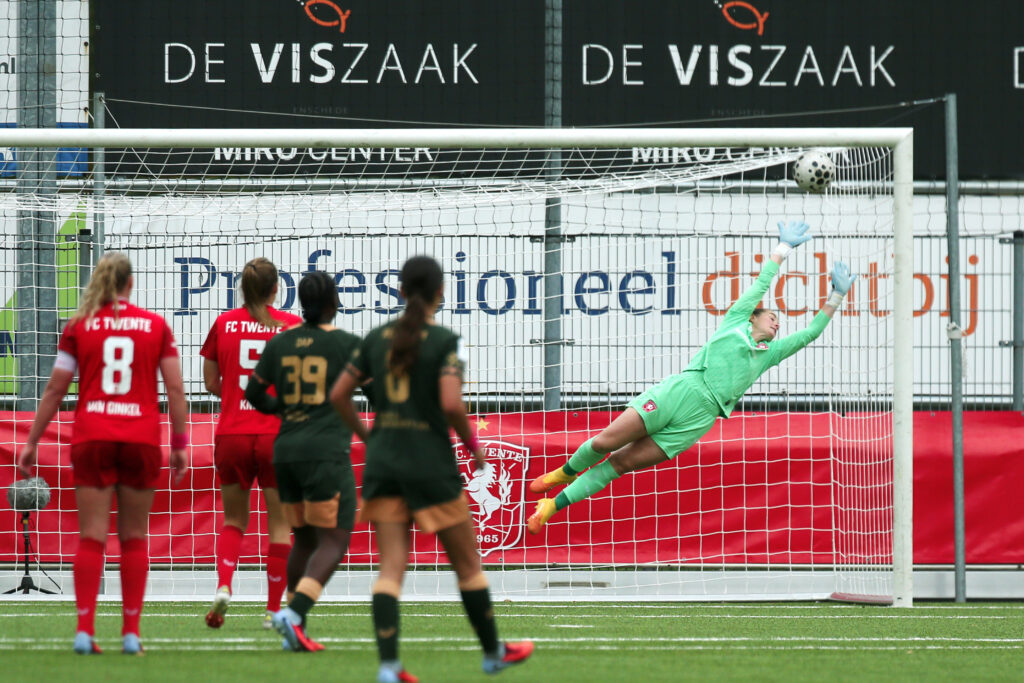
One of those long-range efforts turned into something spectacular: Alieke Tuin unleashed a stunning shot from outside the box — a rising strike that dipped perfectly under the crossbar. It looked like Twente were heading for victory. They continued to attack but grew a bit sloppy in possession.
The introduction of 17-year-old Rochelity Dapp once again proved impactful for FC Utrecht. As a striker, she’s known for her ability to hold up the ball and deliver key assists with her back to goal. This time was no different — she kept her composure and set up Nikita Tromp, who may have scored the goal of the season, firing an unstoppable shot into the top corner past goalkeeper Lemeij.
Twente kept pushing for a winner, but Marthe Munsterman threw herself in front of a shot from her former teammate Jill Roord to preserve the draw. Much like Twente’s own heroic performance against Chelsea, it was Utrecht’s discipline that earned them this result.
This was Twente’s first time dropping points this season, putting them level with Ajax at the top of the table. For Utrecht, after defeats against PSV and Feyenoord, it was a return to the form that made them a dangerous side last season — a team the traditional top three can’t simply brush aside. A moral victory for a team that had twice fallen short against top-ranked opponents.
Ajax draw level with FC Twente in title race
Ajax 3-0 Excelsior Rotterdam
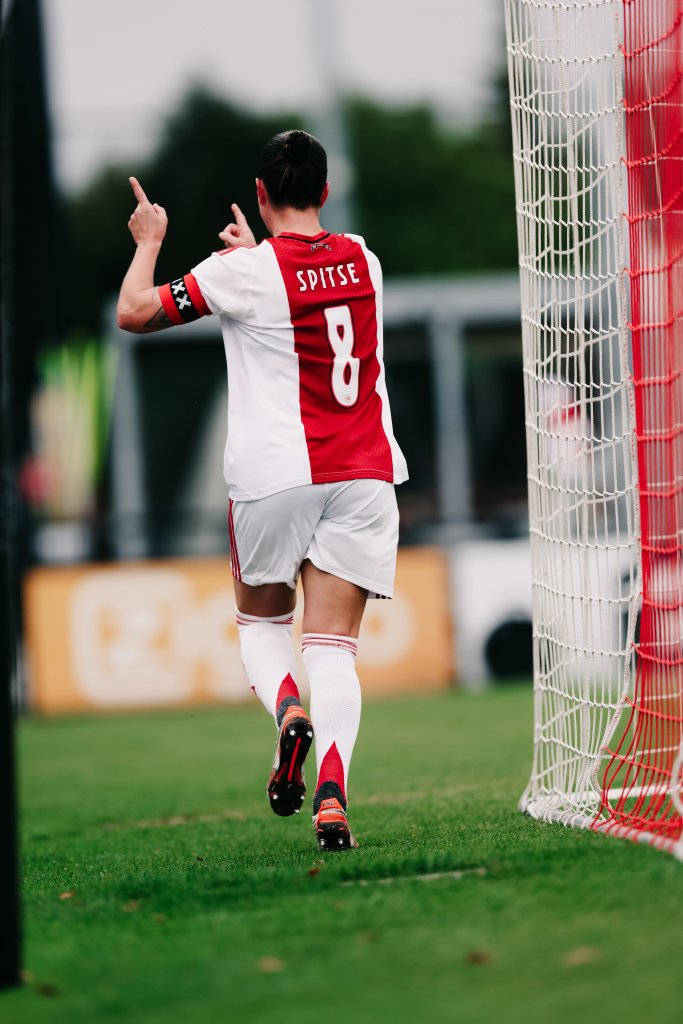
Above: Sherida Spitse celebrates her goal. Photo: Ajax Vrouwen.
Ajax Women remain unbeaten in the Eredivisie after a solid 3–0 win over Excelsior at De Toekomst. Anouk Bruil’s team had to work hard against a resilient opponent, but ultimately proved too strong. With 13 points from five matches, Ajax now share the top spot with FC Twente, who lead only on goal difference.
Excelsior started well despite Ajax being the clear favorite on paper. Defender Jonna van de Velde marked her 100th Eredivisie appearance but was forced off just before halftime with a bruised eye. By then, Ajax were already ahead thanks to Danique Tolhoek, who capitalized on a defensive mistake to open the scoring after 15 minutes.
In the second half, Ajax’s control grew stronger. Sherida Spitse doubled the lead with a well-timed run and finish after a clever assist from Daliyah de Klonia. The experienced midfielder continues to impress in her renewed midfield role, while Tolhoek and Mirte van Koppen remain consistent threats in front of goal.
Excelsior fought back late, forcing keeper Regina van Eijk into a fine save, while Nayomi Buikema made her long-awaited return from injury. In the closing minutes, Van Koppen sealed the win with a composed strike after a great pass from Danique Noordman to make it 3–0. Ajax stay level with Twente and look well-prepared for their upcoming Eredivisie showdown. FC Leeuwinnen profiled upcoming star Danique Noordman – The Sister of Daniëlle van de Donk .
Feyenoord close in on PSV after convincing win over AZ
AZ Alkmaar 1-4 Feyenoord Rotterdam
Above: Feyenoord v AZ. Photo: VrEredivisie on X.
Feyenoord have made a strong statement in the Eredivisie Women’s subtop. Jessica Torny’s team secured a 4–1 victory at AZ on Sunday, bringing them to 12 points — just behind PSV on goal difference. Following earlier wins over FC Utrecht and AZ, Feyenoord are proving they are serious contenders for the top positions.
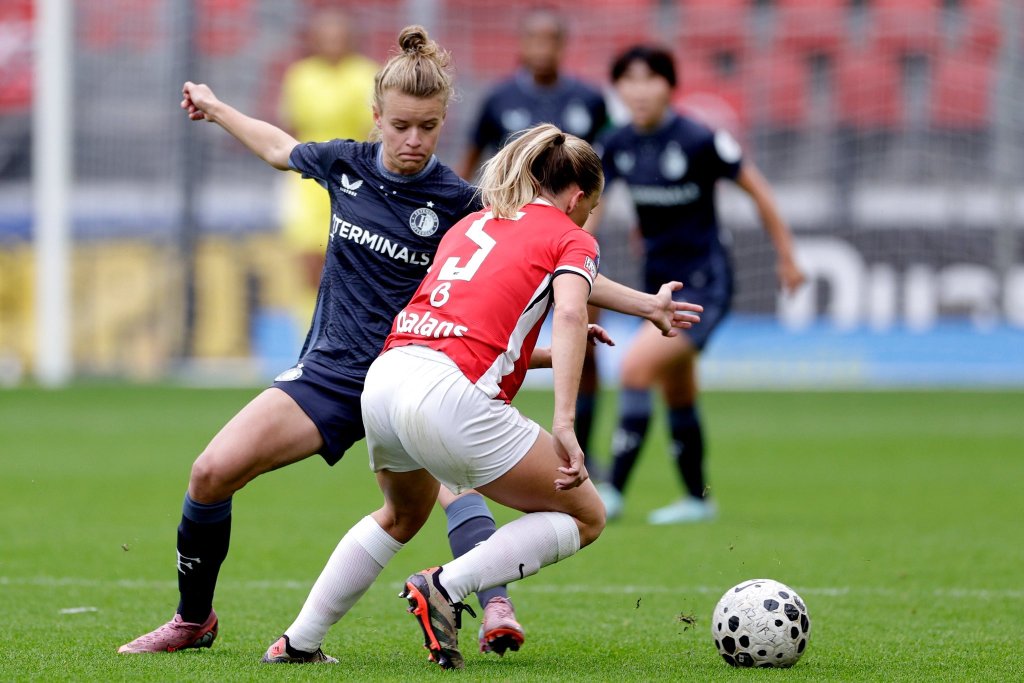
Feyenoord showed growing maturity at the AFAS Stadium. The first half was tough against a well-organized AZ, but just before halftime, Mao Itamura broke the deadlock with a composed header to put her team ahead. Shortly after the restart, AZ leveled from sloppy defending, bringing the tension back into the match.
Torny’s substitution after the hour mark changed the game. Kirsten van de Westeringh needed only one touch to make an impact, intercepting a goal kick and calmly finishing to put Feyenoord back in front at 2–1. Mao Itamura then sealed the win with her second goal, curling a beautiful strike from the edge of the box into the corner.
In stoppage time, Van de Westeringh added her second goal after an AZ goalkeeper error to make it 4–1. With 12 points from six games, Feyenoord are firmly established in the subtop and showing they can challenge the established order. With PSV in their sights and confidence on the rise, Torny’s team looks ready to make a serious push for the top.
Heerenveen secure first win of the season
SC Heerenveen 1-0 HERA United
Above: SC Heerenveen v HERA United. Photo: VrEredivisie on X.
SC Heerenveen claimed a narrow but deserved 1–0 victory over HERA United on Sunday. In a match with few clear-cut chances, the home side ultimately came out on top thanks to substitute Evi Maatman.
The first half lacked real attacking threat. HERA’s forward Hassani was sidelined with injury before kickoff, limiting their offensive options. Heerenveen were stronger organizationally, while HERA stood out mainly for their individual defensive efforts. Lieke Vis had some chances for HERA but hesitated too long, while Heerenveen saw Elfi Maass hit the post and Eef Kerkhof’s shot saved. Inessa Kaagman also narrowly missed just before halftime.
After the break, the game remained tight, but Heerenveen’s first substitution proved decisive. Sterre Kroeze was replaced by Evi Maatman after an hour. Maatman immediately injected more threat, with Heerenveen creating opportunities through Aymee Altena and Kaagman, though both shots went wide.
The breakthrough came in the 74th minute when Maatman headed in a perfect cross from Maass to make it 1–0. HERA had one final chance through Ana Nassette, but her effort hit the side netting. The win lifts Heerenveen further into the Eredivisie midtable, while HERA United continue to search for goals.
PEC Zwolle inflict another defeat on ADO Den Haag
PEC Zwolle 2-1 ADO Den Haag
Above: PEC v ADO. Photo: Eric de Wit.
PEC Zwolle earned a well-deserved 2–1 victory over ADO Den Haag. Playing at home, goals from Zoë Zuidberg and Christina Weiman secured the three points for the hosts.
PEC started strongly, taking the lead in the sixth minute through Zuidberg. The young forward finished a powerful cross in one touch — a technically impressive goal highlighting her potential as a Netherlands U19 player.
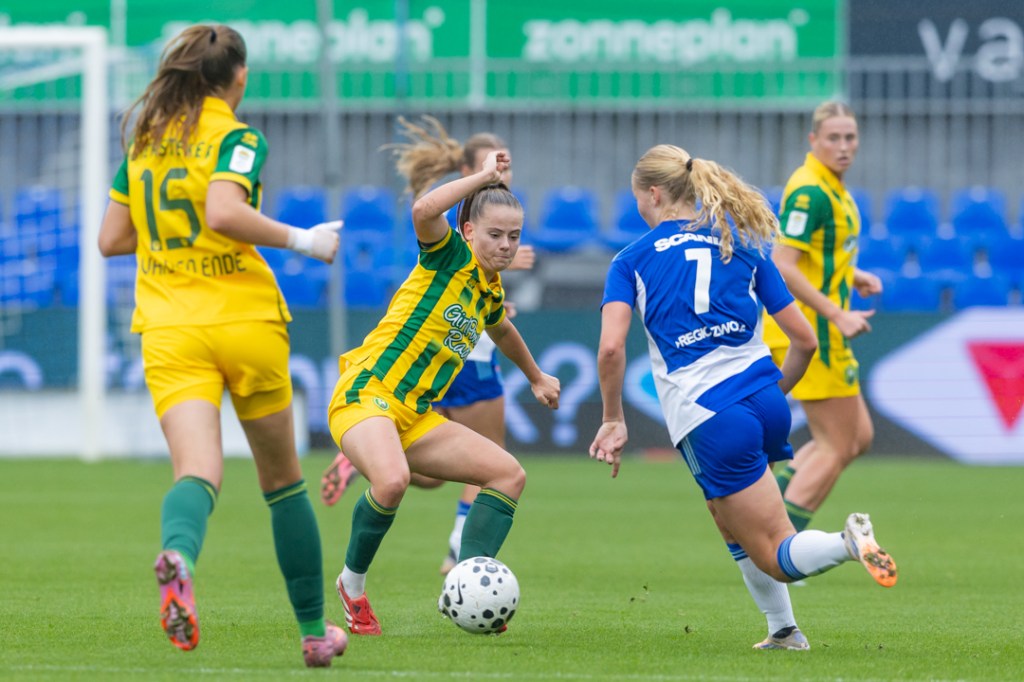
ADO Den Haag responded after the break. Defender Lindner underestimated the pressing of Jill van den Ende completely, losing possession in a dull moment. The 21-year old van den Ende took over the ball and effectively equalized to make it 1–1, briefly unsettling PEC.
PEC showed resilience and continued pressing, eventually seeing Christina Weiman score the decisive goal. Her composed finish secured the win, demonstrating that Zwolle have regained form and are now firmly competing in the midtable alongside FC Utrecht and AZ.
For ADO, there are worrying signs. They struggled in the early half of last year before experiencing a resurgence after a managerial change, with Marten Glotzbach taking over as head coach in December. In January, they lost top scorer Lobke Loonen to FC Utrecht in the club’s first for-profit player sale on the women’s side, however the women’s team have seen few of those funds reinvested.
This was followed up by an exodus in the summer, with half of last year’s starting eleven either retiring or moving. For example, defender Daniëlle Noordermeer moved to Ajax, and has fit in seamlessly, notching player of the match against Excelsior.
A reliance on the youth team is telling – the club are not willing to invest beyond what is necessary as they push for promotion to the Eredivisie for the men’s side. As the women’s league becomes increasingly professional, with clubs spending money and the potential for three relegations this season, the threat of going down is looming for ADO. A shame considering they were one of the founding members of the Eredivisie back in 2007 and have not left the top flight since then.
The game against PEC – another mid-table stalwart – is one ADO would have liked to have won, or at least gained a point from before they face teams higher up the table. They face a difficult end to the year, with their next showing against FC Twente, and games against Utrecht, PSV, and Ajax before Christmas.
Riola Xhemaili the breakthrough star for PSV
NAC Breda 0-5 PSV
Above: Riola Xhemaili celebrates her hat-trick. Photo: VrEredivisie on X.
Riola Xhemaili continues to dominate the Eredivisie Vrouwen. The Swiss forward was once again decisive for PSV on Sunday afternoon, leading her team to a 5–0 victory over bottom side NAC Breda. With a hat-trick, Xhemaili increased her season tally and already looks well on her way to the top scorer title.
The 21-year-old international — who helped Switzerland reach the quarterfinals of this year’s European Championship — has proven herself a true fighter in PSV’s red and white this season. No fear, no mercy: Xhemaili scores with an unshakable conviction that makes her one of the best strikers in the league. PSV can count themselves lucky to have secured her for three more seasons.
Roeland ten Berge’s side had no trouble at all in Breda. After just seven minutes, Xhemaili stepped up to the penalty spot when Renate Jansen was brought down in the box. The Swiss forward stayed calm and converted flawlessly: 0–1.
Ten minutes later, she doubled the lead. With a clever turn, she left her defender behind and slotted the ball past goalkeeper Nikki de Haan. Just before halftime, defender Nijstad made it 0–3 by flicking a corner neatly into the net.
PSV continued to dominate after the interval and were rarely threatened. Just over an hour in, Xhemaili completed her hat-trick: meeting a cross from Nijstad with a powerful header — her third of the afternoon and yet another display of clinical finishing.
Ripa then sealed the final score at 0–5, again assisted by Nijstad. NAC tried to respond in the closing stages, but chances for Brigitte Franken failed to produce a goal.
With the win, PSV remain in third place — just one point behind leaders Ajax and Twente.
Follow Jan for news about Dutch women’s football at www.fcleeuwinnen.nl. Read news about the star players, get strong point of views from their columnists and discover upcoming Dutch talents.
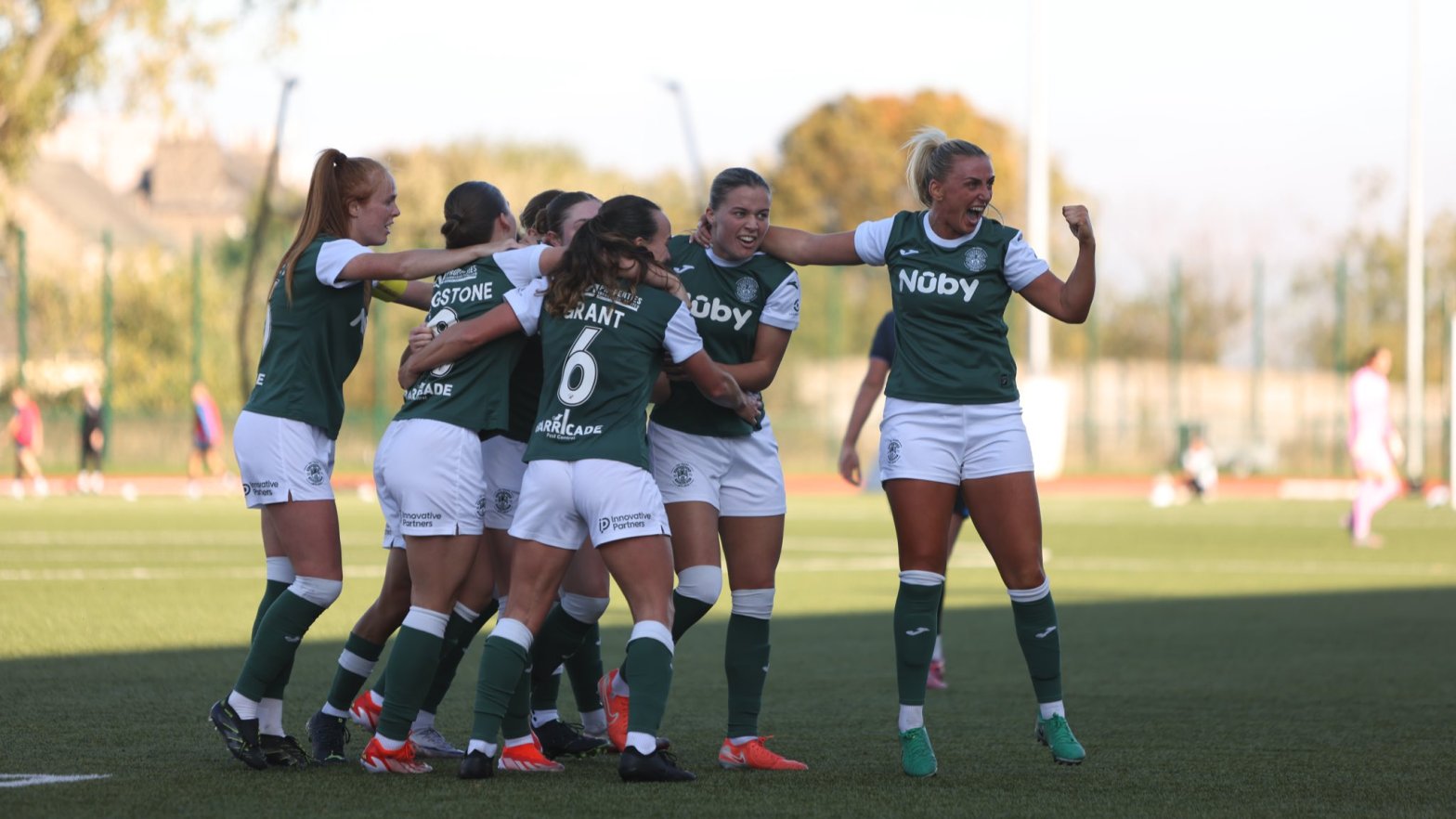
Above:Hibs celebrate Eilidh Adams’ goal which gave them the lead on Sunday Photo:@HibernianWomen on x
Goals from Rosie Livingstone, Kathleen McGovern and Eilidh Adams gave Hibs a memorable comeback win at home over rivals Rangers, having been 2-0 down in a game where club legend Siobhan Hunter took centre stage. The result leaves Hibernian third, trailing Glasgow City by five points with Rangers a further position and two points back.
The Teams
Having successfully moved past Motherwell in the SWPL cup last weekend with a 9-0 victory, Grant Scott’s side took confidence into the game, and he went with the team he seems to have settled on this year. Key in this was a front four with Livingstone and Bowie on the wings, and Adams in attacking midfielder behind Kathleen McGovern, who continued her reign as the only Hibs player in Melissa Andreatta’s Scotland squad for the upcoming window.
Rangers also eased through the SWPL cup round of 16 with a 12-0 hammering of St Johnstone. Having lost their last league game though, Leanne Crichton opted for a number of changes, with ex-Hibernian centre back Leah Eddie replacing Jess Pegram, and Mengwen starting at right back.
The Action
As the game kicked off, it was a physical fight in the middle for control, with Notley and Grant from Hibs and McLeary and Cruft from Rangers winning the ball back and forth. Eilidh Adams even dropped back to try and add some strength to the middle of the park and did a good job considering her natural position is a striker. While Hibs tended to have the ball in attacking areas more in the first 10 minutes, it was the away side that had the first real chance.
Mengwen and Mia McAuley down the right were a threat to Bowie and Papadopoulos throughout the first half. The first time they properly moved up the wing, Mengwen got free and was able to pick out Katie Wilkinson in the middle, who found the gap between Taylor and Hunter at the back and directed her header perfectly into the side of the net, giving Schumacher no chance.
The game went on in this manner for the next 20 minutes or so, with neither side able to break through the opposite defence. Hibs came closest to scoring though, as McGovern had a strong header well saved by Jenna Fife and Linzi Taylor’s shot following a cross was bundled away by the Rangers defence.
It had been an interesting decision to start Eddie against her old club at the back given the form of Pegram recently, but her height was crucial and she quickly proved Crichton right.
With Bowie unable to get into good areas of the left, it was only the right-hand side of Gibb and Livingstone providing forward momentum for the hosts. However, despite both players being good crossers of the ball and the great heading duo of Adams and McGovern awaiting them in the box, the height of Rangers’ defence and keeper Fife meant they were able to dominate in the air and Hibs main attacking threat was thwarted.
As Rangers attacked just past the half hour mark, Siobhan Hunter looked to have cleared any danger with a header back for Schumacher to come and claim. However, she didn’t put enough on the ball, with McLeary running onto it, and after Hunter grabbed slightly at the Rangers midfielder, the referee’s whistle sounded instantly. While she did go down softly, that type of contact is always going to end in a penalty given the context of the situation.
Despite a valiant effort from Schumacher who dived the correct way; Katie Wilkinson tucked her penalty so far into the bottom right corner that it was unsavable.
With Hunter picking up a yellow card for the incident and Papadopoulos collecting her own just minutes later, it looked like Rangers were going to return to Glasgow with three points.
In an almost mirroring incident, Rangers centre back Hill under-hit a back pass to Fife, allowing Rosie Livingstone to nip in and get the ball. Just like Hunter did, Hill’s flailing arm found the back of the Hibs winger who subsequently went down. The referee was unmoved this time and while half the home bench was screaming for a penalty, Livingstone herself stood back up, won the ball, shot against the post before eventually rolling the rebound into the net.
Coming on the stroke of half time, the goal couldn’t have been timed better to motivate Hibs and disrupt the plans of Rangers. With the home fans jubilant and the home players enjoying new-found belief, their second half performance was unrecognizable.
Tegan Bowie had been outstanding recently, but in the first half she spent much of the game dropping deeper to support Papadopoulos in defence and struggled to get herself into space which is where she thrives. McGovern had struggled for touches and ended up in her defensive half many times due to her pressing commitments, which often resulted in Hibs turning the ball over but having no players in the final third to play in.
Both of these players fortunes were transformed in the second half. Bowie caused Li Mengwen all sorts of issues, with her pure speed, strength and skill giving her a range of ways to beat the Chinese international, all of which she employed. McGovern meanwhile, was able to get interlink play between her wingers and Adams behind her without compromising her position and this combination play gave Hibs another means of creating chances – beyond crosses which the Glasgow side were still defending well.
Given this new space created in the middle, Linzi Taylor lobbed a ball up to Adams, who was able to beat Hill at the back easily, sprinting to the by-line inside the box, she pulled the ball back onto a platter for McGovern, who was on the same wavelength as her striking partner and had made that exact run, allowing her to smash the ball home and levelling the tie.
The Rangers side which had carried out Leanne Crichton’s plan so brilliantly in the first 43 minutes of the game looked like a different side and offered no resistance to Hibernians attacking avalanche.
Tegan Bowie’s contribution in the 63rd minute summed up her entire second half performance. Grant played an ambitious ball in front of the winger, and Mengwen had a head start in reaching the ball. She was no match for Bowie though, who fought to get there first, before nutmegging the defender which gave her acres of space in the box. With plenty of time, she rolled the ball across into the path of Adams who lifted her shot into the roof of the net, sending Meadowbank into a frenzy.
Pegram and Berry were brought on to turn the game back around for Rangers, but they had no impact as Hibs continued to create all the chances. McGovern twice shot from long range when she could’ve played her teammates into better positions, while Burchill couldn’t direct her sliding effort into an empty net following a ball across the face of goal. Jenna Fife remained dominant from corners, which is a notable strength of Grant Scott’s side.
Despite all the pressure, Rangers actually had the chance to level the game with the final kick. After a desperate free kick from half time took two fortuitous bounces, Laura Berry was in on goal but she aimed her effort straight at Schumacher who gratefully held on to the ball.
Player of the Match Siobhan Hunter
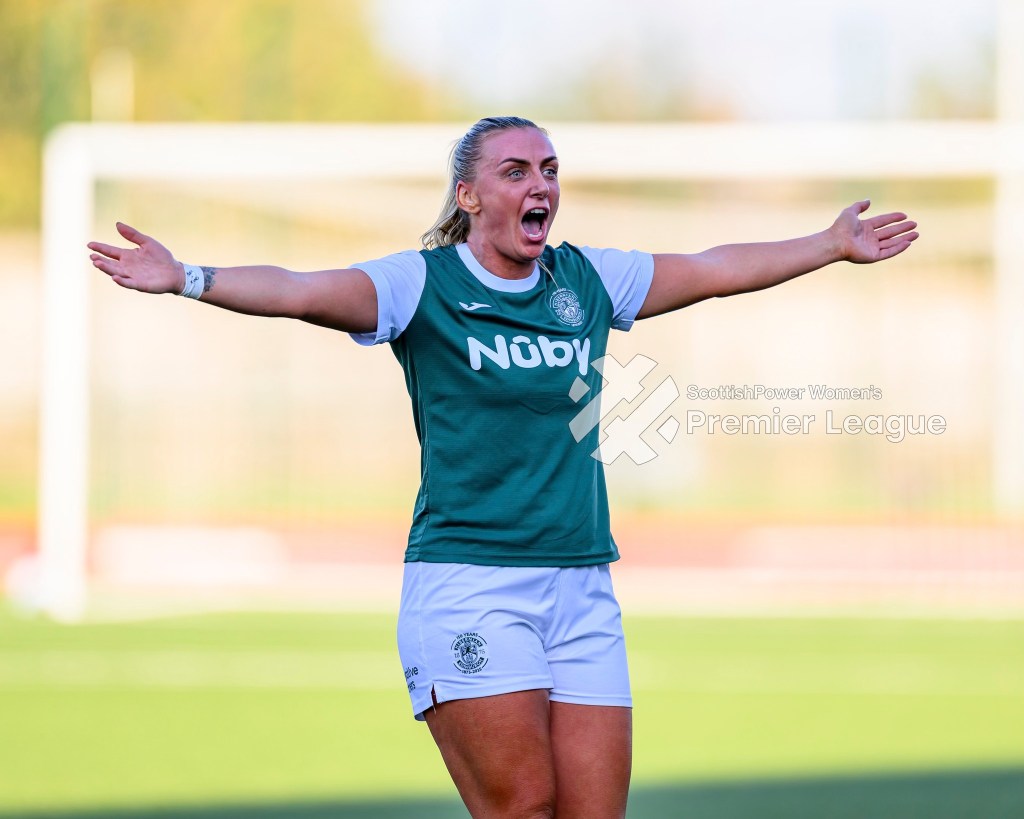
Above: Siobhan Hunter gesturing to the fans after the game Photo: SWPL/Malcolm Mackenzie
This was not just for her play on the pitch, but rather how her passion and fight gave Hibernian the impetus they needed to get back in the game.
Supporting Hibs as a child and playing for them throughout her career, Hunter is about as much of a Hibernian legend as you’re going to find. With this comes an absolute undying love for her club and a passionate hatred of anything that opposes that. She wants nothing more than success for her team and will do anything for that.
This makes her a divisive figure. If you support Hibs, you probably adore her, but if you play for a rival there’s a real disdain there. When she wins she’ll rile you up but when she loses you’ll take glory in witnessing it.
All those emotions were on display in this game. After the first goal went in, ‘Shiv’ was furious at the defence around her for letting it happen, it’s fair to say she was less then impressed with McLeary after the penalty was given and there was a moment where she was shielding the ball from an attacker in the box, hoping goalkeeper Schumacher would come and pick it up. When she stayed back, Hunter cleared the ball then gave the American and ear full of what she thought of the decision.
On the flip side, after the penalty was converted, she took the ball and ran straight to the half way line signalling Hibs’ readiness to restart and fight back into the game. While she is not the captain, she is absolutely a leader and an example-setter in this manner and her side needed no more geeing up. After celebrating Livingstone’s goal with the team, Hunter turned to the crowd and roared the home support on.
This was the case with every possible opportunity in the game after this, riling Hibs’ fans and Rangers fans equally positively and negatively. By the time the final whistle came and Meadowbank was serenaded by the chant of “she’s in your head, in your head, shivy, shivy shivy-y-y” to the tune of Zombie by the Cranberries, the game felt more like Siobhan Hunter versus Rangers than the actual fixture, and she was more than happy to play into this.
Where this leaves the teams
It was an absolutely massive result for Grant Scott and his side. Having faced no resistance from any non-professional sides this year, they have yet to secure a league win against a fellow title-challenger. At 2-0 down, many would have been suggesting this was just natural for Hibs to come back down to earth after the miracle run last season, and that it was just a fluke after all.
The fight and tenacity to come back and get goals through any means looked much more like the Hibs of last year, who have now beaten Rangers in four league games in a row. It also proves that this team can produce in tough games as well, and with Melissa Andreatta watching on, it was perhaps a chance for Caley Gibb, Eilidh Adams, Tegan Bowie and Rosie Livingstone to show that they should join Kathleen McGovern as a member of the senior Scotland squad.
Losing against a great team by one goal is not devastating by itself, but the manner of this one will be for Leanne Crichton. A 2-0 advantage is invaluable in such a title race, and Rangers cannot afford games like this. When Hibs came out in the second half a new team, Rangers could do absolutely nothing to alter the momentum of things back in their favour despite adjustments from Crichton and that’s a damning reflection of the team.
At seven points, the gap to Glasgow City is closable but the last two games – which Rangers could so easily have come away with four or six points from – sum up where the team has been the last few years. A fantastic footballing side full of quality, but there’s something holding them back in those crucial moments. A coaching change doesn’t seem to have addressed this and if Crichton will focus on anything specific to turn the season around perhaps it must be that mental resilience.
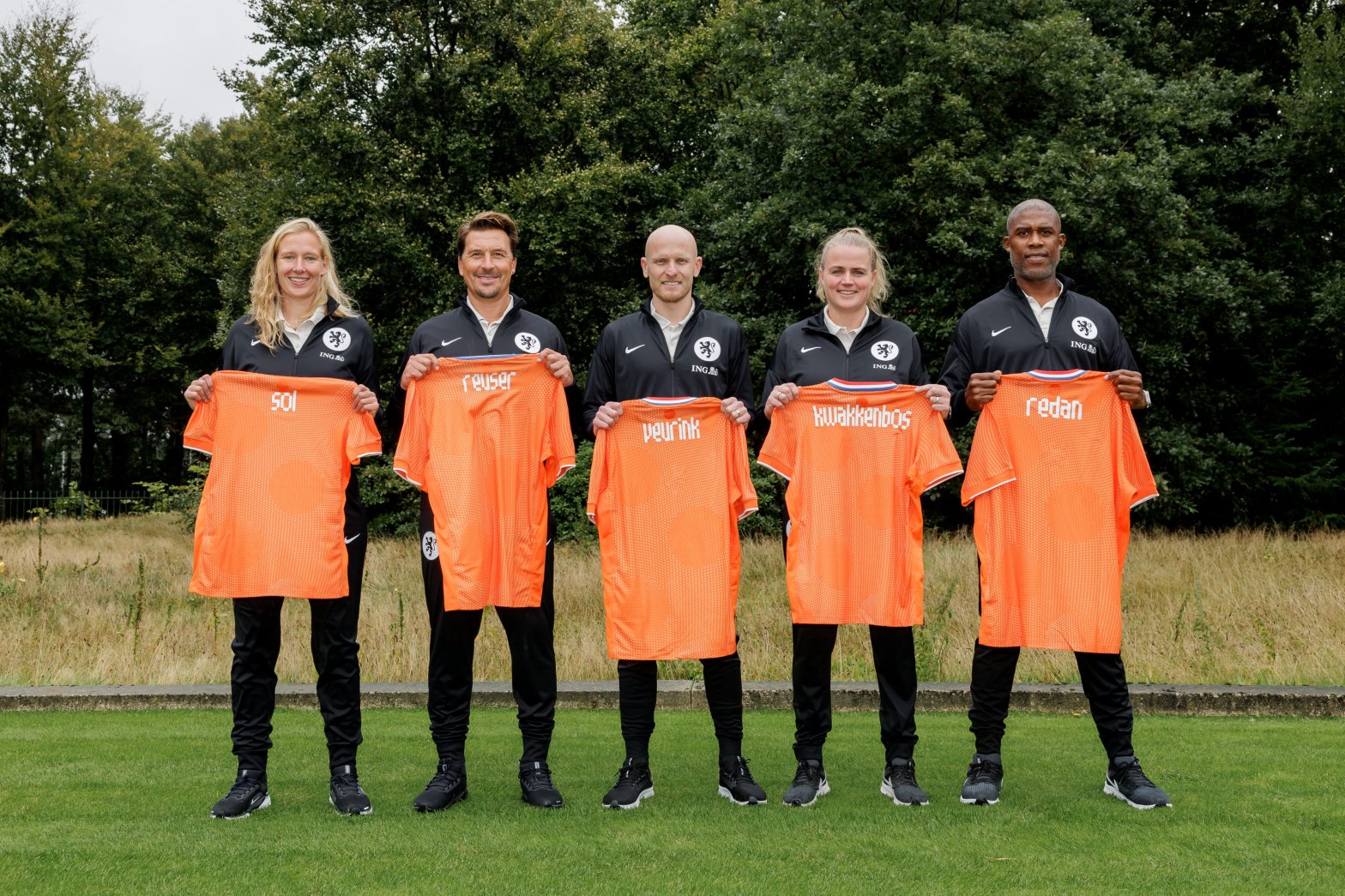
Above: Arjan Veurink and his staff. Photo: Oranje Leeuwinnen on X.
Arjan Veurink will announce his inaugural squad for the Netherlands national team on Tuesday.
He faces some challenges after the team disappointingly went out in the Euros group stages under former head coach Andries Jonker, leaving the squad low on confidence. Arguably one of the biggest challenges is the defensive line of the Oranje Leeuwinnen.
Jonker changed the back line around a lot leading up to the Euros. He also played in a lot of different systems, leading to miscommunication all across the pitch, not just in the back line. It is up to Veurink to restore that defensive stability and make some clear cut personnel decisions.
One of his first moves should be to move Esmee Brugts up the pitch, away from the left back position. Brugts is a very talented footballer, but her qualities are arguably more suited for a position in the front line. Brugts also plays at left back for her club Barcelona but the quality of the opposition, with all due respect to Liga F, is different from the opposition usually faced by the Oranje Leeuwinnen.
Above: Esmee Brugts for Barcelona. Photo: UEFA.
Brugts is able to move up the pitch a lot more for her club which allows her to shine bright. She has been caught out quite often on the pitch wearing an Oranje jersey recently. Her recovery pace makes up for a lot but ultimately we would like to see her in a more advanced position.
In Janou Levels and Marisa Olislagers, Veurink has two players at his disposal who are more natural fullbacks and are both left-footed players. Levels hasn’t been called up for the Netherlands national team since 2022 and has only earned herself 2 caps. It’s not like she isn’t talented: she is the starting left back for the German giants Wolfsburg. Marisa Olislagers isn’t too bad a player either. She currently plays for Brighton & Hove Albion in the WSL and was elected Players’ Player of the Season for the club. Like Levels, it’s been a while since she last got a call up.
Another conundrum faced by Veurink is the position of Sherida Spitse, the longstanding captain of the team. Her leadership qualities are evident on and off the pitch, with her constantly coaching the team. She has often been outpaced whilst against international opposition, however, and Jonker was criticised extensively for maintaining her as a starter despite her age.
Above: Spitse is Europe’s most capped player. Photo: Alex Bierens de Haan/Getty Images.
She plays regularly for Ajax and performs well in the Eredivisie, where the speed of the football is lower. Jonker relied on Spitse a lot, but started giving opportunities to younger players like Veerle Buurman and Caitlin Dijkstra at the end of his tenure.
Interestingly enough, when asked about Sherida Spitse and Daniëlle van de Donk, Veurink hinted that he would not make symbolic choices anymore. Whatever that means, we will have to see. What we do know is that talents like Veerle Buurman and more established players like Caitlin Dijkstra are ready to take over. As for that captaincy, there are enough players that are natural leaders too and are more than suitable to have that (C) behind their names. Jackie Groenen and Vivianne Miedema have both already worn the captain’s armband recently.
The right back position is another interesting one. Manchester City’s Kerstin Casparij has mastered that spot over the past period, but Lynn Wilms has recently played very well for Aston Villa. They are both good candidates for the starting right back position, but it depends on what Veurink wants from his fullbacks. Casparij’s attacking qualities are better than Wilms’, but similarly, Wilms is more stable defensively.
If Veurink can’t pick between the two, another option is to move Casparij to left back and start Wilms at right back, a solution already found by Jonker in the Netherlands’ last group stage match against France. With set piece taker Spitse possibly out, Wilms is a good asset to have as she is very strong on set pieces.
As said above, Jonker changed the team around a lot and used a multitude of systems. He asked a lot of different things of his players, especially in the last part of his tenure. He was often frustrated with his team “playing the ball to someone wearing a different colour”, but that was likely a consequence of the changes he made all the time. Veurink will have to instill a clear playing style again, one where players know what to do and what to expect.
We wouldn’t be surprised to see some fresh faces in Veurink’s first squad and we have already mentioned Levels and Olislagers as good candidates to get their first call up in a while. The first fixtures ahead are friendly fixtures against Poland and Canada. It would give Veurink an opportunity to try out players and tactics without too much riding on it and he will have a bigger squad to his disposal as compared to competitive fixtures.
Jaimy Ravensbergen is Twente’s first pick striker and was the Eredivisie top scorer last campaign with 23 goals scored in 19 matches. The 24-year-old is currently leading the top scorer list too with four in four. With Katja Snoeijs out injured, a call up for Ravensbergen might be on the horizon.
Above: Ravensbergen for Twente. Photo: FC Twente Vrouwen.
Ella Peddemors is a box-to-box midfielder who plays for Wolfsburg. Like many Dutch talents, she started her career at FC Twente. FC Twente is also the club where Lynn Groenewegen plays. She plays as a defensive midfielder, just like Rosa van Gool, who just joined Everton in the summer from Ajax. They all have strong competition from players like Jackie Groenen, Damaris Egurrola and Wieke Kaptein. It really depends on what Veurink wants to see in his midfield.
With Daniëlle van de Donk very likely absent, there is space for an attacking midfielder. That midfielder could be Danique Noordman, who has had a very strong season for Ajax so far and sometimes plays right-back. It could also be Kayleigh van Dooren, who joined AC Milan in the summer from FC Twente, but hasn’t played much for them.
Arjan Veurink announces his first squad this Tuesday and it will be interesting to see who makes the cut. It will be even more intriguing to see who he actually fields against Poland and Canada.
The Oranje Leeuwinnen travel to Gdansk to play Nina Patalon’s Poland on the 24th of October, followed by a home match against Canada in Nijmegen on the 28th.
Above: Bayern Munich women celebrate their win. Photo: FCBfrauen on X.
The clash between Bayern Munich and VfL Wolfsburg is one of the biggest fixtures in German women’s football, often seen as the defining matchup in the Frauen-Bundesliga title race.
Last season was no exception: whilst Bayern achieved their third consecutive title, Wolfsburg were not far behind in second. The title of dominant force in German women’s football has passed between the two clubs for a decade, and their matches are often filled with drama.
Context
This weekend’s game formed the sixth week of Frauen-Bundesliga action, with Wolfsburg and Bayern competing for the top spot. Wolfsburg came into the weekend in good form after beating French giants PSG 4-0 in the Champions League (UWCL) midweek.
Whilst the Wolves were enjoying their first UWCL game of the season, the Bavarian team were being dismantled at the hands of FC Barcelona, ultimately falling to a humiliating 7-1 loss. How well Bayern recover from that blow will be crucial to their hopes of maintaining momentum in the title race and not losing ground, which had to start with picking up points in Wolfsburg.
The teams
Bayern were forced into a number of changes due to injuries and minutes-management. Usual starter Sarah Zadrazil suffered an ACL injury last month, and Lena Oberdorf was still regaining match sharpness after recovering from her own ACL injury. Veteran left-back Caro Simon was withdrawn against Barcelona after picking up a serious knee injury, and is expected to be unavailable for a while. Whilst warming up, the team wore shirts designed in tribute to Zadrazil.
Above: Bayern warm up tops in tribute to Sarah Zadrazil. Photo: FCBfrauen on X.
The back line saw the most changes from the team that faced Barcelona, with Giulia Gwinn returning – this saw Franzi Kett shift to left-back. Captain Glódís Perla Viggósdóttir also returned at right-sided center-back, with Magdalena Eriksson dropping to the bench.
For Wolfsburg, Sarai Linder came in for Dutch defender Caitlin Dijkstra, and Justine Kielland for Ella Peddemors.
The action
Both teams started brightly, with the action end-to-end for the opening few minutes. The first major chance of the game was for the visitors as Klara Bühl’s cross met the head of Momoko Tanikawa. The Japanese international’s header went wide of goal, spurring the home side to have a chance of their own as Alexandra Popp got her head to a Cora Zicai cross, but the effort also went wide.
There were further attempts from both sides: Georgia Stanway had a shot from distance, and Janou Levels from close range, but nothing hit the target until Bühl evaded Svenja Huth and shot straight into the bottom left corner from the edge of the box. With 27 minutes on the clock, Bayern had the opener, regaining some confidence and perhaps laying some Catalan ghosts to rest.
Wolfsburg struggled to recover and for the remainder of the half, the visitors had the momentum, with a number of attempts from Pernille Harder missing the target. The equaliser did eventually come, shortly after half-time as Bayern failed to clear a corner. The corner was well taken, with the initial save spilled by shot-stopper Ena Mahmutovic – the visitors failed to clear the ball before it landed at the feet of Janina Ming, who shot home via a deflection.
The rivals vied for possession as the game became increasingly physical, with Viggósdóttir electing to bypass the midfield by going long. Her pass was perfectly weighted for Gulia Gwinn to cross into the box where Tanikawa was waiting – and this time her effort smashed into the center of the goal.
Once again going a goal down, Wolfsburg regained some of their energy and sought to reignite their press. They had a number of chances towards the end of normal time, with Lineth Beerensteyn forcing a strong block from Stine Pedersen in the box, and Ella Peddemors eliciting a save from Mahmutovic. There was a sense of desperation about the home side as the minutes ticked down, and Marie-Joelle Wedemeyer rushed into preventing Lea Schüller getting a shot off. Wedemeyer was shown a red card for denying a clear goal scoring opportunity – the resulting free kick giving the visitors their third goal to end the game.
The physical battle
When bitter rivals meet, it is always a tense encounter. Saturday’s match seemed even more so as Bayern sought to recover from their humiliation in Spain. The visitors were down, meeting a Wolfsburg on good form. For the Wolves, it was a chance to avenge their Supercup defeat from the beginning of the season, and a chance to prove that the battle for dominance is not over.
Above: Lineth Beerensteyn and Georgia Stanway. Photo: FCBfrauen on X.
This encouraged a physical battle; the duels were flying, with a number of interruptions to play as the referee’s whistle was heard. There were 17 tackles in the second half alone – the bulk coming from the home side – eventually resulting in Wedemeyer’s red card. In a physical game like this, timing challenges well and strong decision-making is paramount – which lost Wolfsburg the game.
Bayern also returned to playing the occasional long-ball (after their high press and insistence on playing out from the back was a key factor in the Barcelona loss). The decisions from Gwinn to press high and Viggósdóttir to aim to bypass the midfield set up their second goal, with Wolfsburg leaving plenty of spaces on the flanks.
Where this leaves the teams
Bayern recovered from their Catalan disaster in style, beating their fiercest rivals away in emphatic fashion. Whilst Wolfsburg had a number of chances to win the game, the away side were simply more clinical. The Wolves will be disappointed with how they responded to setbacks throughout the game – from going a goal down to the red card and head coach Stephan Lurch’s yellow. They capitulated, with poor decision-making ultimately deciding the game.
Neither side have much time to recover. Bayern host Juventus in the UWCL on Thursday, and Wolfsburg have a trip to Vålerenga awaiting them. For now, Bayern top the Frauen-Bundesliga leaderboard, three points ahead.
Above: The last time Arsenal faced Brighton. Photo: BHAFC Women.
After midweek fixtures, Arsenal and Brighton and Hove Albion return to WSL action for week six of the season this Sunday at the Emirates.
After a disappointing loss in the UWCL on Tuesday night, there’s a lot of pressure falling on Arsenal to deliver a result. They’re now winless in four, three of those being losses in the league and expanding the gap between the top of the table.
The additional loss to Lyon in the week was a big hit. Whilst just one fixture of six in the competition’s league phase, the team’s recent form overall has been shaky and far from expectation. If they wish to turn their season around, a huge shift is required across the board, as they simply cannot afford to drop more points.
Their opponents this week are unpredictable. Brighton often change their shape and structure, a fact known after last season when they defeated Arsenal 4-2 on the closing day. They also tend to operate in an intense high press, which was something that the Gunners particularly struggled to deal with against Lyon. Arsenal boss Renée Slegers acknowledged the task:
“It’s going to be a good opposition. I have a lot of respect on what Dario is doing with Brighton. We’re prepared for different scenarios at this game because they can come out with different things like last year, their setups were different in the home and away games.”
Ahead of this weekend’s challenge, the entire squad is still fit barring Leah Williamson. Slegers confirmed the defender is progressing well in her rehab, however her absence to the side as a player that had masses of composure when under pressure is becoming more and more noticeable. Speaking on how they are managing without her, Slegers said:
“Every individual brings certain qualities and the centre-backs that have now played in the position where Leah played most of the time last year bring other qualities, so we will always look at what other qualities this player brings, what do we want them to do on the pitch.”
With big fixtures coming, including Chelsea in just under a month, it’s crucial that Arsenal find their form. The title race in the WSL is already taking shape, with Manchester United and Manchester City now starting to find their feet.
Despite a few difficult results, Brighton sit just one place behind Arsenal in the table, and a win this weekend would see them leapfrog their opponents to push them down another spot.
The Seagulls’ form, much like Arsenals, is wavering. They had a relatively successful start to the season, but lost 2-1 to West Ham midweek in the League Cup, and lost their last WSL fixture 1-0 to Tottenham Hotspur. Manager Dario Vidošić reflected on his side’s loss to West Ham:
“Overall I thought the performance was quite good. There was patches where we lost it a little bit, and I think maybe the goal, sort of missing a big chance and then conceding very quickly, that maybe upset our rhythm a little bit.”
Ahead of this clash with Arsenal, Brighton are a slightly depleted side. The team haven’t had much opportunity to train, with a lot of recovery in the mix and the weekend rapidly approaching. Still, Vidošić has an optimistic outlook, both he and his side approach the match with a level-head and quiet confidence:
“Every game is an opportunity to learn, each training session to know what we need to improve, how we need to match up to the next opponent. We know Arsenal possess a lot of strengths, also when they play at the Emirates.”
“They’re also on a run of results that, again, I don’t think they’ve been fair, some of them i think they’ve been unlucky, but regardless of how it’s going they’ll always want to win at home.”
Despite any preparations, it does not omit the fact that they head into this game with two ineligible players, Arsenal loanees Michelle Agyemang and Rosa Kafaji. The duo have been instrumental in Brighton’s campaign so far, and the loss of the duo in such a big fixture could be a spot of weakness if the team cannot successfully adapt and find an alternative.
Arsenal vs Brighton kicks off at 14:30 UK time and will be broadcast on BBC iPlayer/ BBC Two.
Above: Rebekah Stott (left) at the 2025/26 Melbourne season launch for the A-Leagues. Photo: Alyce Collettfor Impetus.
By Alyce Collett (10/10/2025)
Season 2024/25 may have come with a double dose of heartbreak for Melbourne City, but captain Rebekah Stott and her team mates certainly are not dwelling on the past.
“The group’s feeling great” Stott explained.
“Obviously we’ve lost a few players and we’ve gained some new players. So yeah it’s a bit different, but it’s really good right now.”
“That was heartbreaking. I think anyone who watched that game would be heartbroken for us, but I think it makes us more hungry again” Stott confirmed.
That’s such a good tournament in that one. So we definitely want to do well in that one.”
This season means more double duties for City, but Stott confirmed that the club has plans in place to make sure the players can cope with the demands.
“I think the club did a great job at managing our schedule and making sure we got the best preparation for our games” Stott said.
“So I think just stay with the same kind of strategies and I think we’ll be in a good place.”
The offseason has brought plenty of new faces to City’s Football Centre.
On one end of the age and experience spectrum there is former Everton captain Dan Turner.
“She’s absolutely great” Stott said.
“Her experience, I mean she’s played in England for so long, been a captain of Everton for ages. So I think she brings her experience, her leadership, and obviously her technical ability in the pitch.”
At the younger end of the age spectrum there is Aideen Keane, who comes to the club from Canberra United and off the back of a successful offseason with the Australian Under 23.
“She’s a exciting young player” Stott said.
“I think you could see when she was playing for Canberra, she had moments where she looked unbelievable, so I think it’s just unlocking that potential, and I think she’s in a good environment to be able to do that.”
When asked who she thought in the squad was going to have a break out season this campaign, another of her young team mates came straight to mind for Stott.
“I can’t go past Shelby McMahon” Stott answered.
“I think she’s an unbelievable talent and, and I think she’ll really have a breakout year.”
Above: Kayla Morrison (right) at the 2025/26 Melbourne season launch for the A-Leagues. Photo: Alyce Collettfor Impetus.
By Alyce Collett (9/10/2025)
Season 2024/25 may have brought the ultimate heartbreak for Melbourne Victory, but the excitement about the potential of the season ahead is strong at the Victory.
Speaking at the season launch for the league in Melbourne this afternoon, the excitement about the new season was clear in Victory skipper Kayla Morrison’s voice and body language.
“Once the season comes around, it always feels like a really long off season” Morrison said.
“So to have started already and we’re playing practice matches, feel like things are going well. So yeah, really looking forward to the first game.”
“Obviously it’s really upsetting to kind of think back to the grand final, knowing we were so close and probably favourite to win” Morrison explained.
She also noted that it felt “like it kind of got ripped out of our hands, so we’re going to try and do it in just the 90 minutes this year, and that’s what our focus will be on.”
It is going to be a very new look Victory side that takes to the pitch in Round 1, with a number of key players departing the club in the offseason for overseas opportunities.
One of Victory’s new faces that has drawn praise from Morrison is Zoe McMeeken, who crossed the ditch back to her home town from the Wellington Phoenix.
“I don’t know what happened there, but it was crazy that they let her go with how great she’s been doing in our preseason” Morrison exclaimed.
Another of Victory’s new faces is former Western United star Grace Maher, who has crossed to the dark blue side of town after the demise of United.
Despite plying her craft in defence for the last few seasons, Morrison hinted that Maher may have a different role this season.
“Jeff kind of has what type of defenders he likes – big, strong tackling people” Morrison explained.
“Grace is someone who wants to get on the ball and kind of get at it with her feet. So I think she’ll be more in a midfield role.”
One topic of conversation and intrigue amongst the women’s soccer fandom is the progress in Morrison’s change of FIFA international allegiance.
In unfortunate news for Matildas fans, Morrison confirmed that there has been no further progress in that department.
“I think it’s still kind of stuck with FIFA at the moment” Morrison explained.
“I know JD and Victory, they have been awesome helping. They’re in chats with the Matildas and I think they’re working with lawyers at the moment, so we’ll kind of see what happens.”
Above: Feyenoord celebrate their first ever victory over FC Utrecht. Photo: FeyenoordV1 on X.
In the fourth week of the 2025-26 Vrouwen Eredivisie, Feyenoord won against FC Utrecht for the first time in history, Ajax scored twice in under a minute, and shoelaces became of vital importance.
Feyenoord celebrate first win ever over FC Utrecht
FC Utrecht 1-2 Feyenoord Rotterdam
Above: Feyenoord celebrate a historic victory. Photo: Feyenoord.
In a tense mid-table clash, Feyenoord earned a historic victory — their first ever against FC Utrecht. The Rotterdammers showed their intent early and fully deserved the three points.
In the 23rd minute, Kokona Iwasaki opened the scoring with a stunning strike into the top corner. Feyenoord capitalized on the danger created by Iwasaki and Itamura, while striker Ella van Kerkhoven is still searching for form. FC Utrecht managed a few small threats of their own, but Feyenoord controlled the game with tactical discipline, effectively neutralizing the influence of Nikita Tromp in midfield.
However, the first half took a awful turn when Lotje Keijzer, the young Jong Oranje winger, went down hard. While pressing, her leg got caught in the turf and she fell screaming in pain. She was stretchered off the field, and everyone present feared a serious injury that could end her season.
After the break, FC Utrecht tried to find an equalizer through quick combination play, but Feyenoord responded with aggressive pressing and fierce duels. Yellow cards didn’t faze them — every foul was followed by high fives and encouragement. Despite Utrechts growing number of attempts, precision was lacking, while Feyenoord remained sharp and alert in intercepting passing lanes.
Their high pressing paid off again, and goalkeeper Bastiaen made a crucial save in the 67th minute to keep out a deflected shot. A warning sign, because after eight minutes Dechemaily Lont doubled the lead for Feyenoord with a composed finish to make it 2–0.
In the closing stages, Utrecht brought on Sam de Jong and Rochellity Dapp, who injected attacking energy into the side. In contrast, Feyenoord’s substitutions from Koopman and De Graaf reduced their attacking threat. The 17-year-old Dapp added unpredictability, and when Sam de Jong on the right flank had big impact. De Jong delivered a perfect cross, but Loonen’s shot went narrowly wide.
In stoppage time, Utrecht earned a penalty after another overly aggressive defensive action from Feyenoord — the same issue that cost them a point against Ajax last week. This time, though, the late goal wasn’t enough. For FC Utrecht, this result came to late for them. They remain at midtable with six points hoping the puzzle pieces will fall together for Linda Helblings team. Feyenoord are now points ahead with PSV and are challenging Ajax, PSV and FC Twente.
FC Twente outclass rivals PSV
PSV Eindhoven 1 – 3 FC Twente
Above: PSV v Twente. Photo: FCTwenteVrouwen on X.
FC Twente claimed a crucial 3–1 away victory over title rivals PSV, striking an early blow in the race for the national championship.
Last season, the two sides drew twice and were separated only by goal difference in the title battle — but this time, Twente emerged clearly on top.
PSV took the lead in the first half through Nina Nijstad, who fired past goalkeeper Lemeij just before halftime. But Twente refused to let their heads drop and turned the game around after the break. They equalized with a stunning long-range effort from right-back Leonie Vliek. Renate Jansen was a constant threat for Twente, hitting the crossbar and seeing another powerful strike denied by Lemeij in the far corner.
That sequence summed up both sides perfectly — PSV often dominate early but tend to fade after an hour, while FC Twente rely on endurance and resilience to grind out results in big games. Their persistence paid off once again: Rose Ivens put Twente ahead in the 71st minute, and Jill Roord sealed the win with her first goal of the season in the 83rd.
A vital victory for FC Twente in the title race — and a statement performance against one of their fiercest rivals. FC Twente are now leading the table, with two points ahead of Ajax in second.
PEC Zwolle snatch a late win from Excelsior with help from a shoelace
Excelsior Rotterdam 0-1 PEC Zwolle
Above: PEC celebrate. Photo: PECVrouwen on X.
The Van Dongen & De Roon Stadium set the stage for Excelsior’s home clash — a true bottleneck match that ended in heartbreak for the hosts.
Excelsior fell 1–0 after a dramatic period of added time where everything was decided.
PEC Zwolle and Excelsior were evenly matched for most of the game. PEC showed more attacking intent, but were repeatedly denied by strong goalkeeping from Sophie Frankena and Excelsior’s superbly organized defense. While Excelsior’s attacking play wasn’t as sharp as in their win over Heerenveen, the danger was still there. PEC had clearly learned from that Heerenveen performance, which ended 3–1 in Excelsior’s favor.
As stoppage time ticked away, both sides seemed content to share the points — a result that would have suited two teams battling to stay clear of the relegation zone. But PEC wanted more, while Excelsior appeared to try and manage the result. In a bizarre twist, Excelsior’s Cherif was shown a red card for alleged time-wasting — the referee judged she spent too long tying her shoelaces!
Sensing an opportunity, PEC pushed forward against ten players. From a late corner, captain Judith Roosjen rose highest to head home and secure PEC’s second win of the season.
With this victory, PEC Zwolle climb away from the potential relegation zone. Even though they haven’t faced many top teams yet, six points early in the season is a valuable cushion. Excelsior, meanwhile, will now have to look over their shoulders — with HERA, NAC Breda, and Heerenveen breathing down their necks.
Ajax score twice in under a minute
Ajax 4-1 SC Heerenveen
Above: Touzani for Ajax. Photo: AjaxVrouwen on X.
Ajax defeated Heerenveen 4-1, but that doesn’t tell the full story. In the first half, Ajax did what was necessary, quickly building a 3-0 lead, yet both teams also showed a different side of the game at times.
Once again, a surprising talent from Ajax’s youth academy shone. Lina Touzani scored in the 13th minute from a rebound. After a shot from Danique Tolhoek, the Heerenveen goalkeeper could only punch the ball away. Touzani had only to finish—and she did, deservedly marking her second goal of the season.
In the 23rd minute, Heerenveen fell into even deeper trouble, conceding two goals in one minute. Danique Tolhoek received the ball from a long clearance and immediately fired it into the far corner past the keeper, proving her value as a key striker for Ajax. From the subsequent restart, the ball quickly reached Touzani, who passed it back to Tolhoek while the entire defense struggled to contain her. Tolhoek then found Sherida Spitse, who scored a powerful, low shot that hit the inside of the post—3-0 for Ajax!
Heerenveen showed resilience afterward, keeping Ajax from running up a massive score. After the break, right winger Sterre Kroeze scored an incredible long-range goal, beating keeper Regina van Eijk, who was positioned too far from her goal. It was a moment Heerenveen could take pride in and possibly carry confidence for upcoming matches.
Ajax, however, couldn’t maintain consistent focus to work on goal difference, which remains a concern for coach Anouk de Bruijl. The starting eleven still lacks stability and experience, preventing the tactical plan from fully flourishing. Instead, Ajax relied on individual brilliance from young talents like 17-year-old Ranneke Derks. Coming on as a substitute eager to score, she did so with class, rounding off Ajax’s 4-1 victory over Heerenveen.
ADO Den Haag continue to struggle
ADO Den Haag 0-1 AZ
AZ secured another victory on Sunday afternoon in the Eurojackpot Women’s Eredivisie.
The Alkmaar side defeated ADO Den Haag 0-1, claiming three important points, though Mark de Vries’ team has yet to fully impress. AZ did exactly what was necessary to shake off the uncertainties of recent weeks, but they still didn’t sparkle.
Ahead of the match, veteran goalkeeper Barbara Lorsheyd was celebrated as she started her 350th match for ADO – having been at the club for almost 20 years on/off after being signed by Sarina Wiegman in 2007.
Above: Barbara Lorsheyd is celebrated. Photo: ADODHVrouwen on X.
Unfortunately, Lorsheyd could not celebrate with a clean sheet. At the WerkTalent Stadium, AZ was the more dangerous side. Desiree van Lunteren, Fieke Kroese, and Jet van Beijeren created several chances, while ADO Den Haag struggled to play their way out from under the pressure. Midway through the first half, the home team narrowly avoided an own goal when Senna Koeleman almost deflected the ball into her own net.
After the break, the pattern of play remained the same. AZ dominated the midfield and again created opportunities through Van Lunteren, Shanique Dessing, and Kroese. The woodwork came to ADO’s rescue multiple times, but in the 71st minute, captain Van Lunteren finally broke the deadlock with a well-placed header, putting her team ahead 0-1.
That proved to be the decisive goal. AZ managed the final phase of the match without taking unnecessary risks, while ADO Den Haag could no longer mount any serious threat. It was a mature victory for AZ, who secured the win with solid play, though they still have some way to go before truly impressing.
With this win, AZ remains competitive in the mid-table and seems to be gradually regaining composure, although more conviction will be needed to consistently challenge the subtop.
Follow Jan for all the news about Dutch Women’s Football on www.fcleeuwinnen.nl. Read news about the star players, get strong point of views from our columnists and discover upcoming Dutch talents.