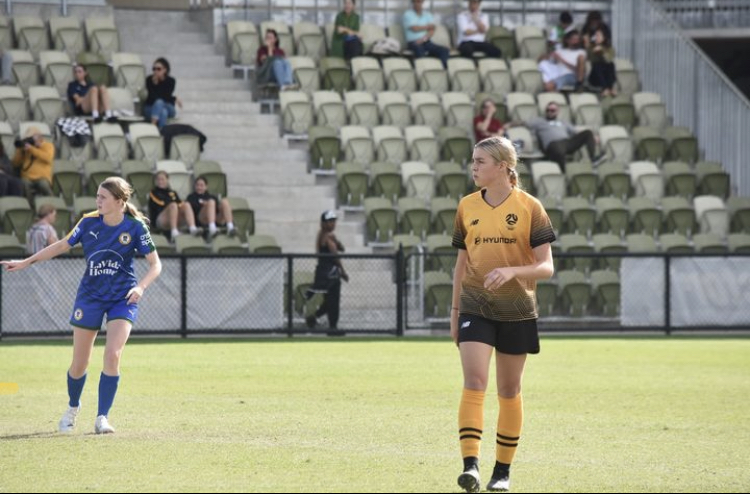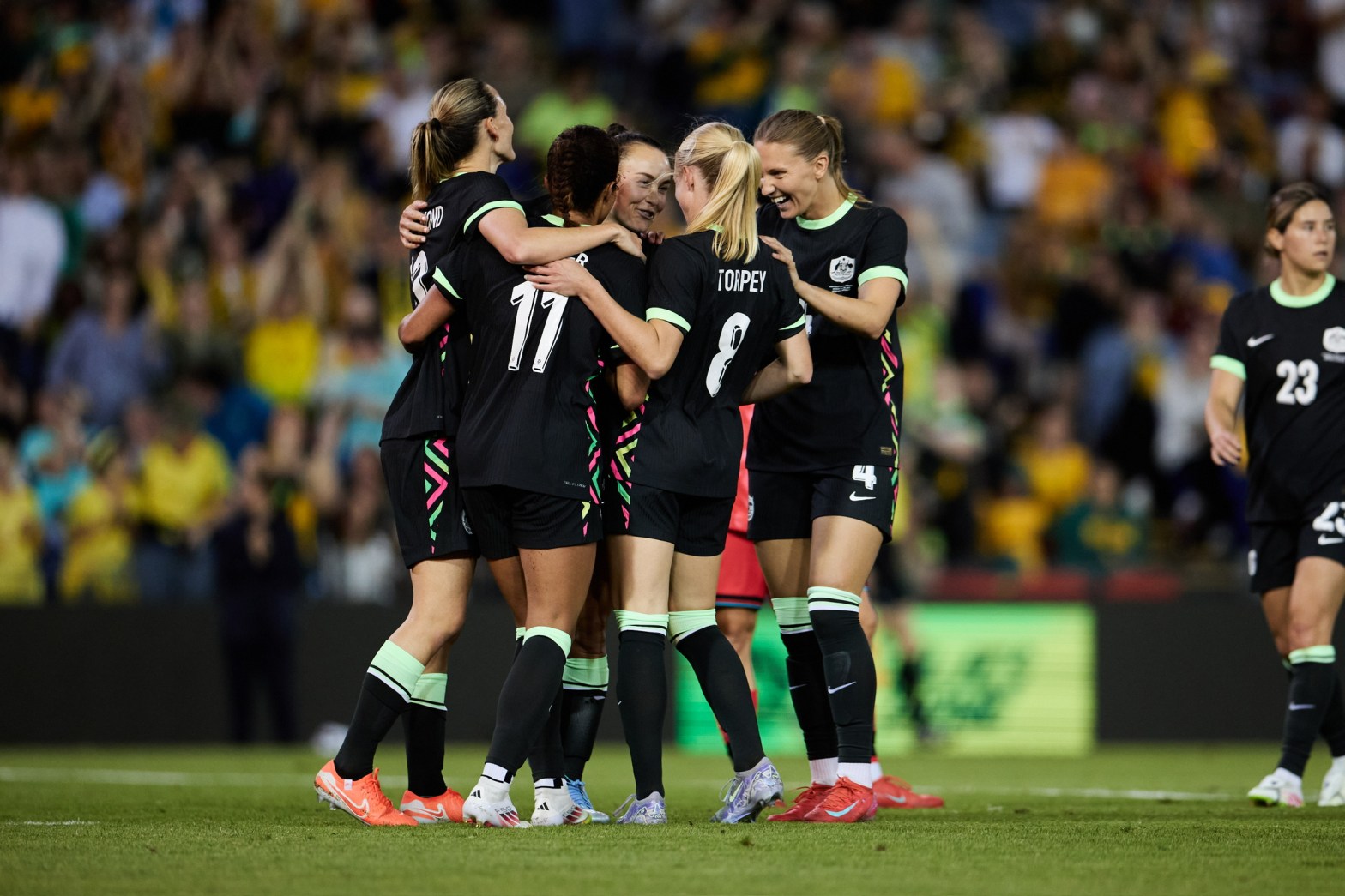

Above:Melbourne City’s Alexia Apostolakis (sky blue shirt), recently capped by Joe Montemurro for the senior Matildas, is in the Young Matildas squad for next month’s U20 Asia Cup qualifiers. Photo: Melbourne City.
New Young Matildas head coach Alex Epakis has revealed his 23-player squad for the forthcoming U20 Asia Women’s Cup Qualifiers that will take place in Dushanbe, Tajikistan.
After finishing third in last year’s finals, Epakis’ side will take on hosts Tajikistan, Palestine, and Chinese Taipei in the group stage. The group winners and the best three runners-up overall qualify for the 2026 Finals in Thailand.
Speaking about his selection, the former Perth Glory A-League Women head coach said: “The squad features a blend of players with previous experience within the U-20 age bracket and emerging new talent…
“While a number of players were unavailable for this August’s qualifiers, we are pleased to have named a strong, well-balanced squad capable of performing across what will be a demanding schedule in Tajikistan.
“The squad has benefitted from a recent domestic camp in July, which provided valuable time to further refine our playing style, strengthen our team culture, and build cohesion – all of which puts us in a strong position heading into the tournament.”
Young Matildas squad for the U20 Asia Women’s Cup Qualifiers
NAME
POSITION
CLUB / MEMBER FEDERATION
Alexia
APOSTOLAKIS
Defender
Melbourne City FC / Football NSW
Amelia
BENNETT
Defender
Western Sydney Wanderers FC NPL / Football NSW
Tegan
BERTOLISSIO
Defender
Macarthur Rams FC / Football NSW
Jasmine
BLACK
Goalkeeper
Northern Tigers FC / Football NSW
Milly
BOUGHTON
Forward
Unattached / Football NSW
India
BREIER
Forward
Macarthur Rams FC / Football NSW
Madeleine
CASPERS
Midfielder
Sydney University / Football NSW
Amelia
CASSAR
Midfielder
Macarthur Rams FC / Football NSW
Sian
DEWEY
Midfielder
Football South Australia NTC / Football SA
Sofia
FANTE
Goalkeeper
Sydney University / Football NSW
Tiana
FULLER
Forward
Sydney Olympic FC / Football NSW
Skye
HALMARICK
Forward
NWS Spirit FC / Football NSW
Isabela
HOYOS
Defender
Brisbane Roar FC / Football QLD
Zara
KRUGER
Midfielder
Brisbane Roar FC / Football QLD
Grace
KUILAMU
Forward
Brisbane Roar FC | FQ Academy QAS Women / Football QLD
Maya
LOBO
Defender
Macarthur Rams FC / Football NSW
Ilona
MELEGH
Goalkeeper
Football SA NTC / Football SA
Avaani
PRAKASH
Midfielder
Bulls FC Academy / Football NSW
Sienna
SAVESKA
Forward
Illawarra Stingrays / Football NSW
Rubi
SULLIVAN
Defender
NWS Spirit FC / Football NSW
Caley
TALLON-HENNIKER
Forward
Illawarra Stingrays / Football NSW
Peta
TRIMS
Forward
Sydney Olympic FC / Football NSW
Talia
YOUNIS
Forward
Western Sydney Wanderers FC NPL / Football NSW
Young Matildas’ schedule in the qualifying tournament:
Above: NSW 15’s celebrate winning their title.Photo: Georgie Lewis
From Ellie Carpenter to Mackenzie Arnold to Kyra Cooney-Cross, some of the biggest names in Australian football began their careers at Valentine Sports Park. For the hundreds of players who competed in last week’s 2025 CommBank Emerging Matildas Championships, that same pathway is now open.
This tournament is not just another week of youth football. It is Football Australia’s most important national talent identification event — a direct pipeline from junior football to the national team. And with Matildas Head Coach Joe Montemurro and other national team staff watching from the sidelines, the message was clear: this is where futures are made
“A Proven Springboard to Senior International Honours”
Football Australia Interim CEO Heather Garriock was unequivocal about the role of the Championships in Australia’s player development system.
“The CommBank Emerging Matildas Championships continue to deliver more football and better football — providing meaningful match minutes, national exposure, and a proven springboard to senior international honours,” Garriock said.
“Players like Mackenzie Arnold, Ellie Carpenter, and Kyra Cooney-Cross have all come through this platform.”
Over six days of competition, the tournament showcased more than 700 players and team staff from all nine of Football Australia’s Member Federations, as well as international guests Malaysia. Two age groups — Under-15 and Under-16 — competed across dozens of matches at Valentine Sports Park in Sydney’s west. In total, over 280 goals were scored.
“This week, over 700 players and team staff from all nine Member Federations — together with our guests from Malaysia — have taken part across two age groups, demonstrating the depth and diversity of emerging talent,” Garriock said.
National Coaches on the Sidelines
Perhaps the strongest symbol of the Championships’ importance was the presence of national team staff. Matildas Head Coach Joe Montemurro presented the championship trophies alongside Garriock, while coaches from across the national women’s team set-up watched every game.
“It has been invaluable having all our national women’s team coaches present — including Matildas Head Coach Joe Montemurro — providing players with a direct opportunity to be seen and assessed as part of a connected national pathway,” Garriock explained.
The Championships sit within a broader development strategy that includes the newly established Perkins XI, Junior Matildas, Young Matildas, and the senior Matildas squad. Each step feeds directly into the next, making the Emerging Matildas Championships a critical point of entry for young players.
“Our goal is for the Championships to remain Australia’s leading talent identification event, while continuing to evolve the educational and development support for players, coaches, and officials alike,” Garriock said.
NSW Sky and Victoria Blue Lead the Way
On the pitch, NSW Sky and Victoria Blue shared the honours. In the Under-15 Championship Final, NSW Sky secured back-to-back titles with a dominant 4-1 victory over Northern NSW. Doubles from Jada Taylor and Tessa Young sealed the result, while Matilda Fleming scored a late consolation for Northern NSW.
NSW Sky Under-15 Head Coach Spencer Prior praised his side’s development across the week.
“I am really proud of the girls and the way that they improved each day in terms of what we were asking them to do,” Prior said.
“A performance like that in the final, where they really didn’t get near us and we controlled the game with and without the ball, is what we are really looking to do so I am super proud of the way they’ve applied themselves.”
In the Under-16 Championship Final, Victoria Blue defeated NSW Sky 1-0 in a tight and tactical match. NSW Sky had not conceded a goal all tournament until Alexis Pantazopoulos broke through in the 26th minute — the goal that ultimately secured the title for Victoria.
Victoria Blue Under-16 Head Coach Santiago Escudero credited his players.
“Honestly, 90% of our success is coming straight from the girls and all their professionalism and commitment. This is a fantastic and mature group. I can’t take too much credit; they are just outstanding,” Escudero said.
“We have played nice football during the tournament. We changed mentality and we came here to be competitive and to win the competition.”
A National Ecosystem: More Than Just Players
While young players competed on the pitch, Football Australia used the Championships as an opportunity to invest in the broader football ecosystem.
Coaches from across Member Federations participated in education workshops, sharing challenges and development practices. A dedicated parent workshop addressed the often-unseen challenges families face supporting young athletes, from navigating high-performance environments to handling transitions as players advance.
On the field, players underwent physical testing to establish individual performance profiles — including sprint speed, jump height, and other metrics used at elite level — giving coaches and national staff another tool in tracking emerging talent.
“Our goal is not just about identifying players but strengthening the entire system around them,” Garriock said.
The Future Is Already Here
For the hundreds of players who laced up their boots at Valentine Sports Park last week, the Championships represented more than a competition. Every match was a trial, every touch a chance to be noticed.
“This isn’t just about competition. It’s about connection — between community clubs, state federations, and national teams,” Garriock said. “That’s how we build the next generation.”
The 2025 CommBank Emerging Matildas Championships are over. But for Australia’s next wave of football stars, the journey is only beginning.
Above:Ruby Marshall (azure shirt) scores her second and Perth SC’s sixth in the league leaders’ win at home to Murdoch University Melville this afternoon. Marshall was involved in four of her side’s goals. Photo: Rob Lizzi.
Balcatta Etna 2-3 Fremantle City
by Ella McShane
Sunday afternoon football at Home Group Stadium was off to a less than ideal start with unfavourable weather and pitch conditions delaying kick off. The waterlogged field caused resistance on the ball and led to a somewhat unavoidable stagnancy throughout the game.
In the first half, Balcatta managed to maintain possession in their preferred side of the pitch whilst Fremantle maintained their threat with their few, yet impactful moments of dominance down the wing.
Despite the contrasting tactical approaches from both sides, the first 40 minutes remained tightly contested. As the first half drew to a close, Balcatta’s Abbey Meakins broke the deadlock, converting a well-placed cross from Jamie-Lee Gale with a volley into the near post, which took the homeside ahead. That’s now 14 goals for Meakins in her last 10 games – an incredible stat.
Freo responded swiftly with an equaliser within mere seconds of the commencement of the second half. A precise through ball from Abbey Green found the feet of a striding Leyna Wood. Splitting Balcatta’s defensive line with admirable pace, Wood slotted the ball past the keeper and secured the equaliser.
Above: Fremantle City’s Leyna Wood (24), seen here in action in a previous game, scored her team’s equalising goal at Balcatta Etna today. Photo: Denyse RM Photography.
The visitors maintained their attacking momentum, and their control over the game became evident. Their efforts were rewarded within rapid succession when Alex Poad’s long ball from the edge of the box found at the 51-minute mark, which earned the port city side the lead.
Fremantle’s momentum was then briefly plateaued by a determined Balcatta defence, which had begun to read and contain the attacking threats more effectively. However, it wasn’t long before Fremantle gained control, when Green struck a clean long ball from the edge of the area and extended their lead three goals to one.
The afternoon concluded with an 89th-minute goal from Gale, reinforcing Balcatta’s continued threat and providing a late spark in an otherwise challenging second half for the homeside.
Despite the seven-point gap separating Fremantle City from Balcatta Etna and the top four, this afternoon’s result has kept their faint top-four hopes alive. With Balcatta now having lost their last two games, the margin for error is gradually narrowing.
Above: Perth SC’s Sam Mathers (azure shirt) is denied by Murdoch University Melville goalkeeper Jemma Skinner. Photo: Rob Lizzi.
The Azzurri extended their lead at the top of the NPLWA to five points after a comprehensive win in difficult conditions at Dorrien Gardens this afternoon.
Whilst the match kicked off in dry and breezy conditions, the pitch was extremely wet from earlier heavy rainfall, with the right hand side of the park showing signs of some spray which slowed up the movement of the ball along this area of the surface.
Perth were fast out of the blocks and ahead with only six minutes played, with a goal which seemed to come about in extreme slow motion. Marshall’s first shot came back off the legs of MUM FC keeper Jemma Skinner, with the rebound falling to the Azzurri attacker to hit an effort which trickled over the line despite the visitors trying in vain to stop it from doing so.
It became 2-0 after 22 minutes when a ball in from the left led to Marshall hitting a shot that Skinner parried, only for Lincoln to tap home the rebound for her fifth goal in the last three games.
Just six minutes later, Marshall was involved again as the Azzurri extended their lead further. This time, it was her cross from the right that found an unmarked Tana at the back post, who smashed a first time shot into the net.
On the half hour mark, the visitors had their clearest sight of goal to date when a corner from the right led to Isabella Baldin seeing a shot fly over the top.
Perth ended the half on top and, with the rain beginning to hose down, a free-kick on the left was met with a superb volley from Boehm which flew in.
The second half opened in drier conditions, and Murdoch University Melville had their best consistent spell of possession and territory, building consistent passing movements, but were still not able to dent the home defence.
With 13 minutes remaining, Perth made it five thanks to a move that began with goalkeeper Dayle Scroeder restarting play. Possession advanced up the right flank and ended with Nossent’s cross that found Flannery unmarked to turn the ball in.
Fittingly, it was Marshall who started what she finished with the final goal of the afternoon. Flannery fed Longmore out on the left and her cross was missed by a MUM defender sliding in, leaving the Azzurri attacker with plenty of time and space to dispatch the ball into the net. Marshall had had an excellent game, and was involved in four of the Azzurri’s six goals.
Above: Stella Zampogna, who hit two of Subiaco’s five goals today. Photo: Denyse RM Photography.
Subiaco made it back to back wins with this success in the local derby with UWA-Nedlands at a wet Rosalie Park this afternoon.
The visitors’ start to the game was as miserable as the weather as they were 2-0 down after just five minutes.
First, UWA-Nedlands lost possession from their own throw, parallel with the penalty area as the ball came crashing back off their own player, leading to the home side gathering possession and as it was turned back across the box, Ginger Cain turned it past her own goalkeeper Madison Large after three minutes. Shortly afterwards, Stella Zampogna slotted the ball into the net from close range.
The visitors got back into the game with 18 minutes on the clock after the ball was squared for Andrea Preiato to lift home a superb shot from outside the box.
However, that was as good as it got for UWA-Nedlands, as Subi hit back with two further goals in an 11 minute spell either side of the half hour mark. Marianna Tabain strode through the middle to play in Greta Bailey, who held off Cain superbly to advance and dispatch the ball into the net.
Zampogna grabbed her brace nine minutes from time when she benefited from superb work by Savannah Olsthoorn along the left to finish a great move in style.
The scoring was completed with 71 minutes played as Bailey’s corner from the right came in high, the visitors couldn’t clear, allowing Tayna Campos to score from close range.
Football West Academy v Perth RedStar was postponed and rescheduled to 13th August, 6:30pm KO.
Ladder
Perth SC P 15 Pts 38 GD +39
Football West Academy P 15 Pts 33 GD + 24
Perth RedStar P 15 Pts 31 GD +36
Balcatta Etna P 15 Pts 31 GD + 25
Fremantle City P 16 Pts 24 GD +16
Subiaco P 16 Pts 16 GD -12
UWA-Nedlands P 16 Pts 7 GD -61
Murdoch University Melville Pts 15 Pts 1 GD -66
Fixtures
STATE CUP SEMI-FINALS:Wednesday: Balcatta Etna v Perth RedStar, Fremantle City v Football West Academy.
NPLW WA Round 17 – Sunday: Balcatta Etna v Murdoch University Melville, Fremantle City v Football West Academy, Perth RedStar v Subiaco, Perth SC v UWA-Nedlands.
Above: German hero of the evening Ann Katrin-Berger. Photo: UEFA on X.
After going down to 10 players inside the opening twenty minutes, few would have imagined Germany would even get to half-time without being at least a goal or two down. However, they defied the odds and managed over 100 minutes of football with a team of 10 against 11, beating favourites France on penalties.
The match started with the pristine pedigree of two European powerhouses, both looking to reach consecutive semi-finals, vying for one available slot to play the world champions, Spain.
Both teams created a flurry of chances in the opening moments, with both defenses busy. However, little of note occurred in the opening 10 minutes, until France were awarded a free kick.
The night took a dramatic turn when VAR spotted a foul as experienced German defender Kathrin Hendrich pulled the hair of the French captain, Mbock Mbathy while defending the free kick. After a quick VAR check, it was an easy decision for the referee, and a hard bite for the Germans as Hendrich was given her marching orders while a penalty was awarded to France.
Grace Geyoro stepped up to convert the penalty with a powerful strike past Ann Katrin Berger, who couldn’t stop the fiery shot despite getting a hand on it.
A typical French citizen would probably think this was going to be a one-sided game, but Germans are called German Machines for a reason. In the 25th minute, exactly ten minutes after they went a player down, Chelsea’s Sjoeke Nusken equalised with a sublime header from a corner.
The French regrouped, stringing swift passes together in quick transitions, with both Delphine Cascarino and Kadidiatou Diani working the German defense up tirelessly. Their efforts almost paid off in the 39th minute when Cascarino connected with an accurately weighted cross from Grace Geyoro to slot in a perfect ball, she was however slightly offside thus the goal didn’t count.
The second half opened with the same intensity, as France mounted pressure, and they thought they finally took the lead with a 58th minute strike, however Maelle Lakrar was judged offside in the build-up.
The eight-time European champions defended in coordination, while relying on counter-attack when opportune, and this almost led to them taking the lead after Selma Bacha gave away a penalty with a clumsy foul on Bühl.
Sjoeke Nusken stepped up to what would have been another twist to this thrilling tale but she couldn’t shoot past Peyraud Magnin, who dived in the right direction.
France continued to dominate possession, but Gotham City shot-stopper Berger produced a series of exceptional saves, ensuring the match went to extra time. The pick of the bunch was her one-handed stop that denied France a Germany own-goal in the 103rd minute.
Above: Ann Katrin-Berger with one spectacular save. Photo: UEFA on X.
The series of substitutions that followed signaled the match was heading to penalties with both teams bringing on penalty takers like Sara Dabritz, and Amel Majri respectively.
After a coin toss, the German captain Minge converted her spot-kick, but France midfield legend, Majri couldn’t follow suit, giving the Germans an advantage.
They kept this advantage as Dallman and Knaak converted their penalties in the second and third take, with Karchaoui, and Malard converting theirs for France to keep mounting pressure.
This almost paid off as the 11th hour substitute, Sara Dabritz hit the bar, despite sending the goalkeeper the wrong way.
Chelsea’s duo Sandy Baltimore and Jean Francois converted for France, Berger converted for Germany, before becoming the hero as she saved France seventh penalty to send push her team into the quarter-finals.
Germany’s resilience, playing more than 100 minutes a player down, and tactical discipline will be remembered by fans and neutrals as Berger’s standout performance marked her as the overnight sensation of the tournament.
France once again fell short in the knockout stages without lifting a major trophy.
Germany will face Spain in the semi-final on Wednesday 23rd July at 20:00 BST.
Above: England celebrate a goal as one team. Photo: Lionesses on X.
Sarina Wiegman rarely makes early substitutions, ‘trusting the gameplan’ to eventually succeed. This is a cause of frustration for some fans and pundits, but are there positives to making substitutions late? What does this approach say about the team dynamics?
Following England’s unlikely triumph in the quarter-final of the 2025 Women’s Euros, most fans and pundits were delighted. That the team had gone to the brink of disaster by conceding two goals in the first half – but emerged victorious – was just cause for jubilation on a large scale. Few would have thought a comeback was possible at half-time, when England were struggling and Sweden were piling the pressure on.
A comeback was possible, however. Following the introduction of substitutes Chloe Kelly, Michelle Agyemang, and Beth Mead, the Lionesses’ scored two goals in three minutes to bring themselves level and take the game to extra-time. No more goals came from either team, and England eventually triumphed through either the best or the worst penalty shootout of all time, depending on who you ask.
The substitutes changed the game, just as they did in 2022 – it was Kelly’s perfectly-placed crosses into the box that gave Lucy Bronze and Agyemang the chances to bring the game level.
A key feature of Wiegman’s success at England has been the use of the ‘finisher’ to change the game, and this tournament has been no different. In their first game, that seismic 2-1 loss to France, 19 year old Agyemang emerged from the bench to run at the French defence.
England finally looked like they had some energy, and they did pull one goal back, but there was not enough time to complete the turnaround. Wiegman was criticised extensively for the lateness of her substitutions – Agyemang in particular, who came on with 10 minutes left on the clock – and England became the first reigning champion to lose their opening group stage game.
On Thursday evening, Agyemang made another appearance off the bench – this time 10 minutes earlier. On the 70th minute mark, she and Kelly stepped foot onto the pitch and truly changed the game. Within 10 minutes, England had pulled one back – and a mere few minutes later had the equaliser. It seemed Wiegman had learned from that opening game. However, some pundits and fans were still not satisfied, calling for much earlier substitutions to be made.
Above: Agyemang celebrates after equalising against Sweden. Photo: Girls on the Ball.
It is arguable that they have a point with one player. Jess Carter was struggling at center-back, despite an improvement mid-way through the first half when Wiegman had her switch sides with center-back partner Leah Williamson. The switch allowed Carter more protection whilst pushing Williamson more towards the wing, where she could distribute the ball more easily to where Sweden were leaving space.
Carter improved as the half progressed, however a half-time substitution would not have been surprising. When Esme Morgan eventually did come on, she made a positive impact, bringing an aura of calmness to the calamatious defensive line.
This brings us to the most common criticism levelled at Wiegman: she often leaves substitutions until later on in the game. When she makes earlier substitutions, these actually tend to be players who have had a strong game. For example, withdrawing Ella Toone at half-time in the match against Wales. Toone wanted to continue, and had put in a strong performance – but Wiegman opted to give other players minutes.
When a player has a poor game, for the most part they are trusted to continue following the half-time break. The exception seems to be when the scoreline is not close – for example, against Belgium in April when the Lionesses were already 3-1 down by half-time and Millie Bright and Niamh Charles were replaced during the interval. Largely, there seems to be immense trust in the starting eleven’s ability to do better – and that trust is arguably a fundamental part of the squad togetherness and cohesion.
It seems to be Wiegman’s view that if a player has a poor first-half, they are talked to at half-time; tactical tweaks made; perhaps a pat on the back (or the hairdryer treatment).
They are then given a second chance: 15-20 minutes of the second half to improve. If there is little in the way of improvement or if the opponent has changed something that requires a formation adjustment, the player is then substituted out – knowing their manager trusts them to be better and that they have been given that chance.
If the Lionesses are successful in this Euros – whatever that success means – a large contributing factor will be their cohesion and togetherness. In the face of extensive adversity off-pitch including high-profile withdrawls and retirements, the team seem more together than ever.
Players have said it numerous times – Ella Toone said recently that “If I had to sum up the game in just a few words, I would go for togetherness, hard work, resilience and fun”, Sarina Wiegman post-Wales win echoed that: “I think we built momentum… You could see the togetherness of the team.” The substitutes even have their own celebration – a positive clicking.
Above: Beth Mead and Chloe Kelly click. Photo: Lionesses on X.
Trust is a huge part of that togetherness. Without building trust in each other, a team does not work, and the manager is no exception to that rule.
Tactically, it is also arguable that there is reason to leave substitutions until late. If the point of the finishers is to be game changers that disrupt the flow of the game, giving the opponent ample time to adapt to this change is likely not a good thing.
In Thursday’s quarterfinal, England were level with around fifteen minutes remaining on the clock (including injury time) – just about enough time for Sweden to adapt to the different qualities on the pitch. In extra time, Sweden did grow momentum, because they had been given the time to settle down.
Trusting substitutes to make an immediate impact in a very short amount of time is risky and will not always pay off – but in this case, there was good reason to be confident. After all, Agyemang scored within 41 seconds on her debut, and teams do not know that much about her yet.
In the famous 1999 men’s Champions League final between Manchester United and Bayern Munich, it was substitute Ole Gunnar Solskjaer who disrupted the German giants enough to get the winner, after being introduced with less than 10 minutes left on the clock. In the 2014 men’s World Cup final, Mario Götze was subbed on in the 88th minute – and he was the one to score the winner. Finally, Chloe Kelly did not enter the pitch until gone the 60th minute in the 2022 final against Germany.
There is a long tradition of late substitutions changing the game.
If England are to reach the final or even win the tournament, it is likely that there will still be rumblings about late substitutions among supporters. The narrative has solidified enough to become part and parcel of debates surrounding this England side and it is unlikely that will change.
Frustrations over timing aside, the substitutes are an integral part of the Lionesses’ progress in this competition, just as they were three years ago, and they can take comfort in that trusting environment.
England play Italy on Tuesday 22nd July at 20:00 BST in the first semi-final of the 2025 Women’s European Championship.
Above: Spain celebrate their win. Photo: SEFutbolFem on X.
The fairytale comes to an end for the hosts of the WEURO2025, Switzerland. World champions Spain proved too strong in the end, despite a strong defensive showing from the hosts that held for over 60 minutes. The Swiss can take comfort in reaching a first ever major tournament knockout round, and a huge showing of local support.
This Matterhorn-sized Mountain that Switzerland would have to climb looked like it would be over before it even begun as Nadine Riesen fouled Arsenal’s Mariona Caldentey, missing the ball and conceding an early penalty. However, the ever-reliable Caldentey smashed the ball wide, bringing the in-game missed penalty count this tournament to three (50%) excluding penalty shootouts. There is clearly something in the Swiss air.
The hosts responded well to this let off, and after perhaps the initial nerves had settled, took on an attitude of ‘we are not going down without a fight’. The Swiss had some good link up play between Sydney Schertenleib and Iman Beney – who was allowed an exclusively attacking role for the first time this summer – which tested the Spanish defence.
Following this bright spark for the hosts, it was time for Switzerland’s defence to show, and they really did. While the Spanish midfield did its thing – forcing the game to be played in the last 25 yards of the pitch; Switzerland held firm, stayed disciplined and held structure, which limited any clear cut chances for the World Champions. Despite all that possession, Spain could hardly argue with the 0-0 scoreline at half time.
Evidently satisfied that it was only a matter of time for Spain, head coach Montse Tome opted against making any changes at half time, with an almost overwhelming array of game changing talent sitting on the bench. For Switzerland, it was a case of sticking to the gameplan, one which had been successfully crafted by football legend Pia Sundhage in the Swiss dugout. Part of this was a first start for veteran Ana Maria Crnogorcevic, who brought bags of experience, as well as some expertise against these specific players given her years at Barcelona.
As the clock started to move, the serial winners of Spain stayed relatively composed, avoiding desperation for the most part. There was a contentious moment for the referee as Laia Aleixandri arguably should have received a second yellow card (and then a third!), and on the ball Spain’s decision-making showed their nerves.
Leila Ouhabi was brought on to offer Spain more of a wide crossing threat with her brilliant left foot. In a game that ultimately needed that special moment, something that only few could produce to break down this defence, Aitana Bonmati stepped up and delivered it. Picking up the ball on the edge of the box, with three defenders tight to her and with her back to goal, the reigning Ballon D’or winner slid a delightful backheel pass through the defence, perfectly meeting the run of Athenea Del Castillo, who shot the ball home.
The introduction of Aliyah Pilgrim had briefly given Switzerland a new dimension in attack, stretching the field with her runs in behind, but the game ended as a contest merely moments later. Claudia Pina picked up the ball on her right foot, about 25 yards out with minimal pressure. As they say: “the rest was history”.
Above: Cl;audia Pina celebrates her goal. Photo: SEFutbolFem on X.
For Switzerland, there was one more moment to enjoy it what has been a magical tournament for them. Lyvia Peng, who has been exceptional across the four games dived beautifully to stop Alexia Putellas’ late penalty giving those passionate fans ones more thing to celebrate.
Above: WEURO2025 Fan walk. Photo: Swiss FA.
Spain will face the winner of France v Germany in the semi-finals in Zurich on Wednesday 23rd July, kicking off at 8pm BST
Above: Teagan Micah signs for OL Lyonnes.Image: Instagram.
In a huge move, Teagan Micah has signed with French giants OL Lyonnes until 2026. The Australian goalkeeper departs Liverpool after making 19 appearances for the Reds over her two year spell in Merseyside.
With the number one spot for the Matildas firmly on lock, Micah’s move to such a strong club makes sense on paper. However, Lyon’s lineup will be tough to break into with Tiane Endler between the sticks for the 18-time French champions. Micah will also be in competition with young French keeper Féerine Belhadj; but one would infer that Micah will assume the role of first back-up due to her experience and reliability.
With just a one-season contract with OL, Australian fans will hope Micah has the opportunity to prove herself, either leveraging herself into a new contract or a move to a club where she will be guaranteed the number one shirt.
The 27-year old has multitudes of experience, playing for UCLA in the US college system, four different clubs in the A-League Women, two in Norway, and Rosengard in Sweden, where she was a crucial player in two successful seasons. At Liverpool, she was the backup to Rachel Laws, but nonetheless impressed during her spell. Her trajectory has been consistently rising, so it’s only fitting she will reach the pinnacle of women’s football.
OL would have many reasons to bring Micah in. Simply, the club needs a backup for Endler. With the sheer amount of games OL plays between Ligue 1, the French Cup, and the Champions League, rotating keepers is a must. Micah can likely expect to see the pitch the most in the Cup or against lower ranked opponents in the league, although Australians will hope she can get some UWCL action. She has big game experience and if the OL coaching staff were to trust her with the responsibility, she could easily play in critical matches.
Above: Teagan Micah in Matildas training session during the SheBelieves Cup. Image: Genevieve Henry for Impetus.
Micah has a plethora of valuable goalkeeping skills, with her shot-stopping from close range like no other. Her distribution is consistently good, as well as her decision making. Most importantly, Micah can play out from the back, which fits Lyon’s possession based style.
Behind a transitional Lyon defence, Micah’s vocality could be a huge asset, able to read the game and organize the backline in stressful situations. With the departure of compatriot Ellie Carpenter, OL will have to integrate a new right-back into the system, as well as a likely shift away from Wendie Renard, who is possibly nearing the end of her career, and towards the likes of Alice Sombath in the heart of defence.
Ultimately, though she may not be taking the gloves from Endler, Micah’s fantastic signing with OL Lyonnes will push her to improve in the highly competitive environment. Her reliability will be crucial to the French powerhouse as an excellent second option. As she reaches her prime, this is a great position for Micah to be in.
Above: England celebrate a dramatic comeback win against Sweden. Photo: Lionesses on X.
England are through to the semi-finals of Euro 2025. The Lionesses produced an impressive comeback win, after going 2-0 down to Sweden in the first half. They then drew level in the second half, taking the game to extra time at 2-2. The tie then went all the way to a remarkable penalty shootout.
The stage was set for an exciting match-up between Sweden and England, who are currently ranked as the fifth and sixth in the world. The two nations had previously met in the semi-finals of Euro 2022, with England producing a convincing 4-0 win. However, the circumstances were very different before this match. Sweden were on a winning streak of 15 matches, whereas England’s form had been much less consistent. However they had recently had two emphatic wins at the tournament, against the Netherlands and Wales.
It was not long after the whistle that Sweden put themselves ahead, with Kosovare Asllani scoring her 50th goal for Sweden with less than two minutes on the clock. Asllani capitalised on a defensive mistake from Jess Carter and put her country 1-0 up. Sweden continued to pile the pressure on England, with Leah Williamson making a crucial block in the fifth minute, to prevent Stina Blackstenius from putting Sweden 2-0 up.
The opening 15 minutes of the game were reminiscent of England’s first game of the tournament, against France, with England struggling to effectively maintain their defensive shape against Sweden. Blackstenius was able to capitalise on England’s defensive mistakes and inaccurate passes and scored Sweden’s second goal of the evening after outpacing Carter.
Above: Stina Blackstenius celebrates. Photo: WEURO2025 on X.
Sweden went into half-time with a two-goal advantage over England, leaving the Lionesses with a mountain to climb in the second half. Hannah Hampton had been called into action on multiple occasions before the half-time whistle and England had struggled to create any clear-cut chances.
Sweden were significantly stronger in transition phases than England, moving the ball up the pitch faster, and they were also quick to capitalise on the occasions that England gave the ball away in the midfield. Blackstenius stood out as one of Sweden’s strongest players, holding the ball up and making driving runs that England’s defenders struggled to shut down, despite many of them having played either with or against her in the WSL.
However, England came out for the second half with determination and grit, and they piled the pressure on Sweden from the start of the second half. Ella Toone had a chance in the 49th minute, and England began to get their attackers further forward on the pitch. Lauren Hemp also had several chances but was unable to get England back in the game.
It was not until Sarina Wiegman made her substitutions after the 70th minute that England got themselves back into the game. Wiegman made a strong attacking change, bringing on Esme Morgan, Michelle Agyemang, and Beth Mead for Jess Carter, Georgia Stanway and Ella Toone. She then brought on Chloe Kelly for Lauren Hemp, whose performance was crucial in England’s victory. Sweden also made changes at this point, having already brought on Smilla Holmberg for Hanna Lundkvist, and Lina Hurtig and Madelen Janogy replaced Asllani and Fridolina Rolfӧ.
Above: England head coach Sarina Wiegman applauds fans. Photo: WEURO2025 on X.
Kelly’s impact was evident as soon as she came off the bench, scoring an assist within two minutes of making her way onto the pitch. She provided the cross to Lucy Bronze, who headed the ball into the back of the net in the 79th minute, starting England’s comeback. Kelly then sent the ball into the penalty box within three minutes of England’s first goal, for Mead to head it to Agyemang, who made it 2-2. Kelly brought an energy in England’s attack which had previously been missing, and Wiegman’s substitutes proved to be the difference which sent the tie to extra time.
Bronze’s determination and resilience shone in extra time of the game especially. Williamson had to be substituted due to an ankle injury, after which Bronze took the armband. Neither Sweden nor England were able to settle the tie in the additional 30 minutes, with both goalkeepers being tested. The game then went to a penalty shootout.
England started the penalty shootout, with Alessia Russo scoring England’s first penalty. Filippa Angeldahl was unable to bring Sweden level, with Hampton saving her penalty kick. Lauren James took the next spot-kick for England; however her effort was saved by Jennifer Falk.
Mead, Alex Greenwood and Grace Clinton all had their penalties saved, whilst Zigiotti Olme scored for Sweden, but Magdalena Eriksson, Nathalie Bjӧrn, Falk and Sofia Jakobssen were not able to send Sweden through. Kelly scored her penalty kick for England, before Bronze heroically sent her penalty into the roof of the net. Holmberg then put her effort over the bar, sending England through to a third consecutive semi-final.
Above: Lucy Bronze celebrates. Photo: Lionesses on X.
England will face Italy on Tuesday 22nd July at 20:00 BST.
ENGLAND (4-3-3): Hampton, Greenwood, Carter, Williamson (c), Bronze, Stanway, Walsh, Toone, Hemp, Russo, James. Substitutes: Agyemang (for Stanway 70’), Beever-Jones, Charles (on for Williamson 105’), Clinton (for Walsh 104’), Keating, Kelly (for Hemp 78’), Le Tissier, Mead (for Toone 70’), Moorhouse, Morgan (for Carter 70’), Park, Wubben-Moy.
Above: Girelli heads Italy into the lead. Photo: Azzurri_En on X.
Italy beat Norway through a brace by captain Cristiana Girelli with the winner scored in stoppage time. The win sees Azzurri through to a first Women’s European Championship semi final since 1997.
Italy looked like a totally rejuvenated team compared to what we saw in the group stages. Having placed 15th in possession throughout the group stage, they played rings around a lacklustre Norway side, particularly having success down the right. Azzurri had a number of chances during the first 45 minutes, with Severini and Di Guglielmo hitting wide from inside the box.
Italy came out even more fired up and connected in the second half, with Girelli shooting into the bottom left corner to finally give them that deserved lead. Throughout the group stage, Norway relied on surviving through difficult periods then hitting back later, and this would come to fruition again.
Rather than pushing on for second, it seemed Italy were satisfied with a one goal lead and sat back, doing what they could to hold on. After Hegerberg put a penalty wide (that looked to have an offside in the build up anyway) she was played in by a long ball by Mjelde. Guiliani in the Italian goal hesitated and 2018 Ballon D’or winner Hegerberg had her redemption.
The entire rest of the game it always looked like Norway that would score the winner, yet Italy managed to hang on and the game looked like it was heading to extra time. Taking advantage of a lapse in concentration from Norway on the transition, Italy found themselves on the attack, and when Sofia Cantore put a well-weighted cross into the box, Girelli was on hand to head home once again.
Above: Girelli celebrates. Photo: FIFAWWC on X.
Italy go on to face the winner of England v Sweden. Given how well they competed with world champions Spain in the group stage, they are not to be taken for granted and will be the semi finalist with the least amount of pressure on them.
Above: Maja Markovski celebrates with teammates after the opening goal
Brunswick Juventus took the points off South Melbourne, Essendon Royals scored five against Bulleen and Heidelberg United extended their lead at the top on an emotional day at Olympic Park. Over at Spring Hills FC, Maja Markovski’s strong return to the league continued with a brace against Bentleigh Greens.
Spring Hills began their home match against Bentleigh on the front foot. Their forwards pressed hard and high up the pitch, while fullback Montana Matthews looked to get forward at every opportunity.
Some promising link up play through the centre of the pitch resulted in Markovski’s strike from range forcing Natalie Picak into a diving, low save.
That resulted in the first corner of the match, which Matthews delivered to perfection. Markovski was positioned on the edge of the six-yard box and backpedalled slightly to angle the header into the net and open the scoring.
The Canberra United striker has always had quick feet and a thunderous shot. She has added work rate and sometimes frightening pace to her game in the last season, and if she has added a consistent arial threat to her game, the league’s defenders best chance is to hope she is having an off night.
Bentleigh Greens looked to respond quickly. Sidney Allen’s solo run opened up the Spring Hills defence. Her pass released Olivia Ingham who lofted the ball over Jenna Ibrahim to level the scores.
If the threat of Markovski and Julia Budiongo was not enough for Bentleigh to deal with, Aleks Sinclair took charge early in the second half to restore the lead. She won possession high up the pitch and was fouled as she cut into the penalty box. Markovski confidently scored from the spot and celebrated in what looked to be a pre-planned routine with some fans behind the goal.
Sinclair’s trickery continued to torment the Green’s defenders. Her weaving run and rapid acceleration drew another foul on the edge of the box, but in a lucky escape for Bentleigh, the shot did not trouble Picak.
Eri Narita almost added as third for Spring Hills after Markovski’s long pass set her clear in on goal. She had only Picak to beat, but the Bentleigh goalkeeper was quick off her line, closed the angle and the shot skimmed wide of the far post.
Montanna Matthews eventually delivered an important third goal for the home side. Her set piece delivery had been dangerous all night and in the 61st minute a free kick from the wing sailed into the net. It looked to be aimed at Markovski once again, but there was no denying the celebrations and Matthews had more than earned a goal for her performance on the night.
Sidney Allen ensured a tense finish with a goal from the edge of the box in the 89th minute. with the score at 3-2, Bentleigh seemed to sense an upset and surged forward in added time in hunt of an equaliser. It was not to be, and the Spring Hills defence held strong for the dying moments with Natasha Dakic in particular standing tall when the pressure was on.
The win keeps Spring Hills within touching distance on a finals spot. When their attack if firing, anything is possible with this team. Sinclair’s ability and experience gives them a chance in any game. Next weekend, they face a tricky opponent when they host the in-form FV Academy who missed this round with a postponement.
Bentleigh remain at the bottom of the table, but with a winnable match against Preston Lions in Round 17. That is easier said than done with the Lions eager to bounce back from a 3-0 defeat to Boroondara-Carey Eagles.
Around The Grounds
Candela Ferreyra-Bas delivered a brilliant individual performance to help Boroondara take all three points in convincing fashion on the road against Preston Lions. Goals to herself and Drew Dempsey gave the visiting Eagles a comfortable lead heading into the main break with speedster Priya Savarirayan adding a third on the 77th minute.
Essendon Royals came from 2-0 down against Bulleen Lions to eventually win 5-3 at The Veneto Club. Sarah Cain scored twice in the first 10 minutes for Bulleen with a pair of opportunistic strikes, but Grace Maher scored with a trademark long range effort to pull one back for the visitors before half time.
The Royals took control in the second half. Fijuwara Airi levelled the scores after rounding the goalkeeper before Essendon winger Deven Jackson scored with her third goal in two games after finishing a swift counter attack.
Maher made it 4-2 from the penalty spot and Alana Cerne provided the two goal buffer to give Bulleen a mountain to climb with about 10 minutes remaining.
Nia Salleh provided the home team with a lifeline in the 83rd minute. The winger cut inside from the left and shot powerfully from distance on her right foot to score an almost identical goal to her winner in the Nike FC Cup Quarter Final.
The loss could have been costly for Bulleen, but fortunately for them they remained in second place on the ladder. Essendon’s sudden rise in form has coincided with Maher and her world class left boot. Jackson’s pace gives them an immediate advantage over most defenders. Essendon attacked Bulleen quickly and tried to get their centre-backs isolated, which resulted in two goals.
Perhaps the biggest surprise of the round was Brunswick Juventus defeating South Melbourne FC.
Mary Stanic-Floody opened the scoring in the 27th minute with Natalia O’Leary doubling the lead in the 39th minute. Raquel Derales gave South Melbourne some hope right after the break, but O’Leary’s second in the 88th minute meant that Alexis Pantazopoulos’s late effort was only for goal difference.
The win against a side seven places above them on the ladder was an excellent response to the defeat against FV Academy last round. Stanic-Floody’s opener was typically spectacular. The Young Matilda and Canberra United playmaker will be crucial for Juve’s quest to avoid the drop.
In an emotional day at Olympic Village, Heidelberg United won their game against Alamein FC 4-1. The home side held a memorial for Keely Lockhart before the game and honoured her with a win on the pitch.
Zoe Houghton gave Alamein an early lead, but Tamar Levin levelled the scores in the 13th minute. Sawa Matsuda scores yet again before half time in what is starting to feel like her compulsory weekly goal and Asuka Miyata (excellent throughout) added a third on the hour mark.