Above:England celebrate with the fans after winning Euro 25 Photo: @Lionesses on X
By Gethin Thurlow(3/8/25)
I’ve been lucky enough to do a lot of amazing things in my life, but I’m not sure much will top seeing England win the Euros in Switzerland. I am truly grateful for what was ultimately a day that I will never forget.
The day for us started in one of the two fanzones of Basel – the ‘England fan’ designated one. Scattered among the nervous English fans were the red shirts of Switzerland, as well as some German and Dutch fans who’d anticipated reaching this stage. The unity displayed here is something special, that only tournament football can bring about.
Not only were those fans willing to unapologetically cheer for another nation, but England fans were also able to put aside any club rivalries. Arsenal fans cheered on Hannah Hampton and Lucy Bronze as much as their blue counterparts, while Chelsea fans roared Chloe Kelly’s introduction to the pitch with the same vigour as Leah Williamson’s countless headed clearances.
These fans can acknowledge the unique circumstances of a final. Whether they have a favourite player or club, if they doubted Sarina Wiegman at one moment, if they don’t trust one of the starting 11, it is time to put all that aside. Everything depends on this one match, the trophy being won or not. For one game and one game only, support for this team, squad and country was unconditional. This is something I really felt throughout the day and was another reason why it was like no other football match experience.
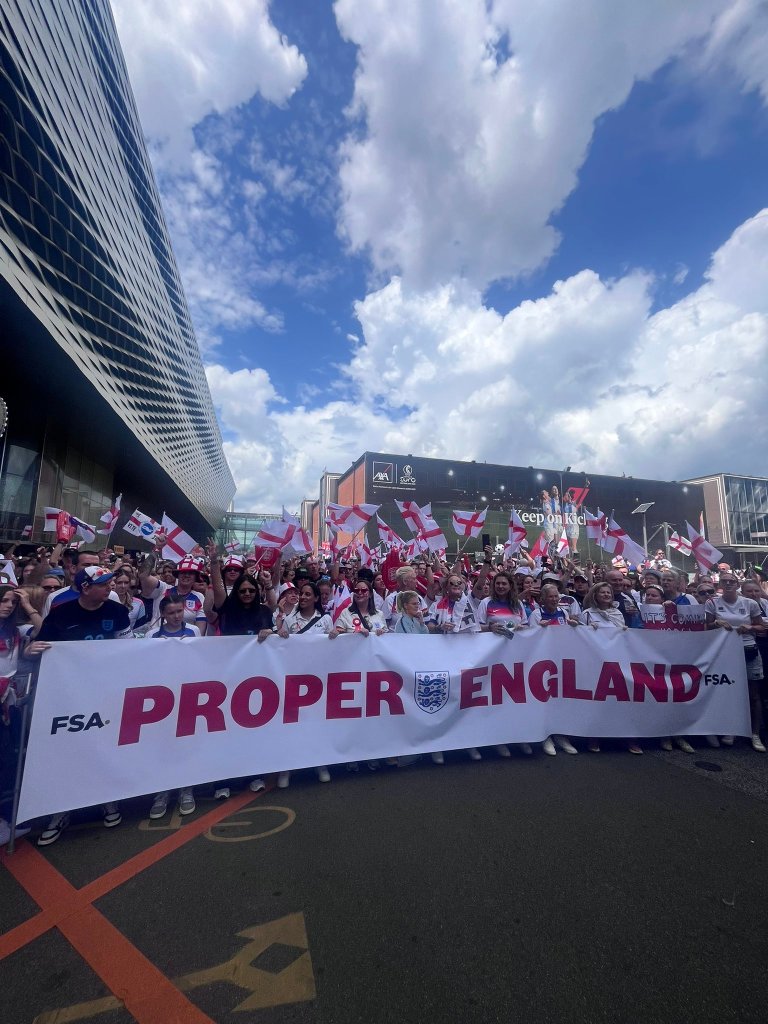
The fan walk was its own event, and an unforgettable one at that. As culturally iconic as you can get, it was a black cab that headed up the walk, giving the streets of Basel a small taste of a London morning. The equally iconic band followed, having been as brilliant as the players throughout the Euros. The new ‘Sarina’ chant was just exceptional, and they’d spent every single matchday playing the same few tunes over and over again, right through extra time and penalties.
Above: The England fan walk to the stadium in Basel Photo: @FreeLionesses on X
Over the 4 kilometre walk to the stadium, through blazing sunshine, some light drizzle and 5 minutes of the rain absolutely thrashing down spirits were kept high by the band, and our overall excitement. Who cares about some rain when you’re about to watch the final of the Euros?
Something that made the fan walk so spectacular were the interactions with people at the side. Manoeuvring through the tight cobbled streets of Basel, there were apartments and balconies everywhere you looked, and so many of them popped their head out to sneak out an English or Spanish flag – provoking either cheers or boos (always in good nature) or just riling up the crowd. One such moment had us singing “we love you Switzerland, we do” and we truly did.
In the ground the vibes were slightly different. It was becoming more real, the nerves and tension were starting to creep in. Luckily the organisers were there to distract us, with two inflated ‘clappers’ for each seat and a tutorial video to follow, as the fans would be participating in the closing ceremony ourselves.
Suddenly, the national anthems were sung, the countdown to kickoff started and the whistle blew, we were off. The first 40 minutes weren’t great, lets be honest. However the fans never quietened down or gave up, and when Chloe Kelly was brought on the noise was louder than ever. The lift this generated in the crowd was similar to the lift to England’s all round play gained from Kelly’s introduction to the pitch.
When Alessia Russo leaned back and her header nestled into the corner, the stadium was even more rocked, England were back in it. As Spain pushed on towards the end the atmosphere never wore off. Every block, tackle, clearance or save felt like a goal and screams of “Sarina” in tune with the band were constant, we really began to believe that England could hold on and get this victory.
Possibly the biggest moment of the day for the Lionesses’ fans was when referee Stephanie Frapport pointed right at us to signal the penalty shoot out would be taken at that end. The penalty shootout itself went exactly how they do – everything that goes your way is the greatest high ever and every one that goes against you is pure devastation. I wouldn’t even describe it as a roller coaster of emotions, it’s more of a washing machine where they just get thrown up, down and any direction every second.
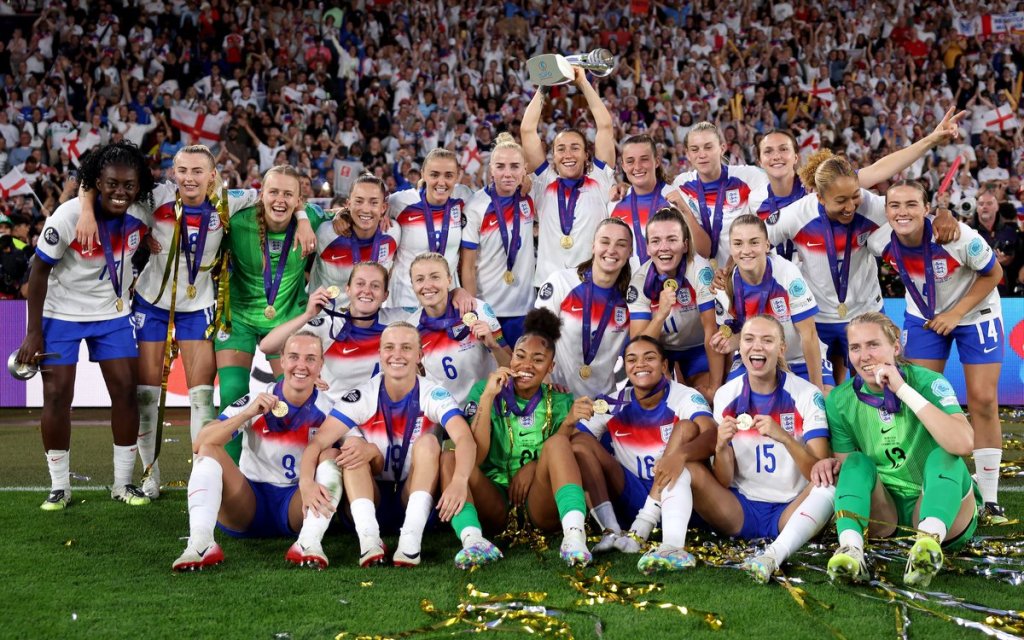
Above: The England squad celebrating with their medals in front of the fans Photo: @Lionesses on X
Eventually though, Chloe Kelly stepped up, buried her penalty and England were champions. Cue the wild celebrations once again, but there was also a sense of relief this time, we had finally done it. There would be no more extra time or penalties, we hadn’t gone through every emotion on this earth just to make it through the quarter final this time, football had actually come home again.
The joy of those next few moments is hard to describe. The entire squad, and a few seconds later the staff all sprinted over to the fans as ‘Sweet Caroline’ began to play over the tannoy. As were we singing and dancing along it did start to sink in that England had won the Euros. After all the doubts, the inconsistent results, the tough group, the rise of our opponents and the retirements had made this seem impossible; here Leah Williamson was lifting the trophy.
It has been such an amazing experience to be at the Euros, and being with the England fans at each game has been fun. It is a slightly different atmosphere to home games in England but I like it, less people doesn’t have to mean less passion or support. In that winning moment and the hours after it felt like we were all on cloud nine, walking around Basel recognising each other and acknowledging that shared experience, knowing we had both just seen England bring it home.
Football has so much power and it showed all of that last Sunday. It might sound pathetic and obsessive to some people, but that was genuinely the best day of my life and I was really the happiest I’ve ever been in that moment seven days ago.
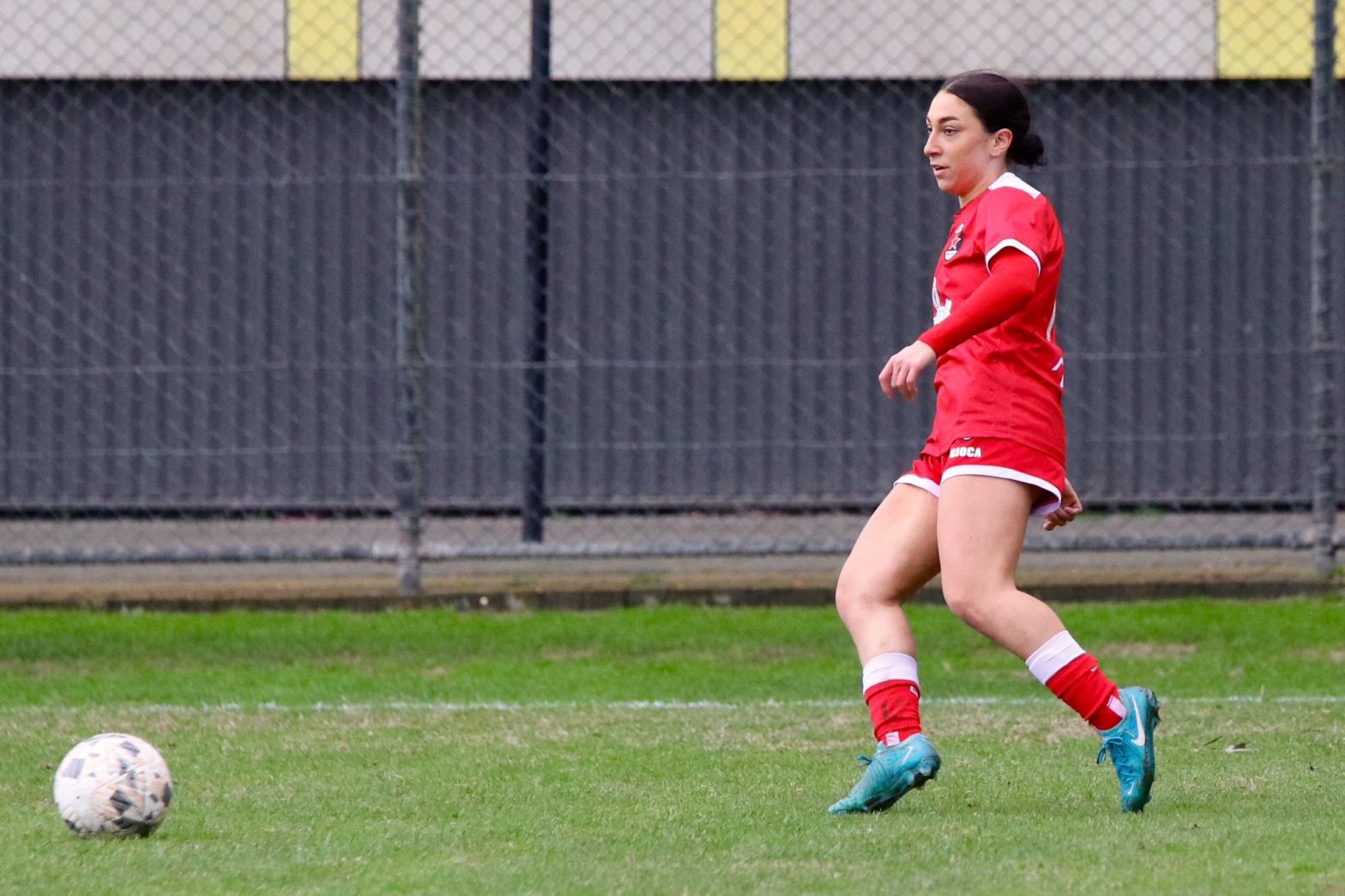
Above:Kaitlyn Bellanca (red shirt), in action in a previous game, scored Perth RedStar’s opening goal at Fremantle City today.Photo: Denyse RM Photography.
Fremantle City 2-3 Perth RedStar
by Ella McShane
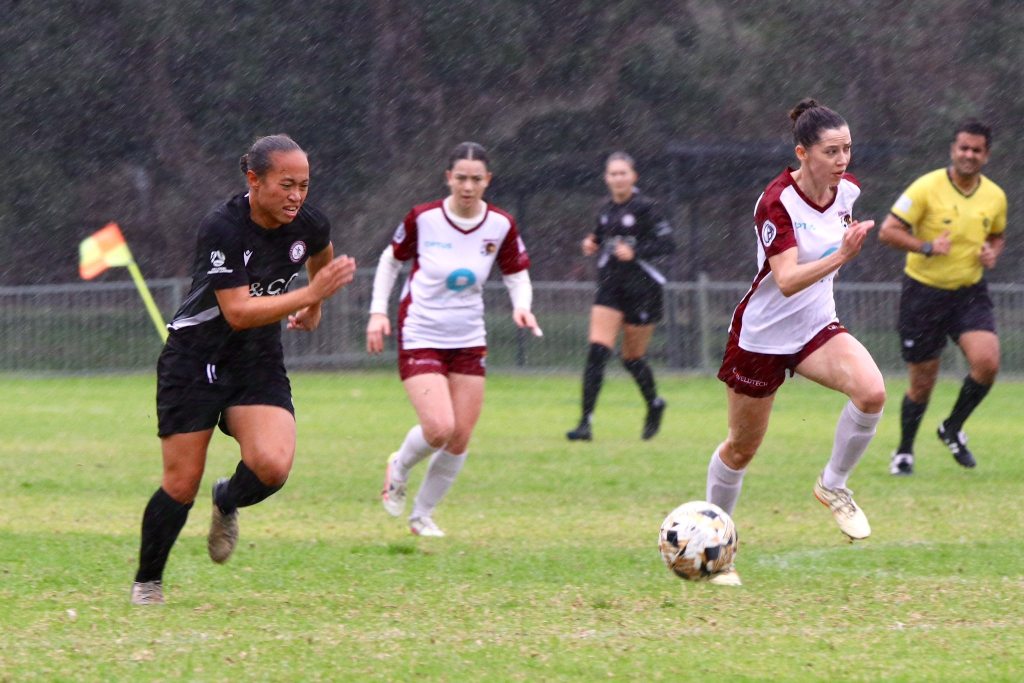
A wet and windy afternoon at Wauhop Park set the stage for a fiercely contested afternoon of football.
Despite the challenging conditions, both teams maintained disciplined positioning even as the weather conditions caused play to fizzle out.
Perth RedStar asserted dominance early when Kaitlyn Bellanca opened the scoring just 12 minutes in. The clean strike from a tight angle on the left wing impressively found the net, despite the elements working against her.
Freo secured the equaliser a mere ten minutes later when Abbey Green’s surging run into the left-hand side of the box allowed a superb cross to clear overhead. Leyna Wood showcased excellent anticipation when she positioned herself perfectly to meet the cross and guided a header into the back of the net.
A quick turnaround for the port city side was emphasised when Sophie Meaden’s run towards goal surpassed RedStar goalkeeper Gabby Dal Busco. The tap-in from Wood gave the homeside the lead, in a somewhat symbolic show with the sun now shining down on Wauhop Park.
Fremantle’s lead was short-lived as, against the run of play, RedStar’s Renee Leota delivered a precise cross from distance. The ball found the feet of a perfectly positioned Lauren Continibali, whose ever-so-slight redirection guided the ball into the net to level the score.
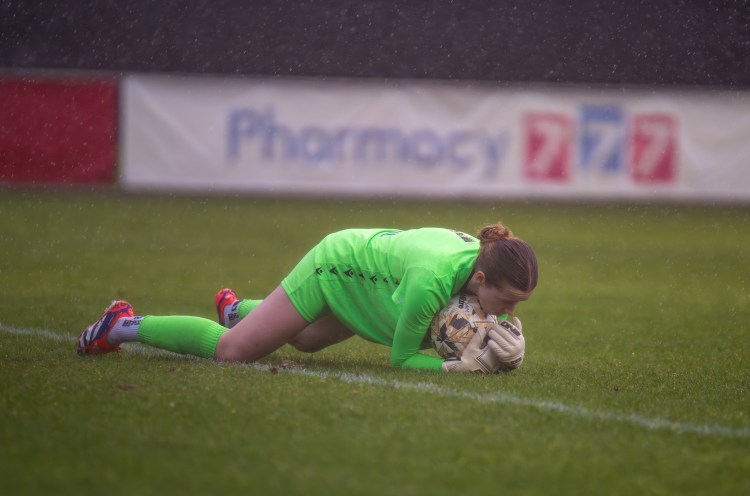
A RedStar free kick ultimately sealed their win. Andreia Teixeira lifted the ball into the box, and while home goalkeeper Megan Phillips got a hand to it, she couldn’t maintain control, and the ball slipped past her, crossing the goal line.
Despite a closely contested remainder of the second half, the visitors gained a well-earned three points on the road and are currently sitting seven points behind front-runners Perth Soccer Club ahead of their showdown with the Azzurri next Sunday.
Murdoch University Melville 0-4 Football West Academy
Above: Theo Mouithys, who celebrated her Junior Matildas call-up for the ASEAN Championships with a brace for the Football West Academy today. Photo: U18sNPL.
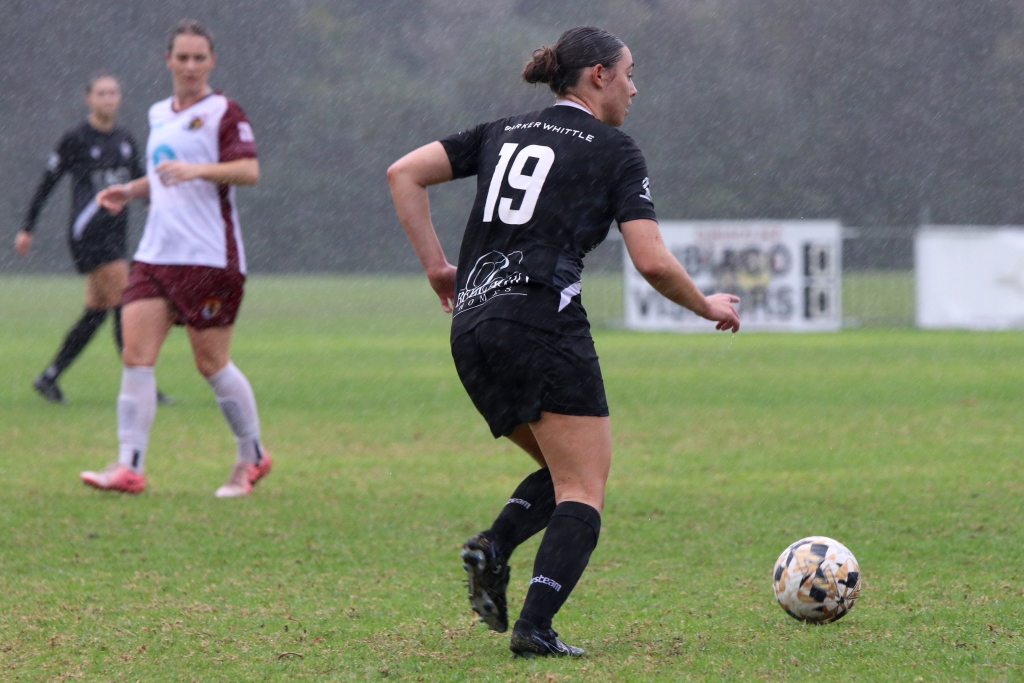
The Football West Academy(FWA)battled through atrocious conditions, which at one point forced the players from the field, to come out on top at Besteam Stadium today.
The game began in exceptionally windy conditions, but the teenage side had the better of the early chances with Theo Mouithys hitting a shot that was pushed out for a corner by home keeper Jemma Skinner.
Just before the quarter-hour mark, the players were taken off the pitch after the strong wind became accompanied by torrential rain, which made playing on impossible. Thankfully, the squall was short-lived, and the action resumed after around four minutes break.
The visitors hit the front with 21 minutes played when Mouithys broke through from the left, and the Junior Matilda slotted a shot across Skinner and in. Eight minutes later, Emily Garnett doubled the FWA’s lead.
Football West Academy got their third with 66 minutes on the clock as substitutes Lacey Heys and Cate McAuliffe combined, with Heys playing a centimetre-perfect pass through for McAuliffe to slot home.
Mouithys got her second and the teenage side’s fourth with five minutes remaining when she turned her defender and curled a shot into the right-hand corner.
FOOTBALL WEST ACADEMY: McGreadie Cole, Z. Dumont, Johnson, Williams-Jones, Leong, Lange, Dalton, Santos, Brady, Mouithys, Garnett. Substitutes: A. Dumont, McAuliffe, Collinson, Houlis, Heys, Barlow, Borg.
Subiaco 0-4 Perth SC
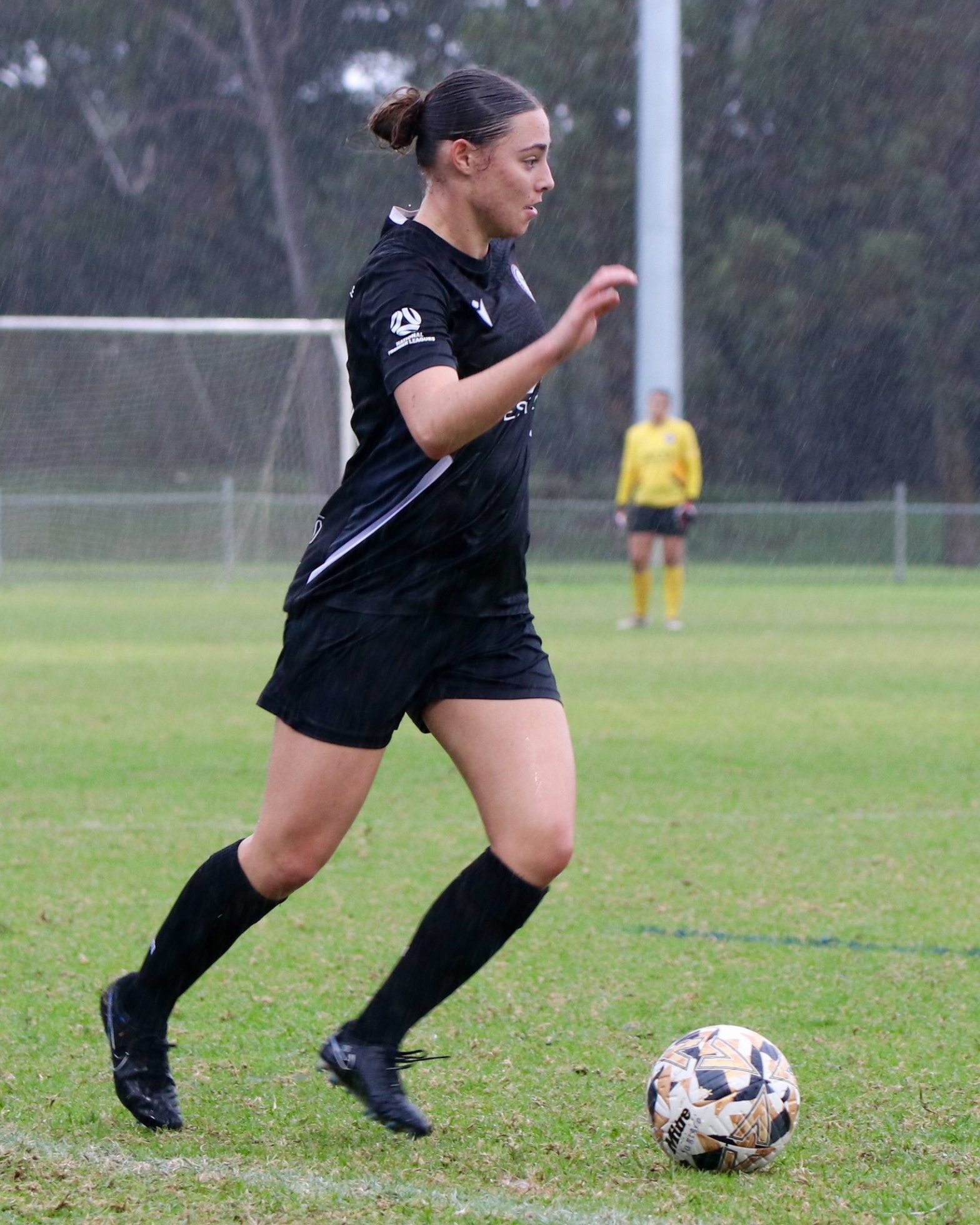
Above: Daisy McAllister (azure shirt), who scored two of Perth SC’s four goals at Subiaco today. Photo: Rob Lizzi.
The Azzurri overcame challenging conditions and a battling Subiaco side to claim a victory that sees them remain seven points clear at the top of the NPLW WA with just four matches remaining of the regular season.
The visitors were rapidly out of the block with Jess Flannery driving along the left to play a ball in for Ella Lincoln, whose shot was held by Monique Todd in the Subi goal. Shortly afterwards, Sam Mathers was also denied by the shot stopper.
It was all Perth, and with a quarter of an hour played, they took the lead. Lincoln put in a cross on the right for Flannery to turn and hit the ball into the net for a superb goal.
Conditions then took a major turn for the worse as heavy rain fell, accompanied by extremely gusty winds that made it exceptionally tough for the players. Perth looked after the ball very well during this period and earned the one remaining chance of the half when Mathers’ turn and shot from the edge of the area came off the right-hand post and out for a corner that Subiaco dealt with.
After the break, the weather eased slightly, but the wind remained a feature of the game. Just three minutes into the second half, Lincoln scored a superb second when she received the ball some 25 yards out with her back to goal. The Azzurri attacker beat Tayna Campos and curled a shot that hit the right-hand post and then rolled along the line to hit the other post. The goal was awarded.
Six minutes later, Perth made the game safe after clearing a Subi free-kick, which saw Daisy McAllister released to break free and direct the ball calmly into the net.
McAllister grabbed her second and the Azzurri’s fourth with 12 minutes remaining – and it was an absolute peach. A Perth free-kick just inside the Subi half was headed on the edge of the box, and McAllister hit a stunning first-time volley from the edge of the area.
This result and another win for Perth RedStar today sets up next Sunday’s clash between the two sides at RedStar Arena as a really enthralling prospect.
Above: Alex Poad in action for Fremantle City this season. Photo: Denyse RM Photography.
31/7/25
We’ve assembled a group of people who are watching the competition’s matches especially closely to identify the league’s most consistent players each month. For May, Ben Gilby, Kelechi Osunwa, and Tommy Doleman produced a shortlist of players, from which the winner was selected.
The shortlist
Dayle Schroeder (Perth SC)
Above: Dayle Schroeder makes a save against Murdoch University Melville this month. Photo: Rob Lizzi.
It has been another good month for Dayle Schoeder. Just one goal conceded during July, with the additional record of only 10 league goals put past her in 2025 as the regular season moves towards its final month.
The Bunbury-born shotstopper’s form has been on a sharp uptick over the past 12 months or so, as she has backed up a hugely impressive 2024 at Fremantle City by continuing to post eye-catching stats in 2025.
With Schroeder the last line of a brick wall style Perth SC defence, the Azzurri will feel confident of continuing their strong run of results as the campaign reaches its conclusion.
Leyna Wood (Fremantle City)
Above: Leyna Wood (left) on the charge for Fremantle City this month. Photo: Denyse RM Photography.
Freo’s all-action American attacker has really stepped up to the plate as the season reaches its last six weeks.
Wood contributed five goals across July in games against Balcatta Etna, Subiaco, and the Football West Academy as her team kept their top-four hopes alive.
The bustling presence, strong ball-playing skills, and an eye for a goal all mark Wood out as someone who will be integral to the Port City side’s run-in as they attempt to close the gap on the sides above them.
Stella Zampogna (Subiaco)
Above: Stella Zampogna on the charge for Subiaco. Photo: Denyse RM Photography.
Stella Zampogna has hit some of her best form of the season right as things are reaching the pointy end.
Zampogna’s July began with a classy goal against Fremantle City when she lifted a glorious shot into the top right-hand corner from outside the box on the right, and continued when she added two further strikes in Subi’s Round 16 win over UWA-Nedlands.
It hasn’t just been the goals that have impressed in Zampogna’s game this month, though. Intelligent runs see her as an integral part of her side’s offensive game, and this has been vital in Subi picking up two wins on the bounce in July, and being a tough nut to crack in games against top-four sides Balcatta Etna and the Football West Academy.
Impetus NPLW WA Player of the Month for July 2025:
Alex Poad (Fremantle City)
Above: Alex Poad in possession for Fremantle City at Subiaco this month. Photo: Denyse RM Photography.
Fremantle City are making a late charge for a place in the top four with a run that has seen them win five of their last six league matches. Alex Poad’s form is a significant reason for that.
Poad’s work at the back and in linking play with those ahead of her has seen the Port City club produce eye-catching wins over top-four duo Balcatta Etna and Football West Academy this month, as well as success at Subiaco.
With a State Cup semi-final also to come, whilst the odds may well be against them, with Poad in this form, Freo will be going all out to keep their improved run of results going over the final six weeks of the league season.
Impetus NPLW WA Player of the Month Roll of Honour 2025 season
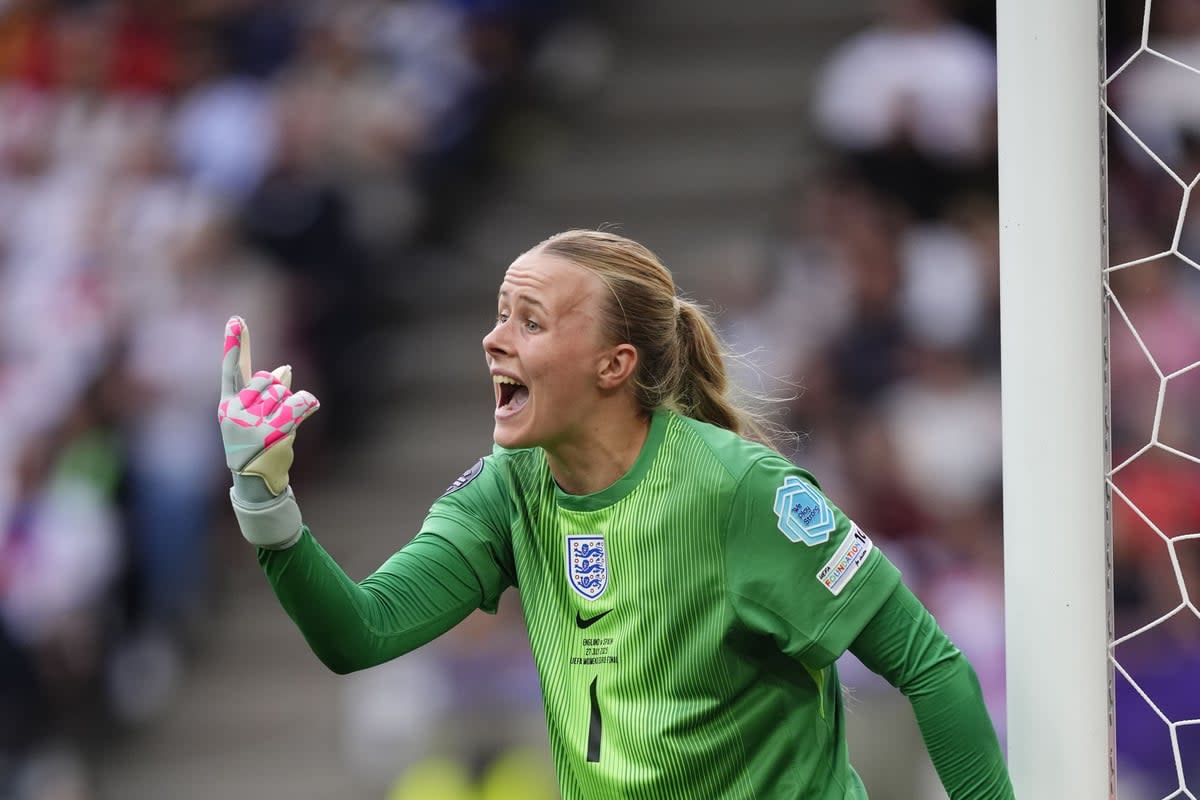
There were many stories to come out of England’s success at the 2025 Euros, with many members of the squad delivering when it ultimately matters to seal a title defence for the Lionesses. One of those was Hannah Hampton, with the 24 year old goal keeper delivering a rock solid performance in goal to see England through two intense penalty shoot outs in both the quarter-final against Sweden and final against Spain.
It has been a pretty remarkable 18 months or so for Hampton, who made her Lionesses debut in 2022 but did not make her competitive debut for the team until the Euros Qualifier against the Republic of Ireland in April last year.
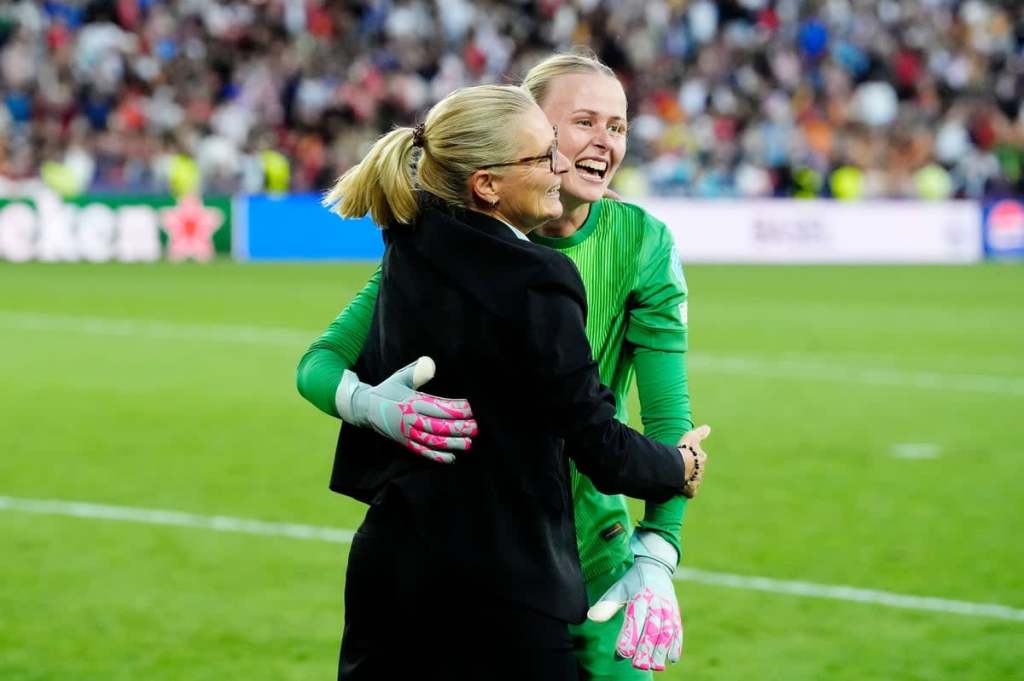
Above: Hannah Hampton with England head coach Sarina Wiegman. Photo: Nick Potts/PA.
Since then she has continued to show her merit and slowly but surely earned her spot as the first choice goal keeper for England, dethroning Mary Earps in the process.
In the weeks leading up to the Euros there had been a lot of discussion in the mainstream media about the decision to have Hampton as the number one keeper, but Hampton certainly proved her doubters wrong during her first major tournament.
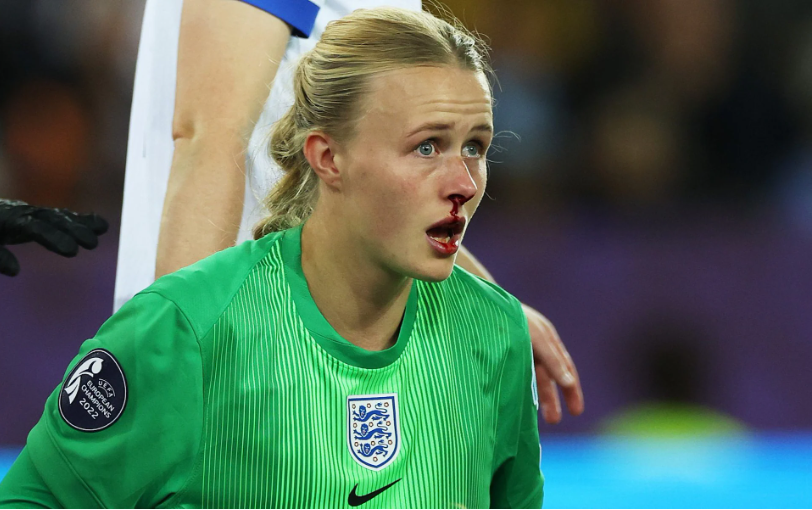
This started with a stellar save to her right in England’s penalty shootout win over Sweden in the quarter-final; which she made with a tampon up one nostril due to a nosebleed. Her heroic status was then sealed in the final, where she once again came up clutch with two saves to deny Spain and ensure England retained their European crown.
Above: Hampton suffered a nosebleed against Sweden. Photo: Eddie Keogh.
Hannah Hampton Stats Euros 2025 Final vs Spain
Shots on Target Against: 5 Saves: 4 Save Percentage: 80%
It is not easy to stay alert and concentrate hard as a goal keeper for a full 90 minutes, but that is exactly what Hampton did in the Euros Final, plus the extra half an hour of extra time.
Up the other end there was clear examples of concentration and communication levels dropping within the Spanish defensive group, which never happened with Hampton and the defenders in front of her.
However, Hampton lifted her performance to another level in the penalty shoot out.
One interesting thing about the way Hampton goes about facing a penalty shot is her lack of movement in anticipation of the shot. Where other goal keepers will bounce up and down the goal line and wave their arms around to try and intimidate the player taking the kick, Hampton takes a very different approach. She does not move her feet aside from a slight hop, with the only real movement coming from what can be described as over emphasised claps.
The first shot she faced was against Patri Guijarro, whose penalty was successful after Hampton dived to her left but Guijarro’s shot went straight down the middle.
The second shot Hampton faced would prove to be a different story for the English keeper.
Facing Mariona Caldentey – who is well known for being a strong penalty kick taker – Hampton again dived to her left, but with a little bit more energy and stretch in her dive than she had in her attempt to save Guijarro’s shot. This proved to be important because it meant she was able to stop Caldentey’s shot, but if she had not had that power, she would not have dived far enough to be able to stop the shot.
The third penalty taker for Spain was Aitana Bonmati, who much like Caldentey was unable to get past Hampton.
This time though, Bonmati took a different approach to both Guijarro and Caldentey, instead choosing to shoot to Hampton’s right side instead of her left. Hampton did initially take a step to her left as Bonmati had a couple of steps before she connected with the ball, but Hampton was able to change direction quickly enough to dive and save Bonmati’s subsequent shot.
The final shot Hampton faced was from young up and coming star Salma Paralluelo, who provided a different factor to navigate for Hampton as she is left footed, whereas the previous three kick takers had all been right footers.
Hampton did choose the correct side to dive to, but it ultimately did not matter as Paralluelo skewed her shot too far and it sailed on out passed the outside of the goal post and the job was done for England.
Defying Expectations
What makes Hampton’s rise to where her football career is today even more remarkable is that it would never have happened if she had listened to what doctors told her as a kid.
Hampton was born with a condition called strabismus, which is also known as a squint and means that if she was looking at an object with one eye, her other eye would be looking in a completely different direction. The issue was so severe that by the time she was three, she had already had three operations to correct it, and even then it was not completely healed.
That was not all, as when she was doing a medical check up at Stoke City when she was 12, she was diagnosed with impaired depth perception. Hampton told the BBC: “I was told from a young age that I couldn’t play football, that it wouldn’t be a profession I could pursue. But here I am.”
Speaking about Hampton’s story following the final win, England head coach Sarina Wiegman said: “Every player has their one story and journey and hers has been incredible. Starting the tournament and losing the first game, there was so much riding on every game, we had five finals. She had to step up and I think she has been amazing. It’s a little bit like a fairytale to stop those two penalties in the final.”
Hampton returns to Chelsea with an international major tournament medal around her neck, which will join her WSL title medals and cup medals. She also returns as England’s undisputed – and heroic – number one.
Above: Aideen Keane celebrates her goal. Photo: Georgie Lewis
It was an action-packed Round 21 of the National Premier Leagues Women’s NSW competition, with a few surprise results reshaping the ladder ahead of the final stretch. With top-four ambitions and relegation battles on the line, every game carried extra weight — and the drama did not disappoint.
Match of the Round: Sydney University 1-2 UNSW
Sydney Uni Football Ground
UNSW FC kept their finals hopes alive with a determined 2-1 win over Sydney University under the lights at Sydney Uni Football Ground.
The away side started brightly, with Akala Howell tested early and Sofia Fante forced into a pair of saves to keep UNSW corners out. At the other end, Uni nearly took the lead through Poppy Tay, but Howell was up to the task.
It was Trudy Camilleri who broke the deadlock in the 23rd minute, beating two defenders and unleashing a stunning long-range strike into the top corner. Sydney Uni responded 10 minutes later through Talia Kapetanelis, who rose highest to power home a header from a corner — showing she’s just as lethal in the air as she is with her left foot.
But it was a well-worked team move that handed UNSW the winner on the stroke of half-time — Camilleri slipping a perfectly weighted pass to Chloe Smith, who rounded the keeper and finished coolly for her first league goal in nine matches.
UNSW created further chances through Leixa Puxty and Angelique Hristodoulou in the second half, but Fante held firm. Despite late pressure from the home side, UNSW’s backline stood tall to secure a crucial three points in the finals race.
Bulls FC Academy 1-0 Western Sydney Wanderers
Northbridge Oval
The Bulls edged a narrow but dominant 1-0 win over Western Sydney Wanderers to maintain their position at the top of the table.
Jynaya Dos Santos sparked the decisive moment in the 27th minute, winning the ball and feeding Petria Phillips, who battled through pressure and poked home past the outrushing Aimee Hall. From there, the Bulls controlled possession and territory but were unable to extend their lead.
Wanderers struggled to mount a consistent attacking threat and were largely pinned in their own half for much of the contest. Despite missed chances, the Bulls did enough to hold on for another important win.
Sydney Olympic 4-2 NWS Spirit FC
Valentine Sports Park
Sydney Olympic returned to form in spectacular fashion with a 4-2 win over finals-chasing NWS Spirit FC, led by a sensational Aideen Keane hat-trick.
Keane opened the scoring within two minutes with a stunning strike, and after Spirit equalised through Victoria Martin — thanks to a lovely ball over the top from Bethany Gordon — she restored Olympic’s lead with a dazzling solo effort just before the break.
Alyssa Whinham added a third after reacting fastest to a loose ball, before Keane completed her hat-trick in the 84th minute with a composed finish from range. Spirit managed a late consolation via Lola Greenberg, but the points stayed in Belmore.
Mt Druitt Town Rangers 3-0 Macarthur Rams
Popondetta Park
Mt Druitt Town Rangers bounced back to winning ways with a commanding 3-0 victory over Macarthur Rams.
Erin Leah Tavares struck inside three minutes, capitalising on a loose header back to the Rams keeper. Leena Khamis doubled the lead just before half-time, finishing off a slick move started by Rosaria Galea and Roukayah Al Fararjeh.
In the second half, Galea turned provider once again, keeping a wayward cross alive and lifting it back in for Khamis to nod home her second. The win gives the Rangers a timely boost heading into the final rounds.
APIA Leichhardt 2-1 Manly United
Lambert Park
Ashlie Crofts bagged a brace as APIA Leichhardt took a huge step towards finals with a 2-1 win over fellow top-four contenders Manly United.
Crofts opened the scoring after a clever ball in behind from Charlotte Lancaster, drilling a low finish past Nicole Simonsen. Manly equalised early in the second half through a slick corner routine, Alexia Forner’s curling cross sneaking straight in at the far post.
But Crofts proved the difference once more, heading home in the 72nd minute from a corner in a crowded box to seal the points. APIA now sit just one point outside the top four.
Illawarra Stingrays 0-0 Northern Tigers
Macedonia Park
The Stingrays and Tigers shared the spoils in a tense 0-0 draw that may have major consequences for Illawarra’s Premiership hopes.
Northern Tigers came out on the front foot, controlling large spells of possession and creating the better chances. But Brianna Edwards was excellent between the posts, cutting out dangerous balls and standing tall under pressure.
The Stingrays had one scare late on when Edwards handled just outside the box, but the resulting free-kick was cleared. A point each, but it feels like two lost for the South Coast side.
Gladesville Ravens 6-0 Newcastle Jets
Christie Park
Eliza Familton ran riot with a hat-trick as Gladesville Ravens demolished Newcastle Jets 6-0 in their most dominant performance of the season.
Familton opened the scoring early and doubled her tally before the break. Goals from Taren King and Keisha Allen gave the Ravens a 3-0 cushion by half-time.
Despite some improvement from the Jets in the second half, the floodgates opened late. Familton grabbed her third after a defensive error, and Patricia Charalambous added a sixth in stoppage time to round off a ruthless display.
Above: Western Australian talent Georgia Cassidy is among the names called up to the U-23 squad. Image: Rob Lizzi for Impetus Football.
by Genevieve Henry (7/30/25).
Head Coach Joe Palatsides has announced the U-23 Squad that will be flying to Vietnam to compete in the ASEAN Women’s Championship taking place from August 6-19. The squad is full of names from the A-League Women, as well as some recent Matildas debutants.
Palatsides, who worked under Joe Montemurro at Olympique Lyonnais in addition to working as a youth coach for Melbourne Victory, will be leading this team to Vietnam with every intention of winning the tournament. Australia tends to send a youth development squad to this tournament, although it is not a U-23 competition. The Nations this team will face will likely be full strength.
Palatsides commented “Development is a big part of what we’re doing, but we’re also going to Vietnam to win. We want our players to embrace the challenge, rise to the occasion, and understand what it means to wear the Australian jersey.”
Australia’s U-23 squad qualified directly for this tournament by winning the AFF Championship in 2022. Although it is not a senior call-up, it is one of the closest environments to the experience and a very valuable opportunity.
“This tournament is a really important opportunity for our players to experience international football in a meaningful way.”
“It gives them a real taste of what it takes to compete at this international level while coming up against quality opposition in unfamiliar conditions and doing it within a structure that mirrors the expectations of the CommBank Matildas.”
“Some of these players have already had a taste of senior football while others are knocking on the door, but no matter where they are on their journey, this kind of experience is incredibly valuable.”
Above: Bryleeh Henry is one to watch this tournament for not only her talent, but experience. Image: Kris Goman for Impetus.
Players such as Bryleeh Henry, Isabel Gomez, and Chloe Lincoln who have debuted for the senior national team will be expected to be leaders within this talented squad. Players such as Perth Glory’s Georgia Cassidy, Western United’s Sasha Grove, and Melbourne Victory’s Alana Jancevski are among the exciting names to watch as they gain experience in a competitive environment.
Australian U-23 Squad for ASEAN Women’s Championship
Name
Position
Current Club/Member Federation
Georgia CASSIDY
Midfielder
Perth SC / Football West
Alana CERNE
Defender
Essendon Royals SC / Football VIC
Amy CHESSARI
Midfielder
Western Sydney Wanderers FC (NPL) / Football NSW
Naomi THOMAS-CHINNAMA
Defender
Unattached
Claudia CICCO
Defender
APIA Leichhardt FC / Football NSW
Tahlia FRANCO
Goalkeeper
Macarthur Rams FC / Football NSW
Holly FURPHY
Midfielder
Unattached
Isabel GOMEZ
Midfielder
Northern Tigers FC / Football NSW
Sasha GROVE
Defender
Unattached
Bryleeh HENRY
Midfielder
Unattached
Sally JAMES
Goalkeeper
APIA Leichhardt FC / Football NSW
Alana JANCEVSKI
Midfielder
Unattached
Grace JOHNSTON
Defender
Preston Lions FC / Football VIC
Aideen KEANE
Midfielder
Sydney Olympic FC / Football NSW
Chloe LINCOLN
Goalkeeper
Unattached
Leticia MCKENNA
Midfielder
Unattached
Emilia MURRAY
Attacker
Coogee United FC / Football NSW
Annalise RASMUSSEN
Attacker
UNSW FC / Football NSW
Sofia SAKALIS
Midfielder
Box Hill United Pythagoras FC / Football VIC
Hayley TAYLOR-YOUNG
Defender
Unattached
Ella TONKIN
Defender
Northern Tigers FC / Football NSW
Tori TUMETH
Defender
Unattached
Alicia WOODS
Midfielder
Brisbane Roar FC (NPL) / Football QLD
Australian U-23 Squad for ASEAN Women’s Championship
Australia ASEAN Women’s Championship Fixtures
v Myanmar: Thursday, 7 August, 4.30pm local / 7.30pm AEST
v Philippines: Sunday, 10 August, 7.30pm local / 10.30pm AEST
v Timor-Leste: Wednesday, 13 August, 7.30pm local / 10.30pm AEST
All matches will be played at Việt Trì Stadium, Phú Thọ, Vietnam.
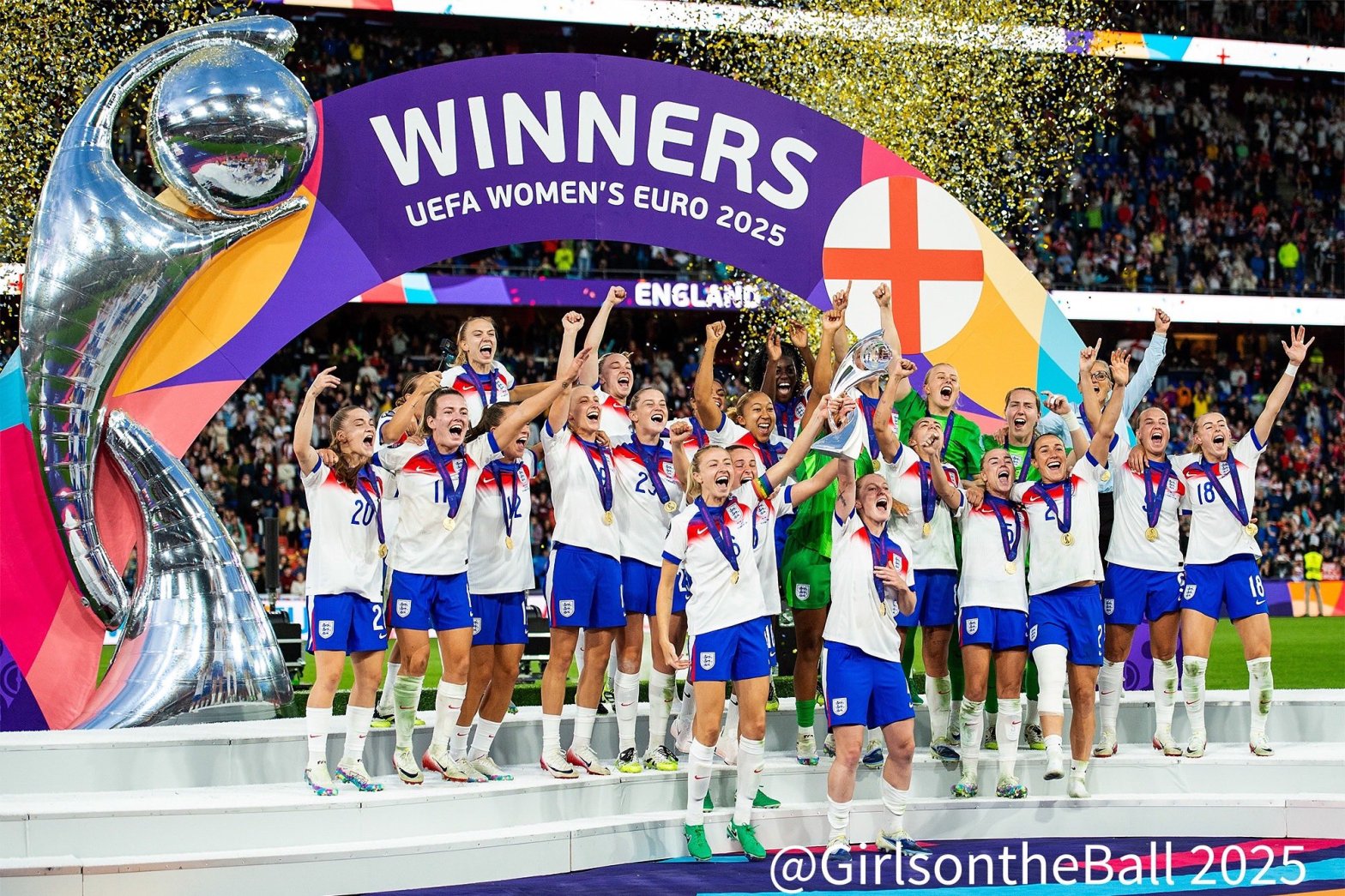
Above: Lionesses celebrate their Euros win. Photo: GirlsOnTheBall.
England emerged victorious on Sunday evening after a tumultuous tournament that saw them defy the odds time and time again. In this piece, Impetus Football’s Catherine MacKenzie considers the reasons behind the success.
Think back to July the 6th 2025. The Euros had just kicked off and England had lost their opening game, a 2-1 defeat to France that felt much worse than the scoreline suggests. In her ITV commentary, Karen Carney suggested England were “bullied”, and this was true: the Lionesses won only 42% of their duels; 41% of their ground duels, and 44% of their aerial duels. The English media were unforgiving, and reaching the knockout stages of the competition felt like a fever dream. The most staggering thing about the loss? It probably played a key role in their eventual tournament win.
Think even further back to June 5th. This was the date that head coach Sarina Wiegman announced her Euros squad, and it was missing some key names: Mary Earps and Fran Kirby had retired from international football, and Millie Bright withdrew from contention, citing her mental and physical wellbeing. The word crisis was being used by the media, and Wiegman was forced to defend not only her decisions, but her entire approach to squad management as the media questioned if the Lionesses’ boss was too blunt in her conversations with players.
Then there were the injuries. Some of the squad’s most vital players were only just recovering from long-term injuries; Georgia Stanway, Lauren Hemp, Alex Greenwood, and Lauren James had all played limited football at club before the tournament due to long-term injury.
Today England celebrate the Lionesses winning their second consecutive Euros – the first time a senior England team won a major tournament on foreign soil. At many points throughout the last few months, this felt absolutely impossible – but the impossible did happen. Despite numerous setbacks both on and off the pitch (exemplified by Lucy Bronze revealing that she had played the entire tournament with a fractured tibia), football stayed home.
Tactical adaptationsand the benefits of France loss
In England’s send off game against Jamaica (a 7-0 win), Chelsea star Lauren James played in the number 10 role. This came as a bit of a surprise – her best position is arguably on the right wing – however it seemed to work, albeit against an opponent that gave James enough space to be creative despite the confines of the role. That she started in the 10 against France was also therefore unsurprising, however against a tough opponent, her position did not work.
The loss exposed England’s weaknesses. These were cracks that we already knew were there – a lack of pace in the back line, lack of depth at left-back – the surprise came at the extent to which these weaknesses were exploited. At times, particularly during the first half, France waltzed through to the England box with ease. England were better in the second half, but were already 2-0 down, and there seemed little hope of a comeback.
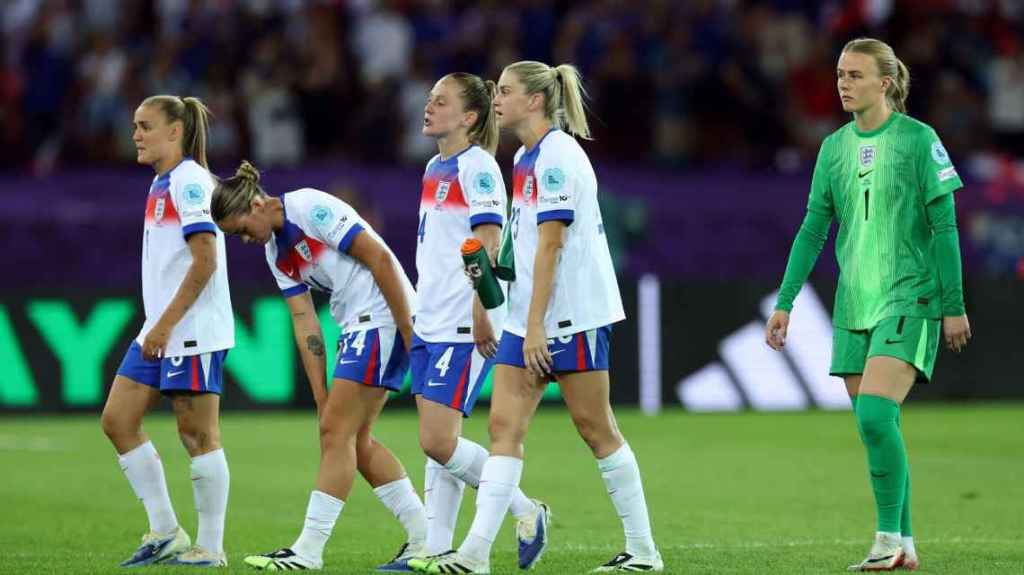
Above: the Lionesses against France. Photo: Alexander Hassenstein.
Teenager Michelle Agyemang was introduced in the closing stages of the game; an incredible show of trust from a manager often accused of not giving young players enough chances. Her introduction sparked a resurgence from England, and they succeeded in getting one goal back, a low shot from an unlikely source in Keira Walsh.
The response was emphatic: on their podcast Boots, Balls, and Bras, ex-Lionesses Fara Williams and Anita Asante complained that the fault lie with Wiegman; others said the same. That Agyemang was only introduced with minutes to go, the lack of urgency in the performance were both the key narratives in the English media. The question became: would the Lionesses bounce back, or would they let the result overwhelm them? The following morning, they held a meeting:
“It was a really helpful meeting. We watched clips but there was a lot of communication,” Georgia Stanway said in That Lionesses Podcast. “We had a lot of discussions which are also super healthy. Twenty-four hours after the game you’re a lot calmer and more logical about the situation. It was communicating about what we need from each other.”
England’s next game came quickly after, against Wiegman’s homeland the Netherlands. The Dutch had been through a rollercoaster of their own – head coach Andries Jonker would be leaving at the end of the tournament, and there had been chaos in press conferences culminating in Jonker and a Dutch journalist calling each other’s work a “puppet show”. The OranjeLeeuwinnen were on good form however, beating Wales 3-0 in their opening game. The return of Vivianne Miedema was the highlight – as was her 100th international goal against Wales.
The fear was that the Netherlands would exploit the same weaknesses as the French, and that England would be low on the confidence needed to combat this. This is where Wiegman’s tactical changes came into play: Jess Carter and Alex Greenwood shifted roles in defence, with Carter moving central to partner Leah Williamson, and Greenwood moving to left-back. This shift provided Carter with more protection, and allowed Greenwood to more freely distribute the ball.
The other major change was in James’ position. James moved back out to the right wing, with Ella Toone playing in the 10. Toone is more physical than James, and a stronger midfield presence.
These changes paid off, and England beat the Netherlands convincingly in a 4-0 routing, the biggest defeat the Dutch had ever suffered at a major tournament.
In the semi-final against Sweden, England were 2-0 down at half-time again, and Wiegman opted for a surprising change: Carter and Williamson switched sides at centre-back, so Williamson was on the left side of the pairing. There was more space down the left as Carter had been left comparatively free, so Williamson had the room to distribute and get the ball forward more easily.
The tactical tweaks did not end there. For the final, James and Hemp switched sides, so James was playing on the left and Hemp on the right. After half-time, Lucy Bronze moved up to central midfield, providing extra protection for a backline that would be incredibly busy facing the world’s most technically gifted players.
That so many tweaks were made shows that a major impact can be made with the same eleven players who started the game, and that personnel changes are not the only way to have a major impact.
Togetherness
This tournament has been won by mentality. England spent just over four minutes of their knockout games ahead, with over 300 minutes coming at least 1-0 down. And that is when they played their best football. Whilst analysis will be made on why this happens, the fact is that the Lionesses have a mentality that means they never think they are done. They don’t see 2-0 down with 10 minutes to go as an impossible hurdle; they see it as 10 minutes of opportunity.
This mentality first emerged following the opening defeat by France. There was a subsequent atmosphere around the camp that changed momentum; players and staff had “difficult conversations”, and the team saw every game from then on as a final. As Michelle Agyemang stated in That Lionesses Podcast:
“I think that fight, you know every single game to be fair ever since the Netherlands game, it’s been a final for us and we’ve gone into every single game with that confidence and to see us pull it out the fire last-minute almost every single time shows that resilience and that belief and I think taking that for myself is really important.”
Lauren Hemp echoed this, saying: “The team spirit is incredible from this team and I think as long as we stick together and push through the hard moments of the game, because it’s not always going to be simple, um, and just expressing ourself and just showing our qualities, and yeah doing that together as a team.”
According to members of the squad, this mentality has origins in being ‘proper English’, emphasised by motivational speeches from Wiegman:
“[Proper England] means we’ll work hard, we’ll work until we can’t run anymore. We’ll stick together. And we know we’re very dominant on the ball as well… that’s our standard, and that’s our DNA as a team.” (Lucy Bronze)
Ella Toone emphasised the importance of Wiegman’s speeches: “We had a good one before the Italy game the night before in the meeting, one that definitely stood out, then again before the game.”
Leah Williamson expanded on this: “Sarina’s speeches before the games have definitely got us motivated.Even though sometimes we have gone a goal down, you still remember the words that she said before the game and it makes you want to go out and put on a performance for the second half as well. She’s been pulling them out of the bag. No matter what Sarina says you listen because she’s reached five major tournament finals so she definitely knows what she’s doing.”
Perhaps most importantly, Wiegman has instilled a culture where every member of the 23-player squad knows their role. Players like Maya Le Tissier and Anna Moorhouse did not play a minute of the tournament, yet their influence feels significant. That is because they were focal points in training – pushing their peers at all times.
During games, the ‘finishers’ (as Wiegman refers to them) were cheering on the team, jumping off the bench to celebrate goals with their teammates. This kind of community and team cohesiveness is arguably the Lionesses’ biggest asset and the main key to their success: every single member of the squad knew they were important.
This was especially important following the quarter-final against Sweden when it emerged that defender Jess Carter had been subjected to racist abuse on social media throughout the tournament. The team and staff were united in their response, echoing the need to support Carter – Lotte Wubben-Moy boycotted social media for a time, and FA CEO Mark Bullingham revealed that police had been contacted, and said:“We strongly condemn those responsible for this disgusting racism“.
Carter was subsequently left on the bench in the semi-final against Italy. Whilst Wiegman asserted that this was a tactical reason, it was also likely a protective measure. The defender was recalled to the starting line-up in the final, and had to overcome a crisis of confidence:
“I was super scared of playing the final for the first time in my life. When I woke up in the morning and saw my team and saw the support I had – and the belief I had from my team-mates, manager and family – I could come out and give my all. That’s all you can do.”
Above: Jess Carter wins her 50th cap. Photo: Lionesses on X.
Then there was the fact that Beth Mead and Ella Toone were facing their first tournaments since losing a parent. This brought the duo closer together, and made the togetherness in the team even more important. Mead shared: “Me and Beth have had so many conversations about it… she helped me massively with everything I’ve gone through.”
The clickers
The finishers made the difference throughout the tournament. No other team had as many substitutes score goals, and the impact of Chloe Kelly and Agyemang off the bench was electric. Although Wiegman was criticised extensively for leaving her substitutions until late, it is difficult to argue with the results: from losing positions in each knockout round, a Lionesses finisher contributed to the equaliser every time. Throughout calls for Kelly to start, Wiegman elected to keep her on the bench – likely because the sight of her warming up must have caused fear in the minds of opponents.
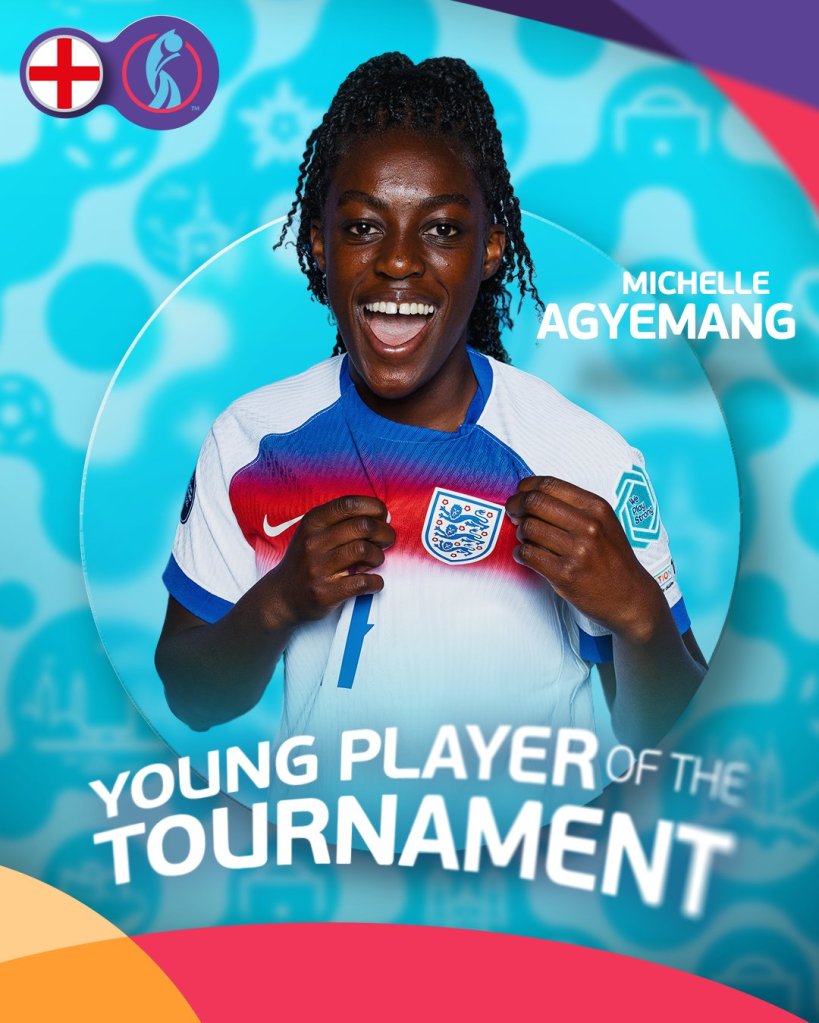
Agymang was dubbed an “agent of chaos” for her ability to have a major impact in a short space of time – and it is arguable that with more time, her impact may have been lessened – opponents never had the opportunity to get to grips with her because she was not on the pitch for long enough. Deservedly named Young Player of the Tournament, Agyemang – who was still playing with the U19s four months ago and was an emergency replacement for Russo in April – scored twice, and is now famous.
Above: Agyemang wins young player of the tournament. Photo: WEURO2025 on X.
Finishers spoke of their readiness to come on if needed but seemed happy to play a different role too. This speaks volumes of the initial squad selection process; the characters and personalities chosen to be part of the squad are truly team-first squad members, who put the team above individual accolades. Michelle Agyemang had to be pushed forward to celebrate a win that she played a huge role in, because she did not want to stand out. Her teammates wanted her to have a moment in the spotlight, however, pushing her towards the crowd of fans shouting her name.
This was exemplified by “positive clicking” – a special way of celebrating goals just for the squad’s finishers. Kelly explained the celebration: “We have a little group of us, a group chat, ‘the finishers’ as you call it, and the positive clicks we call it on the bench before the game. You probably saw we were all clicking, like ‘what are they doing?!’, but it was just a positive click. We said that if one of us comes on and scores, let’s do that as our celebration.”
Reggie the Cavapoo
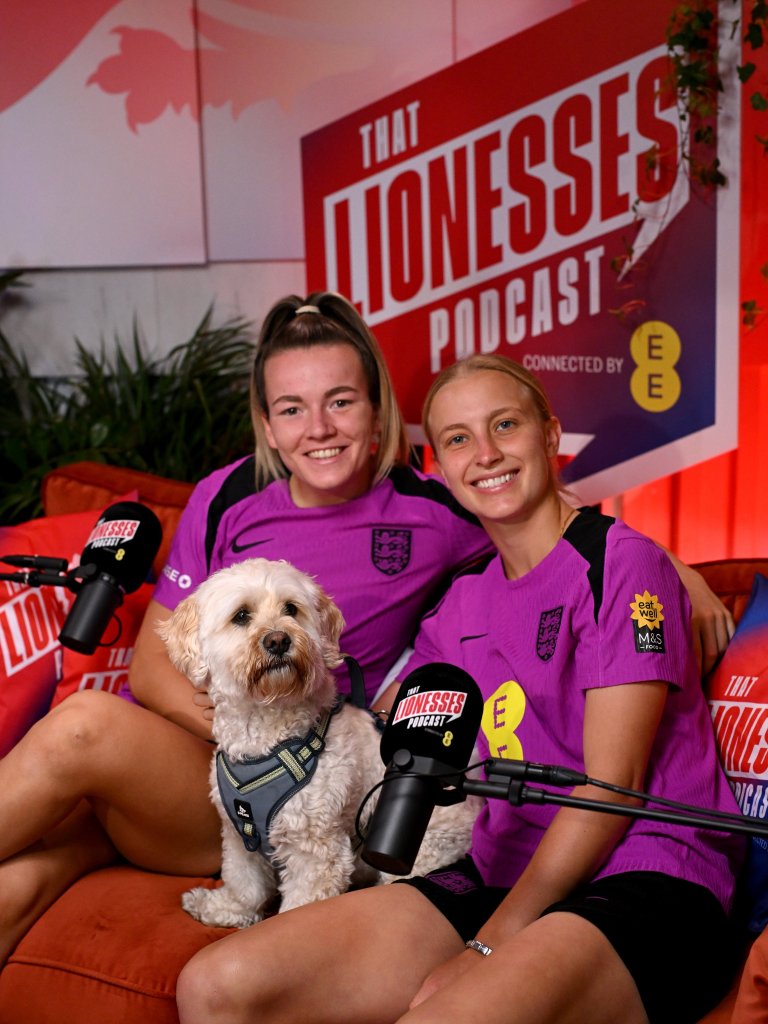
Another important member of the squad does not have a squad number. He is Reggie the cavapoo, the dog belonging to the Lionesses’ contracted coffee partner, Cheals on Wheels. Keira Walsh shared:
“We have a coffee dog that helps, I think most of the girls spend their time with him. I don’t think he realises how much he’s helped us. When we won the game, he came into the meal room afterwards, and we were all so happy to see him. So I think he’s definitely been helping the most, it’s fair to say.”
Above: Reggie the Cavapoo. Photo: Lionesses on X.
Reggie forms the focal point for the squad’s “morning walking club” spearheaded by Maya Le Tissier, Anna Moorhouse, and Aggie Beever-Jones. He spends a lot of time at St. George’s Park, home of the England teams, whenever the Lionesses are on camp, and travelled to Switzerland as an important part of the entourage. Providing that outlet was seen as integral to the squad feeling their best – particularly as so many of the Lionesses would be missing their own pets. Esme Morgan has kitten Biscuit, and Beth Mead’s dog Myle is famous.
The FA also found a way to take Agyemang’s piano, which travelled with the kitman to Switzerland in a van. The 5-star Dolder Grand in Zurich was decked out to the nines with England paraphernalia, aiming to make the squad feel as at home as possible.
This exemplifies the staff’s approach to the Lionesses: that on the pitch is not the only place where difference is made, and a high performance environment requires looking after the whole individual rather than just focusing on football.
In a world where small margins make the difference in knockout football, it is arguable that the effort made off-pitch is what pushed the Lionesses that one extra step. They played 120 minutes three times – a record for the women’s Euros – and went through penalties twice. To emerge victorious after that effort shows the entire team’s belief in their own success, supported by the best possible environment.
Above: Essendon Royal score their fifth goal against Boroondara-Carey Eagles
Essendon Royals have jumped to third on the table with a 5-0 win over Boroondara-Carey Eagles at home. Five separate scorers contributed to the win, that saw the game decided within an hour.
The Royals have risen sharply in the second half of the season. Since the halfway point, they have only lost once and have not gone goalless in any game. One of the league’s most visible improvers underlined their Championship potential with this ruthless display at Cross Keys Reserve.
Boroondara came into this round looking to respond to a loss against Bulleen last weekend and solidify their finals position. But from the outset it looked like it was going to be a tough afternoon. Essendon were dominant from the opening whistle and the match was largely played in their attacking half, while the loss of Boroondara’s starting goalkeeper Mia Mossman early in the first half did them no favours.
Deven Jackson was a constant menace, she was able to get behind the Eagles backline and whip in crosses despite the home side not really playing in a counter-attacking style.
The Royals simply dominated midfield, with Grace Maher an expected standout, while her Western United teammate Alana Cerne ensured that the visitors had few good opportunities at the other end. The Royals probasbly should have taken the lead even earlier than they did, but a free header from a corner kick was directed right at Mossman.
It was a Maher set piece that helped create the opening goal in the 17th minute. Rebekah Van Fort finished well in a crowded penalty area after Boroondara failed to clear an in swinging free kick.
Emma Langley scored the second goal almost by surprise. Her high, looping shot from the wing somehow found the back of the net by the near post. It was a shot out of nothing and caught substitute goalkeeper Emma Olsen completely off-guard.
It felt like a goal was arriving every few minutes. In reality it was every 10. Airi Fujiwara scored the third on the 39th minute with a clever turn and shot across goal to finish off Olivia Wood’s dangerous cross.
Deven Jackson increased the lead to 4-0 before half time. She latched onto some hesitant defending to fire a low trajectory rocket at goal that left Olsen with no chance. The half volley was perfectly struck while running at full pace. There was no stopping it, and the only remaining upside was that there was a whole other half to Boroondara to find a way into this game.
Any hope was snuffed out by the 50th minute. Emma Langley broke free on the right flank and her cross found Jackson on the opposite flank. The cutback found Woods who was presented with the easiest finish.
It was 5-0 in 50 minutes of football, and that was enough to secure another win by The Royals. They look like a team nobody will want to face in a final and with the type of form Jackson is in, few defences will have an answer for them.
They can score and in a variety of ways. Maher is one of the country’s best set piece specialists, Fujiwara has been lethally consistent for most of the season and Cerne has long been one of the NPLW’s best players.
The have contributors all over the pitch like Sasha Coorey and Emma Langley and impressive depth on the bench.
Boroondara need to respond next week. It will not be easy away to a dangerous Alamein FC, but they need to find some goals after going to consecutive matches without scoring.
Essendon Royals will look to reinforce their ladder position and possibly climb into second as they face bottom placed Bentleigh Greens in Round 19.
Around The Grounds
Box Hill have been the other big climbers in the second half of the season. Their ladder position does not reflect that as clearly as Essendon’s but consecutive wins against South Melbourne last week and now Heidelberg United show that they can beat any side on their day.
The league leaders were missing two of their most influential players. Caitlin Karic and Steph Galea were both injured for Heidelberg, but Box Hill still put on an impressive performance in a 2-0 win.
The opening goal was a work of art. A 10-pass move between defence and midfield leading up to Rhianna Pollicina’s brilliant assist for Carina Rossi to finish with one touch. It was a top class goal that shifted the usually dominant Heidelberg midfield out of position and caught the defence by surprise despite Box Hill’s patience.
The second goal was slightly scrappier. A high clearance, a hopefull cross from deep and a strike that was as much a block as it was a deflected effort. But the chasing effort by Katie Cox was rewarded with a vital for for Box Hill who were down to 10 players by that point in the game.
This felt like a danger game for Heidelberg, and they will likely bounce back quickly in the next round. For them, making sure all players are fit by finals is the priority. They still sit three games clear at the top of the table, and will be frustrated at missing an opportunity to help sew up the premiership early, but expect them to brush this result off.
Heidelberg’s nearest challengers are Bulleen Lions. Last season’s premiers finish this round nine points behind the Bergers after a win against Bentleigh Greens.
Danella Butrus was once against a standout, but the home side was buoyed by the return of Paige Zois to the lineup.
Butrus’s trickery and acceleration earned Bulleen a penalty in the firth minute, Tiffany Eliadis unburdened by goalkeeping duties this week, slotted the spot kick beyond Talya Murphy.
Bentleigh hit back from a set piece. Sidney Allen launched a long range free kick over the head of debut goalkeeper Alyssia Ierardo to level the scores.
A dummy and cross by Butrus helped Bulleen retake the lead. Ava Breidis finished the effort with typical composure and by the 32nd minute we had seen three goals.
Another Bentleigh set piece brought them level again. Allen hit the post from close range but Reagan Bridges smashed the ball home to finish off the corner kick.
Bulleen re-took the lead in the second half with a very similar goal at the same end. Zois’s in swinging ball was half cleared and eventually lashed into the net by Sarah Cain.
The lead was extended by a second goal when Lia Privitelli scored after following up Hollie Massey’s shot. Butrus was once again the architect out wide, Bentleigh had lots of answers in this game, but none for the tricky playmaker.
The win was a crucial one for Bulleen. They still have a chance of catching Heidelberg at the summit, but more importantly, they need to keep ahead of the chasing pack beneath them
FV Academy were back in action on the road against Preston Lions. An Anika Dovaston goal opened the scoring early in the second half. The Academy captain tried her luck with a looping shot from distance that dipped at exactly the right moment to score.
The strike was speculative, but perfectly hit and a great option to take in the wintery conditions. FV Acamedy looked headed for the win, but Preston fought their way back and equalised in the 86th minute through Grace Johnston’s right boot.
Mebae Tanaka’s cross from the left found Johnston in space on the opposite side of the box. Her shot was powerfully and confidently hit leaving Charlotte Hrehoresin with no chance to stop it.
Alamein FC climbed back into the top four after defeating Brunswick Juventus 2-0.
Anna Liacopoulos gave them the lead in the 34th minute but the win was not assured until Maximillia’s Kostur’s 90th minute sealer secured all three points at home. Her excellently taken sealer was the result of a swift counter attack deep in added time.
Brunswick Juventus had rolled the dice with a late corner kick which almost paid off but Alamein took advantage of the space in defence and after a cool chipped finish, finally it looked safe to celebrate.
Spring Hills FC provided one of the more surprising results of the round when they defeated South Melbourne 2-0 at home. Eri Narita was on the end of some good buildup play between Alex Sinclair and Maja Markovski to open the scoring in the 8th minute and Erii Yamashita’s 40th minute goal was enough to give them their sixth win of the season.
Spring Hills recent form has been exciting, but may have left their run too late for finals. In their favour is that they play two sides who will be fighting for that fourth spot and if they can pull off miracles against Alamein and Box Hill, anything is possible.
Above: Nigeria celebrate their win. Photo: Backpage Pix.
The WAFCON 2025 Final in Rabat was more than a showpiece, it was a tactical masterclass in adaptation and resilience. Nigeria’s Super Falcons came from two goals down to defeat Morocco’s Atlas Lionesses 3-2 in a contest that underlined the evolving quality and thrill of African women’s football.
Unlike Nigeria’s 2022 semi-final loss to Morocco, where ill-discipline and controversial refeering cost them, this time, the Falcons demonstrated adaptability under pressure. Here’s how the game unfolded tactically.
Starting Shapes and Early Dynamics:
Morocco lined up in a fluid 4-3-3 that morphed into a 2-3-5 in possession.
Full-backs Zineb Redouani and El Haj pushed high, providing width and stretching Nigeria’s midfield. The Atlas Lionesses created numerical superiority in central areas by using Ouzraoui as a dropping pivot, pulling Nigerian midfielders out of position.
Nigeria, on the other hand, started in a conservative 4-4-2 (4-2-3-1 on paper), with Ihezuo playing close to Esther , and Rasheedat Ajibade drifting into the left half-space when they transitioned. Their compactness was effective early in limiting central penetration, but Morocco’s positional play disrupted this block.
Morroco’s first-half Supremacy:
The opening 30 minutes belonged to Morocco. They exploited Nigeria’s reluctance to press high by building patiently through the thirds. Their captain, Ghizlane Chebbak operated as a free eight, constantly receiving between the lines, whileJraidi rotated wide to drag Nigerian center-backs leaving spaces for Ouzraoui and Mssoudy to run into.
The first goal illustrated Morocco’s approach. In the 13th minute, Chebbak received in the left half-space after a diagonal overload. Nigeria’s midfield failed to collapse quickly, and Chebbak’s curling strike punished the gap.
Above: Morocco celebrate. Photo: Safari Sports.
The second goal, in the 24th minute, was a product of structured width and verticality. Jraidipinned Nigeria’s backline whileMssoudy attacked the blindside, finishing clinically after a perfectly weighted through ball. At 2-0, Morocco’s xG reflected their dominance (1.38 to Nigeria’s 0.12). The game looked settled, but the Super Falcons are called Super Falcons for a reason.
Nigeria’s tactical resurgence:
Coach Justin Madugu’s second-half adjustments flipped the script. Nigeria moved into an aggressive 4-2-3-1 in possession, with Okoronkwo drifting centrally and Ajibade staying high to pin Morocco’s full-backs.
This led to three key changes in football progression. To start with, Nigeria triggered presses off Morocco’s first line, forcing rushed long balls instead of controlled build-up, as Alozie stepped up higher, cutting supply to Chebbak.
Doubling down on this, Nigeria targeted the left half-space behind Benzina, where Okoronkwo repeatedly received progressive passes, holding on to the ball, dragging Morocco’s shape narrow.
Lastly, with Jennifer Echegini and Rinsola Babajide on, and the static Ihezuo off, the wingers made inside runs while full-backs (Alzoie and Plumptre) repeatedly overlapped, stretching Morocco and creating gaps between center-backs. Deborah Abiodun was also everywhere nullifying any potential counter attack from the overlaps.
The equalizer in the 71st minute summed up this tactical shift. Nigeria overloaded Morocco’s left, drew Benzina out, and used a third-man combination to release Ijamilusi, who finished smartly.
Turning Point: VAR, Momentum and Mentality
The 63rd-minute VAR penalty was the ignition point. It allowed Nigeria to reset psychologically and forced Morocco to defend deeper. From that moment, Nigeria dominated duels and second balls. The 79th-minute overturned penalty for Morocco was equally crucial. Instead of reclaiming control, especially, because they were in ascension, the Lionesses grew frantic, breaking their earlier composure. Nigeria, by contrast, sensed vulnerability and pushed for the winner.
The 88th-minute goal from Echegini was no accident. It came from a well-rehearsed set-piece routine designed to exploit Morocco’s zonal marking. Infact, it was a carbon copy of two of the goals scored against Zambia in the quarter-finals.
This was more than a comeback, it was a strategic battle that Nigeria won with intelligence and adaptability. The Super Falcons remain the continent’s benchmark, not just for talent but for in-game flexibility.
For Morocco, the defeat will sting, but their evolution since 2022 is clear. Their positional play, pressing triggers, and structured build-up mark them as a team capable of returning stronger. African women’s football is no longer about physicality alone. It’s about patterns and high-level tactical detail, and this final proved it.
Above:Sophie Meaden, who scored two of Fremantle City’s goals against the Football West Academy this afternoon. Photo: Denyse RM Photography.
Fremantle City 5-1 Football West Academy
byBen Gilby
Fremantle City have extended their impressive run of results to five wins in their last six matches with this eye catching success over the Football West Academy (FWA) in a match that came to an end after 86 minutes of play.
Freo backed up last week’s success over another top four side, Balcatta Etna, with this win against an FWA outfit back in action after their participation in the Emerging Matildas tournament in Sydney the week before last.
With 11 minutes played, Sakura Leong, one of two FWA starlets called up to the Junior Matildas squad this week, hit a powerful shot that was repelled by home keeper Megan Phillips. Freo won the turnover and Abbey Green broke through to play in Mikayla Lyons who headed the ball on before slotting past Daisy McGreadie Cole.
Just two minutes later, Freo doubled their lead as Leyna Wood fed Janice Kiama. The move went on with Sophie Meaden involved in a one-two with Green, which resulted in Meaden getting the ball back to score.
With seven remaining of regulation time before the break, the hosts won back-to-back corners on the left. The second of which came in high to the back post where Wood nodded down and into the goal.
There were just four minutes played in the second half when Green made it 4-0 as she was released along the left before cutting in to fire the ball into the right-hand corner.
Meaden got her brace with just under 20 minutes remaining when Wood stole possession from Coco Fonseca and fed Lyons, who in turn played a pass for Meaden to calmly place the ball in the net.
The visitors got a goal back with six minutes remaining, thanks to Ella Lange’s Olimpico from the left-hand side. Shortly afterwards, with thunder audible at the ground, the referee took the players from the pitch.
Above: Two-goal Caitlin Doeglas of Perth RedStar. Photo: Rob Lizzi.
Two goals from Caitlin Doeglas set Perth RedStar on the way to victory over Subiaco at RedStar Arena this afternoon.
The opening tempo of the match was set at an impressive pace, driven by intelligent passing and coordinated play from both sides.
Doeglas inevitably capitalised when a clean through ball from the halfway line found her positioned in prime shooting position just outside the box, and she simply does not miss from there.
As the match progressed, both teams adapted to one another, resulting in more controlled spacing and a slight regulation of tempo. Despite several promising attempts on goal from both sides, neither team was able to find the back of the net in the opening half.
However, RedStar came out firing after the break. Within mere seconds of the restart, Doeglas doubled her tally when she converted a superb cross from Lauren Continibali on the left wing with a short yet powerful overhead shot.
The hosts continued to display dominance, as club legend Carla Bennett added a third with a stunning volley, further solidifying RedStar’s lead.
On paper, goal prospects looked minimal for Subiaco. However, when the away side did regain possession, it was maintained and generated promising opportunities.
It was Jaalah Rudd who finally broke through when she managed to shake off the close attentions of the RedStar defence to score a superb volley from inside the box.
The final goal of the game, with 12 minutes remaining, came courtesy of a superb long-range effort from Renee Leota. The New Zealand international’s worldie surpassed both Subiaco’s defence and goalkeeper. It made for a fitting end to the contest at RedStar Arena.
Above: Maja Archibald, seen here shooting during last weekend’s win over Murdoch University Melville, put Perth SC ahead today. Photo: Rob Lizzi.
Perth overcame tough conditions and a battling UWA-Nedlands side who had goalkeeper Francesca Carr in superb form, to claim victory at Dorrien Gardens this afternoon.
The game kicked off in very wet conditions, with standing water in areas of the pitch on the grandstand side of the field. Perth looked to maximise possession, but for the first 20 minutes, neither goalkeeper was called into action with any regularity.
The first real chance came with 23 minutes played when visiting goalkeeper Carr stood up well to deny a one-on-one.
With nine minutes remaining on the half, Perth’s industrious approach was rewarded when Maja Archibald was played in from the left and the young midfielder let fly with a low shot from around 20 yards that beat Carr.
However, the lead would only last two minutes. Dayle Schroeder’s touch from Epril Nossent’s pass back was heavier than she would have liked, and it allowed Reid to benefit and turn the ball home.
Perth hit back powerfully and ended the half on the ascendency once more. Archibald found the net again with two minutes of regulation time remaining, but she was adjudged to have been in an offside position when receiving Nossent’s cross from the right.
The Azzurri dominated the second half, but a combination of battling defence and superb goalkeeping served to make it hard for the hosts to make it count on the scoreboard.
It took until the 67th minute for the Azzurri to break through again. Substitute Ella Lincoln was brought down by Alyssa Kinkaid on the left flank. Up stepped Georgia Cassidy to curl a superb free kick straight intothe far corner of the net.
At this stage of the season, it’s all about getting the three points, and this latest haul extends the Azzurri’s winning run to five on the bounce and increases their lead at the top of the ladder to seven points ahead of next Sunday’s trip to Subiaco.