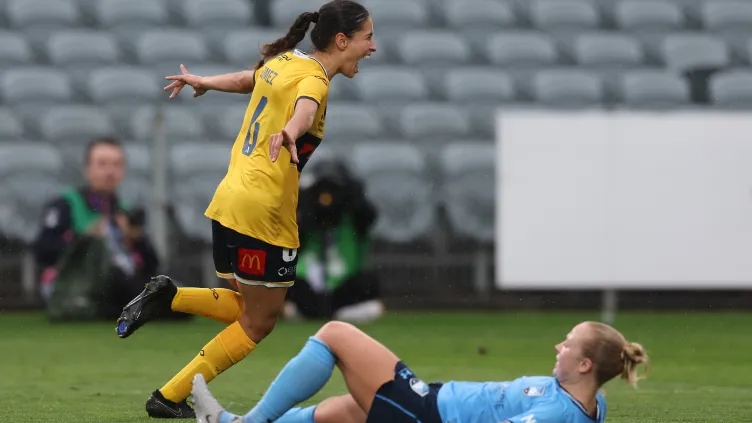
Above: Impetus’ Player of the Month for March, Izzy Gomez. Photo: Central Coast Mariners.
Each month, Impetus‘ team of writers and photographers who cover the competition will vote to decide their best player, head coach, and young player in the A-League Women. Here are the winners from March.
Player of the month
Izzy Gomez (Central Coast Mariners)
Izzy Gomez is the classs and the spark that takes Cebtrak Coast from “tough to beat” to “hard to stop” she is fast, combative and has an attacking streak that few central midfielders can replicate.
Gomez scores goals, sometimes spectacularly, but her workrate and pace mean that teams have to be on alert defensively when she has the ball or when they do. Gomez can pick your pocket, run half the pitch and slide it past the keeper.
She is currently the best player of her kind since Coates Wheeler was at Sydney FC and her return from injury has been a highlight of the last month.
A popular and likely recurring name in the Player of the Month category.
Young Player of the month
Alana Murphy (Melbourne Victory)
Above: Melbourne Victory’s Alana Murphy, Impetus’ Young Player of the Month for March. Photo: Melbourne Victory.
Following her Matildas debut in February, Alana Murphy has continued to be one of the dominant midfielders of the competition.
She patrols the Victory midfield with. Authority beyond her 19 years, screens the defence and is usually the first outlet for attack. Against Canberra United she was dominant and her absence was keenly felt against Newcastle when chaos set in after she was withdrawn with injury.
She always has time on the ball and her decision making is approaching an international standard. It is frightening that she will be eligible for Young Player of the year for many seasons to come.
Head Coach of the month
Michael Matricciani (Melbourne City)
Above: Melbourne City head coach Michael Matricciani who has guided his team to another sensational month. Photo: Melbourne City.
His side has completed yet another month of unbeaten results – extending their record-breaking run. But this time there is an additional achievement that Matricciani has guided his side to.
On 22nd March, his City team played the first ever Asian Champions League match on Australian soil, against Taiwanese side Taichung Blue Whale, and clinched a semi-final berth with a 3-0 win. This success sets up a semi-final against Korea Republic outfit Incheon Red Angels on 21st May.
On domestic duties this month, Matricciani coached his side to wins over Adelaide United, Brisbane Roar, and Wellington Phoenix on top of a draw against Canberra United.
Those achievements make Matricciani the first person to win an Impetus A-League Women monthly award more than once in a season.
Impetus‘ A-League Award Winners 2024/25:
November 2024:
Player: Tameka Yallop (Brisbane Roar).
Young Player: Sarah O’Donoghue (Perth Glory).
Head Coach: Alex Smith (Brisbane Roar).
December 2024:
Player: Laini Freier (Brisbane Roar).
Young Player: Tiana Fuller (Central Coast Mariners).
Head Coach: Michael Matricciani (Melbourne City).
January 2025:
Player: Leticia McKenna (Melbourne City).
Young Player: Alyssa Whinham (Wellington Phoenix).
Head Coach: Jeff Hopkins (Melbourne Victory).
February 2025:
Player: Chelsie Dawber (Adelaide United).
Young Player: Jessika Nash (Central Coast Mariners).
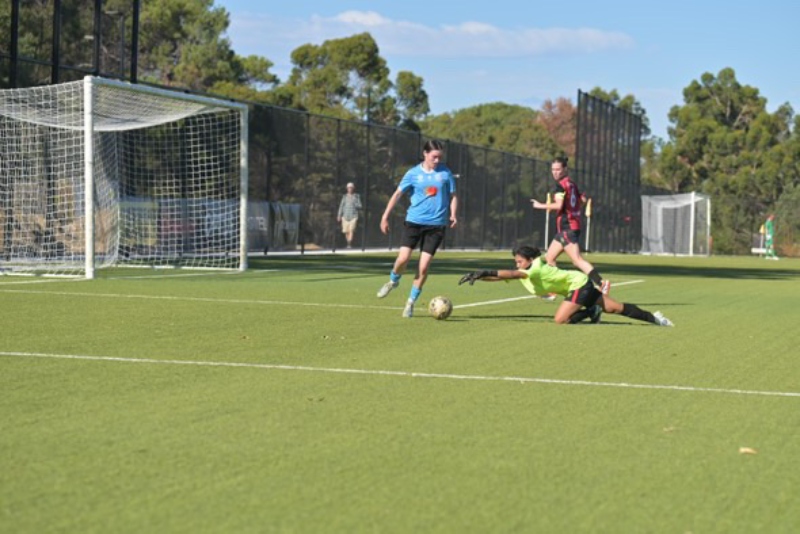
Above: Perth SC’s opening goal scorer Ruby Marshall (azure shirt) out to beat Murdoch University Melville goalkeeper Kaitlyn Mohan. Photo: Rob Lizzi.
After last weekend’s reduced set of opening matches due to extreme heat, this second round saw all eight sides in action for the first time.
However, before the Round Two action, one of last week’s postponed games was played on Monday night at the Sam Kerr Football Centre, and it produced an eye-catching result.
Hyundai Football West Academy (FWA, formerly Hyundai NTC) earned a superb 3-0 win over a Balcatta Etna side who a number of people believe will be pushing hard for championship and Top Four Cup success in 2025.
Pete Rakic’s side already have the Night Series Cup in their back pocket, but FWA took the honours in style with goals from Xuri Dalton, Nelli Johnson, and Sakura Leong.
Above: Xuri Dalton, who opened the scoring for Football West Academy against Balcatta Etna on Monday night. Photo: Football West.
Round Two
Fremantle City 2-2 Balcatta Etna
Week two of the action got underway on Saturday afternoon at Hilton Park with two sides looking for their first win of the campaign, despite being favourites for the top four this season.
Freo have shown in flashes what they are capable of across both the Night Series and during their opening week loss to fellow top-four favourites Perth SC. However, they face a devilishly tough set of fixtures across the opening month with the Football West Academy, and Perth RedStar ahead in the next fortnight.
For Balcatta, this was a chance to get back on the horse and make a statement against a tough opponent after Monday night’s setback at the Sam Kerr Football Centre.
It was the home side that hit the front with just five minutes played. Great work from American Leyna Wood in the build-up play along the right earned her side a corner. Abbey Green’s flag-kick came in high at the near post. Rebecca Bennett in the Etna goal pushed it up, but her defence were unable to clear sufficiently, and the ball fell for Alex Poad to direct goalwards with Janice Kiama pouncing to strike home from just outside the six-yard box.
Above: Janice Kiama (holding ball), pictured here during the Night Series, scored both of Fremantle City’s goals against Balcatta Etna on Saturday. Photo: Rob Lizzi.
Freo’s lead lasted just six minutes. Abbey Meakins lifted a free-kick into the left-hand side of the box from just over 25 yards out, which Jamie-Lee Gale picked up to start a scramble which was ended by Alyssa van Heurck sticking out a leg to direct the ball into the left hand corner of the net, with Megan Phillips wrong-footed in the home goal.
Balcatta completed their comeback just over 15 minutes into the second half from a Freo corner. Zoee Spadano intercepted a loose pass outside the area allowing her to break free and run into space. Up ahead, Lucy Jerram battled with Sophie Meaden, the only home outfield player back, allowing Spadano’s pass to roll into Gale, who ran in unopposed to round Phillips and calmly place the ball into the net.
However, it proved not to be enough to win all three points. With seven minutes left, the impressive Wood raced into the Balcatta box for a one-on-one with Bennett in the Balcatta goal, but van Heurck got back superbly to block at the cost of a corner.
Siah’s resulting flag kick came in high from the right which made it hard for Bennett to claim, and rising highest towards the back post behind the keeper was Kiama to nod home her second.
In tough, hot conditions, this was an excellent game between two good sides. Balcatta may well rue that late equaliser that left them with a haul of one point from a possible six – albeit having faced two very good teams to open their campaign.
For Freo, this will give Sam Geddes’ charges confidence as they look to push on in the coming weeks. They may well need to find more cutting edge upfront as the weeks go by, which could well prove to be the difference in their vital matchups against top-four rivals across the season, but the spirited effort and fight back bodes well.
Above: Theodora Mouithys, who scored Football West Academy’s equalising goal at Perth RedStar. Photo: Football West.
The Football West Academy continued their outstanding start to the season with a come-from-behind win at the death away to champions Perth RedStar.
The teenage side were trailing into second-half stoppage time before last-gasp goals from Theodora Mouithys and Klaudia Houlis sealed an incredible win.
This victory was the FWA’s second win against a team likely to be established in the top four come the end of the campaign in just six days, after they dispatched Balcatta Etna earlier in the week.
All the goal action was condensed into a thrilling last 13 minutes of action. RedStar hit the front when Renee Leota pounced on a loose control from FWA goalkeeper Sofia Borg on the right-hand edge of the six-yard box. Leota turned a low pass for Caitlin Doeglas, who saw her first shot blocked by Daniella Santich, but her second was dispatched into the far corner of the empty net.
Nine seconds into stoppage time at the end of the game, Sakura Leong’s attempt at a tackle ricocheted through for teammate Theodora Mouithys to race ahead into open space and calmly dispatch the ball past Gabby Dal Busco to level the scores.
Three minutes later, Leong hit a perfectly weighted ball from inside her own half to release Lacey Hayes on the left. She broke forward but saw her shot blocked by the onrushing Dal Busco, only for the ball to fall for Klaudia Houlis, who got in ahead of a would-be tackler to shoot into the right-hand corner of the net.
UWA-Nedlands 2-6 Subiaco
Above: Subiaco’s Cass Harvey, who scored two of her side’s goals in another strong personal performance. Photo: Denyse McCulloch.
Subiaco produced a clinical display of attacking football to claim their first victory of the season in their opening game at UWA-Nedlands.
With their Round One game against Murdoch University Melville postponed due to extreme heat last week, Greg Farrell’s team shook the cobwebs off in style against the home team who built a 2-1 lead over Perth RedStar last week before succumbing in the second half.
UWA-Nedlands took the lead in this one as well. With just five minutes on the clock, Emily Dinsdale showed her quality on the right, and the ball went on to find Samara Riches at the back of the 18-yard box, who fired high into the net.
Subi levelled just under a quarter of an hour later. Tayna de Almeida Campos was fouled around 30 yards from goal, before dusting herself down to play the resulting free-kick high into the box. A back header came across for Kim So Yi to direct in at the left-hand post.
The visitors took control with a spell of three goals in less than 15 minutes before half time.
With 34 minutes on the clock, Cass Harvey found de Almeida Campos, who raced through and clipped a finish high into the net. Five minutes later, it was 3-1 as So Yi broke along the right and played in Harvey in the centre of the box to side foot home. Then, two minutes into stoppage time, de Almeida Campos found So Yi, and the 29-year-old midfielder from Korea Republic fired home from the right-hand side of the box.
UWA-Nedlands have been a side that never gives up and always look to create since they came into this league in 2024, and they showed that again by reducing the deficit just after the hour mark. Isabelle Dadswell played a ball over a defender for Melina Franklin who held off Greta Bailey and hit a low shot from the left-hand edge of the six-yard box.
Subi had the final say with another rapid burst of goals – two in as many minutes this time. With 14 remaining on the clock, Harvey strode purposefully through and slotted under the advancing home keeper Janina Sauer. Then, shortly afterwards, Harvey began a similar move before spreading play to the left for So Yi to hit a low effort, which Sauer parried, but de Almeida Campos was in the right place at the right time to score.
Above: Perth SC celebrate their opening goal at Murdoch University Melville. Photo: Rob Lizzi.
Murdoch University Melville 0-3 Perth SC
The Azzurri ran out comfortable winners at Besteam Stadium on Sunday afternoon thanks to goals from Ruby Marshall, Tamsyn Hannan, and Sam Mathers.
After seeing their opening round match against Subiaco postponed due to extreme heat last weekend, this was MUM FC’s first competitive hit out of the new season.
Tom Glavovic’s side were pressing hard from the very start. Any time the hosts looked to play out from the back, they were immediately put under huge pressure which was constant, and gave MUM only rare chances to break out of their own half. Perth were relentless, calm in possession.
With nine minutes played, Daisy McAllister broke through to get one-on-one with MUM goalkeeper Kaitlyn Mohan who saved.
Just three minutes later, the visitors hit the front when Ottobrino found Marshall on the edge of the box with a perfectly judged pass that dissected the Murdoch defence. Marshall was able to advance into the box with ease and slot home with aplomb.
Perth were creating a stack of chances, showed great energy and creativity in the heat, but were just not able to transfer the possession, territory, and shots on goal dominance onto the scoreboard.
Above: Perth break through at Murdoch University Melville. Photo: Rob Lizzi.
The second half was only 42 seconds old when the home side were reduced to 10 after an off-the-ball incident. From here, MUM looked to play the offside trap that bit more often in a bid to both break the game up and reduce the flow of Perth chances.
With 19 minutes remaining, Perth finally got the second goal that their dominance deserved. Marshall picked up possession on the right and fed the ball to Sam Mathers inside her who advanced and laid off a pass for substitute Hannan to fire high into the net.
Ten minutes later, it was three as Mathers’ claimed a stunning Olimpico from a corner on the right.
The visitors had chances to extend their lead further – one such attack saw a 20+ pass movement from inside their own half, which ended with a shot going narrowly wide.
There will be positives for the home side to take from a tough first game of the campaign – they worked incredibly hard and on the occasions when Sadie Lawrence was able to direct traffic and Ellis Glanfield got forward, they showed that they will be confident of picking up points to avoid a repeat of the challenges of 2024.
Ladder Round Two
Perth SC P2 Pts 6 GD: +5
Football West Academy P2 Pts 6 GD: +4
Subiaco P1 Pts 3 GD: +4
Perth RedStar P2 Pts 3 GD: +2
Fremantle City P2 Pts 1 GD -2
Balcatta Etna P2 Pts 1 GD: -3
Murdoch University Melville P1 Pts 0 GD: -3
UWA-Nedlands P2 Pts 0 GD: 7
Round Three Fixtures
Saturday: Hyundai Football West Academy v Fremantle City, UWA-Nedlands v Perth SC. Sunday: Perth RedStar v Subiaco, Balcatta Etna v Murdoch University Melville.
Above: Kiewa Hieda for Western United. Photo: A-Leagues
Western United has tightened its grip on fourth spot of the A League Women’s ladder after a 2-0 win over the Newcastle Jets this afternoon.
The visitors controlled much of the match, and although it took them a while they eventually did score their goals through Catherine Zimmerman and Kiewa Hieda. The result also ends Newcastle’s hopes of making the finals, with the Jets no longer able to bridge the gap between themselves and the top six even if they win all their remaining matches.
In blustery conditions up in Newcastle, the match started as a free flowing affair, with both sides generating decent chances. However, as the first half progressed, Western United started to wrestle control of the match, and started to bank some solid minutes in their attacking third. They were also not afraid to shoot from distance, with the likes of Chloe Logarzo willing to pull the trigger and test the keeper.
Newcastle did certainly have its moments of attacking promise – with the likes of Libby Copus-Brown and Laura Allan being particularly dangerous – but as hard as that pair were working, a well ordered Western defence meant that their efforts came to no avail.
Neither side could get a goal on the board in the first half, but considering how dominant in position Western United had been, Newcastle probably would have been the happier of the two sides with that scoreline at the main break.
However, Western United did not take long into the second half to finally put a goal on the board – less than five minutes – with Zimmerman backheeling the ball into the back of the net after a mad scramble on the goal line. This was the spark of something for Zimmerman, who was a lot more influential in the second half than she had been in the first.
Another visitor who was also starting to become influential was Sasha Grove, who despite in an official sense was playing at left back, was in reality actually playing more like a winger and creating a lot of attacking energy for her side. Despite now finally having that much deserved goal on the board, Western did not drop their intensity, continuing to push hard for a second goal.
With their season now really on the line, Newcastle made an interesting first substitution in the 66th minute, replacing Natasha Prior with Sherridan Gallagher. Although it did seem to give them an initial boost, it ultimately did not give the side its desired outcome in the form of any goals. Western’s second goal came with about a dozen minutes to go when Hieda tapped the ball into the back of the net to convert a Zimmerman cross and further cement the lead.
Perhaps aware of the situation the game was now in, Western United went into game conservation mode after that.
WESTERN UNITED (4-4-2): Lincoln, Grove, Maher, Mihocic, Medwin, Logarzo, Dehakiz, Eggesvik,Hieda, A.Taranto, Zimmerman. Substitutes: Dall’Oste, Sardo, Ibarguen, de Domizio, M.Taranto.
Above: Central Coast celebrations. Photo: A-Leagues.
Central Coast Mariners have taken the points in a thrilling 2-1 win against Brisbane Roar at Industree Group Stadium this Sunday evening. The win has solidified the Mariners 5th place ranking, leaving them just one point away from claiming their place in the Ninja A-League finals.
This highly anticipated match was as exciting as expected from the start, with Laini Freier opening the scoring just 25 seconds in, putting Brisbane Roar in a dangerously early lead.
While Central Coast was quick to fight back and regain possession, a high press from Brisbane made it difficult for the hosts to find any real dominance, in what is already a contentious and physical game.
Brisbane found quite a few early opportunities, getting close to extending their lead just minutes in. A strike from Pringle tested Mariners keeper Sarah Langman, followed quickly with a second shot from Freier that ended too high, keeping the mariners on their toes as they fight for points in this crucial meeting.
A lost opportunity for Brisbane Roar to take a two goal lead came when Popadinova took and missed a free header that was just off target, much to the disappointment of the visiting side.
While in form, it seems that the Mariners side may have been shaken by Roar’s early lead, as they were unable to create any real opportunities, and appeared quite nervous on the ball. That was until Central Coast Mariners equalised with a fantastic solo goal from Izzy Gomez, who gained possession in the midfield, running the ball from the halfway line to the box and shooting directly to the back of the net as Richards was off the line.
Gomez’s goal shifted the momentum, instating a new energy into the hosts, as the match was now anyone’s game, after it seemed to be leaning in favour of Brisbane.
Another run from Izzy Gomez, passing to Peta Trimis, almost put Central Coat in the lead, and although Trimis’s strike was ultimately too high, it was enough to shake a confident visiting side.
There was no lack of action or aggression in the remainder of the first half, with the Mariners taking most of the big chances, however, the scoring was left even at the break, with no more goals to be found.
The impetus did not deplete at the top of the second half, with both sides desperate to take the lead, although it did take quite a while for any opportunities to be created, a far cry from how the game opened.
Brisbane took back the dominance in possession, but could not make a goal of their efforts, despite a few good chances, notably from Deborah-Anne De La Harp, who had a series of attempts early into the second half, none of which could be finished.
The 72nd minute, saw a strike from Annalise Rassmussen put the Mariners in the lead, as the tension of the match hit its peak, marking Rassmussen’s 6th goal of the campaign. The two goal lead was not satisfactory for the hosts however, as they continued to capitalise on any and all opportunities that arose, in search of a third.
The shift in energy for Central Coast appears to be largely due to a triple substitution, with Tiana Fuller, Leia Puxty and Tess Quilligan coming on in place of Jade Pennock, Peta Trimis, and Brooke Nunn, which bought a sense of unity in the midfield that was absent for the majority of play until this point.
Brisbane Roar got dangerously close to equalising when a shot from Tanaye Morris, went straight to the hands of Sarah Langman , foiling what would have been a crucial goal for the Roar, as stoppage time approached.
After four minutes of added time, and as string of last-minute opportunities at both ends, neither side was able to find the back of the net, as Central Coast Mariners came away victorious with a 2-1 win in what was an exhilarating and crucial match.
The meetings of Round 22 will come with immense pressure, as the 2024/24 Ninja A-League season comes to a close in the coming weeks. Central Coast Mariners will host Melbourne Victory at Industree Group stadium in what will be an exciting battle against the current second place holders. Brisbane Roar will also head home to take on Western Sydney Wanderers as they fight to gain any last minute points they can, as the final rounds approach.
Central Coast Mariners (4-4-2): Langman, Nash, Martin, Gomez, Pennock, Galic, Ray, Rasmussen, Rowe, Nunn, Trimis Substitutions: Carmichael, Fuller, Quilligan,
Above:Holly McNamara (left) is congratulated by Leticia McKenna after her goal. Photo: Melbourne City
A Holly McNamara goal, her 12th of the season, has given Melbourne City a vital win away to Wellington Phoenix and maintained their lead at the top of the table with two games left to play.
City arrived in New Zealand in strong form, a 3-0 win the previous weekend in the Asian Champions League was followed up by a 4-0 thrashing of Brisbane Roar on Wednesday. With second placed Melbourne Victory closing in, another win here was crucial and would maintain a five point gap between first and second spot on the ladder.
Wellington needed a win to maintain any mathematical chance of reaching sixth place on the ladder, and even in the best case scenario would need other results to go their way. Still they began in aggressive style. Emma Main’s cross from the right almost set up Olivia Ferguson for the opening goal. The header flashed wide.
City played their usually possession game and looked to build through the midfield or Lourdes Bosch on the right wing. Wellington had some success in crowding the centre of the pitch rather than trying to press high up the pitch for the visitors to play through.
This made for a combative midfield tussle. Annalie Longo and Laura Hughes both looked to exert their influence and for the opening half hour, the strikers from either side were isolated.
The breakthrough came on the 35th minute. McNamara volleyed home the cross from Bosch with instinct and technique. The shot took Carolina Vilao by surprise, but was perfectly directed to beat the Portuguese goalkeeper.
McNamara would have two clear chances to double the lead. First after winning possession and shooting just moments after scoring, and again with a second half penalty that Vilao was equal to. The save lit up the home crowd and gave Wellington some added inspiration for the second half.
For the last 20 minutes of the game, a Wellington equaliser looked likely and may have been deserved. The Phoenix were pushing for a goal, maintained attacking pressure and delivered a series of promising attacks, but they were missing the cutting edge or composure to finish them. The introductions of Alyssa Whinham and Mebae Tanaka added some pace to the side, but neither was able to really test Malena Mieres.
For all their positive play, Wellington’s best chance of the match came in the first half when a corner kick looked to be headed directly for the net, only for City to scramble clear with the desperation of a side hungry for a second successive premiership.
It bodes well for City in the remaining matches of the home and away season. They can win with style, or grind out a result, and when it matters, luck is falling their way.
City next host The Newcastle Jets in a game that could possibly seal the premiership, while Wellington continue the fight with a trip to face Canberra United.
Above: Brian Sorensen in training. Photo: Everton Women.
Following the highs of a big win over Crystal Palace last weekend, Brian Sorensen’s Everton face a different challenge on Sunday as they face third-placed Manchester United.
After picking up the win last weekend, Sorensen said that his side “are all in good spirits” at the moment. He added that “we gave them two days off after that game because it was a Saturday game and now we play Sunday, so I think they also enjoyed that.”
Looking ahead to tomorrow’s match against Manchester United, Sorensen highlighted the squad that United manager Marc Skinner has at his disposal: “[Manchester United] have a very good team…some really good young players in it, but also some really experienced ones.”
Speaking further about his opponent, Sorensen picked out keeper Phallon Tullis-Joyce for particular praise, admitting that he believes the Reds’ American goalkeeper “has done exceptionally well”.
Everton have been able to match top teams fairly well this season, however Sorensen reiterated that because his side is now better resourced than they were earlier in the year, the team is now “in a different place in terms of how we can approach the game.”
“For example the game plan, but also what does it look like in the last 30 minutes or 15 minutes of the game, depending on different scenarios and so on. So we feel more prepared to take the teams above us on.”
As much as all the talk around Everton recently has been the new signings in attack, one of the side’s best players in their win over Crystal Palace was defender Sara Holmgaard.
“I think Sara’s just been consistent now for a long period of time, which wasn’t the case in the beginning with the injuries she had,” Sorensen said.“We know her qualities. She has a good engine. She can go up and down and she has a really good left foot, but in the box, she’s a threat on the header. So yeah, I would like to have her delivery, but I also want to have her in the box. But she showed both last weekend, so that’s good.”
Above: Sara Holmgaard for Everton. Photo: Everton Women
One thing that has been much talked about with the Everton side this season is its ability to adapt, but Sorensen was very adamant that “It’s not going to be any different from us in terms of we have a game plan and we see opportunities where we also can hurt them.”
“Of course we know our defence have to be at our best and we have to be very concentrated for the full 90 minutes because if we give them a bit, they will take advantage of it.”
Everton make the short journey to Manchester on Sunday. Kick off is at 12pm at Leigh Sports Village, and the match will be televised on BBC iPlayer in the UK.
Above:Mary Stanic-Floody celebrates her goal, which put Canberra United 2-0 up from the penalty spot today. Photo: A-Leagues.
Perth Glory’s comeback effort fell just short as they were defeated 2-1 by Canberra United at Sam Kerr Football Centre.
Despite a second-half goal from Tijan McKenna, the hosts couldn’t find an equaliser, and Canberra ended their winless streak with an important victory between two sides looking to break into the top six.
Perth were looking to build on their recent strong form, and with the visitors enduring a tough six-match winless streak, the hosts were determined to take full advantage of their strong record on home soil. The Glory had extended their unbeaten run to three games following a 1-0 win over Western Sydney Wanderers, and were eager to continue their momentum against a Canberra side struggling to find their momentum.
The Glory didn’t waste any time, with Kelli Brown firing the first shot of the match, a long-range attempt that was comfortably gathered by Canberra keeper Sally James. Perth’s Megan Wynne then won a free kick after being fouled. Captain Izzy Dalton stepped up, but her delivery failed to trouble James.
Canberra responded with a corner kick of their own, where Mary Stanic-Floody, known for her dangerous shots from distance, unleashed a strike that threatened but was cleared by Perth’s defence. Things then took a concerning turn when Glory’s Nat Tathem went down clutching her knee, forcing an early substitution that left the Western Australians without one of their strongest players of the season.
Perth continued to press and nearly found the breakthrough as the ball pinged around the goalmouth, but it was cleared to safety. However, it was Canberra who struck first. Stanic-Floody delivered a well-placed ball to the league’s all-time leading goal scorer, Michelle Heyman, who made no mistake in putting the ball past keeper Casey Dumont.
The visitors then doubled their advantage shortly after when Tijan McKenna fouled in the penalty area. Stanic-Floody stepped up for the spot-kick and, in her 50th A-League appearance, made it 2-0, sending Dumont the wrong way.
As the match settled into a quieter phase, both teams struggled to find any rhythm in attack. With just six minutes remaining in the half, Glory’s Georgia Cassidy won another free kick, but the opportunity came to nothing. Sarah O’Donoghue tried to line up McKenna, but James was equal to it once again, keeping her clean sheet intact. Grace Johnston then made a strong run down the right flank, only to see her shot narrowly miss the mark.
With no further chances, the whistle blew for half-time, and the players headed into the break to cool off, not just from the scorching Perth heat but also the intense emotions of the opening 45 minutes.
The second half set off in the same intense fashion, with Heyman going down in the box and being awarded a penalty. Bethany Gordon faced off against Dumont but sent the ball too high and missed the mark, much to the relief of the Perth crowd.
Perth’s luck finally turned in the 60th minute when Tijan McKenna fired a shot into the net, bringing the Glory back into the game and reigniting their hope of a chance at making the finals. Eyes were again on McKenna as she darted towards goal and laid it off for Brown, who was unable to keep her shot low enough to find the net.
Having only spent a short amount of time on the pitch, Susan Phonsongkham had an attempt at leveling the score, but couldn’t generate enough power on the ball to trouble James. At the other end, Canberra came close when Darcey Malone created a chance that rolled across the face of goal, but no one was there to tap it in.
Perth fans were left holding their breath once again when a ball delivered by Izzy Foletta found a purple shirt in the box, though the shot rebounded off the woodwork and was quickly cleared by Canberra’s defence.
Despite their best efforts, the home side couldn’t find an equalizer, and the match ended 2-1 in favour of Canberra. The victory provided them with a crucial boost in their own finals chase.
Perth now need to beat both Sydney FC away and Melbourne City at home on the final day to have any hope of making the top six – but after this defeat, the gap is now five points, which makes it almost impossible to make up.
Canberra United will now have another huge game in the finals race against a fellow top six hopeful next week when they play host to Wellington Phoenix.
Above:Nikki Flannery (right) celebrates her late winner for Melbourne Victory against Adelaide United today. Photo: A-Leagues.
A late goal from Nicki Flannery has kept Melbourne Victory’s Premiership hopes alive after defeating Adelaide United 2-1 at AAMI Park today.
The South Australian side were forced into a change just before kick-off, with their starting keeper Claudia Jenkins, who recently declared for New Zealand, getting injured during warm-up. It led to a debut for 16-year-old Ilona Melegh between the sticks for the Reds.
After an uneventful first half, Victory broke the deadlock when Flannery converted her first for the night with a world-class finish from the top of the 18-yard box with just over 20 minutes to play. Jessica Young, in her second appearance for Victory, provided Flannery with the assist.
Adelaide found themselves back in the game when Victory striker Emily Gielnik gave up an unnecessary penalty by raising her arm and getting hit with the ball from a free kick delivery.
The penalty, taken by Dylan Holmes, was perfectly executed, hit with power and sending keeper Courtney Newbon in the wrong direction.
With the score levelled and less than four minutes of regulation time left to play, Adelaide kicked the intensity up a notch.
Unfortunately, the tactic change left them exposed, allowing Victory the opportunity to find their second and winning goal for the afternoon.
In a moment of swift redemption, Gielnik ran onto a wide ball, taking it to the touchline before sending in a well-timed cross to meet the head of Flannery who was positioned on the penalty spot.
All Flannery had to do was redirect the ball on target, which she did with ease, securing Melbourne Victory all three points and keeping them within reach of the Premier’s plate.
For a superb set of the images from the game by Impetus’ Beck Hartley, check out our Instagram page @ImpetusFootball
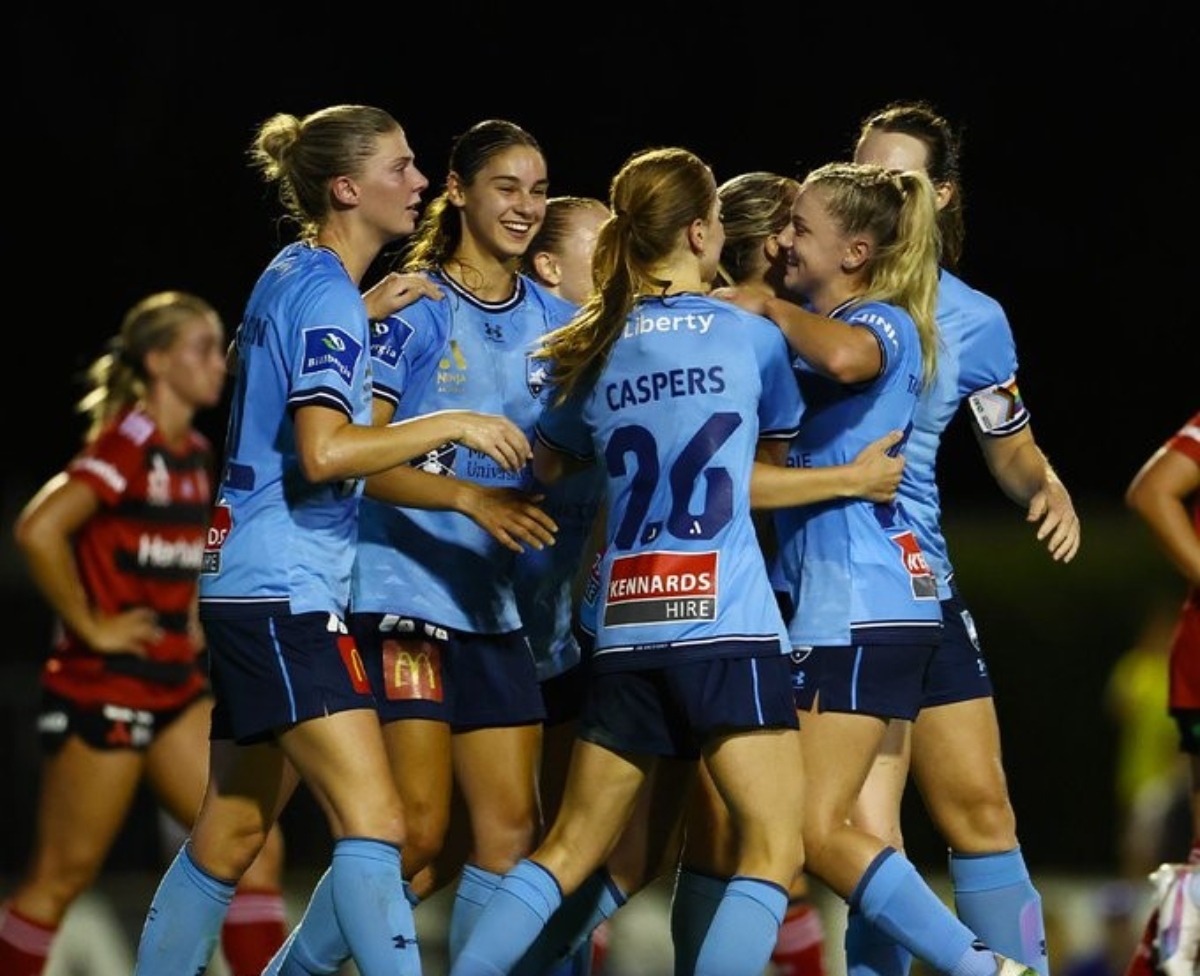
Above:Sydney FC celebrate after Indiana dos Santos (second left) put her side 2-0 up in the derby tonight. Photo: Sydney FC.
Sydney FC’s hopes of clinching what, for so long looked to be a highly unlikely place in the Finals, are firmly on thanks to this success in the Sydney derby at Marconi Stadium tonight.
A penalty from Mackenzie Hawkesby in first-half stoppage time and Indiana dos Santos’ strike with just over 25 minutes to go sealed the Sky Blues’ third win in their last four games, with the latter also claiming the record as the youngest ever scorer in a Sydney derby.
It was dos Santos who was the standout player in an attacking sense in the first half. She forced Sham Khamis into the first serious save of the match and then saw a power blaster of an effort go wide.
The 17-year-old was also involved in the build-up to her side’s opening goal three minutes into additional time in the opening half. Her corner from the right fell for Maddie Caspers who looked to beat Amy Harrison, only for the Wanderers defender to handle in the box.
Mackenzie Hawkesby stepped up to power the ball down the centre and beat Khamis in the Wanderers’ goal.
Sydney kept up the momentum in the early stages of the second half. Just three minutes in, Caley Tallon-Henniker advanced along the right flank and held off her opponent well to step back and feed Hawkesby behind her. The attacker burst into the box, leaving would-be tacklers in her wake to hit a powerful shot that went into the side netting.
Above: Mackenzie Hawkesby (right), who put Sydney FC 1-0 up from the penalty spot, looks to escape from Western Sydney Wanderers’ Amy Chessari. Photo: Sydney FC.
Five minutes later, Bronte Trew was released with a superbly weighted low pass through the midfield, which rolled perfectly into her stride to advance into the box, and just held off two defenders to release a shot that was well saved by the outstretched foot of Sydney keeper Jasmine Black.
Sydney hit back strongly with Millie Farrow showing her influence after coming on as a sub. First, the English striker saw an effort go high over the bar after being found by more excellent wing play from Tallon-Henniker. Then, she squared the ball off to Princess Ibini positioned 25 yards outside the area, to the left of centre. Ibini’s first-time shot came crashing off of the crossbar.
The second goal finally came after 64 minutes. Wanderers coughed up possession trying to play out from the back, allowing Farrow to break forward towards the left-hand post before laying off perfectly into the path of dos Santos to fire first-time high into the far corner of the net.
Wanderers tried to rally, and with a quarter of an hour remaining, with Trew central to their remaining opportunities. First, her shot rolled agonisingly against the right-hand post. Then, Sophie Harding played a glorious one-touch side-footed pass with the inside of the boot into Trew’s path centrally in the box, but the shot went frustratingly wide of the left-hand post.
With two minutes remaining, Western Sydney spurned their final chance. Madison McComasky played in Trew, who had her back to goal, and on the turn, placed a shot well wide of the right-hand post.
Whilst Sydney left Marconi Stadium with the points, it could have been a different story had the Wanderers been able to be far more accurate in front of goal. The creativity was good, the finishing less so. It will now be extremely difficult for them to avoid the wooden spoon this season.
The Sky Blues now return to the Harbour City for their penultimate game of the home-and-away season against a Perth Glory side who, on one hand are yet to win on the road this season, but on the other, should they defeat Canberra United tomorrow, will set up next weekend’s match as a virtual elimination final. Sydney then face a tricky trip to Adelaide United on the final weekend.
Above: Marc Skinner and Ella Toone. Photo: Manchester United
Manchester United face a much-changed Everton in the Women’s Super League this Sunday. Ahead of the game, head coach Marc Skinner has been talking about his fear of The Toffees’ “unpredictability”.
This weekend, Manchester United face a resurgent Everton. The Toffees dismantled Crystal Palace 3-0 in their last run out, with goals from Kelly Gago, Justine Vanhaevermaet, and Sara Holmgaard. Recent games have also seen them beat Aston Villa 2-0, with goals from new signing Maren Mjelde and Japanese International Honoka Hayashi. Between September and December, the club scored six goals in the WSL; since January, they have scored fifteen. Under new ownership, the club made six significant signings in the January transfer window, and this investment is paying off.
Above: Everton celebrate their win over Villa. Photo: Everton Women
Since January, Everton’s goal scorers have come from across the pitch, with an unpredictable attacking shape meaning opponents need to adapt throughout the game. Referencing this unpredictability, United head coach Marc Skinner declared that his team are prepared for the possibility of facing different shapes. He added that although the Toffees tend to “give you space”, United will “have to be really focused” to manage their unpredictable attacks.
In the media, there has been a relatively rare week of positivity for Skinner. Ella Toone, arguably United’s most recognisable player, spoke about the support she has felt from her club coach throughout the most difficult season of her career. Following the loss of her father last September, she experienced her first major injury as a professional player, ruling her out of contention for both United and England for two months.
Speaking to the Daily Mail, Toone said: “Throughout the hardest part of my whole life, he was there, and he got me through it. I know that his door’s always open, and I can have an honest conversation with him and ask for advice, but also, if I need a shoulder to lean on, I know that I can lean on him”.
In an era where news coming out of either Manchester United team (men’s or women’s) is rarely positive, this was a welcome story for Skinner. Although he says that this kind of heartwarming message from one of his players is harder to deal with personally than the criticism that comes with his job, he added that he is “so, so proud of the way she has been able to deal” with the last few months.
This also comes at a time when there has been the occasional story about player distress at Manchester United. In an Instagram post in February, Brazilian forward Geyse wrote “staying in a place where we don’t feel happy is an agonising and lonely feeling. Every day seems heavier, and the simple fact of being there becomes a burden”. The club have consistently denied that there is a negative environment around the women’s team, and Skinner shared his hope that Toone’s comments will “tell the truth about the environment and about me as a person”.
Above: Geyse celebrates. Photo: Matt Appelby
The head coach was also asked about how he is planning to help players navigate the complex months leading up to a major international tournament (this summer’s European Championships), whilst maintaining their attention at club level. Skinner highlighted the importance of good relationships with teams from the national set-up; the head coach alongside their sports science staff. “I talk with Sarina before and after every camp”, he shared, adding that they “have a good relationship”.
The next few weeks are make-or-break for United’s season; although they are currently seven points ahead of Manchester City in the third Champions League place, they also have the toughest run-in. In their final weeks, United face West Ham, Manchester City, Chelsea, and Arsenal. Whilst most focus is on the final three games against the rest of the top four, the two games against resurgent Everton and West Ham are vitally important to maintain the difference to their cross-city rivals.
In a boost to United fans’ hopes, Skinner shared that barring long-term injuries (Evie Rabjohn) and suspensions (Gabby George), the entire squad is fit ahead of Sunday’s game.
Manchester United v Everton kicks off at 12:00 GMT on Sunday and will be streamed live on BBC iPlayer in the UK. Australian coverage will be on Optus Sport.















 impetusfootball.org