Above: Nanako Sasaki breaks through for Adelaide United in today’s game. Photo:Adelaide United.
Finals hopefuls Adelaide United and Western United shared the points in their battle at the Marden Sports Complex today.
The home side took an early lead through Erin Healy. The American international took off down the left flank on an individual mission and wasn’t interrupted by a single defender on her way, before stepping into the centre and firing from the top of the box.
The curling right-footed shot made its way into the top right corner, out of reach of a diving Chloe Lincoln.
Western United had multiple opportunities to equalise during the rest of the first half, with chances falling to both Kahli Johnson and Captain Chloe Logarzo.
They finally found a goal just after the hour mark through their American Catherine Zimmerman.
The former Melbourne Victory star’s close range effort was shot with strength behind it that had it hitting the back of the net before Adelaide United keeper Claudia Jenkins could even react.
With the points shared, Adelaide United remain in third on the table, while Western United sit just outside the top six in seventh place.
Teams: ADELAIDE UNITED (3-4-3): Jenkins, Tolland, McNamara, Tonkin, Leon, Morgan, Sasaki, Hodgson, Dewey, Dawber, Healy. Substitutes: Karambasis, Mullan, Bowler
Scorer: Healy 9’.
WESTERN UNITED (4-2-2-2): Lincoln, Grove, Maher, Dehakiz, Sardo, M. Taranto, Eggesvik, Logarzo, A. Taranto, Zimmerman, Johnson. Substitutes: De Demizio, Roach
Above: Renée Slegers addresses the media ahead of Sunday’s match against ChelseaPhoto: Arsenal FC
Arsenal manager Renée Slegers acknowledged what Sunday’s top of the table clash “means for fans and players” and described how Arsenal is going for the win whilst also admitting her respect for Chelsea.
Slegers addressed the media this afternoon ahead of Sunday’s top of the table clash against Chelsea.
Arsenal currently behind Chelsea in the WSL table and, therefore, all eyes are on their upcoming face off. In addition to gaining three points, Arsenal fans hope that their team will end Chelsea’s unbeaten streak.
According to Slegers, Arsenal is “aware of the threats” that Chelsea has. Specifically, she mentioned their strong upfront players and the way that they’re “goal directed” in and around the box. In response to this, the Gunners will have to be “disciplined” in their “defensive structure”.
Furthermore, she highlighted the opportunistic nature of Chelsea when she said: “they are a team that when they get chances in the game, they are likely to take them, I think that is one of their big strengths; when they get momentum, they capitalise.” This attack-driven gameplay will require Arsenal to have “high concentration levels all the way through”. A particular focus will be on the first 15 minutes which have been noted as being “important” when staff have broken down previous games “into 15-minute blocks”.
Slegers also reflected on the last time Arsenal faced Chelsea, which resulted in a victory for the Blues. She highlighted that their “momentum” then was different as they had just lost to Bayern Munich away.
Expanding on this, she said: “I and the players have a big belief in what we’re doing at the moment”. They recognise “how good Chelsea is” but will “go for the win”.
Despite this belief, Slegers acknowledged that the game will be tight with physical battles and shifting momentum. She said that the team “don’t expect to win every game”, emphasising that they are “very humble for every task”. They are being “realistic about the opposition and their strengths” and they “want to take this game and approach it as any other game”.
When expressing her “respect” for Chelsea, Slegers also admitted her admiration for their manager, Sonia Bompastor. She said that the manager is “really trying to get the best out of that team”.
Beyond this, Slegers spoke on the significance of having two female managers, who are currently managing the best two teams in the country, go head-to-head. She described how it “says something about the opportunities given and how different federations are working to get more women into top roles in football”. This evidence of female managerial talent is also a testament to the increasing “opportunities for women in sport in general”.
Speaking on her own players, Slegers confirmed that Caitlin Foord and Lia Walti will be back in the squad following their absence at Wednesday’s Brighton game. She said that they were “both on the pitch today” and that their removal from Wednesday’s squad was simply a precaution.
Wednesday’s match against Brighton also saw Slegers utilise different players, one of which being Rosa Kafaji. Speaking on Kafaji and her performance, Renee said that she sees her “as a very good player for now and for the future of Arsenal”. She highlighted the positive qualities that Kafaji brings to the team, including deep runs, dribbling and strong 1v1 battles.
One player who scored on Wednesday, and has impressed as of late, is Alessia Russo. When asked about the striker, Slegers said: “I’m very impressed with who Alessia is as a person, she’s just a very good person. She cares for everyone and her teammates, cares for staff, treats everyone with respect.” The manager also highlighted the hard work she puts in on the training pitch, highlighting that “she’s a great player to work with”.
It was Wednesday which also bought Kyra Cooney-Cross’ first official Arsenal goal. Slegers described the Matilda as “an excellent player” mentioning that younger players can “need some time to adjust” when moving to a club like Arsenal. She highlighted that Cooney-Cross has “invested a lot of work” and that this has led staff to be “very happy with her” and “the level that she’s performing at now”.
Questions were also asked about the young Arsenal players who have recently been loaned to Championship League clubs. These are Laila Harbert, Vivienne Lia and Madison Earl. Slegers said that the club try to find what’s “best for these players in the short term and long term” and that it’s good for the young Gunners to “go out on loan and get some minutes”.
Above: Perth Glory co-captain Izzy Dalton speaking to the media yesterday at the club’s Fremantle HQ. Image: Perth Glory.
by Ben Gilby (24/1/25)
Perth Glory co-captain Izzy Dalton insists that her team’s determination to right the wrongs of their performance away to Brisbane Roar can be the deciding factor when the two teams meet again at the Sam Kerr Football Centre on Sunday.
“Our performance away at Brisbane wasn’t great – we fell short majorly and we didn’t look in the game, but we’re well aware of that, we haven’t shied away from it,” she admitted.
“Leading up to this game, we’ve tried to put a lot of things right in training and I think we’ll go out there and put on a much better performance that we did (at Perry Park earlier in the season), and, of course, it’s my former team so you want to play well and you want to win!”
The Glory go into this encounter without a win in six games, with their latest reverse coming 4-1 at Western United on Tuesday. Despite this, Dalton points to the fact that the team’s run has largely been the consequence of small margins rather than consistently poor performances. As a consequence, confidence in the group remains strong.
“We’ve managed to keep the vibe really high, but we know the results have been really disappointing this far. I don’t think that’s changed the way we think and what we are capable of achieving.”
“If you look at our results, when we’ve lost games, it’s been 1-0 and conceding off set-pieces and stuff like that. Some of the defeats we’ve had have been really narrow. Except Western (United on Tuesday) and at Brisbane Roar earlier on in the year, they have been the only defeats that we have had that have hurt us majorly.
“The rest of them have been close games and that’s what we take into the second half of the season where we know we can compete with a lot of the teams.”
Above: Izzy Dalton curls in a shot at home to Central Coast Mariners earlier in the season. Photo: Rob Lizzi for Impetus.
Whilst Brisbane Roar have been among the leaders on the ladder for all of the season, they are currently on a sticky run of results themselves, with three defeats in their last four matches. It’s a statistic that the Perth co-captain believes makes now a great time to face the Roar.
“Like any team in the league, at some point, other teams start to figure other teams out and maybe that’s been the case for them.
“It’s come at a great time. We’ve obviously come off the back of a few losses, and so have they. They’ll be up for it and so will be we, but I think it’s come at a good time to play them.”
“We know it’s hard for teams to travel across the country to play in Perth, so we have to use that to our advantage.”
The positive vibe of Dalton’s discussion also extended to matters surrounding her own fitness, with the news that she is recovered from an hamstring injury that has impacted the number of games that the English born player has been able to play.
“It didn’t come with great timing with the amount of injuries we have in the team, but during my time on the sidelines, we did win, and that’s important and I’m proud of the group for being able to do that.
“We do have a lot of strength in other ways, and we’ll begin to see that in the coming weeks when we have players coming back in training and playing games – we’ll start to look a bit stronger.”
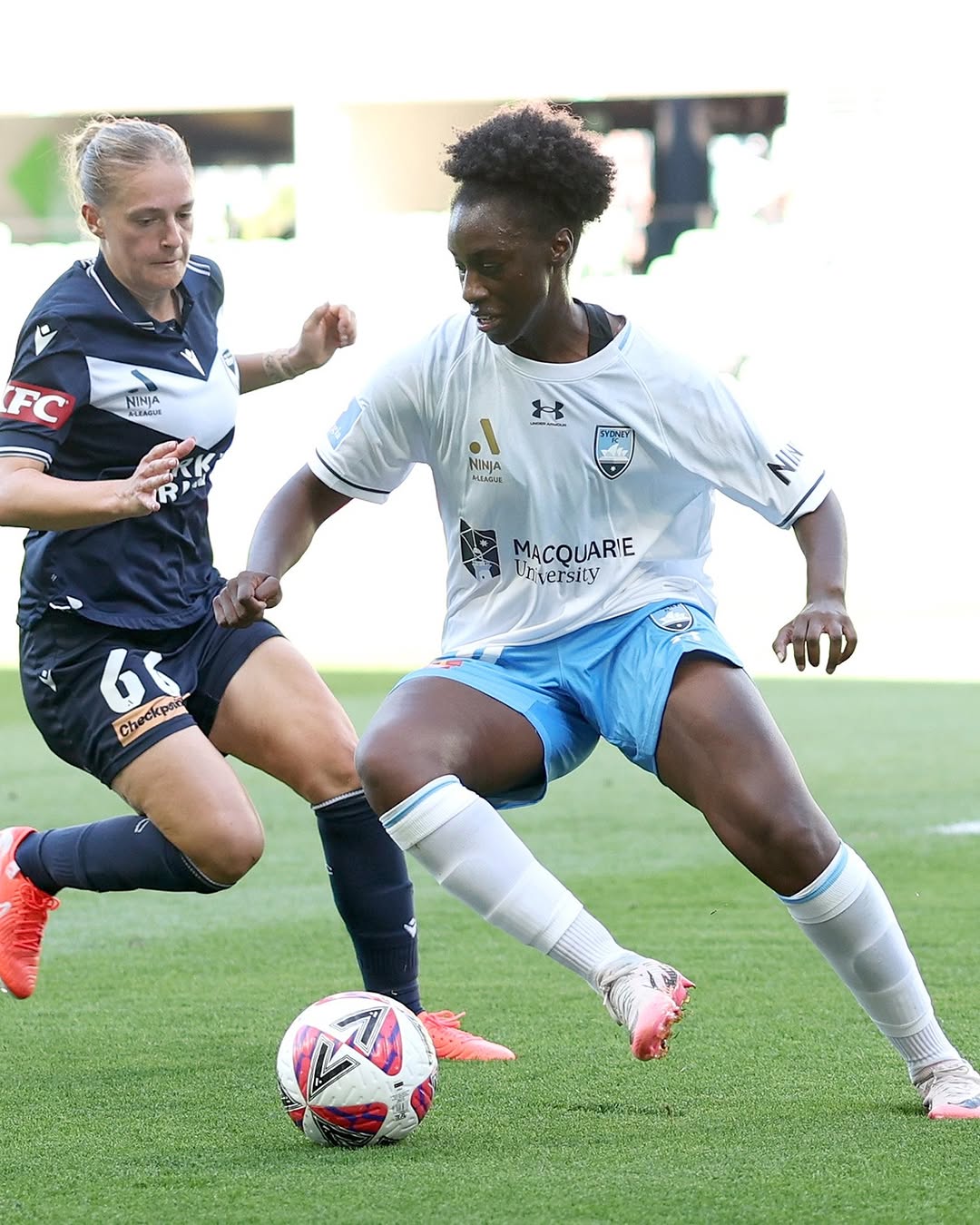
Above:Goalscorer Alana Jancevski (blue shirt) and Princess Ibini challenge for the ball.Photo: Sydney FC.
Melbourne Victory go top of the ALW table following a 2-0 win over Sydney FC in The Big Blue. A brilliant Alana Jancevski free kick and a goal from Holly Furphy on debut give Victory their third consecutive triumph against Sydney FC.
Melbourne Victory was quick to make their mark in the game and Jancevski was the one to do so. It what will be considered one of the goals of the season, Jancevski rocketed home the opener from a tremendous direct free kick from into the top right corner that gave Brianna Edwards minimal chance of saving. It was fitting that a childhood Melbourne Victory fan was the one to open the scoring in The Big Blue
Sydney’s first real response to the goal was on the 40th Minute. Princess Ibini’s cushioned header placed the ball into the path of Caley Tallon- Henniker. Her first touch set up the volley but the eventual attempt on goal was dragged pass the post. Tallon- Henniker again was Sydney’s brightest spark in the first half soon after but her effort at the near post was simple for Courtney Newbon to deal with.
Sydney started the second half brightly, having plenty of the possession and looked threatening. Indiana Dos Santos tried the remarkable and attempted to score directly from a corner just before the hour mark, but Newbon punched away emphatically. Margaux Chauvet also found herself close to scoring her first ALW goal but her effort inside the box was always rising over the bar.
The closet Sydney came to goal came when Mackenzie Hawkesby’s corner was met by Natalie Tobin. Tobin headed into the path of Abbey Lemon who was lurking in the six-yard box. Lemon made good contact but was somehow denied by the shoulder of Newbon,
Immediately following Sydney’s best opportunity to equalise, Melbourne Victory wrapped up the game and it was another Melbourne native on the scoresheet. Rachel Lowe’s outside of the foot through ball found the debuting Furphy. Furphy rounded Edwards, remained composed and finished to seal all three points and take Victory to the top of the table.
To view Beck Hartley’s EXCLUSIVE photo gallery from the match for Impetus, check out our Instagram page @ImpetusFootball
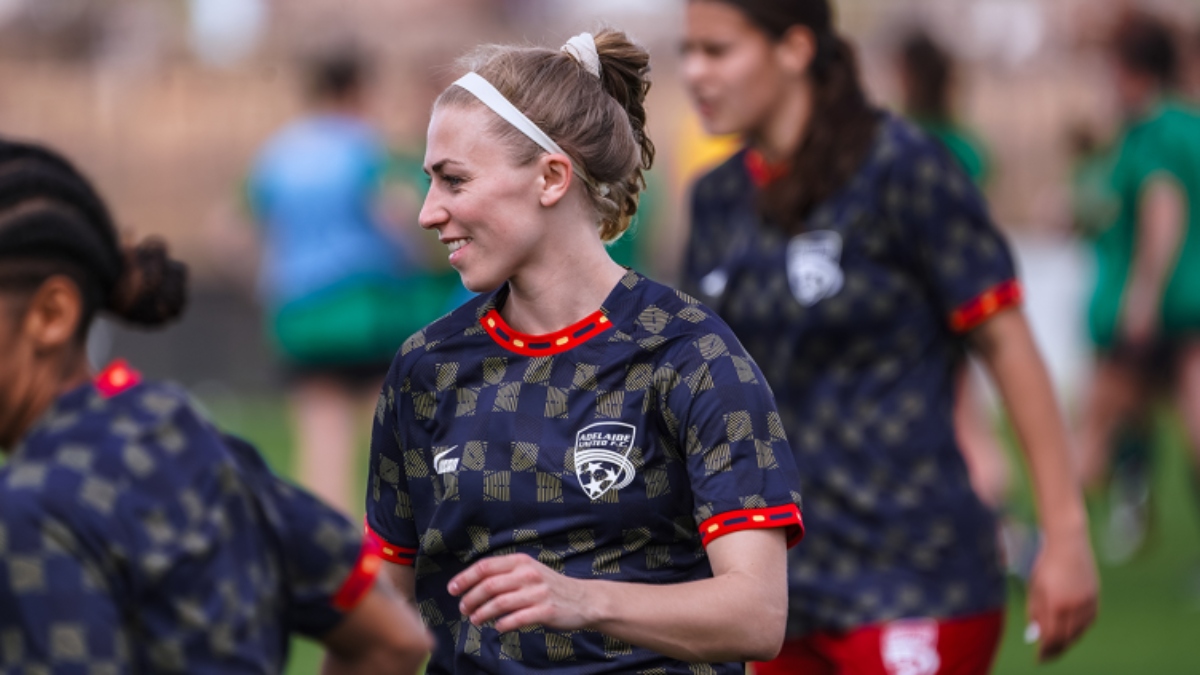
Above:Fiona Worts pictured during training this season. Photo: Adelaide United.
At the end of last season, Adelaide United’s English striker Fiona Worts was at a crossroads. She admitted to Impetus in an exclusive interview that she was considering turning her back on footballbefore she recognised that what she both wanted and needed was a return to her “safe space” – Adelaide United.
“I was leaning towards not playing at all,” Worts told me. “But then I realized that everything I wanted—being around people I cared about and living in a safe place—was in Adelaide. So, I ended up reaching out to Adelaide quite late in the day, and everything just fell into place from there.
“I knew I needed to go home after my time in Sydney, and was planning on staying in England. I just wanted to go home. I was at home, thinking I would stay there, I had a great time reconnecting with people, and it was really important for me. After seeing everyone, I decided I didn’t want to stay and play there, and I even considered not playing at all and staying home.
“By the end of last season, I was very clear that the decision I made had to feel right. I wasn’t willing to sign a contract that didn’t feel right. It wasn’t just about the value of the contract or the league it was in, but also things like housing and other personal factors that were important to me at the time. When I looked at everything as a whole, I didn’t really have anything on the table that met all those needs.”
Until the striker realised that what she really wanted and needed was a return to South Australia and she’s absolutely thriving there once more.
“There have definitely been a lot of ups and downs over the last five years that I’ve been involved (at Adelaide). So there’s probably a shared feeling among many of the people who’ve been through all of that—they just want to enjoy it.
“At the start of the season, there wasn’t as much focus on how well we would do in terms of league standings. It was more about creating a supportive environment where everyone could enjoy themselves. When that’s the case, you can just see what happens. I think that’s where we’ve thrived in the past—when the environment is great, everyone enjoys being around each other and playing football together.
“You can see it when people are playing. So, I think there was definitely a sense of that coming back in, and it felt a bit different from when I left.”
Above: Fiona Worts celebrates with Chelsie Dawber in Adelaide United’s win at Newcastle Jets this season. Photo: Adelaide United.
One of the integral parts of the supportive atmosphere is the Reds’ head coach Adrian Stenta who has created a tight squad who have known each other for a long time, and the bond is tight as a consequence, as Worts asserted.
“There are a lot of girls here who have played with each other for a long period of time. When you go through those tough periods, you want to make sure it’s better for everyone involved. Some of the players who have come in have really bonded well with the girls who are already here, and I think that can make a big difference.
“They’ve definitely added to that. I think everyone is close, really happy for each other, and wants to see each other succeed. I think that often comes from the top as well. The coach creates that environment and drives the idea that we’re a team. We’re going to do it together, go out there, do the best we can, and see what happens.”
Worts’ footballing journey began in the Midlands region of England at the Centres of Excellence at Notts County, Nottingham Forest, and Leicester City. She takes up the story.
“I stayed with Leicester City for a while during my senior years. They weren’t playing at higher levels back then, so I had the chance to witness their rise and played in a few different leagues with them.
“For a couple of seasons, I would return to Leicester just for home games, getting the train down from Leeds where I was at University. Then I came to Adelaide in 2016-17 for a year abroad and ended up playing some NPL here and that’s when I decided, after returning home, that I wanted to try and step up to higher levels.
“I signed with the Guiseley Vixens, who were in the English National Premier League, which was the third tier at that time. I did a season with them while I was still at university, and then I had the opportunity to go back to Leicester City and join them playing in the Championship (tier two).
“It was semi-professional football, so I wasn’t getting paid, but at least it was moving towards a more professional level. I spent a season with Leicester City but was released after that year, which caught me by surprise. I ended up going to Coventry United where I played just over half a season before returning to Australia in the middle of the year.
“After my year abroad, I knew at some point I was coming back to Australia, to Adelaide. I just knew it was going to happen, though I had no idea when, why, or how. Then, in July 2019, I got released from Leicester. It was really close to the season starting, and that same weekend, I was told I had to leave my job if I wanted to keep playing.
Above: Fiona Worts in action for Adelaide United against Canberra United in 2020. Photo: Adelaide United.
“So I was immediately looking for a new job and moving clubs. I wasn’t really settled in anything. It’s quite funny—I’d gone to Norway to visit a friend I’d met during my year abroad in Adelaide, and we were mid-conversation, talking about how I was considering going back to Adelaide.
“Then I received a Facebook message from someone who was part of Adelaide Uni at the time I was there and had gone to Fulham United (in the NPLW SA). They asked, ‘We’re looking for a striker. Would you be interested?’ I replied, ‘Yes, I think I would.’ And everything sort of worked out from there. That was in December 2019, and by March 2020, I was on a plane.”
Worts’ first spell at Adelaide United coincided with the club’s most successful period in their history which culminated in a first spot in the Finals. It was a period that the attacker looks back on with huge pride.
“I think it was great. It was my first time playing in a professional league, and it was an amazing experience. Travelling around the states, especially as an international player, was fantastic because I hadn’t seen many of these places before. We had such a great team, and I think our squad as a whole was strong.
“Many players had waited their turn and suddenly had the opportunity to start week in and week out. They had been playing together for a long time, and everything just came together.
“It was great to be in that professional environment for the first time. I also got to see players moving on to play in Sweden and elsewhere, including American and Dutch players—people from all over the world coming here to play. I had never really witnessed that side of football before, and I think it broadened my perspective on what football could offer. It was definitely great to be a part of that.”
The success of that period, both collectively and personally gave Worts the opportunity to make the move to one of Australia’s most successful clubs, Sydney FC. Looking back now, it was a bitter-sweet experience for her.
“As an international player, it was pretty exciting to live in Sydney. It was one of those things where I thought, as a 10-year-old, could I ever imagine playing professional football in Sydney? The club has such a rich history and a great reputation, so I felt quite honoured to have the opportunity to play for a team like that.
Above: Fiona Worts (sky blue shirt) in action for Sydney FC against Brisbane Roar last season. Photo: Brisbane Roar.
“Sydney is very different from what I’m used to; it’s probably not quite my style. I actually enjoy the slower pace of life in Adelaide. But, for a period of time, it was a great experience. I met some wonderful people and had the chance to be part of a championship-winning team.
“I also played with some amazing players, including Cortnee Vine, a Matilda with so much experience, as well as a number of other players who have their own wealth of experience.
“I really enjoyed playing under Ante (Juric, Sydney FC head coach). He kept football quite simple in some ways. The sessions were straightforward, and the game plans were relatively easy to understand. You would go out and play, with a strong focus on work ethic and effort. It was a good environment. He could be tough when needed, but at the same time, he was very supportive.
“I think he made me tougher and more relentless. It wasn’t the kind of team where you would take extra days off. If you were tired, you worked harder. I think that’s a good mindset to have. In the modern game, there’s more emphasis on loading and taking care of yourself, which I think is great. But sometimes, it makes you check yourself and think, ‘Maybe I can push myself a bit more.’
As Worts completed her season at Sydney, she then made the move back to England. Once she realised that Adelaide was, indeed her “happy place” both personally and professionally, her return to the Reds has brought about an impressive run of form for both the player and her club.
“There’s optimism, and I don’t think there’s as much pressure. It’s not too hard to do better than it was last year, and I think that’s where it started. You just want to make sure it’s better, and once you’ve done that, it’s about keeping going—how far can it go? So, I think it’s the positive atmosphere, with people wanting to be better and going out to play football as well as they can, one game at a time.”
That approach has seen Adelaide continue to build, and as we stand on the brink of the second half of the season, the Reds are strongly placed for Finals football. That’s a real target for Worts and her team.
“I think, for me, finals definitely seem feasible. Sometimes you have games where you think, ‘Yeah, we could have a shot at the championship,’ and then other times, you have a game where you’re like, ‘I don’t know, maybe getting into the top six is a more realistic target.’ But I don’t know.
“For me, it’s just a game at a time—trying to pick up as many points as we can. The table is so hard to read at this point in the season. As you see every year, teams that pick up points early on, and in fact, it’s even happened with us, where we pick up points in the first five or six games, and then drop off. I think the main thing is not to do that—not to settle, thinking you’ve already achieved what you set out to do but to just keep trying to see how far you can take it.”
Above:Sharn Freier (left) and Laini Freier for Brisbane Roar.Photo: Brisbane Roar
Sharn Freier spoke to the media following the announcement she will be joining Wolfsburg at the end of the season.
The Brisbane Roar and Matildas attacker has been signed by the European giants, but will remain in Australia to complete the Roar’s current campaign. The move continues the exciting rise of the Queenslander who has gone from the A-League and NPLW to the Olympics to the Fraun Bundesliga in the space of 12 months.
Brisbane COO Zac Anderson was thrilled for Freier and The Roar who will receive a club record fee for a women’s player, although he emphasised that the exact number would remain undisclosed.
“It’s been an amazing journey for Sharn,” said Anderson to the media.
“We are super excited for the club to make this announcement.
“Full credit to a number of people. Obviously firstly to Sharn and her dedication to keep growing and keep developing her game, but also to the man on her right Alex Smith who has helped her over the last 18 months to progress her game.
“Theres a bigger story here for Australian Football. We’ve got one of our own, a Brisbane product who has come through the NPLS system into the professional ranks.
“We are just really proud to announce Sharn’s move to Wolfsburg and we’re looking forward to seeing Sharn’s journey as she makes the move in July.”
Frier in her her fourth season with Brisbane after initially joining the club in 2020. Her impact gradually increased over the following season’s culminating in her playing 22 games in 2023/24 and scoring three goals.
The stats do not to her justice though. Freier is an aggressive, unpredictable and dangerous winger whose dribbling style and explosive pace can put defenders off balance and leave them hesitant to make a challenge. She gives herself time on the ball and uses it to create havoc either from the start or off the bench. Freier’s performances for the national team have seen her compared to Cortnee Vine and Hayley Raso, and she was dominant in the last national team match against Chinese Taipei.
Despite her obvious talent, Freier is taking nothing for granted. She was a much pursued player and fielded offers after the Olympics, but knows she will have to prove herself at one of the world’s top clubs.
“I’m just going over there to give it everything I’ve got,” Frier told the media.
“I don’t really expect anything to be honest. I know it’s going to be a very big challenge for me.
“Obviously it’s the next level… I’m just going to put my head down and work hard. If I get game time that is the goal, but I’ll put my head down, work hard and see what happens.”
Finishing the season with Brisbane was something Frier felt strongly about. Not only are The Roar in strong trophy contention this season, but for the first time she has been able to play professionally with her sister Laini. The twins have combined for nine goals in the first half of this season. In the meantime Frier can focus on success in the current campaign and begin German lessons.
“Wolfsburg were very accommodating to that,” said Freier.
“I think the season we’ve had so far and this team we’ve got at the club are very special.
“I got to play with her (Laini) for the first time and I didn’t really want to cut that short.
“We’ve got a really good team here… hopefully we could go all the way . I want to be a part of that so I’m really grateful I get to stay and make the move after.
“I’m just trying to push myself a little bit further and see what happens when I get to the Bundesliga.”
A move to Italy was a possibility following the Paris Olympics, but Freier was hesitant to take the leap. Instead she was signed to a two year deal by Brisbane which has ended up netting the club a transfer fee. Something still rare but increasing in the A-League Women. Anderson said that the club intented to reinvest that fee into the women’s program.
“I wanted to take my time,” reflects Freier.
“It’s quite a big move, I’ve never done something like this before, I wanted to make sure it was perfect and Wolfsburg was definitely hitting that and I was obviously very excited about it… I couldn’t turn it down.”
Brisbane Roar coach Alex Smith is a strong promotor of Queensland Women’s football. The Former Peninsula Power coach and Melbourne City assistant says that the talent was obvious when he arrived at the club, and that Freier’s hard work should be the blueprint for others in the competition.
“For her to get a move to a club to Wolsburg it’s a really big thing,” said Smith.
“I could not be happier or prouder of her, I know how much work she’s put in, you go through injuries and all that sort of stuff.
“I don’t know if theres been a better move from a young player in the league in the last 10 years or since the league has been formed.
“To go to a club like Wolfsburg is something that’s fantastic and should be the blueprint for the rest of the players in the league.
“I’m proud to be a very small part in Sharn’s journey. We wish her all the best, but we’ve got a bit to do before then.”
Above: Grace Maher, scorer of Western United’s second goal.Photo: Western United
Western United has put out a dominant display to pick up a 4-1 win over Perth Glory thanks to an own goal and strikes from Grace Maher, Melissa Taranto, and Aimee Medwin. Gabby Hollar did pull one back for the Glory late in the piece, but the Glory were well outclassed by their hosts.
Western United started pretty lively in the opening minutes, with Chloe Logarzo and Kahli Johnson in particular getting in dangerous positions.
The Glory were not without attacking momentum, but were for the most part struggling to connect with their forwards and work around the United defence.
Western United continued to rack up the ‘so close yet so far’ attempts on goal, going extremely close on a number of occasions but could not get one in the back of the net. Perth also had a couple of positive chances, but nowhere near as many as their hosts.
Mel Taranto was also starting to become really influential for the home side, creating a lot of drive through the centre of midfield.
Western finally got its reward just over the half-hour mark when after some confusion in the Perth defence Valletta accidentally guided the ball into the back of the net for an own goal.
United doubled its lead minutes later when Maher scored a wonderful Olympico from her corner kick, and all of a sudden the scoreboard was matching what was happening on the field.
The home side continued to maintain control of the match and keep attacking the goals, but ultimately could not add to their lead before the halftime whistle went.
It was pretty free-flowing proceedings to start the second half, but it was Perth who got closest to scoring a goal in the opening exchanges of the half, but ultimately the Glory were unable to convert any of their chances. Western was also not afraid to bring the aggression with its play, with a number of Perth players finding themselves on the deck after falling victim to a well-timed Western bump.
The hosts then added to its advantage with about 20 minutes to go after Mel Taranto snuck a shot into the bottom corner that originally looked like it was just intended to be a through ball but it ended up in the back of the net.
As the clock ticked down to its last 10 minutes, it did not look like Perth were going to be able to convert any of its chances, but out of nowhere, Gabby Hollar headed a ball on the line into the back of the net to peg one back for the visitors.
However United were quick to restore their three-goal lead when Medwin snuck a ball past Perth keeper Casey Dumont to truly put the final nail in the coffin of the result.
Teams: WESTERN UNITED (4-3-3): Lincoln, Sardo, Dehakiz, Maher, Grove, Eggesvik, M.Taranto, A.Taranto, Zimmerman, Johnson, Logarzo. Substitutes: Dall’oste, Roach, Medwin, De Domizio, Prakash.
Scorers: Valletta [OG] 34’. Maher 36 ‘, M. Taranto 71’ Medwin 87′.
Above: Manchester United celebrate one of their four goals. Photo: @ManUtdWomen on X
Rudderless Manchester City were taken apart by hattrick hero Ella Toone in an explosive Manchester derby
The race for top three is on
As the game kicked off, the race for a top three finish in the Women’s Super League (and therefore Champions League football next season) was on. In first and second place, Chelsea and Arsenal both won their first league matches of 2025 by large margins; Chelsea dismantling West Ham five-nil, whilst Arsenal won against Crystal Palace by the same scoreline. Heading into the evening’s Manchester derby, this provided an added pressure for both teams, with managers Gareth Taylor and Marc Skinner both needing valuable points to stay in the race.
Injury-plagued City needed a leader
Manchester City have been plagued by long-term injuries this season, and captain Alex Greenwood, Lauren Hemp and top scorer Khadija Shaw were all missing for this game. United were relatively healthy, with a minor knock relegating Grace Clinton to the bench for most of the game. However, City had been active in the transfer market – such as bringing in Vivianne Miedema – and whilst you will always miss players like Hemp, Greenwood and Fowler, it is arguable that they were still favourites to win the game.
Instead, their major fallback seemed to be based on leadership. As United stormed to a fiery start (scoring three goals in quick succession), City looked completely broken down, and nobody appeared to want to step up and lead the team. They were rudderless, missing Greenwood’s direction – either shouting orders or playing key passes through the midfield.
Above: Manchester City commiserate following the final whistle. Photo: @ManCityWomen on X
Individual mistakes changed the game
City had most of the possession and created many chances. They did not look bad going forward; Miedema looked energetic and Roord also had a few chances. However, defensively it was a horror show. In goal, Khiara Keating had an extremely unfortunate time, making two major mistakes that cost City goals. Her confidence looked shaken after United’s second goal, and it is here that City were missing Greenwood’s leadership – someone to pick up Keating and give her a word of confidence.
United picked up on this lack of confidence plaguing City’s back line and took every chance they could. They seemed to win every duel, went after every ball and there was a sense that United wanted the win more. Riviere dealt with Mary Fowler effectively, and the midfield trio of Toone, Miyazawa, and Janssen protected United’s back line well. In contrast, although they were impressive in an attacking sense, City’s midfield looked lost, with wayward passes and lazy interceptions (Fujino was the exemption to this).
One question that should perhaps be asked of Gareth Taylor is his lack of substitutes – two were made, and these came relatively late, on 76’ and 85’ minutes. City were fatigued by this point, and their frustration showed in some less-than-stellar decision-making.
Above: Ella Toone with her hattrick ball. Photo: @ManUtdWomen on X
Ella Toone, Hattrick Hero
Ella Toone has had a difficult start to the season and succumbed to injury in late 2024. Her return in the FA Cup match against West Brom was sealed with a goal, and during that game it looked like she was playing with a renewed sense of freedom. That feeling continued into the derby, and she was ferocious in her quest for goals.
A word also needs to be reserved for the unselfishness of Elisabeth Terland. Terland was in a position to shoot more than once, preferring an unselfish pass to a teammate (often Toone). Bizet had a lot of luck producing crosses from the left and put in a huge shift defensively. Tullis-Joyce produced some very good saves and dealt with set pieces and corners well.
United were not reliant on Toone, and this was the first time this season that they performed well as an entire team, with not one weak element.
What this means for both teams
City do not have to wait long for a chance at revenge, as they visit Leigh Sports Village on Wednesday to play United in the League Cup. However, tonight’s game was definitely the more important of the two meetings; United missed out on Champions League football this season and have to aim for a top three finish. With Chelsea still unbeaten and Arsenal gaining momentum under new manager Renee Slegers, it looks like the final spot will come down to a battle between the Manchester clubs, making these three points all the more valuable.
Teams: MANCHESTER CITY (4-1-3-2): Keating, Casparij, Aleixandri, Knaak, Ouahabi, Hasegawa, Fujino, Roord, Fowler, Miedema, Park. Substitutes: Blindkilde-Brown (for Miedema 77’), Murphy (for Park 85’), Yamashita, Annets, Davies, Prior, Coombs, Oyama.
Scorers: Miedema 40’, Knaak 45+3’
MANCHESTER UNITED (4-2-3-1): Tullis-Joyce, George, Turner, Le Tissier, Riviere, Janssen, Miyazawa, Bizet, Toone, Galton, Terland. Substitutes: Middleton-Patel, Sandberg (for George 65’), Malard (for Terland 65’), Clinton (for Toone 77’), Williams (for Bizet 85’), Mannion, Awujo.
Above: Veatriki Sarri being congratulated after scoring the equaliser in yesterday’s game against Aston Villa. Photo: Everton website
Everton managed to rescue a draw from the jaws of defeat, drawing 1-1 with Aston Villa at Walton Hall Park. Aston Villa dominated much of the game and it was rewarded with a first-half goal from Rachel Daly but Everton improved in the second half and found a 90th-minute goal from Veatriki Sarri.
Early in proceedings, Aston Villa dominated possession and time in the attacking half. The Villains also looked a lot more settled moving the ball forward towards the Everton goal than Everton did and had several positive chances on goal, but thanks to some excellent goalkeeping from Courtney Brosnan, those shots came to no avail.
Everton found themselves getting outnumbered on numerous occasions when moving into attack, and the midfield did not push up alongside the strikers quickly enough, leaving Toni Payne and to a lesser extent, Katja Snoeijs to take on four defenders and Villa goalkeeper Sabrina D’Angelo by themselves.
Another issue for the Toffees was their inability to contain the influence of Adriana Leon, with the Canadian able to switch from the right side to the left and back again and create a lot of headaches for Everton without any close marking.
Everton did have several chances on goal in the first half to varying degrees of accuracy, but ultimately they were not particularly difficult shots, and D’Angelo was able to defend them all with ease.
Just as things were starting to even out possession-wise, Daly was able to give Aston Villa the lead on the half-hour mark, managing to sneak a header past Brosnan and into the bottom corner.
As the half progressed, the same issues continued to plague Everton in attack. The Toffees were playing a low block in defence, meaning when they did go into attack they did not have the numbers to navigate past the Aston Villa defence successfully, and a lot of the time they were trying to move the ball with pace but were not doing so calmly and in a composed manner, and Villa were pouncing on the chaos.
The best player for the home side in the opening half was Brosnan. Her ability to keep out several tricky shots from Aston Villa meant that the score was only 1-0 at halftime.
Aston Villa continued to be on the attack early, seeming to continue where they had left off before halftime.
It did not take long for Everton to make their first set of changes, with Emma Watson, Kelly Gago and Melissa Lawley replacing Snoeijs, Toni Payne and Justine Vanhevermaet respectively after only nine minutes of the second-half action. This move seemed to have some positive effects straight away, with Gago lifting the energy of the attack on her debut.
These changes rejigged the shape of Everton’s formations, and the positive effects were clear to see straight away.
Everton were creating more dangerous chances in attack, and in defence the Toffees were also defending better, not letting the Villa midfielders have free reign that they had in the first half.
Someone who was starting to make an influence for Everton as the match progressed was Hayley Ladd, who had been a starter on her debut but as the game progressed she was being an important pivot point in the centre of the park for her side.
As the second half progressed, both sides continued to rack up the chances, but as full-time grew closer it was unclear if the scoreline was going to change.
However, this story was ultimately not quite done.
With 70 seconds left in regular time, Sarri – who had only come on just over 15 minutes prior – let a rocket of a shot go from the top of the box, which sailed past D’Angelo and into the back of the net for the equaliser.
Both sides continued to push for the winner in additional time, but it ultimately never came.
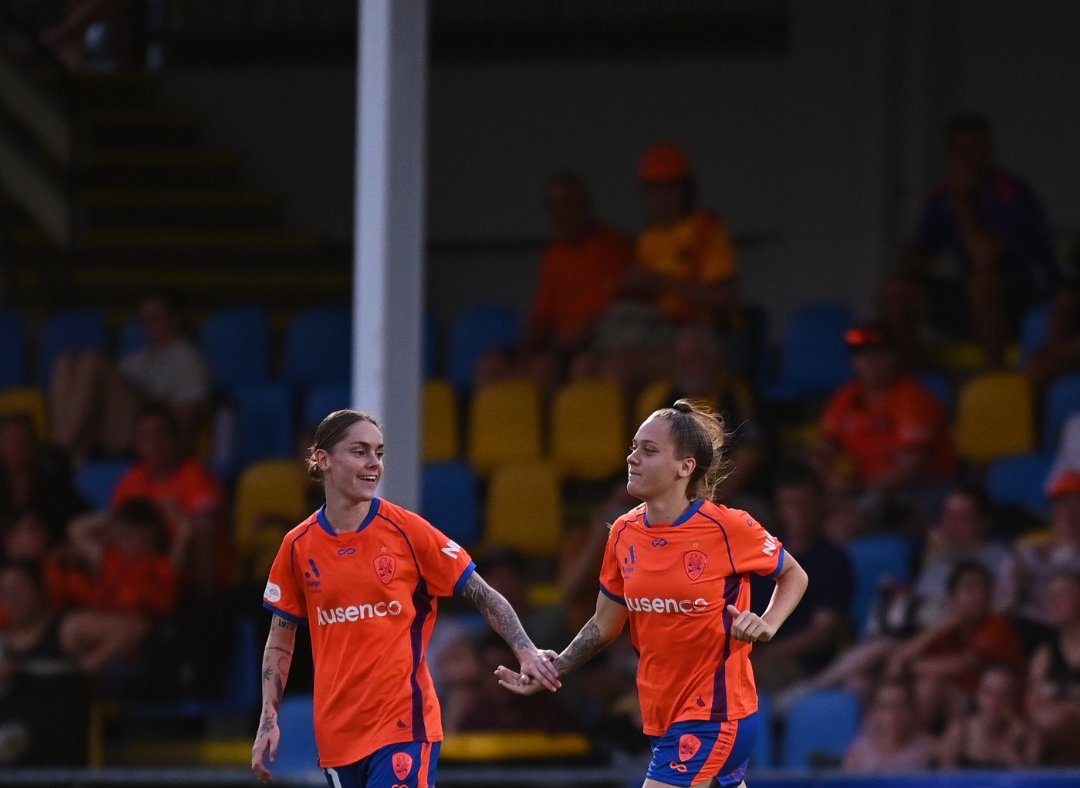
Above: Wellington Phoenix celebrate a goal in their win over Newcastle Jets today. Photo: Wellington Phoenix.
Wellington Phoenix has pulled off a remarkable come-from-behind win over the Newcastle Jets who were 2-0 ahead at half-time thanks to a brace from Sheridan Gallagher.
The Phoenix never gave up and thanks to goals from second-half substitute Manaia Elliott and captain Annalie Longo, pulled off the win.
It was a really free-flowing start to the match, with play flowing from one end to the other easily and both sides getting shots away early.
Newcastle did not take long to get on the board, when Gallagher pounced on a deflection to chip it into the back of the net merely three minutes into the match.
Interestingly though the early goal did not shake the confidence of the home side, who continued to pile on the attacking play, with Mabae Tanaka and milestone girl Alyssa Winham, making her 50th A-League Women appearance particularly dangerous.
However some well-positioned defending from Natasha Prior ensured that Wellington could not reap the ultimate benefit from any of its attacking moments.
For much of the early part of the first half, proceedings felt very even. Maya McCutcheon went within inches of getting an equaliser about 20 minutes after Gallagher’s opener, but her and Olivia Ferguson’s follow-up shot were both denied thanks to some brilliant saves from Danielle Krzyzaniak and a clearance off the line from Prior.
Gallagher picked up her second just minutes from halftime after going for a run and then skirting a shot around Carolina Vilao in the Phoenix net.
Interestingly, despite being two goals behind at half time the hosts were leading many of the key stats at the major break and by a fair gap too. These included time in possession, passing accuracy, and shots on goal.
Phoenix coach Paul Temple was not afraid to swing the changes at the start of the second half, bringing on Elliott and Emma Main straight away.
Elliott did not take long to make an impact on the match, heading in a well-placed Longo cross to peg one back for the home side. She almost had a second minutes later but found herself on the wrong side of an offside call. Main was also creating things in attack and things were looking more positive for those in yellow.
Elliott and Longo then swapped roles for Wellington’s second goal, as Elliott’s initial shot was punched away before Longo pounced and slotted the ball into the back of the net.
The Phoenix definitely had the momentum, but still needed to find one more goal if they wanted to take the maximum points away from this match.
Things got harder for the Jets when Deven Jackson – who had been at times lively for the visitors – was forced from the field after a heavy collision.
Both sides kept pushing to find the match-winner as the second half progressed, but Wellington racked up a lot more chances than their visitors did.
Just as regular time progressed and the eight minutes of extra time started to tick down, it was looking like the match may just end in a draw. But Elliott was not done with her score involvements for the afternoon, as she scored an absolutely brilliant Olympico to finish off the fightback and get the three points for the home side.








 impetusfootball.org