
by Ella McShane (11/11/24)
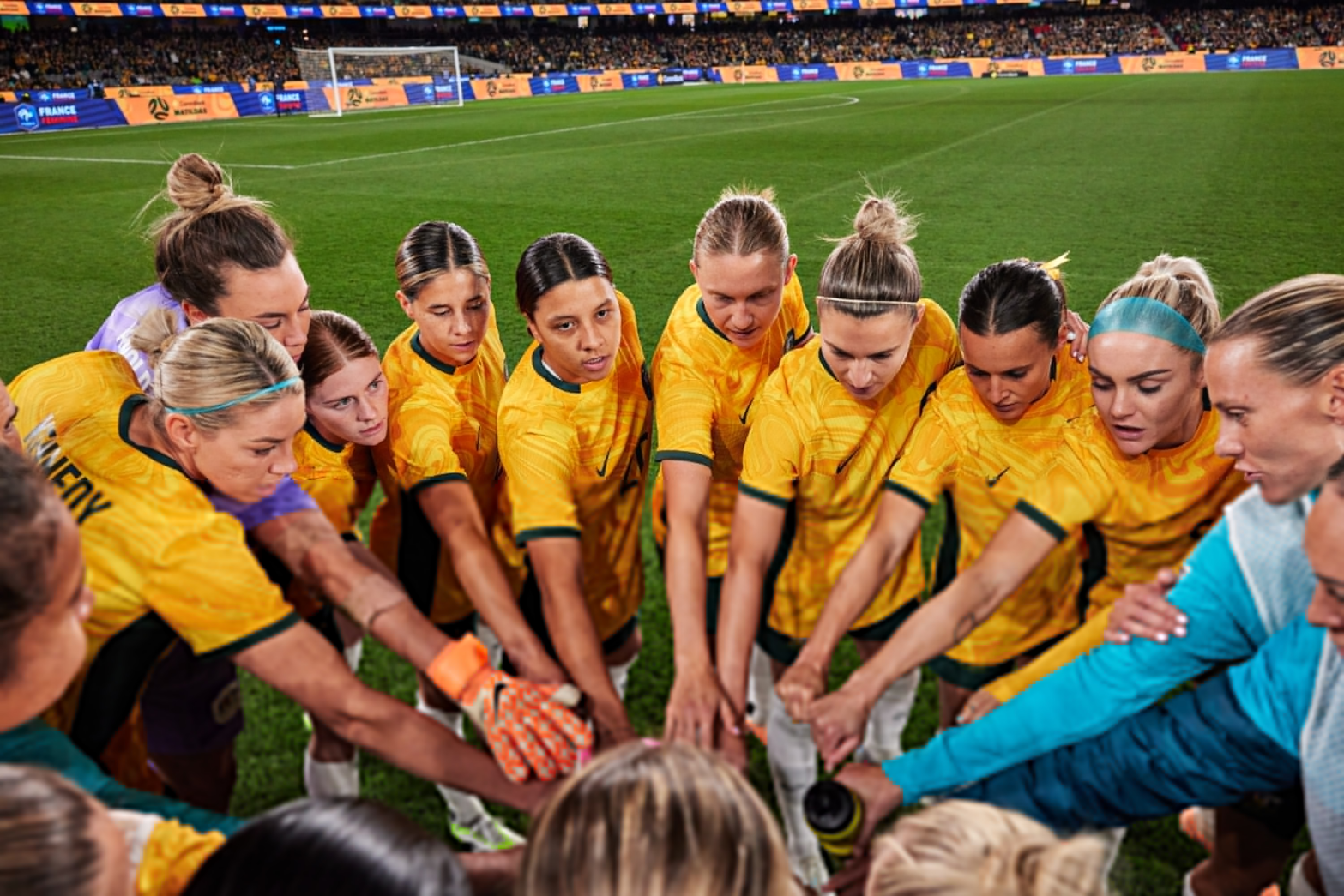
Above: The Matildas come together in the huddle. Photo: Football Australia.
The infamous penalty shootout, the crushing defeat inflicted by Sarina Wiegman’s Lionesses, the society-altering rise of women’s sport. The 2023 FIFA Women’s World Cup undoubtedly left an unprecedented legacy defined by love, loss, and a united Australia. Foord’s statement echoes the thoughts of millions of Australians when discussing the Women’s World Cup legacy.
“It’s something we never thought would happen in a million years.”
Matildas’ striker Caitlin Foord, discussing the legacy left by the 2023 FIFA Women’s World Cup on the Howie Games podcast
As spectator, I can only describe my commitment to the sport as something positive I get to experience in my life. However, now that I have been following the Matildas across club and country, for over a year, I am beginning to observe basic longitudinal sport psychology.
Although the impact of the World Cup was largely positive, there are still an unprecedented number of eyes on the squad. And unique to the women’s game, this all happened rather quickly. I can help but wonder has this put the Matildas under pressure that was grossly unprecedented?
When looking for the answer, I turned to sports psychology and came across two terms.
Social inhibition: “the tendency for otherwise apparent behaviours to be minimised in the presence of others” (Oxford Academic, 2016).
Social Facilitation: “an improvement in the performance of a task in the presence of others” (S. McLeod, 2023).

Above: A packed Stadium Australia supporting the Matildas during the 2023 World Cup. Photo: Ben Gilby.
To put it simply, does the presence of spectators increase negative anxiety within the athlete or does it fill them with the needed adrenaline to rise to the occasion. Whether or not an athlete experiences either one of these psychological phenomena depends on the nature of the sport and “the situation and the characteristics of the of both the athlete and the others present”. (L.Chareyre. et al, n.d.)
In the Matildas’ case however, you’ve gone from match attendances being described as an “11,271-strong crowd” one year to 18 months later, you’ve sold out Stadium Australia and 76,000 people have turned up to a friendly on a cold Monday evening. From a humanistic standpoint, it doesn’t take much empathy too understand how that sort of pressure, accelerating in that sort of time frame, would be an enormous task to rise to as an athlete.
What would go on inside your head both in your everyday and professional life? However, I am not a professional athlete, thus research within sports psychology is the only reliable source of explanation available. And like many issues and questions posed in the women’s game, this exact psychological phenomenon has yet to be specifically researched. Despite it impacting many female athletes, who are experiencing the rapid development of their respective games.
When we analyse the current state of any sports team, we draw conclusions from the results. During the World Cup, the Matildas earnt themselves the greatest ever Australian World Cup performance on paper. However, the results that have followed haven’t exactly “lived up to the hype”. With the team dropping from eleventh to fifteenth in the latest FIFA rankings released in August of 2024.
Therefore, posing the question, have they crumbled under the post-World Cup pressure and are now experiencing a form of social inhibition as a team? Many anecdotal explanations come to mind.
On the one hand, I believe some of the criticism the squad is receiving is warranted. There have been some games over the last 15 months that I can only describe as ‘lukewarm at best’. The football lacked confidence and the tactics did not seem to adapt well to an opponent. Who are the Matildas post World Cup?
On the other hand, I believe a large majority of the discourse surrounding this team was, at the time of the World Cup, ill-informed. This stemmed largely from press giants interested in making quick money and thus manifested into public. Most of the Australian public were introduced to this squad, at a time when this team was in peak form during a time of peak interest.
High expectations were well earned by the Matildas and then exaggerated by the press. A lot of the time, it was not mentioned what a lot of firsts this truly was for the girls. The quarter finals for example. To hold off the, at the time, world number two’s France, for two hours, was a victory in itself.
Looking forward, the future of this Matildas squad does not need to be viewed as one big question mark. The October international break revealed the qualities in this team that have carried it from its foundations, all the way to the 2023 World Cup on home soil.
In the first game, the Matildas took on Switzerland. The result, a lack lustre 1-1 draw. In the second match, they took on the world number four Germany that held a 3-0 victory over their heads, from the disappointing Olympic campaign. The first fifteen minutes were less than ideal for the Aussies, with Germany holding most of the possession and goal in hand five minutes in.
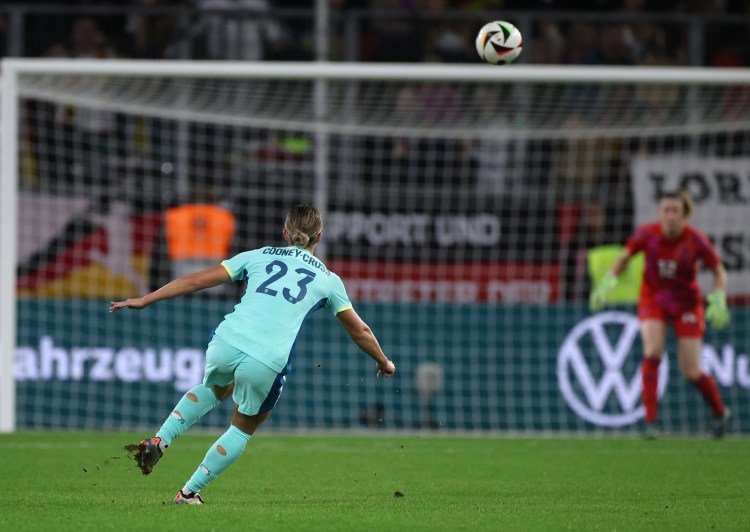
Then, a fire re-ignited by Kyra Cooney Cross’ screamer, scored just before half time. The play was patient, the possession was taken back, and we witnessed some world-class one-v-ones between Australian striker Caitlin Foord and the German backline. Confidence radiated from the pitch. They refused to say die.
So, to answer the question has the rapid and somewhat unprecedented growth of the Matildas, put them under performance-altering pressure? I believe it has but for both better and worse.
There have been moments over the last 15 months, that have posed valid questions regarding the squad’s longevity to maintain results. Getting knocked out of the Olympics at the group stages, the three-spot decline in the FIFA World rankings, disconnected tactics that result in disappointing scoresheets and goal differences.
But the Matildas have gained a very important twelfth player, the masses of fans. Who in February of this year, saw them defeat Uzbekistan 10-0 at home and qualify for the Olympics. When in the first leg of that qualifier, Australia only managed three goals past world-ranked forty-eighth Uzbekistan at their home match in Tashkent.
The win against Germany has hopefully instilled a new sense of confidence in this squad. Because at the centre of this team and its fans, there are Aussies that refuse to “Never Say Die.”
Follow Impetus on social media –
Twitter (X): @impetusfootball TikTok: @impetusfootball
Instagram: @impetusfootball : @impetusfootball

