
by Catherine Mackenzie (1/1/25)
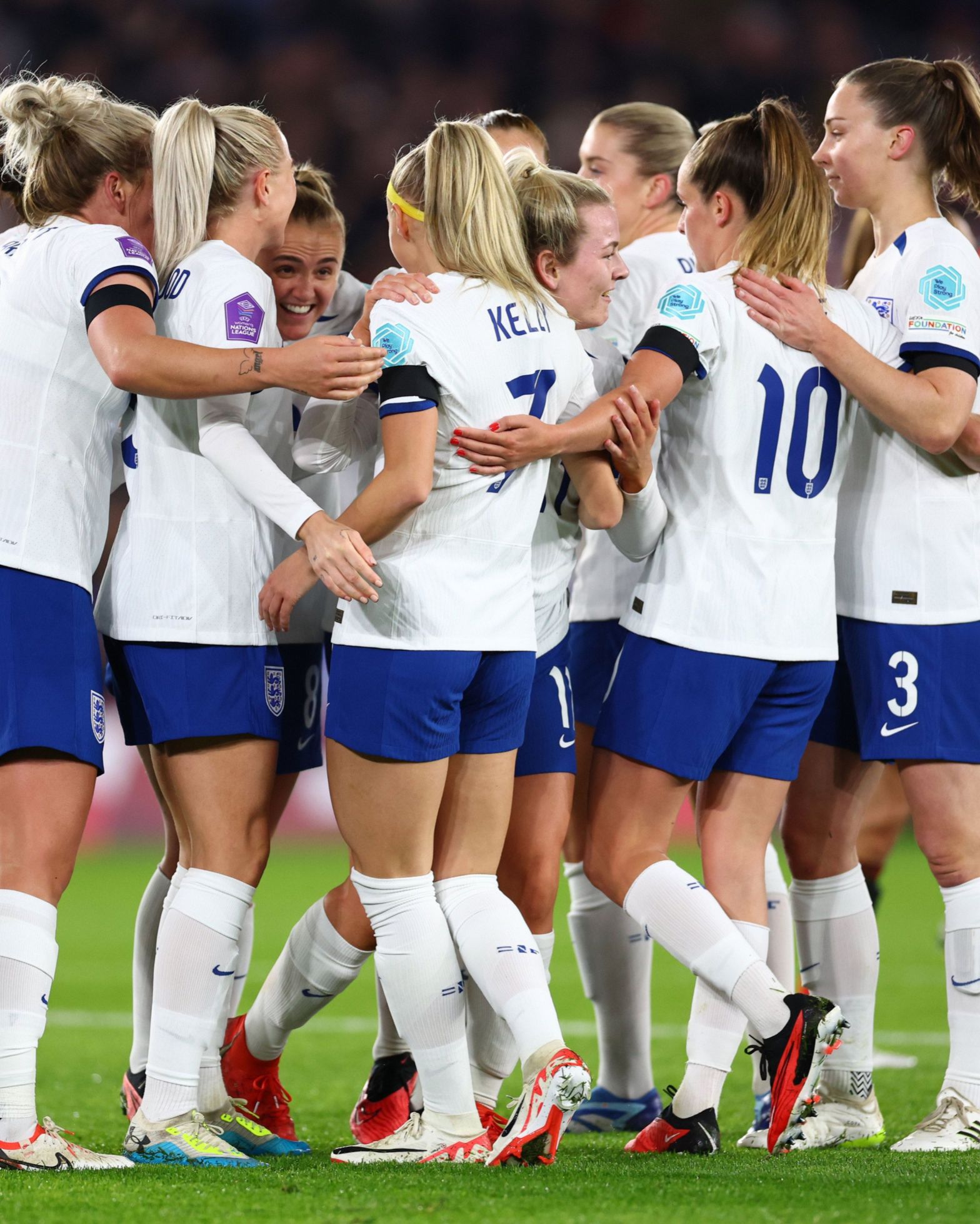
Above: The Lionesses come together to celebrate. Photo: Lionesses.
It was a mixed year for the Lionesses. A common complaint has been that they struggle to create chances and score goals, but how bad has 2024 really been? Has the country been so conditioned to expect total dominance from the team that won the 2022 European Championship, or have they stagnated and declined? Is Wiegman still the head coach to take them forward, or has her stubbornness decimated this England squad’s ability to be creative? I am going to try to answer these questions.
2024 in review
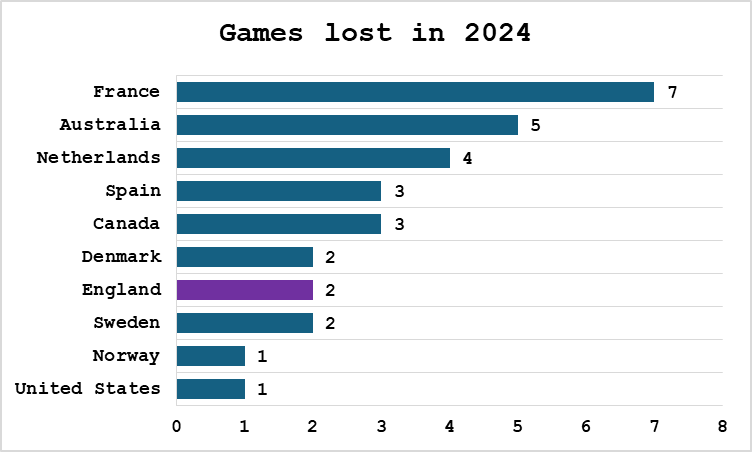
Let’s start with the big picture. In 2024, England played 12 matches: six competitive matches and six friendlies. They won seven, drew three, and lost two. The two losses came against France in a competitive fixture (2-1), and Germany in a friendly (4-3). In the same period, Spain lost three games, the Netherlands lost four, and France lost seven, suggesting that several of Europe’s top national teams struggled in 2024.
There could be a myriad of reasons for this; personally, I believe that the women’s game has progressed in the last few years to a point where the balance between an attacking performance and a defensive one is more fluid; teams are changing shapes more often, and as lower-ranked teams begin to catch up with these tactics and athleticism, they will beat top-ranked teams more often. The evidence for this is beyond the scope of this article, and something I hope to revisit.
In addition to this, I think many teams are experiencing a transition. As women’s football has grown, an increasing number of countries have developed youth programmes. England, for example, now have established teams at U17, U19 and U23 levels.
This is reflected across many of the world’s top international teams and means that there is more scope for including younger players in competitive games as they have some experience at the international level. European nations had two major tournaments (the 2022 European Championships and the 2023 World Cup) barely a year apart, and straight after the World Cup they were then pitched into the Nations League, giving teams little time to embed these younger players in a holistic way.
So, who is ‘struggling’ to score goals?
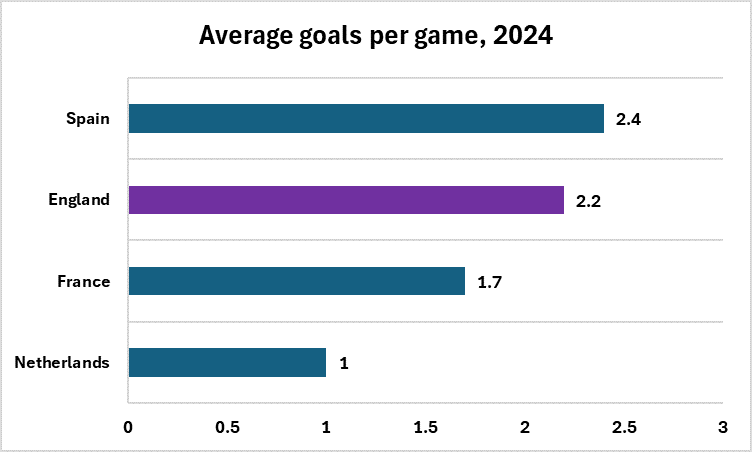
In 2024, England scored 26 goals over 12 games (2.1 goals per game); France scored 29 goals over 17 games (1.7 goals per game); Spain scored 44 goals over 18 games (2.4 goals per game), and the Netherlands scored 11 goals over 11 games (1 goal per game)[1].
Although there have been changes (notably against Sweden at home, South Africa, and Switzerland), England have used a relatively consistent front three of Lauren Hemp, Alessia Russo, and Beth Mead. This front three got off to a good start in the February window, with a 7-2 smashing of Austria. Russo and Hemp appeared again in the next friendly against Italy, recording a 5-1 win. It is therefore natural that they retained their place as England’s starting forward line for the European Championship qualifiers.
In their group, England played Sweden, France, and the Republic of Ireland twice each, with three wins, two draws, and a loss.
To determine the quality of England’s attacking performance through the qualifiers, I have compared our attempts and shots on target to those of France.
| England | France | ||||
| Attempts | Shots on target | Attempts | Shots on target | ||
| Sweden [D] | 10 | 3 | Rep. of Ireland [W] | 21 | 2 |
| Rep. of Ireland [W] | 9 | 5 | Sweden [W] | 13 | 4 |
| France [L] | 16 | 4 | England [W] | 7 | 4 |
| France [W] | 12 | 6 | England [L] | 10 | 2 |
| Rep. of Ireland [W] | 16 | 7 | Sweden [W] | 17 | 6 |
| Sweden [D] | 4 | 1 | Rep. of Ireland [L] | 10 | 2 |
| 67 | 26 | 78 | 20 | ||
Across the fixtures, England scored eight goals and conceded five. France scored eight goals and conceded seven. England had a total of 26 shots on target across the six games, whilst France had 20; however, France created more chances, with 78 compared to England’s 67. This suggests that the quality of England’s finishing was better than France’s throughout the qualifiers; scoring 39% of their attempts compared to France’s 26%.
As an aside – some media and fans have implied that England struggled to qualify and scraped through – which I find interesting given that the Lionesses finished three points ahead of Sweden and with the best goal difference in the group. France also lost an additional game – to the Republic of Ireland (3-1) in their last qualifier. England and other countries like the Netherlands also struggled during their last qualifier, perhaps suggesting fatigue played a role.
So, do England have a scoring problem?
Comparing recent games to those of the 2023 World Cup, the number of shots on target is similar. For example, against Denmark in the group stage, England won 1-0 with 13 total shots, four on target and an xG of 1.15. Against Nigeria, they also had four shots on target (along with a red card for Lauren James). Many hold up the Euros in 2022 as the pinnacle of Lioness performances – however in the 2-1 win over Spain, Wiegman’s team had three shots on target compared to their six, and in our first group stage game against Austria, we had five shots on target, leading to a 1-0 win.
This suggests to me that there has not been a substantial decrease in the number of shots on target; and that any decline has been to do with the quality of finishing – which could have several reasons, however the strongest reason to me is around player confidence and club form: it is impossible to underestimate the impact of player confidence on performance, particularly (I would argue) when it comes to finishing.
At Arsenal, Alessia Russo has had a relatively consistent output, but there have been periods of low confidence and a lack of club goals. Although club and country form are different, the psychological impact is arguably transferable, and I think this has troubled England because Russo and Mead – two key attacking outlets – have played for the same underwhelming Arsenal team. Now that Arsenal and Russo are scoring again, this should prove a confidence boost.
Rotation is not always the solution
The main criticism I see levelled at the England coaching team is that they are too stubborn to give youth a chance and pick favourites. This is based around one key assumption, that players should be picked based on club form.
In previous competitions, Wiegman has preferred to stick to a consistent starting XI. Her reasoning for this has been that a team who have worked together extensively will have more cohesion than a team that has new players in. In tournaments, I would argue her approach has been proven to work; in appearances at four major tournaments, she has reached four finals.
I think the assertion that she picks favourites is erroneous: in 2024, (at my count) 27 different players played for England. There have been debuts for Millie Turner, Grace Clinton, Ruby Mace, Laura Blinkilde-Brown, Aggie Beever-Jones, and Jess Naz. My biggest argument is probably that Mary Earps, a longstanding Wiegman favourite, has been on the bench in favour of Hannah Hampton. Grace Clinton started in midfield against Sweden at Wembley, and in the four winter friendlies, eight changes were made between the Germany and South Africa matches; four between the South Africa and USA encounters, and 10 between the USA and Switzerland games.
Complaints around the forward line have centred mainly on the use of Russo and Mead over players like Aggie Beever Jones, despite poorer club form. Whilst I understand the impulse to suggest that club form should be prioritised, in reality there are different practicalities. Club form is different as it is a different team, potentially a different system, with different expectations.
I understand not giving a young player minutes at Wembley against Germany in front of at least 50,000 fans. Beever-Jones does not start every game for Chelsea, whereas Russo starts most games for Arsenal. I think the Chelsea youngster is a brilliant player and want to see her included in England squads. But there is a danger of utilising younger players in big games – and I would argue that due to our expectations, all England games are big games.
For example, when changes are made and an experimental lineup produced – as against South Africa and Switzerland, the response to a less than dominant performance is just as negative.
The standards we hold this England team to have become so high that anything less than total dominance is deemed substandard – which is counterintuitive as the pressure the response creates impedes the team’s ability to improve and Wiegman’s ability to experiment.
There is a need for nuance and understanding – there is always more than meets the eye to every performance, and for the good of the game, we should at least try to understand that.
[1] Important note about the Netherlands score: I omitted one result, a 15-0 friendly win over Indonesia, as it would skew results. Indonesia are ranked 97th in the world (as of December 2024).
Follow Impetus on social media –
Twitter (X): @impetusfootball TikTok: @impetusfootball
Instagram: @impetusfootball

