

By Catherine MacKenzie (12/07/2025)
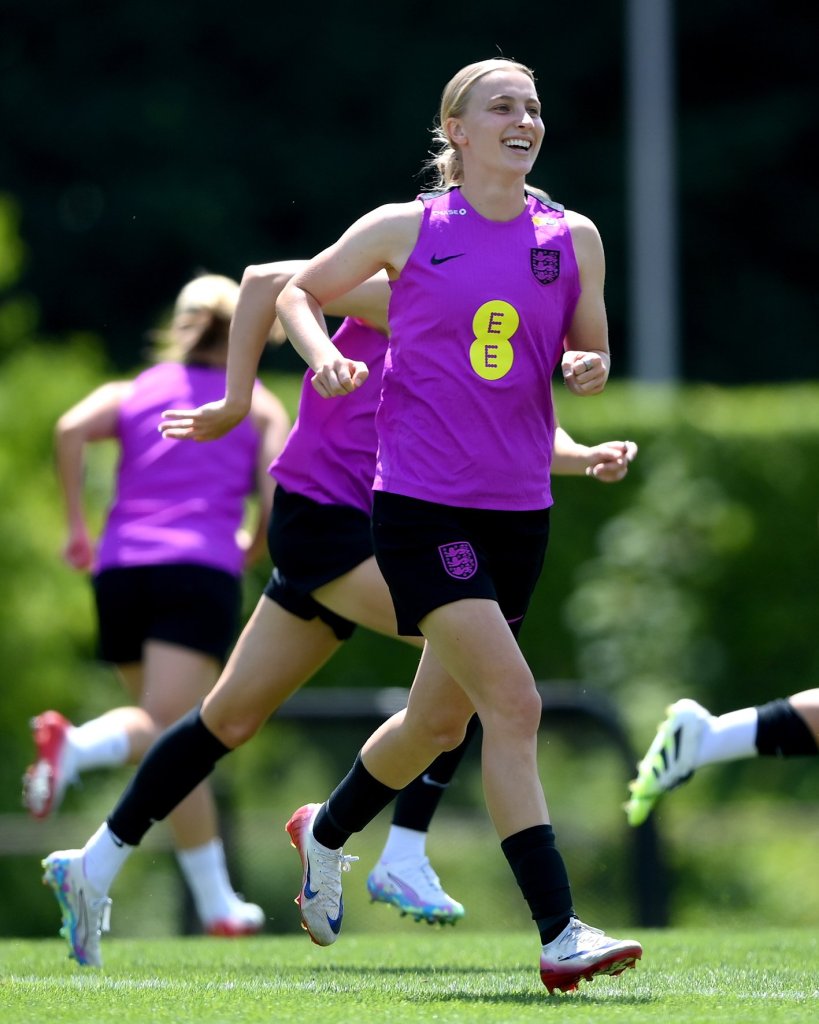
Above: Aggie Beever-Jones and Maya Le Tissier. Photo: The FA / Getty.
Read the comments underneath every social media post announcing the starting lineup for a Lionesses game, and you will undoubtedly see several comments complaining that young players are not being given a chance. This has been a consistent trend throughout head coach Sarina Wiegman’s tenure, and some journalists have even suggested that failure to integrate youth could be the Dutchwoman’s downfall as England manager. We have seen before that narratives surrounding England are not always what they seem – so is this even true? Do England really have a problem with bringing young players through, or is this just another narrative that has come out of nowhere?
Is there a problem?
It is arguable that the issue some people have with this is not down to age but rather experience. The backbone of the squad that won the Euros in 2022 and reached the final of the World Cup in 2023 is still in place – with captain Leah Williamson, Alex Greenwood, Jess Carter, and Lucy Bronze making up the defence, Georgia Stanway and Keira Walsh holding down the midfield, and Alessia Russo, Ella Toone, Lauren Hemp, Chloe Kelly and Beth Mead going forward. Only three of these players are aged 30 or over – Mead recently celebrated her 30th birthday, Bronze is 33, and Greenwood is 31. The rest are all in their mid-20s; reaching their peak in the football world, yet they feel like they have been around for a while.
It is the fact that we have seen them for a couple of major tournaments now that is arguably giving the impression that they are aging – whilst Lauren Hemp is a deceptive 24 years old, and Toone and Russo are 25 and 26 respectively.
The average age of an England starting lineup also tends to be similar to their opponents’. Against France in their Euros opener, the Lionesses’ average age was 27, compared to 26 for the French. Against Spain in the Nations League defeat, the average ages were equal at 27 for both countries. Against Portugal in the Lionesses’ 6-0 win at Wembley, the England team was a younger one with an average age of 26 compared to 29 for Portugal. The loss to Belgium in Leuven was another occasion where England fielded a younger team than their opponent – 27 compared to 28.
Maya Le Tissier
A focal point for these frustrations is defender and Manchester United captain Maya Le Tissier. The Guernsey native has had a stellar season for United and has played every minute of the last few WSL seasons. A centre-back for United, Wiegman has said England see her as more of a right-back. Whilst the reasons for this are debateable, it is likely in large part due to the need to develop the player who will eventually succeed Lucy Bronze – and there is not a lot of competition for the role.
Le Tissier is the most obvious choice and faces far less competition for the right-back role than she would at centre-back. This is true even if first-choice pairing Leah Williamson and Alex Greenwood are not available – there are still a variety of options including Jess Carter, Esme Morgan, Lotte Wubben-Moy, Lucy Parker, not to mention Millie Bright when fit.

It is difficult to truly compare statistics across WSL players because of the variety of playing styles on offer. For example, Arsenal play a much more total-football influenced possession-based game, particularly under Dutch head coach Renee Slegers. Chelsea like to dominate possession but are also fond of going more direct using the distribution of England number one Hannah Hampton. In contrast, Manchester United are known for their defensive displays, however they finished the season as one of the best pressing teams in the league.
Comparing Le Tissier’s statistics to Bronze – who she is being prepared to eventually usurp at England – is therefore difficult and should only be taken lightly. Bronze played three less games than Le Tissier (19), scoring two goals and registering three assists, whilst Le Tissier scored three goals. They had a similar number of touches per game (79 compared to Le Tissier’s 76), and their passing accuracy is very similar (79% for Bronze, 80% for Le Tissier) – Le Tissier is slightly ahead in long balls (46% compared to 39%, although this could be partly explained by how the two teams prefer to play), and they are both accurate in 33% of their crosses.
For England, Bronze’s dominance combined with the disagreement over position – Wiegman preferring Le Tissier at right-back – mean the Guernsey native’s opportunities have been more limited than fans would like. Her last minutes for England came against Portugal in the Nations League, where she replaced Lucy Bronze and played 36 minutes at right-back.
Her last opportunity before then was in England’s series of winter friendlies in October – December. She started two of the games (against Switzerland and South Africa), once at right-back and once in an improvised midfield role. She also played fifteen minutes of the Lionesses’ loss to Germany at Wembley, coming on for Bronze. There were also the friendlies in February 2024 against Austria and Italy. Le Tissier started the game against Austria, playing the full 90 minutes and notching an assist.
In terms of competitive games, aside from the half-hour against Portugal, her last outing came in July 2024, when she played the full 90 minutes as England faced the Republic of Ireland in Euros qualifying. Bronze was rested for this match (without injury), indicating that Wiegman wanted to see Le Tissier in action.
Aggie Beever-Jones
Aggie Beever-Jones tends to be another player fans want to see starting. Understudy to Alessia Russo, Beever-Jones has had an incredible season for Chelsea. She only started half of Chelsea’s games yet managed to notch nine goals, for a return of 0.4 goals per game or a goal every 124 minutes. She has an average of two shots per game, with one being on target. Over the season, she created two big chances and had an 81% passing accuracy. On her first Wembley start, Beever-Jones scored a hattrick against Portugal within half an hour.
Comparing WSL statistics, Russo started 19 matches, scoring 12 goals with a frequency of a goal every 141 minutes. Russo had more shots per game, more on target per game (3.5 and 1.6 respectively) and notched two assists, creating seven big chances with an 83% passing accuracy.
The primary difference between Beever-Jones and Russo is in their work-rate off the ball. When England faced Belgium in Leuven, Russo was injured and Nikita Parris played in the number nine role with Beever-Jones on her left (Lauren Hemp was also missing through injury). During that game, England struggled to cope without Russo tracking back and covering all areas of the pitch; this highlights the many facets of Russo’s gameplay.
Part of the struggle was that with neither Beever-Jones nor Parris tracking back, there was little in the way of support for Niamh Charles against the pace of Tessa Wullaert. However, it is worth noting that tracking back and helping out the defence is not something Beever-Jones is often tasked with at Chelsea, particularly if playing on the left. With Parris also being a recent reintroduction to the squad, there was little time to create a cohesive attacking unit which would not have helped either – but it does highlight the benefit of having Russo as a more multi-faceted striker.
At twenty-one and already capped with the senior team, it is likely only a matter of time before Beever-Jones has a bigger role within the England squad. Whilst Ellen White was the first-choice striker in 2022 with Russo as her backup, Russo’s time to shine came and so too will Beever-Jones’.
The impact of the Nations League
It is arguable that a major barrier to incorporating youth in senior teams is the emergence of the Nations League (UWNL). Before the Euros in 2022 and World Cup in 2023, there were no competitive games, so England (and other nations) had more opportunities for friendly matches – where the bulk of experimentation tends to happen.
Despite a popular narrative being that Wiegman rarely rotates her squad even for friendlies, the only senior player in the starting lineup against Switzerland was Millie Bright – the 10 other starting players had a combined cap total lower than Bright alone. Grace Clinton, Jess Park, Ruby Mace, Laura Blinkilde-Brown, Le Tissier and Esme Morgan were all on the team-sheet that evening, constituting ten changes from the previous match. Against South Africa the previous window, Le Tissier, Jess Naz, Park and Morgan all started.
The inaugural UWNL occurred mere weeks after the World Cup final in 2023, playing a role in the seedings for the qualifiers for the 2025 Euros. The aim of the UWNL was to increase the number of competitive matches for countries still at early stages of developing women’s football, to increase the standard of the game across Europe. With the league system in operation, in actuality this has meant teams playing each other numerous times – for example, Belgium, Portugal and Spain were in the same group for the 2025 Nations League and then for the 2025 Euros, so they will have played each other four times this year alone.
Whilst these games are often referred to as ‘glorified friendlies’, the fact remains that they are competitive games that impact how a nation qualifies for the next major tournament – winning is important, so there is little room to take risks. Having less time for friendlies means there is less room for experimentation, and less time to bed in younger players. However, some countries did overhaul their squads at the time – Germany for example – at the expense of short-term results.
Protection from expectations
Using the UWNL and qualifying games to incorporate younger or new players is acceptable if you continue to win. Germany suffered friendly defeats last autumn – to Italy and Australia – alongside competitive games in last summer’s Olympics, including a chastening 4-1 loss to the USA. Given the reaction from fans and media if England’s Lionesses lose or have a poor performance, it is likely that our expectations would not allow for this kind of experimentation in competitive games.
For example, the team that lost 4-3 in a friendly against Germany in October 2024 was changed significantly for the following game against South Africa, including a number of younger players – Le Tissier, Naz, Clinton, Park, and Morgan all coming in. Whilst the Lionesses won the game 2-1, the reaction was overwhelmingly negative due to the fact that they had not dominated the game. Sky Sports claimed the win was “unconvincing” in their review, and the Guardian referred to the Lionesses as “sloppy”, showing that the expectations for this team – no matter which players are in it – are extremely high.
Given the expectations that come with winning a major tournament and advancing to a World Cup final, it is perhaps understandable that England choose to take a measured approach to incorporating new players. There is an expectation that new players will have a major impact on first showing, particularly if they have been impressing at club level.
In an interview with the Guardian earlier this year, Beever-Jones acknowledged this, saying: “Last year was a bit of a whirlwind. Having the season I had and scoring a lot of goals, there was a bit of pressure that I wanted to match it. At the start of the season, I maybe got in my own head a little bit, but if I’m playing with a smile on my face and with confidence, then I believe everything else will fall into place.”
Whilst some do manage to have that impact, such as Michelle Agyemang scoring 41 seconds into her debut against Belgium, it should not be the expectation, and carefully introducing young players to the senior team should be the norm – particularly as England have an established and successful under-23s programme.
Predictions
It is likely that Manchester United having Champions League football next season will give Wiegman major headaches when it comes to Le Tissier and Clinton. If the duo sustain their good form in the face of some of the best teams and players in Europe, it is almost certain that they will needle their way into the Lionesses’ starting lineup. For Beever-Jones, her chances likely hinge on the fitness and form of Russo – but at twenty-one, there is still a lot of time to come.
It remains to be seen what further impact England’s young players will have this summer. Agyemang impressed in a cameo against France, and Beever-Jones made a strong showing in a cameo against the Netherlands. These small opportunities are likely all there is for now, but come the World Cup in 2027, the picture may be very different.
Follow Impetus on social media –
Twitter (X): @impetusfootball TikTok: @impetusfootball
Instagram: @impetusfootball
 impetusfootball.org