

By Roos Schelen (14/10/25)
Above: The WSL logo. Photo: WSL Football / BBC Media Centre.
The Women’s Super League introduced new kickoff times at the start of the season. Impetus surveyed fans to find out how they feel about the changes.
The Women’s Super League (WSL) is arguably one of the strongest leagues in women’s football, both commercially and athletically. Since this season, the majority of WSL matches kick off at 11:55 or 12:00 pm UK time on Sunday afternoons.
Last year, a new broadcasting deal was announced for the years 2025 until 2030. In the UK, Sky Sports broadcasts the WSL on their different channels and also offers a Multiview channel, where fans can watch all ongoing live games on one screen.
Impetus understands that Sky Sports and the WSL want to drive Appointment to View, a consistent window for fans to watch the league in. That window is the 12pm Sunday slot. Impetus also understands it is part of a wider strategy to drive visibility of women’s football and tell wider narratives to grow the game.
The BBC also broadcasts one match each game week, and some matches are also available on YouTube. For overseas fans, it depends if broadcasting rights have been bought by a broadcaster in their country. If not, games are shown on the WSL’s YouTube channel.
How do the new kick off slots, broadcasting rights and simultaneous kickoffs impact fans? We conducted a survey of 303 WSL fans, based both in the UK and overseas, both match going and non-match going. We also spoke to three fans via a Zoom call for a more in-depth understanding of their experiences.
The majority of UK fans dislike the new schedule
The table below shows that the kick-off times are controversial, with a majority (about 87%) of our respondents disliking the new kick off times. There is a slight difference between UK residents and fans from outside the UK, as UK residents are slightly more unhappy about the times.
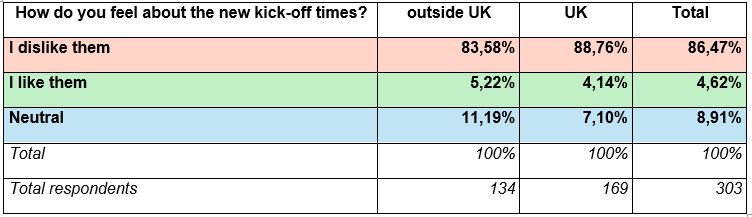
Respondents from outside the UK are more likely to feel neutral about the change. It’s more likely that UK fans are match going fans, so we will look at that more in depth below.
Implications for match going fans
We see a big difference in discontent between match going and non-match going fans, see the table below.
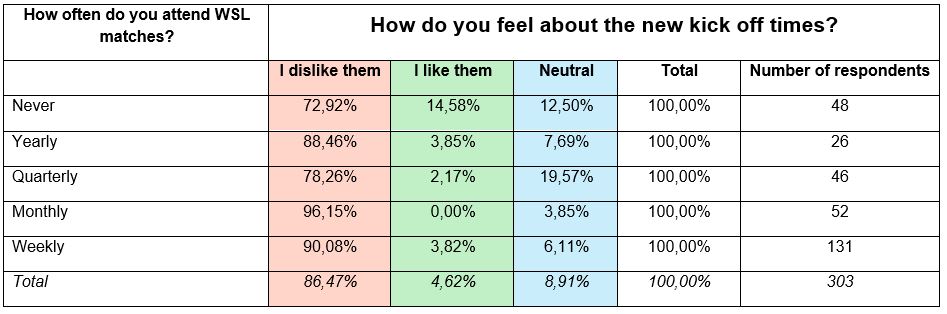
Fans who never go to matches are more likely to enjoy the new kickoff times, whereas match going fans are represented above average when it comes to disliking the new format. Interestingly, the group that frequents matches monthly is the unhappiest with the new format. It could be that these fans would like to games more often, but can’t because of the new format. We checked this, as fans were asked to elaborate on their answers.
A lot of the fans in this group mentioned not being able to travel to (mostly away) games anymore because kick off is too early to allow them to catch trains in time. Trains are not readily available on a Sunday morning and they usually don’t start until relatively late in the morning.
Another issue mentioned by fans is grassroots football mostly taking place on Sunday mornings, excluding a key audience from attending matches: families with children. As one fan mentions in the survey:
“Midday kick offs are the worst. Having two children (8 and 13) they are regularly forced to pick between their own sporting commitments and watching the WSL. In Essex it’s common for grassroots training to happen on a Saturday and matches Sunday so it doesn’t matter which day the league picks. These are normally done by midday so a 2pm kick off, whilst tight is doable.”
Attendances were already dropping across the league last season, compared to the 23/24 season. With the Lionesses Euros win in the summer, this season could have been a good opportunity for further growth in attendances. The Foxes Trust, an organisation representing Leicester City fans, told us on X: “Our attendances have pretty much halved! It’s killing the chance to grow our audiences.”
Many fans in our survey have mentioned a decline in atmosphere in the stadiums due to the earlier kick offs. People do not have time to meet up to build up the atmosphere before matches. Fans also mentioned that the noon kick off slot isn’t as suitable to drink pints or other alcoholic beverages before or during the game. The vibes around football matches are a big part of what makes football, football, for many.
TV picks are generally announced about four weeks prior to the month the fixtures take place in. This causes issues for travelling fans, especially international fans attending fixtures. They need to book and plan their travel, but that is hard if the fixtures are not set in stone. If the date or time of the match changes, travelling fans could face extra booking fees if they have already gone ahead and booked. Booking closer to the date is generally more expensive too. An international fan (female, 34 years old) tells us:
“I have to book a few months in advance for prices not to be too high on trains or flights. But they don’t announce the kickoffs until very close to the match. It’s now sometimes cheaper to stay the whole weekend in London so I can catch a match in any case than to book close to kickoff, but it’s still not ideal.”
Fans watch less games
TV scheduling is a very intricate process, with Sky also showing Premier League matches and the availability of stadiums also a factor. The 12pm window was picked to avoid as many clashes with Premier League matches as possible.
When fixtures do clash, fans are forced to choose between their women’s team and men’s team. One of our Zoom interviewees, Jacob, and other fans think fans will opt for ‘the familiar’ (men’s matches in this case) and thus women’s matches lose out.
According to the Women’s Sport Trust Visibility Report published in June 2025, WSL matches had a bigger TV audience during men’s international breaks. Similarly, they also found that Manchester United women’s matches had more viewers when there were no fixture clashes with the men’s team.
Simultaneous kick offs are not only applied in the United Kingdom in the WSL. ESPN in the Netherlands have done the same thing for the Women’s Eredivisie from the start of this season where one match is being played at 12:15 and the others at 16:45 on Sunday. ESPN also holds broadcasting rights for the men’s Eredivisie, so probably faces the same issues and decisions Sky do.
The current format unfortunately means fans can’t watch as many matches as they used to, as we can see in the graph below.
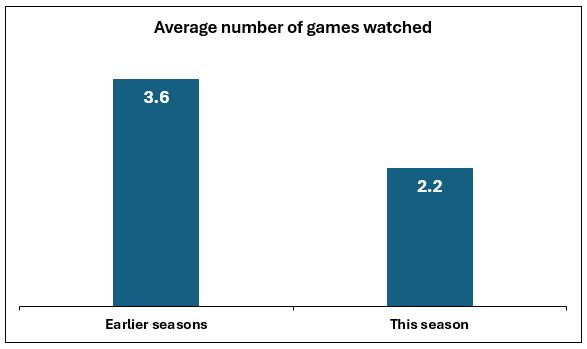
On average, fans watched on average 3.6 games each round last season or the season before, compared to 2.2 games this season. This means that fans watched 1.4 games on average less each game week. Most mentioned the simultaneous kickoffs as the main reason they watch less games, like this 29-year-old female, who explains:
“Once the scores for the games I’m not watching have been spoiled it makes me not want to watch them. I much preferred staggered kick off times, I miss a whole day of football on Sunday.”
She is by far not the only one calling for staggered kick off times. Sky offers fans who want to watch more than one game a solution: the Multiview option, where they can watch all games that are on, on one screen.
What about Multiview?
As for the Multiview channel Sky offers, most of our respondents do not use it as they are either abroad or feel the feature is too overwhelming. Like a 19-year old female tells us: “No, I don’t use it. It’s too confusing and hard to keep up with, I end up missing more because it’s impossible to watch 4 games simultaneously”.
Another point made by fans is the lack of excitement on the Multiview channel. Many feel a Multiview channel can be exciting when there is a lot riding on the matches that are on, like during the final games of a season, but not during the majority of the season.
We spoke to 24-year-old Jacob, a Tottenham Hotspur fan from London, through Zoom. He thinks the multiview channel is a good idea but does not like to use it when his team is playing. “As a Spurs fan, if we’re playing, I don’t want to watch four other games. I just want to watch our game”, Jacob tells us.
Many UK based fans mentioned they can not afford Sky so don’t have access to the Multiview channel.
What do the numbers say?
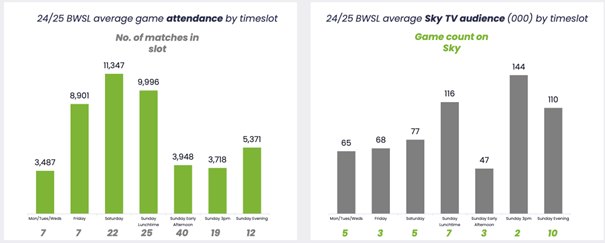
According to the Women’s Sport Trust Visibility Report, the Saturday matches had the highest average attendances in the 24/25 season, followed by Sunday lunch time. So the 12pm Sunday kick off was the second highest attended on average. At the same time, TV audiences were also second highest on average in this slot.
Will the new schedule grow the league?
A vast majority, 86 percent, of surveyed fans says they feel like the new format does not contribute towards growing the league. Fans were asked to elaborate on their answer.
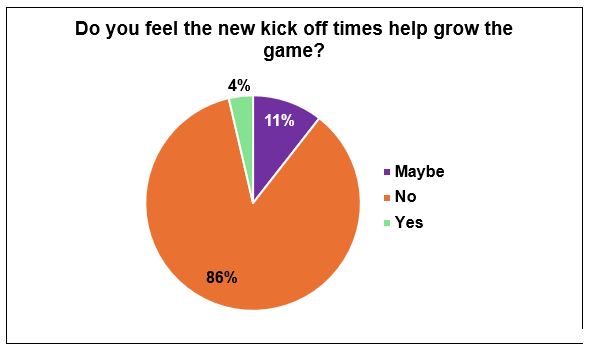
They mostly touch on the points already discussed above. A 32-year-old female asks: “How do you want to grow the game if people can’t watch as many games as they want?”
A 29-year-old male links the lesser atmosphere in the stadiums to the broadcasts, saying:
“By playing early in the day you end up making it so much less easy for people to get to games. It also means that the atmosphere is a lot poorer from those who can go. All this does is degrade the product Sky are providing on tv, and empty seats/bad atmosphere make people less likely to want to tune in”
Lower table teams or teams with a smaller following will be impacted by the new format the most. With multiple teams playing at the same time, most fans will probably choose their own team or the most ‘exciting’ game to watch, which would most likely be a game of one of the bigger teams.
Laura Marie, an international fan from Germany highlighted this point in her interview on Zoom too. She says: “Naturally, if there’s four at the same time, you would tune into Arsenal, Chelsea, United or Manchester City. You wouldn’t watch Leicester City, Everton, whatever, if you’re not a fan of that club.”
Out of the group of eight fans who feel like the new format does help grow the game, four mention the fact that the WSL kick offs do not clash as much with the Premier League any more. This in turn allows men’s football fans to tune into the women’s matches ahead of the men’s fixtures kicking off, they think, which will grow the audience and the game.
If it were up to the fans, then…
We asked our interviewees on Zoom how they would shape the broadcasting slots, if it were up to them. They all gave similar answers.
They would prefer one or two games on Saturday and then three or four games on Sunday, with both days having staggered kick off times. Friday nights are up to debate though, with Jacob, a match going fan, saying it wouldn’t be ideal for people having to make kick off after a work day. Laura Marie, an international fan (who does go to matches occasionally) told us she would like to watch matches on Friday nights, but understands that some match going fans would not prefer the slot.
It’s definitely not all bad
Fans from Australia and Asia are generally supporters of the new kick off times, as they will fall in the early to mid evening in their respective time zones, as opposed to late at night or even way past midnight. And luckily there are morning people who also quite like the new format. Like Leontine, one of the 3 people we spoke to in depth, says: “I can do other things after the matches with these earlier kick offs”.
When asked by The Halfway Line about the new kick off times, Tottenham Hotspur coach Martin Ho explained that he was happy with them. “It doesn’t really affect how we do things,” he said. “You have to work around the kick off times and prepare your team as best as possible. I actually think it’s a good thing. It makes it more unique now to the league and obviously everyone is talking about it, so it’s definitely made a hit within women’s football. I think having a bespoke time makes a big difference, but also enables us to get more eyes on it commercially, which will definitely help it grow.”
A zero-sum game?
To summarise: a large majority of surveyed fans is unhappy with the new kick off times format. Fans watch less games on TV or in person each game week, because of multiple games kicking off at the same time. Supporters mention not being able to go to matches because of the early kick offs, either because they can’t get to the game by public transport, or they or their children have grassroots football matches going on. The majority also doubts that the new kick off slots help growing the league.
WSL Football Ltd, who run the league, face a conundrum. Do they opt for further commercialisation by prioritising the broadcaster’s needs and maybe, potentially lure in a new audience? Or do they prioritise the existing fans, both match going and non-match going ones, by accommodating their wishes for staggered kick off times, and later starts to matches?
It is up to WSL Football Ltd to pan out the development of the Women’s Super League in the future, while trying to keep existing fans happy and meanwhile appeal to a new audience.
(c) Impetus 2025
Follow Impetus on social media –
Twitter (X): @impetusfootball TikTok: @impetusfootball
Instagram: @impetusfootball
 impetusfootball.org
I was discussing the KO times with my dad the other weekend when we went to watch Everton Women v Man Utd Women which was a midday KO
Attendances are already dropping and I don’t think it is at all helpful for the development of the game as travel is difficult at that time on a Sunday especially if you have children playing football in the morning or if it is an away game
It’s an awkward time for me to watch on TV at that time on a Sunday too
I see the logic in not wanting to clash with Premier League games but did anyone survey the fans before deciding on that time
There are lots of weekends these days where there are so few Premier League games on at 3pm that maybe they could use that time slot
I had hoped that a broadcaster such as the BBC might pick up the games to show at least one a week although I do like being able to follow all of the games for my team on YouTube, and the FA Player before that
LikeLike