
Impetus is proud to welcome Roberto Revilla from the Arsenal Women Trailblazers podcast and website. Each week, Roberto will be providing us with a column analysing the Gunners’ most recent games and looks ahead to what’s coming up for the team.
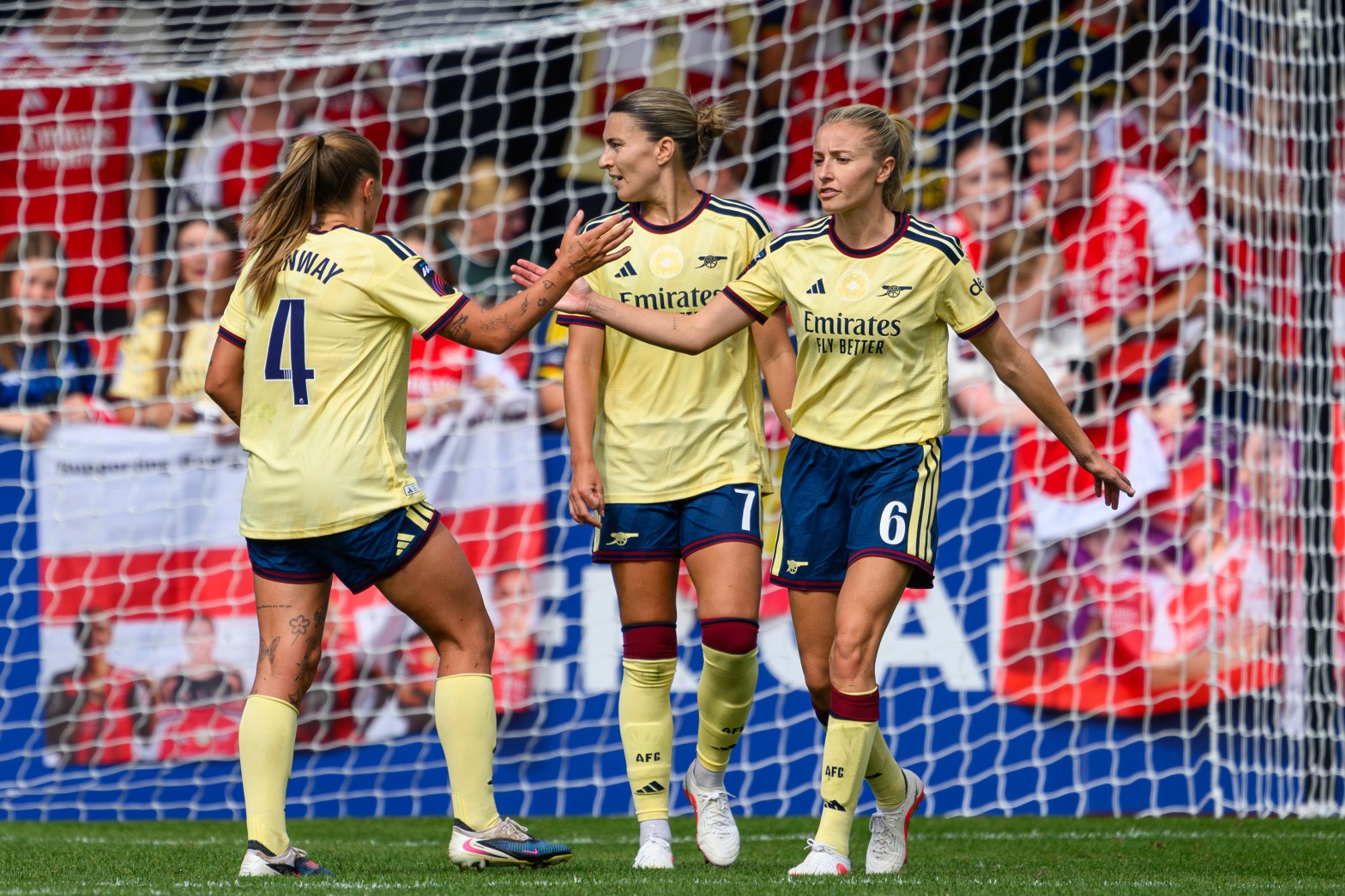
Above: Georgia Stanway (left), Steph Catley (centre), and Leah Williamson (right) come together in Arsenal’s win over Brighton & Hove Albion on Sunday. Photo: cozphotos for Impetus.
Lisa Baum’s spectacular first Women’s Super League goal gave Arsenal a 1-0 victory over Brighton and Hove Albion at Broadfield Stadium on Sunday as Renée Slegers’ side opened their league campaign with three points, despite the hosts increasingly exposing some of the risks within Arsenal’s evolving system.
For the opening 20 minutes, Arsenal looked capable of producing something considerably more emphatic.
Many of the combinations that had appeared throughout pre-season were immediately visible. Georgia Stanway collected the ball from deep, Mariona Caldentey roamed across midfield, Arsenal’s full-backs pushed high and Baum and Olivia Smith moved between attacking areas rather than remaining fixed to their respective wings.
Most noticeably, Arsenal won the ball back quickly.
When Brighton had possession, Arsenal hunted in packs, often surrounding the player on the ball with two or three yellow shirts. It gave Slegers’ side control of the opening stages and offered an early indication of how much more aggressive Arsenal want to become without the ball this season.
Then Baum announced herself to the WSL.
The 19-year-old collected possession centrally and ran directly at Brighton’s defence, drifting towards the left side of the penalty area before unleashing a magnificent strike into the nearside top corner.
It was an extraordinary way to score a first WSL goal, although there was considerably more to Baum’s performance than the moment which ultimately decided the match.
Baum offered Arsenal much more than a goal
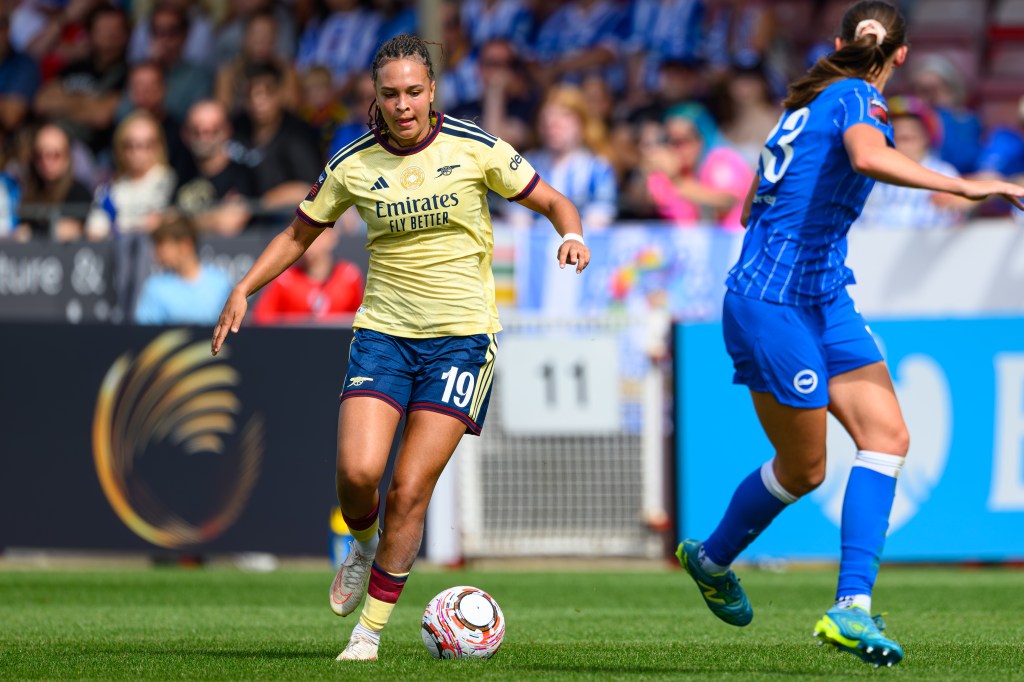
There was some intrigue around Slegers’ decision to start Baum in Arsenal’s opening league game, particularly given the attacking options available to her, but it did not take long to understand the thinking.
Baum was constantly moving.
She began on the left but appeared centrally, combined with Alessia Russo, interchanged positions with Smith and later operated from the opposite side. There was also a revealing moment during the first half when she tracked Kiko Seike all the way back towards Arsenal’s box before dispossessing the Brighton forward.
For a side increasingly reliant on rotations in attacking areas, that willingness to move was important, but so too was the defensive work required when those rotations broke down.
Baum also demonstrated why her ability to carry the ball could become particularly useful. Early in the second half, she drove through the Brighton defence again, gliding beyond several challenges before eventually producing a shot which was comfortably saved by Chiamaka Nnadozie.
Slegers said afterwards that Baum’s performances throughout pre-season had convinced her that she was ready to start, praising the teenager’s maturity, composure and willingness to work.
On the evidence of her first WSL appearance, Baum gave her head coach plenty to think about when selecting her next starting eleven.
Stanway was already changing Arsenal’s midfield
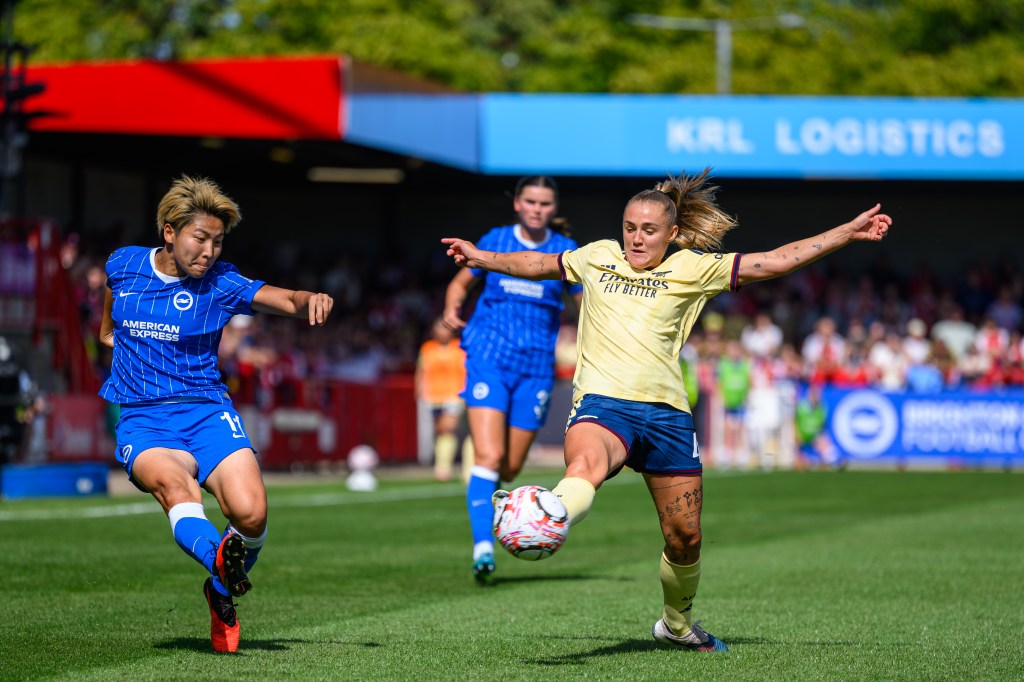
If Baum produced the game’s defining moment, Stanway was arguably the player who best demonstrated how this Arsenal side may evolve.
The England midfielder repeatedly dropped towards the defensive line to collect possession, sometimes allowing Steph Catley to move wider and Ona Batlle to advance further forward.
From there, Stanway gave Arsenal options.
They could continue to progress through the shorter combinations which became familiar under Slegers last season, but Stanway also offered something different: the ability to look beyond the immediate pass and move Arsenal forward much more quickly.
Leah Williamson was similarly willing to look for longer passes into Arsenal’s attacking players.
Slegers spoke after the match about wanting Arsenal to retain their ability to progress through the lines while becoming less predictable, and Stanway appeared central to that idea.
The challenge was deciding when to use it.
There were periods, particularly during the second half, when Arsenal appeared almost too keen to attack immediately after regaining possession. They would win the ball, look forward, lose it and then have to recover again.
Stanway gave Arsenal another way of progressing the ball. The next stage may be recognising when the game requires them not to progress it at all.
Brighton found the space Arsenal left behind

The warning signs had actually arrived before Baum scored.
Nnadozie’s long pass released Seike down Brighton’s right and, although Batlle recovered impressively to reduce the angle, Misa Rodríguez was still required to make an important early save.
Brighton repeatedly returned to that area.
This looked likely to be one of the trade-offs within Slegers’ increasingly adventurous system. Arsenal wanted Batlle high because of what she could offer in attacking areas, but that inevitably created space behind her when possession changed.
Catley consequently found herself providing important cover on several occasions.
Initially Arsenal’s aggressive counter-press prevented Brighton from exploiting those spaces consistently. Once Arturo Ruiz’s side began finding ways through that first pressure, however, the match changed.
Seike remained a threat, Fran Kirby became increasingly influential and Brighton gradually worked their way into the contest.
Arsenal still created opportunities. Smith’s strength and low delivery gave Russo an excellent chance to double the advantage, only for the striker to fire over, while Nnadozie later denied Russo after Stanway had played her through.
Brighton had not taken complete control. They had simply worked out how to make Arsenal considerably less comfortable.
Rodríguez provided the security Arsenal needed
That discomfort increased after half-time.
Brighton emerged with renewed intent and Rodríguez was required to save from Marisa Olislagers shortly after the restart.
The Spanish goalkeeper’s contribution throughout the afternoon went beyond the saves. She dealt confidently with balls into her area, came from her goal when Brighton threatened the space behind Arsenal’s defence and produced one particularly authoritative punch during a period of sustained second-half pressure.
Perhaps just as importantly, Rodríguez appeared willing to slow the game down.
As possession began switching rapidly between the two teams, Arsenal struggled to establish any meaningful rhythm. They would regain the ball only to surrender it again, forcing themselves into another defensive transition.
Rodríguez occasionally became the player willing to hold possession, allow Arsenal to reset and begin again.
On an afternoon when Brighton repeatedly threatened to turn Arsenal’s defensive risk into an equaliser, her composure proved every bit as valuable as her saves.
Arsenal could not quite calm the game down
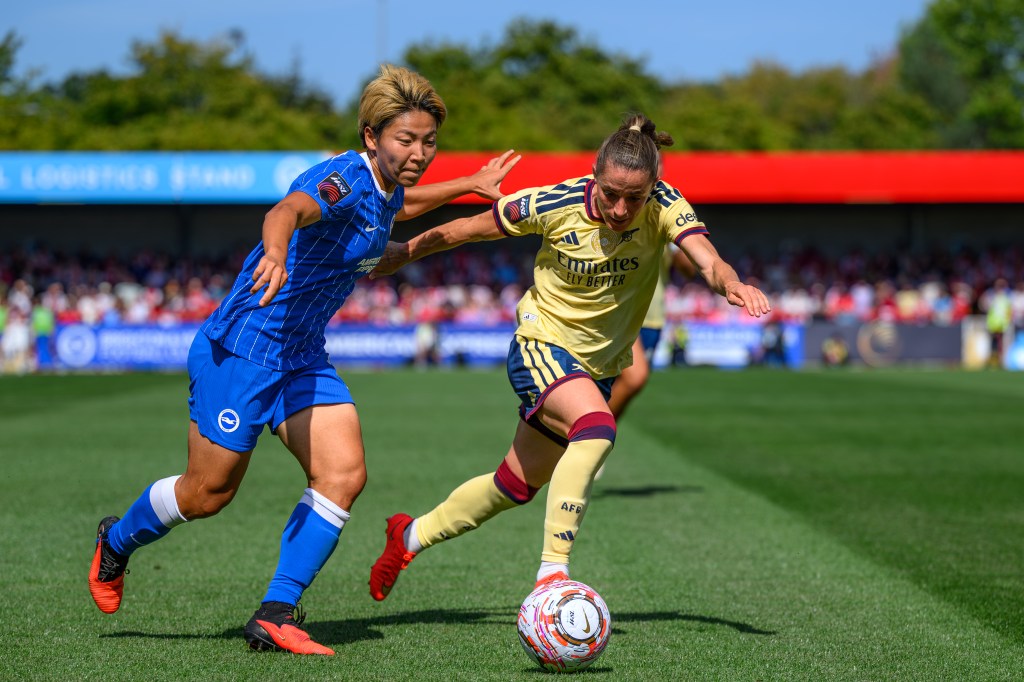
Slegers attempted to change the momentum by introducing Caitlin Foord and Chloe Kelly for Baum and Smith shortly after the hour.
Stina Blackstenius subsequently replaced Caldentey, with Russo dropping into a deeper position, before Frida Maanum and Smilla Holmberg were introduced late on.
There were opportunities to make the game safe. Foord caused problems after coming on and Blackstenius was denied by Nnadozie as Brighton increasingly committed players forward in search of an equaliser.
Yet Arsenal never quite regained the control they had enjoyed during the opening stages.
That may ultimately have been the most useful lesson from their opening afternoon. There will be occasions when the aggressive press, positional rotations and willingness to attack space quickly make Arsenal extremely difficult to contain. There will also be moments when the first pressure is beaten and those same attacking positions leave space for opponents to exploit.
The answer is not necessarily for Slegers to make Arsenal less adventurous.
There may simply be occasions when Arsenal need to become more patient, retain possession, make the opposition chase and allow their structure to reset before attacking again.
That balance between risk and control will take time, particularly with new players being integrated into a system which had largely only been tested during pre-season.
Arsenal nevertheless left Brighton with something they failed to collect from the corresponding fixture last season: three points.
Baum announced herself with a spectacular first WSL goal, Stanway already looked capable of changing the way Arsenal build attacks and Rodríguez demonstrated why her arrival could prove so important.
It was not the statement performance Arsenal’s opening 20 minutes suggested might be coming, but on an afternoon when Brighton found ways to expose some of the risks within Slegers’ new-look side, Arsenal demonstrated another quality which could become just as important over the course of a long season.
They found a way to win.
Roberto Revilla is the founder and host of Arsenal Women: Trailblazers, an independent podcast and website providing in-depth analysis and coverage of Arsenal Women. You can find the podcast and Roberto’s latest Arsenal Women writing at Arsenal Women: Trailblazers.

