
by Roberto Revilla (16/9/26)
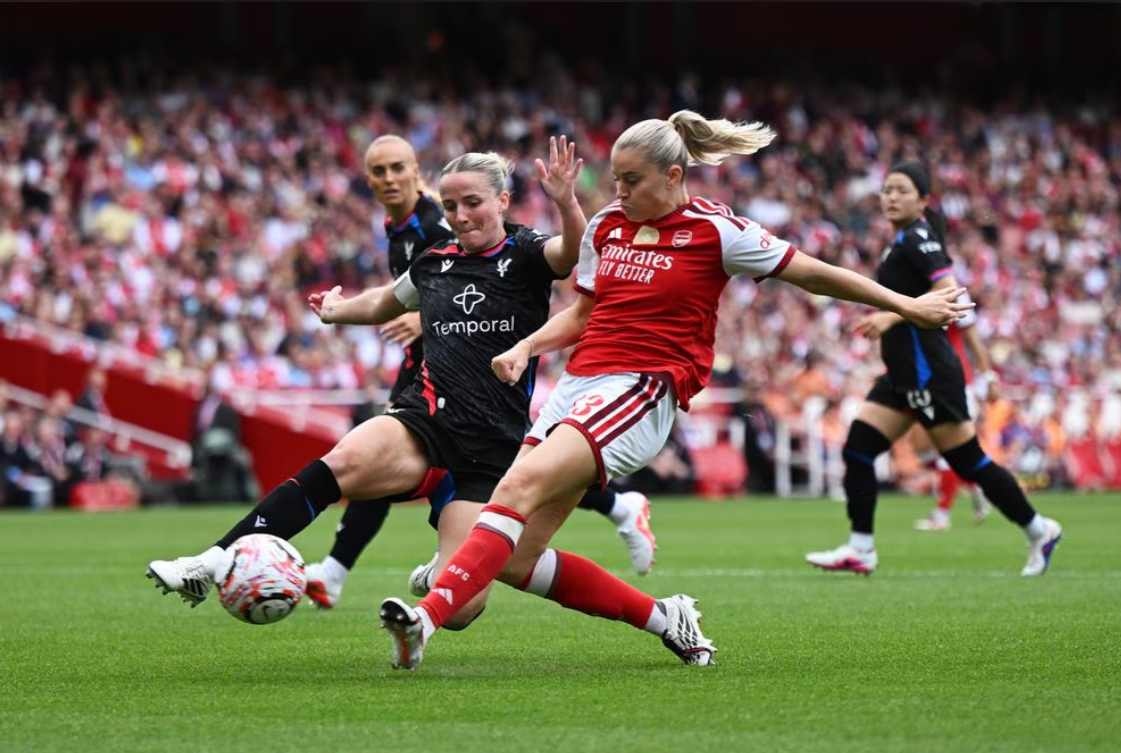
Above: Alessia Russo gets a shot away against Crystal Palace in Sunday’s goalless draw against Crystal Palace. Photo: Alex Burstow/Arsenal FC.
Arsenal find new routes but familiar frustration against Crystal Palace
Arsenal registered 30 shots, enjoyed 79 per cent of possession and struck the crossbar twice, but Crystal Palace left the Emirates Stadium with a point after an extraordinary defensive performance.
The visitors made 73 clearances, blocked nine attempts and restricted Renée Slegers’ side to a goalless draw despite spending almost the entire afternoon around their own penalty area.
For Arsenal, the immediate frustration came not only from dropping two points at home to newly promoted opposition, but from how familiar the result appeared.
Slegers’ side drew six Women’s Super League matches last season, and several followed a similar pattern. Arsenal controlled possession, established themselves around the opposition area and finished the match wondering why that control hadn’t been reflected on the scoreboard.
However, a closer look at Sunday’s performance paints a more encouraging picture than the result initially suggested.
Arsenal didn’t lack attacking intent or ways of reaching the Palace goal. They created several opportunities that players of this quality would normally be expected to finish. The failure came in the final action, not in an inability to build meaningful attacks.
Arsenal start with purpose
Slegers made three changes to the team that began the opening-weekend victory at Brighton and Hove Albion.
Lotte Wubben-Moy replaced Steph Catley in central defence, Kyra Cooney-Cross came into midfield for Kim Little and Chloe Kelly started in place of Olivia Smith.
Misa Rodríguez remained in goal behind Emily Fox, Leah Williamson, Wubben-Moy and Ona Batlle. Georgia Stanway partnered Cooney-Cross in midfield, with Mariona Caldentey operating behind Alessia Russo. Lisa Baum started on the right, and Kelly began on the left.
Arsenal needed less than two minutes to create their first significant opportunity.
Kelly held the width on the left as Caldentey, Cooney-Cross and Stanway moved the ball across midfield. Stanway then drove forward and passed through the Palace defence to find Russo.
The striker moved ahead of her marker, turned and shot towards the near post, but former Arsenal goalkeeper Pauline Peyraud-Magnin reacted sharply to push the ball away.
It was an early indication of both Arsenal’s attacking approach and the challenge they would face.
Palace defended with two compact lines and surrounded Russo whenever the ball reached her. At the moment Peyraud-Magnin made the save, three defenders were positioned inside the six-yard box with another three immediately outside it.
Arsenal continued to move the ball quickly and came within inches of taking the lead shortly afterwards.
Baum played the ball into Cooney-Cross, who intelligently allowed it to run through to Stanway rather than slowing the move with another touch. Stanway carried possession towards the penalty area and found Batlle moving inside from the left.
Batlle released Kelly inside the box, and her deflected cross looped towards Caldentey. The Spaniard controlled the dropping ball before sending a wonderful half-volley beyond Peyraud-Magnin.
The goalkeeper was beaten, but the ball struck the underside of the crossbar and bounced away.
Arsenal had created two clear opportunities by attacking in different ways. Russo’s early shot came from Stanway driving through midfield and passing directly into the striker. Caldentey’s effort followed a wider combination involving Baum, Cooney-Cross, Stanway, Batlle and Kelly.
That variety continued throughout the half.
Cooney-Cross and Caldentey combined to release Fox into the penalty area, forcing Peyraud-Magnin to leave her goal quickly and smother the danger.
Fox was involved again when she moved inside from the right and delivered towards Stanway. Two defenders prevented the midfielder from making clean contact, but Caldentey reacted to the loose ball and headed it back towards Russo.
With Peyraud-Magnin no longer properly protecting her goal, Russo’s shot appeared destined to give Arsenal the lead. Palace recovered quickly and Molly Bartrip retreated to clear the ball from the goal line.
Palace’s best opportunity of the half came from a free-kick. After Cooney-Cross made contact with the initial delivery, the ball dropped towards former Arsenal defender Teyah Goldie, who sent her effort over the crossbar under pressure from Wubben-Moy.
Palace protect the centre
Palace’s performance was built around more than simply retreating towards their goal.
Jo Potter’s players defended the spaces between Arsenal’s attackers. Whenever Arsenal formed a triangle or diamond around the ball, Palace placed several players inside it.
The pass could still reach an Arsenal player, but she rarely had time to turn, assess her options and make the next decision before another defender arrived.
Russo received the closest attention. Palace regularly surrounded her with two defenders while another watched the wide player on the opposite side and prepared to move across if the ball was delivered into the middle.
That organisation was evident in the 36th minute when Arsenal created their clearest opportunity of the first half.
Stanway collected possession deep inside Arsenal’s half and passed through a group of Palace players to find Caldentey near the centre circle. Batlle received the lay-off before releasing Baum on the left.
As Baum looked towards the penalty area, two defenders were already recovering towards Russo. Bartrip checked Kelly’s position on the opposite side before deciding she could leave the winger and move across to provide further protection.
Baum still drove an excellent low cross beyond the final defender and into Russo’s path.
The striker met it in front of goal but sent her effort several yards wide. It was an uncharacteristic miss from a player who would normally be expected to convert from that position.
Arsenal had finally moved the ball quickly enough to get beyond Palace’s recovering defence. The delivery was right, the opportunity was clear and the finish was missing.
Despite the goalless scoreline, Arsenal hadn’t spent the first half circulating possession without purpose. They played through Palace, attacked from both wings, and took shots from outside the area when closer routes were unavailable.
The task after half-time was to continue creating those moments while improving the final pass or finish.
Baum provides Arsenal’s greatest threat

Slegers made no changes at the interval, and Arsenal immediately pushed Palace back towards their penalty area.
Stanway released Baum on the right, allowing the winger to cut inside Goldie and force another save from Peyraud-Magnin. Stanway then found Caldentey with a longer pass, but her shot travelled narrowly wide.
In the 57th minute, Baum came within the width of the crossbar of scoring for the second successive weekend.
Caldentey found Stanway outside the Palace area and the midfielder played a first-time pass into Russo. With two defenders closing around her, Russo protected the ball before releasing Baum from the right.
The 19-year-old wrong-footed Goldie, moved the ball onto her right foot and struck a powerful effort across goal. Peyraud-Magnin was beaten again, but the ball crashed against the crossbar.
Baum had scored against Brighton after moving inside from the left and finishing with her left foot. Against Palace, she created danger from both wings and came close to scoring from the opposite side with her right.
That ability to attack in different ways makes her difficult to direct towards a supposedly safer area.
She can move outside a defender, cut inside to shoot or release a teammate before the additional pressure arrives. Despite making only her second competitive Arsenal appearance, she repeatedly accepted responsibility and remained Arsenal’s most dangerous attacker.
Changes add numbers to Arsenal’s attack
Slegers made her first substitutions after an hour.
Smith replaced Kelly, and Stina Blackstenius came on for Cooney-Cross. Caldentey moved into a deeper role beside Stanway, while Blackstenius became the central striker and Russo began operating in the spaces around her.
The change gave Palace’s central defenders another forward to cover and allowed Russo to move away from the areas where she had been repeatedly surrounded.
Smith also offered a more direct threat from the left after Palace had prevented Kelly from regularly receiving the ball with enough space to build momentum.
Arsenal soon created another good opportunity.
Fox found Caldentey on the right and despite three Palace players closing around her, she moved the ball first time into Baum.
The winger came inside and threaded a pass beyond Palace captain Aimee Everett and into Blackstenius’ path. The striker reached it near the six-yard box, but Peyraud-Magnin came out quickly and smothered her first-time attempt.
It demonstrated why Blackstenius had been introduced. She found the space behind the defence and Baum recognised the run, but the former Arsenal goalkeeper again prevented the breakthrough.
Palace managed only their second shot of the match when Abbie Larkin tried her luck from outside the area. Rodríguez collected the attempt comfortably.
Arsenal’s defensive control remained one of the most encouraging parts of the performance. Williamson and Wubben-Moy managed the space behind midfield, while Fox and Batlle spent much of the match supporting the attack.
Palace offered almost nothing from open play, and Rodríguez completed her second clean sheet in two league appearances.
Stanway then forced Peyraud-Magnin into another low save from outside the area after Palace had closed every passing route ahead of her.
The decision to shoot was understandable. Arsenal’s forwards were positioned between two lines of Palace defenders and there was no clear route into the area.
Slegers introduced Little and Caitlin Foord after 75 minutes, replacing Caldentey and Baum.
Baum’s removal was the most surprising decision because she remained Arsenal’s greatest attacking threat. However, she had started both opening league matches and expended significant energy moving between the two wings.
Foord attempted to offer a direct threat from the left, with Smith switching to the right, but had limited time to settle into a match that had already established a very specific rhythm.
Little brought greater calmness to Arsenal’s midfield, although Palace had retreated even closer to their penalty area by that stage.
Frida Maanum replaced Russo with five minutes remaining. She helped create one final opening for Smith, whose shot from outside the area passed narrowly wide.
Smith also sent a late free-kick over the crossbar before Palace completed their defensive effort and celebrated a valuable point.

More than possession without reward
The statistics demonstrate how completely Arsenal controlled the match.
Slegers’ side had 79 per cent possession, recorded 30 shots and placed nine on target. Twenty attempts came from inside the Palace penalty area and Arsenal had 74 touches inside the box.
An expected-goals figure of approximately 2.4 further suggests these weren’t simply speculative attempts from unreasonable distances.
Caldentey and Baum struck the crossbar. Russo saw one effort cleared from the line before missing Arsenal’s clearest opportunity and Blackstenius was denied from close range.
If one of the first-half chances had gone in, Palace would have been forced to reconsider their approach. Potter’s side could no longer have spent the entire afternoon protecting a level score and greater attacking ambition would have created spaces for Arsenal to exploit.
Slegers felt the variety and number of chances represented a significant improvement from the victory at Brighton. She also acknowledged that the final decision and final detail needed improvement.
That assessment was fair.
Arsenal attempted 40 crosses and won 13 corners. Several deliveries produced good opportunities, but too many later attacks ended with the ball being sent into an area Palace were already prepared to defend.
The visitors were comfortable facing the ball with several defenders positioned around Russo and Blackstenius. Arsenal didn’t always use their width to move beyond the nearest defender and deliver from closer to the goal line.
However, the wider attacking plan hadn’t failed.
Stanway’s forward runs offered an additional threat from midfield. Caldentey found spaces around the penalty area, while Baum attacked from either wing. Fox and Batlle moved inside and outside as Arsenal tried to alter Palace’s defensive shape.
The chances were created. The finishing prevented the performance from receiving its reward.
A warning rather than a crisis
The result will inevitably invite comparisons with last season.
Arsenal scored nine fewer league goals than Manchester City and dropped points in several matches they had controlled. After scoring only once across the opening two games of the new campaign, supporters are entitled to question whether the same weakness remains.
The resemblance is real, but it isn’t yet proof that the season is following the same path.
Against Palace, Arsenal created several opportunities that their forwards would normally be expected to finish. That is a different problem from failing to move the ball into dangerous areas or leaving the striker isolated.
Russo won’t regularly miss from the position Baum created for her. Caldentey and Baum won’t hit the crossbar every time they beat the goalkeeper and Blackstenius has built much of her Arsenal career around converting close-range opportunities.
If Arsenal continue producing chances of this quality, the goals should follow.
If similar performances are still producing goalless draws later in the autumn, the concern will become more serious. A team hoping to win the WSL cannot repeatedly require 20 or 30 attempts to score.
For now, the Palace result should be treated as a warning rather than a crisis.
Arsenal’s finishing must improve, but the performance contained greater movement and attacking variety than the scoreline suggested. The team also retained its defensive security, recorded another clean sheet and allowed the opposition almost nothing in open play.
The disappointment surrounding the result was understandable. Arsenal should have won.
The responsibility now is to ensure that a frustrating afternoon remains an isolated result rather than the beginning of another familiar pattern.
Roberto Revilla is the founder and host of Arsenal Women: Trailblazers, an independent podcast and website providing in-depth analysis and coverage of Arsenal Women. You can find the podcast and Roberto’s latest Arsenal Women writing at Arsenal Women: Trailblazers.
@ImpetusFootball on Threads, Instagram, Facebook and TikTok.

