

by Roberto Revilla (30/9/26)
Above: Kim Little leads the discussion in the Arsenal huddle at Stamford Bridge on Sunday. Photo: Arsenal FC.
Arsenal’s problems are starting to look bigger than finishing
Alyssa Thompson’s 39th-minute goal gave Chelsea a 1-0 victory over Arsenal at Stamford Bridge on Sunday, leaving Renée Slegers’ side with five points from their opening four Women’s Super League matches.
On the surface, it was another game in which Arsenal created enough attacking situations to take something but failed to score. They finished with 18 attempts, only two on target, and have now scored just twice in their opening four league games.
The concern is that this is becoming increasingly difficult to explain simply as poor finishing.
For the opening half an hour at Stamford Bridge, Arsenal were good. At times, very good.
They controlled possession, competed well physically and repeatedly found promising positions against a Chelsea side which, unlike several of Arsenal’s recent opponents, was prepared to engage them higher up the pitch.
Lisa Baum was particularly dangerous on the right, Kyra Cooney-Cross continued to move possession forward positively and both Kim Little and Mariona Caldentey struck the woodwork.
Slegers acknowledged afterwards that Arsenal had dominated until Chelsea scored, but also recognised the importance of taking advantage of those periods against another strong side because the momentum will eventually change.
That is precisely what happened.
Chelsea gradually established themselves in the game before Arsenal lost possession attempting to play out from the back in the 39th minute. Keira Walsh’s resulting shot was parried by Anneke Borbe and Thompson reacted quickest to score the only goal.
The mistake was costly, but what happened before Chelsea’s goal was arguably more important to Arsenal’s continuing problems.
The extra touch keeps appearing

Arsenal have spent several weeks discussing the quality of their attacking decisions.
Against Crystal Palace, they registered 30 attempts without scoring. Against HB Køge, 21 attempts produced only two on target. At Stamford Bridge there were another 18 attempts, two efforts against the woodwork and no goal.
Once again, there were moments when the opportunity to shoot appeared but Arsenal took an additional touch, tried to improve the angle or searched for a better option.
That extra second repeatedly allowed Chelsea to recover.
The pattern continued after half-time. Kelly found herself with an opportunity around the edge of the area but required another touch before Katie McCabe blocked the eventual shot. Foord later received a cut-back from Ona Batlle in another promising position but again took an additional touch rather than shooting first time.
Neither opportunity was guaranteed to become a goal, but that is not really the point.
Arsenal are repeatedly reaching situations where an instinctive decision is required and hesitating.
The same issue was apparent against Køge, when promising attacks were frequently slowed by another pass, another touch or a delayed decision. Selina Cerci eventually changed the game by doing almost the opposite, attacking the penalty area directly and forcing the challenge which produced Arsenal’s stoppage-time penalty.
Against Chelsea, the opportunities were there again.
Arsenal simply did not exploit enough of them before Chelsea recovered their defensive shape.
Slegers’ substitutions raise questions
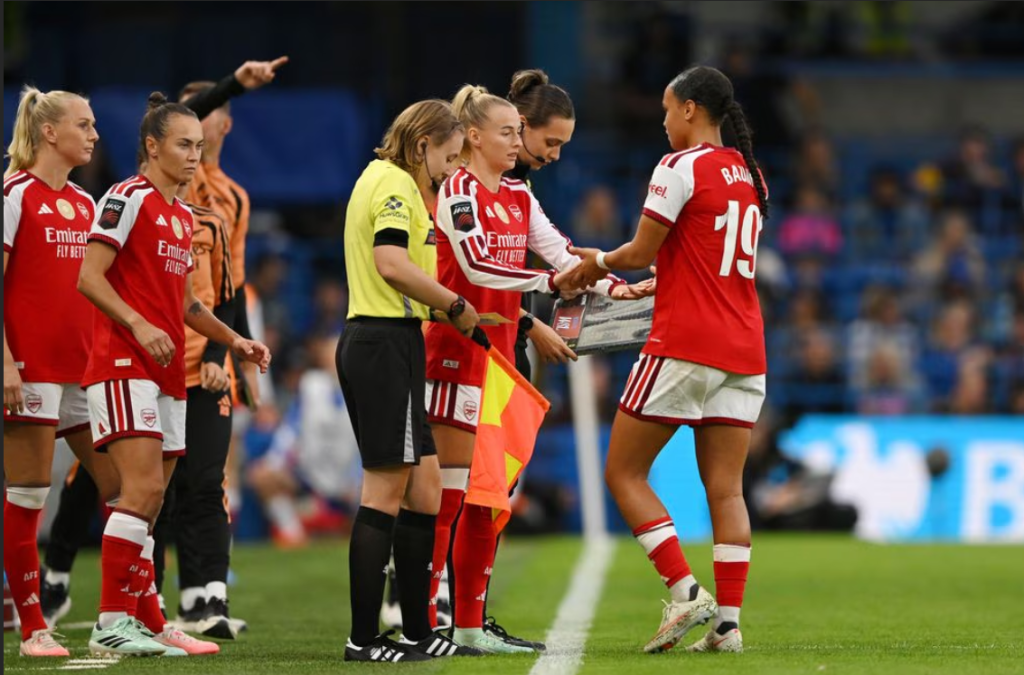
The second half introduced another concern.
With Arsenal trailing 1-0, Slegers made three substitutions shortly after the hour. Caitlin Foord replaced Caldentey, Stina Blackstenius replaced Georgia Stanway and Chloe Kelly came on for Baum.
Slegers explained afterwards that she wanted a new attacking three to create different threats against Chelsea’s back line, adding greater directness and different overloads.
The reasoning is understandable.
The outcome was less convincing.
Arsenal had produced some of their best football during the opening half an hour, when their movement and combinations repeatedly caused Chelsea problems. After the changes, they increasingly looked disjointed and never established the same control.
There was also visible discussion between the players and bench about Arsenal’s shape.
BBC Sport’s Emma Sanders reported from Stamford Bridge that Little was heard asking the bench, “Am I the six now?”
One shouted question should not be exaggerated into evidence of some wider problem within the dressing room, particularly when Slegers offered a plausible explanation afterwards.
Emily Fox had temporarily left the pitch at the same time as the substitutions, meaning Arsenal needed one shape while playing with ten and another when Fox returned. Slegers said the players were therefore receiving two different messages and insisted there was clarity around Arsenal’s overall principles.
That explains the immediate communication.
It does not completely remove the wider question about what Arsenal became after the substitutions.
The changes were designed to make the team more dangerous, but Arsenal arguably became less coherent.
There is also a legitimate question about the hierarchy of Slegers’ attacking options.
Foord and Blackstenius have contributed enormously during their Arsenal careers and both remain important members of the squad. The issue is not whether either deserves to play.
It is whether they represented the most appropriate solution to the particular problem Arsenal were facing.
Cerci had changed the Køge game five days earlier through her willingness to attack defenders and space directly. Smilla Holmberg has repeatedly demonstrated her ability to change the tempo of a game from the right and scored Arsenal’s late equaliser against Manchester United.
Géraldine Reuteler was signed after an outstanding period for club and country but had still not played a competitive minute for Arsenal before Sunday.
Yet Slegers’ first attacking response at Stamford Bridge was to turn to the more established options. Cerci and Reuteler were introduced with nine minutes of normal time remaining. Holmberg did not play.
The question is therefore not whether all three should have been thrown onto the pitch together, but what Arsenal’s attacking hierarchy currently looks like when Slegers needs to change a game.
If directness is required, Cerci has demonstrated it. If Arsenal need intelligent movement into space, Reuteler was recruited with exactly those qualities. If the right side needs additional energy and attacking intent, Holmberg has already demonstrated what she can provide.
Slegers has considerable options. The challenge is using the right one for the problem in front of her rather than automatically returning to the most familiar solution.
Are Arsenal losing clarity?

This is where the questions surrounding Arsenal are beginning to move beyond finishing.
There is no evidence that Slegers has “lost the dressing room”, despite some supporters beginning to make comparisons with the final months of Jonas Eidevall’s time in charge.
Those comparisons should be treated carefully.
A difficult run of results and one moment of confusion during a substitution are nowhere near enough to support such a conclusion.
There is, however, a reasonable question to ask about whether some of the clarity which defined Arsenal during Slegers’ early months has started to disappear.
When she initially took over from Eidevall, one of the most noticeable changes was the freedom within Arsenal’s football. Players appeared to understand their roles, combinations developed naturally and the team eventually carried that momentum all the way to winning the Champions League.
At present, some of that instinct appears to have been replaced by hesitation.
Players are getting into promising positions and taking another touch. Shooting opportunities are being delayed. Potentially dangerous transitions are sometimes slowed sufficiently for the opposition to recover.
That raises an uncomfortable tactical question. Can a team become so concerned with finding the correct position, pass or opportunity that some of its natural attacking instinct begins to disappear?
The individual players involved make that question difficult to dismiss.
Alessia Russo has consistently demonstrated that she can score goals. Olivia Smith is naturally direct. Kelly is hardly a cautious attacking player. Cerci’s instinct is to attack space and Caldentey is one of the most intelligent players in Arsenal’s squad.
When a collection of attacking players with those qualities repeatedly begins to look indecisive around the penalty area, responsibility cannot sit entirely with the individual taking the final shot.
Eventually it becomes a coaching problem too. Slegers continues to back her players and has spoken about maintaining simplicity, protecting them from unnecessary pressure and helping them find the clarity required in front of goal.
Those are sensible principles, but Arsenal are now four league matches into the season with five points from a possible 12 and only two goals.
The same attacking problem has followed them through games against very different opponents.
At some stage, saying Arsenal need to improve in those moments stops being an explanation and becomes the problem the coaching staff must solve.
Arsenal are not a bad team

Perhaps the most frustrating part of Sunday’s defeat is that Arsenal do not look like a poor side.
Had Chelsea comprehensively outplayed them for 90 minutes, the conclusions might be considerably simpler, but they did not.
For a significant part of the first half, Arsenal were the better side at Stamford Bridge. They controlled the game, found promising positions, hit the woodwork twice and caused Chelsea significant problems.
The ingredients remain. What Arsenal are failing to do is turn those dominant periods into something meaningful.
When the opportunity to shoot appears, they need to take it. When the decisive pass becomes available, it has to arrive before the opposition recovers. When momentum begins to change, Slegers has to recognise what the game requires and use the considerable depth available to change it again.
That depth is one reason this situation remains fixable. Cooney-Cross has made an excellent case for continued involvement. Cerci offers directness. Reuteler brings intelligence and movement between spaces. Holmberg has already changed games from the bench. Baum has become one of Arsenal’s most dangerous attacking outlets, while Smith, Russo, Kelly, Foord, Blackstenius and Caldentey provide further options.
There is too much quality available for Arsenal to become predictable. They are not miles away from playing well, which perhaps explains much of the frustration surrounding their start. This is a very good team repeatedly reaching the point where matches can be decided and failing to decide them.
Chelsea did on Sunday – Arsenal did not.
The questions are getting bigger
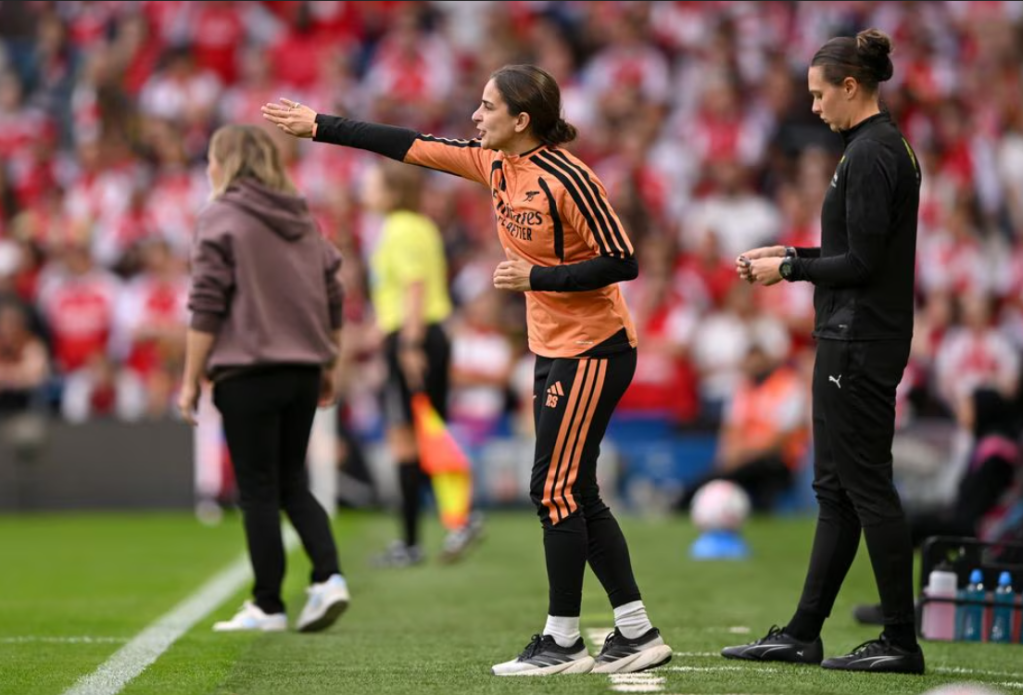
Arsenal have now dropped seven points from their opening four WSL fixtures.
They have conceded only twice, which makes their total of five points particularly striking. The defence is not collapsing and opponents are not creating chance after chance against them.
Arsenal simply are not scoring enough.
That makes it increasingly difficult to continue answering every disappointing result with the same explanation that the team needs to become more clinical.
- Why are so many players hesitating in similar situations?
- Why does the extra touch keep appearing?
- Why is there so little instinct around the penalty area?
- Why, when the attack is not working, are substitutions not consistently changing the nature of it?
Those are now coaching questions as much as player questions.
None of this means Slegers should suddenly be under pressure for her job four league matches into the season, nor does it demonstrate that she has lost her players.
It does mean that, for perhaps the first time since she became Arsenal head coach, legitimate questions are beginning to be asked about more than the players failing to take their chances.
Arsenal travel to Paris FC next in the Champions League before another difficult WSL away fixture against Manchester City.
They do not need to tear everything apart before then, but they need to rediscover the clarity and instinct which made this collection of players so dangerous in the first place.
Because after Palace, Manchester United, Køge and now Chelsea, Arsenal’s attacking problem is becoming increasingly difficult to describe as simply poor finishing.
It is beginning to look bigger than that.
Roberto Revilla is the founder and host of Arsenal Women: Trailblazers, an independent podcast and website providing in-depth analysis and coverage of Arsenal Women. You can find the podcast and Roberto’s latest Arsenal Women writing at Arsenal Women: Trailblazers.
Follow Impetus on social media:
@ImpetusFootball on Threads, Instagram and TikTok.

