Ben Gilby provides a full review from this weekend’s action along with photography from Rob Lizzi andDenyse McCulloch(10/6/24).
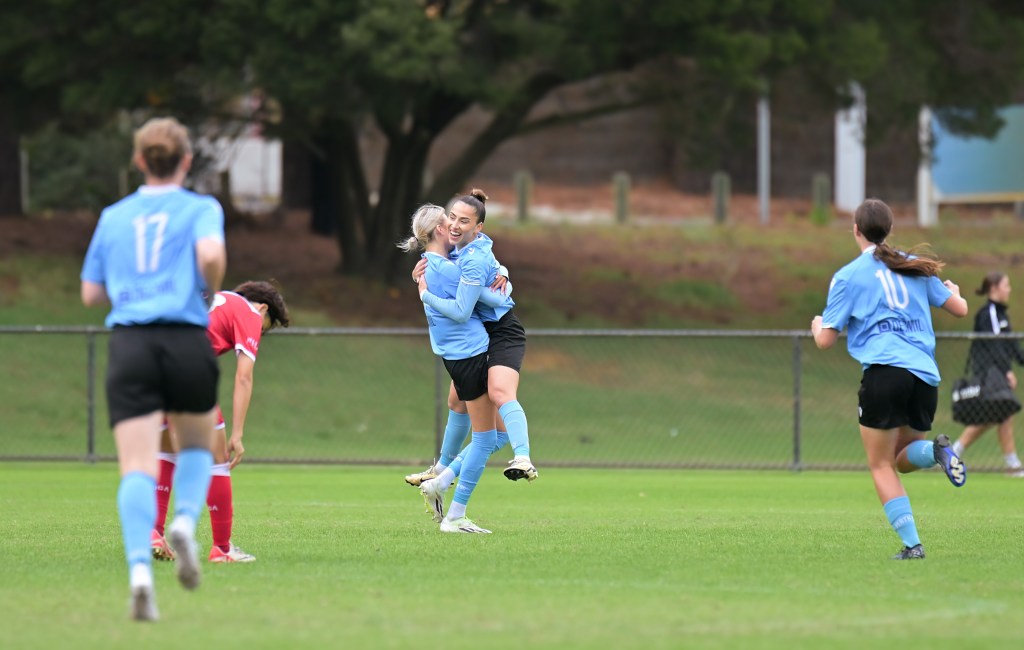
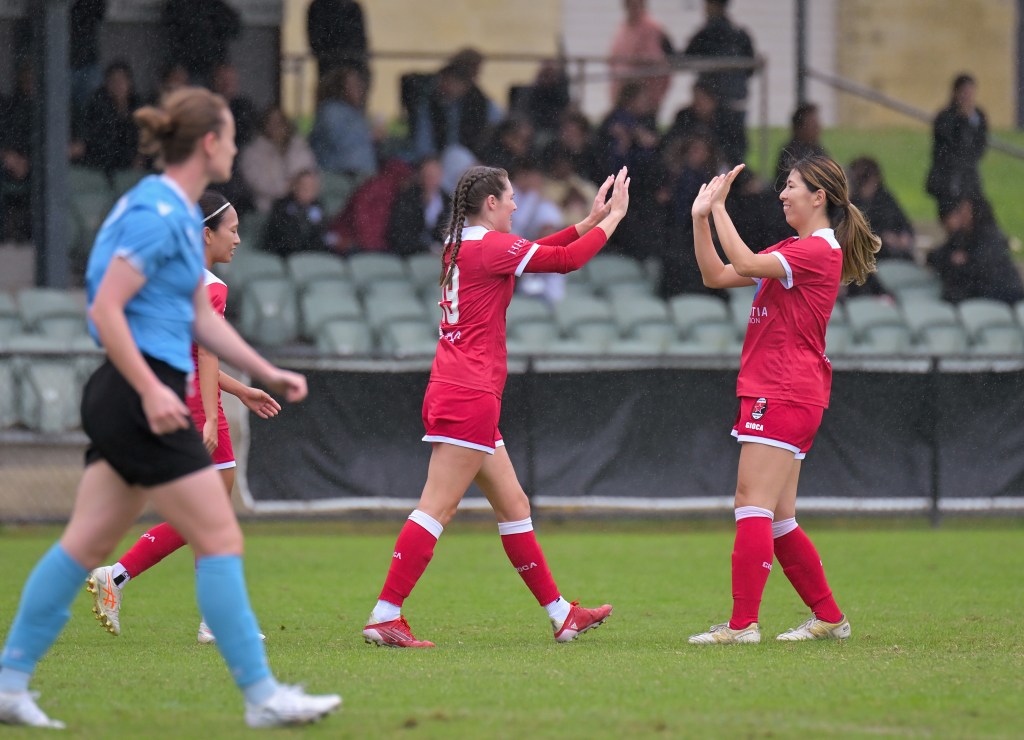
Above:Subiaco celebrate after Marianna Tabain (second left) hit a stunning free kick to put them 1-0 up against UWA-Nedlands yesterday. Photo supplied to Impetus by: Denyse McCulloch (Denyse RM Photography on Facebook).
Round wrap
Murdoch University Melville 2-4 Hyundai NTC
The NTC won their second game in a row with this success at Besteam Stadium against Murdoch University Melville (MUM FC).
Ben Anderton’s teenage side took advantage of a below-par clearance to take the lead with only five minutes on the clock. Brooke Burdett played a pass back to keeper Manon Gebauer who could only direct the ball into the path of Theodora Mouithys. The attacker had the simplest task of hitting into an empty net from 20 yards.
Hyundai NTC doubled their advantage on the half-hour mark as Sakura Leong was able to run at the MUM FC defence along the right before cutting into the box and hitting a low finish past Gebauer.
GOAL! 29:41
Goal in the NPLWA – Women's competition for Hyundai NTC W in the Hyundai NTC W vs MUM FC W match at Besteam Stadium at Murdoch University.
However, the hosts gave themselves a lifeline just after the half-hour mark. Megan Phillips in the NTC goal couldn’t quite deal with Mia Britton’s back pass quick enough, allowing Emmanuella Boaduo in to direct the ball into the net from close range.
Just before the break, NTC tellingly re-established their two-goal lead. Nelli Johnson gathered possession, turned her marker to advance up the field, and then released Britton on the right flank in acres of space. Britton was able to cut inside and fire home across Gebauer and into the net.
The visitors made the game safe just under 10 minutes into the second half after a stunning move made of seven passes ended with Jessica Johnson advancing into the right-hand edge of the box and comfortably slotting home her first of the season against her former club.
GOAL! 53:27
Goal in the NPLWA – Women's competition for Hyundai NTC W in the Hyundai NTC W vs MUM FC W match at Besteam Stadium at Murdoch University.
The home side rallied and reduced the deficit with 25 minutes remaining. Boaduo picked up possession in the centre of the field from Gebauer’s dropkick and fed Taylor Reid who ran into the box to hit a cool finish at the near post. It would be as close as Murdoch University Melville would get.
Subiaco 3-0 UWA-Nedlands
Above: Subiaco’s Tayna Campos (white shirt) leaps for the ball against UWA-Nedlands yesterday. Photo supplied to Impetus by: Denyse McCulloch (Denyse RM Photography on Facebook).
Subi earned an important win in their bid to keep top-four hopes alive against UWA-Nedlands at Rosalie Park in Sunday’s late game.
Greg Farrell’s side went ahead after just six minutes when Marianna Tabain’s stunning free-kick just outside of the box on the left-hand side where the 18-yard area lines meet arrowed into the top right corner.
GOAL! 05:55
Goal in the NPLWA – Women's competition for Subiaco AFC W in the Subiaco AFC W vs UWA Nedlands FC W match at Rosalie Park.
It would become 2-0 just before the quarter-hour mark. Building possession along the left flank, Tayna Campos played in a perfectly weighted pass into the feet of Cass Harvey in the middle of the park. Harvey broke away, held off two defenders, and slotted home under Morgan Springer in the UWA-Nedlands goal.
The home side wrapped up the three points with 12 minutes remaining as Tabain picked up a UWA-Nedlands defensive clearance and found Frankie Murray-Hocking on the left who pulled a low ball across to give Dakota Van-Vugt the easiest of tap-ins from the six-yard line.
More of Denyse McCulloch’s images from the game at Rosalie Park:
Game of the week
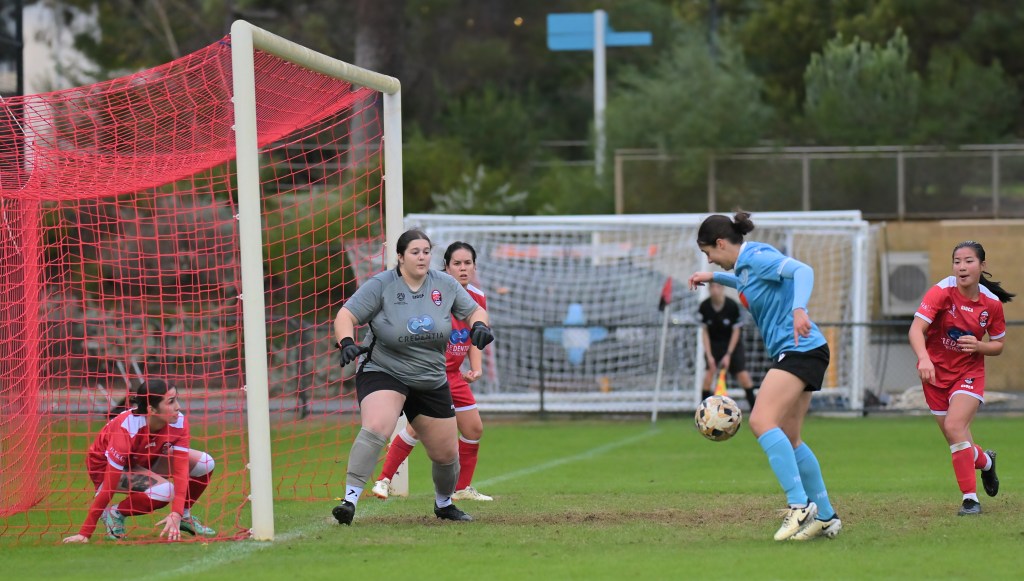
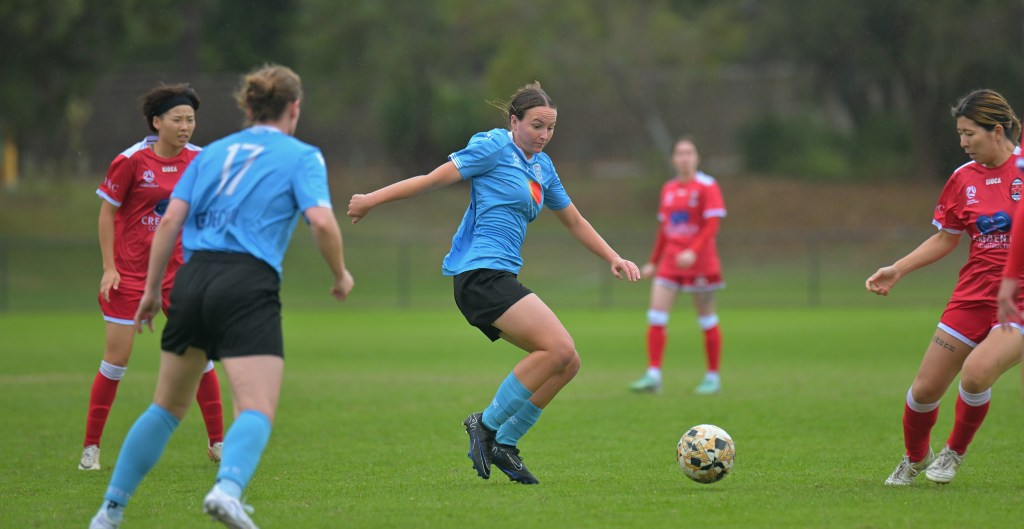
Perth RedStar 3-4 Perth SC
Above: Ella Lincoln drives away for Perth SC at Perth RedStar yesterday. Photo supplied to Impetus by: Rob Lizzi.
Click here to read our detailed match report published yesterday with Rob Lizzi’s photo gallery:
Above: Perth SC celebrate after Kim McCartney’s free-kick put them 4-2 up earlier today. Photo supplied to Impetusby: Rob Lizzi.
Perth SC earned their first-ever NPLW WA win at champions Perth RedStar in a superb seven-goal thriller between the league’s top two sides today.
The Azzurri were never behind against the league leaders, but still needed to score four times in order to ensure their victory which is vital in the context of the title race as Danielle Brogan’s side are now within two points of RedStar.
The visitors went into the game with evidence of yet further strengthening of their squad. Reliable defender Baxter Thew, a key part of the Balcatta Etna backline last season made her first start, and Perth Glory youngster Grace Johnston, who was consistently impressive in her debut A-League Women season before injury, took her place on the bench.
Above: Georgia Cassidy (azure shirt) looks to escape from Reina Kagami today. Photo supplied to Impetus by: Rob Lizzi.
In grey, breezy conditions with rain developing as the game went on, RedStar had the first offensive opportunity, forcing a corner in the opening two minutes. The league leaders were looking to immediately install their rapid press game on The Azzurri to force concession of possession.
So often in the games between these two sides, Perth SC have the better of the first half but struggle to convert chances into goals and pay the ultimate price on the scoreboard. That was not the case this time round as their growing number of dangerous offensive players were at their razor-sharp best.
Just four minutes in, Daisy McAllister, who was outstanding throughout, motored up the right-hand touchline to find Ruby Marshall. Looking up, she fed Ella Lincoln on the edge of the box who turned her defender and let fly with an absolute rocket into the top of the net to put Perth SC ahead.
Above: Ella Lincoln (facing camera) jumps for joy after putting Perth SC ahead at Perth RedStar today. Photo supplied to Impetus by: Rob Lizzi.
Not long after, there was a chance for Brogan’s side to double their lead. Lincoln attacked through the middle and fed Epril Nossent, one of the real unsung heroes of the Azzurri side this season. Nossent repaid the favour for Lincoln to supply a low cross from the right to find McAllister centrally, but Dal Busco saved.
However, as is their wont, RedStar stepped up to the plate, and before the quarter-hour mark were level. Momoko Sakairi turned to find Leota centrally. Kim McCartney tried to hold the menacing home attacker Doeglas for long enough for keeper Stacey Cavill to come out and pounce, but there was a fatal hesitation between the pair and the former Perth Glory player nipped in to turn the ball home from 15 yards.
Above: Caitlin Doeglas (red shirt) rounds Perth SC goalkeeper Stacey Cavill to level the scores today. Photo supplied to Impetus by: Rob Lizzi.
Crucially though for the visitors, they hit back almost immediately. A gloriously well-weighted low ball from McAllister in the centre of the park dissected the RedStar midfield and found Lincoln outside her on the left of the box. Her low ball in was swept home first time at the back post by Marshall.
Perth’s success in this period was down to the dual factors of taking their chances when they came as well as a clever tactical ploy. If one azure shirt lost possession, there was always another in the immediate vicinity to attempt to close down the resulting RedStar threat. They were also playing the crisper football and were that bit pacier with their passing.
RedStar were finding it challenging to get shots in on goal as the visitors were well-organised at the back. Thew was superb alongside the consistently strong Matilda Bohm, Nossent, and McCartney. The keys for the hosts would be Renee Leota and Sarah Carroll who had the vision and the ability to thread telling passes through under the pressure of being closely marked.
Indeed, Leota was involved with the home side’s best chance in the remaining period of the first half as she supplied Manami Arai to break through, but the resulting shot was pushed out for a corner by Cavill in the Perth SC goal.
Above: Perth SC goalkeeper Stacey Cavill makes a save today. Photo supplied to Impetus by: Rob Lizzi.
As the half entered its last five minutes, the visitors stepped up the pressure once more. Lincoln drove across from the left, turned Andreia Teixeira, and played the ball across – it was too pacey for Marshall, but McAllister smashed a shot goalwards from the right of the box that Dal Busco pushed away for a corner.
That proved to be a warning sign as shortly afterwards, Lincoln threaded a pass through for Jess Flannery. Her marker Quyen Doan looked to have the situation under control but unfortunately slipped allowing Lincoln to pick up the pieces and find Flannery in space again outside her. A pass was then squared for McAllister to come in unmarked at the back post to score.
Above: Celebration time for Perth SC at Perth RedStar today. Photo supplied to Impetus by: Rob Lizzi.
Perth RedStar boss Carlos Vega Mena looked to ring the changes at the interval in a bid to change his side’s fortunes, with Abbey Woolley and Jayna Ridley coming on. The early momentum was with the hosts, who forced an immediate corner.
Whilst the Azzurri remained steadfast, generally well-organised at the back, and able to use their pacey passing game to launch attacks with regularity, another one-off error cost them a second goal.
Charli Wainwright sprayed a pass to Georgia Cassidy in the centre of midfield, but the Young Matilda’s control was not to its usual standard and Doeglas gobbled up possession, comfortably beat McCartney in the foot race, and advanced in on goal. Whilst her initial shot was repelled by Cavill, the ball squirmed out to the attacker to side-foot home the rebound for her 10th goal of the campaign.
Above: Caitin Doeglas (red shirt) tries to beat Perth SC’s Matilda Bohm today. Photo supplied to Impetus by: Rob Lizzi.
Despite this setback, the visitors kept plugging away, and they responded immediately with Lincoln crossing from the left for McAllister to angle a first-time shot from the back post that Dal Busco pushed away for a corner.
Three minutes later, Lincoln surged forward through the centre and was brought down by a combination of Doan and Teixeira around 25 yards from goal, to the left of centre. McCartney picked up the ball and fired in the free-kick which bounced in front of the diving Dal Busco at the left-hand post and into the net to restore their two-goal advantage.
Above: Kim McCartney’s free-kick bounces in front on Perth RedStar goalkeeper Gabby Dal Busco and into the net for Perth SC’s fourth goal today. Photo supplied to Impetus by: Rob Lizzi.
Perth SC were now visibly full of confidence. They kept possession by playing pacey passing football to continue to come forward when opportunities were there. Wainwright put in another superb shift that belied her tender years. Her vision and passing ability marks her out as a potential A-League player of the future.
In addition, Perth were well marshalled at the back, with a switched-on push to catch RedStar offside. These tactics resulted in the defending champions being largely held at arms-length, with very few penetrations into the visitors’ penalty box.
There would be though one further goal for the hosts. With six minutes left, Mischa Anderson floated an intelligent corner right into the mix. Cavill, under heavy pressure, couldn’t make sufficient contact to get the ball away, allowing Reina Kagami to fire home. A grandstand finish was in the offing.
Above: Perth RedStar set up a dramatic finale after bringing it back to 4-3 with six minutes remaining. Photosupplied to Impetus by: Rob Lizzi.
Yet, RedStar were not able to mount the time-honoured siege of their opposition box to gain a late equaliser that they have done so often before.
Indeed, it was Perth SC who had the best chance to grab a further goal in the final minute of regulation time. McCartney’s corner came in from the right and was met by a firm header from Marshall in the middle of the box. Teixeira was at full stretch on the goalline to prevent it from going in, then substitute Anika Stajcic’s follow-up from close range was repelled magnificently by Dal Busco. Closer inspections of the match footage after the event would show that the ball was behind the line when Teixeira cleared it.
Above: Anika Stajcic (azure shirt) has a late chance to increase Perth SC’s lead today, but Perth RedStar goalkeeper Gabby Dal Busco pulled off a sensational save. Photo supplied to Impetus by: Rob Lizzi.
The final whistle brought the win for Perth SC. It was an intelligent performance that saw them complete all the jobs necessary to send RedStar to a rare defeat – take chances when they come, remain focussed and well-organised at the back, and have all key players performing at the top of their game for the full 90 minutes. Despite that though, RedStar still scored three times.
Whilst this result will be savoured at Dorrien Gardens today, it doesn’t get any easier for the Azzurri next weekend. They will travel to in-form Balcatta Etna who have so many weapons that can trouble the Perth defence. If they can come through that challenge with a win, there can be ever greater positivity about what the club can achieve this season.
Perth RedStar next face UWA-Nedlands, and one feels that they will be firing at 110% next weekend to put this result behind them.
Further images from Rob Lizzi at RedStar Arena today:
Don’t miss Ben Gilby’s review of the round’s other two games – on the site tomorrow evening.
NPLW Victoria: Bentleigh Greens FC 1-4 South Melbourne FC
By Joe Rosedon 9/6/24
South Melbourne scored four goals to defeat Bentleigh Greens FC. Goals from Emily Roach, Meisha Westland and a double from Danielle Micallef contributed to a stunning second half performance.
It was South Melbourne who had the first opportunity of the game. Tayla Christensen collected the ball in her own half, drove to the outside of the box and hammered the ball of the crossbar
But it was Bentleigh Greens who opened the scoring against the run of play. Isabella Fernandez was found with acres of space down the left-hand side. Her cutback reached Madeline Cook whose initial effort produced an excellent save from Christina Esposito. However, following in was Candice Kilderry to fire home the parried ball to give the home team the lead. Kilderry almost set up a second for Bentleigh, her cross was poked away from Isabella Fernandez by Espostitoin the penalty area.
Cook could have scored too for Bentleigh in the latter stages of the first half, winning the ball back from Grace Rapp high up the pitch but curled her effort just wide of the post
South Melbourne opened the half with hitting the crossbar and closed the first half by hitting the crossbar. A dangerous corner caused chaos in the Bentleigh Greens defence; Maeve Brown’s eventual clearance clipping the bar on its way out of play.
From the outset of the second half, South Melbourne ramped up the pressure. This pressure was awarded with a penalty as Aimee Medwin was tripped in the box. Emily Roach did therest, scoring her third goal of the season to equalise
It felt as if a second goal for South Melbourne was just around the corner. Indeed, it was, and this time Medwin was the architect. Her intricate dribbling manufactured space down the right- hand side, past Jueun Han. Her cross was pinpoint for Mesiha Westland who had the simple task to head home. South Melbourne had turned it around in the space of twenty second half minutes.
But South Melbourne had not finished the goal scoring yet and third came from the penalty spot once again and it was Medwin who was brought down once again. This time it was captain Danielle Micallef’s turn to convert from twelve yards to give South Melbourne a 3-1 lead
The captain then added the fourth and final goal. A clearance from Bentleigh’s goalkeeper Melissa Barbieri could only find Tayla Christensen who fed the ball to Micallef. She composed herself and slotted home to seal the victory for South Melbourne.
South Melbourne keep the gap to one point between themselves in fourth and Essendon in third after this victory. Their next game is at home against second placed Preston Lions. A victory there could see them move up past Preston into second place, depending on other results
This is Bentleigh’s eight defeat in a row which leaves them second from bottom with six points. They next face Box Hill United who sit two places above them in the table in ninth. A victory in the game could see them climb up one place up to tenth in the table.
Above: Liverpool come together – their superb season is the latest in a series of positive years the club has had after a period in the doldrums. Photo: Liverpool FC Women.
It is an exciting time to be a fan of Liverpool. After years in the mire, the club is on an upward trajectory and is pushing to break into the elusive top-three group at the summit of the Women’s Super League. After years of ups and downs, the club has gained stability and, most crucially, investment and interest from those at the top.
Liverpool were founded in 1989 as Newton LFC, but it took until 1994 for that club to be associated with Liverpool FC, adopting the name Liverpool Ladies FC. The 90s were a successful period for the club, maintaining its position in the Premier League National Division, the top tier of women’s football between 1991 and 2010. For its final three years of existence between 2010 and 2013, the league became the second tier.
Above: The 1994/95 Liverpool team. Photo: Match Programme of 1995 Women’s FA Cup Semi-Final.
Liverpool reached the FA Cup final twice in 1995 and 1996, but they failed to win either. As with many women’s football teams, funding issues reared their ugly head, and Liverpool fell foul. They were relegated to the Northern Division in 2003, returned to the National Premier League the year after, and were subsequently relegated again. Between 2004 and 2011, the club fluctuated between promotion and relegation but were able to stabilise and became a founding member of the Women’s Super League in 2011.
The year after, current manager Matt Beard joined for his first spell at the club, leading Liverpool into their most successful period in their history, winning back-to-back Women’s Super League titles in 2013 and 2014 and making their Champions League debut. At the time, the club boasted players such as Lucy Bronze and Fara Williams, ending Arsenal’s nine-year grip on the league title. During the period, Liverpool became the first club in England to offer professional contracts for their women’s team, revolutionising women’s football in the country and opening the pathway for a future all-professional league.
Above: Liverpool’s 2013 WSL winning team. Photo: Kevin Walsh.
In September 2015, Beard announced that he was leaving the club to take over at Boston Breakers in the USA, and things began to fall apart, finishing seventh in the league. When his departure was announced, Beard said,” I feel like I need a new challenge and I feel I have taken the club as far as I can.” From his perspective, a fresh approach seemed the best way for Liverpool to progress to a new level but evidentially this could not have been further from the truth.
The women’s side lost key players such as Bronze alongside emerging talents such as Caroline Weir, Alex Greenwood, Shanice van de Sanden, and Asisat Oshoala. Considering what these players went on to achieve, it would be fair to suggest that Liverpool’s long-term fans have had regular thoughts of ‘what might have been…’
Bronze left the club to join Manchester City in 2016, where she won the league and cup double in her first season. She then went on to Olympique Lyonnais to win four Champions League titles. Weir would also join Manchester City in 2018, winning two Conti Cups, and two FA Cups. Greenwood, alongside Bronze, won the Champions League at Lyon. When Oshoala moved to Barcelona, she was a key player in establishing them as the premier dynasty in women’s football, winning everything with the Catalan club. The key thread here is that all these world-class players felt they could not achieve the biggest honours in football whilst playing for Liverpool any more.
Above: Matt Beard (right) gives advice during a Liverpool game at Lewes. Photo: James Boyes.
For a club that is so highly revered and respected around the world, this was a serious stain on its reputation and should have been a warning sign that the situation needed drastic attention and improvement. They failed to heed the warnings. In the 2018/19 season, Liverpool spent £733,257 on wages. This contrasts with Manchester City’s wage budget of above £1.9 million for the same season.
Although Manchester City are a financial juggernaut bankrolled by a nation-state, Liverpool is by no means an impoverished club and could have matched or even overtook City in terms of investment. During that season, the men’s team spent just over £160,000,000 on transfer fees alone, not including the vast wages on top of that. In comparison, £1,900,000 seems like a drop in the ocean. Although it would be somewhat reductive to suggest that all of Liverpool’s issues at this time were based around investment, the teams that are at the top are often accompanied by the highest budgets, and Liverpool was failing to keep up. That season Manchester City finished second in the table compared with Liverpool’s eighth-place finish. Occam’s Razor rings true here.
The 2019/20 season was the culmination of years of disinterest and disregard. This season was riddled with issues from top to bottom that signified the disconnect between the team and the club that had developed. In a cruel twist of irony, whilst the Liverpool men’s side won their first Premier League title, the women’s side games were getting postponed due to the waterlogged pitches at Tranmere Rovers’ Prenton Park, Liverpool’s home ground. After Liverpool’s 1-1 draw against Chelsea that season, Emma Hayes said: “I think the quality of that pitch – the worst in the league – is a stain on their football club.”
The team eventually relocated their remaining games to Chester FC’s Deva Stadium, a near one-and-a-half-hour journey by public transport. Although the club were put into a difficult position regarding external factors such as excessive rainfall, a club of Liverpool’s size and financial might should have been proactive, whether scheduling postponed games at Anfield or at the very least finding a ground that was actually in the Merseyside area so that fans in the local area could attend games with relative ease.
Above: The Liverpool squad that took on Tottenham Hotspur on 19th September 2019 at The Hive. Photo: Kaite Chan.
At the time, the women’s side based at Tranmere Rovers’ facility, The Campus. At the same time, the men’s side had moved into a brand-new training ground alongside its academy team, yet there was no consideration for the women’s team.
Regarding the new facilities, Liverpool Director Andy Hughes said, “Everything we set out to achieve – everyone on one side and in world-class facilities”. But this statement was a clear contradiction. How could the club director claim to have “everyone on one side” but have no space for the women’s team to join their colleagues from the men’s and academy sides?
The departures, both players and coach, were not isolated incidents, rather they were emblematic of the poisonous cocktail of decay and apathy that had taken over at the club. It seemed inevitable that the club would drop out of the Women’s Super League, and they did, finishing last in the COVID-shortened 2019/20 season.
Subsequently, another batch of players left the club, their reasons being the most telling of the situation the club faced. Forward Courtney Sweetman-Kirk said upon her departure, “It’s time for a change and a new environment that challenges me as a player and as a person.” Goalkeeper Fran Kitching said, “I can’t wait to be enjoying the game I love again and being truly happy.”
It is often darkest before the dawn. Susan Black was given the role of Executive Director of Liverpool Women in September 2020. In retrospect, this appointment was the catalyst for Liverpool’s steady rise back to the top table of women’s football in England. Her first season in the role can be summarised by two major decisions made by the club.
The first was an increase in funding. The Athletic reported a 21% increase in spending for the women’s team, a reduction in losses, and an increase in the number of permanent staff dedicated to the women’s team. Black must be credited with renewing the interest from those in senior positions at Liverpool, in having ambitions for the women’s side to reach the heights of yesteryear.
Above: Susan Black, whose appointment was the start of things moving in a positive direction again at the club. Photo: Liverpool FC Women.
The other critical decision centred around on-field matters. When Liverpool began the 2020/21 season in the Women’s Championship, they were led by Vicky Jepson who joined the club in 2018 and oversaw the team amid extensive chaos and uncertainty. Despite this, she remained in her job with the aim to return Liverpool to the WSL as soon as possible.
The season began in frustrating fashion, conceding a late equaliser against eventual title rivals Durham in a 1-1 draw. Durham, a solely women’s outfit proving to a football dignitary like Liverpool that name recognition is far from enough on its own to generate success in women’s football. They followed this draw with three consecutive victories against London Bees, Charlton Athletic, and Coventry United before falling to a 2-1 defeat against eventual promotion winners Leicester City.
The first half of the season followed a similar pattern. Liverpool would seem as if they had figured out how to be successful in the Championship only to come unstuck by a disappointing result, often conceding a late goal. This pattern of form came to a head with back-to-back defeats against Durham and Leicester City.
This was enough to see Jepson resign from her role as manager, replaced by her assistant Amber Whiteley in an interim role for the rest of the season. Although form improved for the rest of the season, it was not enough to secure a return to the WSL, finishing in third position.
The season did have positive aspects to it, however. Young players such as Missy Bo Kernes and Taylor Hinds were given plenty of game time to establish themselves as key parts of the future of the club. Now both players are regular starters in the WSL, Kernes even receiving her first call-up to the Lionesses squad against France as a standby player.
Above: Missy Bo Kearns – a member of the Liverpool side who have grown from a Championship side to a dangerous WSL one. Photo: Liverpool FC Women.
After finding their feet at a lower level, Liverpool needed to hit their stride going into the 2021/22 season, with a return to the WSL paramount. Both on and off the pitch Liverpool delivered. They finished the season in first, eleven points clear of second-placed London City Lionesses, and went a staggering nineteen games unbeaten. Key additions over the both the summer and January transfer windows took the club to the next level.
The signing of Leanne Kiernan transpired to be one of the most important. Kiernan joined the club from West Ham United and despite making regular appearances for the East London side, it had not quite clicked for the Ireland international in terms of goal-scoring returns. However, at Liverpool she thrived, scoring thirteen goals in twenty-two league appearances.
She was joined in January by American Katie Stengel. Stengel, who had previously played in her home country, Australia, Germany, and for Norwegian side Vålerenga provided a wealth of experience. She went onto score an impressive eight goals in 12, giving Liverpool a timely boost in their journey to promotion. Their return to the WSL was sealed with a 4-2 away victory against Bristol City, with two games to spare.
While the side went from strength to strength on the pitch, off the pitch mirrored it. Russ Fraser was appointed Liverpool’s first Managing Director of the women’s team in October 2021. Susan Black said: “His appointment builds on the solid foundation changes already put in place at LFC Women, giving us a structure led by an experienced women’s football leader who can take us forward and continue our rebuilding journey step by step.”
Statements along these lines suggested that a significant shift in focus had taken place and that Liverpool were being much more assertive in terms of women’s football.
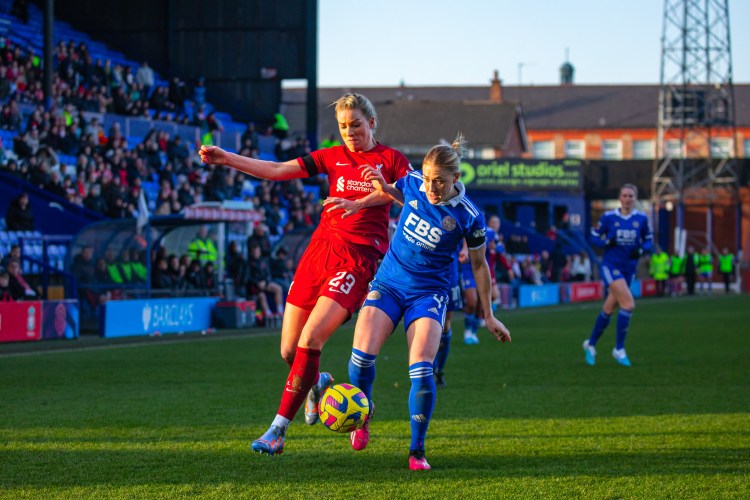
Above: Liverpool contest possession with Leicester City at Prenton Park during 2022/23. Photo: Matthew Appleby for Impetus.
Their first season back in the Women’s Super League resulted in a respectable seventh-place finish. They opened their campaign with a stunning 2-1 victory against reigning WSL champions Chelsea. Stengel slotted away two second-half penalties to ensure all three points. However, the season would be typified by inconsistency. Following this sensational victory, The Reds fell back down to earth, losing 3-0 to local rivals Everton in front of over 27,000 fans at Anfield.
This kickstarted a seven-game winless streak which was finally ended with a 2-0 win over West Ham United. Towards the end of the season, they were able to get crucial wins against Tottenham Hotspur, Brighton and Hove Albion, and Champions League-chasing Manchester City to make sure their WSL status was retained.
Stengel’s goalscoring form continued with the American scoring nine goals in twenty-one league games. These goals were especially crucial as Liverpool only scored twenty-four goal league goals.
However, the most important achievement of that season was the club repurchasing their previous training ground, Melwood, and dedicating it as a permanent home for the women’s team for the 2023/24 season. After years at unsuitable facilities for top-level professional athletes, the players finally had somewhere to call home.
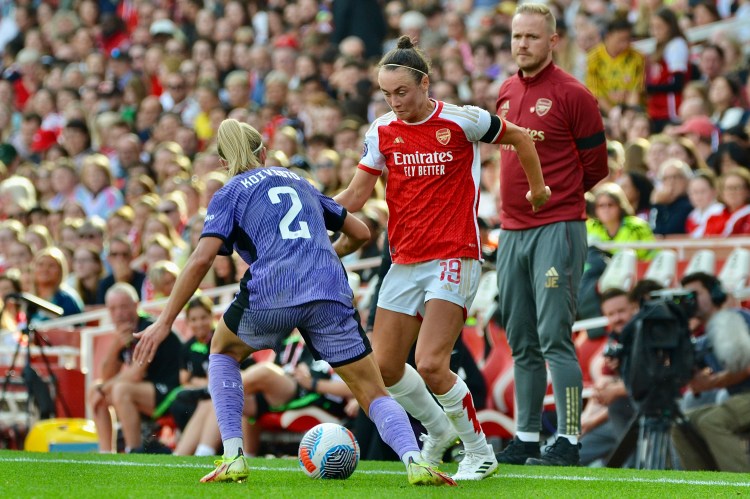
With a committed board, a vastly experienced manager, and a dedicated training facility, Liverpool had all the ingredients for a successful 2023/24. Their opening-day victory against Arsenal at the Emirates Stadium was a thrilling start. Beard’s tactical nous shone through, producing a brilliant defensive masterclass from his team. They limited the home side to three shots on target, forcing them into aimless crosses which experienced defenders like Gemma Bonner could easily combat.
Above: Liverpool’s Emma Koivisto (2) looks to deny Arsenal’s Caitlin Foord in their opening day win over the North London side at the Emirates Stadium. Photo: Mariella Prew for Impetus.
Considering the attacking talent Arsenal possess, this was an incredibly impressive achievement and put them in good stead for the rest of the season. They followed this up with a 2-0 home win over Aston Villa. Unlike last season where they failed to follow up on an outstanding opening-day victory, Liverpool showed that the consistency issues that had plagued them seemed to evaporate.
Beard’s experience paid off in another home win against Chelsea but in a different context. After Chelsea’s physically and mentally tiring defeat to Barcelona in the Champions League, Beard knew they would be vulnerable.
A chaotic game ended in a 4-3 Liverpool win, their attrition proving the key factor in this victory. However, the highlight of the season must be winning both home and away against fierce rivals Manchester United, their first success against the Red Devils in the WSL. These victories propelled Liverpool to a fourth-place finish, their highest place since last winning the league title in 2014.
However, there have been disappointments this season, particularly the FA Cup quarter-final defeat to Leicester City, which, looking at how the competitions have panned out, could have been a real opportunity for silverware this season. But the current makeup and construction of the squad will lead to continued chances of trophies soon.
Beard’s ability to blend experienced players with high-potential prospects has been critical to Liverpool’s success. Their current squad features WSL stalwarts such as Bonnar, Rachel Laws, Niamh Fahey, and Melissa Lawley. They have been paired with younger players such as Mia Enderby, Jenna Clark, and Kernes.
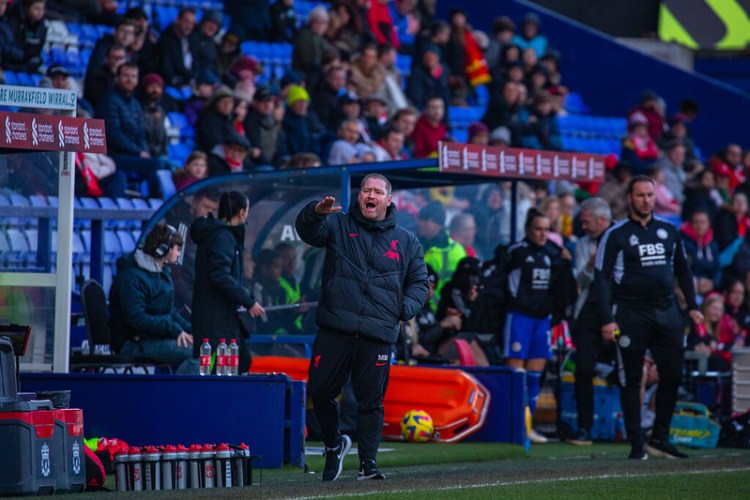
Above: Liverpool head coach Matt Beard. Photo: Matt Appleby for Impetus.
This blend has allowed the experienced players to solidify Liverpool’s status in the league so that when they eventually move on from the club, the younger players will be able to take their places and benefit from the foundations that have been set. Alongside this, recruitment has been excellent. The January transfer window saw the arrival of Marie Höbinger, Sophie Román Haug, Teagan Micah, and Grace Fisk, who all have improved the squad.
Höbinger has had an outstanding season in the Red’s midfield, scoring important goals against Bristol City and Aston Villa, but it is in the creative aspect of her game that she ranks amongst the best midfielders in the league this season. She ranks joint fourth in the league for assists, providing three in the stunning 4-3 victory over Chelsea and another in a 1-0 win against fierce rivals Manchester United in the same week.
Höbinger has also taken the creative burden from the shoulders of Emma Koivisto who was provided four assists last season, the most of any Liverpool player. This allowed Koivisto, who mainly plays in a right wing-back role, to focus more on defensive duties.
One of her favoured attacking options has been fellow new addition Haug. The forward joined from Roma and finished the season with seven goals in the WSL, Liverpool’s current top scorer. Her aerial presence has been a real threat, winning 105 aerial duals this season, double the number of second-placed Millie Turner.
This need became even more crucial when Stengel departed the club last summer, so it is commendable that Haug has been able to take over the goal-scoring mantel. Liverpool’s goals increased to a total of thirty-six. Although clearly the goal-scoring department is heading in the right direction, it’s an area that needs to be focused on. Haug was often paired with Enderby in a front two, so the Norwegian would be more than comfortable playing alongside another forward if Liverpool decide to add more bodies in that area of the pitch.
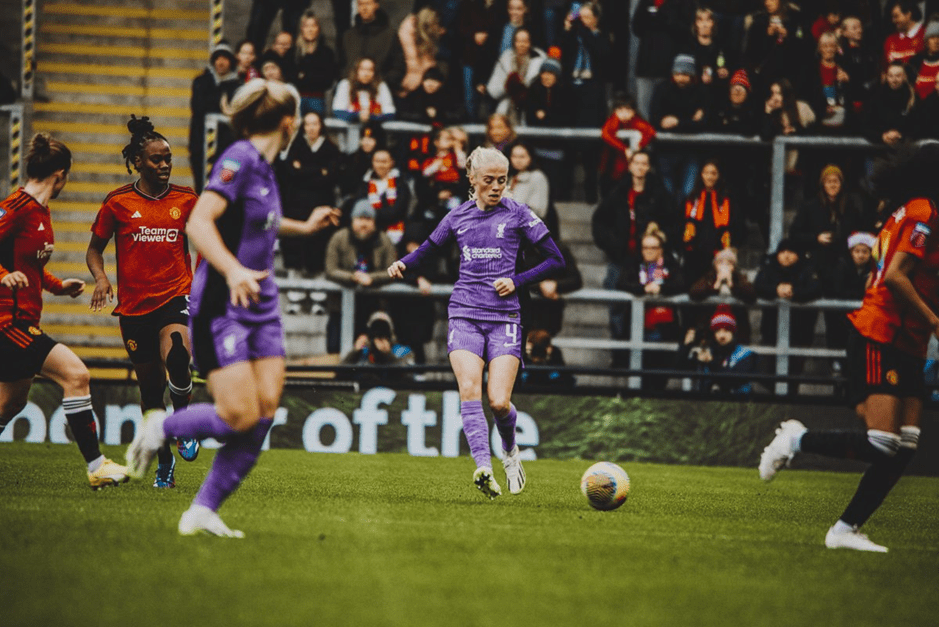
Above: Grace Fisk (4) in action for Liverpool at Manchester United this season. Photo: Liverpool FC Women.
Fisk as well has also proved to be a crucial signing. The defender joined from Beard’s former club, West Ham United, and has started every game in the league this season. Her performances this season should have her on the cusp of a Lionesses call-up. She has slotted well into a back three alongside Clark and Bonner.
Liverpool’s robust defence has been their defining feature, conceding the fourth least number of goals this season with twenty-eight. Fisk has played an important role in aiding this defensive stability. Not only has she flourished defensively, but her on-the-ball ability is just as important to her game, completing the most progressive passes so far in her career at 94. In comparison, the most she completed at her previous club West Ham was 32.
When called upon this season, Micah has done a solid job deputising for Laws. The Matilda, who had already won two league titles in Sweden with FC Rosengård, produced solid performances when called upon this season. Her standout moment would be the spectacular save she produced to deny Aggie Beaver Jones in the 4-3 win over Chelsea. There will certainly be more opportunities for the Australian in the pipeline
Looking towards the 2024/25 season, Liverpool made another major announcement. The club has moved from Prenton Park to the Totally Wicked Stadium in St. Helens, agreeing a ten-year leasing agreement with the world-renowned rugby league club. It was additionally announced that more home games will be played at Anfield.
While The Totally Wicked Stadium is a much more contemporary facility to Prenton Park, it is further away from Liverpool, clocking in at just under 40 minutes on the train from Lime Street Station. The club clearly feels it is the right step in the right direction, but it potentially will take longer for fans to be on board with the move. Announcing more games at Anfield however is an across-the-board positive move, signifying the importance status the club has in the wider Liverpool family.
Above: St. Helens RLFC’s Totally Wicked Stadium, Liverpool’s new home stadium. Photo: Rodhullandemu.
The adage states that three times is the charm. After two periods when Liverpool’s future was bright, these have turned out to be false dawns. On this, the third time around, fans, players, and those at the top of the club hope this rings true.
Above: The Young Matildas squad together at the U20 Asian Cup earlier this year. Photo supplied to Impetus by: Football Australia.
The Young Matildas have been drawn in Group A for the FIFA U20 Women’s World Cup, and will take on hosts Colombia in the opening game of the tournament on 31st August.
Australia will also face Mexico and Cameroon during the round-robin stage of the competition that features 24 nations for the first time. The biennial global youth showcase will take place from 31 August – 22 September across four venues in Colombia.
Today’s draw took place at Hall 74 Centro de Eventos in the Colombian capital, Bogotá. Australia was drawn out of pot three which also included Korea Republic, Ghana, Canada, Paraguay, and Argentina.
Australia will call Estadio El Campín in Bogotá home with all three of their group stage matches to be held in the 39,000-capacity stadium.
They will open their campaign and the tournament against Colombia on Saturday 31st August (local) before taking on Mexico on Tuesday 3rd September (local), finally completing their group play against Cameroon on Friday 6th September (local).
Young Matildas’ Head Coach Leah Blayney, who was in attendance for the draw, expressed her delight at opening the tournament against the hosts and discovering their opponents for the group stage.
Above: Young Matildas head coach Leah Blayney. Image: Football Australia.
“We are very pleased with the draw today and extremely excited to come to Colombia and play in the opening match of U20 Women’s World Cup,” Blayney said.
“After featuring in the opening match back in 2022, we know what an occasion this will once again be for our playing group with the passionate Colombian crowd in attendance. We expect the atmosphere to be second to none and for it to be an incredible opportunity we will be looking to fully embrace.”
“Drawing Colombia, Mexico, and Cameroon is an enticing prospect and will provide our team with a diverse range of playing styles to tackle. This exposure to a mix of football systems and cultures will provide so many fantastic learning and developmental moments and be beneficial for their long-term careers.
“Our preparation for our group stage rivals will have to encompass playing against those similar playing types and formations. We are very fortunate that we’ve got a versatile playing group and tactically we feel like we’re in a good place around our flexibility. That’s going to be something that we’re going to look to test ourselves at this World Cup,” concluded Blayney.
This will mark Australia’s fifth appearance at the tournament with the Young Matildas qualifying for the tournament by taking home bronze at the AFC U20 Women’s Asian Cup in Uzbekistan earlier this year. They will represent Asia alongside former winners North Korea, reigning U20 silver medallists Japan, and Korea Republic.
Entering its 11th edition, the FIFA U-20 Women’s World Cup sees the 24 competing countries divided into six groups of four teams. The top two nations from each group, and the two best third-place finishers following the completion of group play will progress to the knockout phase.
A round of 16 will take place for the first time in tournament history and is scheduled for 11th and 12th September, with the quarterfinals contested on Sunday 15th September. The semi-finals will be held on Wednesday 18th September with the final to be played on Sunday 22nd September 2024.
DRAW FOR GROUP STAGE OF U20 WORLD CUP:
Group A: Colombia, Australia, Cameroon, Mexico.
Group B: France, Canada, Brazil, Fiji.
Group C: Spain, USA, Paraguay, Morocco.
Group D: Germany, Venezuela, Nigeria, Korea Republic.
Group E: Japan, New Zealand, Ghana, Australia.
Group F: North Korea, Argentina, Costa Rica, Netherlands.
Balcatta Etna‘s Abbey Meakins was announced as Impetus’ NPLW WA Player of the Month for May last week. She speaks to Ben Gilby about a bittersweet 2023 campaign, her move to Balcatta, and aims for a successful 2024 (5/6/24).
Above:Abbey Meakins (left) in action for Balcatta Etna against her previous side Perth SC earlier this season. Photo supplied to Impetus by: Rob Lizzi.
Abbey Meakins is back to her best after a frustrating 2023 season. The newly crowned Impetus NPLW WA Player of the Month for May was part of a strong Perth SC side who captured their first-ever trophy before injury struck Meakins and many of her teammates. Now at Balcatta Etna, the attacker is aiming to seal more success this time round.
A strong Perth SC team had just gained their first piece of silverware, defeating the perennially successful Perth RedStar in the 2023 Night Series Grand Final. A major challenge looked set to be mounted by the Azzurri to bring a first NPLW WA league title back to Dorrien Gardens – but then a string of regular starters picked up long-term injuries. Despite this, the team still made the Top Four Cup Final, but there still remains lingering thoughts of what might have been. Meakins began our chat by reflecting on that period.
“Last season was tough as we had such a strong start to the year winning the Night Series, and doing well early on in the league. We had a really solid well-balanced team, but unfortunately, had a lot of serious injuries throughout the year. I had surgery after a freak accident from a ball to the wrist at training where I ended up with a badly broken wrist, a plate was put in, and serious ligament damage that kept me out for six months. It was a frustrating few months as we had injury after injury, however, I am back out on the park now and really enjoying my football.
Above: Abbey Meakins (second left, middle row) with her Perth SC teammates after winning the 2023 Night Series Grand Final. Photo supplied to Impetus by: Rob Lizzi.
“I thought we had a really positive season, we won the Night Series, finished second in the league, and played in the Top Four Cup Final. There was a lot of opportunity for playing time for the young girls with all the injuries we had, and they really stepped up in the second half of the year.
“Since Pete Rakic took over the coaching job at Perth (in 2022), I thought I probably played some of my best football in that year and a half before I got injured. Pete’s philosophy really aligns with how I love to play the game.”
Meakins is a player well versed in making brave comebacks from injury – the period from 2019-2021 was one of continuing major challenges, notably two back-to-back ACL injuries.
“That ACL reconstruction in 2019 was the biggest challenge I have faced in my career. I had just come out of a season at Perth Glory where I had managed to play a few games and was feeling at the top of my game. Unfortunately, I tore my ACL in the second Night Series game back which ended up keeping me out of the game for 16 months due to the next season being delayed because of COVID.
“I looked at my injury as a blessing in disguise, I was able to take a break from football for some time which I hadn’t had in many years – spending more time with friends, focusing on my university studies, and going on lots of holidays. Focusing on these things helped me to overcome the challenges of an ACL injury, and once I was back playing, I really started to enjoy my football again.”
Above: Abbey Meakins during her spell with Perth Glory in what was then the W-League. Photo: Perth Glory.
Following the end of the 2023 NPLW WA season and her recovery from the wrist and ligament injuries, Perth SC’s head coach Rakic decided to make the move to take up a similar role across at Balcatta Etna. Meakins was one of several former Azzurri players to join him.
“When I knew he (Rakic) was moving across that was ultimately the deciding factor in my decision. As well as a few of my closest friends moving to Balcatta, I saw it as a great opportunity, however, it was a tough decision since I had been at Perth from their very first season in the NPLW and had some great memories at the club.
“Balcatta looked to be invested in the women’s game, as well as having some great supportive people around the club which has fostered a great culture. They seemed to really believe in what Pete would bring to the club from a coaching perspective, as well as being excited at the thought of having quite a few of us players join the club.”
Meakins was just one of several high-quality new players coming into Balcatta ahead of the 2024 season. Whilst a number of players came across from Perth SC, there were several other new faces from different backgrounds. Such a changed team could have taken a long time to find their feet, but Balcatta made the Night Series Grand Final and are firmly established in the top four. The attacker explained the key reasons for her new club hitting the ground running.
“We have gelled really well as a team so far, a lot quicker than I expected considering Pete brings such a different game plan to what a lot of the existing Balcatta girls, and few new players are used to playing. Not only from a footballing perspective has everyone gelled well, off the pitch we have a great culture and all the girls are getting on really well.
Above: Abbey Meakins (dark blue shirt) battles away against her former Perth SC side earlier this season. Photo supplied to Impetus by: Rob Lizzi.
“It’s been exciting to play with players like Kat Jukic, Lucy Jerram, and Jamie Lee Gale who I’ve played against for many years, and now find myself on the same team. We still have a lot of work to do, and I feel like we have so much more to give as the season goes on, which I’m really excited for.”
Meakins herself has been in fine goalscoring form, with 11 goals in eight NPLW WA games, and is well on her way to hitting one of her identified targets for the season.
“I’m hoping to stay injury-free and just play some really consistent football this season. Obviously, last year was quite frustrating personally, so to stay out on the park, play some exciting football and hopefully get on the scoresheet a bit more will be my main aim for this year.
“As a team, I think we have the players and ability to take it to any team this year. We want to be in the title race fighting for silverware and really push teams like RedStar who have had so much success over the past few seasons. We had a great start to the Night Series and the first few games of the season, so we will be looking to continuously improve our game plan and start to become a really consistent team.”
For any team in the NPLW WA, Perth RedStar are the team that need to be beaten in order to ensure silverware can be won. Carlos Vega Mena’s team has such tactical nous and that sheer relentless ability which makes it exceptionally challenging for anyone to defeat them. Meakins though believes that she knows what her Balcatta team need to do.
“I think consistency over 90 minutes as well as having the hunger and desire to win games will help us to overcome teams like RedStar. In the Night Series Final (which saw Perth RedStar defeat Balcatta 4-1), we had patches of good play however we just couldn’t sustain it over the course of 90 minutes. Once we start to put consistency, sticking to our game plan, and having that hunger to win together I think we will see our full potential as a team being unlocked. I’m really excited for the rest of the season, and to see what we can achieve in 2024.”
Above: Abbey Meakins (white shirt) contesting possession for Balcatta Etna at UWA-Nedlands earlier this season. Photo: One Touch Sports Photography.
Above: The Australia U23’s mob Ana Margraf after her 80th minute equaliser.
Australia U23’s 2-2 Poland U20’s
(5-3 on penalties)
Australia’s Under 23 team has ended the Four Nations Tournament on a high with a win on penalties over Poland.
Mel Andreatta’s substitution’s made a huge impact, as Alana Cerne and Ana Margraf both scored for Australia to level the scores after going down 2-0. Margraf then slotted the decisive penalty to give the Aussies their first win of the tour.
Compared to the previous two matches, this was a more open game. Shay Hollman and Cushla Rue started in midfield and attack respectively, while Daniela Galic was rested after two full matches where she attracted close attention from Germany and Sweden.
Australia looked sharp early, the passing game that had been a feature of the first two matches was still evident, but there was an extra sharpness in attack that felt promising. Kahli Johnson tested the Poland goalkeeper with a trademark effort after cutting in from the left.
Poland’s strength was on the flanks and a cross from the right drifted over Chloe Lincoln but fortunately bounced off the far post. The rebound was skied over in an escape for the Aussies.
Milly Broughton was involved and proactive in attack, creating chances for herself and others. Her confidence on the ball is growing with each appearance in Green and Gold, and although she didn’t score, this was her best performance since joining the Matildas pathway.
Australia conceded first. The high line and aggressive formation was undone by a speculative long kick from Poland’s goalkeeper. The ball bounced over the head of Alexia Apostolakis and with a burst of pace Nadia Krezyman was free to run in behind and finish calmly.
Poland extended their lead in the second half with a header from captain Natalia Wrobel. The Aussies were 2-0 down, but quickly found a way back into it.
Andreatta made three substitutions. Alana Cerne, Ana Margraf and Isabel Gomez all entered the pitch to almost immediate effect.
Australia earned a free kick wide on the right and Gomez directed the ball back across goal for Cerne to finish on the line. They had pulled one back just five minutes after conceding.
Margraf was making her presence felt playing on the left side of the attack. Her approach was a mix of physical aggression to test the Polish defence and some frankly Bergkamp-like touches to control high balls. Some of her efforts on goal were wayward, but the intent and lack of hesitation was encouraging.
Polly Doran made her way onto the field soon after, and Bryleeh Henry moved into the centre forward role.
Henry’s defensive efforts in pressing the Poland defence added more energy to Australia’s attack but her hold up play helped deliver the equaliser.
After receiving the ball from deep, Henry held off the centre back before flicking a pass to Leah Davidson. The midfielder found a lurking Margraf on the left and the finish matched the buildup for quality. Australia was level and in the ascendancy.
The hold up play from Bryleeh Henry, the final pass from Leah Davidson (I think) and the finish from Ana Margraf.
The Aussies continued to attack. Henry was collected brutally by Poland’s goalkeeper as the two raced to a long ball from Chloe Lincoln.
The Aussie goalkeeper had also pulled off some crucial stops as both teams hunted a win.
Australia almost snatched a winner late but Gomez was inches away from reaching a ball at the back post. Regular time ended 2-2 and the game would be decided by penalty kicks.
Gomez, Hana Lowry and Jessika Nash slotted the first three, and Poland replied in kind. Hollman scored the fourth, and Australia had the advantage when Poland’s last effort hit the woodwork.
Margraf capped off an impressive game with the winning spot kick and Australia celebrated the win.
Every youth camp is primarily about development over results and although the bare score lines make for tough reading, this was a worthwhile camp for the Under 23’s.
In all three games they moved the ball very well, in most cases they were able to play out of trouble in deep areas and creating chances was not a problem.
On the basis of these games it appears that there is a lack of dominant centre forwards, but Johnson and Broughton look to be fast improvers in that area, Henry was excellent when moved to the role and Lowry was desperately unlucky in the opening game.
Importantly, this team never stopped trying, and found a way to victory when a third consecutive loss looked likely.
There is a gap between Australia’s and Europe’s best at youth level, just as there is between Australia and Japan in Asia, but it is closing fast. Our players can compete, and they are at home at international level.
It is very exciting to think about where these players could be in a few years time.
Lineups:
Australia: Lincoln, Apostolakis, Henry, Tonkin, Rankin, Hollman, Davidson, Hughes, Rue, Johnson, Broughton. Substitutes: A Grove, Aquino, Margraf, Doran, Lowry, Gomez, Galic, L Mckenna, Cerne, Trimis, Nash, Chinnama.
With Lydia Williams set to retire from international football, Impetus Football looks back at the impact she had during her career, and the legacy she leaves on and off the field.
When Lydia Williams made her debut for The Matildas it was a different era. Five years on from the Sydney Olympics, crowds for the Australian national team were made up of a handful of die-hard fans, family, and friends. She retires with The Matildas having sold out stadiums around the country, with 103 caps and with the game in a much better place than when she arrived.
Her career has spanned four generations of players, and for much of those 19 years, she has been the number one choice to wear the gloves on matchday. Australia has long been blessed with great goalkeepers and she comfortably sits among the very best in both longevity and ability.
For many adult Matildas fans, Lydia Williams IS their goalkeeper. She took the baton from Melissa Barbieri and had been one of the most constant names on the teamsheet in the most visible and transformative period in Australian football history.
Williams was the starting goalkeeper for two World Cup’s but has been named in four tournaments. She was on the pitch when The Matildas became the first Australian team to win a knockout match at a World Cup, and she was on the field long after the final whistle when they went one further and made the semi final of 2023. She has been a standard bearing player for a long time, many fans do not really remember the game without her, and none of the current side know a locker room without her.
lydia williams sitting in the goal crying after her final world cup is the end for me pic.twitter.com/p4vilHKjaH
Williams may be a household name, but the longevity and success can be misleading. Although she was a prodigy, for many reasons, this was not an obvious path like it would have been for a young boy.
The result is that she leaves the game as an inspiration to the global football community but also one much more local.
Growing up in Kalgoorlie like Williams, Perth Glory’s Tanika Lala did not have access to the same facilities her future peers did, and looked to Williams for inspiration.
“There is quite a big difference from playing football regionally (than what) I have experienced from the main city,” Lala told Impetus.
“Cities provide greater resources and opportunities, such as developmental academies and increased exposure.”
“Growing up in Kalgoorlie, I was not exposed to any academies…it was difficult for me to adjust to the quality of football in Perth. I had to work hard and push myself to catch up technically, physically, and mentally. It goes to show Lydia’s talent as she got national attention at a very young age.”
“That is very impressive coming from the Goldfields.”
Williams did not mean to be a goalkeeper. After spending her childhood playing football alongside Aussie Rules in Kalgoorlie, she and her family moved to Canberra. When she joined her local team, the only position available was in the net. From there, she quickly rose to prominence, making her debut for her country only six years after she first donned the gloves.
Williams was appearing for the Australian national team before the W-League was even created and was only second Indigenous player at the time of her debut.
From empty stadiums when she was 15 to sellout crowds every time the Matildas play at home, Williams has been there through it all.
During her club career, Williams has played with some of the world’s best teams, such as Arsenal and Paris Saint-Germain. Like many Australians for much of the 2010s, Williams played in the NWSL as well as the W-League, starting most games for every club she graced. Her time with Melbourne City from 2016-2020 was perhaps some of her most impressive work, earning accolades such as Goalkeeper of the Year.
But, as much as one can say about her career, what makes Williams so special is her character. Highly respected and beloved among her peers, Williams’ leadership and compassion set her apart.
Even the timing of her retirement displays the team-first attitude that she is known for. With Australia set to host another international tournament, the 2026 Asian Cup, she could be forgiven for trying to hold on for one last dance. Before injury, her form at Melbourne Victory showed that her powers had not yet faded.
Some tough choices will need to be made after the Paris Olympics, Williams made the call herself, when she could be forgiven for going on another two years to chase a trophy.
It is a brave decision to step away when the game the most popular it has ever been, and when her matchday pay has never been higher. But Williams has never been about herself, goalkeepers cannot be. They put their hand up for the most criticized and solitary role in the sport, ready to shoulder all the blame for a loss and let the strikers take the glory for a win.
As one of the first women to join the PFA, the Australian players’ union, Williams has always advocated for the rights of her fellow players as well as girls inspired by them. She was one of the leaders in the Matildas successful strike in 2015 to earn them equality with the Socceroos. In her press conference on Sunday, Williams shared, “the one thing that I really wanted was that this team really fights for what they believe in, and we’ve really seen that throughout the years – that it’s okay to fight for things.”
She is a huge advocate for Indigenous women in sport and has used her platform to bring attention to the importance of visibility for future generations. A proud Noongar woman, Williams’ has always encouraged and hoped that her career has inspired young Aboriginal girls and boys to embrace their identity and shoot for the stars.
Williams is leaving The Matildas in a better place than when she first played, and a lot of that is thanks to her bravery, advocacy, and activism. “I want that culture and environment to continue and I think it will. The girls have a fire in them, we’ve brought people in to lead the team in a positive way and really make sure that it is about results and the team and the culture and the Matildas as a whole.”
This is a footballer and a person who put the shirt, The Matildas, and her teammates first for almost two decades. Her legacy on and off field is secure. But the final chapter is not yet written, and Impetus Football wishes her the best in whatever comes next for Australia’s Number One.
Above: Clare Wheeler (left) speaking to the media alongside Clare Hunt. Image: Football Australia.
It’s been a rollercoaster ride of a week for the Matildas. Two final chances to impress Tony Gustavsson before he named his squad for the Olympics, and Australian icon Lydia Williams’ final game on home soil. There was a lot for the duo of Clare Wheeler and Clare Hunt to reflect on with the media.
Starting with the fact that the Everton star recorded her second international goal – in perhaps the most unlikeliest way possible with “the shortest player on the pitch heading home” – Wheeler collapsed into fits of giggles reminiscing about the moment.
“It wasn’t planned (scoring with a header), and the celebration definitely wasn’t planned! An opportunity came up, I was the one to take it and I was as shocked as everyone!”
After mixing Olympics qualification with losses in Canada and then a win over Mexico last time out, Wheeler felt that it was hugely important to produce two back-to-back performances where there were clear signs of progress. Overall she felt it was job done.
Above: Clare Wheeler jumping for joy after putting Australia ahead against China yesterday. Photo: Kris Goman for Impetus.
“It helps us with momentum. We wanted to come back and make an impact on the last game in Adelaide, and we definitely did that with our performance and a lot of positives and key learnings to take away.”
Whilst the Matildas had a late, late equaliser from Michelle Heyman to save them in the first match against China in Adelaide, Monday’s win over the same opposition in Sydney came with a much more consistently impressive performance. Hunt outlined the key focus points for the team that led to that showing.
“We were more aggressive, more attacking, we changed our formation slightly to allow for that and then also the personnel we had on the park were more attacking players. We pressed higher up the park as well and that was beneficial for us, particularly in the second half, we won a lot of ball and led to the second goal, so that gave us momentum and opportunity to capitalise on errors from China but also keep them under pressure.”
Both players also shared their stories about how special sharing a final camp on home soil with retiring goalkeeping legend Lydia Williams, with Hunt saying: “It’s always a privilege to share a field with Lyds and share a training environment with her as well.
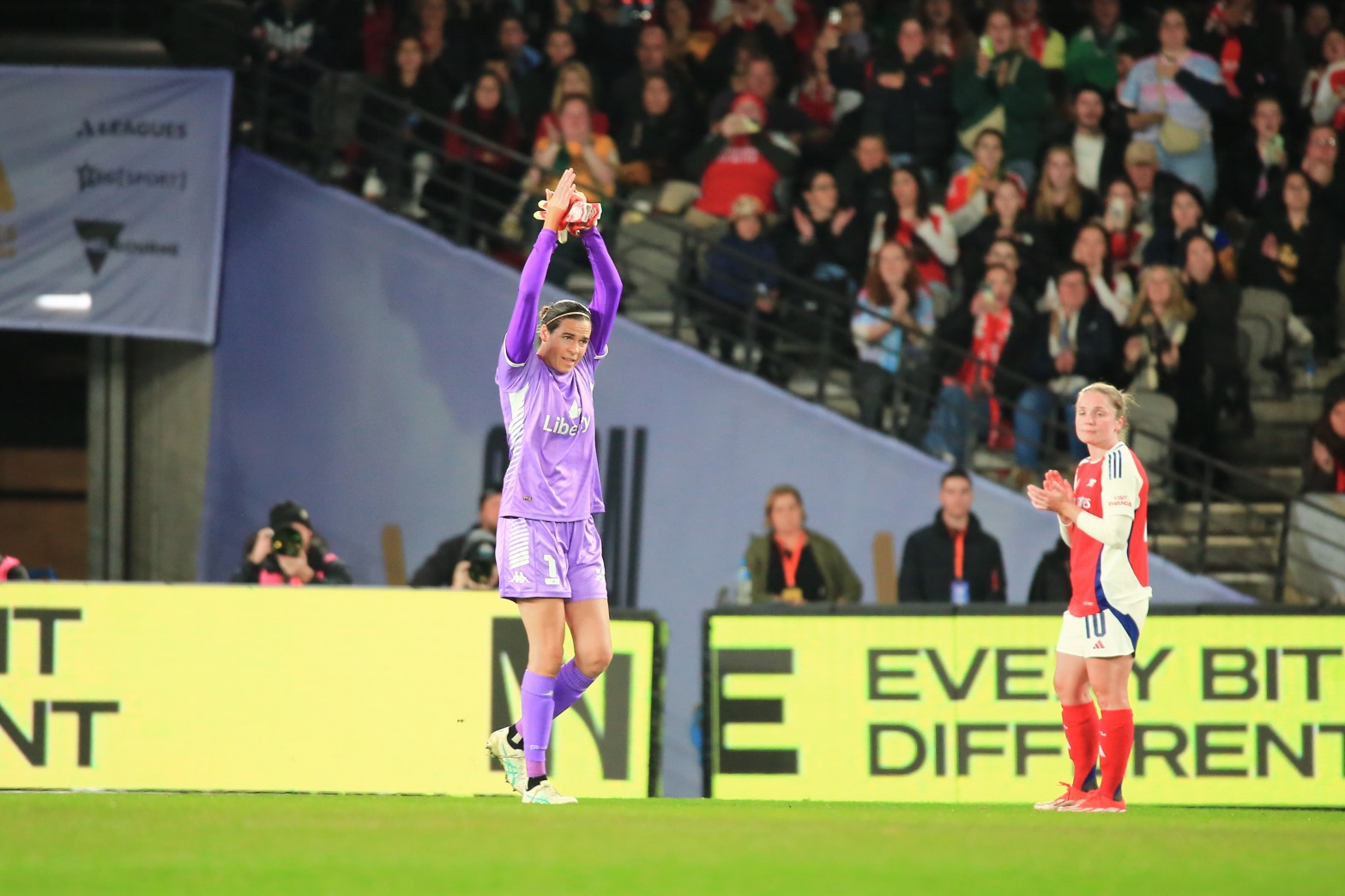
“She’s a very old head and very experienced. It’s amazing to be in an environment where you can learn from her every single day, and I feel very grateful to have shared the 40-something minutes with her on the field today and all the memories I have of her in camp as well. It’s amazing to have her still part of a team and today was an awesome celebration of all she has achieved in her career, but also Australian women’s football and football across the world.”
Above: Clare Hunt (right) reflecting on the past week in camp with the Matildas. Image: Football Australia.
Wheeler emphasised the deep-lying emotions around the celebration of Williams’ career had not just on the keeper, but on the wider team due to her impact
“In the lead up to it, behind closed doors, preparations and everything was handled and I think she (Williams) knew there was something that was going to commemorate her and her career, and seeing how emotional she was, taken back by it all, I don’t think anything can ever prepare you for that.
“Everyone in the team knows how much Lydia brings – her leadership and her compassion – to honour her in every way – that’s what the team wanted to do because she gives that tenfold back.”
The send-off for Williams individually and the team for the Olympics collectively was watched by another record Matildas crowd of just under 77,000 – a fact that Wheeler is still blown away by, and recognises the importance of the team rewarding their huge fan base with performances and achievements.
“It’s special. It’s so special. It’s always an honour and a privilege to wear the badge and just seeing the amount of people coming to see our games – it’s the new norm, selling out…it’s not lost on us. We’re privileged to have so many people coming out to support us and we want to keep this momentum going and we want to make everyone proud of us at the Olympics.”
by Kris Goman at Accor Stadium for Impetus (4/6/24)
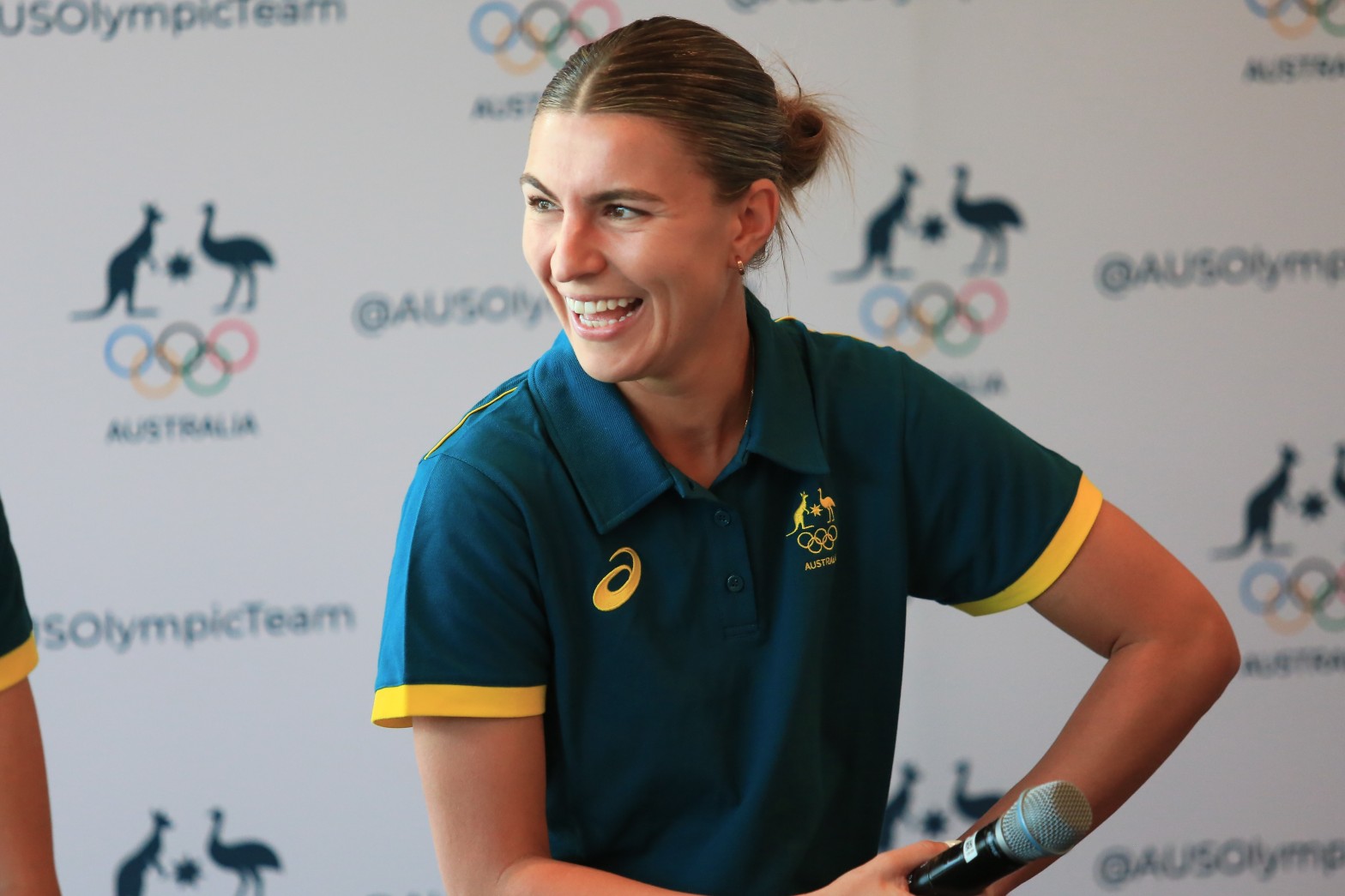
Above:Steph Catley at the press conference today.Photo: Kris Goman for Impetus.
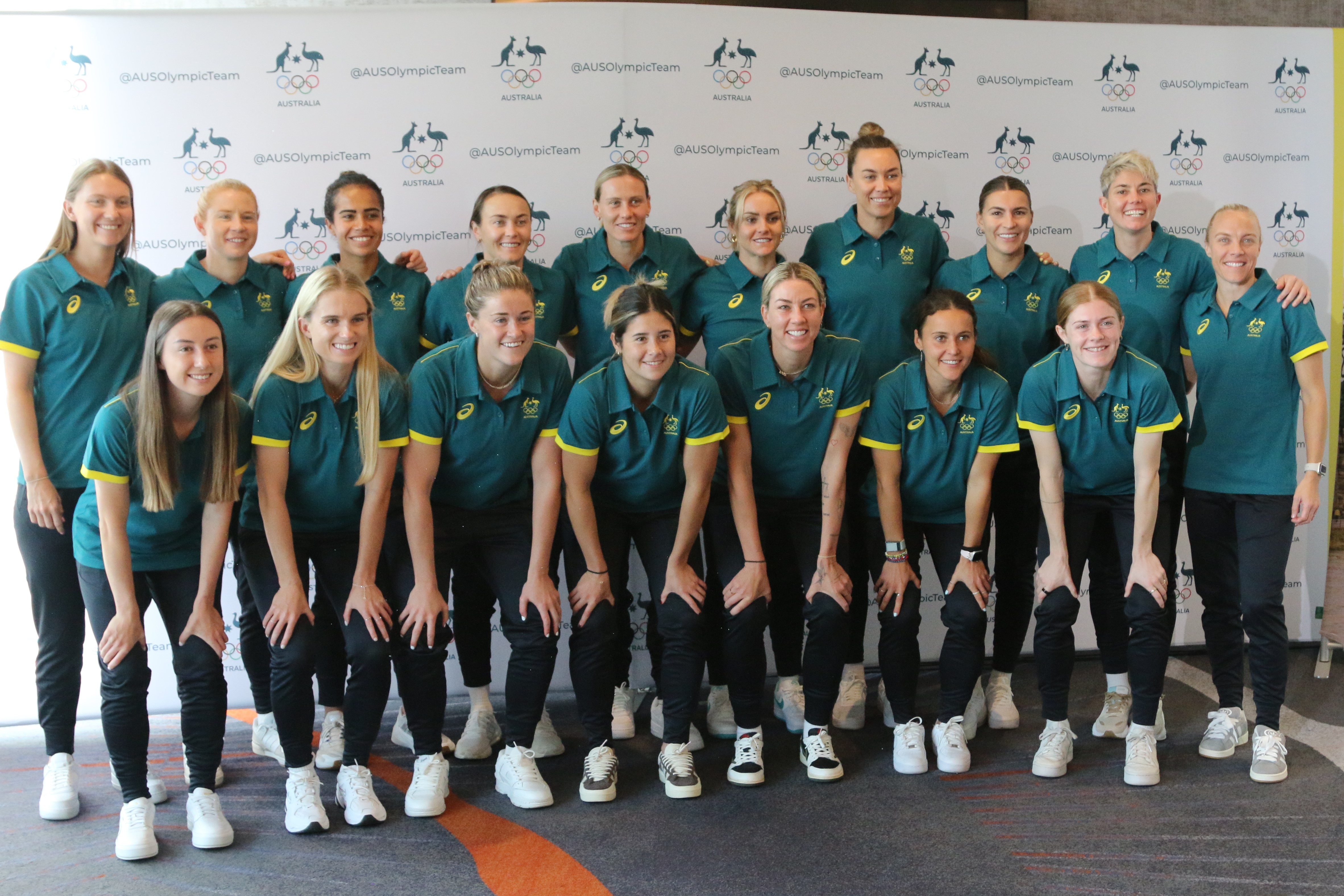
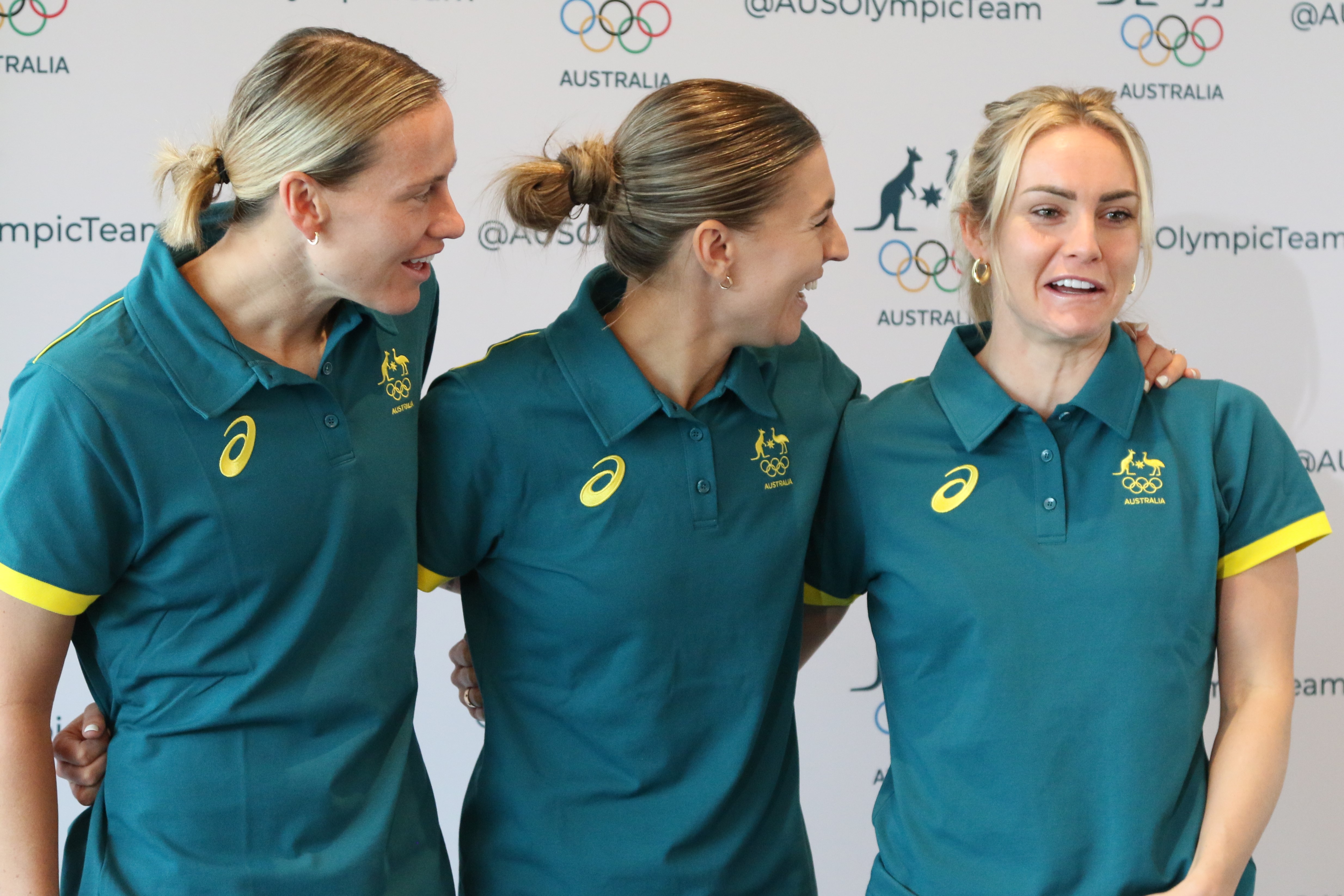
The formal announcement of the Matildas squad selected for the Paris Olympics was made this morning. The team gathered at Olympic Park in Sydney for the announcement accompanied by the Olympic Chef de Mission, Anna Mears.
There were no real surprises in the selection with the core team of regular starters Steph Catley (Captain), Emily van Egmond (Vice Captain), Ellie Carpenter (Vice Captain), Caitlin Foord, Haley Raso, Clare Polkinghorne, Alana Kennedy, Mackenzie Arnold, Mary Fowler, Tameka Yallop and Clare Hunt picked as expected.
The remaining positions up for grabs went to Cortnee Vine, Clare Wheeler, Kaitlyn Torpey, Michelle Heyman, Kyra Cooney-Cross, Tegan Micah and possibly surprisingly, given her current injury, Katrina Gorry, who was not able to attend today.
Fan favourite Charlotte Grant did not make the full squad but will be a travelling replacement along with Lydia Williams, Courtney Nevin and Sharn Freier.
Jada Whyman and Winonah Heatley who have been in the squad recently were not selected. Other notable absences include Emily Gielnik, Chloe Logarzo, Aivi Luik and Kyah Simon.
The Matildas Olympic squad (minus Katrina Gorry) at the announcement today. Photo: Kris Goman
Manager Tony Gustavsson explained his rationale behind the selection. “We have limitations on the numbers of players available and a very tight schedule with games every third day. One of the considerations is that you need coverage in every position. I need three centre-backs, three outside-backs, three midfielders, three wide players and three 9 and 10s and one multifunctional player. So that comes into play, but you also need players that can play in multiple positions, and you’ve seen over the last two games some of these players playing three and four different positions in two games. We need some flexibility in such short turnaround at the Olympics.”
Above: Jubilant Matildas in anticipation of their Olympic adventure. Photo: Kris Goman for Impetus.
Captain Steph Catley described the desire to bring home a medal at this Olympics. “We’ve been to two major tournaments now where we’ve finished fourth and there’s definitely something within us that wants something tangible to take out of this whole experience, whether it’s the youngest player on the team to the oldest player who’s been on the team for over ten years, we all want the same thing. We’re very excited and very ready to get to Paris now.” Catley further explained, “You never take an Olympics for granted. It’s the most prestigious sporting event in the world and something I’m very honoured to be a part of.” “We’re coming up against a powerhouse straight away in the group and that’s the way the Olympics go. It’s a really difficult tournament. We will go out and do our absolute best and make the country proud regardless.”
When asked about Charli Grant’s omission from the squad, Catley said, “I think that’s the hard thing with the Olympic squad – it’s so small – and one of the things that’s most important is having flexibility and I think that sometimes that means you’re not going to have double ups in different positions.
“You’re going to have more players that can play different roles. If you get an injury in one area you might need someone that can play multiple roles and I think that’s where it may have tipped Charli out of favour. I think that’s the space the team is in and it’s so competitive and there’s so many players that have come in and really proven themselves and been hungry for a spot.
“It’s a really, really hard thing and obviously we’ve had the announcement over the last couple of days in camp and there’s been lots of emotions and lots of people that are obviously heartbroken but football’s also a funny game and she steps into the role as an alternate and you never know what’s going to happen, touch wood there’s no injuries or nothing like that, but anything can happen and she just needs to be ready to be called in as well as the other three.”
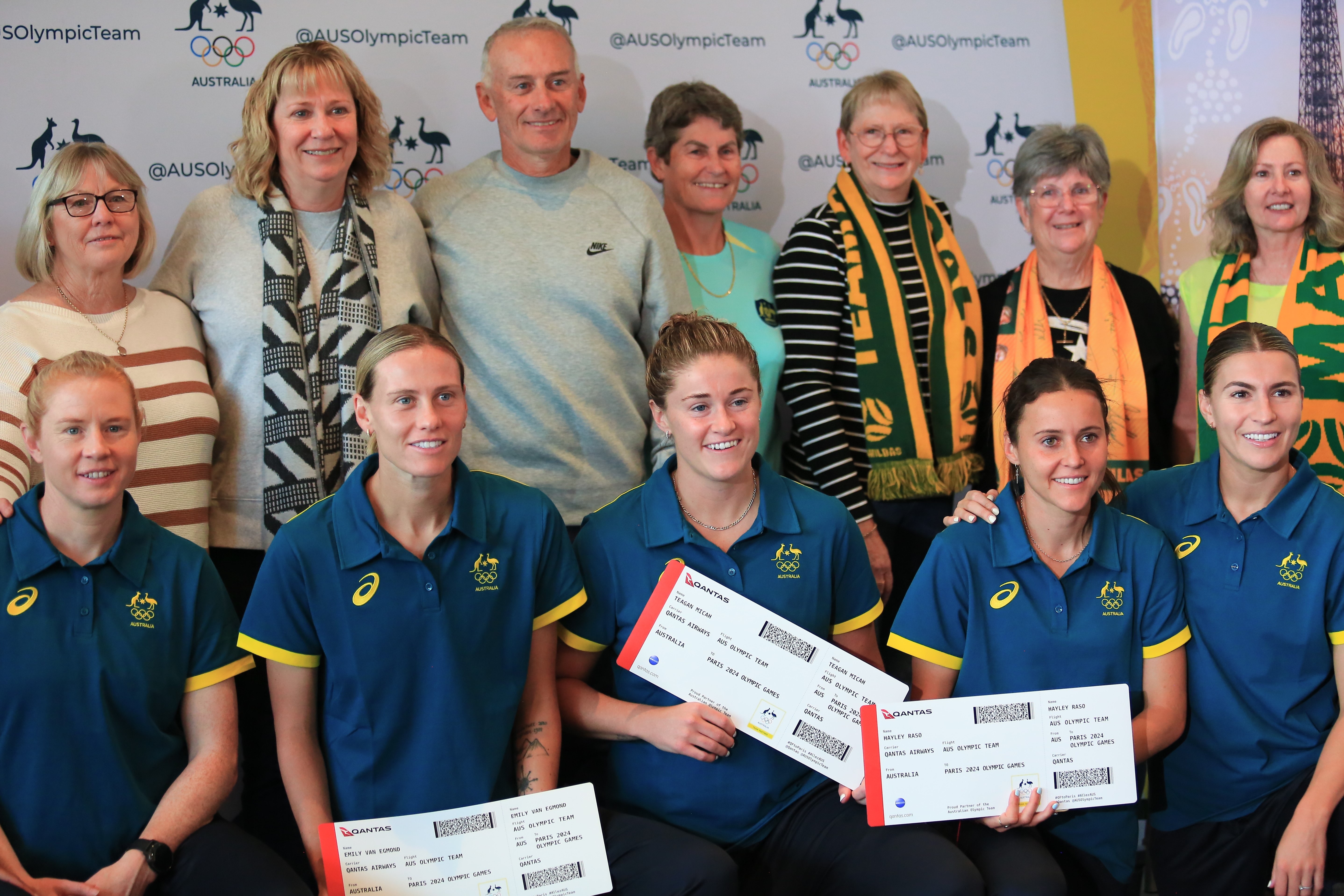
Family and friends were invited to the announcement and there was plenty of excitement in the room and a lot of proud parents as the tickets were presented.
Above: (Front row): Clare Polkinghorne, Emily van Egmond, Tegan Micah, Hayley Raso and Steph Catley with their families and Olympic tickets. Photo: Kris Goman for Impetus.
Excitement was palpable for debutante Cortnee Vine who said that, “The Olympics have been a dream of mine from way back – when I was doing athletics.” She said she’s, “Done everything I can and put my best foot forward for Tony and it’s paid off luckily.”
When describing when she found out, she was very nervous and very stressed going into the meeting. “Tony tries to get to the point pretty quick but also make you second guess as well which is stressful. I’ve spoken to him before that the Olympics is the one thing that I’ve always wanted to be a part of, probably more than the World Cup. Back when I was younger, that was my thing. I’ve watched Cathy Freeman, I’ve watched the 2000 Olympics here and I’ve always thought that’s something I want to do.” “I shed a tear and was very emotional but I slept like a baby that night.”
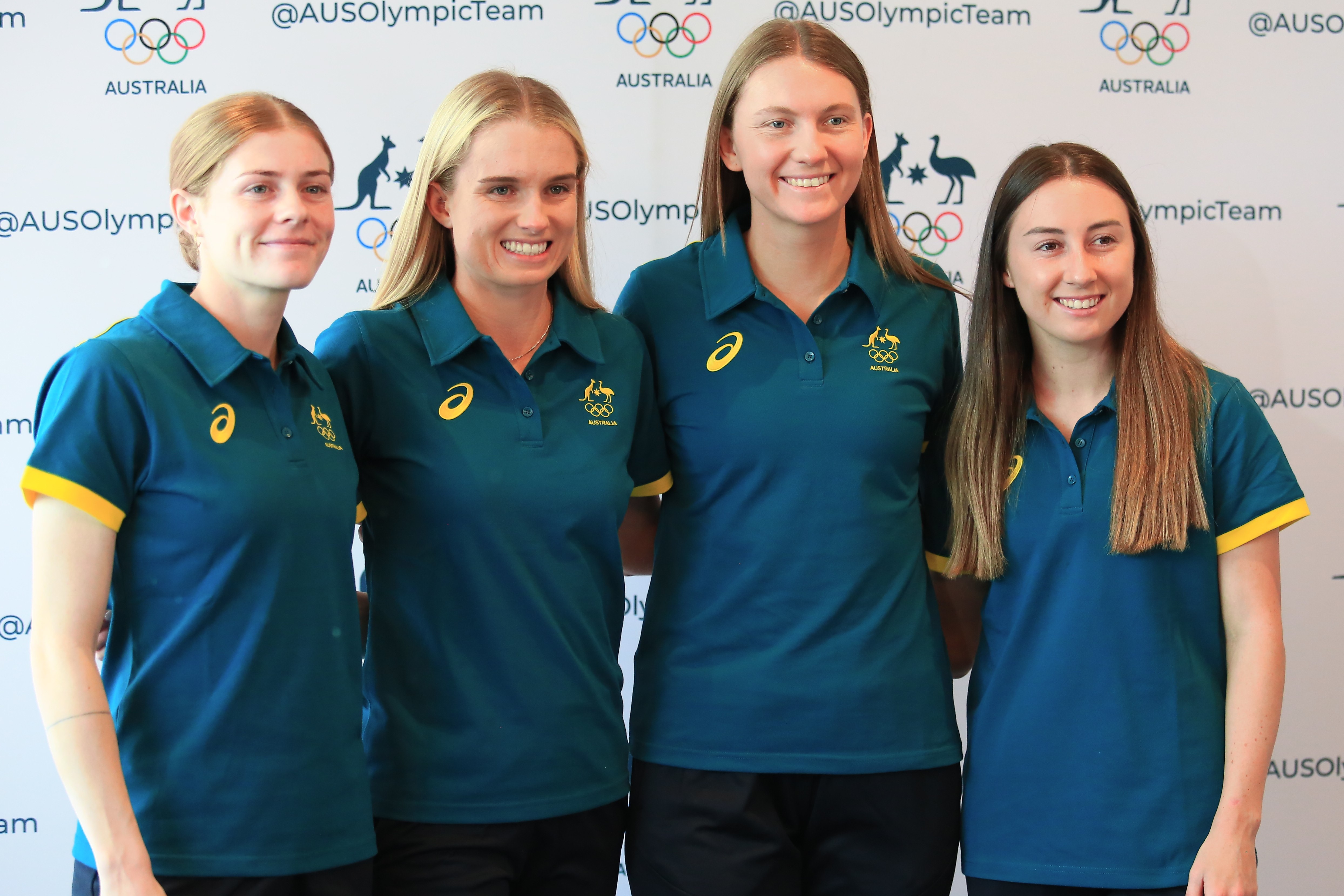
Above: (Left to right): Cortnee Vine, Kaitlyn Torpey, Clare Hunt, and Clare Wheeler will be attending their first Olympics. Photo: Kris Goman for Impetus.
The team will be taking a short break with some returning to their leagues before assembling in Spain for the final camp prior to the Olympics. Gustavsson mentioned they are looking to arrange at least one more friendly before the Olympics.
AUSTRALIA SQUAD FOR THE 2024 PARIS OLYMPICS:
Name
Position
Age
Olympic Games
Mackenzie Arnold
Goalkeeper
30
3rd (2016, 2020)
Ellie Carpenter (vc)
Defender
24
3rd (2016, 2020)
Steph Catley (c)
Defender
30
3rd (2016, 2020)
Kyra Cooney-Cross
Midfielder
22
2nd (2020)
Caitlin Foord
Midfielder / Forward
29
3rd (2016, 2020)
Mary Fowler
Midfielder / Forward
21
2nd (2020)
Katrina Gorry
Midfielder
31
2nd (2016)
Michelle Heyman
Forward
35*
2nd (2016)
Clare Hunt
Defender
25
Debut
Alanna Kennedy
Defender
29
3rd (2016, 2020)
Teagan Micah
Goalkeeper
26
2nd (2020)
Clare Polkinghorne
Defender
35
3rd (2016, 2020)
Hayley Raso
Midfielder / Forward
29
2nd (2020)
Kaitlyn Torpey
Defender
24
Debut
Emily van Egmond (vc)
Midfielder / Forward
30*
3rd (2016, 2020)
Cortnee Vine
Midfielder
26
Debut
Clare Wheeler
Midfielder
26
Debut
Tameka Yallop
Midfielder
32*
3rd (2016, 2020)
* = will have birthday between now and the Olympics starting.
Additional players going along to cover for injuries only:
Sharn Freier, Charlotte Grant, Courtney Nevin, and Lydia Williams have been named as the travelling reserves who can be selected as a replacement athlete onto the Australian Olympic Team in case of injury or other withdrawal of one of the selected 18 athletes.

















 impetusfootball.org