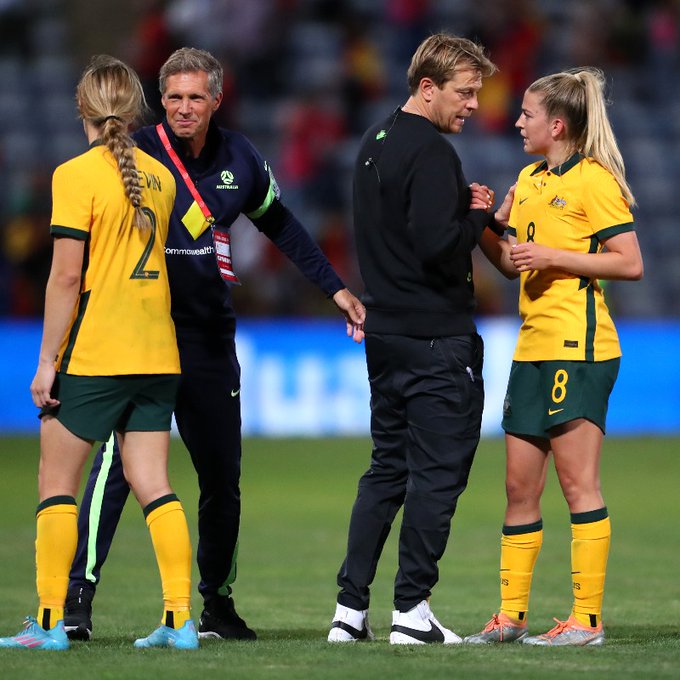
Gustavsson: Post-Portugal I’ve Got Answers

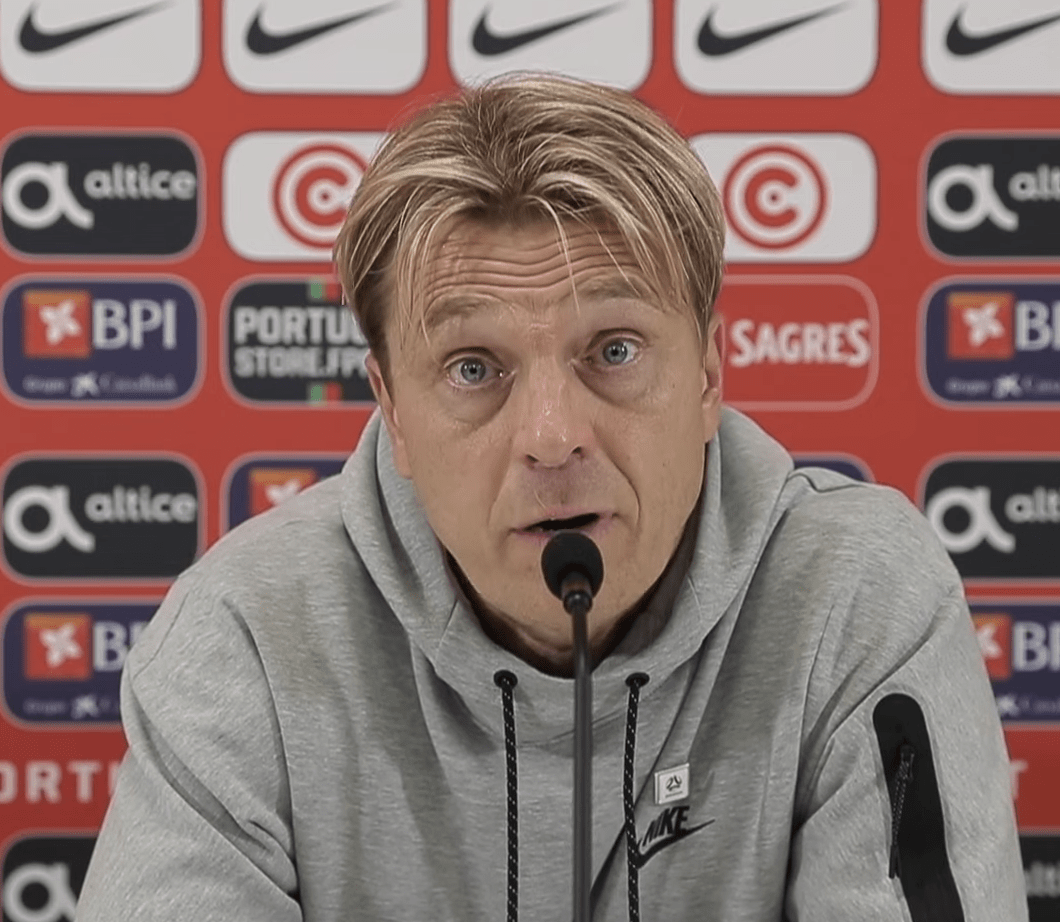
Martin Townley and Ben Gilby heard from Australia head coach Tony Gustavsson after last night’s 1-1 draw with Spain (29/6/22).

Above: Tony Gustavsson addresses the media from Portugal last night. Photo: Football Australia.

Prior to the Matildas’ double header in this international window against Spain and Portugal, head coach Tony Gustavsson said that he needed answers. 

His side was without a large number of established stars meaning his focus was to be on training and performances during the camp. 

Last night’s 1-1 draw with Portugal saw Princess Ibini score her first international goal just after halftime. Gustavsson was impressed with her contribution coming on from the bench – not just in terms of the goal, but also what she offered with her runs.

“Princess Ibini, who comes off the bench, has some unique skill sets. What we’re pleased with her is that she committed to run without the ball in this camp, both in training and in the game. 

“We knew what she can do with the ball. We’ve seen that in the A-League. She also commits to run more without the ball balls defensively, and in behind the back find like the goal today, for example, was a run empty run on the back post 30, 40 metres to score that goal.”

This camp however was not just about giving experience to new players as the Matildas coach also admitted that he was learned more about his wider squad.

“It’s not just about the new and younger ones. We tested (the others), playing Clare Wheeler in different roles to get answers on those players. We tested some of the backline players that have been with us for a while both in the back five and a back four both on the left and right-hand side. So, in that sense, I think we’ve gotten a lot of answers.”

“I’ve got a lot of answers on the individual players for sure. Not just from games but from training. We’ve seen some players perform good at clubland. And we have gotten an answer that some of their performances club land have been challenging to bring to the Matildas training environment because everything here is much faster.

“This is so much faster even though the tempo in the training camp this time around have not been the same as it normally is due to the lack of a lot of key international players. But still, it’s been a huge step for a few of them. But we think it’s good that they got exposed to it.

Despite feeling he has some positive answers Gustavsson, has faced criticism from some quarters for a lack of a consistent tactical approach and stating some of his players are not up to speed with international football.

Above: Lessons learned and answers gained according to Tony Gustavsson. Photo: Football Australia.

“I’m trying to be as consistent as I can with the players available in camp. In this second game, we went back to normal 4-3-3. We tried to be brave on the ball even though we knew it was going to be difficult and challenging against Portugal.

“I think they dominated us with the defending and not with the possession, but we tried to play out through that pressure and I thought we saw a lot of technical mistakes.

“We wanted to try to be ourselves in that sense more in this game even though we knew it was a tough game against Portugal

“I think what surprised me a little bit today like I said is that we struggled in the centre of the park with some of the more experienced and technical players that took too long on the ball and get dispossessed a lot.

“The Portugal aggressive pressing was better than our passing in that central area. So, I would like to see us improve in that sense.”

Gustavsson went on to say that with experienced players missing he didn’t have a team on the field that matched Australia’s ranking of 12th in the world. 

“Again, I think it’s the result that a lot of people think just looking at the rankings and look at the teams would say it’s a 12 ranked team against a 20-something ranked team that should win this game.

“What I ask then, is did we have a 12-ranked team on the field today? “That’s not to criticise the players. It’s where they are at and the lack of experience that we have in this team.”

When questioned about how this could affect the confidence of the players Gustavsson was quick to defend his methods. “I’m not criticising the players. But I’m saying that what I even said was, it’s unfair to expect these players to come out and win against Spain.

“I think it’s unfair because they’re coming from an environment where they’re not ready for it. And it’s not saying hey, you’re bad, you’re not good enough. It’s saying the environment you’re in right now has not made you ready for this type of international top-level football. But we brought you here because we think you can get ready for it, and when you get this experience and bring that back home to training.”

Wales And Ferns Share The Spoils

Wales 0-0 New Zealand (in Pinatar, Spain)

by Martin Townley (29/6/22)

Above: Combative action between Wales and New Zealand yesterday. Photo: PhotoSport NZ.

Wales and New Zealand played out a goalless draw on a sunny evening in Spain.  In a competitive encounter, both teams created chances despite not being at their best. 

Indeed, the Football Ferns could have taken the win through Grace Jale late on if not for a fine save from Laura O’Sullivan in the Wales goal. It was a New Zealand side who fielded some of the young stars from Wellington Phoenix’s inaugural A-League Women season with the Jale joined by team-mate Kate Taylor on the bench.

A goalless first half saw a combination of shaky play and chances. New Zealand enjoyed more spells of possession, but Wales always had opportunities.

The first chance of the game came from a quick Wales counterattack.  Kayleigh Green found Rachel Rowe on the left.  Rowe played the ball across the six-yard box but the advancing Ceri Holland, but she could not connect. 

Annalie Longo could have put New Zealand ahead after a poor defensive pass from Hayley Ladd.  Ladd played the ball across her own box gifting possession to Longo but under pressure, her shot went off a Welsh player and wide. 

Rhiannon Roberts found Angharad James with a cross from the right.  James struck the ball from the edge of the area, but her effort was deflected and never a danger for Esson’s goal.

Above: Wales captain looks on in Pinatar as her team faced New Zealand. Photo: FAW.

Sophie Ingle began to try and pull the strings for Wales putting a sublime pass into Natasha Harding to set her though but pulled her shot across goal. 

The Ferns had two great opportunities to go ahead before the break. First, Perth Glory’s Liz Anton who latched onto the ball on the edge of the box and unleashed a shot that looked to be heading into the top corner.  O’Sullivan was across goal to push the ball over the bar and keep the score at 0-0. 

Soon after, Katie Bowen found Meilayla Moore free who headed over the bar when if she had headed down would have likely given her side the lead.

New Zealand began the second half quicker than their opposition, making crisp passing moves and forcing Wales to play in their own half. 

Above: Possession was keenly contested in Pinatar. Photo: PhotoSport NZ.

Gemma Evans was forced to concede a corner as Sydney FC star Paige Satchell was working towards the box.  From the corner, Wales tried to clear but the ball fell to Rebekah Stott who fired a shot over the bar. 

Ceri Holland had a chance for Wales after an error let her in.  Seeing Victoria Esson slightly off her line she went for a lob, but the keeper made an easy save. 

New Zealand were looking the better side and a good cross in from the right forced Laura O’Sullivan to punch away.  With the keeper out of position, Olivia Chance fired at goal but Roberts was back to clear. 

With time running down, New Zealand almost took the win as Jacqui Hand met a cross from the right from Grace Jale with a bullet header.  O’Sullivan reacted quickly with a fine save putting the ball over the bar.

Teams: WALES: O’Sullivan, Roberts, Ladd, Evans, Rowe, Sophie Ingle, James, Jones, Harding, Green, Holland. Substitutes used: Green, Morgan, Filbey, Woodham, Wynn, Ward.

Above: The Welsh team that started the match against New Zealand yesterday. Photo: FAW.

NEW ZEALAND: Esson, Anton, Bunge, Moore, Stott, Bowen, Chance, Steinmetz, Longo, Satchell, Wilkinson. Substitutes used: Green, Taylor, Hand, Jale, Hassett, Rennie.

Above: The Football Ferns side that started against Wales. Photo: NZ Football.

Gustavsson And Grant Reflect And Look Ahead

Ahead of tonight’s friendly in Portugal, Impetus’ Ben Gilby heard from Australia’s head coach Tony Gustavsson and Charli Grant who put in an impressive performance in difficult circumstances against Spain on Saturday (28/6/22).

Above: Australia head coach Tony Gustavsson facing the media today. Photo: Football Australia.

“It Surprises Me That People Are Surprised”: Gustavsson On Reaction To Spain Loss.

Listening to today’s pre-game media conference with Tony Gustavsson ahead of the game with Portugal, two key elements came to the fore.

Frustration, and a desire to re-set people’s mindsets.

Frustration that he was not able to field the sort of team he originally wanted to against Spain. Frustration that people haven’t quite understood the reality of the situation he and his players faced. There was also a desire in his words for those around the women’s game in Australia to focus on developing a stronger platform or pathway for players to come through who are more prepared for the increasing challenges of international football.

“It has surprised me that people are surprised (by the result against Spain). If you follow the women’s game, see where Spain are, and what they have done, if you look at their scorelines against Scotland (8-0) and you look at the team that we brought to play them, it surprises me that people are surprised. That’s where we are, and we need to be OK to see the truth here, and keep investing, keep believing, and want to improve.

“I as a coach always want the best team available when we play the best teams. When we realised what would happen for this match, I had to decide whether I say as a coach ‘no, we have to have everyone available regardless’, or I look at the longer-term issues. So then you change perspective for the camp. You think about how we can get benefits from it.

“It’s about looking at the depth of the roster in terms of where we are now, and then look at the players and get them the experience (so they) know what it’s like and what it takes to be ready for this level when you are next called in. Whether that means an individual training program, a more challenging environment to play in, or looking for more games for the players over a 12-month period…remember The Gap Report stated our players are not playing enough games over a year.”

Above: Katrina Gorry – one of the positives in the defeat to Spain – and an example of a player who has moved overseas to get more games at a consistently higher level. Photo supplied to Impetus by: Football Australia.

Gustavsson reiterated his argument first raised in his post-match media conference that the second half, where the Matildas conceded six goals, saw him field a team containing “four players playing NPL and another playing college football”. Whilst at the present time this is factually correct, it is disingenuous, and easy meat for Gustavsson’s critics to pounce on.

Those playing NPL in the Matildas squad right now are all players with extensive A-League Women experience. The college footballer, Amy Sayer, has played 21 matches at W-League/A-League Women level. They are not just players he has plucked from state football and put straight from there into international football.

Gustavsson went on to be brutally honest by saying that as a result of playing a second half with these players, “You know you are going to lose, and it is a question of how many goals. It tells us where we are right now with those players and the pathway we have. We need to keep investing in these players to give them the best chance of going from clubland to international football. At the moment, that jump is too big for them.”

Effectively, the argument that A-League Women players should be more actively looking to play in strong competitions outside of the top domestic league calendar is a good one, but it has got slightly lost in the way Gustavsson chose to raise it.

The head coach then looked to raise the spectre of a necessary change in thinking about the way the whole Australian women’s football system needs to change to prepare players for top-level action.

“A senior national team should not be looking at developing players. It should be looking at the tip of the iceberg and everything else that happens in clubland and other areas of development pathways should be about making them ready for international football. That is where we need to invest and develop.

Above: Tony Gustavsson admitted he is being scrutinised and being held accountable, but also highlighted the longer-term issues in the women’s game in Australia that this camp has raised. Photo: Football Australia.

“When it comes to reputation, all I can say is that my name as a coach will be scrutinised. Sometimes, a reality check even if it hurts, can be healthy for the long term. Short term it really hurts – for players, the media, fans, coaches, and staff, but in the long run, maybe it is what we need.

“I will never stop believing in this team, but we need to be fair on what we can expect and at what time we can expect it.”

Gustavsson also recognised that he is in the firing line and emphasised that he is held accountable after every national camp.

“After each camp, we review internally. We need to think about what we learned rather than what went wrong. What went wrong is saying we failed and should have done something better, but we always discuss what we learned.”

Moving on to the next challenge, Portugal tonight local time, Gustavsson was clear that there is a lot of work to be done.

“Portugal play in a very different way to Spain, and so our preparations have involved more individual meetings with players on top of a training session. It’s all about getting the players mentally ready as well as physically ready.

Above: The Matildas training in Portugal this week. Photo supplied to Impetus by: Football Australia.

“We have tried to look at past experience against them. We went back to 2018 in the Algarve Cup when we played them twice – a draw and a loss. We had a much more experienced team then. We have to be humble enough to realise that this will be a tough match too.

“They are peaking for the Euros, and we might see a different formation from us and tactical flexibility.”

The Australia head coach closed by addressing the challenge of filling an Ellie Carpenter-shaped hole in his squad over the coming months.

“Ellie is so professional and mature for her age. We will support her and Lyon with everything we can in her rehab. We need to look for replacements, but it’s not (about) looking for another Ellie.

“We are looking for another outside back or wing-back. We have a few options, play a back three and have wingbacks, or we look at natural replacements like Charlotte Grant. We’ve looked at Cortnee Vine. We can take attacking midfielders back into the position too. We’ll look at one, maybe two options tomorrow.”

Charli Grant: Stepping Up The Levels Of Intensity And Staying Positive

Above: Australia and Rosengård defender Charli Grant speaking earlier today. Photo: Football Australia.

For Charli Grant, opportunities to start for The Matildas have been few and far between. One such opportunity came on Saturday against Spain, and despite the intense pressure, the 20-year-old South Australian put in a great shift.

Reflecting on the experience, Grant said: “It was definitely a tough one. We knew they were one of the favourites for the Euros and it was a great chance for us to play against one of the world’s best teams. We learned a lot from it.

“They are such a high-tempo team and it taught us to make the most of every moment we had on the ball and then be focused when they are on it as you just never know what they are going to do with it. They are so technical and strategic.”

The former Adelaide United star outlined some of the factors behind her strong performance. “As a young defender, I just want to make the most of every opportunity. I had to stay so focused. I had to focus on one thing at a time – each individual thing as it happened. One tackle at a time, one pass at a time. It will definitely help me going into future games.

“It helped me massively being exposed to that sort of game. Going forward as a result, we’re only going to get better from here. We trust the process that Tony has put in for us. I know how much I have improved since I first came into the Matildas last year and my level will only go up going towards the World Cup.”

“I have technically improved and my composure on the ball has improved as well. Being around the girls in the squad has taught me to be a better defender.

“For me, coming from Adelaide United to Rosengård was definitely a step up in terms of (a more) technical (game) and a fast pace. Then going into the national team, that (move to Sweden) definitely helped me to transition. Yet playing against Spain is a whole new level! I was excited to be exposed to it, but it was definitely something that needed to be adjusted to.”

Whilst some may expect young players such as Grant to be adversely impacted confidence-wise after such a heavy loss, the defender feels otherwise. “The result was disappointing, but we can only look at what we can improve from it and put all our focus onto the Portugal game and put things right there.”

Euros Preview: Iceland

by Kris Goman (28/6/22)

Above: Iceland celebrate their qualification for Euro 2022. Photo: Iceland Review.

Iceland, placed 17th in the FIFA World Rankings, are known as Stelpurnar Okkar (Our Girls) and are a small island nation with a population of only just over 370,000 people (slightly more than the English city of Coventry or the Central Coast of NSW). The nation bats well above average in women’s football for its size. Vigdis Finnbogadottir was the world’s first female elected head of state, becoming president in 1980, and Iceland is known for its progressive feminist politics. Icelandic people use Patronymic or Matronymic surnames meaning their surname indicates the first name of their father or mother followed by dottir (daughter) or son (son). So for example, Sara Bjork Gunnarsdottir is the daughter of Gunnars.

The Squad:

Goalkeepers: Telma Ivarsdottir (Breidablik), Cecilia Ran Runarsdottir (Bayern Munich), Sandra Sigurdardottir (Valur).

Defenders: Aslaug Munda Gunnlaugsdottir (Breidablik), Elisa Vidarsdottir (Valur), Glodis Perla Viggosdottir (Bayern Munich), Ingibjorg Sigurdardottir (Valerenga), Gudny Arnadottir (AC Milan), Gudrun Arnardottir (Rosengard), Sif Atladottir (Selfoss), Hallbera Gudny Gisladottir (IFK Kalmar).

Midfielders: Alexandra Johannsdottir (Eintract Frankfurt), Dagny Brynjarsdottir (West Ham United), Karolina Lea Vilhjalmsdottir (Bayern Munich), Selma Sol Magnusdottir (Rosenborg), Gunnhildur Yrsa Jonsdottir (Orlando Pride), Sara Bjork Gunnarsdottir (Olympique Lyonnais).

Forwards: Svava Ros Gundmundsdottir (Brann), Berglind Bjorg Thorvaldsdottir (Brann), Agla Maria Albertsdottir (Hacken), Elin Metta Jensen (Valur), Sveindis Jane Jonsdottir (Wolfsburg), Amanda Andradottir (Kristianstads).

The Head Coach:

Above: Thorsteinn Halldorsson, Iceland’s head coach. Photo: Visir.

Thorsteinn Halldorsson was appointed coach in January 2021 After coaching the Breidablik woman’s team since 2014, winning the Icelandic Championship three times and making the final 16 of the Champions League in 2019. He was a successful defender prior to coaching making over 150 appearances in the men’s top division.

Since he’s been their manager, they’ve only lost to the Netherlands and the USA. Iceland have also recorded wins against the likes of Japan, the Republic of Ireland, New Zealand, and the Czech Republic.

Euros History

Iceland have qualified for three previous Euros, in 2009, 2013, and 2017. They made the quarter-finals in 2013 but lost all their group games in 2009 and 2017.

Qualifying       

Iceland qualified after being runners up in Group F which consisted of four other nations: Sweden, Slovakia, Hungary, and Latvia. Iceland only lost one match – against Sweden in their away match, 2-0. They drew their home match against the Olympic silver medallists 1-1. They recorded the biggest win of the group against Latvia 9-0 and Elin Metta Jensen topped the goal scoring in the group with 6 goals. Their goal difference was +20.

Strengths

Iceland has a good grassroots football scheme that inspires young girls to compete professionally. The small population means that the Icelandic people are just as interested in supporting the women’s team as the men’s, particularly when they do well.

Iceland have prolific scorers in Elin Metta Jensen, Dagny Brynjarsdottir and Sveindis Jane Jonsdottir. They had a high-scoring run in qualifying and still kept out the likes of Sweden with solid defence. Most of the team play in the Scandinavian and German leagues, with the notable exceptions of Jonsdottir playing for Orlando Pride in the NWSL, Brynjarsdottir playing for West Ham United in the FAWSL and Gunnarsdottir having recently left Olympique Lyonnais in the D1 Arkema for Juventus. Only seven members of the squad play for domestic Icelandic teams giving them wide-ranging experience with their European opponents.

Development Areas:

Iceland have never qualified for a World Cup and have only qualified for the Euros three times before. They’ve had reasonable success in the annual Algarve Cup but they lack big tournament experience. The pressure of this tournament could take its toll on some of the less experienced and younger players.

Key Player:

Above: Sara Bjork Gunnarsdottir, a Champions League winner with Olympique Lyonnais before heading to the Euros with Iceland. Photo: OL Feminin.

Sara Bjork Gunnarsdottir is the Iceland captain and most successful player. She was a regular starter for Lyon prior to falling pregnant and then having a baby last November. She played again in March and was part of the Champions League-winning team in May. She’s just signed for Juventus for next season and is a calm and strong leader. Her presence will lift the team.

One To Watch:

21-year-old Sveindis Jane Jonsdottir is making a name for herself with Wolfsburg. The team made the semis of the Champions League this year losing to Barcelona so she has some big match experience. She also won the league this year with Wolfsburg. She is fast, technical, and brave.

Prediction

France are likely to win their group but Iceland could get to the quarter-finals. Italy are becoming stronger and stronger of late but Iceland have a solid, experienced squad and it’s certainly not inconceivable they could get through. It’s unlikely they’d get any further though.

Group Fixtures

10th July: Belgium, 5pm, Academy Stadium, Manchester.

14th July: Italy, 5pm, Academy Stadium, Manchester.

18th July: France, 8pm, New York Stadium, Rotherham.

Impetus is previewing a different nation every day between now and the start of the European Championships. Click below to read the previously published articles: FRANCE – by Jean-Pierre Thiesset: https://impetusfootball.org/2022/06/25/euros-preview-france/ AUSTRIA – by Jorge Ceron: https://impetusfootball.org/2022/06/26/euros-preview-austria/ GERMANY – by Johnathan Stack: https://impetusfootball.org/2022/06/27/euros-preview-germany/- https://impetusfootball.org/2022/06/27/euros-preview-germany/

Matildas Analysis: Seven Levels Of Huelva

by Jonathan Tay (27/6/22)

Above: Post-match scenes after Australia’s 7-0 defeat to Spain. Photo: Football Australia.

It’s the 90th minute.

Clare Polkinghorne, standing near her own penalty spot, is surrounded by the youthful trio of Courtney Nevin, Taylor Ray, and Charli Grant.

Having just conceded their seventh goal, there’s a pause, as all three turn towards the veteran defender, looking for an answer.

All Polkinghorne can offer is a trudge, head-bowed, back to her position for another kick-off.

It’d be easy to write this match off as “the Matildas rested seven key players against Spain, the favourites for the Euros”. But there are a number of takeaways and implications for the bigger picture, on this challenging road toward the World Cup 2023.

“Controlling” the space against uncontrollable Spain

Australia Head coach Tony Gustavsson spoke in his pre-match press conference about being able to “control the game without the ball”. 

Against a possession-dominant and imperious Spain, they would have to compromise; could the Matildas control the spaces where they would allow their opposition to have the ball?

Setting up in an unfamiliar and ultra-conservative 5-4-1 formation, Australia hoped to deny the central areas of the pitch, ceding ball control (they ended with just 27% possession) and forcing Spain out wide. 

Above: The Matildas seeking to deny central areas with two defensive banks.

Though Gustavsson spoke of choosing moments to be aggressive in their press, the Matildas allowed an average of 27 passes per defensive action (their average the past year is nine).

On paper, it made sense. But this is a team boasting the peerless Barcelona midfield of Patricia Guijarro, Aitana Bonmatí, and Alexia Putellas; the system may have seemed sound, but the gulf in individual quality was immense.

The Matildas did hold La Roja at bay until the 43rd minute, but cracks appeared in their gameplan from the off. 

Less than a minute into the game, Katrina Gorry, playing as the widest midfielder on the right, lost her mark too easily, allowing Mariona Caldentey to play a defence-splitting pass through to Lucia Garcia. 

Garcia herself evaded Tameka Yallop’s unsuccessful attempt to play for offside, and her redirected shot forced goalkeeper Teagan Micah into action early. 

Spain were confident of winning their one-on-one duels throughout the game, and happy to utilise whatever space was afforded to them. Regardless of the integrity of the formation, Spain felt they were able to have their way in any match-up across the field

Here in the 38th minute, Mariona burned right-wingback Cortnee Vine down the outside. 

She promptly stood Vine up again by the by-line, before deciding to go straight through her with a nutmeg, working her way into a dangerous position in the box.

For the first goal of the match, Aitana was able to receive the ball on the edge of the 18-yard box. 

She jinked past an overmatched Courtney Nevin, conjuring the space to curl a delightful ball into the top corner.

La Roja were patient in their build-up, probing for outlets from flank to flank, and racking up 94 passes to the final third (to Australia’s 12). A continual revolving door of midfield and forward runs consistently sought to manipulate the Matildas’ shape. 

Their irrepressibility eventually wore down an inexperienced side, with the floodgates opening to little resistance in the second half.

On a wingback and a prayer

With Steph Catley rested for this international window, and Ellie Carpenter sidelined with an ACL injury, question marks surrounded the right- and left-back positions for the Matildas.

Gustavsson opted for the makeshift pair of Cortnee Vine and Tameka Yallop in a five-player defence, particularly curious given the strength of their opponents. 

It proved to be costly; Spain constantly found joy out wide on both sides of the pitch, exposing the improvisational backline, with the additional consequence of handcuffing Vine from using her pace going forwards as well.

Here in the 17th minute, a simple wall pass bypasses a ball-watching Vine.

Mariona is able to put in a great ball which is swept into the goal, however from an offside position.

In the 20th minute, Yallop again attempts a lazy offside trap.

Garcia is able to waltz onto a through-ball, with all the time in the world to find a cutback to a teammate in the box.

Things, unfortunately, did not improve when Jamilla Rankin came in on the left for her debut.

For the fourth goal of the night, Garcia is able to dart in front of the young defender unawares.

The movement catches Rankin in an inferior position, and Garcia is able to outjump her opponent and power the header home.

In reality, the cupboard was laid bare for Gustavsson, forced to work with the few options at his disposal.

However, Charli Grant, who seemed the obvious candidate to take Carpenter’s spot, and was consistently solid amidst the barrage of attacks, was preferred as the right-centre back for the night.

The wingback position is an area of real concern as the search for depth in the roster continues

New faces, same old challenges

Lost in the negativity of the result, were the debuts for Rankin and Ray; rewarded for fine seasons in the A-League Women with their first international caps.

And while promising to see new players continue to be blooded, particularly from the local Australian domestic market, criticism can be directed at the timing of the introductions.

Gustavsson spoke pre-match about this being a great opportunity to play Spain and to find “answers” to where this squad, and particularly the younger players were in their development; whether they could translate their abilities to the international level.

Realistically, however, the writing was already on the wall, those answers are already known. Against a side peaking for the European Championships, there was no need to test the hypotheses.

Questions are probably better asked of Football Australia and the relevant organisers, who espoused taking the “long-term view” in resting a host of key players for these international friendlies. 

A visibly frustrated Gustavsson explained post-match, “When we planned this match, the plan was to have our best team here.” 

“We knew 12 months ago that this was the only time this year we could go up against one of the best teams in Europe, a week out from the Euros.”

That would seem to be at odds with the bigger picture, and questions have to be asked about when this long-term view was really adopted. 

With the World Cup on the horizon, the time to align perspectives and answer questions is running out.

Euros Preview: Germany

by Johnathan Stack (27/6/22).

Above: The Germany squad line-up for their Arnold Clark Cup match against Canada in Norwich earlier this year. Photo: De Fodi Images.

The Germany squad was announced on the 18th June, and features eight players from Women’s Bundesliga champions VfL Wolfsburg and seven from Bayern Munich.

Chelsea midfielder Melanie Leupolz will miss out on this year’s tournament after announcing back in March that she is pregnant with her first child. Also missing out is Olympique Lyonnais midfielder Dzsenifer Marozsan as she is recovering from a torn ACL that caused her to miss the Champions League final win against Barcelona.

Not quite making the final squad were Martina Tukefovic (Hoffenheim), Maximiliane Rall (Bayern), Jana Feldkamp (Hoffenheim), Sjoeke Nusken (Eintracht Frankfurt). Chantal Hagel (Hoffenheim). Chantal Hagel has been listed as the 24th player in the squad so if any player were to drop out, she will take their place.

The Squad:

Goalkeepers: Ann-Katrin Berger, Merle Frohms, Almuth Schult.

Defenders: Sara Doorsoun, Giulia Gwinn, Marina Hegering, Kathrin Hendrich, Sophia Kleinherne, Felicitas Rauch.

Midfield/Forwards: Nicole Anyomi, Jule Brand, Klara Bühl, Sara Däbritz, Linda Dallmann, Laura Freigang, Svenja Huth, Lena Lattwein, Sydney Lohmann, Lina Magull, Len Oberdorf, Alexandra Popp (C), Lea Schüller, Tabea Waßmuth.

The Head Coach:

Above: Germany’s national coach, Martina Voss-Tecklenburg. Photo: DFB.

Germany are led by 54-year-old Martina Voss-Tecklenburg a legend of the women’s game. During her time as a player, she played for KBC Duisburg, TVS Siegen, and FCR 2001. For the national team, Voss-Tecklenburg represented Germany 125 times. She appeared at three World Cups (1991, 1995, and 1999) as well as the 1996 Olympic Games.

Voss-Tecklenburg has fond memories of the Euros, winning the competition four times (1989, 1991, 1995, and 1997) from five attempts. In 2009 she managed FCR 2001 Duisburg to UEFA Women’s Cup (now known as the Champions League) glory before going on to lead FF USV Jena. She led the Swiss national team from 2012-2018, taking them to the last sixteen in their first appearance at a World Cup in 2015. Voss-Tecklenburg also ensured qualification for Switzerland for their first European Championships in 2017. She took over as Germany’s national head coach in 2019.

Euros History:

The Germans are no strangers to Euros glory. They are the most successful team in the tournament’s history holding the record for the most titles. They have lifted the trophy eight times – 1989, 1991, 1995, 1997, 2001, 2005, 2009, and 2013.

Qualifying:

Germany won eight out of eight matches in Group I as they soared through qualifying for this summer’s tournament, scoring an impressive 46 goals and conceding only one goal in the process with their biggest win coming against Montenegro which was 10-0 victory. They finished nine points clear of second-placed Ukraine.

Strengths:

Going forward Germany has an eye for goal and is a threat. Players like Magull, Freigang, and Popp scored goals regularly in qualifying and will have a goal or two in them once the tournament has begun.

Development Areas:

Despite a very strong qualifying campaign where Germany only conceded one goal to the Republic of Ireland, questions were asked of their defence after a shock 3-2 defeat in World Cup qualifying to Serbia back in April. So, if Germany is to go all the way to clinch a ninth European crown they will have to tighten up at the back.

Key Player:

Above: Lea Schüller, one of Germany’s most prominent players. Photo: Richard Callis/Sports Press Photo.

Lea Schüller. The 24-year-old was named 2021 German Player of The Year back in January. Schüller has had a great season for Bayern Munich scoring 21 goals in all competitions and bagging 11 goals in seven World Cup qualifying games for the national team.

One to watch:

Laura Freigang. The Eintracht Frankfurt forward scored 14 goals in all competitions and four during Germany’s qualifying group for this summer’s tournament.

Prediction:

Latter stages. I think Germany will be within the top eight of the tournament, so with that being said, I expect them to be anywhere from the quarterfinals onwards to the final. Germany certainly has the firepower up top, they just keep it tight in defence.

Group Fixtures:

8th July: Denmark, 8pm, Brentford Community Stadium, London.

12th July: Spain, 8pm, Brentford Community Stadium, London.

16th July: Finland, 8pm, Stadium MK, Milton Keynes.

This is Johnathan Stack‘s first article for Impetus. To read his bio, and those of the rest of our contributors, click here: https://impetusfootball.org/about-our-contributors/

Impetus is previewing a different nation every day between now and the start of the European Championships. Click below to read the previously published articles:

FRANCE – by Jean-Pierre Thiesset: https://impetusfootball.org/2022/06/25/euros-preview-france/

AUSTRIA – by Jorge Ceron: https://impetusfootball.org/2022/06/26/euros-preview-austria/

Grainger And Ingle: Wales Are Going In The Right Direction

Impetus’ Martin Townley was in today’s Wales media conference and heard from head coach Gemma Grainger and captain Sophie Ingle (27/6/22).

Above: Gemma Grainger at today’s media conference. Photo: FAW.

Wales manager Gemma Grainger spoke to the media ahead of her side’s friendly international against New Zealand. The match on Tuesday will take place in Pinata, Spain where the squad has been enjoying some warm weather training.

“Since we travelled out last Wednesday, we’ve had a real opportunity to enjoy some time together both on and off the pitch. “That was always the plan really to come to pinata was that we had that time, which we haven’t really had as a team before.”

This camp is the last time the squad will get together before they face Greece and Slovenia in their final World Cup Qualifiers. Wales, who are second in their group will make the playoffs if they can win the two games and Grainger is using the time to keep improving her side.

“It’s given us an opportunity to speak about some key themes that we want to talk about as a team to take on to the pitch and really continue our improvement as a team on and off the pitch.

“So, the week is a week has been great, it is hot, I think we knew it was going to be hard. There’s an enjoyment part to that when we’re not training. But then when we are training, we obviously have planned for the heat.

“It’s been quite a nice opportunity to do a different type of session, you know, a different type of coaching session, because when it is hot, we do get the opportunity to you know, to talk a little bit more whereas, sometimes in the cold, we must move things on quite quickly. So nice relaxed vibe, but preparation going well so far.”

Grainger has continued playing opposition of a higher ranking in friendly games with New Zealand ranked 22nd in the current FIFA rankings. “We’ll play a higher-ranked opposition, but what we’re hoping to get out of it is a competitive game.

Above: Wales boss Gemma Grainger emphasised the importance to her side of playing higher-ranked opposition regularly. Photo: FAW.

“We want to utilise the game to continue our progress. And with preparation for September in mind, you know, New Zealand will be an opportunity to play a higher-ranked nation. And then that will build into the September prep nicely.

With the option to use up to six substitutions in this game the Wales manager will make use of all options, believing that the squad depth she has available is exciting.

“When we had the development camp on Monday and Tuesday, we’re really starting to explore and learn more about the whole group, because what we do know is that player depth and squad depth is a real sign and correlation between successful teams.

“You know, when I look at the teams in the European Championships this summer, and the teams that people tip to win it, there’s no clear favourite, but the teams that have the best depth, there’s a good opportunity for those teams”

Grainger also praised the way the New Zealand side will play and that she is excited for the game

“You know, they like to play football, which is a credit to them, they have a real clear playing style in terms of how they want to play. They have some fantastic qualities, both in and out of possession. And they’re an opposition and we’re excited to test ourselves against”

The last meeting of the sides saw Wales win a close game 1-0 with Kayleigh Green getting the winning goal.

Above: Sophie Ingle speaking to the media today. Photo: FAW.

Wales captain Sophie Ingle spoke about the positives and challenges of how Wales’ warm-weather training camp today. 

“Yeah, it has been nice. Obviously, it’s always helps training when it’s warm weather, but it’s tough as well, because it’s a bit warmer. And, you know, we’re out of season. So that heat kind of gets to us a little bit quicker than it usually would.

“Away from football pitches, we’ve done some team bonding activities, down the beach, and just to get out the hotel and enjoy the nice weather.”

Ingle will lead Wales into their final World Cup qualifying games in September and revealed that the squad have been using this time to prepare for those games. 

“Yeah, more prep for September.  I think the girls know that. Obviously, we’ve got New Zealand to play, and they play potentially a different way to the two teams we’re coming up against, but we can still work on things for September.”

Wales beat the Football Ferns the last time the side met in Cardiff and the Wales captain reflected on what transpired in that encounter.

“I remember a lot of rain! I remember was it Kayleigh Green who scored. “It was quite an even match game. I think we were probably a little bit better in possession than them. But it could have gone either way.”

Wales are playing just one game in this window, but New Zealand travelled to Norway on Saturday losing 2-0.  Ada Hegerberg and Guro Bergsvand getting the goals.  Ingle is hoping that the busy schedule can work to Wales advantage. 

“They’ve travelled to Norway, and then got here yesterday, so hopefully they are a bit fatigued which might work in our favour. But they’re quite direct team, they’re athletic, they like to get it to their number nine, or their striker and kind of play off her.”

“We want to win, and that’s why we play football, but it’s the performance at the end of the day. We’ve worked on a few things this camp on the training pitch. That’s kind of what I want to see that comes out in this game, that the things we’ve worked out on the training pitches, we’ve been able to transfer into a game situation.”

With two big games top come in the Autumn, Ingle emphasised what making the World Cup in 2023 would mean the world to her.

“It would obviously mean the world to me and the girls if we do qualify for the World Cup. You know, not just the World Cup, we want to go on to then qualify for the next Euros and so on and so on.

“We want to put Welsh women’s football on the map. I think we’re going in the right direction.”

Euros Preview: Austria

by Jorge Ceron

Above: Action from Austria’s game with Northern Ireland. Photo: Irish FA.

Austria have assembled a squad that contains players who are more than capable of troubling the top nations. With Arsenal goalkeeper Manuela Zinsberger at the back, and quality from the likes of Viktoria Schnaderbeck, Carina Wenninger, Sarah Zadrazil, and Nicole Billa, the Austrians are capable of a strong tournament.

The Squad:

Jasmin Pal (Sand), Manuela Zinsberger (Arsenal), Andrea Gurtner (Granadilla Tenerife), Mariella El Sherif (Sturm Graz), Viktoria Schnaderbeck (Tottenham Hotspur), Katharina Naschenweng (Hoffenheim 1899, Verena Hanshaw (FFC Francfórt), Carina Wenninger (Bayern Munich), Sabrina Horvat (Koln), Laura Wienroither (Arsenal), Marina Georgieva (Sand), Katharina Schiechtl (Werder Bremen), Virginia Kirchberger (Eintracht Frankfurt), Jennifer Klein (St Polten), Barbara Dunst (Eintracht Frankfurt), Celina Degen (Hoffenheim 1899), Laura Feiersinger (FFC Francfórt), Lena Triendl (Sand), Marie-Therese Höbinger (Turbine Potsdam), Lara Felix, Sarah Zadrazil (Bayern Munich), Katja Wienerroither (Grasshopper Club Zürich), Lisa Kolb (Freiburg), Lisa Makas  (St Polten), Stefanie Enzinger (St Polten), Nicole Billa  (Hoffenheim 1899).

The Coach:

Above: Irene Furhmann, Austria’s head coach. Photo: Wiener Zeitung.

Irene Fuhrmann took over as national coach in July 2020. Fuhrmann is totally immersed in the direction of her national team. FOr almost 10 years, from 2011 to 2020 she was assistant to Dominik Thalhammer and was a part of Austria’s superb achievements at Euro 2017 when they reached the semi-finals.

Before that, in 2008 she was a coach for the Austrian U19 team. Most of her football career was spent at USC Landhaus Wien. The challenge for Fuhrmann and her team will not be easy, to overcome what was achieved in the last Euro, but the Austrian fans can rest easy, they are in the hands of a great coach.

Euros History:

In 2013 the Austrian women’s team came close to qualifying, but lost the playoff 3-1 on aggregate against Russia. But in 2017, they finally made it, and what a tournament they had. After getting through the group stage with wins over Switzerland (1-0) and Iceland (3-0), plus a 1-1 draw with France, they overcame Spain after a penalty shoot-out. This set up a semi-final with Denmark, which again went to penalties, but this time the Austrians were eliminated 3-0.

Qualifying:

Above: Austria’s Laura Feiersinger (black shirt) takes on Serbia’s Tirana Filipovic in their qualifying game. Photo: Imago.

Austria qualified as one of the best second-place finishers in a group. Their campaign opened with a 3-0 over North Macedonia. The second game was more complicated, but a solitary goal from striker Nicole Billa in the 12th minute gave them the second win, this time away in Serbia. The third game repeated the dose against North Macedonia, but this time away, 3-0 was the score.

The matches against Kazakhstan were the easiest matches, the first game was decided with a 9-0 in favor of the Austrians with four goals from Hickelsberger and three from Nicole Billa. In the away match they won 5-0. Those games were just training to get to the most difficult matches of the qualifying campaign against the French favorites, the first game was in Vienna, and the match ended 0-0. In the game that decided the first place in the group, Austria defeated 3-0 by les Bleus. The last game was key, since the three points would clinch qualification as one of the best second-placed nations, and it was not until the 81st minute when Nicole Billa scored the winning goal against Serbia.

Strengths:

Without a doubt, it is their defense. In all the qualifiers for the European Championship, they only conceded three goals, and all of those came in one game against the French and are currently looking to repeat that stat in the World Cup qualifiers. This defence is commanded by veteran Bayern Munich defenders Carina Wenninger and Tottenham’s Viktoria Schnaderbeck, accompanied by English Arsenal player Laura Wienroither, and a group of young defenders who play for different FrauenBundesliga teams such as Katharina Naschenweng and Celina Degen from Hoffenheim. They will seek to zero out the hosts, plus powerful Norway with Northern Ireland also in the group.

Areas For Development:

A fairly competitive and balanced team wherever you look at it, a couple of excellent goalkeepers, defense is their strong point, a young but experienced midfield, and a forward line capable of scoring goals against the best teams in the world. However, they have a tough group. Opening against the powerful English, and close against one of the favorites, the Norwegians with a must-win game against Northern Ireland in between.

Key Player:

Above: Nicole Billa – Austria’s star. Photo: AIlura/CC-BY-SA.

The player to watch for Austria is Nicole Billa: A born, lethal scorer who is at the right time, scoring goals and providing assists. The 26-year-old Kufstein striker is the main card that the Austrian team could be so strong. Billa made her debut at the age of 14 with Wacker Innsbruck, later moving to one of the most popular teams, St. Pölten-Spratzern, and from there he made the jump to the FrauenBundelisga with TSG 1899 Hoffenheim in 2015. There at Hoffenheim, she had a quiet start, scoring six goals in her first two complete seasons.

But she did not lose patience, nor did the team lose it with her, in 2018/19, she scored nine goals, and for the following season, she finished as runner-up in the scoring charts of the FrauenBundesliga with 18 goals. In the 20-21 season and at the age of 25, she won the scoring title that season with 23 goals, becoming the first Austrian to achieve such an achievement in the German league. These are numbers that make their rivals in Group A worry a lot about her. Regarding the national team, Nicole Billa has impressive numbers, in 77 games she has scored 42 goals, although she has never scored a goal in the European Championship, so in this summer’s competition she will go out with everything to get her first goal.

Prediction:

It is unlikely the Austrians will have another fairytale-like Euro 2017 and it seems to me that they will go home early. They share a group with a couple of favourites. England will seek to get rid of the bad taste in their mouths of that Euro 2005 when they were hosts and did not manage to even get out of the group stage. Just a few months ago they met at Southampton, and England struggled to beat Austria 1-0, with that result the Austrians will cling to a good result against the hosts.

They also share a group with Norway, which is motivated by the return of one of the best players in the world, Ada Hegerberg. If they want to aspire to a hypothetical second round, this is the key game. Northern Ireland complete the group, and even this will pose a threat for Austria as the Northern Irish already drew against Austria in recent times.

Group Fixtures:

6th July: England, 8pm, Old Trafford, Manchester.

11th July: Northern Ireland, 5pm, St. Mary’s Stadium, Southampton.

15th July: Norway, 8pm, Amex Stadium, Brighton.

Impetus is previewing a different nation every day between now and the start of the European Championships. Click below to read the previously published articles:

FRANCE – by Jean-Pierre Thiesset: https://impetusfootball.org/2022/06/25/euros-preview-france/


Gustavsson: “This Is A Wake-Up Call For A Lot Of People”

Impetus’ Ben Gilby was in the post-match press conference which followed an experimental Australia squad’s 7-0 defeat to Spain. He heard the Matildas head coach Tony Gustavsson outline how initial plans to field his strongest squad went up in flames and how he believes that deeper investment is needed to bring the next tier of players up to top international standard (26/6/22).

Above: Tony Gustavsson in his post-match media conference after last night’s 7-0 loss to Spain. Photo: Football Australia.

Tony Gustavsson went into this clash with Spain claiming that regardless of the outcome on the scoreboard, finding just one new player for his World Cup squad would be a good result. After his team’s second-half mauling by the Euros-bound Spanish, there are more searching topics for him to examine.

“I’m always honest,” he said. “When we planned this match, the plan was to have our best team here. We wanted to match ourselves against one of the best teams in the world. We knew 12 months ago that this was the only time this year we could go up against one of the best teams in Europe, a week out from the Euros.

“We would have loved to have had the strongest group here. But, at the end of the day, we had to look at well-being in a long-term way. We entered into a contract with the Spanish so the game was always going ahead.”

Above: Lots to ponder now for Tony Gustavsson and Football Australia. Photo: Football Australia.

Asked about what this result shows about the depth of the Australian game that Gustavsson has long made a point at wanting to work on, the head coach said: “We need long-term answers. It’s about legacy from 2023 and the investment after the World Cup. The answers we have now is a wake-up call for a lot of people.

“It was too fast for some players. They need to be exposed to that. I’m not saying that to criticise these players, I’m saying it to get them to where they need to be. If they are not quick enough to get into the right positions, we’re not going to win.”

Given the squad that was available to him for this match, Gustavsson outlined how he approached the clash.

“We wanted to look at this game as two forty-five-minute periods. In the first of those periods, we got answers showing that, considering the experience, or lack of experience that we had on the park, to commit to a game-plan like that against Spain, one of the best teams in the world, I was happy with the girls’ efforts and commitments. The effort in the defending – it was a good mix between high pressing and low walk defending.

Above: Katrina Gorry’s performance was one of the few positives for Tony Gustavsson last night. Photo: Football Australia.

“A real positive was Katrina Gorry. ‘Mini’ was world-class. She showed she has the tactical ability to match any player in the Spain team. If she can get in an environment where she can be forced to play at maximum speed football, it will be even better for her. This is not me saying she doesn’t play at a club where she can do this, it is about her working on it now between international camps.”

As he moved on to the plan for the second half, Gustavsson recognised that he knew it was always going to be difficult.

“The second half, we looked at different things, different players, and I want to be very clear now that it’s not about blaming players for this loss. It’s more about representing the situation that we are in right now (in terms of a less experienced squad in this international window).

“We finished the game with four players who are playing NPL and one player in college, and to expect those individual players to match up against Spain, it’s not fair for them to take that hit.

“I will take that hit as a coach. I said it from day one, we need answers. We need investment in our program, and I think this was very clear. We need to make investment and players need to get into an environment where they can thrive and be ready for international football.”

Above: Teagan Micah – has impressed when given chances for Australia and is in consistent form for her club side in Sweden. Photo: David Lidstrom.

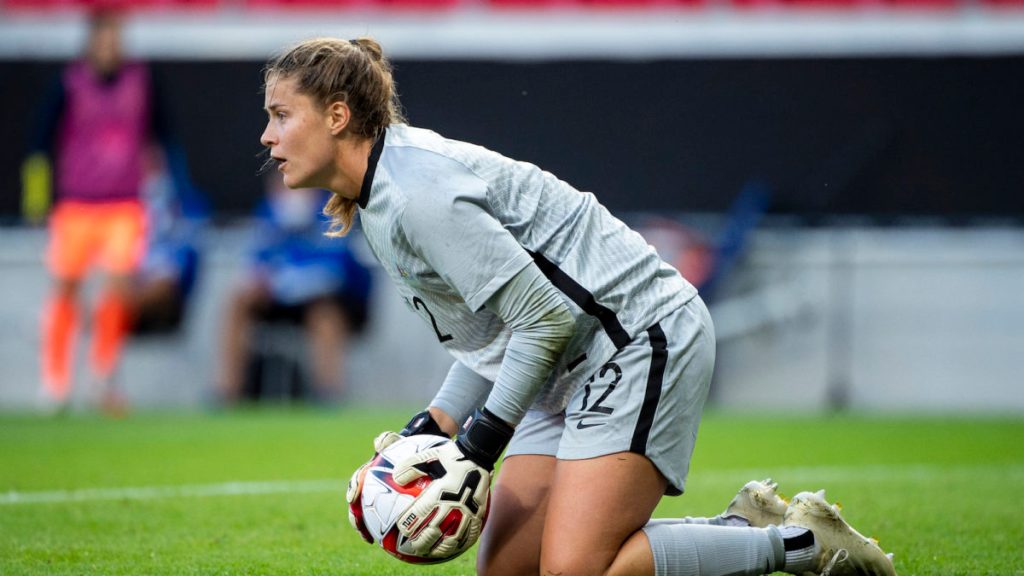
One of several key matters to consider once the dust settles on this defeat is Gustavsson’s inability to settle on a regular goalkeeper. With Teagan Micah regularly playing well at international level when she gets a chance, and consistently at a high level for her club side, Rosengård, the time has come to give her a consistent run of 90-minute opportunities for the Matildas.

It would appear that Lydia Williams will play at least some part in next week’s friendly in Portugal to claim her hundredth cap, but with chances few and far between for her at Arsenal, and the Rosengård custodian in consistently good form, it is time for Micah to get as many minutes as possible behind her in the national team.