Olivia Wood is having an impressive campaign with Perth RedStar. The youngster spoke to Impetus’ Ben Gilby about her footballing journey and life at the unbeaten NPL WA club who are in outstanding form(29/6/22).
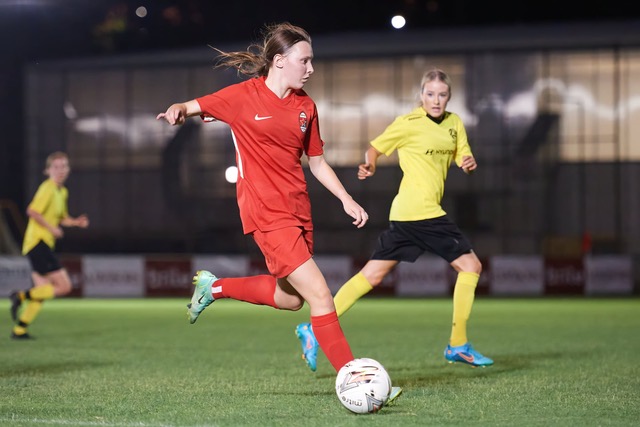
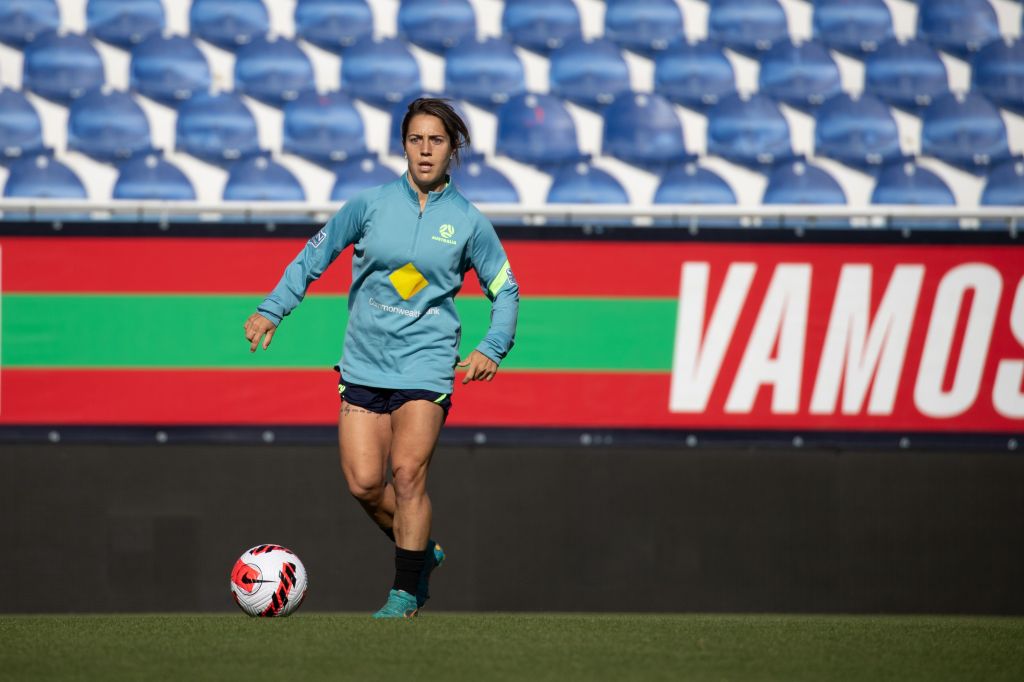
Above: Olivia Wood in action against Hyundai NTC this season. Photo supplied by: Perth RedStar.
Olivia Wood experienced some of her earliest footballing moments in the relatively isolated city of Karratha, 950 miles north of Perth. These formative memories were influenced by her father.
Above: Karratha, WA, where Olivia Wood grew up. Photo: ABC.
“I have been in and around the game since I was little as my dad loved the game and wanted me to play. In Karratha. I was playing in country weeks and the local leagues for Nickol. After moving back to Perth I started off playing U10 at Joondalup United with the boys all the way through to U15 NPL at Joondalup City.
“After having a tough season, I thought having a go with girls would be fun and a change. This led me to the Northern Redbacks and joining their U16 team. I had a great season making new friends and had a great coach, Carlos Vega Mena, who got my passion back for the game.”
In terms of how she sees herself as a player, Wood states: “I’m always a player who is looking to improve and thrive on advice from others. I don’t take challenges lightly and always find a way to make things fun which I find is important for me to excel in the game. I consider myself a more attacking player, playing in position such as striker, central attacking midfielder or winger.”
Above: Olivia Wood in control against Hyundai NTC. Photosupplied by: Perth RedStar.
The attacker is surrounded by a number of teammates who have played hundreds of games for the club over a long period of time. Having been part of the group for three years now, Wood has had a number of memorable experiences.
“I have had some great times here. From my first being the top goal scorer for the U16’s league, I think my most memorable achievement was the 2022 Night Series Cup. It was my first trophy and was really great to win and to see what it meant to the girls. It was a great ending to the Redbacks era, which I am lucky to have been a part of.
“It was a great game to be a part of and definitely a nail-biter. When Balcatta scored their two goals early on, I wasn’t really worried and I had a feeling we were going to come back. There was no real secret to the comeback other than belief and trust in each other.
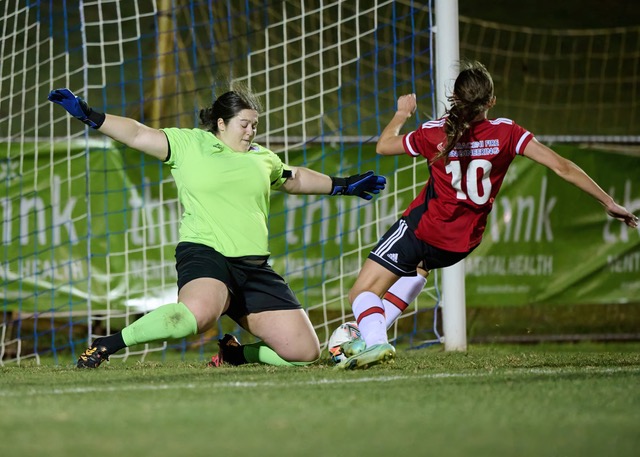
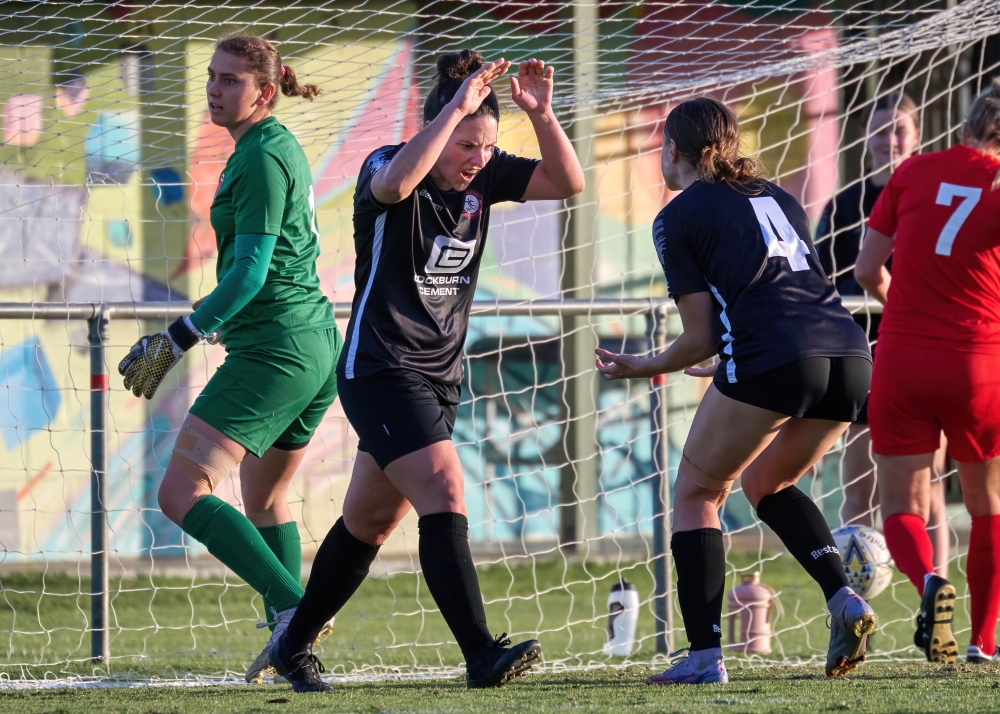
Above: Olivia Wood in action for Northern Redbacks looking to score against Balcatta goalkeeper Gabby Dal Busco. Photo supplied by: Perth RedStar.
“The team knew what we needed to do and after the break we came out calm and ready to work. After our first goal, we all realised we were still in the game, and after that it was down finishing our chances which the keeper did well to stop. I could definitely feel the third goal coming and knew we deserved it. The fourth goal was the icing on the cake and were ready for the final whistle after the hard fought 120 minutes.”
“The sense of community within the club is unmatched. I have made long lasting friendships with teammates and the support from younger teams is great to see. I always look forward to training as Carlos (Vega Mena, head coach) makes it fun and engaging and challenges us to be the best players we can be.”
That final game for the Northern Redbacks was a result of their merging with men’s side ECU Joondalup under the banner of Perth RedStar with the promise of greatly improved facilities. Wood sees many positives in the changes.
“There was definitely a mix of emotions at the start. It was sad on one hand to leave behind what was the Northern Redbacks, but I’m definitely excited to see what opportunities the new club holds. So far playing under the RedStar lights has been awesome, especially on super Saturdays where you can see many supporters in and around the grounds. Things are moving smoothly and can’t wait to see what the season has to offer for the club.”
“As a whole, I’m certain the club is going to have a great season. Our NPL sides have had a great start and can see this continuing throughout the season. Our aim as a club is bringing silverware home for our new name and getting the Perth RedStar name known around the leagues. For me personally, I think this season is trying to stay as consistent as I possibly can, and to learn from our experienced players in the team. I definitely would like to score some goals as I did in the pre-season.”
Wood sees positive developments on a much wider basis across the WA NPL women’s competition this season. “We have seen more and more media. With a new podcast detailing each round and with the Clutch TV partner, the NPL WA leagues are seeing greater media coverage. Clutch TV are making it more accessible for other states to watch the NPL WA games. I think the future is bright and I am glad to be a part of it.”
Kieran Yap provides his weekly round-up of all the action from the Victoria NPLWomen’s competition. As usual, there is a detailed report on one game and a wrap of all the other matches along with photos (29/6/22).
Above: A tussle in possession between Calder United (white shirt) and South Melbourne. Photo: Jack Dilks/171819.
MAIN REPORT OF THE WEEK:
Calder United 3-0 South Melbourne
League leaders Calder United continued their unbeaten run when they faced South Melbourne in Round 13 of Victoria’s NPLW.
Mark Torcaso’s side has not lost since Heidelberg United got the better of them in April. South Melbourne came into this game in need of a win. After a tough start to the season, they made a resurgence that had them on the edge of the top four. But since a hard-fought and impressive win over Alamein, they had lost the next two before making the journey west.
Not helping matters was the fact that they were without Claudia Mihocic in defence after an injury in Round 12 against Heidelberg. Without the Young Matilda, they are much easier to score against. Her excellent one-on-one defending was one of the reasons for their turnaround, and Calder United wasted no time in testing the new-look South Melbourne defence.
Above: Calder United look to escape and advance on goal. Photo: Jack Dilks/171819.
Calder speedster Stacey Papadopoulos received the ball wide on the left and raced into the area. She used the defender’s momentum against her to cut inside and open up the angle from the by-line. The finish was from close range but was not easy. She hit it with enough power to leave Jenna Farrow with no chance. It was one-nil after seven minutes played.
South Melbourne looked set up to counterattack. They allowed Calder United to bring the ball out from the back with minimal pressure, defending deep and hoping to use the pace of Janna Lawson to launch attacks.
However, this meant that Calder were able to attack in multiple ways and any errors could be potentially damaging. Natasha Dakic’s cross almost resulted in another goal for the hosts. Emma Rober’s header was on target but saved well by Farrow.
The score remained at 1-0 until early in the second half. In the space of a few minutes, Calder United put the result beyond doubt with two brutal attacks.
Above: Harriet Withers and Raquel Derales celebrate. Photo: Jack Dilks/171819.
Raquel Derales won possession wide on the right. She played the ball inboard to Melissa Taranto who sent a long pass into the path of Harriet Withers. The winger collected the ball in her stride and held off close attention to finish calmly and make it 2-0 in the 47th minute.
Soon after, they had a third. South Melbourne won a corner through the efforts of Francesca Iermano. However with numbers committed forward for the set-piece, Calder United were able to burst away through Withers. She easily outpaced Bella Stringfellow and cut it back inside to Derales. Her first touch looked slightly heavy, and the ball bobbled on the pitch, but she lifted it over Farrow and finished into the open goal with her third touch. 3-0 after 49 minutes.
To South Melbourne’s credit, they continued to attack, though they had little choice. Janna Lawson had their last attempt on goal. Her control and cutback was very nicely done, but Alyssa Dall’Oste was untroubled by the finish.
Calder United extended their lead at the summit of the NPLW. They are five points clear of second-placed Heidelberg United and have only lost the one game so far. South Melbourne’s second loss sees them drop to seventh. They host Box Hill United next week and desperately need a win.
Squads: CALDER UNITED: Dall’Oste, Cain, Dakic, O. De La Plaza-Sanchez, R. Deralas, El-Hayek, Groba Mathews. Papadopoulos, Robers Rossi, Sardo, Sinclair, Stojcevski, Taranto, Taranto, Withers.
SOUTH MELBOURNE: Farrow, Carman. Claridge, Goff, Houndalas, Iermano28, Kandilas, Keppens, J. Lawson, Picak, Pickett, Sandhu, Stringfellow, G. Taranto, K. Tolios.
Referee: Aleksandar Nikoloski.
Round 13 Wrap:
Above: Action from the game between Box Hill United (blue) and Heidelberg United. Photo: Passion Creations.
In other results, Bulleen and FV Emerging’s game was postponed, The NTC side sits just outside the top four with a game in hand. Bulleen Lions’ ladder position did not change despite not taking to the field.
HeidelbergUnited continued in their consistent year with a 2-1 win away to Box Hill United. Goals to Stephanie Galea and Kathryn Vlahopoulos saved the day in the second half after Madison Van Dooren opened the scoring for Box Hill in the 47th minute.
Above: Dramatic goalline action as Bayside United (orange) take on Alamein. Photo: Centre Circle Photography.
Alamein continued to present their credentials for fourth place, dispatching Bayside United 4-0. Elaina Vatcky scored a brace, with the first coming in just the second minute of play. Nia Stamatopoulos added one from the penalty spot and Sidney Allen scored Alamein’s fourth before halftime.
With FV Emerging hot on their heels, Alamein will need to get a result against the odds away to Calder United in Round 14.
Above: Spain – one of the favoured nations at this year’s competition. Photo: GOAL.
With the groups set out and the squads revealed, the Women’s 2022 Euro Championship has started to take shape, and for Spain, there is a quiet optimism surrounding the camp heading into the competition.
In recent seasons, Spain have had huge success at club level, with Barcelona building on their 2020-21 treble-winning season by winning their 14th consecutive league title unbeaten this season. Within La Blaugranes there is a strong Spanish core, that La Roja coach Jorge Vilda has the luxury to choose from.
In his provisional squad for the Euros, which is held in England, Vilda has called upon 10 Barcelona players including, Ballon d’Or winner, Alexia Putellas.
Originally the former Spanish youth team coach announced 11 Barcelona players in his squad, but lethal striker, Jennifer Hermoso will miss the tournament due to a knee injury.
Her absence meant that Claudia Zornoza returned to the squad, after the Real Madrid midfielder was notably omitted from the squad, with 18-year-old Salma Paralluelo, who made her Villarreal debut in January against EDF Logrono, rewarded with a first senior call-up.
Defenders: Irene Paredes (Barcelona), Maria Leon (Barcelona), Leila Ouahabi (Barcelona), Andrea Pereira (Barcelona), Ivana Andres (Real Madrid), Ona Batlle (Manchester United), Laia Aleixandri (Atletico Madrid), Olga Carmona (Real Madrid), Sheila Garcia (Atletico Madrid), Ainhoa Vicente Moraza (Athletic Club).
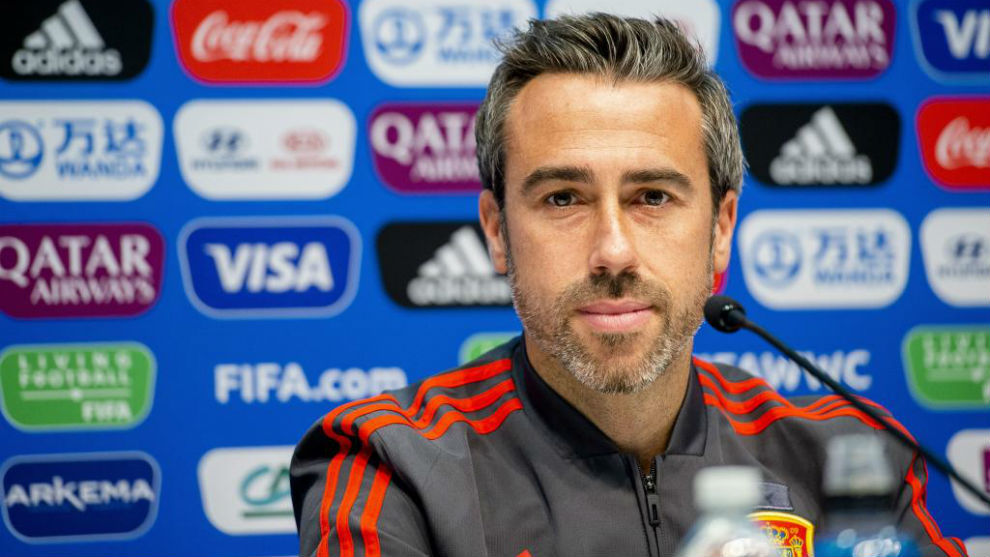
Above: Jorge Vilda, Spain’s head coach. Photo: AFP.
Jorge Vilda has experienced all levels of the Spanish women’s national team, first managing La Roja’s under 17 for five years, where he led his country to two victorious Euro campaigns, before taking charge of Spain’s under 19 in 2014, the same year he was nominated for FIFA’s Women Coach of the Year. In 2015, he succeeded Ignacio Quereda as the senior women’s head coach and has established many of the players he worked with at youth level as regular inclusions within the squad, including Putellas, Lola Gallardo, and Patri Guijarro. His greatest success with La Rojas, so far, was in the 2020 She Believes Cup, beating England to finish second to the United States, with the 40-year-old looking to go one step further in this international competition.
Euros History:
Despite being touted as contenders for the tournament, Spain’s pedigree within the Women’s Euros isn’t rich, reaching their sole semi-final 25 years ago. Since that defeat to Italy, they have only managed to get to two quarter-finals, both of them coming in the last two editions of the tournament.
In recent years Spain have found huge amounts of success domestically, with Barcelona Femeni filling their trophy cabinet with league and cups over the past decade, as well as finding prosperous talents and turning them into some of the world’s best. Despite all this success at club level, La Roja have struggled to replicate that form internationally, and are often seen as perennially underachievers and unable to turn domestic triumphs into national glory.
But as Euro 2022 draws closer, Jorge Vilda’s side head to England quietly confident and with the aim to go further than they ever had before, and create some more moments, like these three, in Europe’s most prestigious competition.
Spain 2–1 England, European Qualifier First Leg Play-off, 8th September 1996 – Although not technically a Euro’s match, but a play-off match, that if victorious would help La Roja take a step closer to an inaugural Euros campaign.
But before they caught a flight to Sweden, they first entered the field at Montilla, in Southern Spain, to face England, who already had some European pedigree, after featuring in the tournament that presided the 1997 edition. Despite the European experience and prize on the line, Spain were not fazed and struck first through Prieto Ibanez, eight minutes in.
The early goal put Spain on their way, as they gained a grip of the first play-off game, Ibanez struck again the other side of the break, with Hope Powell halving the deficit with 26 minutes to go. Spain won on home soil and flew to England to hold onto a draw that saw them reach their first Euro competition.
Spain 1 – 0 Russia, European Championship Group Stage, 5th July 1997, After battling past England, Spain were handed France, Russia and Sweden in Group A. La Roja’s maiden game against Les Blues, ended in a draw, followed by a narrow defeat to European regulars, Sweden, which balanced the group nicely for Spain, knowing a win against Russia, would see them through to the knockout stages at the first time of trying.
Above: Veronica Boquete – Spanish legend who scored against England in 2013. Photo: Minas Panagiotakis.
Manager Ignacio Quereda lined up a similar team to their match against England, and saw a similar result in Karlskoga, as Maria Parejo got the sole goal of the game to send Spain through to face Italy and pick up their first victory in the Euros.
England 2-3 Spain, European Championship Group Stage, 12th July 2013 – Since that defeat to Italy in 1997, Spain’s senior women’s side had botched multiple opportunities to get to the Euros, until 16 years later when they returned to Sweden to pick up their first win in the tournament since the turn of the century in dramatic fashion.
After eight minutes, Eni Aluko dragged the Lionesses level, after Veronica Boquete opened the scoring four minutes earlier, and it wasn’t until 81 minutes after the former PSG player’s early strike, that the game found a new lease of life.
The clinical Jennifer Hermoso reacted quickest to Silvia Meseguer’s deflected shot to fire in, only for England to fight back with one minute left on the clock. Anita Asante cushioned the ball into Laura Bassett’s path to guide it in, but La Roja wasn’t knocked back and three minutes into added time Putellas header sent Spain fans into pandemonium after a 16-year absence from the tournament.
Similarly, to their 1997 campaign they reached the knockout stage but fell short once again and this time became the victims of a stoppage-time winner by Ada Hegerberg and Norway.
And heading into this tournament Vilda will be hoping to create more history by coaching them to a first Euro knockout victory in England this summer.
Qualifying:
Although they have underachieved on the international stage, La Roja flexed their muscles in the qualification phase, winning nine and drawing one as they comfortably finished top of Group D, six points clear of the Czech Republic. They racked up some big results on their way. Esther Gonzalez and Hermoso both scored five goals as they whacked Azerbaijan 13-0 away, whilst also beating Moldova 19-0 over two games. The five-goal haul by Barcelona’s striker saw her finish as the side’s top goal scorer in qualification, as Vilda will need to find a solution to replace Hermoso’s goalscoring talent.
Strengths:
The side line-up in a 4-3-3 formation that allows them to dominate possession, in the classic ‘tiki-taka’ style. With this, they are going to be one of the most enjoyable teams to watch, and with Putelas, Gonzalez, and Claudia Pina the Spain squad is full of entertainers.
Development Area:
The fact that their top goal scorer in qualification will miss the tournament is the biggest area of concern for Vilda. It will be difficult to replace what Hermoso offers, not just with her threat in the final third but, collecting 91 caps for Spain, the striker offers a wealth of experience, and the Spanish fans will be hoping that the Barcelona core can transfer their winning mentality over across to the national team.
Key Player:
Above: Spain’s superstar Alexia Putellas. Photo: Jose Luis Contreras/DAX Images/NurPhoto.
Alexia Putellas. Currently UEFA Women’s Player of the Year, Putellas has been the instrumental focal point in Barcelona’s dominance. The midfielder has all the traits needed to succeed in the middle of the park, dictating play, whilst also having a killer instinct when it comes to playing a defence-splitting pass or when she finds herself with an opportunity to score. The 28-year-old is also deadly from set-pieces, with the ability to combine her powerful strikes with precision, she will add an extra advantage to Spain’s attack.
One To Watch:
Claudia Pina. One of Putellas’ teammates at Barcelona, Pina returned from her loan spell at Sevilla last season, ready for the challenge at Barca, which she has battled successfully. Injuries to Mariona Caldentey and Lieke Martens gave the 20-year-old a pathway into the starting line-up and she has impressed. 15 league goals along with 11 assists is an impressive return for any professional, and there is more to her game than just these stats.
The diminutive midfielder is always busy searching for areas to become a goal threat, and being a forward player her ability to keep control of the ball in tight areas helps Barcelona and Spain function. This will be her first senior tournament with La Roja and after a successful breakout season, Pina will look to build on that in England.
Prediction:
Semi-Finals. Drawn in the group of death, against Germany, Finland, and Denmark, it will be an early test for Vilda’s side but if they manage to fight their way through, then La Roja will be confident they can beat anyone. The teams they are likely to face in the quarter-finals are Norway or England, and with the English crowd, Vilda will be keen to avoid the Lionesses – although to do that they are likely to have to win the group. With the squad flooded with talent, though, Spain will be looking forward to what could be a fruitful tournament for them.
12th July: Germany, 8pm, Brentford Community Stadium, London.
16th July: Denmark, 8pm, Brentford Community Stadium, London.
Impetus is previewing a different nation every day between now and the start of the European Championships. Click below to read the previously published articles:
Martin Townley and Ben Gilby heard from Australia head coach Tony Gustavsson after last night’s 1-1 draw with Spain (29/6/22).
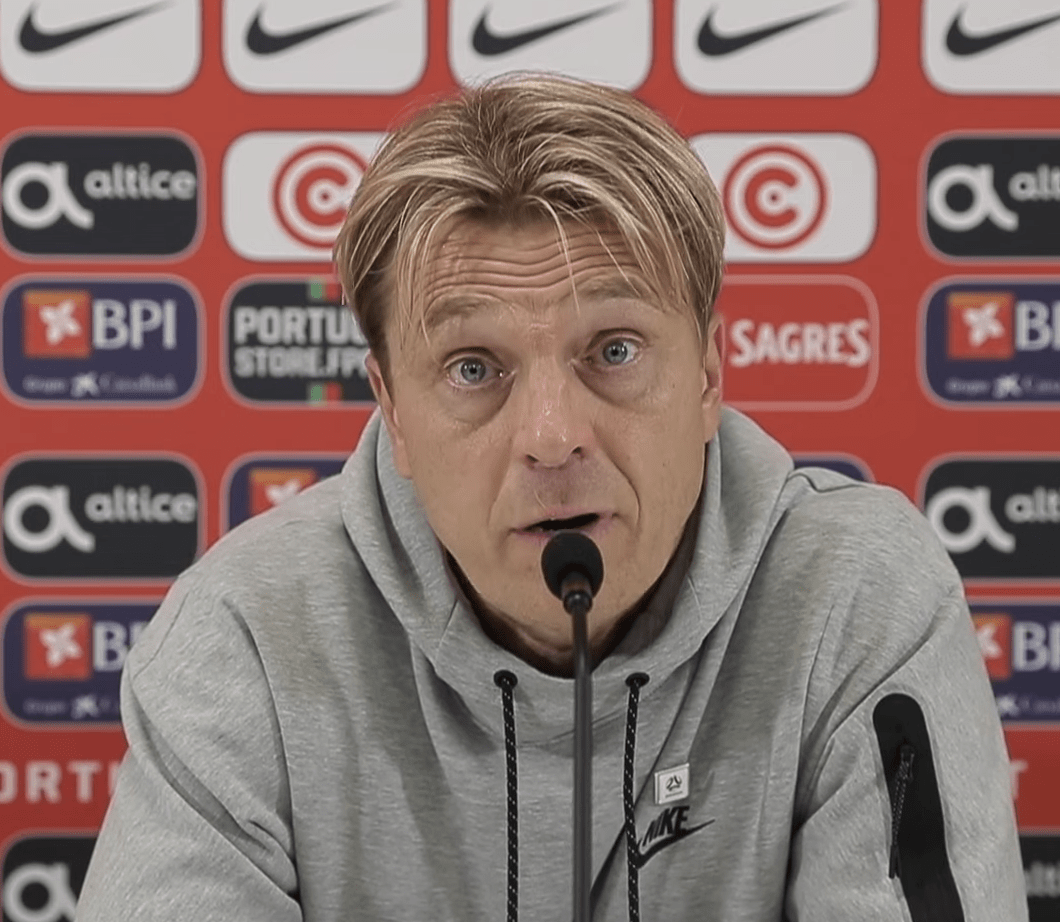
Above: Tony Gustavsson addresses the media from Portugal last night. Photo: Football Australia.
Prior to the Matildas’ double header in this international window against Spain and Portugal, head coach Tony Gustavsson said that he needed answers.
His side was without a large number of established stars meaning his focus was to be on training and performances during the camp.
Last night’s 1-1 draw with Portugal saw Princess Ibini score her first international goal just after halftime. Gustavsson was impressed with her contribution coming on from the bench – not just in terms of the goal, but also what she offered with her runs.
“Princess Ibini, who comes off the bench, has some unique skill sets. What we’re pleased with her is that she committed to run without the ball in this camp, both in training and in the game.
“We knew what she can do with the ball. We’ve seen that in the A-League. She also commits to run more without the ball balls defensively, and in behind the back find like the goal today, for example, was a run empty run on the back post 30, 40 metres to score that goal.”
This camp however was not just about giving experience to new players as the Matildas coach also admitted that he was learned more about his wider squad.
“It’s not just about the new and younger ones. We tested (the others), playing Clare Wheeler in different roles to get answers on those players. We tested some of the backline players that have been with us for a while both in the back five and a back four both on the left and right-hand side. So, in that sense, I think we’ve gotten a lot of answers.”
“I’ve got a lot of answers on the individual players for sure. Not just from games but from training. We’ve seen some players perform good at clubland. And we have gotten an answer that some of their performances club land have been challenging to bring to the Matildas training environment because everything here is much faster.
“This is so much faster even though the tempo in the training camp this time around have not been the same as it normally is due to the lack of a lot of key international players. But still, it’s been a huge step for a few of them. But we think it’s good that they got exposed to it.
Despite feeling he has some positive answers Gustavsson, has faced criticism from some quarters for a lack of a consistent tactical approach and stating some of his players are not up to speed with international football.
Above: Lessons learned and answers gained according to Tony Gustavsson. Photo: Football Australia.
“I’m trying to be as consistent as I can with the players available in camp. In this second game, we went back to normal 4-3-3. We tried to be brave on the ball even though we knew it was going to be difficult and challenging against Portugal.
“I think they dominated us with the defending and not with the possession, but we tried to play out through that pressure and I thought we saw a lot of technical mistakes.
“We wanted to try to be ourselves in that sense more in this game even though we knew it was a tough game against Portugal
“I think what surprised me a little bit today like I said is that we struggled in the centre of the park with some of the more experienced and technical players that took too long on the ball and get dispossessed a lot.
“The Portugal aggressive pressing was better than our passing in that central area. So, I would like to see us improve in that sense.”
Gustavsson went on to say that with experienced players missing he didn’t have a team on the field that matched Australia’s ranking of 12th in the world.
“Again, I think it’s the result that a lot of people think just looking at the rankings and look at the teams would say it’s a 12 ranked team against a 20-something ranked team that should win this game.
“What I ask then, is did we have a 12-ranked team on the field today? “That’s not to criticise the players. It’s where they are at and the lack of experience that we have in this team.”
When questioned about how this could affect the confidence of the players Gustavsson was quick to defend his methods. “I’m not criticising the players. But I’m saying that what I even said was, it’s unfair to expect these players to come out and win against Spain.
“I think it’s unfair because they’re coming from an environment where they’re not ready for it. And it’s not saying hey, you’re bad, you’re not good enough. It’s saying the environment you’re in right now has not made you ready for this type of international top-level football. But we brought you here because we think you can get ready for it, and when you get this experience and bring that back home to training.”
Above: Combative actionbetween Wales and New Zealand yesterday. Photo: PhotoSport NZ.
Wales and New Zealand played out a goalless draw on a sunny evening in Spain. In a competitive encounter, both teams created chances despite not being at their best.
Indeed, the Football Ferns could have taken the win through Grace Jale late on if not for a fine save from Laura O’Sullivan in the Wales goal. It was a New Zealand side who fielded some of the young stars from Wellington Phoenix’s inaugural A-League Women season with the Jale joined by team-mate Kate Taylor on the bench.
A goalless first half saw a combination of shaky play and chances. New Zealand enjoyed more spells of possession, but Wales always had opportunities.
The first chance of the game came from a quick Wales counterattack. Kayleigh Green found Rachel Rowe on the left. Rowe played the ball across the six-yard box but the advancing Ceri Holland, but she could not connect.
Annalie Longo could have put New Zealand ahead after a poor defensive pass from Hayley Ladd. Ladd played the ball across her own box gifting possession to Longo but under pressure, her shot went off a Welsh player and wide.
Rhiannon Roberts found Angharad James with a cross from the right. James struck the ball from the edge of the area, but her effort was deflected and never a danger for Esson’s goal.
Above: Wales captain looks on in Pinatar as her team faced New Zealand. Photo: FAW.
Sophie Ingle began to try and pull the strings for Wales putting a sublime pass into Natasha Harding to set her though but pulled her shot across goal.
The Ferns had two great opportunities to go ahead before the break. First, Perth Glory’s Liz Anton who latched onto the ball on the edge of the box and unleashed a shot that looked to be heading into the top corner. O’Sullivan was across goal to push the ball over the bar and keep the score at 0-0.
Soon after, Katie Bowen found Meilayla Moore free who headed over the bar when if she had headed down would have likely given her side the lead.
New Zealand began the second half quicker than their opposition, making crisp passing moves and forcing Wales to play in their own half.
Above: Possession was keenly contested in Pinatar. Photo: PhotoSport NZ.
Gemma Evans was forced to concede a corner as Sydney FC star Paige Satchell was working towards the box. From the corner, Wales tried to clear but the ball fell to Rebekah Stott who fired a shot over the bar.
Ceri Holland had a chance for Wales after an error let her in. Seeing Victoria Esson slightly off her line she went for a lob, but the keeper made an easy save.
New Zealand were looking the better side and a good cross in from the right forced Laura O’Sullivan to punch away. With the keeper out of position, Olivia Chance fired at goal but Roberts was back to clear.
With time running down, New Zealand almost took the win as Jacqui Hand met a cross from the right from Grace Jale with a bullet header. O’Sullivan reacted quickly with a fine save putting the ball over the bar.
Ahead of tonight’s friendly in Portugal, Impetus’ Ben Gilby heard from Australia’s head coach Tony Gustavsson and Charli Grant who put in an impressive performance in difficult circumstances against Spain on Saturday (28/6/22).
Above: Australia head coach Tony Gustavsson facing the media today. Photo: Football Australia.
“It Surprises Me That People Are Surprised”: Gustavsson On Reaction To Spain Loss.
Listening to today’s pre-game media conference with Tony Gustavsson ahead of the game with Portugal, two key elements came to the fore.
Frustration, and a desire to re-set people’s mindsets.
Frustration that he was not able to field the sort of team he originally wanted to against Spain. Frustration that people haven’t quite understood the reality of the situation he and his players faced. There was also a desire in his words for those around the women’s game in Australia to focus on developing a stronger platform or pathway for players to come through who are more prepared for the increasing challenges of international football.
“It has surprised me that people are surprised (by the result against Spain). If you follow the women’s game, see where Spain are, and what they have done, if you look at their scorelines against Scotland (8-0) and you look at the team that we brought to play them, it surprises me that people are surprised. That’s where we are, and we need to be OK to see the truth here, and keep investing, keep believing, and want to improve.
“I as a coach always want the best team available when we play the best teams. When we realised what would happen for this match, I had to decide whether I say as a coach ‘no, we have to have everyone available regardless’, or I look at the longer-term issues. So then you change perspective for the camp. You think about how we can get benefits from it.
“It’s about looking at the depth of the roster in terms of where we are now, and then look at the players and get them the experience (so they) know what it’s like and what it takes to be ready for this level when you are next called in. Whether that means an individual training program, a more challenging environment to play in, or looking for more games for the players over a 12-month period…remember The Gap Report stated our players are not playing enough games over a year.”
Above: Katrina Gorry – one of the positives in the defeat to Spain – and an example of a player who has moved overseas to get more games at a consistently higher level. Photosupplied to Impetus by: Football Australia.
Gustavsson reiterated his argument first raised in his post-match media conference that the second half, where the Matildas conceded six goals, saw him field a team containing “four players playing NPL and another playing college football”. Whilst at the present time this is factually correct, it is disingenuous, and easy meat for Gustavsson’s critics to pounce on.
Those playing NPL in the Matildas squad right now are all players with extensive A-League Women experience. The college footballer, Amy Sayer, has played 21 matches at W-League/A-League Women level. They are not just players he has plucked from state football and put straight from there into international football.
Gustavsson went on to be brutally honest by saying that as a result of playing a second half with these players, “You know you are going to lose, and it is a question of how many goals. It tells us where we are right now with those players and the pathway we have. We need to keep investing in these players to give them the best chance of going from clubland to international football. At the moment, that jump is too big for them.”
Effectively, the argument that A-League Women players should be more actively looking to play in strong competitions outside of the top domestic league calendar is a good one, but it has got slightly lost in the way Gustavsson chose to raise it.
The head coach then looked to raise the spectre of a necessary change in thinking about the way the whole Australian women’s football system needs to change to prepare players for top-level action.
“A senior national team should not be looking at developing players. It should be looking at the tip of the iceberg and everything else that happens in clubland and other areas of development pathways should be about making them ready for international football. That is where we need to invest and develop.
Above: Tony Gustavsson admitted he is being scrutinised and being held accountable, but also highlighted the longer-term issues in the women’s game in Australia that this camp has raised. Photo: Football Australia.
“When it comes to reputation, all I can say is that my name as a coach will be scrutinised. Sometimes, a reality check even if it hurts, can be healthy for the long term. Short term it really hurts – for players, the media, fans, coaches, and staff, but in the long run, maybe it is what we need.
“I will never stop believing in this team, but we need to be fair on what we can expect and at what time we can expect it.”
Gustavsson also recognised that he is in the firing line and emphasised that he is held accountable after every national camp.
“After each camp, we review internally. We need to think about what we learned rather than what went wrong. What went wrong is saying we failed and should have done something better, but we always discuss what we learned.”
Moving on to the next challenge, Portugal tonight local time, Gustavsson was clear that there is a lot of work to be done.
“Portugal play in a very different way to Spain, and so our preparations have involved more individual meetings with players on top of a training session. It’s all about getting the players mentally ready as well as physically ready.
Above: The Matildas training in Portugal this week. Photo supplied to Impetus by: Football Australia.
“We have tried to look at past experience against them. We went back to 2018 in the Algarve Cup when we played them twice – a draw and a loss. We had a much more experienced team then. We have to be humble enough to realise that this will be a tough match too.
“They are peaking for the Euros, and we might see a different formation from us and tactical flexibility.”
The Australia head coach closed by addressing the challenge of filling an Ellie Carpenter-shaped hole in his squad over the coming months.
“Ellie is so professional and mature for her age. We will support her and Lyon with everything we can in her rehab. We need to look for replacements, but it’s not (about) looking for another Ellie.
“We are looking for another outside back or wing-back. We have a few options, play a back three and have wingbacks, or we look at natural replacements like Charlotte Grant. We’ve looked at Cortnee Vine. We can take attacking midfielders back into the position too. We’ll look at one, maybe two options tomorrow.”
Charli Grant: Stepping Up The Levels Of Intensity And Staying Positive
Above: Australia and Rosengård defender Charli Grant speaking earlier today. Photo: Football Australia.
For Charli Grant, opportunities to start for The Matildas have been few and far between. One such opportunity came on Saturday against Spain, and despite the intense pressure, the 20-year-old South Australian put in a great shift.
Reflecting on the experience, Grant said: “It was definitely a tough one. We knew they were one of the favourites for the Euros and it was a great chance for us to play against one of the world’s best teams. We learned a lot from it.
“They are such a high-tempo team and it taught us to make the most of every moment we had on the ball and then be focused when they are on it as you just never know what they are going to do with it. They are so technical and strategic.”
The former Adelaide United star outlined some of the factors behind her strong performance. “As a young defender, I just want to make the most of every opportunity. I had to stay so focused. I had to focus on one thing at a time – each individual thing as it happened. One tackle at a time, one pass at a time. It will definitely help me going into future games.
“It helped me massively being exposed to that sort of game. Going forward as a result, we’re only going to get better from here. We trust the process that Tony has put in for us. I know how much I have improved since I first came into the Matildas last year and my level will only go up going towards the World Cup.”
“I have technically improved and my composure on the ball has improved as well. Being around the girls in the squad has taught me to be a better defender.
“For me, coming from Adelaide United to Rosengård was definitely a step up in terms of (a more) technical (game) and a fast pace. Then going into the national team, that (move to Sweden) definitely helped me to transition. Yet playing against Spain is a whole new level! I was excited to be exposed to it, but it was definitely something that needed to be adjusted to.”
Whilst some may expect young players such as Grant to be adversely impacted confidence-wise after such a heavy loss, the defender feels otherwise. “The result was disappointing, but we can only look at what we can improve from it and put all our focus onto the Portugal game and put things right there.”
Above: Iceland celebrate their qualification for Euro 2022. Photo: Iceland Review.
Iceland, placed 17th in the FIFA World Rankings, are known as Stelpurnar Okkar (Our Girls) and are a small island nation with a population of only just over 370,000 people (slightly more than the English city of Coventry or the Central Coast of NSW). The nation bats well above average in women’s football for its size. Vigdis Finnbogadottir was the world’s first female elected head of state, becoming president in 1980, and Iceland is known for its progressive feminist politics. Icelandic people use Patronymic or Matronymic surnames meaning their surname indicates the first name of their father or mother followed by dottir (daughter) or son (son). So for example, Sara Bjork Gunnarsdottir is the daughter of Gunnars.
Above: Thorsteinn Halldorsson, Iceland’s head coach. Photo: Visir.
Thorsteinn Halldorsson was appointed coach in January 2021 After coaching the Breidablik woman’s team since 2014, winning the Icelandic Championship three times and making the final 16 of the Champions League in 2019. He was a successful defender prior to coaching making over 150 appearances in the men’s top division.
Since he’s been their manager, they’ve only lost to the Netherlands and the USA. Iceland have also recorded wins against the likes of Japan, the Republic of Ireland, New Zealand, and the Czech Republic.
Euros History
Iceland have qualified for three previous Euros, in 2009, 2013, and 2017. They made the quarter-finals in 2013 but lost all their group games in 2009 and 2017.
Qualifying
Iceland qualified after being runners up in Group F which consisted of four other nations: Sweden, Slovakia, Hungary, and Latvia. Iceland only lost one match – against Sweden in their away match, 2-0. They drew their home match against the Olympic silver medallists 1-1. They recorded the biggest win of the group against Latvia 9-0 and Elin Metta Jensen topped the goal scoring in the group with 6 goals. Their goal difference was +20.
Strengths
Iceland has a good grassroots football scheme that inspires young girls to compete professionally. The small population means that the Icelandic people are just as interested in supporting the women’s team as the men’s, particularly when they do well.
Iceland have prolific scorers in Elin Metta Jensen, Dagny Brynjarsdottir and Sveindis Jane Jonsdottir. They had a high-scoring run in qualifying and still kept out the likes of Sweden with solid defence. Most of the team play in the Scandinavian and German leagues, with the notable exceptions of Jonsdottir playing for Orlando Pride in the NWSL, Brynjarsdottir playing for West Ham United in the FAWSL and Gunnarsdottir having recently left Olympique Lyonnais in the D1 Arkema for Juventus. Only seven members of the squad play for domestic Icelandic teams giving them wide-ranging experience with their European opponents.
Development Areas:
Iceland have never qualified for a World Cup and have only qualified for the Euros three times before. They’ve had reasonable success in the annual Algarve Cup but they lack big tournament experience. The pressure of this tournament could take its toll on some of the less experienced and younger players.
Key Player:
Above: Sara Bjork Gunnarsdottir, a Champions League winner with Olympique Lyonnais before heading to the Euros with Iceland. Photo: OL Feminin.
Sara Bjork Gunnarsdottir is the Iceland captain and most successful player. She was a regular starter for Lyon prior to falling pregnant and then having a baby last November. She played again in March and was part of the Champions League-winning team in May. She’s just signed for Juventus for next season and is a calm and strong leader. Her presence will lift the team.
One To Watch:
21-year-old Sveindis Jane Jonsdottir is making a name for herself with Wolfsburg. The team made the semis of the Champions League this year losing to Barcelona so she has some big match experience. She also won the league this year with Wolfsburg. She is fast, technical, and brave.
Prediction
France are likely to win their group but Iceland could get to the quarter-finals. Italy are becoming stronger and stronger of late but Iceland have a solid, experienced squad and it’s certainly not inconceivable they could get through. It’s unlikely they’d get any further though.
Group Fixtures
10th July: Belgium, 5pm, Academy Stadium, Manchester.
14th July: Italy, 5pm, Academy Stadium, Manchester.
18th July: France, 8pm, New York Stadium, Rotherham.
Ben Gilby provides his weekly round-up of all the action from the Western Australia NPLWomen’s competition. As usual, there is a detailed report on one game and a wrap of all the other matches along with photos(27/6/22).
Above: Fremantle City’s Kat Jukic (centre) who was hugely influential for her team in Sunday’s game against Balcatta Etna. Photo: FotoEnzo.
MAIN REPORT OF THE WEEK:
Balcatta Etna 1-2 Fremantle City
A looping cross-shot from Tash Rigby was ultimately the difference between the two sides in a dramatic and entertaining game on Sunday afternoon.
This was the second meeting between the two sides in four days after they played their rearranged Round Six clash in midweek. Balcatta came from behind to record a 2-1 win on that occasion to seal their fifth straight league win and meant that if they could repeat the success, they would go second in the ladder.
Both teams produced a hugely enjoyable high tempo and skilful encounter in the Grindleford Reserve sunshine. The opening quarter saw Freo have the edge in terms of possession and chances, but the hosts had the dangerous Monique Prinsloo, who was combining ominously with Monique Godding on occasions to suggest that once Balcatta were able to put together a consistent period of pressure, they were capable of giving as good as they got.
Much of the visitors’ successes were down to the pace and guile of Jessica Darmago on the left, the physical presence and experience of Kat Jukic who drifted across the centre and towards the right, along with the work rate and quick thinking of Tash Rigby on the right who played in a number of deliciously pacey crosses throughout.
Despite missing the influential pairing of captain Mikayla Lyons and Siobhan Longmore, Fremantle were solid at the back and dangerous going forward. They won back-to-back corners, before using their rapid-fire passing game to cut through once more. Darmago escaped from Tahlia D’Opera on the left and cut across to find Kayla McCulloch who in turn linked with Matilda Boyle. Rigby was then played in on the right to play in a cross for Jukic to hit a first time volley wide.
With fifteen minutes on the clock, the creativity of the visitors combined once more. From a Balcatta throw parallel with their own 18-yard box, the ball went straight to Jukic. The former Perth Glory W-League player was tightly marked by two, but showed great skill to escape and cut in towards the edge of the box where she laid off to Jamie-Lee Gale who advanced into the area and hit a low shot across home goalkeeper Gabby Dal Busco and into the net.
Above: Fremantle City celebrate after Jamie-Lee Gale put them ahead at Balcatta Etna on Sunday. Photo: NPL.
From the re-start, Fremantle almost doubled their advantage. Darmago skipped along the left and pulled the ball across for Rigby towards the back post who crashed a shot first time against the bar.
Yet, Balcatta are made of stern stuff, and they came back from this adversity to put together their longest spell of consistent pressure in the first half. Prinsloo hit a long ranger just wide of the far post before Tahlia D’Opera rifled in an effort from outside the box which needed to be pushed over by Dayle Schroeder in the Fremantle goal.
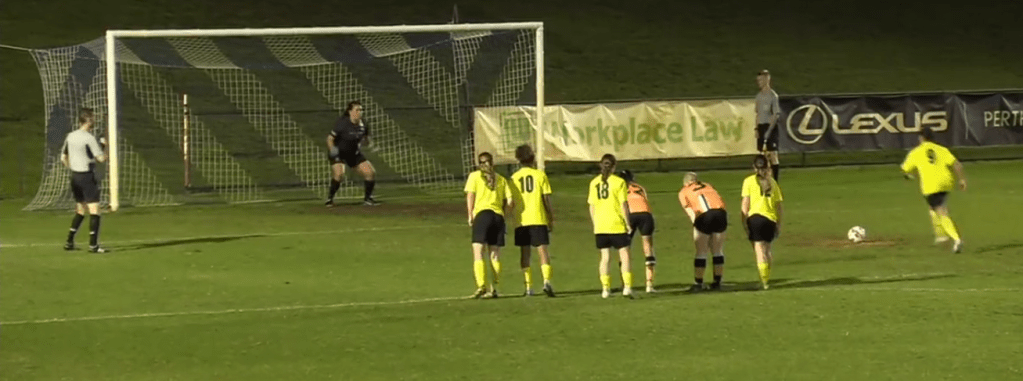
From the resulting corner, as the ball was ricocheting around in the box, it was handled by a visiting defender, and referee Stephen Knight pointed to the spot. Up stepped Godding to dispatch the penalty for her second goal in a week, and Balcatta were level.
Above: The ball hits the right hand side of the net after Monique Godding dispatches a penalty to level the scores. Photo: NPL.
After an initial bout of arm-wrestle football after the equaliser, it was Freo who had the slight edge before the break. McCulloch’s influence on the ball was growing. She was comfortable in possession and in one such move found Annabelle Leek to commence another rapid passing exchange from the visitors, the ball was played into Jukic and moved on to Gale whose effort was forced into the side netting after Dal Busco cleverly advanced to narrow the angle.
Matilda Boyle was forced off the pitch due to injury for the visitors before the break to be replaced by Coral Buxey. During the interval, Balcatta brought on Mia Yeo, and it didn’t take long for the teenage left-sided player to show her worth as the second half opened with a bang.
Monique D’Opera showed great vision to switch the play from the centre out to Yeo on the left. Fremantle gave the Balcatta youngster too much space – something she thrives on – and Yeo advanced up the wing and played in a cross for Prinsloo who hit a shot that was handled by Laura Waltman, and Balcatta were awarded their second penalty of the match.
Laura Continibali placed the ball on the spot this time, and Freo keeper Dayle Schroeder repelled the shot to the left of centre – however, the visitors celebrations were cut short as referee Stephen Knight ordered a re-take. Continibali v Schroeder take two sensationally went the same way as the original as Schroeder saved with her legs.
Buoyed by this incredible turn of events, the visitors immediately went on the offensive and Rigby hit another long ranger which was pushed away from the top corner by Dal Busco.
Back came Balcatta, and Continibali beat Natarsha Smith on the right, to play in a tempter towards the back post for an unmarked Yeo, but the teenager sidefooted wide. Shortly afterwards, injury claimed Yeo and Carys Davis came onto the left.
Above: Tash Rigby (4) hits the winning goal for Fremantle City. Photo: NPL.
Into the final ten minutes, Freo grew once more. They had a penalty shout waved away claiming Aaliyah Jorquera handled the box, but Stephen Knight wasn’t moved. The visitors continued to push. With six minutes remaining, Jukic, on the left turned her way out of a cul-de-sac once more despite the close attentions of Balcatta markers and laid a pass inside for McCulloch who in turn found Rigby outside her on the right. The Perth Glory A-League Women captain advanced before looping a cross-shot which left Dal Busco grasping as it sailed into the net.
Despite Balcatta’s best efforts in the remainder of the game, it was Fremantle who ran out winners to strengthen their position in the top two.
Above: Ischia Brooking (second right) celebrates with her teammates after putting Hyundai NTC 1-0 up against Curtin University on Friday night. Photo: NPL.
This weekend’s action began on Friday night as Hyundai NTC hosted bottom-of-the-table Curtin University at E&D Litis Stadium.
The home side went ahead with just eight minutes on the clock as they profited from a move along the left which saw the ball played in low. Curtin had several opportunities to clear, but failed each time, allowing Ischia Brooking to comfortably side-foot home the opener.
Five minutes later it was 2-0. Grace Johnston put in a high cross from the right which caused chaos in the Curtin defence and it was easily nodded back across goal for Anna Powell to chest the ball across the line. With 18 on the clock, a corner from the right was prodded on by Louise Tana for Powell to smash home from inside the six-yard box for the first in a spell of three goals in four minutes.
Above: Hyundai NTC’s Tanika Lala (9) completes the scoring from the penalty spot. Photo: NPL.
The second in that period came when Curtin lost possession from goalkeeper Stacey Cavill’s short pass out of the box to Tana who fed Tanika Lala outside her. Lala advanced and was able to place a shot into the far corner. It was 5-0 after a similar catastrophic loss of possession at the back. Cavill’s short ball was returned back towards the area and the second attempted clearance only found Lala just inside the box to the left. The young star took a touch and unleashed a rocket into the top right-hand corner of the net.
The flow of goals was stemmed until just after the hour mark. Tana showed great pace to get away along the right and play in a cross that looped up high. Lala went in with Curtin keeper Cavell who initially repelled the danger only for her work to be undone as the ball rebounded off of Powell and in, for her hat-trick. The final goal in NTC’s 7-0 success came from the penalty spot with Lala stepping up to complete her hat-trick.
Above: Perth RedStar celebrate Olivia Wood’s goal that settled matters at Murdoch University Melville. Photo: NPL.
Unbeaten league leaders Perth RedStar maintained their 13-point lead at the top of the ladder with a 2-0 win at Murdoch University Melville on Saturday. But they needed two late goals in order to keep up their 100% start to the season.
They went ahead thanks to Renee Leota goal. The outcome at BeSteam Stadium was finally settled when Olivia Wood forced home from close range at the right hand post.
The round’s remaining scheduled game between Subiaco and Perth SC was postponed.
P
W
D
L
F
A
Pts
GD
Perth RedStar
12
12
0
0
48
5
36
+43
Fremantle City
13
7
2
4
30
14
23
+16
Perth SC
11
6
2
3
19
6
20
+13
Balcatta Etna
12
6
1
5
15
11
19
+4
Hyundai NTC
12
4
4
4
20
24
16
-4
Murdoch University Melville
12
3
3
6
12
16
12
-4
Subiaco
11
1
3
7
10
34
6
-23
Curtin University
11
0
1
10
9
48
1
-39
Round 14 Fixtures: Curtin University v Subiaco, Perth RedStar v Balcatta Etna, Perth SC v Murdoch University Melville, Fremantle City v Hyundai NTC.
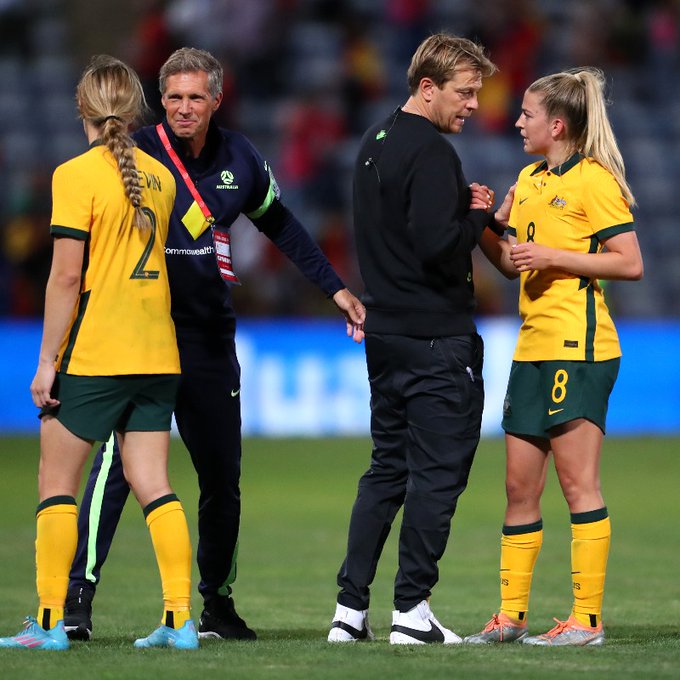
Above: Post-match scenes afterAustralia’s 7-0 defeat to Spain. Photo: Football Australia.
It’s the 90th minute.
Clare Polkinghorne, standing near her own penalty spot, is surrounded by the youthful trio of Courtney Nevin, Taylor Ray, and Charli Grant.
Having just conceded their seventh goal, there’s a pause, as all three turn towards the veteran defender, looking for an answer.
All Polkinghorne can offer is a trudge, head-bowed, back to her position for another kick-off.
It’d be easy to write this match off as “the Matildas rested seven key players against Spain, the favourites for the Euros”. But there are a number of takeaways and implications for the bigger picture, on this challenging road toward the World Cup 2023.
“Controlling” the space against uncontrollable Spain
Australia Head coach Tony Gustavsson spoke in his pre-match press conference about being able to “control the game without the ball”.
Against a possession-dominant and imperious Spain, they would have to compromise; could the Matildas control the spaces where they would allow their opposition to have the ball?
Setting up in an unfamiliar and ultra-conservative 5-4-1 formation, Australia hoped to deny the central areas of the pitch, ceding ball control (they ended with just 27% possession) and forcing Spain out wide.
Above: The Matildas seeking to deny central areas with two defensive banks.
Though Gustavsson spoke of choosing moments to be aggressive in their press, the Matildas allowed an average of 27 passes per defensive action (their average the past year is nine).
On paper, it made sense. But this is a team boasting the peerless Barcelona midfield of Patricia Guijarro, Aitana Bonmatí, and Alexia Putellas; the system may have seemed sound, but the gulf in individual quality was immense.
The Matildas did hold La Roja at bay until the 43rd minute, but cracks appeared in their gameplan from the off.
Less than a minute into the game, Katrina Gorry, playing as the widest midfielder on the right, lost her mark too easily, allowing Mariona Caldentey to play a defence-splitting pass through to Lucia Garcia.
Garcia herself evaded Tameka Yallop’s unsuccessful attempt to play for offside, and her redirected shot forced goalkeeper Teagan Micah into action early.
Spain were confident of winning their one-on-one duels throughout the game, and happy to utilise whatever space was afforded to them. Regardless of the integrity of the formation, Spain felt they were able to have their way in any match-up across the field
Here in the 38th minute, Mariona burned right-wingback Cortnee Vine down the outside.
She promptly stood Vine up again by the by-line, before deciding to go straight through her with a nutmeg, working her way into a dangerous position in the box.
For the first goal of the match, Aitana was able to receive the ball on the edge of the 18-yard box.
She jinked past an overmatched Courtney Nevin, conjuring the space to curl a delightful ball into the top corner.
La Roja were patient in their build-up, probing for outlets from flank to flank, and racking up 94 passes to the final third (to Australia’s 12). A continual revolving door of midfield and forward runs consistently sought to manipulate the Matildas’ shape.
Their irrepressibility eventually wore down an inexperienced side, with the floodgates opening to little resistance in the second half.
On a wingback and a prayer
With Steph Catley rested for this international window, and Ellie Carpenter sidelined with an ACL injury, question marks surrounded the right- and left-back positions for the Matildas.
Gustavsson opted for the makeshift pair of Cortnee Vine and Tameka Yallop in a five-player defence, particularly curious given the strength of their opponents.
It proved to be costly; Spain constantly found joy out wide on both sides of the pitch, exposing the improvisational backline, with the additional consequence of handcuffing Vine from using her pace going forwards as well.
Here in the 17th minute, a simple wall pass bypasses a ball-watching Vine.
Mariona is able to put in a great ball which is swept into the goal, however from an offside position.
In the 20th minute, Yallop again attempts a lazy offside trap.
Garcia is able to waltz onto a through-ball, with all the time in the world to find a cutback to a teammate in the box.
Things, unfortunately, did not improve when Jamilla Rankin came in on the left for her debut.
For the fourth goal of the night, Garcia is able to dart in front of the young defender unawares.
The movement catches Rankin in an inferior position, and Garcia is able to outjump her opponent and power the header home.
In reality, the cupboard was laid bare for Gustavsson, forced to work with the few options at his disposal.
However, Charli Grant, who seemed the obvious candidate to take Carpenter’s spot, and was consistently solid amidst the barrage of attacks, was preferred as the right-centre back for the night.
The wingback position is an area of real concern as the search for depth in the roster continues
New faces, same old challenges
Lost in the negativity of the result, were the debuts for Rankin and Ray; rewarded for fine seasons in the A-League Women with their first international caps.
And while promising to see new players continue to be blooded, particularly from the local Australian domestic market, criticism can be directed at the timing of the introductions.
Gustavsson spoke pre-match about this being a great opportunity to play Spain and to find “answers” to where this squad, and particularly the younger players were in their development; whether they could translate their abilities to the international level.
Realistically, however, the writing was already on the wall, those answers are already known. Against a side peaking for the European Championships, there was no need to test the hypotheses.
Questions are probably better asked of Football Australia and the relevant organisers, who espoused taking the “long-term view” in resting a host of key players for these international friendlies.
Above:The Germany squad line-up for their Arnold Clark Cup match against Canada in Norwich earlier this year. Photo: De Fodi Images.
The Germany squad was announced on the 18th June, and features eight players from Women’s Bundesliga champions VfL Wolfsburg and seven from Bayern Munich.
Chelsea midfielder Melanie Leupolz will miss out on this year’s tournament after announcing back in March that she is pregnant with her first child. Also missing out is Olympique Lyonnais midfielder Dzsenifer Marozsan as she is recovering from a torn ACL that caused her to miss the Champions League final win against Barcelona.
Not quite making the final squad were Martina Tukefovic (Hoffenheim), Maximiliane Rall (Bayern), Jana Feldkamp (Hoffenheim), Sjoeke Nusken (Eintracht Frankfurt). Chantal Hagel (Hoffenheim). Chantal Hagel has been listed as the 24th player in the squad so if any player were to drop out, she will take their place.
Midfield/Forwards: Nicole Anyomi, Jule Brand, Klara Bühl, Sara Däbritz, Linda Dallmann, Laura Freigang, Svenja Huth, Lena Lattwein, Sydney Lohmann, Lina Magull, Len Oberdorf, Alexandra Popp (C), Lea Schüller, Tabea Waßmuth.
The Head Coach:
Above: Germany’s national coach, Martina Voss-Tecklenburg. Photo: DFB.
Germany are led by 54-year-old Martina Voss-Tecklenburg a legend of the women’s game. During her time as a player, she played for KBC Duisburg, TVS Siegen, and FCR 2001. For the national team, Voss-Tecklenburg represented Germany 125 times. She appeared at three World Cups (1991, 1995, and 1999) as well as the 1996 Olympic Games.
Voss-Tecklenburg has fond memories of the Euros, winning the competition four times (1989, 1991, 1995, and 1997) from five attempts. In 2009 she managed FCR 2001 Duisburg to UEFA Women’s Cup (now known as the Champions League) glory before going on to lead FF USV Jena. She led the Swiss national team from 2012-2018, taking them to the last sixteen in their first appearance at a World Cup in 2015. Voss-Tecklenburg also ensured qualification for Switzerland for their first European Championships in 2017. She took over as Germany’s national head coach in 2019.
Euros History:
The Germans are no strangers to Euros glory. They are the most successful team in the tournament’s history holding the record for the most titles. They have lifted the trophy eight times – 1989, 1991, 1995, 1997, 2001, 2005, 2009, and 2013.
Qualifying:
Germany won eight out of eight matches in Group I as they soared through qualifying for this summer’s tournament, scoring an impressive 46 goals and conceding only one goal in the process with their biggest win coming against Montenegro which was 10-0 victory. They finished nine points clear of second-placed Ukraine.
Strengths:
Going forward Germany has an eye for goal and is a threat. Players like Magull, Freigang, and Popp scored goals regularly in qualifying and will have a goal or two in them once the tournament has begun.
Development Areas:
Despite a very strong qualifying campaign where Germany only conceded one goal to the Republic of Ireland, questions were asked of their defence after a shock 3-2 defeat in World Cup qualifying to Serbia back in April. So, if Germany is to go all the way to clinch a ninth European crown they will have to tighten up at the back.
Key Player:
Above: Lea Schüller, one of Germany’s most prominent players. Photo: Richard Callis/Sports Press Photo.
Lea Schüller. The 24-year-old was named 2021 German Player of The Year back in January. Schüller has had a great season for Bayern Munich scoring 21 goals in all competitions and bagging 11 goals in seven World Cup qualifying games for the national team.
One to watch:
Laura Freigang. The Eintracht Frankfurt forward scored 14 goals in all competitions and four during Germany’s qualifying group for this summer’s tournament.
Prediction:
Latter stages. I think Germany will be within the top eight of the tournament, so with that being said, I expect them to be anywhere from the quarterfinals onwards to the final. Germany certainly has the firepower up top, they just keep it tight in defence.
Group Fixtures:
8th July: Denmark, 8pm, Brentford Community Stadium, London.
12th July: Spain, 8pm, Brentford Community Stadium, London.
Impetus is previewing a different nation every day between now and the start of the European Championships. Click below to read the previously published articles:


















 impetusfootball.org