Above: Hannah Roberts of Pride Park wins a tussle against Belper Town to escape with the ball. Photo: Shaun Hardwick Photo
The weather was fine and the pitch was in good condition for the first home game of the season in the Derbyshire Ladies League Division One. With Summer Evans unavailable through illness, Bleu Lewis-Wilson moved into an attacking role, with Beth Thompson switching from full back to midfield.
Belper made a good start and enjoyed the best of early possession in the opening few minutes, but Pride Park grew into the game, which settled into a sparring contest for twenty or so minutes – with few clear chances created but those that did come were either off target or not really connected with fully, so the goalkeepers weren’t really tested.
Izzy Wilsoncroft, returning after missing two games had made a good start including a couple of forays forward but had to come off after 25 minutes, to be replaced by Hannah Kwiatek – her first outing since an ankle injury at the end of June – to fill in at right back.
Above: Tash Allderidge (5) shows poise in possession for Pride Park against Belper Town. Photo: Shaun Hardwick Photo.
Shortly afterwards Maja Znamirowska came on and had an immediate impact, receiving the ball after good build up play, and slotting a precise ball through the Belper back line for Annie Laight to take a touch out of her feet and lash a shot across the ‘keeper and into the far side of the net.
It was typical of how close the game was that the lead only lasted four minutes, before Belper struck back to equalise. However, with half-time approaching Pride Park’s lead was restored when another good move resulted in Annie Laight receiving the ball on the edge of the area and laying it off neatly into the path of Maja Znamirowska, who took the ball in her stride, waited for the keeper to come out and slotted the ball into the bottom left hand corner of the net.
It was to be expected that Belper would up the ante after the interval, and our concentration and application needed to be at its highest in readiness, so it was disappointing that only four minutes after the restart it was all square again at 2-2.
Just after the hour Hannah Kwiatek came off, as her efforts after a long lay-off and lack of pre-season started to catch up with her, so a reshuffle was required with Beth Thompson dropping in at right back and Bleu Lewis-Wilson into midfield, with Jess Page coming on up front.
Above: Bleu Lewis-Wilson gets a shot away for Pride Park. Photo: Shaun Hardwick Photo.
With around quarter of an hour to play Belper must have thought they had taken the lead when a looping shot seemed to be dropping in over Jade after a deflection, but Jade showed superb agility and reflexes to adjust and somehow managed to push the shot up and over the bar.
A couple of minutes later there was a chance at the other end; Maja Znamirowska was clear through and one-on-one with Emma Varnam in the Belper goal, who dived at the striker’s feet and diverted Maja’s shot. She may not have known an awful lot about it, but it was nevertheless a good save.
Shortly after that Sophie Ayton stayed down after rolling her ankle in a challenge for the ball, and we all held our breath. Fortunately, she was able to continue after treatment.
There were four minutes left to play when the game’s decisive moment came. Belper attacked down the right and put in a cross from the wing. Sophie Ayton advanced to try to clear on the half volley under challenge from a Belper player, but the ball bounced up awkwardly and hit her arm. The Belper players had been appealing incessantly throughout the game for handballs – most, if not all, of which had been imaginary – presumably in the belief the law of averages says they would have to get one eventually.
Above: One of several close attempts thwarted by Belper Town goalkeeper Emma Varnam. Photo: Shaun Hardwick Photo.
There was an inevitable crescendo of appeals, and the referee duly obliged. There’s no real argument, however, that it was a handball on this occasion, and a penalty, although a case could be made for a foul on Ayton as she attempted the clearance – if only judging by the angry red weals left by studs raked across her knee from the challenge as she attempted the clearance. It’s typical of the Pride Park player that she made no real fuss and just got up and got on with it.
Alice Faulding took the penalty for Belper and made no mistake with a firmly struck shot to Jade Howell’s left.
It was a bitter pill and with only four minutes left not much time to salvage anything – but within a minute Pride Park were inches away from grabbing an equaliser, as Maja Znamirowska was denied again by an outstretched hand from Varnam in the Belper goal.
There was still time for Pride Park to win a corner in the dying moments, sending everyone upfield. Tash Allderidge delivered another terrific ball in, which resulted in a melee in and around the Belper six yard box, as defenders tried to hack the ball away and attackers tried to find the scoring touch. There were at least two headers/shots parried away by the ‘keeper, before a shot from Rachel Weaver was blocked, the rebound falling to Hannah Roberts on the edge of the area. Rather than go for power she lifted a delicate shot up over the crowd of bodies in front of her, and with the goalkeeper stranded saw her shot rebound off the top of the crossbar and out for a goal kick. It would have been a terrific way to mark her 50th appearance but, more importantly, would have salvaged a point.
It was, more or less, the last action of what had been an enthralling and entertaining game described on Belper’s social media after the game as “a fantastic advert for the game at this level with both sides working to play football”. We can only second that.
It was telling that Belper also named their ‘keeper, Emma Varnam as their POTM, and we would have no cause to disagree with that either, as a string of excellent saves by her – including one that struck her in the face – ultimately made the difference.
Despite the disappointment of another defeat we can take encouragement from our build up play and the chances we created in a game that was extremely close fought, and which could have gone either way. Another close and competitive game is in prospect next Sunday, when Park host Wirksworth Colts at Moorways (1.30pm).
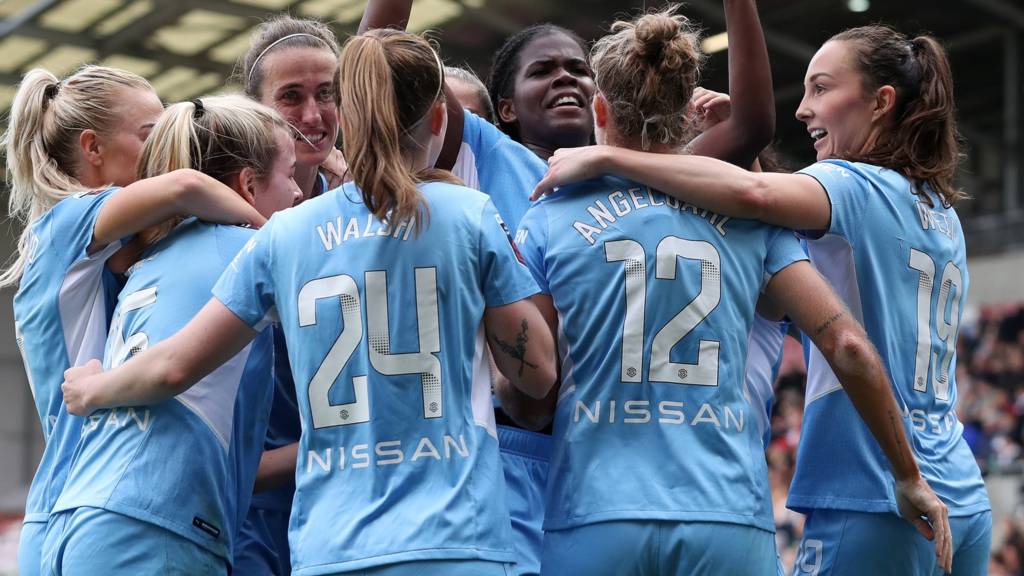
Above: Ellen White wheels away to celebrate her equaliser for Manchester City. Photo: Reuters.
The local derby between City and United has a lot riding on it. City come in after four rounds of the FAWSL with three losses on the trot and a single win, on top of being knocked out of Champions League before the group stage. United on the other hand are in a much better position with three wins and a single loss however they’ve never beaten City in their history in the WSL.
The drums are beating for Gareth Taylor and more people are coming for his head. It’s critical they win today.
The first decent attack is from City with a pass pushed down the left to Lauren Hemp who wins the foot race to the ball and with a single touch crosses to Janine Beckie. Her shot to the top left connects with the outstretched hand of Mary Earps who deflects it out.
City continues the attack when a cross from the right comes to Hemp’s head and is pushed towards goal with some interest. Maria Thorisdottir heads it away safely as Earps dives behind her unnecessarily. For my money, Hemp is one of the most exciting players in the WSL. She’s everywhere, doing everything, causing havoc and integral to every goal for City.
Another attack is launched by Hemp when she drives in past Ona Batlle from the left to shoot but the shot is far too high and sails into the stands.
An attack by Leah Galton, who has had a couple of offside incursions into the box, ends up on the right with a throw in. The ball comes to Katie Zelem who passes to Kirsty Hanson who shoots. Karima Benameur Taieb has to jump slightly but has it under control for United’s first shot on goal and the first time she’s troubled after 32 minutes.
A couple of minutes later a ball comes to Galton on the left and she controls it. As she does, Georgia Stanway comes in, studs up and straight into her thigh. Galton goes down clutching her leg. Stanway has put her full weight behind it and tumbles in the background. She realises what’s happened and starts apologising as the ref comes towards them. She pulls out a red card and Stanway is off and City are down to ten players. Gareth Taylor seems to be complaining but there’s no doubt that deserved a red card. Stanway does some stupid things at times and this was definitely one of them. City have looked stronger in the first 35 minutes so it remains to be seen how much this will affect them.
Above: Khadija Shaw celebrates after putting City ahead. Photo: Getty Images.
Turns out, not much. About a minute later, Hemp evades the defence and passes to Caroline Weir. She passes back to Keira Walsh who sends it back out left to Demi Stokes. Stokes crosses and it lands right in front of the box allowing Kadeisha Bunny Shaw to run on to it and head it to the bottom right corner, leaving Earps to watch it go by her for the first goal of the match. Manchester United go up 1-0.
Another attack by Hemp sees her dribble it right into the goal around Batlle before passing back but there’s no one around to capitalise and it goes back to Alex Greenwood. She shoots from the top of the box but Earps sees this one coming and is able to punch it away safely.
United launch a bit of an attack in the box and Jill Scott clears the ball directly into Hemp’s face. It was a decent kick so that’s gotta hurt but she comes back on OK.
In another brilliant attack, seconds before half time, Stokes sends a long ball up the left to Hemp. She brings it down, avoids Batlle and comes into the box. Instead of shooting herself, she crossed and Filippa Angeldahl slides in but can’t direct it and the ball is out. Heading into the second half, city looks more organised, has a little bit more possession and has more shots on goal but United aren’t out of this yet.
Shortly after coming back on the field Ella Toone takes a crack at goal but Alex Greenwood places herself in harms way and the ball deflects out for a corner. It’s taken short and cleared.
Once again Hemp is involved after jumping on to a clearance, sidestepping a couple of players and shooting. Earps gets a hand to it to stop the goal.
Back up the other end again and Hannah Blundell slips Toone a pass. She aims to the right post and Taieb has to make a diving save.
Just before the 60 minute mark, goalscorer Bunny Shaw is off to be replaced by Ballon D’or nominee, Ellen White.
At 66 minutes, Lucy Staniforth comes on to replace Hanson.
Blundell sends a perfectly weighted pass to Galton on the left. She runs onto it and into the box and Jill Scott executes a brilliant sliding tackle for a United corner. Zelem’s corner is headed away by Scott, who’s doing the hard yards in defence.
A Thorisdottir-Blundell-Galton combo scores another corner which is taken quickly by Zelem. She takes it short to Toone who flicks it towards goal. Staniforth backheels it past a surprised Earps and levels the score 1-1. United are jubilant, none more so than Staniforth who can’t believe her luck.
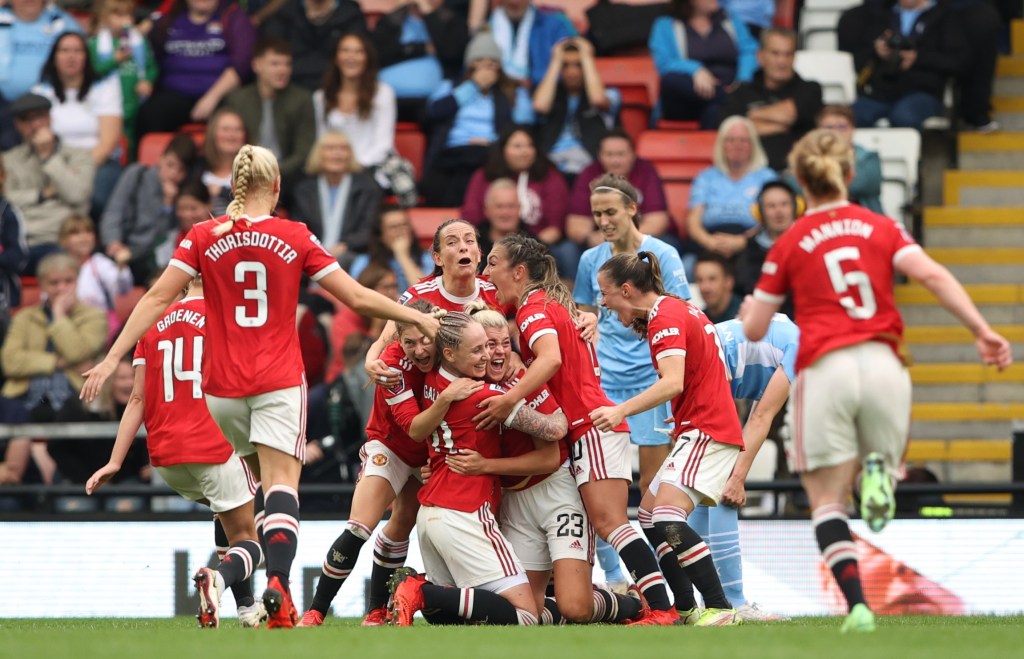
Above: Alessia Russo (23) is mobbed after putting Manchester United 2-1 ahead. Photo: Action Images via Reuters/Molly Darlington
Minutes later, Galton is on a solo breakaway but her shot is wide to the right of goal. The goal has lit a fire under United and straight away they are back on the attack. Blundell brings it down the left, passes to Toone and gets it straight back, crosses across the top of the box to Alissia Russo, she stumbles but recovers as Weir arrives but somehow manages to turn and get a shot away that skims the right post and gets past Earps to hit the back of the net. There’s elation in crowd and on the field as the score goes to 2-1 Manchester United.
During the celebrations Jess Park has come on to replace Angeldahl.
A big goal clearance by Taieb sees Park run onto it and do a long range strike for what must be her first touch of the match. Earps gets a hand to it and pushes it onto the top post for it to rebound back into the path of an onrushing Ellen White who buried it in the back of the net. We’re level once more at 2-2 after three goals in short succession. The punters are getting their money’s worth today in this thriller.
Above: Joy unconfined after Ellen White levelled for Manchester City. Photo: Jan Kruger/Getty Images/FA
There’s a heartstopper for the United fans as Hemp’s cross is headed across the goal by White but it passes safely across the front of the goal and out eventually.
At 84 minutes, Jackie Groenen is substituted for Hayley Ladd. And with 2 minutes of regular time left Laura Coombs is on for Weir.
United continue to apply pressure and get a couple of corners but can’t convert them. There’s four minutes of extra time as Beckie gets a yellow for an overenthusiastic tackle on Staniforth. Staniforth takes the free kick that floats into the box to be headed out by Hemp.
Galton gets to the corner kick but it must have deflected off a city player as another corner is awarded. Next corner also goes to Galton but she heads it out.
In the dying seconds Batlle guides a ball to the far post from the far right but Taieb jumps up to capture it safely under immense pressure. The whistle blows and both teams secure a point from this memorable derby with the final score 2-2.
Its been a week of big stories in the women’s game in Australiaas Lisa De Vanna and others lifted the lid on abuse and bullying within the game. Elsewhere, we hear from 11 signings announced in the A-League Women and the six clubs. Ben Gilby has all the news.
Lisa De Vanna and Rhali Dobson Lift Lid On Abuse and Bullying
Above: Lisa De Vanna has revealed some appalling experiences she suffered throughout her career. Photo: Molly Darlington/Getty Images.
In an article published in the Sydney Daily Telegraph on Wednesday, Australia legend Lisa De Vanna made explosive allegations of indecent assault, sexual harassment, bullying and grooming within Australian soccer.
Within the article, De Vanna said:
“There needs to be consequences. There needs to be accountability. I have seen cultural problems at all levels throughout the years – from men and women – and girls coming through need to be brave, and also the girls that have been through this also need to be brave and know they are not alone.
“It’s a sensitive topic and it takes a brave and courageous person to speak up. Have I been sexually harassed? Yes. Have I been bullied? Yes. Ostracised? Yes. Have I seen things that have made me uncomfortable? Yes.”
She then details one experience from 2001 when she was 17 years-old with the Young Matildas when several of her team-mates pulled her down to the ground – an incident witnessed by former Matilda Elissia Carnavas who has spoken publicly this week to support De Vanna’s experiences.
In the same article, another former W-League star Rhali Dobson also revealed that she was the target of “predatory behaviour.”
Football Australia issued a statement in response to the allegations, stating:
“Australian football takes a zero-tolerance approach to any conduct which breaches the standards and values expected of people involved in the game. To that end, we encourage anyone to bring forward their concerns through Football Australia’s formal complaints process under the Member Protection Framework, with the knowledge that any such matter will be taken seriously and investigated thoroughly.
“While it is not appropriate to discuss individual cases, we have met with Lisa De Vanna and heard her grievances, and can confirm that the specific allegations made public were not raised with us in that meeting. We have no knowledge of what steps, if any our predecessor organisation, Soccer Australia, undertook in 2001. In the event that Lisa chooses to lodge a formal complaint through the appropriate channels, we will be in a position to investigate and, if appropriate, act accordingly. The same process is open to Rhali Dobson and other former players and staff to formally bring forward any claims.
“Over and above Football Australia’s formal complaints handling protocols, we have also been engaging with Sport Integrity Australia (SIA) to develop an additional process for independently investigating allegations of a historical nature as they relate to former players and staff – such as Lisa and Rhali. We will announce the joint initiative with SIA once the details have been finalised.”
Jets Announce Key Retention of Taren King and Signing Of Young Keeper:
Artwork: Newcastle Jets
Defender Taren King has re-signed for Newcastle Jets ahead of the upcoming 2021/22 A-League Women’s Season.
King returns to the Club after featuring in all 12 matches last season in what was her first with the Jets after joining from Canberra United.
The 24-year-old has made 34 appearances in the A-League Women’s competition, and Coach Ash Wilson believes her experience will prove vital.
“It’s pleasing to be able to re-sign Taren this season,” Wilson said.
“She is an experienced defender who reads the game well and has a competitive mentality. Her leadership qualities, on and off the pitch, have been asset to the team environment, and she will bring further stability to our back line, enabling us to build on principles and partnerships as we work toward achieving our goals.”
King said; “I’m excited to continue the journey as a group and see what we can achieve this year. I’ve returned to the Club this season because I feel as though we showed some really positive glimpses at times but never really got into our full stride.
“I’m hoping to get a positive season of football under my belt again, and make some improvements in my personal game.”
Artwork: Newcastle Jets.
Newcastle Jets further strengthened their squad with the signing of young goalkeeper Georgia Boric on Thursday.
Boric has represented Australia as part of the Junior Matildas and has previously spent time as part of Canberra United but has yet to make her league debut.
The 23-year-old is excited for the challenge. “The opportunity to compete for a position in the A-League Women’s competition is really exciting to me,” Boric said.
“I’m excited to step back into the professional scene and push myself outside my comfort zone. I hope to make my debut in the league, and to add to the team environment and culture, driving my teammates to work as a unit and reach our goals.”
Coach Ash Wilson spoke of her anticipation to see the young goalkeeper join the squad. “Georgia is an exciting prospect having going through the National Youth system. As well as having desirable technical qualities, she is motivated to achieve and loves a challenge. We expect her to bring that to the team and football environment.”
Reds Sign Shay Evans:
Artwork: Adelaide United.
Adelaide United have signed forward Shadeene ‘Shay’ Evans for the forthcoming A-League Women 2021/22 season.
A product of the famous John Moriarty Football initiative, who are charity partners of Impetus, (see https://impetus885775742.wordpress.com/official-charity/) Evans has also been a member of the Future Matildas and has represented the Young Matildas.
The 20-year-old Marra woman made her A-League Women debut with Sydney FC in January 2019 and scored her first goal the following season against Melbourne Victory.
Evans has spent the offseason in the NSW Women’s National Premier League with Northern Tigers where she has netted five goals in 12 appearances.
Speaking about joining the Club, Evans, said: “It means a lot to me to be playing for Adelaide United. I’ve been training hard and can’t wait to get on the pitch with my new teammates and have a fantastic season.
“I’m proud as well of the special connection between Adelaide and my mentor, John Moriarty. I’m excited to be moving forward with my football career at a time when women’s football is growing so much around the world especially in the lead up to the Women’s World Cup 2023 in Australia and New Zealand.”
Adelaide United’s A-League Women Head Coach, Adrian Stenta, said: “Shay is one of the most promising players in the country. She has some experience in the A-League Women competition before, as well as with the Young Matildas, and will add quality to our final third.
“We’re delighted to have her join the squad and I believe she can have a breakout year for us because of her determined mindset.”
Born in Borroloola, a remote community in the Gulf of Carpentaria, Northern Territory, Evans was the inaugural scholarship recipient of John Moriarty Football (JMF), Australia’s most successful and longest-running Indigenous football initiative. JMF was co-founded by Yanyuwa man John Moriarty, the first Indigenous footballer selected to play for Australia.
Moriarty said: “Shay began training with us when she was just 12 years old and playing football barefoot on the school oval in our program. Our coaches could immediately see she had natural talent and a love of the game.
“Scouted by former Matildas coach, Alen Stajcic, Shay won her JMF scholarship to Sydney at 14 to study at Westfields Sports High School and undertake intensive football training and mentorship.
“She has worked hard to graduate from Year 12 and play in the A-League Women, as well as serve as Vice Captain of the Young Matildas. She won a scholarship to study at the University of New South Wales and we’re thrilled she is now signing with Adelaide United.
“This is a perfect next step in Shay’s football career and we are immensely proud of her.”
Moriarty has a special connection with the Adelaide football community. Moriarty’s football career began with South Australian First Division teams Port Thistle, Port Adelaide, and Adelaide Juventus, as well as a summer season with Adelaide Croatia. He represented South Australia 17 times and is recognised in the Football Australia Hall of Fame.
Victory Announce Goalkeeping Duo:
Artwork: Melbourne Victory
Melbourne Victory have revealed the identities of their goalkeepers for the new season after re-signing Casey Dumont and Melissa Maizels ahead of the 2021/22 A-League Women’s season.
Dumont returns to the squad for the upcoming campaign after spending 2020/21 on the sidelines with a ruptured Achilles tendon.
The two-time A-League Women’s Champion has made over 103 appearances in the league, notching 35 clean sheets in her domestic career and playing a crucial role in the Club’s 2018/19 Championship season.
Maizels has also re-committed to the Club for the upcoming season with the goalkeeper deputising to Gaby Garton during the 2020/21 Championship campaign.
A-League Women’s Head Coach Jeff Hopkins said he was delighted to lock in his goalkeeping stocks for his side’s title defence.
“We’re thrilled to welcome Casey back to the squad for the upcoming season and know she will bring a level of experience and leadership we will need to go back-to-back,” Hopkins said.
“She was with us every step of the way last season and to have her back on the pitch – leading our defensive line – will be invaluable to us and the goals we have set this year.”
Dumont was also excited to be returning to the squad after making a full recovery.
“Watching from the sidelines last season was tough for me but I was proud of what the team accomplished and I have the hunger to achieve even more success with the squad this season,” Dumont said.
“Jeff and his team have supported me since I arrived at the Club and to be back between the sticks for Melbourne Victory shows the faith they have in me to deliver on the pitch.”
Melbourne Victory will continue their pre-season preparations ahead of the Round 1 clash against Adelaide United on Sunday 5 December.
Crofts Heads For Western Sydney:
Artwork: Western Sydney Wanderers.
Western Sydney Wanderers confirmed the signing of midfielder Ashlie Crofts for the upcoming A-League Women’s campaign.
Crofts made her debut in the domestic competition in 2019 where she scored on her debut with Canberra United.
The agile midfielder has spent the last two seasons in the nation’s capital and is this season set to play for her hometown club for the first time in her career after plying her trade at Blacktown Spartans for close to ten years.
Head coach Catherine Cannuli welcomed the Western Sydney local to the club. “Ashlie is a very proud Western Sydney girl and we’re delighted to welcome her to the club,” said Cannuli.
“Having watched Ashlie during her time at both Canberra and Spartans, we know what she can bring to the team this season and she understands how important it is to represent our region and community.”
Crofts said she was delighted to play for the club she has passionately supported over the years. “Western Sydney is my home, I’ve grown up here, played my junior football in the BDSFA competition and have played for Blacktown Spartans for almost ten years. I had a Wanderers membership and went to watch the team every week at the old Pirtek Stadium.
“There is still plenty for me to learn, especially off some of the older, more experienced players. But as a local, I’m hoping to bring a sense of community and what it means to represent Western Sydney to the club.
“Cath (head coach Catherine Cannuli) is a coach that I’ve always wanted to work with and I’m just excited to get started.”
Roar Add Two More To Squad:
Artwork: Brisbane Roar.
Brisbane Roar has brought in two further players with the announcement of prolific forward Meaghan McElligott and defender Jessie Rasschaert.
Versatile Western Pride captain McElligott returns to the top tier of Australian football after spending a season with Canberra United in 2018. Having starred locally for the likes of Gold Coast United, Souths United and Logan Lightning before and after that experience, McElligott said she had long targeted a chance to pull on the orange shirt.
“It’s always been a dream of mine to play for Brisbane, being the Queensland side,” McElligott said.
“Having played up here for six or seven years in the NPL, it’s a whole new level of pride to play for Brisbane Roar and definitely something I always wanted. When Garrath [McPherson] offered me the opportunity it was a no-brainer. I’m super excited and keen to play alongside girls that I know, and I think it’s a really exciting time.
“It’s cool to see the local talent get rewarded and hopefully we can use that Queensland focus to our advantage.”
Appointed captain at Ipswich-based Pride this season, McElligott has scored 18 goals across all competitions including five in the club’s run to the Kappa Women’s Super Cup final.
“This season being captain out at Pride has taught me a bunch of leadership skills I probably didn’t know I had in me. I’ve really enjoyed the position I have out there,” she said.
“I definitely think there are things now that will just come naturally to me. In a team environment, everyone can be a leader in their own way. I’m keen to bring my own flair but I’m sure there are other people who can lead the team in different ways.”
Head Coach McPherson said: “Meaghan has been scoring dozens of goals each year in the NPL Women’s competition. She has a killer instinct in front of goal that has previously been acknowledged with involvement on the national stage.
“The staff are all really excited to work with Meaghan, supporting her in taking her game to the next level this season.”
Artwork: Brisbane Roar.
Jessie Rasschaert has signed on for the upcoming campaign after spending the past two seasons with her hometown team Canberra United.
The centre-back relocated to Queensland earlier this year and quickly established herself as one of the state’s premier players through consistent performances for Gold Coast United, culminating in a call from Roar Head Coach Garrath McPherson.
“I was pleasantly surprised when Garrath got in touch,” Rasschaert said.
“Moving from Canberra to the Gold Coast and settling into a new side, a new NPL competition, was a bit daunting but I think I’ve found my feet. This opportunity now is a fantastic chance for me to grow as a player and be part of a team that has established itself in past seasons as being really strong and competitive. I always strive to do my best and improve, and I’m excited to be part of the team.”
Rasschaert, a former NPL Women’s Player of the Year in the ACT, joins Gold Coast team-mate Ayesha Norrie on the Roar roster for the 2021/22 season.
Roar head coach Garrath McPherson said: “I am excited to have a player of Jessie’s experience join our backline for the upcoming season. She is a tall, mobile defender who has who has been one of the standout performers in the NPL Women’s competition since moving here from Canberra.
“Her positivity and winning attitude will have a great impact on our environment and we are all looking forward to seeing her get started with her team-mates in just under three weeks’ time.”
McPherson’s side will come together for the first time on Monday, 25 October as they build towards the Round 1 clash with Perth Glory on 4 December.
Canberra Add Three More:
Artwork: Canberra United
Canberra United have unveiled goalkeeper Beth Mason-Jones plus Alexia Karrys-Stahl and Mikayla Vidmar for the upcoming A-League Women’s (ALW) season.
Mason-Jones joins Canberra with three years of experience in the ALW, playing for Melbourne Victory from 2016-2019. After taking 15 months away from the game for personal reasons, Beth signed with Victorian NPLW club Alamein United FC in early 2021.
Beth said she can’t wait to get stuck into the Canberra United preseason from October 25.
“I’ve always heard great things about Canberra as a team; the girls, the fans, the environment overall,” Beth said.
“Watching them over the past few seasons I’ve really noticed the fight they have for each other as a team which is something I really value and find really rare. I’m really looking forward to the new challenge ahead.
“Having a fresh slate to work with, a bunch of new players I haven’t ever played with, a new coach and a new training and playing environment is very enticing to me.”
Artwork: Canberra United.
On Thursday, the club added the signings of former Canberra United Academy players, Alexia Karrys-Stahl and Mikayla Vidmar for the upcoming A-League Women’s season.
Mikayla Vidmar has football in the blood. The daughter of former Socceroo legend Tony Vidmar, Mikayla joined Woden Valley SC when she was 12, before being selected into the Canberra United Academy Program. Mikayla has been playing for Adelaide City for two years now and was part of their 2019 Premiership winning team. She has been in excellent form once more this season.
“Being part of the Canberra United Academy, we would always watch the Canberra United games,” Mikayla said.
“We had some girls in the academy who were also in and out of Canberra United, training and playing so they were always girls we looked up to. The environment and atmosphere at the games has always been incredible.
“The support and unity you feel is like nothing else, and it has always been something I wanted to be a part of.”
Alexia Karrys-Stahl also grew up playing in Canberra, with Gungahlin United and the Capital Football SAP Program. She represented the ACT in the PSSA, before being selected into the Canberra United Academy. From there, she was selected into the U17s Young Matildas, for the AFC Championship qualifiers in Malaysia.
“It has always been a goal of mine to represent my home town,” Alexia said.
“The atmosphere is like no other and to score in front of my family and friends would be unreal.
“I’m excited to play with so many familiar faces as well as some new ones. I can’t wait to work with Vicki and all the other CU staff, it’s an absolute privilege.”
With Champions League action as well as the latest round of matches in the Damallsvenskan and Elitettan, Ben Gilby rounds-up the events of the past week with drama at the top of both divisions.
Above: Action from BK Häcken’s midweek UEFA Women’s Champions League game with Olympique Lyonnais. Photo: Gunnar Hoffsten/Getty Images.
UEFA WOMEN’S CHAMPIONS LEAGUE NEWS:
BK Häcken made their Champions League debut with a Group D tie at home to giants Olympique Lyonnais. For a summary of the game, see Impetus’ Jean-Pierre Thiesset’s report: here
DAMALLSVENSKAN:
Kristianstads blew a 2-0 lead at home to KIF Örebro who came away with a 2-2 draw. Miranda Nild and Alice Nilsson put the hosts two goals clear before the half hour mark. Jessie Scarpa got one back early in the second half. There was a dramatic conclusion as Jenna Helmstrom hit the equaliser four minutes into stoppage time at the end of the match to the frustration of the 410 spectators.
Above: Jenna Helmstrom, who hit the late equaliser for KIF Örebro at Kristianstad. Photo: Aftonbladet.
AIK gained a hugely important 1-0 win over Växjö in the battle of the bottom two in Solna. Jenny-Julia Danielsson grabbed the winner with four minutes to go in front of 233 people at Skytteholms.
Vittsjö saw off Linköping with a 3-0 win in front of 322 fans. Fernanda Da Silva (34), Nellie Persson (46) and Elizabeth Klinga were on target. Linköping sit just a point above the bottom four.
Eskilstuna United are now six points clear of the chasing pack in third place as memories of the large numbers of clubs once competing for that spot are now fading fast. Their latest success came courtesy of a come from behind 3-1 win over Djurgården in front of an impressive crowd of 1,412. The visitors took the lead after 20 minutes thanks to a strike from Michaela van den Bulk. Eskilstuna levelled two minutes later through Vaila Barsley. Mia Jalkerud put the hosts ahead on the hour mark before Felicia Rogic sealed the win a quarter of an hour from the end.
Above: Felicia Rogic sealed Eskilstuna United’s win at home to Djurgården. Photo: Anders Nilsson
Hammarby suffered a disappointing 1-1 draw with third bottom Piteå, a score which, combined with Eskilstuna United’s winning run goes a long way to killing off their dreams of a third placed finish. Cajsa Hedlund put Piteå ahead just after the half hour mark. To the relief of the 755 gathered, Emilia Larsson levelled for Hammarby with 13 minutes left.
The destination of the Damallsvenskan title is back up in the air after second placed BK Häcken gained a 2-0 win at home to leaders Rosengård which halved the visitors lead at the top of the table to three points and cut the goal difference between the sides to just a single goal. Roared on by 2,814 fans, Stina Blackstenius put Häcken ahead with 74 minutes played with Johanna Rytting Kaneryd sealing the points five minutes later. BK Häcken had further cause for celebration later in the week when, despite strong rumours linking her with a move overseas previously, Stina Blackstenius signed a new contract with the club.
Above: Johanna Rytting Kaneryd (right) who sealed BK Häcken’s win over leaders Rosengård in the battle of the top two. Photo: Goteborgs-Posten.
Table: Svensk Fotboll
Round Nineteen Fixtures:
Rosengård v Linköping
BK Häcken v Vittsjö
KIF Örebro v Djurgården
Växjö v Piteå
Kristianstads v Eskilstuna United
Hammarby v AIK
ELITETTAN
Above: Lisa Dahlqvist – scorer of the last gasp goal for Umeå IK at IK Uppsala. Photo: Teller Report.
IK Uppsala’s poor run of results which has seen them drop from the top to now outside the promotion spots, continued with a 2-1 defeat at home to leaders Umeå IK in a game full of late drama. Marika Lundin gave the home side the lead with 10 minutes to play. But just two minutes later, Umeå levelled through Lisa Bjork and then into stoppage time at the end, Lisa Dahlqvist’s goal ensured all the points would go to the visitors, to the frustration of the 226 fans. Umeå’s lead at the top of the table is now eight points with five games to go. IFK Kalmar are second after a 3-1 win at bottom side Bollstanäs SK in front of 85 spectators. Tabby Tindell continued her excellent current run of scoring by putting Kalmar ahead just before the half hour mark and she added a second eight minutes into the second half. Andrea Thorisson made it 3-0 on the hour mark. Malin Engdahl got a consolation for Bollstanäs after 74 minutes. IF Brommapojkarna’s 2-1 win at home to Sundsvalls DFF ensured they stayed in the top three. It was Sundsvalls who went ahead just after the break thorugh Ebere Orji, but two goals in four minutes either side of the hour mark from Mathilda Prakt sent the 55 spectators home happy. Morön BK are fifth after coming from behind to win 2-1 at mid table Älvsjö AIK FF. Naomi Okhira put the hosts ahead on 12 minutes with Emma Viklund levelling with 11 minutes to play. Deep into stoppage time at the end of the game, Viklund popped up again to take the points to the frustration of the crowd of 70.
Latest Results: IK Uppsala 1-2 Umeå IK, Bollstanäs SK 1-3 IFK Kalmar, IF Brommapojkarna 2-1 Sundsvalls DFF, IFK Norrköping 3-1 Lidköpings FK, Jitex Mölndal 3-0 Mallbackens IF Sunne, Alingsås FC United 4-2 Borgeby FB, Älvsjö AIK FF 1-2 Morön BK.
Next Fixtures: Umeå IK v IF Brommapojkarna, Borgeby FB v Bollstanäs SK, Lidköpings FK v IK Uppsala, Sundsvalls DFF v Alingsås FC United, Morön BK v IFK Norrköping, IFK Kalmar v Jitex Mölndal, Mallbackens IF Sunne v Älvsjö AIK FF
Article kindly provided to Impetus by the Irish FA
Above: Lauren Wade pictured celebrating after a goal for Glentoran earlier in the season. Photo: Glentoran FC
Northern Ireland international Lauren Wade netted four goals as Glentoran Women put the gloss on their Danske Bank Women’s Premiership title win with a thumping 9-1 victory over Derry City on Tuesday night.
Two of Wade’s goals came in the space of a minute as the Glens took control at The Oval after fellow international Caragh Hamilton opened the scoring for the east Belfast side.
The title party continued when Hamilton added another while Northern Ireland star Nadene Caldwell also fired home. Wade popped up with two more and NI teenager Danielle Maxwell got in on the act with the eighth goal of the night.
Caroline Gallagher pulled one back for the Candystripes before Cora Moran netted goal number nine for the champions.
Above: Glentoran lift the Danske Bank Women’s Premiership trophy. Photo: Belfast Telegraph.
Elsewhere on the closing night of the league season Cliftonville also rounded off their campaign in style as they hit Sion Swifts for six in an entertaining 6-2 win at Solitude.
Several Northern Ireland players were also on target for Cliftonville as they defeated Sion Swifts 6-2. Senior international Kirsty McGuinness and U19s star Fi Morgan both bagged braces for the Reds after Louise McDaniel opened the scoring, with Caitlin McGuinness also finding the net.
Erin McLaughlin and Caoirse Doherty grabbed the Sion goals.
Linfield Ladies finished the campaign with a 2-1 victory over Crusaders Strikers at New Midgely Park.
The Blues raced into an early two-goal lead thanks to a Rebecca Bassett strike and Victoria Carleton penalty before Danielle McDowell pulled a goal back for the Crues eight minutes into the second session.
Impetus partner club Ashford Town Middlesex have started the Tier Five London & South-East Premier with six wins from six – averaging over six goals a game in the process. Assistant Head coach Matthew Aumeeruddy, captain Liss Down and striker Ashley Cheatley, sponsored by Impetus all spoke to Ben Gilby about their campaign so far.
Above: Ashford Town (Middx) in the huddle at AFC Wimbledon in a pre-season friendly. Photo: Ben Gilby.
In this first of a two part feature, we discuss pre-season focuses, aspirations and a critical examination of their start to the campaign.
BEN GILBY: (BG) Let’s first start in pre-season. After the frustration of your promotion application being turned down, was it hard to lift the players at all or was it all a sense of channelling the frustration into making sure you did it on the pitch this time round?
MATTHEW AUMEERUDDY: Not really, we recognised that there was always a chance that it would not happen, so was prepared for either event happening. In terms of lifting the players, that was far from the case. There was a natural frustration, which happens when things do not go your way. However, they recognised that this process was out of their hands so to speak, and that we couldn’t have done anymore. There is certainly a determination to do well this season but that’s more of an intrinsic motivation for us to be the best we can be rather than as a reaction to events which have happened.
BG: From a captain’s perspective, Liss?
LISS DOWN (LD): Everyone was disappointed that our application to be promoted to the FAWNL wasn’t successful but our aim has stayed the same from last season and every season, to gain promotion to the league above. The club as a whole is very ambitious and everyone is fighting towards the same thing, which is trophies and success.
BG: How did the pre-season recruitment process go? Who came in and what was it about them that made you keen to bring them on board?
MA: I look at recruitment from a couple of points, which are retaining and bring in news players. Retaining and looking after the players who have served Ashford well, is what we first look at and then at ways in which we can strengthen the squad. The pleasing thing is that the majority of the first team are still with us and believe in the longer-term vision at Ashford. We also managed to add players a couple of players in Frances Cotter and Megan McGarvey. who have settled in well and have demonstrated great potential which will see them get stronger as the season progresses.
For us, the recruitment process is still ongoing as we are always looking to recruit the right players in order to give our squad a different dimension. We welcome hearing from any potential newcomers so please do get in touch!
Above: Matthew Aumeeruddy, Ashford Town (Middx) Assistant coach. Photo supplied by: Matthew Aumeeruddy
LD: Matt’s right. Our squad is very similar from the last campaign. We were lucky that everyone re-signed. Only Phoebe Head and Holly Symons left but they played a key role in getting us off to a good start before going to university.
BG: How do you assess the pre-season friendly program in terms of outcomes?
MA: Our pre-season programme saw a lot of changes from what was originally set out at the beginning, which was due to covid related issues with opposition. Whilst it was frustrating, we fully support the clubs’ decision as it is always better to be safe than sorry in these matters. Overall, we were pleased with the different tests that we had ranging from tier four to tier six teams. The main aims were to build match fitness and continue to implement our principles of play which were largely achieved.
LD: Pre-season as a whole was positive, we played some very good teams who gave us different challenges and that has given us a positive mentality going in to the season. Looking back at the game against AFC Wimbledon from the league above (FAWNL Division One South-East) where the result didn’t go our way, what we learnt about ourselves in that game was more valuable than the overall result.
ASHLEY CHEATLEY (AC): During pre-season the conversations centred around winning, gaining promotion and having success.
We want to play good football, become fluid in different formations and win trophies. In order for us to do that we need to treat every game like a cup final whether that be a friendly, cup, or league fixture.
In terms of the pre-season fixtures that we had, I thought we did OK. We prepared well, away to Luton Town (of the Eastern Region Premier – parallel tier five to Ashford’s own level) we didn’t have a great result and AFC Wimbledon, who play in the division above in the FA Women’s National League is always a challenge, but overall I think we did OK and it prepared us for the season we have ahead.
Above: Ashley Cheatley, pictured in action for Ashford Town (Middx) on the opening day of the London & SE Premier at home to Millwall Lionesses. Photo: Ben Gilby.
BG: Ashford Town have started the league season with six wins from six. How do you assess the opening matches and what aspects do you feel the team still need to improve in?
MA: We are of course pleased with our start to the season. Each game has provided different challenges to overcome and so far we have found a way to overcome them. I think the pleasing aspect has been the style of play and to see the patterns of play that we worked on happen in the game. But we realise that this is only the beginning, with a lot of football still to be played. We always look for ways to improve our performances.
LD: We couldn’t have got off to a better start, everyone is buzzing but we are definitely taking each game as it comes. Every game so far has provided us different challenges which we have overcome and managed to get a positive result in. I feel that going forward we play with freedom and we score a lot of goals. Our main target as a team is to stop conceding as many goals and hopefully keep some more clean sheets.
AC: We’ve really started well, we couldn’t have asked for a better start to the league, but we know we still need to continue to work hard for the rest of the season and every week we look to improve on all aspects of the pitch.
I think you can always improve all areas, so I wouldn’t necessarily pick a specific area for this.
BG: Liss, tell us a bit specifically about your role as captain how the team ethos is continuing to build ever stronger.
LD: Being appointed as captain of this team this season is such an honour, the girls are fantastic and so easy to captain. Our group is close which makes things a lot easier, we enjoy having banter at training and match days but when it comes to 2pm we are focused on the game. We are all only focusing on each game as it comes, obviously we look at the other results after our game on a Sunday, who doesn’t? We know what we want to achieve but we are only a quarter of the way through the league campaign and nothing is won now, the important thing is to remain focused.
Above: Liss Down (left of the referee) leads out Ashford Town (Middx) against Millwall Lionesses. Photo: Ben Gilby.
BG: Ash, you’re having another red hot season in front of goal already. How do you assess your form so far and what are the particular attributes that make you such an incredible goal scorer?
AC: I’m slowly starting to find my form, I had a slower start to the season than I would have liked, but ten goals in the last three games has given me a bit of life, I’m hoping to just keep scoring every week.
I do actually set myself targets, I tend to look at the previous season and try and top it. I have a target to be the highest goal scorer in the league as well.
I think I’m quite quick and agile, with the ability to run at players and keep the ball close by which is hard to defend. It helps too with making runs to get to the right places! I do have confidence in my own ability to take players on and to score goals consistently, but I have confidence in the players around me to be able to assist me.
Next Thursday, Matthew, Liss and Ashley discuss the London & SE Premier so far, the progress of Ashford’s other teams and their role models growing up.
Jean-Pierre Thiesset rounds-up Olympique Lyonnais’ 3-0 win away from home to 3-0 against BK Häcken in Sweden last night as Group D of UEFA Women’s Champions League got underway.
Above:Melvine Malard pictured after scoring Lyon’s first goal last night. Photo: @OLFeminin
Olympique Lyonnais were never really in danger and dominated this game as shown by the statistics of game: for Lyon, 64% of possession, 573 passes (80% successful), 22 shots with 9 on target, 12 corners; for BK Häcken, 36% of possession, 338 passes (65% successful), seven shots with two on target, and two corners. With a little bit more success, Lyon could have scored a lot more goals. Conditions were awkward due to heavy rain.
Highlights of the first half:
4’ Shot on target from OL’s Van De Donk following a bad clearance of BK Häcken defence
6’ Buchanan clear the ball out for a BK Häcken corner.
9’ Shot on target from OL’s Malard.
10’ GOAL LYON! Malard after a right-wing cross at ground level towards the middle of the 18-yard area from Van De Donk, 0-1
20’ Cross shot from OL’s Bacha, caught by the goalkeeper.
32’ Shot from BK Häcken, stopped by Endler.
33’ On the counterattack, cross from OL’s Bacha from the left, Header by Egurrola earned a corner for Lyon.
35’ Huge opportunity for BK Häcken but Endler caught the ball at feet of Larsen in the 18-yard area making a great save.
45+2’ Huge opportunity for Lyon, shot from Malard pushed out by the goalkeeper Falk; Bruun regains possession and her shot was deflected on the cross bar by Falk.
Half-Time: BK Häcken 0-1 Olympique Lyonnais
Lyon started the second half with a lot of rhythm in their game and quickly scoredthe second goal after 48minutes; a shot from Cascarino following a cross from Bacha at the far post was cleared by Falk, but Macario regained possession and scored. From then Lyon dominated the game.
Above: Ada Hegerberg makes her return to action in the second half after over 20 months out injured. Photo: Getty Images.
To note, Ada Hegerberg made her return, at the 78th minute, after more than 20 months off the field following several injuries.
Highlights of second half:
48’ GOAL LYON! Macario 0-2
53’ GOAL LYON! Own goal from Larsen; following a corner from Bacha, Larsen was under pressure from Buchanan and put the ball in her own goal, 0-3.
78’ Ada Hegerberg came on from the bench for OL. Her first game for over a year and a half.
During the last 30 minutes of the game, Lyon obtained a lot of corners (63’, 65’, 72’, 82’, 84’) without being able to increase the score.
Impetus French editor Jean-Pierre Thiesset rounds up all the action from the fifth week of matches in the D1 Arkema.
Above: Amel Majri (arm raised) celebrates her goal for Lyon at Bordeaux before departing the pitch with a devastating injury. Photo: @OLFeminin.
Olympique Lyonnais remain top after winning 4-1 away from home against the waning force that is Bordeaux. The five first minutes were a little bit difficult for Lyon as Eve Périsset forced Christiane Endler to make a save in second minute, and shortly after took the lead through Inès Jaurena. Incredibly, these two shots on target will be the only ones for Bordeaux in the whole game and Lyon quickly recovered with Catarina Macario equalizing in the seventh minute.
Thereafter, the action was largely dominated by Lyon. The statistics of the match are unequivocal: for Lyon, 62% of possession, 17 shots with seven on target, and 488 passes (78% successful); for Bordeaux, 38% of possession, eight shots with two on target, and 307 passes (70% successful).
For her second game back after her long injury, Griedge MBock played 90 minutes and scored a penalty. It seems that her injury is behind her and that the Great Griedge is back.
Unfortunately, Amel Majri, who had scored after 26minutes after a cross from Catarina Macario towards the middle of the 18 yard area, left the game just gone the hour mark with an injury which, they next day was diagnosed as a rupture of the anterior cruciate ligament and the external lateral ligament of the left knee.
Introduced after 58 minutes, Selma Bacha produced an excellent performance and delivered a superb corner which was met by the head of Damaris Egurrola in the 87th minute.
Goals for Lyon from Catarina Macario (7), Amel Majri (26), Griedge MBock (73 on penalty), and Damaris Egurrola (87). Goal for Bordeaux from Inès Jaurena (3).
Fleury won 2-1 away from home against Montpellier in a game largely dominated by Montpellier who failed to transform their scoring chances into goals. The game statistics: for Montpellier, 63% of possession, 16 shots with seven on target, and 489 passes (78% successful); for Fleury, 37% of possession, nine shots with two on target, and 301 passes (66% successful). With this third consecutive victory, Fleury are now fourth in the standings.
Katriina Talaslahti contributed significantly to her team’s victory by making over 10 stops and saves; Only teenage Matildas star Mary Fowler prevented her from making a new clean sheet with an unstoppable strike late in the game. Goals for Fleury from Léa Le Garrec (24), and Nicola Karczewska (85). Goal for Montpellier from Mary Fowler (94).
Above: Midfield action from Montpellier (pink) v Fleury. Photo: @MontpellierHSC
Reims won away from home against Issy 3-1. With this first victory, Reims climb to the tenth place. It was a game level in terms of possession (52% for Reims) and passes (Reims 367 and Issy 353), but Reims was more efficient in attack with 18 shots (eight on target) against seven shots (two on target) for Issy. To be noted was the very good performance from Reims’ Melchie Dumonay, who came on at half time, and who delivered a decisive pass (84) and shot several times on target forcing the goalkeeper of Issy to make saves. Rachel Corboz, Reims’ captain hit a free-kick with her weaker left foot narrowly over the bar. Goals for Reims from Naomie Feller (4), and Kessya Bussy (73, 84). Goal for Issy from Roselord Borgella (30 penalty).
Dijon won away from home against Soyaux 2-1. Dijon were able to win in a quite even game, simply by being a little more efficient in front of goal. Goals for Dijon from Desire Oparanozie (24, 52). Goal for Soyaux from Kelly Gadea (51).
Paris FC won away from home 3-1 against Saint-Etienne by dominating largely the game (60% of possession). Goals for Paris FC from Louna Ribedeira (45), Clara Matéo (68), and Ouleymata Sarr (88). Goal for Saint-Etienne from Kelly Gago (24).
Paris Saint-Germain against Guingamp has been postponed to a later date because of heavy rain in Paris.
Impetus’ French editor Jean-Pierre Thiesset spoke exclusively to Olympique Lyonnais’fitness coach Romain Segui about his experiences of working with some of the world’s greatest footballers and the differences in coaching women and men.
Above: Romain Segui supervising the training session before the friendly game against Fribourg (Switzerland) on July 31, 2021. Photo: Jean-Pierre Thiesset for Impetus.
Romain Segui was born on February 8, 1987, in Bourgoin Jallieu, France. After obtaining a training licence at the University Lyon 1 Claude Bernard from 2007 to 2010, Romain obtained a Masters in Mental Physical Preparation and Re-athleticism at the same university over the course of the following two years. Then, anticipating the future and wanting to improve in new technologies, he passed another University diploma entitled Video Analysis and Expertise in Team Sports at the University Lille 2 Law and Health in 2013-2014 as part of continuing education with Olympique Lyonnais. Segui joined Olympique Lyonnais in July 2010 as an intern before then spent four seasons with the boy’s U15s side, before a two year spell with the boy’s U17 team. A further move saw Segui joined the men’s U19 group during the 2016/17 season. He also trained the U10 boy’s side during his four seasons with the U15.
Jean-Pierre Thiesset: (JPT): Who inspired you to become a Fitness Coach in football?
Romain Segui (RS): Cyrille Dolce. I always name him because he is a great man who helped me a lot. He has been at the club for thirty years and he is a great educator both in football and human terms; he trains the man before training the player. He is my mentor as a coach. He helped me to easily integrate the club. When I arrived, I was young, I lived that as a child dream, and he “professionalized” me.
JPT: What made you move across to be a fitness coach in women’s football?
RS: It is rather an opportunity that I seized. I wanted to integrate professional football and in men it is difficult because the coaches very often came with their own staff. The women’s fitness coach role was vacant, and I was interviewed by Vincent Ponsot (OL General Director) who thought that I had the right profile for this position.
After nine years at the training centre, I had done just about everything with the young players, and I wanted to see something else. So, when we offer you to be the fitness coach of the players of the best women’s club team in the world, you from Lyon, and you say to yourself that you can play the Champions League and win it, then take the chance and sign the contract.
It a great privilege to work daily with Wendy Renard, Eugénie Le Sommer, Amandine Henry and all the other great players. My job is almost similar to the one of a fitness coach for men’s team because we have players which go to their national squad all over the world.
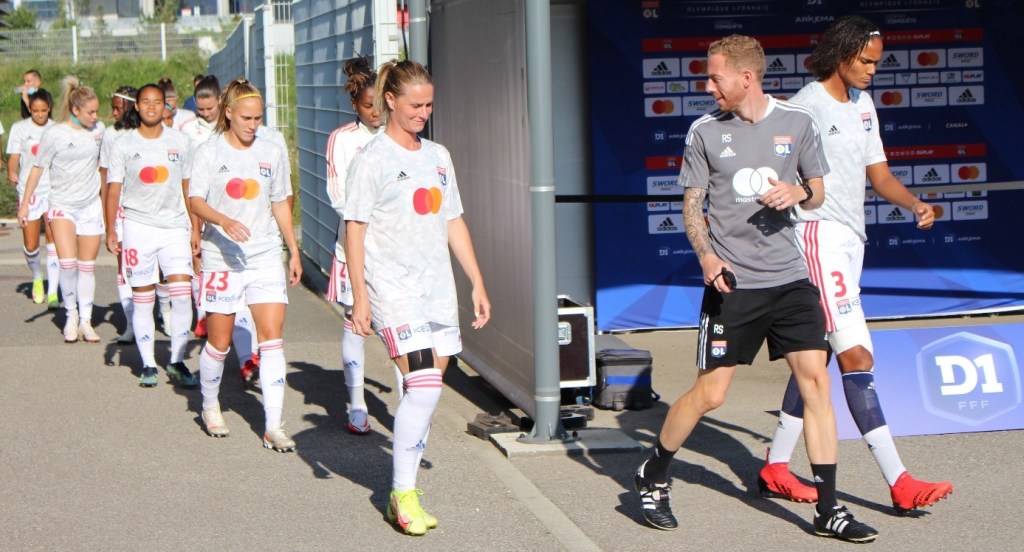
Above: Romain Segui with the players entering on the field for warming up for the game against Reims on August 27, 2021. Photo: Jean-Pierre Thiesset for Impetus.
JPT: What does your job entail?RS: It is a little bit complicated because there are several elements. You must be able to prepare the player in different physical qualities which are endurance, speed, strength and flexibility so that she performs as well as possible without putting the sliders too high because otherwise you can injure her.
When there is an injury in football, it is always the fault of the fitness coach, so we have a big emphasis on injury prevention. For that, we perform testing to individualize the workload and ensure that each player has adapted preparation and prevention routines and be as precise as possible. After all, at some point, there are injuries following collisions and on that we cannot do anything.
There is also the data nowadays and this new technique which arrived in France since five to seven years with GPS which allow us to have a lot of data on the player: distance covered, distance walked, distance made in sprint, number of sprints, acceleration, deceleration, peak speed. We as fitness coaches, must be able to process and analyze all this data and report back to coaches. You still have to be careful not to interpret everything in numbers and let football do things; the feeling is also important, and the data must be taken into account because it help without becoming categorical with them.
Above: Romain Segui, preparing Catarina Macario during half time of the game against Guingamp on September 24, 2021. Photo: Jean-Pierre Thiesset pour Impetus.
So, the job is very varied. We prepare the players for the training session in the morning indoors, then during the training session we will do specific workshops, for example, to develop endurance during twenty to thirty minutes, and we will verify the workload on the players because we have all data in live and ensure that the goal set is reached during the workshops; if necessary, we will adjust the training, for example, by asking to the coach to add a game sequence in order to reach the workload wanted on the players.
We have also to manage the returns from injury and re-athleticism. Hopefully, this year I have an assistant, Rémi Pullara, who can take care of this part and we can work better.
I am lucky because it is not a repetitive job, and it is not boring. For example, one day we do endurance work and the next day speed work.
JPT: What are the main exercises and the compulsory workshops that you carry out to correctly prepare the players?
RS: I am starting from the principle that it is the player’s intrinsic quality which is the most important. At the beginning of the season, we must perform a battery of tests, not only to have data, but to individualize the work in all areas included in the prevention. Some players will need mobility and other something else.
Right now, we speak a lot about integrated method, do the physical preparation with the ball, or of the dissociated method, do the physical preparation without the ball. Some fitness coaches advocate the dissociative method for the physical work. Personally, I have a little trouble with that, and I think we should use the two alternately depending on the desired goal. I like to activities without the ball to be sure to develop what we target because in this case you cannot cheat; for example, when we said to go from point A to point B in a certain time, the player cannot hide. But in long term, it is exhausting, and this is for this reason that integrated method, with the ball, is also interesting.
However, I have a principle with which I never deviate, this is that at the beginning of the season, I need an aerobic base. For that, at the beginning of each season of preparation, I need around twenty days where the players will run to make volume to build a tank; this is what we call the aerobic capacity. This base will allow the players to be more aggressive on the field, to press the opposing players but also to be able to come back quickly in case of counterattacks.
After this base, we need to work a lot on the high intensity and the speed because nowadays women football evolved more and more, and it is quicker even if we heard a lot that men football is quicker, but the gap is narrowing.
JPT: Is it very different to prepare women players rather than men players?RS: The difference may be in power and speed because men are naturally more powerful as they have more muscle mass. But it tends to evolve in women football as now we see some women players with speed peaks at 32 to 34 km/h; whereas not all men players are at 32 or 33 km/h.
However, we can consider the periods because it is the major difference between women and men. The doctors are interested in it and our doctors in the staff which are closer to the players, are attentive to this but personally it never happens to me that a player did not train because she had her period. There are a lot of things right now in the scientific journals on sport, as that the periods could be the source of a new method of individualized training; we look at what is being said and we think about it but today we have not yet implemented a protocol on this point.
There are other clubs that do, like Chelsea, but for now we think about it, we are not closing the door at all, but we want to find the best solution. I train women players as if they were men players, but I consider the fact that they are not as powerful by individualizing the work.
There is also a difference on the injury prevention because women tend to have knees a little more tucked in (a little more in an X shape) which could be the source of knees ligament ruptures. Besides, in statistics, there are more knees ligaments ruptures in women than men in all sports.
For me, this difference is even more important than the periods, and we must do specific strengthening in the glutes and hamstrings to try to rebalance the situation. For that, we do a specific test at the beginning of the season, and we adapt the strengthening if necessary.
JPT: What are the main qualities to be a good fitness coach?RS: You must be organized, methodical, have creativity, be attentive and open-minded because you must know how to question yourself; what we are doing today may not be true tomorrow and we must also open up to other sports to see how they work. You must be also a little sporty because when you must run with the players, you have to ensure you can!
Above: Romain Segui, running with OL’s players during warming up before the game against Saint-Etienne on September 5, 2021. Photo: Jean-Pierre Thiesset pour Impetus.
JPT: What do you prefer, to prepare the players for one game per week or for one game every three days?
RS: For one game every three days because that means that we are playing in the Champions League!
JPT: What is your greatest challenge on the pitch or during training session?RS: That we complete the training sessions without injury. We must push the players to the maximum without exceeding their limits.
JPT: What is your greatest challenge off the pitch?RS: I love to run, and my biggest challenge would be to do the UTMB (Ultra-Trail Mont Blanc) in the Alps; about 180 kilometers with a total elevation gain of around 10,000 meters. At the moment, I do not have the time to train to do it because my job takes a lot of time and my family that must not be forgotten (Romain is married and he has two children, a 7 year old girl and a 3 year old boy). It is impossible to train every day to prepare it.
JPT: What do you like to get up to off the pitch?
RS: Running and playing guitar.
JPT: What makes Olympique Lyonnais such a great club where to work?RS: We have a great President, Jean-Michel Aulas, who has always provided the necessary means as much for working conditions as for financial means and which makes that we have been far ahead of other clubs. We have great working conditions that a lot of other clubs do not have, and it is why the best players want to play at Olympique Lyonnais and want to stay there.
JPT: What is your main quality?RS: I think I am a very honest and caring person, and I am whole.
JPT: What is your main fault?RS: I am impulsive and jealous. I can get angry very quickly.
JPT: Is there a message you would like to give to Olympique Lyonnais fans?RS: First, I would like to thank all fans who follow OL Women because they are brilliant. I have seen them throughout the COVID period going at the games away from home and being stranded at the stadium gates just to see our bus arrive. I saw supporters clinging to the walls in Soyaux to see a bit of the game. I find it fantastic because they give a lot for us while it feels like we have not been able to give them a lot in return for a few months. I really want to thank them from the bottom of my heart. I hope we can celebrate the three titles together at the end of the season, it will be the best gift we can give to fans. And I believe it!
Above: Two of Chelsea’s scorers Guro Reiten and Beth England celebrate after the defending champions go 3-1 up. Photo: Sky Sports.
Brighton and Hove Albion continue to be a thorn in the side of Chelsea. Last season they were the only team to defeat the premiers. Although Chelsea won convincingly in the end today, ‘The Seagulls’ managed a goal against Chelsea at home, which is not a common event.
Chelsea nicked an early goal to take a 1-0 lead. After a couple of near misses by Sam Kerr, a quick throw in to Pernille Harder has her bringing it into the box and passing to Fran Kirby. She juggles and swivels and passes back to Guro Reiten who takes one touch then slams the ball past keeper, Megan Walsh, who gets a hand to it but can’t stop it.
Above: Guro Reiten fires Chelsea into an early lead. Photo: Getty Images.
Brighton retaliated soon after with a shot on goal headed away by Magda Eriksson.
Chelsea then settled down with the confidence of the opening goal to control play through most of the second half culminating in another goal at the 36 minute mark.
A cross from the left by Kirby is lifted over the defence. Kerr runs on to the perfectly placed ball, as do the keeper, Megan Walsh, and defender, Felicity Gibbons. The Western Australian rises above the three of them and heads the ball into goal as Walsh and Gibbons collide in her wake. Gibbons is down injured and requires treatment as Chelsea celebrate the goal.
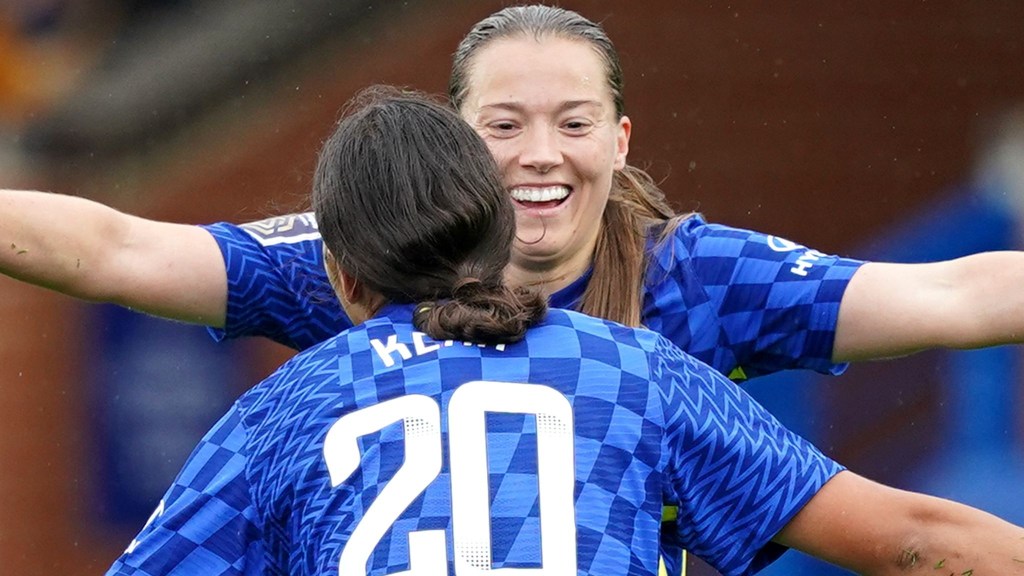
Above: Sam Kerr celebrates with Fran Kirby after scoring Chelsea’s second. Photo: Sky Sports.
The defending champions look to have the match sewn up as they come on in the second half but Brighton aren’t giving up that easily. Within two minutes, a throw in from the right is flicked across goal by Aileen Whelan to Dan Carter who turns and rolls the ball out to the left post for Brighton’s first goal of the day and the first goal conceded at home this season by Chelsea.
This rattles the hosts somewhat and elevates Brighton. The next ten minutes sees a more even affair until a Chelsea corner is guided to Reiten but her header clears the crossbar.
Chelsea step up the pressure with Kirby going down the left and into the box. She slips the ball through to Reiten who passes to Harder, who, under pressure, flicks back to Kirby. Her shot on goal goes high and to the right.
Above: Danielle Carter (centre) celebrates after scoring Brighton and Hove Albion’s goal at Kingsmeadow. Photo: Sky Sports.
Immediately afterwards, Melanie Leupolz has a spirited shot on goal from the results of a free kick which ultimately skimmed the crossbar.
Chelsea get a free kick just outside the box after a foul on Kirby. Erin Cuthbert and Reiten line up to take it. Reiten takes a direct shot on goal that is batted away by Walsh. Kerr goes for the rebound but it’s deflected away safely.
A beautiful ball through the defenders to Kerr is just overcooked on her first touch and Walsh gets there before Kerr to clear it away successfully.
Above: Beth England battles with Maya Le Tissier at Kingsmeadow yesterday. Photo: Brighton & Hove Independent.
Leupolz has a crack from the top of the box that skims the top bar. The pressure is unrelenting now.
At the 80 minute mark, a Brighton goal kick gets headed back towards the Chelsea goal and Kirby runs on to it and crosses into the box to England. Her shot goes to the top left and in for a well-deserved 3-1 lead.
Before the end, Harder takes an ambitious shot from outside the box that goes across the face of an empty goal and out past the far post.












 impetusfootball.org